Maybe We DID Come From Stars

NASA
Scientists have found a bizarre similarity between human cells and neutron stars

Our link to the stars.

JOSH HRALAFacebook Icon

But, according to new research, we share at least one similarity: the geometry of the matter that makes us.

Researchers have found that the ‘crust’ (or outer layers) of a neutron star has the same shape as our cellular membranes. This could mean that, despite being fundamentally different, both humans and neutron stars are constrained by the same geometry.

“Seeing very similar shapes in such strikingly different systems suggests that the energy of a system may depend on its shape in a simple and universal way,” said one of the researchers, astrophysicist Charles Horowitz, from Indiana University, Bloomington.

To understand this finding, we need to quickly dive into the weird world of nuclear matter, which researchers call ‘nuclear pasta’ because it looks a lot like spaghetti and lasagne. See for yourself:

NuclearPastaD. K. Berry et al.

This nuclear pasta forms in the dense crust of a neutron star thanks to long-range repulsive forces competing with something called the strong force, which is the force that binds quarks together.

In other words, two powerful forces are working against one another, forcing the matter – which consists of various particles – to structure itself in a scaffold-like (pasta) way.

As one of the team, Greg Huber, a biological physicist from the University of California, Santa Barbara, explains:

“When you have a dense collection of protons and neutrons like you do on the surface of a neutron star, the strong nuclear force and the electromagnetic forces conspire to give you phases of matter you wouldn’t be able to predict if you had just looked at those forces operating on small collections of neutrons and protons.”

Now, it turns out that these pasta-like structures look a lot like the structures inside biological cells, even though they are vastly different.

This odd similarity was first discovered in 2014, when Huber was studying the unique shapes on our endoplasmic reticulum (ER) – the little organelle in our cells that makes proteins and lipids.

At first, Huber thought that these structures on the ER – which he called “parking garages”, or more formally, Terasaki ramps – were something that only happened inside soft matter.

But the he saw Horowitz’s models of neutron stars, and was surprised to find that the structures of the ER looked a heck of a lot like the structures inside neutron stars.

“I called Chuck [Horowitz] and asked if he was aware that we had seen these structures in cells and had come up with a model for them,” Huber said. “It was news to him, so I realised then that there could be some fruitful interaction.”

You can see the ER structures (left) compared to the neutron stars (right) below:

NeutronStarsUniversity of California, Santa Barbara

The discovery brought both of the scientists together to compare and contrast the differences between the structures, such as the conditions required for them to form.

Normally, matter is characterised by a phase – sometimes called its state – such as gas, solid, liquid Different phases are usually influenced by a plethora of various conditions, like how hot the matter is, how much pressure it’s under, and how dense it is.

These factors change wildly between soft matter (the stuff inside cells) and neutron stars (nuclear matter). After all, neutron stars form after supernovae explosions, and cells form within living things. With that in mind, it’s quite easy to see that the two things are very different.

“For neutron stars, the strong nuclear force and the electromagnetic force create what is fundamentally a quantum mechanical problem,” Huber said.

“In the interior of cells, the forces that hold together membranes are fundamentally entropic and have to do with the minimisation of the overall free energy of the system. At first glance, these couldn’t be more different.”

While the similarity is cool, and makes us feel connected to the cosmos in a strange way, the differences signify the importance of the discovery, because they hint that two very different things – cells and neutron stars – might be guided by the same geometric rules that we’re only just beginning to understand.

It will take further research to really figure out what’s going on here, but it’s a starting point that could help us understand something fundamental about how matter is structured, and we’re excited to see where that leads.

The team’s work was published in Physical Review C.

from:    http://www.sciencealert.com/scientists-have-found-a-structural-similarity-between-human-cells-and-neutron-stars?utm_source=ScienceAlert+-+Daily+Email+Updates&utm_campaign=e224a761a7-MAILCHIMP_EMAIL_CAMPAIGN&utm_medium=email&utm_term=0_fe5632fb09-e224a761a7-365552945

UFO Over Italy

Last week, the Italian city of Lecco became witness to a bizarre event featuring what some believe to be an advanced Pleiadian UFO.

By UFOholic

Photos showing what appears to be an interdimensional craft hovering over the picturesque city have captured the attention of UFO enthusiasts all over the world and are cited as clear evidence of alien intervention. The controversial images were taken on November 2 by Giuseppe Filipponi and posted on Facebook the following day. They were viewed by thousands and quickly went viral.

The images show an enormous, translucent craft that materialized in the sky after traveling through an interdimensional portal, or so it’s been described. The perplexing craft then began to deploy a number of smaller, orb-type devices or entities. These smaller orbs appear as spheres of light and are believed to act as the UFO’s surveillance drones.

pleiadian-alien-ship-and-orbs

This sighting elicited numerous and diverse reactions, once again proving that this subject is open to discussion.

Some consider there was nothing unnatural behind this apparition and cite the most likely culprit as a freak weather phenomenon involving a cumulonimbus cloud. Their argument is that pareidolia makes people see things and recognize familiar shapes in places where most of the time there isn’t anything.

On the other side of the table we have a great number of alien aficionados who are convinced the photos actually show the extraterrestrials’ vested interest in mankind and its problems. They don’t see this sighting as a coincidence but rather as a consequence of the country being hit by multiple earthquakes over the past few months. Since August, Italy has bore the brunt of over 250 tremors, the strongest of which left hundreds dead and thousands homeless.

The most recent earthquake to strike Italy occurred on October 30 and seismologists are calling it the strongest in nearly half a century. It’s pretty obvious that the boot-shaped peninsula is going through some tough times.

This argument is what leads believers into suspecting the ethereal craft belongs to one of the ‘good guys’ who are currently keeping Earth under observation, as evidenced by the video below:

The Pleiadians, also known as Nordic aliens are a race of highly-advanced, benevolent beings that originated on a planet orbiting one of the stars in the Pleiades group. Also known as the Seven Sisters, the Pleiades are one of the closest star clusters and they’re also visible with the naked eye. They occupy an important role in the mythology and star culture of many ancient civilizations, and this has lead many into believing the Pleiadians have been supervising humanity for a long time.

Alien hunters claim that although Pleiadians have a physical form which is strikingly similar to the Scandinavian physiognomy, they can also take on an incorporeal form that allows them to travel between dimensions. Unrestrained by physical forms, the Pleiadians are free to explore realms we couldn’t even comprehend. Although their true motivations remain hidden to us, their actions reveal a compassionate response to our struggle.

In the particular case of last week’s sighting, we could assume the craft was sent to investigate the increased seismic activity in the Italian peninsula. The appearance of the ghostly starship could be interpreted as a warning signal that things beyond our control may come to pass. Although as humans we enjoy a strong hold on Earth, this is only an illusion. The fact that there are over 7 billion of us alive today gives the false impression of stability. But we are still at the mercy of Mother Nature and with one fell swoop, we might not be here tomorrow.

This deception of security must be plenty obvious for our hyper-advanced observers, which is why they are always nearby when disaster strikes. And just because we don’t see them intervene on our behalf, that doesn’t mean they’re idly standing with their hands behind their back. Who knows how many catastrophes they helped avert without us knowing?

Source: UFOholic

from:     http://www.theeventchronicle.com/metaphysics/galactic/pleiadian-ufo-photographed-italy-goes-viral-warning-signal/#

Reflecting on Tomorrow

A moving and powerful statement from my daughter, Emilie Clasgens Wilson, in regard to standing up for WHO we are in the midst of uncertainty and fear:

I’m not one to post my personal feelings and opinions on Facebook. I appreciate and tend to guard my privacy. But I woke up this morning after a restless night of sleep to memories of Trump onstage, standing next to his young son who looked like a forgotten boy, unsupported by adults, and I remembered echoes of his hollow acceptance speech.

I jumped on my phone, on Facebook, to try to connect with people who might feel as I do, to commiserate as conscientious objectors in mourning.

I see sorrow, anger, and disbelief.

I see genuine hopefulness, too.

I’ll cling to that, because it’s all I’ve got right now.

I see people who are afraid that we’ll slide back into a time of outright racism, homophobia, sexism, a time when you and your loved ones can be physically, verbally, emotionally assaulted for practicing a particular religion or identifying as a particular gender or being born on the other side of invisible lines for just being anything other than a white man born in America.

I made myself a promise this morning:

I will not take my position in this country, or in this world, for granted.
I will NOT participate in subtle or overt racism, sexism, homophobia, or in anything that implies or states the inherent “betterness” of one group of people.
I will stand up for my rights and for the rights of my fellow Americans to be exactly who we are, and to fight the fear that we may be entering a time when we could once again be penalized for this.

Because I have to do something: I promise I won’t do nothing.

You can contact Emilie Clasgens Wilson @ http://www.mindbodycenterforintegrativemedicine.com/

Time to Remember


The following was originally published on Kingsley Dennis’s website.

‘We are dreaming a symbolic world, only briefly waking to what is real’
Arthur Deikman, M.D.

‘He not busy being born, is busy dying’
Bob Dylan

Something is not quite right…you feel it…you may have experienced this feeling, this nagging, for a long time. So you most probably just try to ignore it and hope that it goes away; but sooner or later the persistent nagging finally brings an idea to your mind – there’s something very odd about the way the world is. Maybe you feel like you are at the cinema watching a film and yet you sense there must be something wrong about the film you are seeing. The images are all there, but there’s a feeling that something is out of sequence, or the frames are running out of ‘normal’ time. However, after a while you get used to the style of the film, and your senses adjust to its rhythm and you lose the sense of strangeness and you get pulled into the show and you go along with the ride…

…the film tells you that the world has no grand meaning, that human life is an accidental anomaly – but as you walk down the street, engage with friends, fall in love, follow your dreams, you experience meaning and significance…wait, there’s that glitch in the film again – something about its ‘randomness’ and ‘meaninglessness’ doesn’t make sense…your personal experience has shown you something different…and then there’s that nagging feeling again…somewhere – wasn’t there?

Life is life, and most people go through it with trial, joy, adventure, challenge, love, and all the rest. This is the same for all of us, yet it doesn’t always occur on the same playing field. There is a different perspective we can take – a different position vis-à-vis the world. We can see the world in which we live as solely an exterior phenomenon; or we can choose to view it as also an expression of our interior life.

I have come to regard the cosmos as not just the expression of mathematical equations, but as the play of lyrical forces that, like a living being, is intoxicated with love and wonder, and the joyful curiosity of adventure. And I often wonder what it would be like to live with the view that human life is the result of random, accidental forces; as a meaningless happening forced to live out its years on the back of a dead rock hurtling through a lifeless universe. I am reminded of the ‘Myth of Sisyphus,’ a figure of Greek mythology who was condemned to repeat for eternity the same meaningless task of pushing a boulder up a mountain, only to see it roll down again – and then to push it up again, ad infinitum. For me, this lifeless exterior view of life is truly absurd[i]. And yet the physical demands of a normal life compel us to focus our gaze continually on the external where our daily waking consciousness has to deal with all the impacts and noise coming from the outside – it is very physical work and can, and often does, occupy the whole consciousness and conscious awareness of a person. Yet for some people another gaze peers out onto the world – a gaze from within. I refer to this as the interior life, whereby a person deeply feels, intuitively knows, that there is another perspective upon life, one that is far richer, pervasive, subtle; and yet one that must be sought with effort.

There are many people – in fact, they may be the majority – who have never sought or felt an urge toward the interior life. They never stop to ask themselves not only ‘why am I here?’, but also ‘how did I get here?’ This is a fundamental question that appears to bother few people. It is not unfair to say that some people only know themselves by the name they wear through life. If pushed, they would find it difficult to truly distinguish themselves from others who bear similar conditioned attitudes and opinions. And yet this realization is often hidden from us. Perhaps the shock of such recognition would greatly disturb our mental and emotional balance. And so a majority of people continue to identify and individualize themselves through the given name they bear, or the job they have elected to perform. This is evident on the occasion when someone is asked who they are, they reply either with their name or their occupation. It’s a most unsettling question and for many people they can only answer this by their work function or their given name. It’s also true that most of the time this socially accepted question is only asked and directed to a person on the most superficial and banal level. And so who a person actually is remains a lifelong mystery. And this is a condition common to most of us.

…There’s that film again, and it’s telling you that your conscious experience is just a consequence of chemical brain functioning – I do this, I do that, I see this, I feel that, I think this – …but the ‘I’ is just a state of awareness that comes as a by-product from a complex of neurons…but wait a minute – haven’t I just been observing my own thoughts and feelings…standing back from the ‘I’? Is this then the real me? Or is this observer of my thoughts just another neuronal by-product observing the workings of another random by-product?…ah, here’s the film again, the glitch is gone…

It’s also the case that many people rebel against their essential nature, whether they know it or not. People may say a thousand things – or only one thing – and yet in each spoken moment they move away from the essential. Again, what is it to know oneself? To grow, to develop, to attain understanding and self-awareness – what do these things mean to the everyday person? At best, society has rendered them as abstract concepts, or as wishful thinking. Within our specific cultures we are so used to living at a primary, basic level – a survival level – that we spend very little time and attention upon the interior level. In fact, the notion of an interior world often remains a luxury for the few.  The rest of us have to get on with managing and coping with our normal lives.

And so we live with many unrecognized questions, failing to notice them or awake them from their slumber within us. Do we ever wonder why events have turned out this way? Or is it that the forces of division, polarity, and ignorance that drive our world are so convincing that we seek no other reason (or excuse?) for the oddities of our world and its incongruous reality? Perhaps we find no compelling need to want to see things in a different way. In fact, some people actively seek to forget.

The compulsion to forget is likely to be rationalized by calling it by another name. Through the seeking of pleasurable diversions and distractions through entertainment, challenges, or addictive pursuits, people are actually seeking to forget. Greek mythology tells of how before the human soul incarnates into this world it drinks from Lethe, the river of Forgetfulness – one of the five rivers of the underworld – so that it cannot remember its divine origins. Similarly, there is a Jewish legend that speaks of how we are struck on the mouth by an angel before birth so that we cannot speak of our pre-birth divine origins. We may come from inspired and sacred origins, yet when we arrive in this earthly reality we come dumbstruck and needy. Or rather, perhaps it is only that we lack the key, the crucial guide, to unlock our memories and unleash our interior gaze and soulful longing. The truth may be that rather than to forget we are in fact here to remember.

Sometimes it is a tragedy or catastrophe that triggers a person to remember and to seek answers. On a larger scale, perhaps it is necessary for humanity to reach a crisis point – in its materialism, commercialism, and social systems – for there to arise within people the need for something else. The interior life recognizes that it is the essential nature of being human to seek for something more, something beyond. This need for communion with something greater has largely been fed by the role of religious, and/or spiritual, traditions. However, the human being’s need for a meaningful, developmental life has still not been met by our societies, especially so among the highly industrialized cultures. We have developed our faith, our reason, our mental pursuits; we have established industry and created marvellous technologies – yet we have failed to work on ourselves. We have failed to grow our souls.

Soul-making as well as taking care of one’s soul are not specifically introverted or monastic pursuits – they do not require steadfast introspection or a dramatic withdrawal from the world. The Romantic Poet Keats said – “Call the world if you please, ‘the vale of Soul-making.’ Then you will find out the use of the world.” It is my opinion that ‘soul-making’ needs to be re-imagined and reintegrated into our societies. We need not go back to animism or alchemy to find soul-making. We can find it here, in the everyday Now. The genuine expression of a truth takes no fixed form. Self-development, or self-refinement if you prefer, is not an ideology or a fixed science. It is a basic human right. The interior life should be recognized as an inherent human need, and it should be socially acceptable and encouraged to direct part of our gaze in its direction. After all, if the outer sun rises but the inner sun does not, then nothing has been gained.

‘One is an architect of the interior – who works on interior architecture’
Anon


[i] No wonder then that the absurdist French philosopher Albert Camus wrote an essay titled ‘The Myth of Sisyphus’ (1942) describing man’s useless search for meaning in an unintelligible world.

from:   http://realitysandwich.com/320902/the-interior-life/

To Honor the Earth

The White Horse and the Humvees—Standing Rock Is Offering Us a Choice

Right here, between the barricades on a North Dakota highway, is a pivotal confrontation between two world views, two futures.
Horse650px.jpg

Two lines, facing each other on a North Dakota highway. On one side, concrete barriers protect a row of armored vehicles and helmeted police with assault rifles. On the other, a young man rides a white horse whose legs are stained with blood. A woman, wearing a scarf to protect her lungs from tear gas, wafts sage smoke over a boy to give him strength, wash away hate, and remind him of his sacred purpose.

Here, on a highway stretching across trampled prairie grass, the fundamental contest of our time is playing out.

The fundamental contest of our time is playing out.

It’s a confrontation not only between two groups of people, but between two world views. The space between the lines vibrates with tensions of race, historical trauma, broken treaties, money and politics, love and fear. But the underlying issue that charges the air, mixing with the smells of tear gas and sage, is the global contest between two deeply different ideas about the true meaning of land.

On one side is the unquestioned assumption that land is merely a warehouse of lifeless materials that have been given to (some of) us by God or conquest, to use without constraint. On this view, human happiness is best served by whatever economy most efficiently transforms water, soils, minerals, wild lives, and human yearning into corporate wealth. And so it is possible to love the bottom line on a quarterly report so fiercely that you will call out the National Guard to protect it.

On the other side of the concrete barriers is a story that is so ancient it seems revolutionary.  On this view, the land is a great and nourishing gift to all beings. The fertile soil, the fresh water, the clear air, the creatures, swift or rooted: they require gratitude and veneration. These gifts are not commodities, like scrap iron and sneakers. The land is sacred, a living breathing entity, for whom we must care, as she cares for us. And so it is possible to love land and water so fiercely you will live in a tent in a North Dakota winter to protect them.

It may turn out that the cracks in that stretch of two-lane highway mark a giant crack in time, when one set of assumptions about reality snaps and is replaced by another. This, like all times of paradigm shift, is an unsettled time, a time of shouting and police truncheons, as privileged people defend the assumptions that have served them royally.

What are they so afraid of out there in North Dakota, that they arrest journalists, set dogs on women and children, send prayerful protectors to jail and align para-military force against indigenous people on their own homelands?

Everyone can join the people of Standing Rock and say No.

Maybe they are afraid of the truth-telling power of the people at Standing Rock and their busloads of allies, who are making clear that we live in an era of profound error that we mistakenly believe is the only way we can live, an era of insanity that we believe is the only way we can think. But once people accept with heart and mind that land is our teacher, our mother, our garden, our pharmacy, our church, our cradle and our grave, it becomes unthinkable to destroy it. This vision threatens the industrial worldview more than anything else.

Indigenous people are saying, there are honorable and enduring lifeways that beckon to people who are weary of destruction.

Everyone can join the people of Standing Rock and say No. No more wrecked land. No more oil spills. No more poisoned wells. We don’t have to surrender the well-being of communities to the profit of a few. We can say Yes. Yes, we are all in this together. Yes, we can all stand on moral ground. Yes, we can all be protectors of the water and protectors of the silently watching future. The blockade on the highway is an invitation to remember and reclaim who we might be — just and joyous humans on a bountiful Earth. Right here, between the barricades, we are offered a choice.

On the highway, a warrior steps around the concrete barrier, offering a sage bundle that trails white smoke. Approaching a figure in riot gear, he extends the blessing to the officer, letting the smoke wash over him. To give him strength. To wash away hate. To remind him of his purpose.

Robin Wall Kimmerer, citizen Potawatomi Nation, is director of the Center for Native Peoples and the Environment and Distinguished Teaching Professor at the SUNY College of Environmental Science and Forestry. Her most recent book is Braiding Sweetgrass. 
Kathleen Dean Moore, the author of Great Tide Rising: Toward Clarity and Moral Courage in a Time of Planetary Change and co-editor of Moral Ground, is Oregon State University Distinguished Professor of Philosophy, Emerita.
from:    http://www.yesmagazine.org/people-power/the-humvees-and-the-white-horse2014two-futures-20161105

The Buffalo Nation Responds!

The Tatanka Oyate were called upon and gave us courage. Pilamiya Maske for your vision. Stay strong Water Protectors! Davidica Littlespottedhorse

The great bison or buffalo of North America is a very powerful symbol to American Indians. Though best suited to cooler climates, bison roamed virtually in entire continent.

The smaller woodlands bison and its bigger cousin, the plains bison were revered and honored in ceremony and every day life. To the plains Indian, our Bison Brother meant sacred life and the abundance of the Creator’s blessing on Mother Earth.

The bison is powerful medicine that is a symbol of sacrifice and service to the community. The bison people agreed to give their lives so the American Indian could have food, shelter and clothing.

The bison is also a symbol of gratitude and honor as it is happy to accept its meager existence as it stands proud against the winds of adversity.

The bison represents abundance of the Creator’s bounty and respect for all creation knowing that all things are sacred.

The chairman of the Standing Rock Sioux Tribe criticized law enforcement’s “militarized” response to the camp and called for demonstrations to remain peaceful, but stressed that activists would not give up their cause.

“Militarized law enforcement agencies moved in on water protectors with tanks and riot gear today. We continue to pray for peace,” Dave Archambault II said in a statement Thursday evening.

“We won’t step down from this fight,” he added. “As peoples of this earth, we all need water. This is about our water, our rights, and our dignity as human beings.”
Video Source Davidica Littlespottedhorse

VIDEO
(DO not know whether the video came through, but you can get it at the link below)
from:    http://www.whitewolfpack.com/2016/10/givers-of-courage-thousands-of-wild.html

Antidepressants and Violence

Study Finds That Antidepressants Can Double Person’s Likelihood of Depression and Violence

Posted by October 27, 2016 

anti-depressant

Brianna Acuesta | True Activist

In a landmark study conducted by Danish researchers found that antidepressants can cause a person to become twice as likely to commit suicide or engage in violent activity than before they started taking the drugs. The analysis looked at 11 studies in which people without any signs or history of depression were given antidepressants and then afterwards reported their level of anxiety, nervousness, and depression nearly doubled.

Professor Peter Gotzsche, from the Nordic Cochrane Centre and lead author of the study, said such feelings could be considered as “precursors to suicidality or violence.”

These findings indicate that when healthcare professionals assume that heightened anxiety or depression is caused by the person’s already-existing mental illness and not antidepressants, that this is a “potentially lethal misconception.”

Trial phases of the research conducted by drug companies that produce the SSRIs, such as Prozac, Luvox, Paxil, Zoloft, and Celexa, reported that some patients had experienced suicidal thoughts and ideations, and thoughts of violence.

Though antidepressants are seen as dangerous for children because they produce these feelings and thoughts, they are thought of as safe for adults. These findings show that this is not necessarily the case. Professor Gøtzsche told The Express,

“It is well documented that drug companies under-report seriously the harms of antidepressants related to suicide and violence, either by simply omitting them from reports, by calling them something else or by committing scientific misconduct.”

The dangers of antidepressants and the agenda that Big Pharma is pushing is becoming increasingly known, as people fight for their right for safe and affordable healthcare. Though these drugs can produce amazing effects on some of those suffering from depression and anxiety, the likelihood that they are also harming some users is high.

Warning labels on antidepressants do include mention that suicidal thoughts could increase during the initial period, but the results of such trials and how the drugs even affect people without mental illness are not made clear in any capacity.

Despite these findings by Professor Gøtzsche, many are quick to refute the claims. Professor Sir Simon Wessely, President of the Royal College of Psychiatrists and Professor of Psychological Medicine, King’s College London’s Institute of Psychiatry, Psychology and Neuroscience, said,

“Overall, medications used in any branch of medicine that do good can also do harm. The same applies in psychiatry. Current evidence from large scale studies continues to show that for antidepressants the benefits outweigh the risks. If the evidence changes then so will our advice, but this study changes nothing.”

Though it may change nothing about how pharmaceuticals market and make their antidepressants, it may change how people view the effectiveness and safety of such drugs. Reaching users and citizens is at the core of uprooting corrupt systems, such as pharmaceuticals who are primarily concerned about profit over safety.

What are your thoughts on these findings? Please share, like, and comment on this article!


This article (Study Finds That Antidepressants Can Double Person’s Likelihood Of Depression And Violence) is free and open source. You have permission to republish this article under a Creative Commons license with attribution to the author and TrueActivist.com

from:    http://consciouslifenews.com/study-finds-antidepressants-double-persons-likelihood-depression-violence/11127747/

Finding Your Way

How to Answer Your Calling – 3 Ways to Remember Why Your Soul Chose This Life

How to Answer Your CallingOctober 28th, 2016

By Juliet Tang

Guest Writer for Wake Up World

You Are On a Mission

Prior to birth, just like an artist who is selecting which paints will go onto the blank canvas, our souls choose a set of colors to work with which determine our parents, ethnicity, country of birth, etc. We also choose a number of possible paths that would allow us to experience certain aspects of our being. For instance, if courage is one of those aspects of ourselves we wish to experience, we would collaborate with other souls in this physical realm so circumstances would arise in our lives where we are required to invoke courage within us. Likewise, we choose a certain mission, or a calling that would allow us to maximize our full potentials on this live stage called earth.

In order to fully step into our calling with power and consciousness, we must first elect to forget what it is at birth so we may, after years and decades, and for some, lifetimes of soul searching, arrive at a point in our lives where we must make a choice to remember who we truly are and deliberately call forth what gives us highest joy.

Personally, I see the long years of painful searching as nothing more than a rite of passage with intended experiences and divinely placed circumstances that fully prepares us to be who we came here to be. The second we reunite with our soul’s calling, the universe registers our seriousness and we come to the realization that nothing can and will stand in our way.

At that moment, all fears and obstacles begin fading as the path unfolds in front of us. At that moment, we will move mountains and cross oceans just so that we can become one with our highest intention and commit to our divine mission. At that moment, our body, mind and soul become aligned with one single purpose – to experience ourselves as our own grandest creation in this life.

Funny enough, once we remember our mission, we often realize the mission has very little to do with us and everything to do with everyone else. It is a mission that allows us to serve humanity and to light the paths for others through servicing, healing, inspiring, teaching and empowering.

It is no coincidence that for many, in order to remember that mission, we must first experience the pains and turmoil in life so we may later not only decide to transcend what limits us, but also use our life journey as a tool to inspire and encourage others to do the same. Some of the most influential teachers from Hay House such as Louise Hay, Anita Moorjani and the late Wayne Dyer are but a few who had journeyed to the darkness and back so they may light the way for others.

Know that wherever you are in life is exactly where you need to be. You are not bound to any fate and you have the power to change and create anything in life. It is my hope that by sharing the following 3 reminders that are embedded in your soul blueprint, you will begin manifesting your calling.

You came here with something to do. You are part of a universal consciousness, and there are no accidents in it. In your true essence—not the false self, not the ego part of you, but in the true essence of who you are—you are infinite and you have something very profound to accomplish while you’re here. Otherwise you wouldn’t be here.

Find it. Pay attention to it. Listen to the callings. See the clues, the cues. See the alignments, whatever they might be, no matter how absurd or bizarre they might seem to everyone around you…if you have a calling inside that says there’s also something else, don’t ignore that. Don’t die with your music still in you. Don’t die with your purpose unfulfilled. Don’t die feeling as if your life has been wrong. Don’t let that happen to you. ~ Wayne Dyer

Identify Your Highest Joy

As beings of energy, we ourselves are literally the creation tools we are born with and our feeling is the direct line of communication with our soul, or the higher self. At any time when our thoughts, words and actions are aligned with the soul’s vision, we know it immediately by the way we feel which is usually identified as harmony, inner-peace, joy, gratitude and love.

Whenever we feel good, our vibration is instantly higher which easily leads to inspired action; and by committing ourselves to inspired action, it leads to more joy which expands the breeding ground of inspired action. The more we can get in touch with the “feel good” component within ourselves and listen to it, the easier it will be for us to define our mission in life.

For the longest time, I had not a clue what my calling was and I spent the majority of my time complaining and wishing I could do something else with my life while holding onto the belief that a job and a passion are mutually exclusive. I did have many passions and since I felt miserable with my job, I indulged myself with activities I enjoyed whenever I had free time. Being a spiritual seeker since birth, one of my passions was alternative healing. For many years, I heard and read about Reiki and there was always that little voice in the back of my head whispering, “Take a Reiki class.” Like many, I brushed aside the little voice with as many excuses as I could find but eventually, the voice became so persistent that I decided to just go for it.

As someone who was also obsessed with doing the due diligence for everything I stepped into, I spent hours researching for an experienced teacher. I already signed up for a course elsewhere when the name of my first Reiki teacher popped up in my search, and for reasons unknown to me at the time, I made a last minute decision to go with this class.

During the two days of training, I met someone whom I became friends with. Fast forward to years later, we currently share an office space doing healing work in Midtown Manhattan. Within the same year after the initial training, the same friend introduced me to another Reiki teacher who is the very reason why I eventually became a recovery and wellness coach as well as Reiki master. During those years, every time when I was guided by inspiration, life rewarded me with more people, events and circumstances that helped me remember my true essence and carry out my mission.

Do not despair if you do not yet remember what you came here to be. Your only duty in this life is to follow your highest joy. Believe me, it is much more than just a cliché line that we use as a bumper sticker.

Once we follow the first inspired idea, we are sending out the energy with the intention of “I am my highest joy at this given moment” into the universe which slowly intensifies and magnifies as we become more accustomed to singing our heart’s song. What has started as a seed is given more opportunities to grow and flourish every time when we follow our highest feelings because the energy behind that intention is literally snowballing and creating more and more movement in the quantum field in bringing us what make us happy.

How To Answer Your Calling - Joy

What inspires you? What makes your heart sing? What’s that one thing you’ve been wanting to do but have been putting off forever?

It’s time.

Allow Your Being to Guide Your Doing

One of the most frustrating things we do to ourselves is we get stuck envisioning the million tasks we must do to accomplish anything, that can also be the very thing that keeps us from moving forward.

Answering our calling is very much a process like everything else. The end result may look nothing like what we started off with or what we planned, and that is completely ok. Sometimes what we think we want only serves as a stepping stone that leads us closer to fulfilling our mission. The universe does not care about what we do that makes us radiate with joy, it can be taking a Reiki class or a baking class, going on that spontaneous vacation or calling an old friend we haven’t seen for years. The universe only cares about the vibrational signature we give off when we are being that joy.

By giving ourselves into inspired action, we may be meeting a teacher for life who becomes our source of inspiration, or be welcoming an opportunity that otherwise would not be there had we not chosen to follow our heart and arrive at that exact location and time.

The only decision we have to make on a daily basis is to start following whichever things that give us whatever amount of joy out of all the available daily activities in front of us rather than coming up with a huge plan of action to get ourselves from point A to B because “it is the right thing to do” or “everyone else does it.”

If your only daily activities are comprised of chores such as house cleaning, meeting deadlines and cooking for a family of six, then invite yourself to do some (or all) of those things with as much joy and presence as you can, and to squeeze in a couple of little activities that bring you peace and make you come alive. They can be as simple as having quiet time to read for 15 minutes or working on that hobby when everyone goes to sleep. You just never know what may come out of them!

Do not ever underestimate the power behind these little activities as they are what make the energy accumulate. Remember, it is always about being the “I am my highest joy at this given moment” energy rather than flooding ourselves with tasks and running around aimlessly for the simple reason that we cannot find our calling outside of ourselves, but we can remember or create it within us. The more we can allow that energy to flow to us and from us, the more the universe can bring us everything that resonates on the same energy level to help us remember and create our destinies.

Is the path of committing ourselves to remembering, and eventually embodying our calling always peachy? The answer is no. It is a journey that is made of a thousand little steps of learning and choosing. Along the way of building my healing practice, I was constantly discouraged by my lack of knowledge and tools to run a business as well as overwhelmed by the millions of tasks I was constantly bombarded with.

I invested a great deal of energy on training courses from learning how to write my about page to polishing up the content of my website so I can reach a larger audience. No matter how much I tried to tweak my writing while working with business coaches and alike, I was unable to meet their standards of using “simple and client friendly” language where I could explain what I do in a couple of sentences to an eight-year old.

One day, exactly one year from the day I resigned from my last job, it finally hit me. While I will always remain grateful of the knowledge and support I have taken away from the courses, my writing reflects my true essence, and who I am at the core is someone who thinks, feels and speaks like the spiritual geek that I am proud to be. By giving myself endless tasks of to-do’s that do not align with my inspired actions, I am neglecting who I came here to be – someone who helps others heal, awaken and create through spiritual writing, healing and coaching.

In fact, this article was entirely inspired by hours of staring at weeks worth of unfinished homework documents from my latest course with the sudden realization that the content of my website may never appeal to everyone, and that is perfectly ok. I was faced with two choices, to continue doing the daunting task of sounding like someone I am not, or being immersed in the joy of writing. The moment I chose the latter, a stream of inspiration poured in and gave birth to these words.

How to Answer Your Calling - Inspiration

At the end of the day, it isn’t about what we do, how we do it, what our titles are, how polished our website looks, how many credentials are displayed in our bios and how many award-winning books we’ve published. It is about whether we can allow ourselves to step into who we truly are, and boldly and lovingly declare our authenticity to the world. No vibration in the universe is more powerful than our energy when it becomes an extension of our divine calling.

What are some things on your daily to-do list? Which ones of those give you any amount of joy? How can you insert more “feel good” activities into your life? How can you replace the aimless “to-do’s” with more inspired action?

Your Calling is Your Own Creation

Our souls have chosen a certain mission prior to birth, but the moment we become fully conscious of who we are and awaken to the creator within, we are no longer bound to any predetermined paths we laid out for ourselves before coming into this physical body. The more we are aware of our true essence and our connection with the divine source, the more empowered we become and the more we can claim the gift of free will which ultimately allows us to exercise our birthright as the conscious creator to Be, Do, and Have anything our soul desires.

To achieve that, we must first free ourselves from everything that limits us. Limitations can take the form of fear such as fear of uncertainty/change, fear of lack, or even fear of success. Limitations can also manifest as endless excuses ranging from “I have a full time job with no time or money” to “I’m too old to do this.” In addition, limitations show up as disempowering beliefs including, “There isn’t enough for everyone” or “I am not special enough.”

There is no one way to initiate that journey of liberation, there is only what works for you. Personally, I’ve found spiritual practices such as energy healing, Kundalini yoga, meditation, working with a spiritual coach, being in nature, journaling and reading inspirational books are all great ways to awaken.

I used to be the queen of “what-if’s.” “What if I failed?” “What if I lost it all?” “What if I became a laughingstock?” One day, I grew sick of my negative what-if’s and decided to do a 180. “What if I succeeded?” “What if I learned something from this?” “What if I could help others?” I made a point to do this every day for months and it made a remarkable difference in my ability to exercise my free will.

Prior to tapping into our true creator role, many of us feel like powerless victims who take whatever life throws at us. We may be passionate about answering our calling as an artist but end up working at a bank because we are afraid we won’t make ends meet. We feel limited, even enslaved by the conditions in our lives. We submit ourselves to our so-called fate and tell stories of how we aren’t fortunate enough to be one of those who seem to have it all.

When we awaken, we become aware that we are who we say we are, and what we create as well as how we wish to experience everything in life depends on one thing and one thing only – our choice.

Your calling is something you soul chose in the realm of the formless before it took on a body, and you can choose again at any time in this life because the truth is, your soul remains who you truly are while your body and mind are only additional tools for you to carry out your mission so you may experience your own creations physically in this 3D time and space dimension. That power of choice has never left you. Once you decide, allow the universe to bring you the rest of the co-creators to make it happen.

It is time to unleash your free will and write your own destiny. There is nothing written in the stars that are foreshadowing who you are and what you can become. Once every part and every cell within you is aligned with this inner-knowing, you have awakened to the divine power of creation you have inherited. That power lives in you and patiently awaits for you to call upon it.

You are neither your past, your birth conditions, your roles, your accomplishments, your credentials, your awards, your bills, your bank statements, your 9-5 job that makes you cringe every morning upon waking up, nor are you your body, your mind, your beliefs, your thoughts, your baggage, your limitations, your past relationships, even your soul contract. Deep down inside, you are a being powerful beyond your imagination. Once you remember all this, you will remember your sacred ability to create anything you wish and your joyous vibration will make the world just a little brighter.

It matters not one bit if you do not know your calling. If you could start from a blank slate and create anything you wanted in life without limitations from this moment on, who would you be? What would you create?

What is one small step you can take today to be that?

Follow your heart.

from:    http://wakeup-world.com/2016/10/28/how-to-answer-your-calling-3-ways-to-remember-why-your-soul-chose-this-life/
Police fr/5 States Descend on Standing Rock

Cannonball, ND – Over 300 police officers in riot gear, 8 ATVs, 5 armored vehicles, 2 helicopters, and numerous military-grade humvees showed up north of the newly formed frontline camp just east of Highway 1806.  The 1851 Treaty Camp was set up this past Sunday directly in the path of the pipeline, on land recently purchased by DAPL.  Today this camp, a reclamation of unceded Dakota territory affirmed as part of the Standing Rock Reservation in the Ft. Laramie Treaty of 1851, was violently cleared.  Both blockades established this past weekend to enable that occupation were also cleared.

In addition to pepper spray and percussion grenades, shotguns were fired into the crowd with less lethal ammunition and a sound cannon was used (see images below).  At least one person was tased and the barbed hook lodged in his face, just outside his eye. Another was hit in the face by a rubber bullet.

Photo by Sara Lafleur-Vetter

Photo by Sara Lafleur-Vetter

A prayer circle of elders, including several women, was interrupted and all were arrested for standing peacefully on the public road.  A tipi was erected in the road and was recklessly dismantled, despite promises from law enforcement that they would merely mark the tipi with a yellow ribbon and ask its owners to retrieve it.  A group of water protectors was also dragged out of a ceremony in a sweat lodge erected in the path of the pipeline, wearing minimal clothing, thrown to the ground, and arrested.

Photo by Sara Lafleur-Vetter

Photo by Sara Lafleur-Vetter

A member of the International Indigenous Youth Council (IIYC) that had her wrist broken during a mass-arrest on October 22nd was hurt again after an officer gripped her visibly injured wrist and twisted it during an attempted arrest. At least six other members of the youth council verified that they had been maced up to five times and were also shot and hit with bean bags. In addition to being assaulted, an altar item and sacred staff was wrenched from the hands of an IIYC member by police. Several other sacred items were reported stolen, including a canupa (sacred tobacco pipe).

Two medics giving aid at front line were hit with batons and thrown off the car they were sitting on. Then police grabbed another medic, who was driving the car, out of the driver side while it was still in motion. Another water protector had to jump into the car to stop it from hitting other people.

Photo by Sara Lafleur-Vetter

Photo by Sara Lafleur-Vetter

Members of the horse nation herded around 100 buffalo from the west and southwest of the Cannonball Ranch onto the the DAPL easement. One rider was reportedly hit with up to four rubber bullets his horse was reported to be hit in the legs by live rounds. Another horse was shot and did not survive.

A confirmed DAPL private security guard was spotted among the protectors with an automatic rifle heading towards camp. Water protectors acted swiftly to stop the man who was attempting to flee the scene in his pickup. One protector stopped the assailant’s vehicle with their own before the security guard fled to nearby waters, weapon in hand. Bureau of Indian Affairs police arrived on scene and apprehended him.

Three water protectors locked themselves to a truck in the middle of the road and surrounded it with large logs.   After several hours of standoff, the police advanced in a sweep line and moved people approximately 1 mile back down the highway towards the main encampment on the Cannonball River.  Water protectors then retreated to the bridge over Highway 1806  and erected a large burning blockade that the police were unable to cross.

Law enforcement from at least five states (North Dakota, South Dakota, Minnesota, Wyoming, Nebraska) were present today through EMAC, the Emergency Management Assistance Compact.  This law was passed by the Bill Clinton administration and allows states to share law enforcement forces during emergencies.  It is intended for natural disasters and has only been used twice for protests; once in the summer of 2015 during the demonstrations in Baltimore and here on the Standing Rock Reservation. Over 100 were arrested today in total.

Kandi Mossett, Indigenous Environmental Network stated, “I went to the frontline in prayer for protection of the Missouri River & found myself in what I can only describe as a war zone. I was sprayed in the face with pepper spray, the guy next to me was shot by something that didn’t break the skin but appeared to have broken the ribs & another guy beside me was randomly snatched violently by police shoving me into the officers who held me off with batons then tried to grab me.  I’m still in shock & keep waiting to wake from what’s surely a nightmare though this is my reality as a native woman in 2016 trying to defend the sacred.”

Ladonna Bravebull Allard of Sacred Stone Camp says, “My people stand for the water, and they attack us. My people stand up for the graves of our people, and they attack us. My people stand up for our sacred places, and they attack us. My people pray, and they stop us, dragging us from our prayer, and throw us in the dirt. I know this is America- this is the history of my people. America has always walked though the blood of my people.

How can we stand in the face of violence? Because I was born to this land, because the roots grow out of my feet, because I love this land and I honor the water. Have we not learned from history? I pray for each of the people who stand up. We can not live like this anymore. It has to stop- my grandchildren have a right to live. The world has a right to live. The water, the life blood of the world? has a right to live. Mni Wiconi, Water of Life. Pray for the water, pray for the people. Stop Dakota Access- killer of the world.”

Eryn Wise of the International Indigenous Youth Council stated, “Today more than half of our youth council were attacked, injured or arrested. In addition to our brothers and sisters being hurt and incarcerated, we saw police steal our sacred staff. I have no words for what happened to any of us today. They are trying to again rewrite our narrative and we simply will not allow it. Our youth are watching and remember the faces of the officers that assaulted them. They pray for them.”


###


Shotgun into the crowd: https://drive.google.com/file/d/0BysUexxOGui6a3BXQ3NWdDJ5TTQ/view?usp=sharing

Peppersray: https://drive.google.com/file/d/0BysUexxOGui6VFZJemhaMU9Iek0/view?usp=sharing

Prayer Circle: https://drive.google.com/file/d/0BysUexxOGui6NUJodDVKZDAxLTA/view?usp=sharing

from:    http://sacredstonecamp.org/blog/2016/10/28/police-from-5-states-escalate-violence-shoot-horses-to-clear-1851-treaty-camp

Indigenous Activism & the Environment

The growing indigenous spiritual movement that could save the planet

North Dakota is just the beginning.

Demonstrators in Canon Ball protest the Dakota Access Pipeline. CREDIT: Flickr/Joe Brusky

When Pua Case landed in North Dakota to join the ongoing Standing Rock protests in September, she, like thousands of other participants, had come to defend the land.

Masses of indigenous people and their allies descended on camps along Cannonball River this year to decry the construction of the Dakota Access pipeline, a series of 30-inch diameter underground pipes that, if built, would stretch 1,172 miles and carry half a million barrels of crude oil per day — right through lands Native groups call sacred.

“We are not here to be anything but peaceful, but we are here,” Case told ThinkProgress, describing the moment she linked arms with fellow demonstrators and stared down rows of police in Bismarck. “We will stand here in our tribal names in respect and honor.”

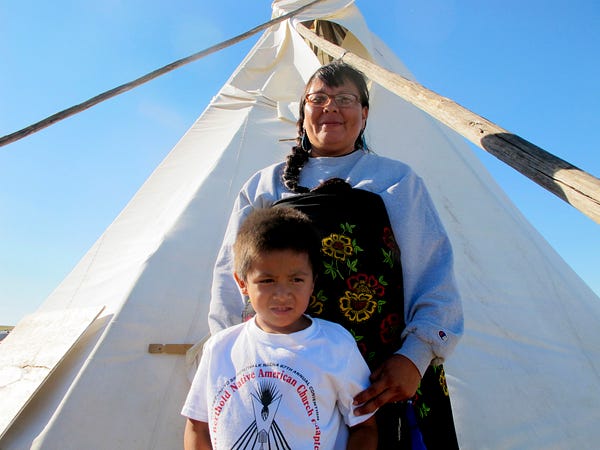
A Lakota Sioux and her 5-year-old son pose for a photo at a protest camp erected to halt the construction of the Dakota Access Pipeline. CREDIT: AP Photo/James MacPherson

But while media attention has focused on the massive, sometimes heated demonstrations—which include several alleged instances of brutality and dog attacks —there has been less attention paid to how the protest is recharging the lager climate movement, not to mention the peculiar nature of the participants. Case, for instance, traveled quite a long way to the Peace Garden State: she is from the sunny shores of Hawaii, not rugged North Dakota, and she claims a Native Hawaiian identity, not a Native American one. And she wasn’t there just to protest; the sacredness of the land is especially important to her, so she was also there to pray.

“Standing Rock is a prayer camp,” she said. “It is where prayers are done.”

“Standing Rock is a prayer camp. It is where prayers are done.”

Case’s experience is shockingly common—both as a protester visiting a far-flung land to support a Native cause, and as a witness to an emerging indigenous spiritual movement that is sweeping North America.

She’s part of something bigger that is, by all accounts, the theological opposite of the aggressively Christian “awakenings” that once dominated American life in the 18th and 19th centuries, when primarily white, firebrand ministers preached a gospel of “manifest destiny”—the religious framework later used to justify the subjugation of Native Americans and their territories. The diverse constellation of Native theologies articulated at Standing Rock and other indigenous protest camps champions the reverse: they seek to protect land, water, and other natural resources from further human development, precisely because they are deemed sacred by indigenous people.

And this year, after centuries of struggle, their prayers are starting to be answered.

The size and intensity of the Standing Rock protest caught many observers off guard — the media included. Beginning with just a few tents sprinkled across a barren field earlier this year, protesters now say nearly 10,000 people have visited the thriving camps, with guests hailing from as many as 300 different indigenous tribes.

“Seeing all the tribes come out was just incredible,” Caro “Guarding Red Tarantula Woman” Gonzales, a 26-year-old Standing Rock protester and founding member of the International Indigenous Youth Council, told ThinkProgress. “We can do that for every single indigenous fight.”

“Seeing all the tribes come out was just incredible.”

Expressions of solidarity between indigenous groups may sound predictable, but the history of Native American activism is pockmarked with internal squabbles. Early attempts to unify indigenous causes in the United States, such as the creation of the American Indian Movement in the 1960s, have since been marred by controversy and factionalism. Native Hawaiians once avoided connections between their cause and that of Native Americans, lest they suffer the same humiliating defeats as those in the continental United States. And while flashes of unified activism persisted throughout the late twentieth and early twenty-first century, indigenous communities in North America often struggled to win major victories — legal, cultural, or otherwise.

CREDIT: Dylan Petrohilos/ThinkProgress

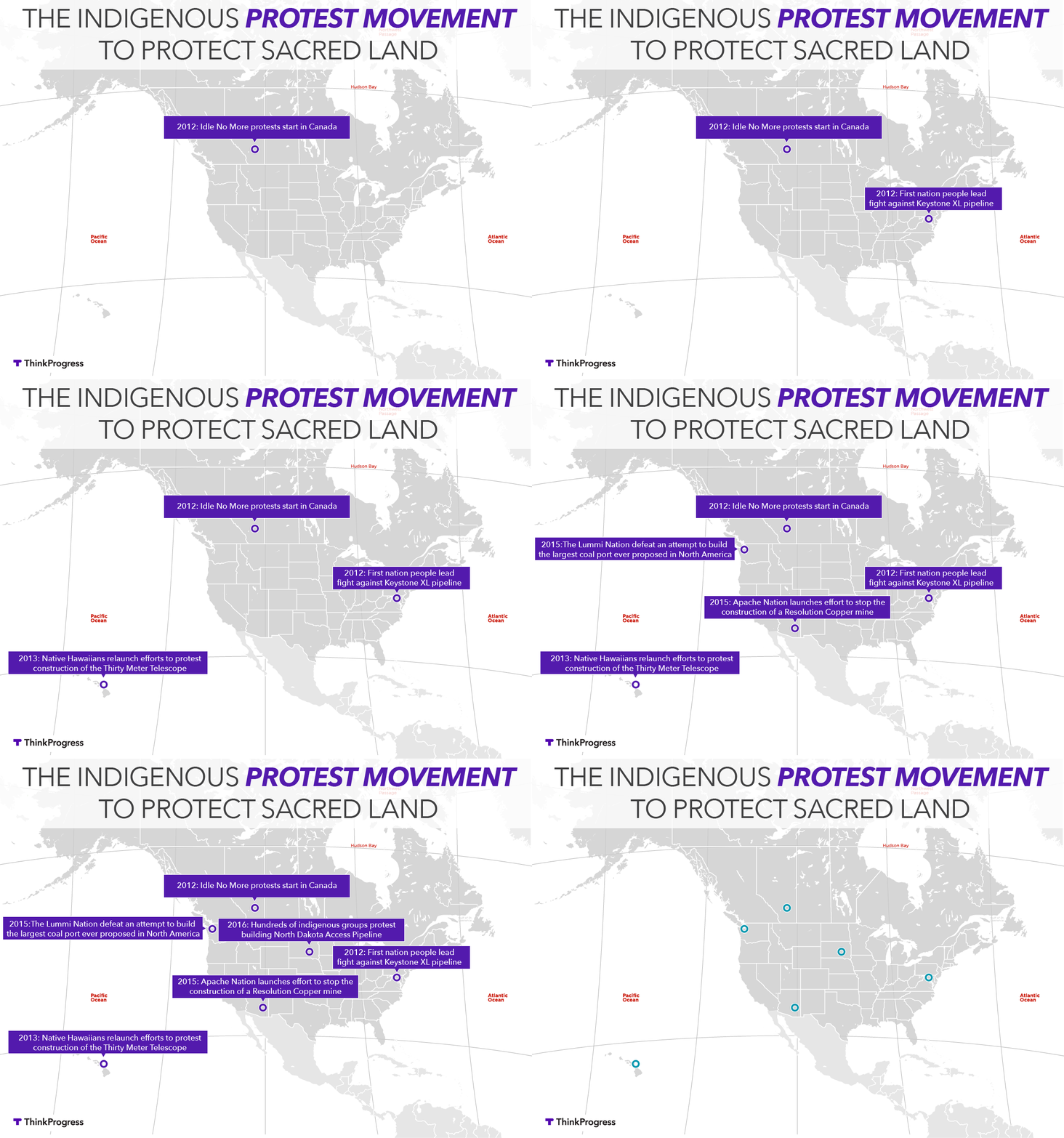
But all that changed in December 2012, when four women in Western Canada — three First Nations women and one non-Native ally — held a teach-in to protest legislation they said would weaken environmental laws that protect lands Natives hold sacred.

The activists entitled their demonstration “Idle No More,” and the movement exploded on social media; within days, flash mobs performing traditional spiritual dances sprung up in city centers and shopping malls across the country. Taking cues from Occupy Wall Street’s organic structure, a series of marches, rallies, and direct-action peaceful protests that blocked highways and railways quickly followed, making headlines in Canada and abroad.

Idle No More’s success set off a firestorm of solidarity protests among indigenous groups in the United States, who in turn used the energy to draw attention to their own local fights — virtually all which involved some sort of spiritual claim. In Hawaii, protesters inculcated the same tactics — and sometimes even the same slogans — into an ongoing effort to halt the construction of the Thirty Meter Telescope (TMT) atop Mauna Kea, a volcano Native Hawaiians consider sacred. In Arizona, members of the Apache nation began occupying an area known as Oak Flat, vowing to fend off the proposed development of a copper mine on land they call holy. And when environmentalists pushed back against the creation of the Keystone XL pipeline, organizations such as the Cowboy and Indian Alliance bolstered the existing climate change movement with Native activists in both Canada and the United States.

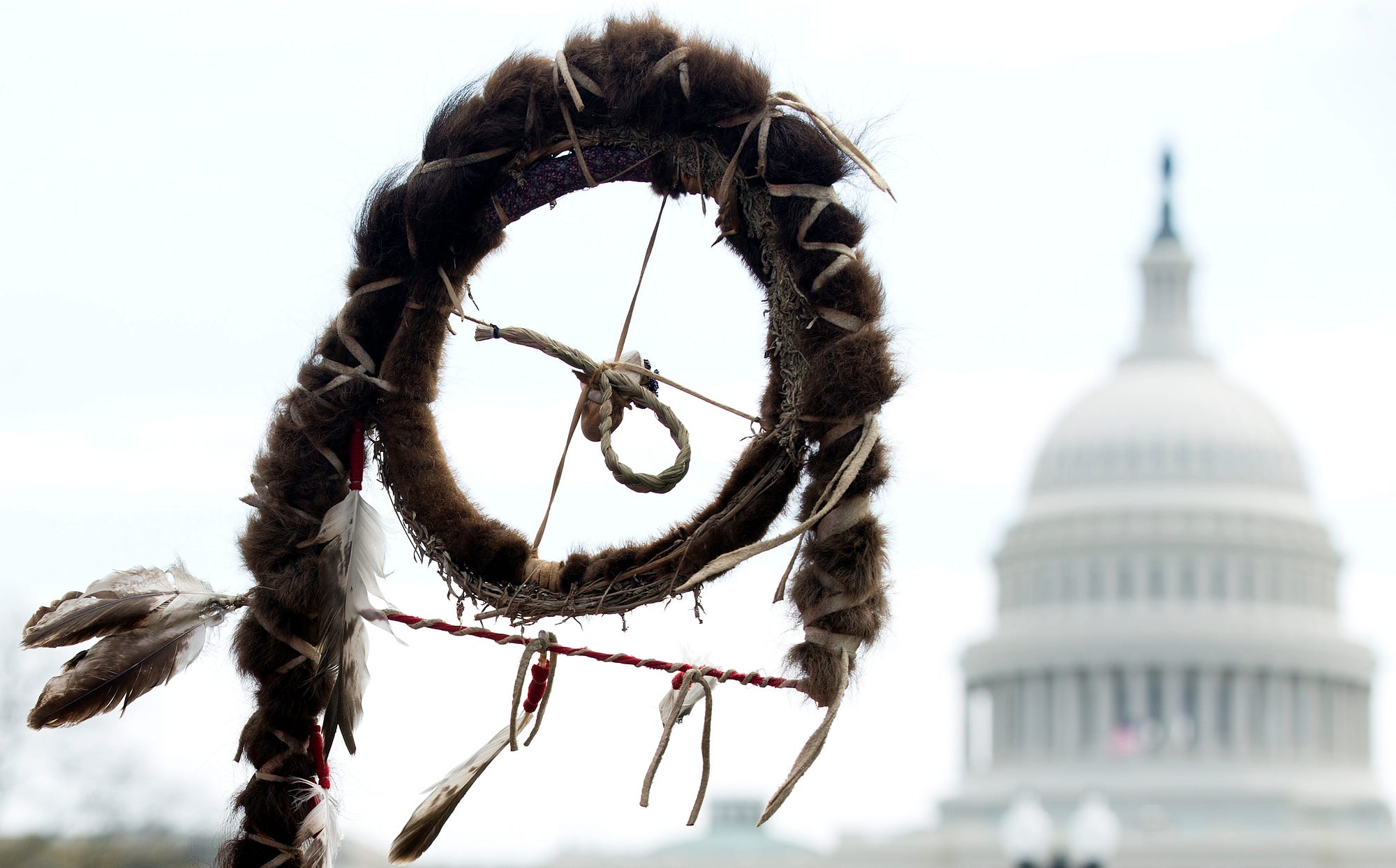
A Native American prayer stick is held near the capital during a Keystone XL protest in 2014. CREDIT: AP Photos/Manuel Balce Cenata

“Idle No More raised our consciousness,” Gonzales, who is of the Chemehievi nation, said. “When people are chaining themselves to bulldozers, that is prayer.”

Meanwhile, something new happened: social media allowed indigenous people across the country to show support for their fellow activists with a few simple clicks, adding hashtags and memes to their own Facebook and Twitter profiles. The digital connections helped elevate their respective causes, but also forged real-world relationships between activists in different tribes.

“When people are chaining themselves to bulldozers, that is prayer.”

By the time Standing Rock rolled around, a spiritual network of indigenous people was already in full effect.

“Many of the people I met at Standing Rock I’ve been friends with on Facebook for years,” said Case, who has been a key organizer in Native Hawaiian activist circles.

Case noted that she and several of the Standing Rock protesters had been “sending prayers” back and forth over social media for some time. These connections inspired Native Americans such as Caleen Sisk of California’s Winnemem Wintu nation to join her in an occupation of Mauna Kea in Hawaii. Years later, Case returned the favor by assisting Sisk in her effort to restore California waterways once frequented by millions of local salmon.

“We prayed on each others’ mountains and made commitments to one another,” Case said, speaking over the phone just minutes after finishing a ceremonial raft ride down the river. “They have prayed for us — they’ve come out physically to Mauna Kea. So now it’s our turn.”

“The most important word here is alliances,” she said.

Asked about the movement’s religious elements, Gonzales insisted spirituality isn’t a cursory side-effect but a crucial, driving force behind the recent surge of Native environmental activism. Virtually all of the protests she has attended, she said, featured some form of prayer or sacred ritual.

“All of us are protesting because we are part of this sacred [connection] to the earth,” Gonzales said. “We are all the mountains, we are all the birds — it sounds corny, but it’s true.”

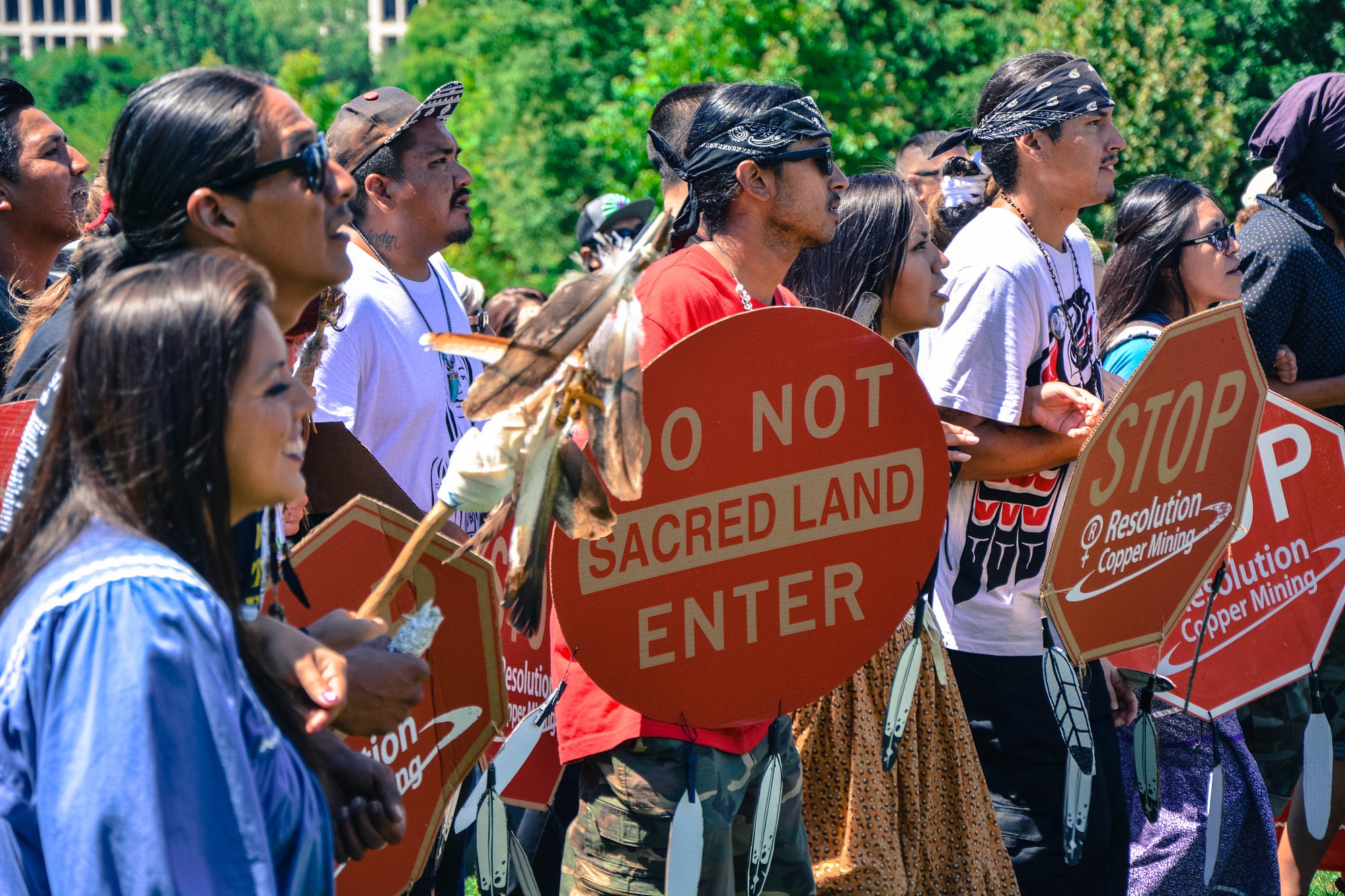
Native protestors rally on Capitol Hill in 2015 to stop the construction of a copper mine in Oak Flat, Arizona. CREDIT: ThinkProgress/Jack Jenkins

It would be a mistake to characterize the new wave of indigenous activism as emanating from a uniform, codified theology. All of the activists ThinkProgress interviewed insisted they spoke only for themselves when discussing faith, explaining that each tribe harbors its own unique spiritual traditions, practices, and customs forged over the course of centuries, if not millennia.

But for all their differences, the various indigenous populations share a common theological belief typical of what Joshua Lanakila Mangauil, a Native Hawaiian activist, called “earth-based” cultures: that the environment, at least in parts, is sacred in and of itself.

“Earth-based cultures are tied to places,” Mangauil, whose current Facebook profile picture reads “Solidarity with Standing Rock,” said. “There is no separation from our spirituality and our environment — they are one and the same.”

“Other [religious groups] have these debates over whether or not God exists — but I know my god exists,” he added, referencing Mauna Kea, which towers above his island home. “It’s the mountain — I can see it.”

“Other [religious groups] have these debates over whether or not god exists — but I know my god exists. It’s the mountain — I can see it.”

Religion has long been a part of Native American protest movements, as has its connection to the environmentalist struggle. But religious scholars say they’re also seeing something unusual this year: demonstrators are actively creating new religious expressions. Greg Johnson, a Hawaiian religion expert and an associate professor of Religious Studies at the University of Colorado, Boulder, said these indigenous protests are increasingly led by young, creative organizers who are “generating” religion through their activism.

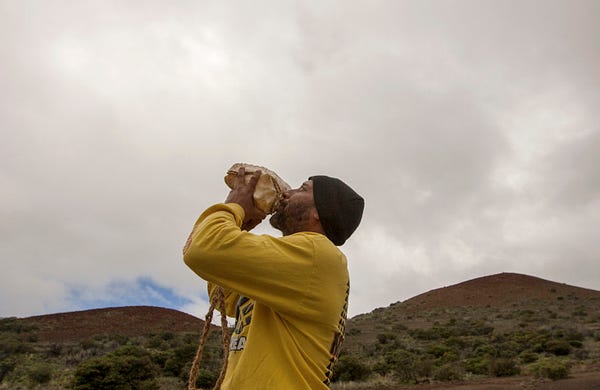
TOP: A Native Hawaiian chants before oral arguments at the Hawaii State Supreme Court regarding the Thirty Meter Telescope in August 2015. BOTTOM: A man blows a conch shell near a protest camp next to the summit of Mauna Kea in 2015. CREDIT: AP Photo/Craig T. Kojima, AP Photo/Caled Jones

“The kids of today’s generation know a new set of chants, a new set of prayers because of those who came before them,” Johnson said. He noted that Native Hawaiian schoolchildren are already singing songs written in the protest camps of Mauna Kea just a year before. “In this moment of crisis, the religious tradition is catalyzed, activated, but most of all articulated — this is when it happens.”

While this groundswell of religious generation is rooted in old traditions, it sometimes reawakens ancient elements that can challenge elders.

“My sacredness as a human is part of my tradition — myself as a protector, as a sacred protector.”

“To introduce another spiritual element — I am a two spirit,” Gonzales said, referencing a Native American term used to describe gay, lesbian, bisexual, and transgender people in their communities. Although traditionally celebrated in many tribes, two-spirit people have not always been welcomed by modern indigenous people. Yet when Gonzales and others formed the International Indigenous Youth Council at Standing Rock, the majority of the leadership identified as two-spirit — a designation they link to their faith.

“My sacredness as a human is part of my tradition — myself as a protector, as a sacred protector,” she said. “There are a lot of two-sprits at [the Standing Rock] camp, and that is sacred too… We see that as integral to our activism.”

Faith is a core mobilizing and stabilizing force for the movement, but it’s also central to the legal arguments used by Native groups to defend their land. In addition to other claims, both the Oak Flat and Standing Rock lawsuits contend that the federal government — or the companies it employs — violated the National Historic Preservation Act, which requires agencies to “consult with any Indian tribe… that attaches religious and cultural significance to properties with the area of potential effects.” The Hawaii case is similarly rooted in disputes over sacred land, although the lawsuit currently focuses on state laws, not the federal statutes.

Native groups can also lean on the American Indian Religious Freedom Act of 1978, which compels the federal government to “protect and preserve for American Indians their inherent right of freedom to believe, express, and exercise [their] traditional religions…including but not limited to access to sites, use and possession of sacred objects, and the freedom to worship through ceremonials and traditional rites.”

But according to Johnson, an expert on sacred land disputes, the law is often not enough to guarantee indigenous groups a win.

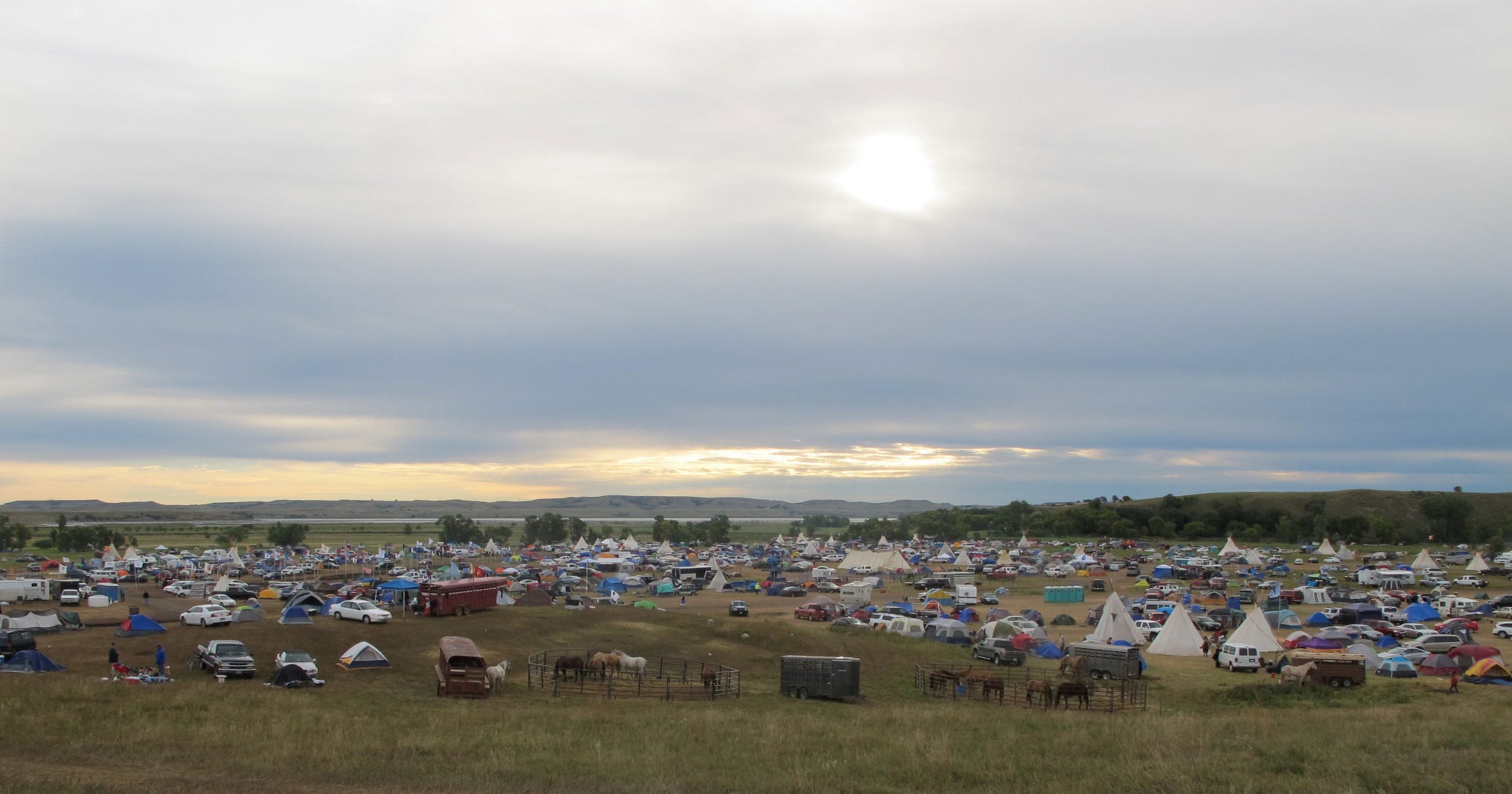
One of the camps near North Dakota’s Standing Rock Sioux reservation on September 9, 2016. CREDIT: AP Photo/James MacPherson

“There is very little track record of sacred land victories,” he said. “More likely what they will generate is allegiances, attention — the secondary effects of having made the case for their tradition.”

“There is very little track record of sacred land victories.”

Indeed, the movement thus far has largely been sustained through protest and agitation. The legal case to protect Standing Rock ultimately fell flat in early September, for instance, when a U.S. District Court judge denied the nation’s request to halt pipeline construction. But the movement proved more powerful than one judge: shortly after the ruling, the Obama administration — under pressure from scores of Native groups and their allies — called on the Dakota Access to stop construction voluntarily, and the D.C. Circuit Court of Appeals temporarily halted work on the pipeline shortly thereafter.

Such is the recurring — and increasingly successful  — strategy of these protests. Slowly accruing support and attention over time, and leaning on sacred claims, activists whittle away the patience of corporations and government officials until they (ideally) give up.

In Hawaii, construction of the TMT is currently stalled while lawyers debate aspects of the construction process, prompting The Hawaii Island New Knowledge fund to begin investigating alternative sites. In March, the Obama administration moved to place Oak Flat on the National Register of Historic Places, adding another bureaucratic hoop preventing the Resolution Copper company from installing a mine on site. The Lummi Nation in Washington State successfully defeated an effort to build the largest coal port ever in North America near their land earlier this year, and Native groups are also credited with helping stop the construction of the Keystone XL pipeline in 2015.

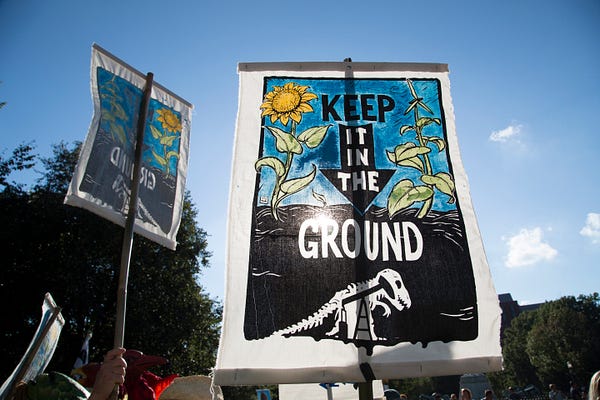
A Dakota Pipeline protest in Washington, DC in September. CREDIT: ThinkProgress/Alejandro Davila

And in addition to their secular allies in the climate movement, indigenous groups are also attracting partners in non-Native faith traditions. Representatives from the Presbyterian Church (USA), United Church of Christ, Episcopal Church, and the United Methodist Church have all visited the Standing Rock camp or expressed solidarity with the protesters, as has the Nation of Islam, according to the Religion News Service.

But the fight is far from over. Many of these disputes—including the Dakota Access Pipeline—are not yet resolved, and Native activists are already gearing up for new campaigns. In late September, dozens of tribes in Canada and the United States signed a treaty pledging to combat any further development of Canadian “tar sands,” which they say put their reservations and “sacred waterways” at risk of oil spills.

“If one of us loses, then we all have to work harder,” Case said. “We need to be stronger every day, and I believe the creator believes that’s what we need as well.”

Case said movement members will continue to lean on each other for strength moving forward (“We could use some prayer,” she joked) and that they won’t rest until they make it clear that the environment — earth, sky, and water — is, in a very literal sense, sacred.

There comes a time when people have a right to say no — and now is that time,” she added. “So we’re saying no, resoundingly, like the thundering sky.”

FROM:    https://thinkprogress.org/indigenous-spiritual-movement-8f873348a2f5#.khsb77fms