Occupy Gaia – The Gaiafield Project

Occupy Gaia in 2012: Subtle Activism Meets Street Activism

meditate.jpg 

In early October of 1939, one month after Germany invaded Poland, British esotericist Dion Fortune sent a letter to her network announcing the start of a magical project to support the war effort by opening a channel to allow spiritual influences to uplift the “group mind” of the nation. The project came to be known as the “Magical Battle of Britain.”

The letter contained instructions for a specific meditation practice that all members were asked to perform each Sunday from 12:15-12:30 p.m. and then again daily at any regular time of their choosing. A small group of experienced practitioners under Fortune’s guidance formed the focusing point for the meditation work, sitting in circle together each Sunday at Fortune’s home in London.

The meditations involved visualizing certain symbols believed to attract and focus spiritual forces that acted through them. Although the symbols were first created through the imagination, Fortune describes them “coming alive” early on in the group’s work, as though taking on independent forms that maintained themselves of their own accord and that developed organically over time. A set of symbols eventually emerged that were associated with key figures from the Arthurian tradition (King Arthur and Merlin) and from Christianity (Christ and Mary). It was understood that, through meditating on these symbols, the network helped to transmit to the collective British consciousness the archetypal ideals of chivalry and bravery associated with both Christianity and the myth of King Arthur, crucially strengthening the nation’s resolve during its hour of need. Because the myth created by the network was in deep harmony with the British national tradition, it was thought to have been especially accessible to the national mind. The theory was that individuals would pick up the ideas unconsciously and bring them to consciousness by thinking about them. Experts in various positions of influence would then give concrete expression to the ideals through action in the world. Indeed, Fortune claimed that the editorial pages of The Times — widely regarded at the time as the mirror of the national mind — came to give expression to the ideals of the work in a way that was “not only adequate but verbatim.


Subtle Activism


The Magical Battle of Britain is a striking example of what I call “subtle activism” — the use of spiritual or consciousness-based practices for collective (rather than individual) transformation. Subtle activism is a bridge between the inner world of spirituality and the outer world of activism (as normally conceived) that emphasizes the potential of spiritual practice to exert a subtle but crucial form of social influence. It arises from the recognition that there are many creative ways to support social change and that shifting collective consciousness lies at the heart of any successful campaign. History is replete with examples of victories by armies or social movements that were badly outmatched by their opponents in technology and size, yet which prevailed because they possessed the superior will. Subtle activism feeds the will of a social movement by making it more conscious of, and permeable to, profound evolutionary and spiritual currents that underlie it, adding deeper dimensions of meaning to the movement and inspiring greater levels of motivation and commitment among its participants. It works on the assumption that, beneath the appearance of separation, we are profoundly connected to each other at deeper levels of consciousness, and that the focused spiritual attention of even a relatively small group can subtly and positively affect the collective consciousness of an entire community, nation, or even species.(1) It is not a substitute for direct physical action, but it can play a vital role as part of a more integrative approach to social or planetary change.

While the “Magical Battle” example illustrates a western esoteric approach to subtle activism, it can be practiced in a variety of spiritual forms and traditions. A notable form that has emerged since Fortune’s time — facilitated by the development of the Internet, the growing global interfaith movement, and the increasing hybridization of spiritual traditions — is a global meditation event involving many thousands of people engaged in synchronized spiritual practice in different parts of the planet. In whatever way it is practiced, subtle activism can be seen as one of a growing number of creative spiritual responses to the challenges of our times that recognize the need to integrate the paths of inner and outer transformation. 

Looking at our present moment, how might we engage in the practice of subtle activism to support the Occupy Movement and the broader movement for global transformation it represents?


The Spiritual Dimension of the Occupy Movement


From the beginning, there seems to have been a certain magic to the Occupy Movement. Whereas most interventions by progressive activists in recent decades failed to make hardly a dent in mainstream awareness, the Occupy Movement almost instantly struck gold. It was quickly recognized as something more than just another protest, a movement of potentially historic significance. Whether it was the brilliant marketing meme of “Occupy,” the simplicity of the “We are the 99%” message, the strategy of setting up encampments, or just the stars lining up right, it evidently tapped a red-hot vein in the collective psyche and inspired a widespread excitement that fundamental systemic change might actually be possible.

At the time of writing, with many encampment sites largely abandoned for the winter or having been shut down, the movement seems to be in a liminal phase, trying to ascertain its next move. Some are already writing eulogies, arguing that the movement has failed to channel its early momentum into a mission specific enough to gain political traction. Perhaps this is true. Yet the seeds of revolution planted in the fall will inevitably sprout forth again in new ways, and probably soon.

The injustices highlighted by the movement have not in any way been addressed and, with the events of the Arab Spring, the emergence of the Spanish and Latin American indignados, and the proliferation of Occupy sites world-wide, it is obvious that we have entered one of those rare historical periods in which the zeitgeist supports revolutionary action.

The bigger picture is that the issue of economic injustice targeted by the Occupy Movement is just one symptom of a multidimensional global crisis that is exerting enormous evolutionary pressure on humanity to make a fundamental shift. To acknowledge the multiple threats of climate change, peak oil, massive species extinction, calamitous loss of topsoil, overpopulation, and potential financial collapse is to recognize that the current form of our civilization is rapidly approaching its demise. In this context, the Occupy Movement represents an inevitable uprising of the life force on the planet to attempt to initiate a new way forward.

The transition we are called to make goes far beyond incremental policy changes within the current system, positive though such changes might be. We are called to re-imagine and re-create our world around fundamentally new organizing principles. The old world is essentially on life support in any case. Our choice really is to participate consciously in the birth of the new era, or to have it forcibly and painfully delivered to us.

At the heart of the transition lies a shift in consciousness from the modern trance of experiencing ourselves as somehow separate from each other, from nature, and from the cosmos to a mode of awareness in which we acknowledge and live the truth of our interdependence and interconnection. Ecologist and cultural historian Thomas Berry succinctly summarized this shift as one in which we will experience the universe as “a communion of subjects” rather than as “a collection of objects.” For human civilization truly to become a benign and sustainable presence on the planet, we will need not only to develop a global culture of cooperation, rather than competition, to solve the many planetary-scale challenges that affect all humans, but also to fundamentally transform our relations with the entire community of life on the planet.

Although the Occupy Movement has focused its attention on the inequities of the financial system, I believe that much of the excitement it initially generated was because, in the diversity of its participants and in the generality of its aims, it also represented a long awaited public stance for a fundamentally new and more inclusive world on every level. The General Assemblies and the practice of making decisions by consensus, for example, can be understood as an evolutionary experiment to create new, more participatory governance processes that could serve as models to better harness the collective wisdom of a society. The spiritual significance of the movement can thus be seen in the way it has created an opening in the socio-political domain through which the seeds of the new consciousness can enter.

Whether the new consciousness will actually take root and flower through the Occupy Movement is an open question. As noted, after the initial eruption of energy in the fall, the movement has entered a more introspective phase, an in-breath, to pause, gather energy, and reflect before making its next major outward push. And the movement does face many challenges: how to resolve internal conflicts about whether to adhere to non-violence as a strategy versus ‘a diversity of tactics’ that includes property damage or even physical violence; how to avoid becoming overly focused on disputes with police and local authorities regarding the encampments at the expense of highlighting the primary issue of economic injustice; how to embrace the complexity of protesting against a financial system we still use and depend upon.

Yet this period of inner reflection and dialogue represents an ideal time to channel energy into the movement to help realign it with the deeper impulses that provided it with its power and relevance in the first place. This is the work of subtle activism, accessible to almost anyone. Again, it is not a substitute for more obvious or direct forms of action — which are necessary and to be encouraged — but it represents a creative response that allows many people to become engaged who might otherwise remain passive. Out of the wide spectrum of actions that can be undertaken for social change, frontline engagement does not call to everyone (and of those called, not all can respond). Indeed, in relation to the Occupy Movement, for every person who has camped out in tents and marched in the rallies, there have surely been hundreds, if not thousands, or even millions who have sympathized with the protesters, yet who would not or could not join them in the streets. Through subtle activism, we can link together with all who share our sense of the underlying promise of the Occupy Movement (including those on the streets) and build a global field of awareness that holds a space for the highest possibilities to emerge from the movement. 

Here is a project that provides a way to do just that.


Occupy Gaia


Occupy Gaia is a subtle activism program convened by the Gaiafield Project (http://gaiafield.net) to help build a global field of support for the Occupy Movement. (2) It is one of a surprisingly large number of initiatives that have been developed to link the transformative power of spirituality to the Occupy Movement (other examples include meditation flash mobs, Sit for Change, Buddhist Peace Fellowship, Zen Peacemakers, and various interfaith coalitions). Occupy Gaia involves two free one-hour teleconferences/audio webcasts per month, in which participants engage in a simple subtle activism practice. After callers introduce themselves, the practice starts with a short guided meditation to connect participants to themselves, to others on the call, and to subtle and overt dimensions of the natural and spirit worlds. Then a period of silent meditation follows, usually about 20-25 minutes long, during which participants bring their inner attention to the Occupy Movement while remaining open for any guidance that might arise from the field. In the final stage of the practice, participants are invited to share any insights or experiences that came to them during the meditation. The call becomes like a multi-dimensional planetary oracle, with a field of deep collective wisdom about the current state of the movement emerging from the intersection of our human awareness, the inner and outer ecology of Gaia, and subtle dimensions of spirit. Personally I almost always experience the calls to be profoundly meaningful and am usually struck by how quickly an atmosphere of deep intimacy develops from participants sharing their inner worlds with each other.

This article is a call to action for all who resonate with an inner approach to collective transformation. To those who feel the call, we invite you to join us on the second Wednesday of each month, from 5.30-6.30pm Pacific time and/or on the fourth Friday of each month from 8.30-9.30am Pacific. For the call-in details, please visithttp://gaiafield.net.

for notes, go to article source:   http://www.realitysandwich.com/occupy_gaia_subtle_activism


Tips on Successful Veggie Growing

How to Grow The Top 10 Most Nutritious Vegetables in Your Garden

By Colleen Vanderlinden

Treehugger

A perfectly ripe, juicy tomato, still warm from the sun. Sweet carrots, pulled from the garden minutes (or even seconds!) before they’re eaten. Growing your own vegetables is one of those activities that balances practicality and indulgence. In addition to the convenience of having the fixings for a salad or light supper right outside your door (or on your windowsill), when you grow your own vegetables, you’re getting the most nutritional bang for your buck as well. Vegetables start losing nutrients as soon as they’re harvested, and quality diminishes as sugars are turned into starches. For the tastiest veggies with the best nutrition, try growing a few of these nutrient-dense foods in your own garden.

And don’t let the lack of a yard stop you – all of them can be grown in containers as well.

1. Broccoli

Broccoli is high in calcium, iron, and magnesium, as well as Vitamin A, B6, and C. In fact, one cup of raw broccoli florets provides 130% of your daily Vitamin C requirement.

  • How to Grow Broccoli
  • Grow Broccoli in Containers: One broccoli plant per pot, pots should be 12 to 16 inches deep.
  • What to Watch Out For: Cabbage worm. If you start seeing pretty white butterflies fluttering around your broccoli, you’re guaranteed to start seeing little green worms all over your broccoli plants. To avoid this, cover your broccoli plants with floating row cover or lightweight bed sheets. If you start seeing cabbage worms, simply pick them off by hand.

2. Peas

There is nothing like peas grown right in your own garden – the tender sweetness of a snap pea just plucked from the vine is unlike anything you can buy in at a store. Aside from being absolutely delicious, peas are high in fiber, iron, magnesium, potassium, and Vitamin A, B6, and C.

  • How to Grow Peas
  • Grow Peas in Containers: Sow peas approximately 2 inches apart in a pot that is at least 10 inches deep. Provide support for peas to climb up.
  • What to Watch Out For: Hot weather. Once the weather turns hot, pea production will pretty much shut down. Grow peas in early spring and late summer/autumn, or any time of year when temperatures are consistently between 40 and 85 degrees Fahrenheit.

3. Beans (especially navy beans, great northern beans, kidney beans)

While snap beans (green beans/wax beans) are a great addition to any garden, it’s the beans we grow as dried beans that are real nutritional powerhouses. Dry beans, in general, are high in iron, fiber, manganese, and phosphorous.

  • How to Grow Beans
  • Grow Beans in Containers: Bush beans are your best option for growing in containers. Plant beans four inches apart in a container that is at least 12 inches deep.
  • What to Watch Out For: Harvest at the right time. Harvest dry beans when the pods have completely dried on the vine. The pods should be light brown, and you should be able to feel the hard beans inside. Shell the beans, and let them sit out a few days to ensure that they’re completely dry before storing them in jars in a cool, dark, dry place.

4. Brussels Sprouts

The bane of many a childhood, Brussels sprouts get a bad wrap mostly due to overcooking. When prepared right, Brussels sprouts are sweet, tender, and delicious. They also provide tons of fiber, magnesium, potassium, and riboflavin, as well as high levels of Vitamins A, B6, and C.

  • How to Grow Brussels Sprouts
  • Grow Brussels Sprouts in Containers: Grow one plant per 16-inch deep container.
  • What to Watch Out For: Cabbage worms (see “Broccoli, above.)

5. Tomatoes

Fresh, homegrown tomatoes are the reason many gardeners get into vegetable gardening in the first place. There’s just nothing that compares to eating a perfectly ripe tomato, still warm from the sun. Tomatoes are also incredibly good for us, packing plenty of fiber, iron, magnesium, niacin, potassium, and Vitamin A, B6, and C. They’re also a great source of the antioxidant lycopene.

  • How to Grow Tomatoes
  • Grow Tomatoes in Containers: Container sizes will vary depending on the variety you’re growing. If you’re growing an indeterminate variety, your container will need to be at least 18 inches deep. For determinate varieties, 12 inches is a good depth, and for dwarf or “patio” type tomatoes, 8 inches is perfect. One tomato plant per pot.
  • What to Watch Out For: Tomato horn worm can be a problem in many areas – these large caterpillars should be removed by hand whenever you see them. Also watch out for signs of blight, which is a real problem in many parts of the U.S.

6. Red Bell Peppers

Red bell peppers are high in potassium, riboflavin, and Vitamins A, B6, and C – in fact, one cup of red bell pepper packs an amazing 317% of the recommended daily allowance of Vitamin C and 93% of the recommended Vitamin A.

7. Beets

Beets are a great “two-fer” crop – you can harvest the beet roots, of course, but you can also harvest and eat the greens. Young beet greens are delicious when added raw to a salad, and larger beet greens can be sauteed as a quick side dish or used the way you’d use other greens such as spinach. Beet roots are very high in iron, potassium, and vitamin C. Beet greens are even better, as they are high in iron, calcium, magnesium, potassium, zinc, and Vitamins A, B6, and C.

  • How to Grow Beets
  • Grow Beets in Containers: Plant beet seeds three inches apart in a container that is twelve inches deep. Because each beet seed is actually a cluster of seeds, be sure to thin the seedlings to one per cluster. Thinnings can be added to salads or sandwiches.
  • What to Watch Out For: Knowing when to harvest. Beet roots are at their best when they are harvested small – between one and two inches across. At this size, they are sweet and tender. Larger beets tend to be kind of woody and less flavorful.

8. Leaf Amaranth

Leaf amaranth is a less-common vegetable that is well worth a try in your own garden. The leaves have a sweet and slightly tangy flavor that works well in a variety of dishes, from stir-fries and soups to simply steaming it all by itself. As a bonus, leaf amaranth is one of the few heat-tolerant greens. It won’t bolt in the heat of summer the way spinach and kale are prone to. Nutritionally, leaf amaranth is very high in calcium, iron, magnesium, phosphorous, potassium, riboflavin, zinc, and Vitamins A, B6, and C. Everyone should be growing this!

  • How to Grow Leaf Amaranth
  • Growing Leaf Amaranth in Containers: Scatter the tiny seeds over the soil’s surface in a pot that is at least 8 inches deep. Harvest the leaves when they are two to four inches tall. You will be able to get at least two or three harvest before you’ll have to sow more seeds.
  • What to Watch Out For: Leaf amaranth is fairly easy to grow, and relatively problem-free. Rarely, leaf miners can become a problem.

9. Carrots

Carrots are at their sweetest, crunchiest best when freshly harvested from the garden. These icons of healthy eating deserve their “good-for-you” rep – they’re very high in fiber, manganese, niacin, potassium, and Vitamins A, B6, and C. Their only drawback is that they do tend to be high in sugar, so if you’re watching your carb intake, you’ll want to limit the amount of carrots you eat.

  • How to Grow Carrots
  • Grow Carrots in Containers: Sow carrot seeds two to three inches apart in a pot that is at least twelve inches deep. Look for shorter varieties, such as ‘Thumbelina,’ or ‘Danver’s Half Long.’
  • What to Watch Out For: Harvesting at the perfect size. Carrots are at their tastiest when harvested small. Leaving them in the ground too long can result in overly large, woody carrots. You’ll also want to make sure to keep your carrots evenly moist, as letting the soil dry out too often can also result in somewhat bitter, fibrous carrots.

10. Leafy Greens

OK, I cheated here. I can’t recommend just ONE leafy green, because they are all incredibly good for us, as well as delicious — kale, collards, spinach, turnip or dandelion greens — how can you possibly choose just one? In general, the “green leafies” contain high amounts of calcium, iron, potassium, and Vitamins A, B6, and C.

  • How to Grow Kale and Other Leafy Greens
  • Grow Greens in Containers: Grow one kale or collard plant per ten inch deep pot. Other greens can be grown a few plants to a pot — they should be planted at least 4 inches apart and harvested small.
  • What to Watch Out For: Heat and cabbage worms. Most leafy greens are cool-weather crops, so they’re best grown in spring and fall in most areas – hot weather will cause them to bolt. In addition, many of these greens are members of the Brassicas family, which means they are prone to cabbage worm infestations. Control them with the same methods outlined in the “Broccoli” section, above.

Try growing one or two (or all!) of these nutrient-dense, delicious vegetables in your own garden, and you’ll get double the health benefits: healthy food and time spent outdoors, nurturing your plants

from:    http://wakeup-world.com/2011/06/17/how-to-grow-the-top-10-most-nutritious-vegetables-in-your-garden/

The South Atlantic Anomaly

Has The Magnetic Pole Reversal Already Begun? South Atlantic Anomaly Could be First Evidence – Part I
2005 10 10

By Mitch Battros | ECTV Newsletter


(The Van Allen Belts) Image source: click here

In my last two interviews, one with Dr. Peter Olson, Geophysicist from Johns Hopkins University, and Dr. Nicola Scafetta, Applied Physicist from Duke University has sparked my curiosity to apply an additional direction to my published “Equation”.

Still, the Sun is no doubt the origin of all interactive play. (at least in our solar system, but this will be explained in my book “Cosmic Rain” due out late spring.). The Sun is the triggering mechanism for a causal chain reaction to what happens on our home planet. One might say for all planets…in our solar system. What I have been learning lately is what slower acting, but perhaps far more powerful effect the Sun has on the Earth’s core. What we all agree upon (myself and my distinguished guest Dr. Olson and Dr. Scafetta) is the Sun is the primary cause for our climate and weather. It is pronounced and almost instantly in active effects. But what is going on below is far more powerful but disguises in a stealthy slow moving mannerism. The old story of the frog in the slowly heating pot comes to mind.

Although most of our scientific equipment is pointed towards the sky (satellites, telescopes etc,) to measure the Sun’s activity and its effect on our magnetic field, ionosphere, stratosphere, and as of late our “weather” (see equation), not much has been disclosed or known about what lies beneath our feet. So lets take a closer look.

Equation: 
Sunspots => Solar Flares => Magnetic Field Shift => Shifting Ocean and Jet Stream Currents => Extreme Weather and Human Disruption

In very much the same way as lightning strikes, so does the Earth’s highly charged core. Did you know when we think we see a lightning bolt hitting Earth; it is actually met with a matching bolt from the ground shooting upward? That’s’ right. A lightning bolt rises from the ground and meets a lightning bolt from the sky up to several hundred feet in the air. With this understanding, and upon Dr. Olson’s studies of the Earth’s core, mantle and crust, I am suggesting the solar flares, CME’s, and various space emitted charged particles, having a similar “reverse charge” in the same manner as lightning bolts. More on this later, but first let’s take a look at what is the “South Atlantic Anomaly”.

South Atlantic Anomaly
Earth is surrounded by a close-to-spherical magnetic field, the magnetosphere. According to what we know today, it is being generated by dynamo action in the Earth’s interior where conducting liquid metals are kept in motion by the forces of convection (heat exchange), coriolis, and gravitation, and just as the charged windings in the coil of a dynamo generate a magnetic field when moved, these masses create the Earth’s magnetic field. Without it, our compasses wouldn’t work, there would be no northern lights (auroras), and it protects us from space radiation by deflecting high energy particles from deep space or by capturing them in the so-called Van Allen Belts. Of these, discovered by the first US satellite, Explorer 1, in 1958, there are two, one closer, the other farther away, and both surround the Earth like a doughnut.

Unfortunately, at a certain location over the South Atlantic Ocean, off the coast of Brazil, the shielding effect of the magnetosphere is not quite spherical but shows an unusual distortion, which scientists explain as a result of the eccentric displacement of the center of the magnetic field from the geographical center of the Earth (by 280 miles) as well as the displacement between the magnetic and geographic poles of Earth. This is to say Magnetic North is not consistent with Geographical North. At times this area becomes very unstable and “bounces” kilometers apart. But there is more to this “unpredictable” monolithic anomaly than many in the science community had ever known…until now.

Article from: ECTV Newsletter

from:    http://www.redicecreations.com/news/2005/10oct/poleshift1.html


Amazing & Non-Stop Auroras

BROKEN RECORD? The recent sustained activity of sunspot AR1429 has kept the Arctic Circle alight with auroras for almost two weeks. “I have spent many thousands of hours watching and photographing the Northern Lights,” says aurora tour guide Chad Blakely of Abisko Sweden, “and I can honestly say that I have never seen the auroras this strong for so many days in a row.” In a movie he made last night, March 12th, a green tornado of light swirls across Venus and Jupiter:

“We were all absolutely stunned by the natural beauty of this display,” says Blakeley. “I know I sound like a broken record, but sunspot 1429 just will not stop!”

fr/spaceweather.com

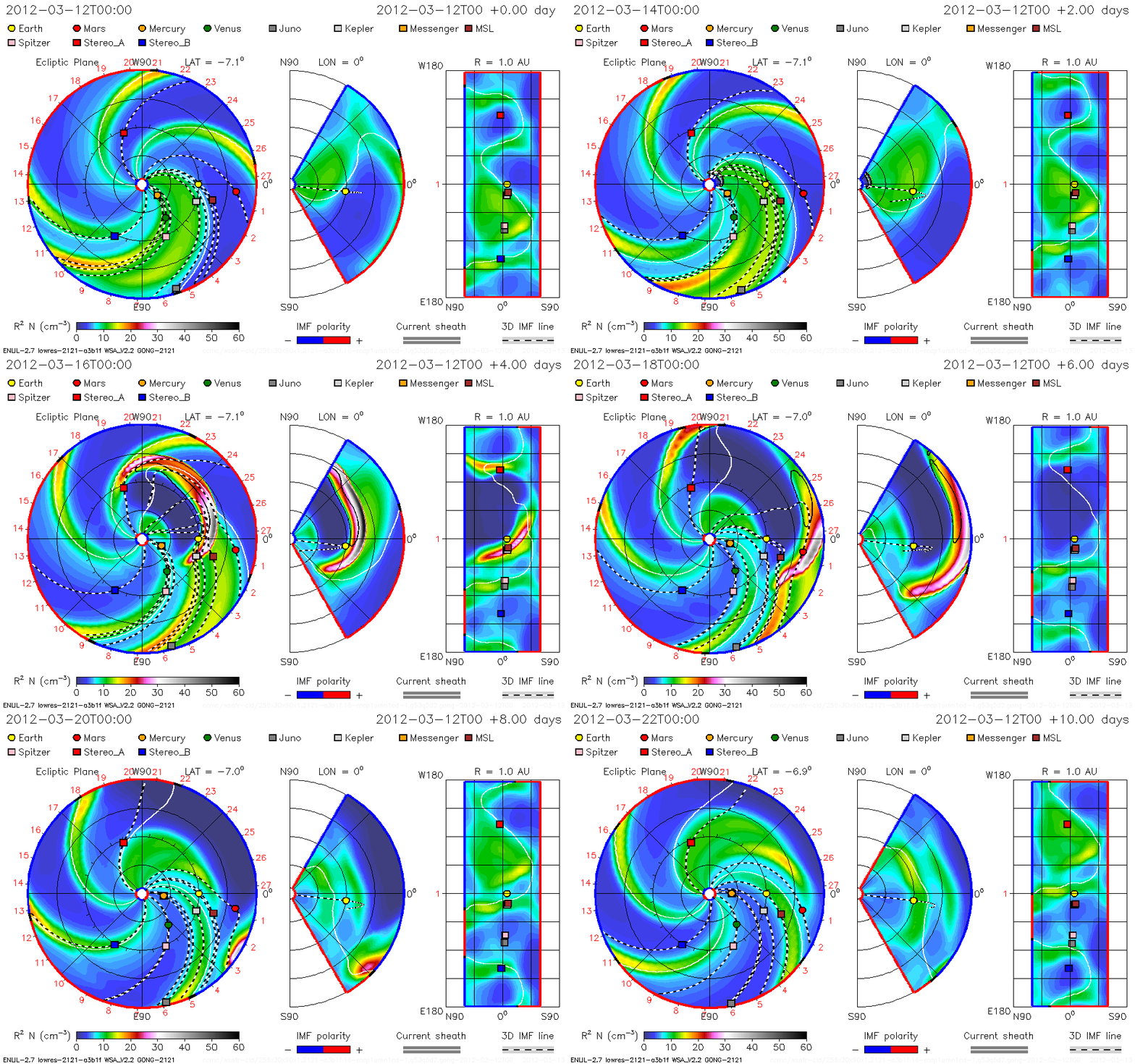
Incoming CME 3/15

STRONG FLARE, INCOMING CME: Departing sunspot AR1429 unleashed another strong flare on March 13th, an M7-class eruption that peaked around 1741 UT. Although the sunspot is no longer directly facing Earth, the blast will affect our planet. Analysts at the Goddard Space Weather Lab say a CME is en route to Earth, and its impact on March 15th at 06:20 UT (+/- 7 hours) could trigger minor to moderate geomagnetic storms

fr/spaceweather.com


Large Earthquake Near Tokyo

Dangerous M5.7 earthquake strikes close to Tokyo

Last update: March 14, 2012 at 1:33 pm by By 

Most important Earthquake Data:

Magnitude : M5.7 (USGS), M6.1 (JMA)
UTC Time : Wednesday, March 14, 2012 at 12:05:05 UTC
Local time at epicenter : Wednesday, March 14, 2012 at 21:05:05 LT
Depth (Hypocenter) : 16.9km (USGS), 10km (JMA)
Geo-location(s) : 76 km (47 miles) SSE of Mito, Honshu, Japan
90 km (55 miles) E of TOKYO, Japan  

A dangerous earthquake has struck close to Tokyo (90km). It had a M5.7 and was shallow in depth. The earthquake will be as strongly felt in some parts of Japan as the M9.0 earthquake from March 11th, 2011.

UPDATE: – No damage has as yet been reported from Chiba and Ibaraki – this is good news considering the shaking. FDMA is reporting no injuries or emergencies as yet.


Intensities from JMA – www.jma.go.jp

Expected intensities from JMA (courtesy JMA – jma.go.jp)

The towns of Asahi and Hasaki can expect some damage. Minor liquefaction may occur in some locations in Chiba.

JMA is expecting an intensity 5+  (approx. MMI 7-8) in the provinces close to the epicenter.

The fire and department agency has not yet released any details.

The epicenter was east of the coast off of Chiba Prefecture. Intensity 5 upper – Kamisu, Ibaraki Prefecture, Chiba Prefecture and Choshi

Intensity 5 lower – Hitachi City, Ibaraki Prefecture and Asahi City, Chiba Prefecture

Intensity 4 – Chuo-ku, Chiba and Mito, Moka, Tochigi Prefecture, the town Miyashiro, Saitama Prefecture, Tokyo.

Intensity 3 – Tamagawa, Fukushima Prefecture Besides, Shinagawa and Chuo-ku, Tokyo (some), Naka-ku, Yokohama-shi, Kanagawa, Minamiuonuma, Niigata Prefecture.

for more information and updates, go to:   http://earthquake-report.com/2012/03/14/dangerous-m5-7-earthquake-strikes-close-to-tokyo/

Bus-Top Gardening

Gardens Thrive on Top of City Busses


27th Feburary 2012

By urbangardensweb.com

Bus Roots is a living garden planted on the roofs of city buses. It’s an effort that rose out of New York City designer Marco Antonio Castro Cosio’s graduate thesis at the NYU. The project aims to reclaim the forgotten space on the tops of city buses, while enhancing the quality of urban life by proliferating green spaces on these unused bus roofs. A prototype of the rolling gardens has been installed on the roof of the BioBus, a mobile science laboratory and the first bus with an extensive green roof system. It has been growing for five months while travelling around New York City and as far as Ohio.

Bus Roots joins the ranks of mobile gardens planted on truckstrains, and other roving sites. Cosio explains his project as an exercise in “nomadic urban agriculture.”

Benefits
According to the bustop gardener, benefits include:
• Aesthetic Value
• Mitigation of Urban Heat Island Effect
• Acoustical and Thermal Insulation
• Storm Water Reduction and Management
• CO2 absorbtion
• Habitat Restoration
• Public Education and Recreation
• Reclaiming Forgotten Real Estate


Raising the Roots
Cosio estimates Bus Roots can add greatly to the city’s green space. Each public transit bus has a surface of 340 ft2., and The Metropolitan Transit Authority has a fleet of around 4,500 buses. Do the math.

“If a garden were planted on the roof of every one of the 4,500 buses in the city’s bus fleet,” calculates Cosio, his busses could add 35 acres of new rolling green space in the city.

from:    http://wakeup-world.com/2012/02/27/gardens-thrive-on-top-of-city-busses/

El Hierro Update

El Hierro Volcano : Yellow alert – Atlantic Explorer will try to use the ROV on Tuesday

Last update: March 12, 2012 at 3:19 pm by By 


Update 12/03 – 07:28
– The Atlantic Explorer vessel of the company QSTAR SLU, hired by members of ‘Universidad de las Palmas de Gran Canaria’ (ULPGC) and collaborating, the non-profit organisation, SOS Océanos is back in town. Julio received an Email from one of the people in charge that they will try to use the ROV today on Tuesday, weather permitting of course.
– 2 earthquakes so far today – M &.1 and M 1.3 both at a depth of 12 km


Update 11/03 – 23:55
– New images from Joke Volta have been loaded in our picasaweb
– A 5th earthquake with a magnitude of 0.6 occurred at 21:37

Update 11/03 – 22:58
– no more new earthquakes
– some people are looking for a new name for the new volcano. IGN scientists are talking internally about “El Volcan de La Restinga”  but a new name is certainly desirable.
– Involcan and ITER have published the new CO2 graphs who are showing a light increase to 934 ton per day.

Update 11/03 – 21:34 UTC
– Today a number of people and Joke saw a faint jacuzzi or rather degassing in the vent area. This was also confirmed by scientists.
– The degassing started already yesterday afternoon and was mentioned by some ER readers, Julio and AVCAN.
– We think it is probably too early to talk about a reactivation of the eruptive process.

Update 11/03 – 18:38 UTC
– Images Joke Volta from today showing a beautiful sunrise and a few images with a super faint jacuzzi. Click here.

Update 11/03 – 08:38 UTC
– 4 earthquakes so far since midnight. Resp. 1.8, 1.5, 0.3 and 1.7. Depths in between 8 and 12 km.


Update 10/03 – 23:10 UTC
– The Atlantic Explorer vessel is currently navigating to El Hierro for a new campaign. In the team, members from the Universidad de Las Palmas de Gran Canaria and SOS Océanos. Lets hope this time the conditions will be good enough for deploying the ROV.
Update 10/03 – 21:45 UTC
– The following video shows the activity at ‘El Mar de Las Calmas’ from 18:55 to 19:55 UTC  x10 normal speed, by Julio del Castillo Vivero.

– AVCAN (Actualidad Volcánica de Canarias) believe the eruption was not over and continues.
– Joke Volta has spoken with Ramón Ortiz and here we have translate his words for what he believes could be happening:

” What can be observed now we saw 2 weeks ago. I have looked at the seismic network, and there has been no variation, no anomalies. When there is an eruptive activity this is reflected in the seismic network. What could be happening is that as magma is still hot, it takes time to cool down, this material is still releasing heat and vapor, and there is still gas release. That is why there is still an exclusion zone around the volcano. Tides can affect the process that we see. As the tide changes, the pressure does too and this can alter what is happening. The effect of the tides we have observed it two weeks ago when there was a decrease in activity. The visibility of the volcano changes and this is also due to the tides.

– What we are sure of is there has been no official communication about what is happening.

for more information and updates, go to:    http://earthquake-report.com/2011/09/25/el-hierro-canary-islands-spain-volcanic-risk-alert-increased-to-yellow/

Earthquake — Kashmir, India

March 12, 2012 – Strong earthquake in Kashmir

Last update: March 12, 2012 at 7:12 am by By 


M 5.6      2012/03/12 06:06      Depth 49.3 km     NORTHWESTERN KASHMIR

Local time : 11:06:45 AM at epicenter
Satellite map of the greater epicenter area (see below)
141 km (87 miles) NW of Gilgit, Kashmir
154 km (95 miles) NE of Chitral, Pakistan
Max. expected shaking : moderate for 9,000 people and light shaking : 332,000
The nearest populated places are: Lasht (13km), Baroghil (19km), Kharach (20km), Dehe Gholaman (18km). The closest civilian airport is Chitral (159km).
The Murgab hydrodam is located at a distance of 62 km from the epicenter.
Koyo Zom is the highest peak in the Hindu Raj mountain range in Pakistan at 6872 m. The Hindu Raj mountain range lies between the Hindu Kush and the Karakoram ranges
Based on the current hypocenter (49.3 km) and the epicenter location (preliminary) , earthquake-report calls this earthquake moderately dangerous. The biggest danger will come from landslides and rockfall. Additionally, the houses in the area are mostly build of stones and are very vulnerable

from:   http://earthquake-report.com/2012/03/11/earthquakes-list-march-12-2012/

Weekly Volcano Report

Smithsonian/USGS Weekly Volcanic Activity Report 29 February – 6 March 2012 8 March 2012

Posted by admin in activity reportsAlaskaBaganaBezymiannyCanary IslandsChileClevelandEcuadoreruptionsEtnaFuegoGuatemalaHawaii,HierroItalyJapanKamchatkaKanagaKarymskyKilaueaKizimenMexico,Papua New GuineaPopocatépetlPuyehueRussiaSakura-jimaSanta María,ShiveluchSpainSuwanose-jimaTungurahuaUnited StatesWeekly Volcanic Activity Reports.
Tags: 
add a comment

The latest Smithsonian Institution and United States Geological Survey Weekly Volcanic Activity Report has been published by the Global Volcanism Program, covering the week 29 February to 6 March 2012. The report is compiled by Sally Kuhn Sennert. Some of the highlights of the volcanic week:

  • Continuing activity at Etna including strombolian eruptions, lava fountaining and lava flows
  • Explosions at Fuego produced plumes that reached 0.6 km above the crater
  • Plumes rose to 1 km above Puyehue-Cordón Caulle as low-level eruptive activity continues

SI/USGS Weekly Volcanic Activity Report 29 February - 6 March 2012

from:   http://volcanism.wordpress.com/category/weekly-volcanic-activity-reports/