Just in Case You Thought You Were Off “The Menu”

Plunder: Financing the Panopticon

“If you want long-term success in business, relationships and life, you have to get better at accepting uncomfortable truths as fast as possible. When you refuse to accept an uncomfortable truth, you’re choosing to accept an uncomfortable future.”

~ Steven Bartlett, The Diary of a CEO

By Catherine Austin Fitts

Plunder is an ancient story. The promise of plunder brought Attila and the Huns over the Alps to raid the Roman Empire in northern Italy. It inspired the conquistadors of Spain to hunt for silver in Mexico and South America, where they wiped out the Aztec and Incan Empires. Protected by court intrigue and secrecy, pirates have teamed up for centuries with royalty whose reign depended on rich spoils to pay back their bank loans. When the leaders of the British Empire could not maintain a trade surplus, they flooded the Chinese with opium, conquering with addiction and gunboats what could not be secured with manufacturing and diplomacy.

The founding of the Bank of Amsterdam, the Bank of Sweden, and the Bank of England in the 1600s launched the beginning of the economic paradigm I call the “central banking-warfare model”—but we could just as easily call the dominant economic model the “central banking-plunder model.” Plunder in its many forms has been essential to the rich accumulation of capital that helped to build the Western world. You can grow wealth, or you can take it—and in many cases, taking it is the preferred method. Alibaba founder Jack Ma once said, “When trade stops, war starts.”

The long history of Western plunder inspired the formation of the intergovernmental organization known as BRICS (whose current membership includes founding members Brazil, Russia, India, and China in 2009, followed by South Africa in 2010, and Egypt, Ethiopia, Indonesia, Iran, and the United Arab Emirates in 2024-2025)1 and the BRICS nations’ ongoing efforts to achieve financial and military independence. More recent history helps explain Russia’s fierce resistance to NATO encroachment—the Russian people have not forgotten the “Rape of Russia”2 after the Soviet Union collapsed. As Samuel Huntington observed in his 1996 book The Clash of Civilizations:

“The West won the world not by the superiority of its ideas or values or religion (to which few members of other civilizations were converted) but rather by its superiority in applying organized violence. Westerners often forget this fact; non-Westerners never do.”

As technological innovation grows, so do the applications of plunder—along with its profitability. As David A. Hughes explained in our recent Omniwar report,3 “Omniwar” involves “the weaponization of everything.” Thus, instead of killing their prey physically in open combat, plunderers now can simply empty victims’ bank accounts while distracting them with propaganda and pornography. Plunder leaves students, who spend years getting an education that is not relevant to generating an income, with enormous student loan debt that they cannot retire. Frauds like the Madoff Ponzi scheme4 steal a mother’s savings, and when she commits suicide, her children’s inheritance can scarcely cover funeral expenses, much less finance their education and future. Plunder also encompasses the politically engineered health, food, and education policies that poison children. Moreover, the poisoning has a profitable postscript: the medical establishment claims that the children are sick (instead of poisoned),5 and parents liquidate their savings to try to heal their children in a manner that generates significant revenues for medical enterprises and pharmaceutical businesses.6

A key reason why the Solari team focuses on financial freedom7 is out of a desire to protect ourselves and our subscribers from being plundered. Because so much of the art of plunder involves management and manipulation of the financial system and the train tracks of transactions, we place great emphasis on having a good map of the world in which we live and understanding how to recognize the difference between “official reality” and reality. That is why the second of the six pillars of our Building Wealth curriculum8 is “Navigation Tools.”9 With the ability to develop and maintain a good map of reality, you can navigate. You can invest your time and resources to serve your purpose and achieve your goals, rather than find yourself plundered by someone trying to take the wealth—both the living and financial equity—that you have worked so hard to accumulate.

At Solari, our intention is not to depress you by dwelling on the unpleasant topic of plunder, but rather to help you build a strong immune system against being plundered. Ideally, you should also build networks and communities that help members do the same. Now is the time to do so, because technological innovation is powering the plunder game in new and challenging ways.

The 21st-Century Panopticon

We are in the midst of a quantum leap in the technology of surveillance and control. Let’s start with the metaphor of the “panopticon”—reintroduced in recent years by Ian Davis, Whitney Webb, and Mark Goodwin in their writings for Unlimited Hangout. English philosopher and social theorist Jeremy Bentham originated the term panopticon in the 18th century, Wikipedia explains, to convey the idea of “a design of institutional building with an inbuilt system of control…. The concept is to allow all prisoners of an institution to be observed by a single prison officer, without the inmates knowing whether or not they are being watched.”10 Davis, Webb, and Goodwin use “panopticon” to describe U.S. and Israeli surveillance, assassination, and warfare systems—including those supported by Palantir—as well as the public distributed ledger systems, including blockchain, being used to shift the financial system into a control grid.

In 1975, French philosopher Michel Foucault (1926–1984) described a panopticon as follows:

“The Panopticon is a machine for dissociating the see/being seen dyad: in the peripheric ring, one is totally seen, without ever seeing; in the central tower, one sees everything without ever being seen…. The ideal point of penality today would be an indefinite discipline: an interrogation without end, an investigation that would be extended without limit to a meticulous and ever more analytical observation, a judgement that would at the same time be the constitution of a file that was never closed, the calculated leniency of a penalty that would be interlaced with the ruthless curiosity of an examination, a procedure that would be at the same time the permanent measure of a gap in relation to an inaccessible norm and the asymptotic movement that strives to meet in infinity.”11

As governments and militaries around the world use satellite constellations, telecommunications, digital technology, and invisible weaponry to build a planetary panopticon, the U.S. administration and its allies are demonstrating the unique features of this new model. For example, on June 13, 2025, financed by the United States, Israel launched its war on Iran by assassinating 11 of Iran’s top military leaders and nuclear scientists. Some were reportedly targeted at home, resulting in the death of their families and neighbors. Describing the events, Ron Unz wrote, “I cannot recall any previous case in which a major country had ever had so large a fraction of its top military, political, and scientific leadership eliminated in that sort of illegal sneak attack.”12

In short, war has been converted to a high-powered manhunt with assassination as the end point. This is possible because, according to technology entrepreneur and economist Dr. Pippa Malmgren, U.S. and Israeli systems now can track all 92 million Iranians and identify each of them by their unique biometrics:

“The key to understanding all this is that Iran is now a digital Panopticon prison, now that the US and Israel, and probably some other regional allies of these two, can detect a person’s location, communications, conversations, and state of mind at any time, anywhere. The Iranian leadership is effectively already in a digital prison. A person can now be tracked based on their walking gait, unique heartbeat, voice, the network of people in their circle, and their own behavioral patterns. There is no place to hide in a digital Panopticon prison.”13

Moreover, as The Economist commented last year with respect to the legality of assassinations in Gaza, it is possible no military officer can be found guilty of an international war crime because it is software that is now choosing the targets. As we discussed in our interview and report on AI with Whitney Webb,14 AI has been positioned to assume responsibility and take the blame. This is why, in my introduction to the AI report, I warned, “the people who are using AI as a scapegoat are dangerous.”15

Anyone, Anywhere

It was immediately obvious that the Iranian assassinations had planetary implications. If software can identify each person in Iran, then, as long as Starlink or other U.S. satellite constellations are operating overhead, those who control the panopticon can identify pretty much anyone, anywhere. Whether with drones, invisible weaponry, or missiles, parties who are remote and unaccountable can influence targets’ thoughts and health or end their life—all on a highly economic basis.

In two important Solari Report interviews, “Control & Freedom Happen One Person at a Time16 and “The Economy of the Energy Body,”17 Ulrike Granögger and I described how an automated and cost-effective control system has been built that is customized for each unique human. Thus, it did not surprise me when, following the deaths of the Iranian leaders and their families and neighbors, most European leaders fell right in line with increasing their country’s NATO contributions to 5% and agreeing to new tariff conditions. Add to this the financial controls of the sanction systems, or the Epstein-type files that surveillance and kickbacks create, and you start to see how the overriding of global treaties and laws and the extraction of tariffs from countries as well as corporations is working, as the control grid assembles and integrates into a global panopticon.

Although each one of us can be surveilled, tracked, and eliminated, the system doing the observation and pulling the trigger is invisible. No one is accountable. In fact, this opaqueness is an essential feature of control. In his 1984 classic, The Evolution of Cooperation, political scientist Robert Axelrod demonstrated in economic gaming scenarios the general population’s willingness to shun dirty players. This type of shunning is a powerful strategy that can advantage the players who cooperate and are willing to enforce against those who engage in dirty tactics. It only works, however, when the general population can see who’s who. In other words, transparency is essential to identify the dirty players.

Unfortunately, the panopticon has taken secrecy to a whole new level. It is no accident that alongside the descent of Western civilization into the panopticon, we have witnessed the growing success of media propaganda in making sure dirty players either remain invisible or (as an equally effective strategy) are portrayed as successful, rich, famous, and worthy of admiration.

Israel has played a significant leadership role in building the technology that powers the emerging planetary panopticon, and nothing demonstrates the plunder that these technological systems enable better than the genocide currently underway in Gaza. Antony Loewenstein’s The Palestine Laboratory: How Israel Exports the Technology of Occupation Around the World is an excellent source on the history of the prototyping of control technologies in Palestine.18

Israel’s crypto community has also played a leading role in developing and prototyping the distributed ledger technology essential to building financial transaction control systems. However, the systems—and the AI and databases that make the control grid go—are extremely energy-intensive. Building and operating the necessary data centers requires land, energy, and water. Now that the panopticon systems have matured, the Palestinian population is no longer useful, whereas their resources are seen as a valuable component of a profitable control grid infrastructure. Israel has, therefore, increasingly laid claim to Palestinians’ offshore oil and gas, land, and aquifers, while attempting to move the population out of Palestine, but—despite systematic destruction of Palestinians’ civilian, farming, and transportation infrastructure—the transfer of Palestinians to Egypt and neighboring countries has not succeeded. Consequently, the Israel Defense Forces (IDF) is now exterminating the population through bombings, sniper assassinations, and mass famine. Some reports indicate that the Palestinian population has dropped from 2.2 million—including 1.1 million children—to 1.6 million. Given the effort to force mass famine, a rapid die-off appears imminent.

Nothing has visually communicated plunder’s powerful potential better then a short AI-generated video retweeted by the U.S. President celebrating a redeveloped Gaza Riviera.19 Video scenes show a Trump golden statue and resort, and Elon Musk (let’s not forget his role as leader of the Starlink satellite network) enjoying a bowl of hummus while Trump and Netanyahu sip cocktails by a swimming pool. This video followed the publication of Netanyahu’s vision for Gaza, “Gaza 2035,”20 which in turn led to reports indicating that various neighboring Arab states have been cut in on the potential development deals. This public visioning process appears to have been used to syndicate potential plunder profits and build political constituencies for escalating the genocide. Gaza is a method,21 and we dare not forget it.

Understanding the Panopticon Threat

As control becomes more centralized and automated in the planetary panopticon, fewer human hierarchies are needed to maintain control. For example, why continue to spend billions on soft-power bureaucracies such as those fielded and funded by the U.S. Agency for International Development (USAID)? Who needs thousands of federal civil service workers to implement and enforce complex federal regulations? All of this can be done much more economically by controlling people’s money with programmable stablecoins, credit cards, and bank accounts. While many people cheered the firing of well-paid bureaucrats and nongovernmental organization (NGO) personnel, they seem not to appreciate the fact that the automated replacements will be far worse. I would much prefer to try to reason with a government bureaucrat than with an AI software bot that has no contact or support function and may have the power to cut off my bank account or electricity or send in a drone.

We face several challenges in understanding the panopticon. The first is understanding the point of view of the people who are building it. I just finished reading The Technological Republic: Hard Power, Soft Belief, and the Future of the West by Palantir CEO Alexander Karp and his general counsel, Nicholas W. Zamiska. Karp and Zamiska make the case that the West must maintain a superior capability in national security if it is to protect our way of life. This may sound like common sense, but the argument breaks down when you understand the relationship between Palantir’s U.S. government contracts and the U.S. build-out of a financial transaction control grid.

Look at Palantir’s role in building the Lavender system for the Israeli military—an AI targeting system used to direct Israel’s bombing in Gaza.22 Palantir is helping to build the planetary panopticon, paid for with our tax dollars but operating on behalf of a transnational crime syndicate. There is a difference between national security and digital concentration camps. There is a difference between national security and genocide with plunder. The line of who is protected and who is plundered is far more fluid than Karp and Zamiska describe. As Colombian President Gustavo Petro said in a July speech to the Hague Group:

“Gaza is simply an experiment of the mega-rich trying to show all the peoples of the world how they will respond to a rebellion of humanity. They plan to bomb us all.”23

The builders of the panopticon have sent a message: You are being watched and, at any time, you may be killed. This has nothing to do with national security—this is about the engineering of a coup d’état in the Western world. When the chief operating officer of Palantir claims that Palantir’s goal is to be the operating system of the U.S. government, he is stating that they intend the end of U.S. government sovereignty.

A second challenge is that plunder in the panopticon is facilitated with invisible weaponry that we do not understand. Do we think the tsunami in Indonesia in 2004 was natural? Nope. Do we think the fires in Northern California in 2017 or in Lahaina in 2023 were natural? Nope. Do we think Hurricane Helene and the floods in East Tennessee and Western North Carolina in 2024 were natural? Nope. That said, how do we know who is responsible? How do we see them? How do we figure out how they did it? How do we hold them accountable? That is the nature of the panopticon—we are seen, but they are unseen. And it is hard to pull the plug on or shut down the unseen.

A third challenge is the extent to which the financial panopticon diminishes market price discovery and financial disclosure. Private equity and credit are moving far more businesses out of the public market and into privately controlled hands. The federal government’s long-standing refusal to comply with federal audit and disclosure laws or to account for over $21 trillion of undocumentable adjustments—and the adoption of FASAB Statement 56 in combination with the existing national security and classification laws—have rendered large parts of the financial disclosure in the U.S. government as well as the U.S. stock and bond markets essentially meaningless.24

While these challenges are significant, they are also inspiring a backlash by those who understand that such assaults on fundamental productivity threaten to shrink the pie for one and all. If we can face the panopticon and understand that no one is as smart as all of us, we can work together to unleash the global hearts and minds of millions so that people come to see who is doing this and how their technology works.

In 2023, Peter Gabriel wrote a song along those lines called “Panopticom.” Wikipedia describes the song as follows:

“The song’s title references the panopticon, a prison structure designed by Jeremy Bentham that enabled prison guards to observe the actions of all of [sic] prisoners without being detected. Gabriel’s concept of the panopticom was to invert this model by enabling ‘ordinary people’ to observe the actions of authority figures. The ‘com’ in the panopticom refers to the ability for people to ‘communicate both to the globe and what’s going on in the globe. It’s turning surveillance on its head.25

Panopticom” by Peter Gabriel26:

In the air
The smoke cloud takes its form
All the phones
Take pictures while it’s warm

Panopticom, let’s find out what’s going on
Panopticom, let’s see where clues are leading
Panopticom, won’t you show us what’s going on?
Panopticom, show how much is real

And we pour the medicine down
While we watch the world around us
We got witness on the ground
Takin’ in the evidence
And we reach across the globe
Got all the information flowing
You face the motherload
Tentacles around you, around you

From above
And deep below the ground
It was in Berlin
That all the evidence was found
Look from the street
And we look down from the skies
See through the barriers
We can see through all those lies

Panopticom, let’s find out what’s going on
Panopticom, let’s see where clues are leading
Panopticom, won’t you show us what’s going on?
Panopticom, show how much is real

Again, plunder is an ancient story. On the other hand, the effort to understand and map it and create systems to prevent it at scale by millions of people collaborating openly throughout the world is a very new story. This is the story in which the Solari team wishes to play a part. With this report dedicated to unpacking plunder, we invite you to build and protect your own wealth and to join us, in cooperation with others, in shifting the state of play entirely.

As Sherlock Holmes would say, “The game’s afoot!”

Pano

from:    https://solari.com/plunder-introduction/

Another Face Of the Surveillance Monster

The most dangerous man in America isn’t Trump—it’s Alex Karp

If Orwell warned us about Big Brother, Palantir CEO Karp is quietly building his AI-powered control room
Don’t let Palantir CEO Alex Karp’s whacky professor look fool you. Image: YouTube Screengrab

Alex Karp doesn’t look like a warmonger. The Palantir CEO is often photographed in quirky glasses and wild hair, quoting St Augustine or Nietzsche as if he were auditioning for a TED Talk on techno-humanism.

But behind the poetic digressions and philosophical posturing is a simple truth: Karp is building the operating system for perpetual war. And he’s winning.

For years, Karp was treated like a curiosity in Silicon Valley—too weird, blunt and tied to the military-industrial complex. “We were the freak show,” he once said, half-proud, half-wounded.

But today, he’s not just inside the tent. He’s drawing the blueprint for a new kind of techno-authoritarianism where AI doesn’t just observe the battlefield—it becomes the battlefield.

Palantir’s flagship product, AIP, is already embedded in US military operations. It helps with target acquisition, battlefield logistics, drone coordination, predictive policing and data fusion on a scale that would make the National Security Agency (NSA) blush.

Karp boasts that it gives “an unfair advantage to the noble warriors of the West.” Strip away the romantic rhetoric, and what he’s offering is algorithmic supremacy—war by machine, guided by code, sold with patriotic branding.

And corporate America is buying. Citi, BP, AIG and even Hertz now use Palantir’s product. The line between military and civilian application is evaporating.

Surveillance tech once designed for combat zones is now monitoring customers, employees and citizens. Karp doesn’t just want to power the Pentagon. He wants Palantir in schools, hospitals, courts and banks.

What makes him so dangerous isn’t just the tech—it’s the belief system. Karp talks about “transforming systems” and “rebuilding institutions” like he’s Moses on a mountaintop.

But beneath the messianic tone is something more chilling: a conviction that democratic drag—messy deliberation, public resistance, moral caution—is something to be bypassed. He’s not selling tools; he’s selling inevitability.

Karp doesn’t hide his politics. He’s pro-military, anti-transparency and openly contemptuous of Silicon Valley’s squeamishness. While other CEOs flirt with ethics boards and open letters, Karp says the quiet part loud: Palantir is here to wage war—on inefficiency, on bureaucracy, on enemies foreign and domestic.

He ridicules the idea that tech should be restrained by liberal hand-wringing or ethical hesitation. To Karp, the moral compass is obsolete. What matters is effectiveness—disruption, domination, and deployment. He speaks like someone who doesn’t just want to assist power, but to optimize it, weaponize it, and automate it.

This isn’t a CEO seeking balance; it’s a man forging the software layer of the surveillance state and calling it liberation. The software doesn’t just solve problems; it decides which problems are worth solving.

Palantir’s rise mirrors a “massive cultural shift,” Karp says. He’s right. America is leaning harder into surveillance, speed and simulated control. His systems offer all three.

And unlike Meta’s Mark Zuckerberg or SpaceX’s Elon Musk—who still pretend to sell social goods—Karp makes no apologies. He’s proud that his software underwrites missile strikes, ICE raids and predictive dragnet surveillance. He calls it progress.

And it is working. Palantir is now one of the most highly valued defense contractors in US history, trading at 200x projected earnings. Wall Street loves him, and Washington loves him more.

He’s already delivered TITAN vehicles to the US Army and spearheaded the AI-powered Maven program that turns satellite data into instant strike intelligence. That’s not just infrastructure; that’s imperial logistics.

The philosopher-warrior routine may impress investors and national security hawks, but the rest of us should be alarmed. Karp is selling a future where wars don’t need public support—just a backend.

He’s selling a future where morality is outsourced to code and every human interaction becomes a data point to be processed, scored and acted upon.

If Orwell warned us about Big Brother, Karp is quietly building his control room. Not with fanfare, not with propaganda—but with procurement contracts and PowerPoint decks. Not in backrooms with shadowy spymasters, but in full daylight with press releases and Q1 earnings calls.

While others sell platforms, Karp sells architecture—digital, total and permanent. His danger lies in the fact that he seems civilized. He quotes scripture, wears Patagonia and looks like a cool professor.

But behind the affectation is a man laying track for a future where dissent is a glitch, ambiguity is a flaw and the human is just another inefficiency to be engineered out.

His vision—total awareness, preemptive decision-making, seamless militarization of every institution—is, in many ways, truly terrifying. So, while the media obsesses over Trump’s theatrics, keep your eyes on Alex Karp.

The most dangerous man in America doesn’t shout, he codes.

from:    https://asiatimes.com/2025/05/the-most-dangerous-man-in-america-isnt-trump-its-alex-karp/#

Stablecoin – A New Attempt at CBDC

The Stablecoin Trap: The Backdoor to Total Financial Control

The walls are closing in on your financial freedom—but not in the way most Americans believe.

While the debate rages over the future threat of Central Bank Digital Currencies (CBDCs), a far more insidious reality has already taken hold: our existing financial system already functions as a digital control grid, monitoring transactions, restricting choices, and enforcing compliance through programmable money.

For over two years, my wife and I have traveled across 22 states warning about the rapid expansion of financial surveillance. What began as research into cryptocurrency crackdowns revealed something far more alarming: the United States already operates under what amounts to a CBDC.

  • 92% of all US dollars exist only as entries in databases.
  • Your transactions are monitored by government agencies—without warrants.
  • Your access to money can be revoked at any time with a keystroke.

The Federal Reserve processes over $4 trillion daily through its Oracle database system, while commercial banks impose programmable restrictions on what you can buy and how you can spend your own money. The IRS, NSA, and Treasury Department collect and analyze financial data without meaningful oversight, weaponizing money as a tool of control. This isn’t speculation—it’s documented reality.

Now, as President Trump’s Executive Order 14178 ostensibly “bans” CBDCs, his administration is quietly advancing stablecoin legislation that would hand digital currency control to the same banking cartel that owns the Federal Reserve. The STABLE Act and GENIUS Act don’t protect financial privacy—they enshrine financial surveillance into law, requiring strict KYC tracking on every transaction.

This isn’t defeating digital tyranny—it’s rebranding it.

This article cuts through the distractions to expose a sobering truth: the battle isn’t about stopping a future CBDC—it’s about recognizing the financial surveillance system that already exists. Your financial sovereignty is already under attack, and the last off-ramps are disappearing.

The time for complacency has passed. The surveillance state isn’t coming—it’s here.

Understanding the Battlefield: Key Terms and Concepts

To fully grasp how deeply financial surveillance has already penetrated our lives, we must first understand the terminology being used—and often deliberately obscured—by government officials, central bankers, and financial institutions. The following key definitions will serve as a foundation for our discussion, cutting through the technical jargon to reveal the true nature of what’s at stake:

Before diving deeper into the financial surveillance system we face today, let’s establish clear definitions for the key concepts discussed throughout this article:

Central Bank Digital Currency (CBDC)

A digital form of central bank money, issued and controlled by a nation’s monetary authority. While often portrayed as a future innovation, I argue in “Fifty Shades of Central Bank Tyranny” that the US dollar already functions as a CBDC, with over 92% existing only as digital entries in Federal Reserve and commercial bank databases.

Stablecoin

A type of cryptocurrency designed to maintain a stable value by pegging to an external asset, typically the US dollar. Major examples include:

  • Tether (USDT): The largest stablecoin ($140 billion market cap), managed by Tether Limited with reserves held by Cantor Fitzgerald
  • USD Coin (USDC): Second-largest stablecoin ($25 billion market cap), issued by Circle Internet Financial with backing from Goldman Sachs and BlackRock
  • Bank-Issued Stablecoins: Stablecoins issued directly by major financial institutions like JPMorgan Chase (JPM Coin) or Bank of America, which function as digital dollars but remain under full regulatory control, allowing programmable restrictions and surveillance comparable to a CBDC.

Tokenization

The process of converting rights to an asset into a digital token on a blockchain or database. This applies to both currencies and other assets like real estate, stocks, or commodities. Tokenization enables:

  • Digital representation of ownership
  • Programmability (restrictions on how/when/where assets can be used)
  • Traceability of all transactions

Regulated Liability Network (RLN)

A proposed financial infrastructure that would connect central banks, commercial banks, and tokenized assets on a unified digital platform, enabling comprehensive tracking and potential control of all financial assets.

Privacy Coins

Cryptocurrencies specifically designed to preserve transaction privacy and resist surveillance:

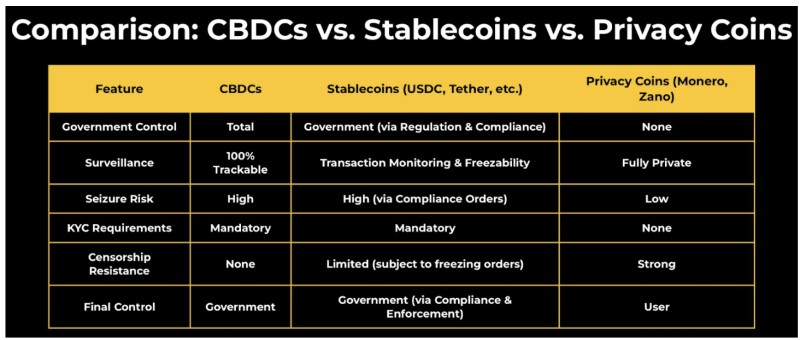
  • Monero (XMR): Uses ring signatures, stealth addresses, and confidential transactions to conceal sender, receiver, and amount
  • Zano (ZANO): Offers enhanced privacy with Confidential Layer technology that can extend privacy features to other cryptocurrencies

Programmable Money

Currency that contains embedded rules controlling how, when, where, and by whom it can be used. Examples already exist in:

  • Health Savings Accounts (HSAs) that restrict purchases to approved medical expenses
  • The Doconomy Mastercard that tracks and limits spending based on carbon footprint
  • Electronic Benefit Transfer (EBT) cards that restrict purchases to approved food items

Know Your Customer (KYC) / Anti-Money Laundering (AML)

Regulatory frameworks require financial institutions to verify customer identities and report suspicious transactions. While ostensibly aimed at preventing crime, these regulations have expanded to create comprehensive financial surveillance with minimal oversight.

Bank Secrecy Act (BSA) / Patriot Act

US laws mandate financial surveillance, eliminate transaction privacy, and grant government agencies broad powers to monitor financial activity without warrants. These laws form the legislative foundation of the current financial control system.

STABLE Act / GENIUS Act

Proposed legislation would restrict stablecoin issuance to banks and regulated entities, requiring comprehensive KYC/AML compliance and effectively bringing stablecoins under the same surveillance framework as traditional banking.

Understanding these terms is essential for recognizing how our existing financial system already functions as a mechanism of digital control, despite the absence of an officially designated “CBDC.”

The Digital Dollar Reality: America’s Unacknowledged CBDC

The greatest sleight of hand in modern finance isn’t cryptocurrency or complex derivatives—it’s convincing Americans they don’t already live under a Central Bank Digital Currency system. Let’s dismantle this illusion by examining how our current dollar already functions as a fully operational CBDC.

The Digital Foundation of Today’s Dollar

When most Americans picture money, they imagine physical cash changing hands. Yet this mental image is profoundly outdated—92% of all US currency exists solely as digital entries in databases, with no physical form whatsoever. The Federal Reserve, our central bank, doesn’t create most new money by printing bills; it generates it by adding numbers to an Oracle database.

This process begins when the government sells Treasury securities (IOUs) to the Federal Reserve. Where does the Fed get money to buy these securities? It simply adds digits to its database—creating money from nothing. The government then pays its bills through its account at the Fed, transferring these digital dollars to vendors, employees, and benefit recipients.

The Fed’s digital infrastructure processes over $4 trillion in transactions daily, all without a single physical dollar changing hands. This isn’t some small experimental system—it’s the backbone of our entire economy.

The Banking Extension

Commercial banks extend this digital system. When you deposit money, the bank records it in their Microsoft or Oracle database. Through fractional reserve banking, they then create additional digital money—up to 9 times your deposit—to loan to others. This multiplication happens entirely in databases, with no new physical currency involved.

Until recently, banks were required to keep 10% of deposits as reserves at the Federal Reserve. Covid-19 legislation removed even this minimal requirement, though most banks still maintain similar levels for operational reasons. The key point remains: the dollar predominantly exists as entries in a network of databases controlled by the Fed and commercial banks.

Already Programmable, Already Tracked

Those who fear a future CBDC’s ability to program and restrict money use miss a crucial reality: our current digital dollars already have these capabilities built in.

Consider these existing examples:

  • Health Savings Accounts (HSAs): These accounts restrict spending to approved medical expenses through merchant category codes (MCCs) programmed into the payment system. Try to buy non-medical items with HSA funds, and the transaction is automatically declined.
  • The Doconomy Mastercard: This credit card, co-sponsored by the United Nations through its Climate Action SDG, tracks users’ carbon footprints from purchases and can shut off access when a predetermined carbon limit is reached.
  • Electronic Benefit Transfer (EBT) cards: Government assistance programs already use programmable restrictions to control what recipients can purchase, automatically declining transactions for unauthorized products.

These aren’t theoretical capabilities—they’re operational today, using the exact same digital dollar infrastructure we already have.

Surveillance and Censorship: Present, Not Future

The surveillance apparatus for our digital dollars is equally established. The Bank Secrecy Act mandates that financial institutions report “suspicious” transactions, while the Patriot Act expanded these monitoring requirements dramatically. The IRS uses artificial intelligence to scrutinize spending patterns across millions of accounts, while the NSA bulk collects financial data through programs revealed by Edward Snowden.

This surveillance enables active censorship, as demonstrated during Canada’s trucker protests in 2022, when banks froze accounts of donors without judicial review. Similar account freezes have targeted individuals ranging from Kanye West to Dr. Joseph Mercola—all using the existing digital dollar system.

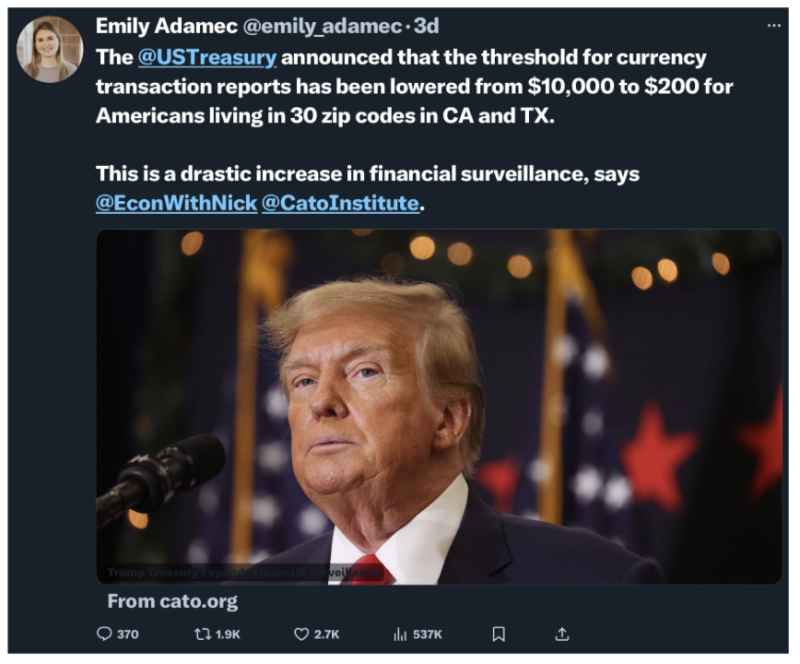
In March 2025, the Treasury intensified this framework, lowering the cash transaction reporting threshold from $10,000 to $200 across 30 ZIP codes near the southwest border, subjecting over a million Americans to heightened scrutiny under the guise of curbing illicit activity.

The Semantic Shell Game

When politicians and central bankers claim we don’t have a CBDC, they’re playing a game of definitions. The substantive elements that define a CBDC—digital creation, central bank issuance, programmability, surveillance, and censorship capability—are all present in our current system.

The debate over implementing a “new” CBDC is largely a distraction. We’re not discussing whether to create a digital dollar—we’re discussing whether to acknowledge the one we already have and how to modify its architecture to further enhance surveillance and control.

Understanding this reality is the first step toward recognizing that the battle for financial privacy and autonomy isn’t about stopping some future implementation—it’s about confronting and reforming a system already firmly in place.

The Weaponization of Financial Surveillance

The government justifies financial surveillance under the guise of fighting terrorism, money laundering, and organized crime, but the data tells a different story. Since the passage of the Bank Secrecy Act (BSA) in 1970 and the Patriot Act in 2001, the US government has accumulated trillions of financial records on ordinary Americans, yet these laws have failed to curb financial crime. Instead, they have been used to target political dissidents, seize assets without due process, and criminalize cash transactions.

  • The US Treasury admitted it cannot track $4.7 trillion in spending, yet demands compliance from individuals over transactions as small as $600.
  • The Financial Crimes Enforcement Network (FinCEN) has harvested billions of transaction records but has failed to demonstrate any meaningful reduction in financial crime.
  • Suspicious Activity Reports (SARs) are used to justify asset seizures without charges, while banks like JPMorgan and HSBC have laundered billions for drug cartels with no consequences.
  • The US Dollar remains the primary currency for terrorism, human trafficking, and war financing—yet the government wants to blame privacy coins.

These financial laws were never about stopping crime—they were about controlling the people. Meanwhile, the same government that demands total visibility over our money has lost track of trillions and even funneled taxpayer dollars directly to terrorist groups. If financial transparency is so important, perhaps the US Treasury should be the first to comply.

Defining the Real Threat: The Government’s Surveillance Machine

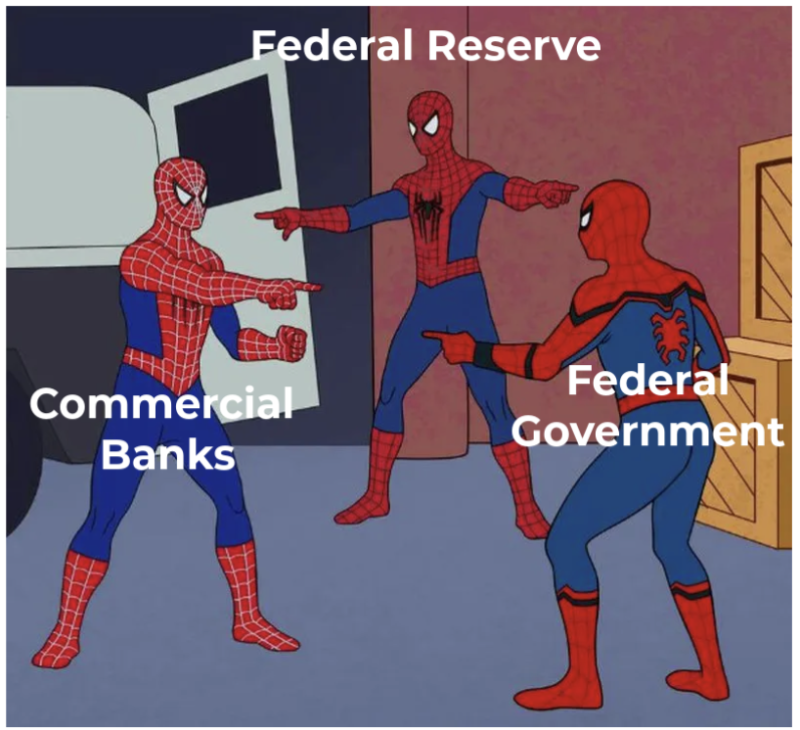
Before we delve deeper, let’s cut through the noise and define the true stakes—because the focus on banning a Central Bank Digital Currency (CBDC) and vilifying the Federal Reserve misses the bigger picture. President Trump and others have zeroed in on the Federal Reserve as the architect of digital tyranny, with a public blame game unfolding as the Fed, federal government, and commercial banks point fingers at each other like squabbling overlords.

But this distraction obscures the real enemy: a government surveillance apparatus that already tracks, programs, and censors our money, paving the way for digital tyranny—social credit systems, digital IDs, vaccine passports, and more. The Federal Reserve is just one cog; the government’s machinery, backed by the banks that own the Fed, is the true enforcer.

The End Goal: Digitizing Everything

My two-year crusade against Central Bank Digital Currencies (CBDCs) stems from a chilling realization: the endgame isn’t just controlling our money—it’s digitizing all our assets—money, stocks, bonds, real estate, and more—under a global ledger with the same tracking and programmability as CBDCs.

As I detail in my book The Final Countdown, this vision involves CBDCs paired with Regulated Liability Networks (RLNs), systems designed to tokenize every financial instrument—stocks, bonds, and beyond—settling only in CBDCs. Countries like the US, those in Europe, the UK, and Japan are developing their own RLNs, engineered to interoperate, creating a seamless global ledger. The ultimate aim, rooted in the technocracy movement since the 1930s, is a single digital currency backed by energy credits, tying our wealth to resource consumption and a social credit system.

This isn’t speculation—it’s a deliberate blueprint. RLNs enable central banks and governments to monitor and program every asset, ensuring compliance with policies like carbon limits or social scores. The technocracy movement, founded by figures like Howard Scott in the 1930s, envisioned energy as the basis of economic value, a concept now resurfacing in digital form. This global ledger threatens to erase ownership and freedom, a reality already taking shape as governments and banks tighten their grip. This sets the stage to uncover how the US government’s surveillance machine, already in motion, accelerates this dystopian future.

The Government’s Surveillance Arsenal

The US government has perfected financial surveillance long before any CBDC label was applied, as I detailed in my Brownstone Institute article “Fifty Shades of Central Bank Tyranny.” The National Security Agency (NSA) bulk collects financial data on domestic and international transactions, a revelation from Edward Snowden exposing its access to phone calls, internet communications, and undersea cable intercepts—turning your bank account into a government peephole.

The IRS, wielding artificial intelligence, scrutinizes spending patterns with chilling precision, as seen in Rebecca Brown’s 2015 case, where $91,800 was seized via civil asset forfeiture for no crime, or the IRS’s recent mandate forcing Venmo and PayPal to report transactions over $600, ensnaring even the smallest earners. These AI tools transform every purchase into a potential target for government scrutiny.

The Patriot Act amplifies this overreach, authorizing warrantless wiretapping and data collection, while National Security Letters (NSLs)—like the one silencing Nick Merrill in 2004, gagging him from consulting a lawyer about FBI demands—ensure silence under threat of law. The Bank Secrecy Act compels banks to report “suspicious” activity, fueling Operation Chokepoint 2.0, where commercial banks like JPMorgan Chase and Bank of America froze accounts of dissenters—Kanye West, Melania and Barron Trump, Dr. Joseph Mercola—often exceeding federal directives. Congress, not the Fed, drives this surveillance juggernaut, embedding it through bipartisan laws like the Patriot Act, Bank Secrecy Act, CARES Act, and the addition of 87,000 armed IRS agents poised to audit the average citizen.

A Distinction Without a Difference

Focusing solely on the Federal Reserve as the villain is a distinction without a difference. The Fed, a private entity veiled in secrecy, is owned by the largest commercial banks—JPMorgan Chase, Citibank, and others—forming a cartel that profits from the system, as G. Edward Griffin’s The Creature from Jekyll Island exposes. Its digital money creation feeds these banks, which multiply it through fractional reserves. Eliminating the Fed and letting the government issue currency directly, as Senator Ron Wyden advocates—a stance I challenged at a conference where he opposed CBDCs but endorsed government control—wouldn’t end surveillance; it would intensify it. Wyden’s vision centralizes power further, removing the Fed’s buffer and amplifying government oversight with no accountability.

The real threat lies in the system’s design: digital money is already tracked and censored by government decree. Whether it’s the Fed’s Oracle databases or banks’ Microsoft systems, the infrastructure is programmable, enabling control without new laws—just new rules, crafted daily in backrooms. This surveillance machine, not the Fed alone, drives us toward a dystopian future where every transaction fuels tyranny. With this system already entrenched in the US, the global race for CBDCs—and the US’s pivot to stablecoins under the STABLE and GENIUS Acts—only accelerates the spread of this control, amplifying the threat both abroad and at home. We must confront this escalating reality head-on to grasp the full scope of the battle for our financial freedom.

Global CBDC Development Accelerates Despite Trump’s Ban

Even with President Trump’s Executive Order (EO) 14178, signed on January 23, 2025, banning the Federal Reserve and other US agencies from pursuing a Central Bank Digital Currency (CBDC), the global race to develop CBDCs has not slowed down—it’s actually speeding up. Before the EO, 134 countries and currency unions, representing 98% of global GDP, were actively exploring CBDCs, according to the Atlantic Council’s Central Bank Digital Currency Tracker. With the US stepping back from explicit CBDC work, that number drops to 133 countries.

The US accounts for approximately 26% of global GDP (based on 2024 World Bank estimates of a $105 trillion global GDP, with the US contributing $27 trillion). Subtracting the US share, the remaining 133 countries still represent about 72% of global GDP—a massive portion of the world economy—continuing their CBDC efforts. Meanwhile, the US has shifted its focus to a backdoor approach through stablecoins, empowering commercial banks and the Federal Reserve to extend digital control at the expense of privacy and decentralized finance (DeFi).

The US pivot isn’t just about stablecoins like Tether and USDC—it’s a broader strategy codified in two legislative proposals: the STABLE Act (House, February 6, 2025) and the GENIUS Act (Senate, February 4, 2025). These bills restrict stablecoin issuance to insured depository institutions, federal nonbanks, and state-regulated entities, effectively handing the reins to big banks like JPMorgan Chase and the Federal Reserve’s network of member banks.

The STABLE Act bans unauthorized issuers, while the GENIUS Act prohibits unapproved payment stablecoins, ensuring only the financial elite can play. Both mandate strict Know Your Customer (KYC) and Anti-Money Laundering (AML) requirements, turning every transaction into a surveillance opportunity. Algorithmic stablecoins used in DeFi platforms, which thrive on anonymity and decentralization, are effectively sidelined, as banks and the Fed tighten their grip on the digital dollar ecosystem. This isn’t innovation—it’s a power grab, cloaked as financial stability.

The pace of global CBDC development remains striking. In May 2020, only 35 countries were exploring CBDCs. By early 2025, that number had ballooned to 134 before the US exit, with 65 in advanced stages—development, pilot, or launch. Every G20 country except the US is now involved, with 19 in advanced stages and 13 running pilots, including Brazil, Japan, India, Australia, Russia, and Turkey. Three countries—the Bahamas, Jamaica, and Nigeria—have fully launched retail CBDCs, and 44 pilots are ongoing worldwide. This momentum persists despite Trump’s ban, as other nations see CBDCs as a way to modernize payments, enhance financial inclusion, and compete geopolitically, especially with China’s digital yuan (e-CNY) pilot, the largest globally, reaching 260 million people.

Recent developments underscore this acceleration. In Israel, the Bank of Israel released a 110-page design document in early March 2025, detailing plans for a Digital Shekel. This follows years of research and aligns with Israel’s participation in a 2022 project with the Bank for International Settlements to test international retail and remittance payments using CBDCs. The Digital Shekel aims to improve transaction efficiency and financial access across its tech-savvy population, marking a significant step toward implementation.

In the European Union, the European Central Bank (ECB) is pressing forward with its digital euro, targeting a rollout by October 2025. ECB President Christine Lagarde has been vocal about this timeline, stating in a recent address, “We are on track to introduce the digital euro by October this year, offering a secure and programmable complement to cash that ensures financial inclusion while maintaining privacy standards.” This follows the ECB’s October 2023 decision to enter the preparation phase for a digital retail euro, with a focus on both retail and wholesale applications. The EU’s push reflects a broader European trend, with countries like Sweden and the UK also advancing CBDC pilots, aiming to reduce reliance on US-dominated payment networks like Visa and Mastercard.

Across the Atlantic, Canada’s new Prime Minister, Mark Carney, who assumed office in March 2025, brings a pro-CBDC stance to the table. Carney, a former Governor of the Bank of England from 2013 to 2020, has long advocated for digital currencies as a tool for financial innovation. During his tenure at the Bank of England, he oversaw early CBDC research, including the July 2019 CBDC Technology Forum, which laid the groundwork for the digital pound.

Carney’s alignment with the World Economic Forum (WEF), where he has been a prominent figure pushing for sustainable finance and digital transformation, further underscores his support for CBDCs. The WEF has been a strong advocate for CBDCs, hosting roundtables through 2023 to promote interoperable designs. Under Carney’s leadership, Canada is likely to accelerate its CBDC efforts, building on the Bank of Canada’s 2023 analytical note emphasizing offline payment functionality—a move that could deepen digital control over Canadian finances.

Despite Trump’s EO, the global CBDC train is charging ahead, with the US taking a detour through stablecoins that empower banks and the Fed while stifling privacy and DeFi. The Digital Shekel, the EU’s October rollout, and Canada’s new leadership under Carney show that the world isn’t waiting for the US to catch up—it’s forging a digital future where control, not freedom, may be the ultimate prize.

Stablecoin Legislation: Backdoor CBDCs by Design

to read the rest of the artile, go to:    https://brownstone.org/articles/the-stablecoin-trap-the-backdoor-to-total-financial-control/

What’s up With The Weather?

(Before going to the article, I will urge that everyone pray for the Earth, pray for the people in North Carolina and Tennesee, and pray for our country that good and right may prevail and that the evil doers be shown for what they are and removed from their positions.)ci

How to Steer Hurricanes, Flood Homes, and Steal Lithium

The lithium rich mines in North Carolina and the thieves who occupy government

We have had the technology to create, control, and steer hurricanes for decades.

“Project Cirrus is the first Official attempt to modify a hurricane. It was run by General Electric with the support of the US military. The official theory was that by changing the temperature outside the eye-wall of a hurricane, which they did by seeding the clouds with various compounds such as silver iodide, a decrease in strong winds will result. 

On October 13, 1947, Project Cirrus targeted a hurricane heading out to sea. Approximately 180 pounds of dry ice was dropped into the clouds. The crew then reported a "pronounced modification of the cloud deck". And the hurricane abruptly changed direction and made landfall near Savannah, Georgia. The public blamed the government.

Irving Langmuir, who pioneered General Electric’s atmospheric research department, and admired that the project was about learning how to weaponize the weather, also claimed the reversal of the hurricane had been caused by the project, but the government denied it for twelve years.

After a short delay, the project officially continued. And in 1965, Project Stormfury had targeted Hurricane Betsy for seeding. On that day the storm immediately changed direction and made landfall in Southern Florida. Congress blamed it on Project Stormfury but the government claimed that the hurricane changed direction before they ever had a chance to seed it. And after two months of Congressional hearings, the project was allowed to continue.”

~ Reese Report “Weather Weaponization and Hurricane Ian”

In 1997, U.S. Defense Secretary William Cohen admitted we have the technology to control the weather, including earthquakes and volcanoes. The U.S. government has placed gag orders on employees of the national weather service.

In October of 2012, after Hurricane Sandy weakened to a tropical storm, microwave imagery shows a thick red beam immediately followed by Sandy growing into a category 1 hurricane and taking an unexplained “left Turn” into New Jersey.

The push towards alternative energy demands more lithium. And according to the U.S. Geological Survey, the United States has over 6 million tons of identified lithium resources. The majority of this lithium has been identified in Kings Mountain, North Carolina. Kings Mountain is believed to have one of the largest resources in the world. But the biggest problem is that people live there. And they don’t want their quiet towns turned into lithium mines.

“People in Cherryville have been pushing against a proposed lithium mine for the last several years, but everyone we spoke with here said it's too divisive of an issue to share their opinion on camera. Cherryville is a small, quiet town.”
~ Local news reporter

“I think it's good that we keep it small.”
~ Anonymous resident

“So quiet, many don't feel comfortable speaking out against Piedmont Lithium's proposed mining operation nearby.”
~ Local news reporter

“I think we're a silent majority. I think a lot of people are afraid to say anything about it because they are bringing a lot to the town as far as money.”
~ Anonymous resident

Last year, the Department of Defense entered a ninety-million-dollar agreement with Albemarle Corporation to increase domestic production of lithium for the nation’s battery supply chain. Specifically, from Kings Mountain, North Carolina starting by 2025.

This is the same area experiencing what is being described as biblical floods.

While the Federal government spends billions on foreign wars and illegal immigrants, they simply can not be bothered with the health and well-being of the American people. Especially those living on coveted mineral rich land.

Check out the link for the 5 minute video:    https://gregreese.substack.com/p/how-to-steer-hurricanes-flood-homes

Let’s Protect Our Kids

6 ‘Noncompliance’ Strategies for Protecting Kids and Teens in 2023

Since 2020, parents have had to contend with increasingly brazen efforts by governments, schools, foundations, Big Tech, Big Pharma and others to hijack, injure or destroy children’s minds and bodies. Here are some strategies for parents to help kids resist the pressure to comply.

Miss a day, miss a lot. Subscribe to The Defender’s Top News of the DayIt’s free.

Since 2020, parents have had to contend with increasingly brazen efforts by governmentsschoolsfoundationsBig TechBig Pharma and others to hijack, injure or destroy children’s minds and bodies.

Far from being piecemeal or merely opportunistic responses to a convenient “pandemic,” these assaults on children — and adults, too — reflect a well-financed, long-term control agenda aimed at implementation of digital identities, social scoring and “full monitoring and tracking of every human being through … mechanisms already in place.”

At the “Defeat the Mandates” rally in January 2022, Children’s Health Defense Chairman and Chief Litigation Counsel Robert F. Kennedy, Jr., asserted, “Nobody in the history of the planet has ever complied their way out of totalitarian control” and reminded the public, “Every time you comply, you get weaker.”

Kennedy also warned, “they’re coming for our children.”

As if in confirmation, infantskindergartners and college students were badgered throughout the year to get — and then suffered atrocious damage from — COVID-19 shots, despite overwhelming evidence that the jabs urgently needed to be withdrawn from the market.

Clued in to these and other dangers crowding around their children, a growing number of parents recognized the need for noncompliance.

Keeping noncompliance as the watchword for 2023, here are some actions that could make a real difference in the coming year.

Choose home schooling

In a nine-part series written earlier this year, journalist Corey Lynn of Corey’s Digs described comprehensive social engineering efforts — “obedience training” — rolling out in coordinated fashion in 110 countries, in part via school-based “Social and Emotional Learning” programs.

Implemented by educators, counselors and other professionals in “public schools, charter schools, after-school programs, summer camps, virtual schools and remote schooling,” the goal is, according to Lynn, “shaping minds, regulating emotions, controlling behaviors, instilling twisted beliefs, and building an obedient workforce.”

As Anna L. Noble put it in an April 2022 article in The Defender, “Schools provide a useful testing ground to experiment with ways to hold the attention of children, develop nudges, and elicit desirable behavioral responses.”

Scathing education whistleblower Charlotte Thomson Iserbyt, a now-deceased former senior policy advisor for the U.S. Department of Education, decried the “deliberate dumbing down of America” and traced the education system’s shift “from academics to behavioral modification” back to at least 1965.

Iserbyt observed that the Department of Education did not exist prior to its 1979 creation under the Carter Administration, stating, “There is nowhere in the constitution that calls for a Department of Education.”

Even private schools, under the thumb of the agenda-driven National Association of Independent Schools, appear to have lost any vestiges of “independence,” with enrollment contracts reportedly prohibiting parents “from ‘[voicing] strong disagreement’ with school policy or curricula, under threat of expulsion.”

Instead of continuing to expect something different from an “abusive” educational system, Lynn suggests that home schooling can be a powerful form of noncompliance.

Many parents apparently agree — responding to schools’ disastrous imposition of measures like remote learning and masking in 2020, a record number of households turned to home schooling.

Prior to COVID-19, roughly 3.4% of school-age children were home-schoolers, but by the start of the 2020-2021 school year, the U.S. Census Bureau’s estimate had risen to 11.1%.

Home schooling is now the fastest-growing form of education in the U.S.

Stop the poisoning

Earlier this month, more than a third of parents surveyed (35%) — up from less than one-fourth (23%) in 2019 — questioned school vaccine mandates,

And this was only the latest in a string of reports addressing rising parental ambivalence about “routine” childhood vaccines.

These trends suggest that a critical mass of parents is coming to see vaccines as a “con man trick,” understanding that promises of vaccine safety were false and conflict-of-interest-riddled well before COVID-19 shots came along — and in fact, since the very inception of childhood vaccination programs.

The world’s vaccine experts conceded this point in a roundabout manner at a World Health Organization Global Vaccine Safety Summit in late 2019, as did Danish researcher and long-time vaccine insider Christine Stabell Benn at around the same time.

Benn commented, “Vaccination opponents are justified in being concerned [about safety],” adding:

“No vaccines have been studied for their non-specific effects on overall health, and before we have examined these, we cannot actually determine that the vaccines are safe.”

Benn’s colleague Peter Aaby admitted, also in 2019, “Most of you think that we know what all our vaccines are doing; we don’t.”

In mid-2021, Benn and Aaby cautiously argued against COVID-19 shots for children in the high-status BMJ scientific journal.

Given the shocking odds of vaccine injury that already prevailed prior to COVID-19 — conservatively estimated in a 2010 government-commissioned report at one in every 39 vaccines administered — it is not surprising that the carnage from COVID-19 jabs would now be swelling the ranks of questioners and “ex-vaxxers.”

However, vaccination — even with its payload of known and undisclosed toxic ingredients and apparent batch-to-batch variability — is far from the only vehicle for poisoning our most vulnerable.

Parents willing to do their own research and forge their family’s own nutritional and healthcare path will find that it may be within their reach to lessen, if not entirely eliminate, their children’s exposure to other common poisons such as food additivesglyphosateorganochlorine and organophosphate pesticides and over-the-counter drugs like acetaminophen, all of which come with vastly underreported dangers.

Reduce screen time

In 2006, author Richard Louv coined the term “nature-deficit disorder” in the subtitle to his book “Last Child in the Woods,” suggesting that today’s “wired generation,” with parents’ conscious or unconscious permission, has unwisely prioritized screens over time in nature.

With the worsening of children’s screen habits over the past several years, the nature deficit has become a “hot topic.”

Worried researchers also describe how screens are displacing “developmentally beneficial activities” as basic as sleep, physical activity, family interactions and book reading.

The related problem of screen or social media addiction — linked not just to sleeplessness but to eating disorders and outcomes like suicide — has become the focus of lawsuits alleging that social media companies “aggressively” deploy algorithms designed to addict children and adolescents.

Discovering the major role that “social influencers” seem to play in the exploding phenomenon of “rapid onset gender dysphoria” among girls, author Abigail Shrier’s top recommendation in her book, “Irreversible Damage: The Transgender Craze Seducing Our Daughters,” is to not give one’s daughter a smartphone.

As “Financial Rebellion” and the Solari Report’s Catherine Austin Fitts explains, “Children are targets of some of the most powerful people and dangerous technology on the planet,” and it is parents’ job to “understand this and protect them.”

Teach kids to use cash, not plastic

In late 2020, Bank for International Settlements General Manager Augustín Carstens shared central bankers’ unfriendly vision of a monetary system enabling complete control of all transactions through central bank digital currencies (CBDCs) which, ominously, would also allow central banks to turn people’s money on and off at will.

Unfortunately, the younger generations are marching heedlessly toward this dystopian vision, with millennials, according to 2021 research by Capital One, “increasingly moving away from cash spending” in favor of digital payment systems.

Pushing a “convenience” narrative, some banks — seemingly unaware that CBDCs threaten their own future — are promoting the cashless agenda by offering high school debit cards that double as school ID cards, telling parents they’ll no longer have to “worry about lost lunch money.”

Fitts is a strong proponent of revitalizing the use of cash.

Parents can help by not only being cash role models themselves but by having their children “start handling cash when they are young.”

In 2015, Editor-at-Large Janet Bodnar of Kiplinger’s Personal Finance opined that “using cash is the best way to get young minds thinking wisely about money,” including older teens who can benefit from “the discipline of managing a stash of real cash.”

Bodnar dismissed as flawed the parental argument that plastic can teach kids “financial responsibility.”

A British math expert told The Guardian in 2021, “Being able to handle money and buy something yourself is very special: it builds up your confidence with money.”

Don’t fall for mental health traps 

Over the years, many parents have learned to be wary of recommendations coming from the Centers for Disease Control and Prevention (CDC), an agency so accustomed to conflicts of interest and fake science that it is not embarrassed to use the same PR firm as Big Pharma.

Thus, calls for more mental health screening and greater access to “care” — from birth through young adulthood — by CDC and CDC/pharma front groups like the American

Academy of Pediatrics deserve careful scrutiny.

As recently outlined in The Defender, cradle-to-grave psychiatric surveillance is a stealth tool for social control, and also risks stigmatizing and potentially life-threatening consequences like overdiagnosis, overmedicalization and overmedication.

Schools increasingly serve as the delivery mechanism for mental health screening and services, but as the Los-Angeles-based Citizens Commission on Human Rights (CCHR) — a mental health watchdog group — warned in a fact sheet, the “subjective and unscientific” mental health screening tools that schools are using are “developed by psychiatrists predominantly with financial ties to the pharmaceutical industry.”

According to CCHR:

“Mental health screening asks young students embarrassing, personal and potentially upsetting questions that psychiatrists have worded in such a way that no student could escape being labeled mentally ill at some point during their education.”

CCHR adds, “These questionnaires can result in psychological or psychiatric intervention in the lives of a child and his or her family — often against their will or under threat.”

For households that are not home schooling, the watchdog group recommends that parents become aware of what is happening, sign exemption forms prior to mental health screening or counseling and “unite to get psychiatric screening expelled from schools.”

Stop financing the enemy

Author and researcher Dr. Naomi Wolf recently braved the cold in front of her alma mater Yale University to make the case that the university’s COVID-19 vaccine mandates turn students into “medical hostages” and constitute human trafficking.

In her Substack account of the Yale visit, Wolf described conversations with parents, who said “their children had begged them not to speak out, not to call the Dean, not to advocate for them to protect them from these injections, in any way,” due to the fear of reprisal and expulsion.

However, parents have a duty to make sure their young people understand what they are trading off for prestige — including, potentially, their health, their future fertility or their life.

Moreover, even if, as Wolf alleges, universities are now more beholden to government contracts than to those who pay tuition, college students and their parents still represent a powerful economic bloc capable of voting with their feet.

One tool at parents’ disposal, suggests Wolf, is to escrow potential donations to show universities the funds they are missing out on.

But parents who give their current or soon-to-be college students the permission and courage to shun any higher education institution that shows itself willing to poison them and deprive them of their constitutional freedoms can offer their children an even more powerful life lesson.

A high school student who recognized that “mandates will not end as long as we participate” developed a letter for college admissions offices (available as a template for others) that says:

“At this time, I’m only considering schools, colleges or universities that do not require a Covid-19 vaccine and that would mean the initial series, any boosters and including upcoming requirements to be considered ‘up to date.’ Medical freedom and body autonomy are my highest priority.”

Say no to the control grid

Although this article has focused on measures to protect young people, the control grid — in the form of interventions like digital IDsvaccine passports and CBDCs — is also coming after adults.

As Kennedy wrote in the afterword to his bestseller, “The Real Anthony Fauci,” “We can bow down and comply … Or we can say no. We have a choice, and it is not too late.”

CHD.TV’s “Financial Rebellion” offers weekly suggestions on how to not comply.

In Kennedy’s words:

“We can say no to compliance with jabs for work, no to sending children to school with forced testing and masking, no to censored social media platforms, no to buying products from the companies bankrupting and seeking to control us. These actions are not easy, but living with the consequence of inaction would be far harder. By calling on our moral courage, we can stop this march towards a global police state.”

from:    https://childrenshealthdefense.org/defender/protecting-kids-teens-noncompliance/