Your Color Vibe for Friday, 5/15

Friday, May 15:   Otter Brown

Things are going to be moving along at quite a rapid pace today, so get ready. If there is something that you wish to hold onto, that you wish to review, that you want to see again, you are not going to have that opportunity right now. That means that you are going to have to pay attention to things that are said and done because there is more there than meets the eye. This is a day of hints. Things will not be put out in the open, rather they will be hinted at, alluded to, implied. If you want to know more, you will have to dig deeper on your own. This is a good day to keep your sense opened and to be aware of things that resonate. There are things coming your way soon that are being hinted at right now.

Your Color Vibe for Thursday, 5/14

Thursday, May 14:   Grey

Beware the Guru who talks too much! This is a day when there are going to be a lot of people saying a lot of things. There are many agendas in the air right now, and people are trying to set up their teams. You know who your team is. Your team is composed of the propel you love and trust, those who have a history of being there for you, those who can make you smile when you are feeling glum. There are things out in the energetic field today that are trying to distort the truth that you know so deeply. This is a day for grounding and centering, for being within your truth, and for discernment from the deep recesses of your own wise heart center.

Your Color Vibe for Tuesday, May 12

Tuesday, May !2:   Lilac Pink

Today is a day for stepping back, getting away, going within. This does not mean that you are not to engage with the outside world, rather it means that in dealing with things outside of self, you work from within self. This will bring you a whole new way of looking at things. Interestingly, when you are within, your deep compassion brings you to a place of understanding those people and things that otherwise would just frustrate and annoy you. And that is pretty great news! These times call for knowing WHO you are and working from your heart, working with your intuition, and allowing things to just to be. Today gives you a short initiation, a taste of what that can mean.

Ah, Doggies!

Why People Love Their Dogs So Much, According to Science

DOGS

By MaryAnn Barone

Whether it’s during a run through the park or after offering a treat, there’s no feeling like looking at your pet adoringly and getting a loving stare right back.

You don’t have to tell dog lovers the feeling is both mutual (and very real), but a new study published in the journal Science reveals the fascinating reason why we feel so close to our furry companions: When humans and dogs look into each other’s eyes, both get a boost of the feel-good hormone oxytocin, which is the same hormone behind the special bond between new parents and their babies.

To reach their results, researchers had 30 dog-and-human pairs come into a lab to look in each other’s eyes and give urine samples. Oxytocin concentrations were then measured in the human and animal samples. In the end, the dogs had a 130 percent rise in oxytocin levels, and owners showed a 300 percent increase, regardless of gender.

Your pets do a lot more than just make you feel happiness and love: They can also help lower your cholesterol, relieve stress, and boost your self-esteem.

If this has finally convinced you it’s time to get a dog, do your research. Learn about active or hypoallergenic breeds, and don’t forget about the many shelter pets in need of homes!

Already have a dog? Now that it’s spring, get ready to hit the trails, beach, or sidewalk with your four-legged friend. Staying in shape is good for the both of you.

Why People Love Their Dogs So Much, According To Science originally appeared on Health.com.

from:    http://www.huffingtonpost.com/2015/05/12/why-people-love-their-dog_n_7204984.html?utm_hp_ref=gps-for-the-soul&ir=GPS+for+the+Soul

On Knowing the Self

Self Recognition: Tuning In to the Inner Guidance of Your Body


The following is excerpted from In Touch: How to Tune into the Inner Guidance of Your Body and Trust YourselfPublished by Sounds True, April 2015.

Self-recognition
We cannot understand, love, and welcome others without first knowing and loving ourselves. –Jean Klein

Our body’s deep sensitivity is calling us home. Yet home is not somewhere, some when, or something other than what is already wholly present now. Our true nature is not some inner state that will be found in the future. It is always here and now, unbounded by space or time. It can never be objectified. Further, the heart of the one who is looking—the apparent separate self—is what is being looked for. Nisargadatta Maharaj said it most succinctly: “The seeker is the sought.”

This wisdom teaching is very puzzling for the linear mind that thinks in terms of someone attaining something. A student of the Indian sage Ramana Maharshi once asked for help to find his true nature. “You are like a man standing in his living room, asking how to get home,” Ramana replied. We are already home—we just don’t realize it. Infinite awareness is shining through your eyes as you read this—you are not who you think you are. Take a moment to open to this possibility.

Our body’s inner knowing is pointing us toward this self-recognition. Certainly being relaxed, grounded, aligned, spacious, and openhearted makes day-to-day living much easier, but there is a deeper invitation at work within each of us—to wake up. Self-recognition and awakening are different ways of describing the same thing. At some point we realize that we are not the limited being that we consciously and subconsciously take ourselves to be. We see that none of our stories and images about ourselves are actually true. This initial recognition can feel as if the clouds have briefly parted, revealing a vast, open space.

When this happens, the veil of personal identity temporarily lifts, and we know ourselves as open, awake awareness. We are in touch with our natural lucidity. In rare instances this awakeness is sustained after the first contact. In most cases, however, the conditioned bodymind reasserts itself, and there is a return to one’s familiar identity. Yet a taste of this homecoming remains. It is like someone who briefly awakens from a dream and then falls asleep again; the wakefulness is never completely forgotten. It continues to vibrate on the periphery of the dream, in the background of who we imagine ourselves to be. Our lives start to reorient around this clearer sense of who we really are.

As a result, we may begin to slow down and start paying attention to our actual experience. We may tune in to the sensations of our body or start to notice moments of silence between thoughts. We may question our limiting beliefs and emotional reactions and become interested in the process of how we bind and blind ourselves. Or, as Adyashanti puts it, we become interested in “the pitfalls and cul-de-sacs that un-enlighten us along the journey.”

“How do I unenlighten myself?” is a subtly different question from “How do I awaken?” The former presumes that we are obscuring a natural wakefulness that is already here. Rather than wondering how we get there, we can inquire, “Is it true that what I seek is not already here?” I invite you to sit with these questions and feel what they evoke. Something in you will respond if you don’t go to your thinking mind for an answer.

Awakening does not come from moving forward, but from falling back. It is a letting go into the unknown. In Zen it is called “the backward step.” We start to track our experience backward. For instance, you can evoke the sense of “I am” and then follow it back to its source—a classic form of self-inquiry. What happens if you focus your attention on the thought “I am”? Can you sense where and how it localizes in your body? If you follow it inward, where does it draw your attention? Or you can feel the deep yearning of the heart to come home and follow that yearning back. These kinds of intuitive inquiries
lead us out of the certitude of the conditioned mind into the unfamiliar territory of “I don’t know.”

The mind may think that “I don’t know” is the wrong answer to the question “Who or what am I?” Yet, in fact, “I don’t know” is the most accurate and honest answer. When we deeply investigate all of our placeholder identities, such as being a man or a woman, an American or a German, a white, a brown, or a black, a hetero- or homosexual, they fall to the side like name tags scattered on the floor at the end of a convention. The simple truth is that we actually don’t know who we are. Gradually we learn to relax into this not knowing. As Jean Klein once told me during a private interview, “Abide in the heart, not knowing.”

At some point, having made ourselves available, we are taken by grace. This taking may be sudden and clearly recognizable or slow and barely noticed—a waterfall or a broad river gently meeting the ocean. Whether sudden or gradual, there is a gravitational shift of identity from form to formless, from being someone to being no one, from being an object bounded by time and space to being open, awake, and infinite awareness. There is clarity, with no one left to claim it as his or her own. It marks the beginning of a new chapter of life.

to read more of this article, go to:    http://realitysandwich.com/315005/self-recognition-tuning-in-to-the-inner-guidance-of-your-body/

Another Huge Quake in Nepal

New massive further damaging earthquake in the Dolakha area, Nepal – 59 dead currently

Last update: May 12, 2015 at 2:58 pm by By
Contributors: Armand Vervaeck, James Daniell, Jens-Udo Skapski

For our main NEPAL article : Click here

  Update 14:20 UTC:   41 are dead in Nepal but counting will take a number of days. 1115 injured.

Update 13:20 UTC: Good news! The death toll has reduced to 37 in Nepal.

Lalitpur 1; Sunsari 1; Sindhupalchok 5; Dolakha 19; Unknown 1; Sarlahi 1; Sindhuli 2; Rautahat 1; Ramechhap 1; Gorkha 1 – 37 deaths in Nepal.

Update 12:55 UTC: Landslides are blocking roads to Dolakha which unfortunately means that the worst of the damage is yet to be realised.

We are hopeful that more people were outside than calculated. If 85% were outside at the time near the epicenter, the expected death toll is closer to 200.

Update 12:40 UTC:  Landslides on the (Sidhartha, Koshi, Arniko) Highways are in many places. Landslides have occurred in:-
Rasuwa – Mailung
Dolakha – Singati
Dhankuta – Karkichhap
Syanja – Bhalupahad
Ramechhap – Lakhanpur

Update 12:15 UTC : 16 are reported dead in Bihar, with at least 21 injuries.

Update 12:05 UTC :
Sindhupalchok – 9 deaths; Dolakha – 19 deaths; Kathmandu – 4 deaths; Lalitpur – 1 death; Sindhuli – 2 deaths; Sunsari – 1 death; Rautahat – 1 death; Sarlahi – 1 death; Dhanusha – 1 death; Ramechhap – 3 deaths = 42 deaths in Nepal.

This follows the following distribution. We hope that given that the earthquake occurred around 1pm, that many more people were outside, and that the death toll will not reach 500.

Update 11:55 UTC :  The Indian injuries have been confirmed: 16 in Bihar, 8 in West Bengal. “Several” in UP. 25 are said to be buried under a collapsed building also in Bihar.

Update 11:25 UTC :  Injured so far: Kathmandu 357, Bhaktapur 187, Lalitpur 174 – in total 1117 injured.

There have been 12 “live rescues””, 9 in Dolakha and 3 in Kathmandu.

Update 11:15 UTC : 51 dead : 36 Nepal, 14 India and 1 in China. 1132 injuries.

Update 10:54 UTC : This earthquake is a new event, and has its own aftershock sequence. This is the sequence so far as mapped out by Andreas Schaefer, CEDIM.

A map of the aftershocks of the M7.3 mainshock earthquake of today.

Update 10:45 UTC : The time of day was again lucky for the Nepalese, with many people being outside of their houses. We hope that a lot more than 40% were out of their houses!

Update 10:45 UTC : At least 16 have died in Nepal, and 335 are reported injured so far. Chautara – 2 have at least died. 8 have died in Dolakha (this may mean that Bhaktapur was wrong information. 2 have died in Sindhuli.

Update 10:42 UTC : At least 4 people have died in Bihar, India. 4 people have died in Chautara, Sindhupalchok, and 8 in Bhaktapur. More information is expected from Dolakha soon.

Update 10:30 UTC : The likely fatalities from the CATDAT model unfortunately from this cruel triggered event seem to be around the expected 250-600 mark depending on how many people were in their houses. It should be noted that these are median estimates, and that only the distribution should be looked at. Based on historical sequences, this triggered event was quite likely. Most fatalities are expected in Dolakha and Sindhupalchok.

Likely fatality distribution from the model of Dr. James Daniell

Information is quite slow to surface due to the shock and recovery that was going on at the time of the event.

Update 10:10 UTC : Many rockfalls and landslides have occurred.

Update 09:40 UTC : This triggered earthquake has caused much damage throughout Dolakha.

Update 09:30 UTC : Much damage is expected in Dolakha. 4 have been killed in Bihar.

Update 09:20 UTC : Updated CATDAT fatality estimate using 40% occupancy: median 580 fatalities with a range from 125-2000. The economic losses have reduced to 250-1200 million with $550 million coming from additional damage. This is with removing the previous losses from the M7.8 earthquake. This does not include the potential extra landslide deaths and losses!

Update 09:15 UTC : 8 dead in Bhaktapur.

Update 09:10 UTC : Of the fatalities through the theoretical model, most are expected in Sindhupalchok (+100), Dolakha (+170), Dhanusa, and a few in Kavrepalanchok.

Lalitpur, Bhaktapur, Kathmandu are expected to have additional damage.

Chautara has reported 4 fatalities and a number of collapsed buildings.

Update 09:05 UTC :

Please stay in open field, help us make free road, do not make phone nw busy. SMS is suggested.

Update 08:55 UTC : From the CATDAT Model:

“The key issue with this triggered earthquake is that there will be much damage on both sides of the border and there is very little data historically. Taking the intensities into account as well as a very different occupancy ratio, it is likely that there will be 50-815 fatalities with a median of 200 additional fatalities. This is using a 10% occupancy ratio in affected communities.

In addition to the damage caused by the first quake, we are calculating an additional 300-1400 million USD damage caused by this earthquake with a median of 600 (620) million USD. There are many uncertainties at this point in terms of all losses, so this will be updated in the coming hours.”

Update 08:38 UTC : There will be significant damage from this earthquake, in already damaged locations. Sindhupalchok, was already hard hit from the earthquake, with most people living outside.

Update 07:38 UTC : Below the shaking maps as published by USGS

Screen Shot 2015-05-12 at 09.37.09 Screen Shot 2015-05-12 at 09.36.56 Screen Shot 2015-05-12 at 09.36.39

Update 07:25 UTC : This earthquake or aftershock will certainly cause new fatalities and even a lot more damage

Screen Shot 2015-05-12 at 09.26.13

22km (14mi) SE of Zham, China
66km (41mi) ENE of Banepa, Nepal
69km (43mi) ENE of Panaoti, Nepal
83km (52mi) E of Kathmandu, Nepal
84km (52mi) ENE of Patan, Nepal

Most important Earthquake Data:

Magnitude : 7.3

Local Time (conversion only below land) : 2015-05-12 12:50:18

GMT/UTC Time : 2015-05-12 07:05:18

from:    http://earthquake-report.com/2015/05/12/massive-earthquake-nepal-on-may-12-2015/

UFO Ships Enter Sun’s Orbit

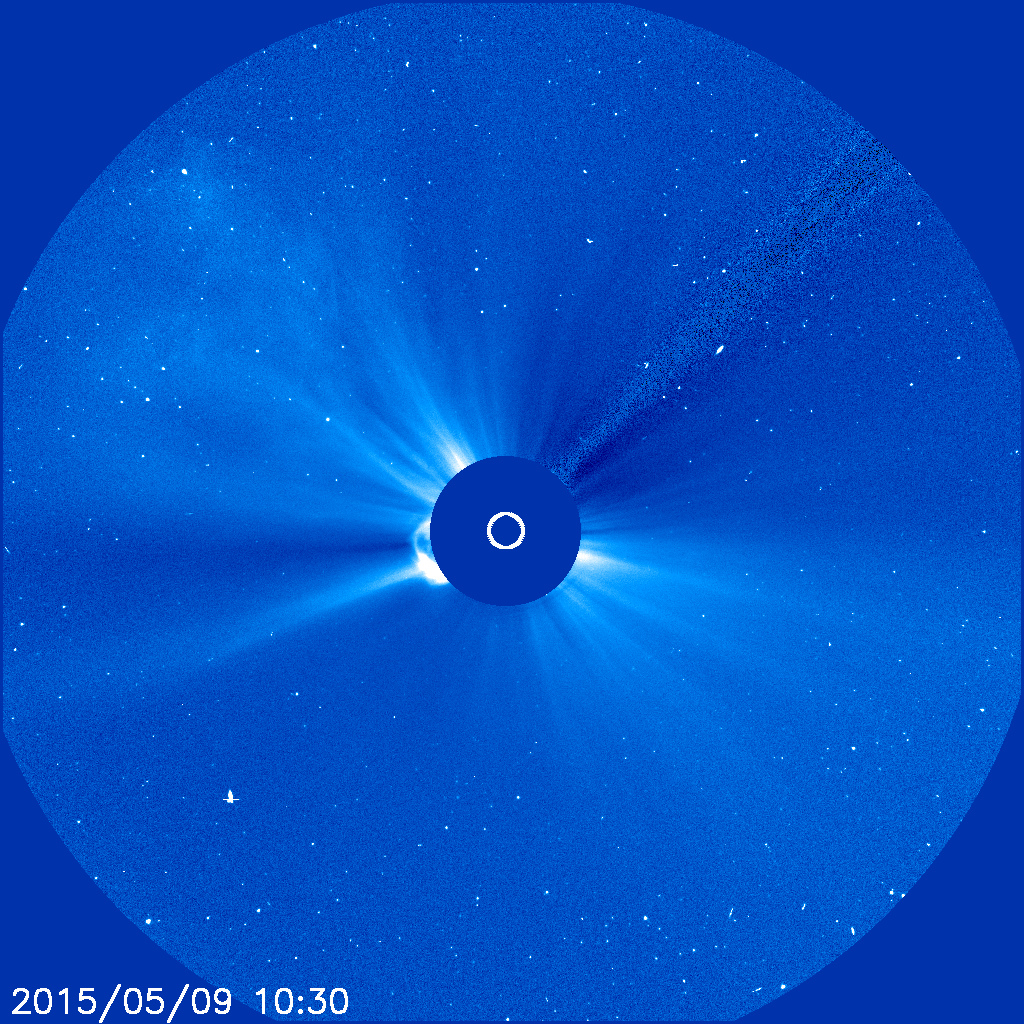
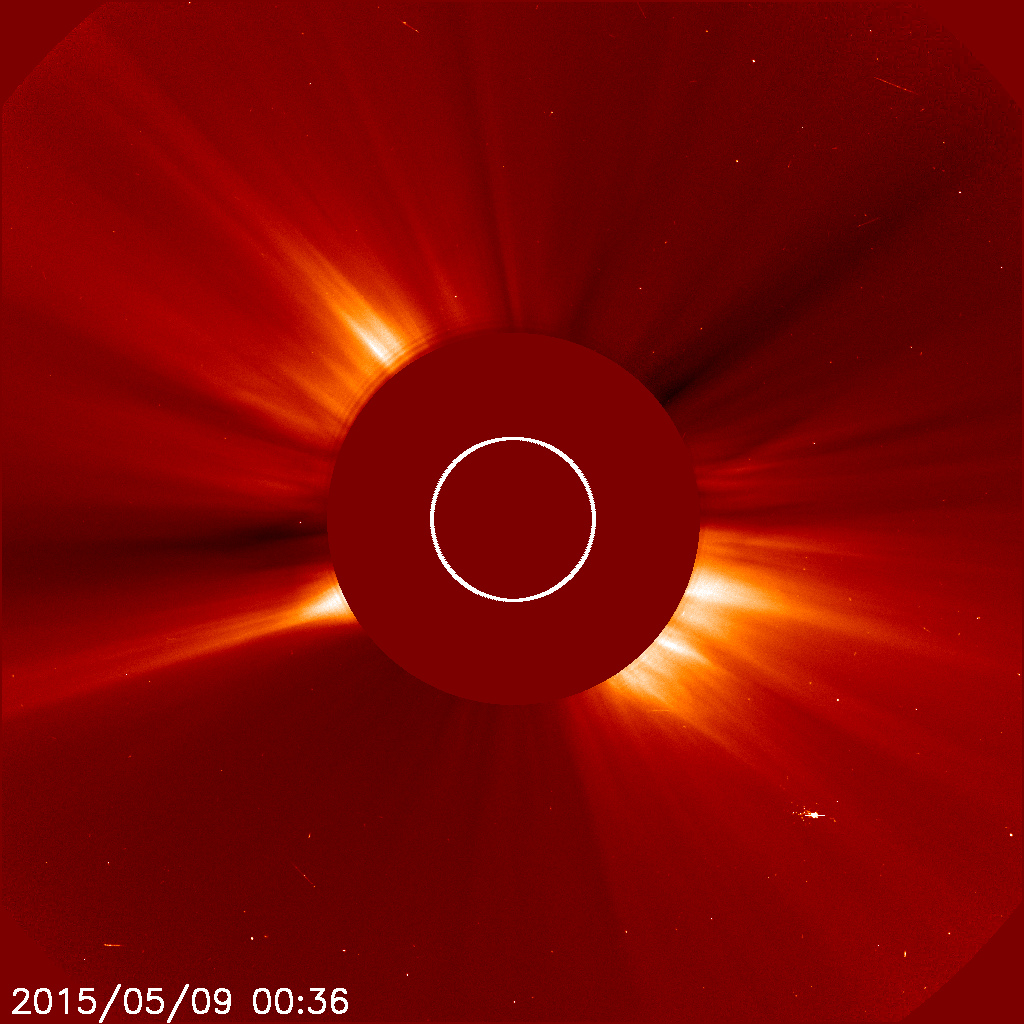
Two More Massive Ships Enter Suns Orbit, Three Now! May 9, 2015, UFO Sighting News.

Date of sighting: May 9, 2015
Location of sighting: Earths sun
http://sohowww.nascom.nasa.gov//data/REPROCESSING/Completed/2015/c3/20150509/20150509_1030_c3_1024.jpg
http://sohowww.nascom.nasa.gov//data/REPROCESSING/Completed/2015/c2/20150509/20150509_0036_c2_1024.jpg
Cameras: Lasco C2 and C3.

Two more massive UFOs have been spotted in SOHO images today. Streetcap1 of Youtube found two more and that make three this week. Look at the right angles on the ship that looks like a giant crystal tower in space. Its beautiful. You can even make out the lines along its edges. I count 17 right angles on it! Remember this is a photo taken by a SOHO satellite whose soul purpose is to photograph our sun. These images are very clear and made with best tech NASA has to offer. The second ship looks equal in size, but its center is thinner and less obvious.

I see two possibilities.
1. Aliens are meeting at or in our sun to convene a United Worlds kind of meeting.
2. Aliens are sending massive ships to suck our suns energy. If we are sharing our sun…its not going to last the 5 billion years scientist predicted it at, but may drop below a billion years before its used up.

SCW

from:    http://www.ufosightingsdaily.com/2015/05/two-more-massive-ships-enter-suns-orbit.html


Typhoon Noul & 1st Atlantic Invest

Atlantic’s First Invest of the 2015, 90L, Organizing Over the Bahamas

By: Jeff Masters and Bob Henson , 3:50 PM GMT on May 06, 2015

The first Atlantic Ocean “Invest” of 2015 has arrived, as the National Hurricane Center (NHC) designated the area of disturbed weather over the Northwest Bahamas as Invest 90L on Wednesday morning. Note that there is no formal definition of what qualifies as an “Invest”; declaring an “Invest” is merely done so that a set of forecasting aids like computer model track forecasts can be generated for the disturbance. NHC gives an “Invest” a tracking number 90-99, followed by a single letter corresponding to the ocean basin–“L” for the Atlantic, or “E” for the Eastern Pacific. Other warning agencies assign “Invests” for the other ocean basins–“W” for the Western Pacific, “A” for the Arabian Sea, etc. When the numbering reaches 99, the next disturbance gets the recycled name “90”. The appearance of 90L on May 6 this year marks the third earliest arrival of the year’s first “Invest” over the past ten years:

2015: May 6
2014: June 4
2013: May 18
2012: February 5
2011: March 10
2010: May 24
2009: May 18
2008: May 31
2007: May 8
2006: June 10


Figure 1. Latest satellite image of Invest 90L.

Satellite loops show heavy thunderstorms between the Southeast coast of Florida and the Northwest Bahamas in association with 90L increased on Wednesday morning, but there was no evidence of an organized surface circulation trying to form. Long-range radar out of Melbourne, Florida showed no low-level spiral bands trying to form, and the activity was not well-organized. Wind shear was a moderate to high 15 – 25 knots. Water vapor satellite loops show a large area of dry air to the west of 90L over Florida and the Gulf of Mexico, and this dry air is retarding development, thanks to strong upper-level winds out of the west driving the dry air into the core of 90L. Ocean temperatures were near 26°C (79°F), which is about 1.7°C (3°F) above average for this time of year, and just at the limit of where a tropical storm can form. The Hurricane Hunter mission scheduled for Wednesday afternoon was cancelled, and has be re-scheduled for Thursday afternoon, if necessary.


Figure 2. Wind forecast for Saturday, May 9, 2015 at 11 am EDT made by the 00Z Wednesday run of the European model. The model is predicting a subtropical depression to be off the coast of the Southeast U.S.

Forecast for 90L
The 8 am EDT run of the SHIPS model predicted that wind shear over 90L would fall to the moderate range, 10 – 20 knots, on Thursday and Friday, which should allow 90L to approach subtropical depression status by Friday at the latest. Phase space diagrams from Florida State University from Wednesday morning’s 06Z run of the GFS model support the idea that this system could be a subtropical or tropical system by Friday. Ocean temperatures fall to about 25°C (77°F) in the waters off of the North Carolina coast, so the farther north the storm wanders, the tougher time it will have developing tropical characteristics–though if the storm manages to find a sweet spot over the core of the warm Gulf Stream current, it has better odds of development. Steering currents are weak over the waters off the Southeast U.S. coast, so expect a slow and erratic motion for 90L. The Wednesday morning 00Z runs of our two top models for predicting tropical cyclones tracks, the European and GFS models, both showed the system making landfall this weekend, with the GFS model predicting landfall in South Carolina on Saturday, and the European model taking the storm ashore in North Carolina on Sunday. Beginning on Friday, coastal regions of both of these states can expect heavy rains and high surf causing rip currents and coastal erosion. Note that the west side of 90L will be weaker and drier, due to the dry air to the west of the storm, and the heaviest rains and stongest winds of 90L will be on the east side of the storm, over North Carolina. In their 8 am EDT Tropical Weather Outlook, NHC gave the disturbance 2-day and 5-day odds of development of 60%, respectively.

Wunderblogger Steve Gregory has a more detailed look at the meteorology of 90L in his Wednesday afternoon post.


Figure 3. Latest projected track of Typhoon Noul from the Joint Typhoon Warning Center (JTWC); a time of 9:00 p.m. JST Wednesday is 1200 GMT or 8 am EDT.

Typhoon Noul posing an increased threat to northern Philippines
After dumping more than 10 inches of rain at Yap International Airport, Category 1 Typhoon Noul is on its way toward the northern Philippines. Noel is gradually intensifying, with sustained winds of 90 mph reported at 8 am EDT (1200 GMT) Wednesday. Satellite loops show that the storm’s center is obscured by central dense overcast, but microwave data obtained by satellite shows that an open eye is already present. Noel is well structured and passing over warm waters, with only weak to moderate wind shear, so continued strengthening into a Category 4 storm is expected. Noel will encounter a trough as it approaches the Philippines, which may force the storm to recurve before making landfall there. However, model guidance has been trending westward, albeit with some uncertainty, and the official Joint Typhoon Warning Center track (see Figure 3) now brings Noul ashore along the northeast coast of Luzon, the largest and northernmost island of the Philippines. Noel is expected to peak in intensity just a few hours before approaching Luzon, with sustained winds of 105 knots (120 mph) projected by the JTWC near landfall. The northeast part of Luzon is mountainous, which could increase the risk for very heavy rains as Noul moves onshore or nearby, although a grazing landfall would put most of Luzon on the weaker western side of the circulation. Noul will be referred to as Dodong in the Philippines’ naming system.

Another tropical system, Invest 93W, is organizing to the east, and is likely to develop late this wee. It is too soon to know what its chances are of affecting the Philippines or Japan next week.

An exceptionally busy early portion of typhoon season
Noul’s formation date of May 3 marks the second earliest appearance on record for the Northwest Pacific’s sixth named storm of the year, according to statistics of the Japan Meteorological Agency’s database from 1951 – 2015 maintained by Digital Typhoon. The average is 1.8 storms before May 8. The record is held by 1971, when the sixth named storm of the year (Babe) formed on May 3, six hours earlier than Noul’s formation time. Noul will be the second tropical cyclone to affect the Philippines so far in 2015. The first was Tropical Storm Maysak, which hit the Philippines exceptionally early in the season–during Easter weekend, April 4 – 5. Fortunately, Maysak was weakening rapidly as it made landfall, and no deaths or significant damage were reported (though four people were injured after huge waves generated by Maysak hit them while they were taking selfies along the shoreline of Dipaculao town in Aurora province on April 4.)

Jeff Masters and Bob Henson

from:    http://www.wunderground.com/blog/JeffMasters/comment.html?entrynum=2975

Large Sunspot Forming

BIG SUNSPOT, CHANCE OF FLARES: Yesterday, sunspot AR2339 unleashed an intense X2-class solar flare. It might not be finished. The active region has doubled in size since yesterday, and it has a ‘beta-gamma’ magnetic field that harbors energy for more eruptions. Amateur astronomer Philippe Tosi sends this picture of the behemoth sunspot from his backyard in Nîmes, France:

As the blue-circular insert shows, several of the sunspot’s dark cores are larger than Earth itself. From end to end, the sunspot group sprawls more than 100,000 km. These dimensions make it an easy target for backyard solar telescopes. If you have one, take a look. You might catch some action. NOAA forecasters estimate a 55% chance of M-class flares and a 10% chance of X-flares on May 7th.

from:    spaceweather.com

Massive Quake Off PNG – Tsunami Alert

Massive earthquake off the coast of Bougainville, Papua New Guinea – local tsunami alerts

Last update: May 7, 2015 at 9:14 am by By

Earthquake-report.com only survives with (mostly small) PRIVATE DONATIONS. Your gift will be highly appreciated.
This page will automatically refresh every 10 minutes as we might be adding updates. Do not close it but leave it open in a browser tab.

Update 08:31 UTC : When you are reading these updates, we at ER are calling you a premium reader. The world has almost NO attention for even massive earthquakes who occur in remote less popular areas as PNG. For us at ER we do follow earthquakes all over the world precisely because we think every country on the globe has the right to be informed.

Screen Shot 2015-05-07 at 10.39.36

Update 08:30 UTC : Below the Geofon seismogram from the seismograph installed in Port Moresby, Eastern PNG. Pretty impressive picture.

Update 08:06 UTC : The focal mechanism image below (courtesy Geofon) shows a spreading mechanism (extension).  “Understanding Beach Balls” article. The PNG Solomon region is a very complicated tectonics area with a lot of very strong interaction among many plates and sub-plates.

Screen Shot 2015-05-07 at 10.05.57

Screen Shot 2015-05-07 at 10.23.17

Update 08:00 UTC : The buoy in the middle of the map (somewhat greater icon) is the activated alert with the reading of it (showing minor changes on the red line 15 second interval)

Screen Shot 2015-05-07 at 09.58.07 Screen Shot 2015-05-07 at 09.59.22

Update 07:50 UTC : Professor Max Wyss, who specializes in theoretical prognoses of injuries and fatalities expects : NO expected injuries or fatalities due to shaking

Screen Shot 2015-05-07 at 09.52.11

Screen Shot 2015-05-07 at 09.54.09

Update 07:40 UTC : No reason to believe that shaking would be a problem as only 1000 people would have felt a strong shaking (the epicenter is off the coast). A very strong shaking is at least necessary for serious damage.

Screen Shot 2015-05-07 at 09.39.21 Screen Shot 2015-05-07 at 09.39.35 Screen Shot 2015-05-07 at 09.39.44

Update 07:35 UTC : We do fear for some Tsunami risk on the nearby islands. People are used to massive earthquakes in PNG and the Solomon Islands but tsunami’s are always a risk. A distance of 160 km means less than 10 minutes for tsunami waves but local people tend to immediately look for higher grounds if the feel very strong shaking like in this case.

Screen Shot 2015-05-07 at 09.23.10 Screen Shot 2015-05-07 at 09.25.11

130km (81mi) SW of Panguna, Papua New Guinea
143km (89mi) SW of Arawa, Papua New Guinea
414km (257mi) SE of Kokopo, Papua New Guinea
536km (333mi) ESE of Kimbe, Papua New Guinea
628km (390mi) WNW of Honiara, Solomon Islands

Most important Earthquake Data:

Magnitude : 7.1

Local Time (conversion only below land) : 2015-05-07 17:10:22

GMT/UTC Time : 2015-05-07 07:10:22

Earthquake-report.com only survives with (mostly small) PRIVATE DONATIONS. Your gift will be highly appreciated.

from:    http://earthquake-report.com/2015/05/07/very-strong-earthquake-bougainville-region-p-n-g-on-may-7-2015/