IPCC Climate Panel Says Weird Weather Here to Stay


Despite uncertainties, the IPCC warns that climate change will bring more extreme weather.

Extreme weather, such as the 2010 Russian heat wave or the drought in the horn of Africa, will become more frequent and severe as the planet warms, the Intergovernmental Panel on Climate Change (IPCC) warns in a report released today. Some areas could become “increasingly marginal as places to live in”, the report concludes.

Climate change will make extremes of hot weather more common, and more extreme, in coming decades.

It is “virtually certain” — meaning 99–100% probability in IPCC terminology — that the twenty-first century will see an increase in the frequency and magnitude of warm temperature extremes and a decrease in cold extremes.

It is much less clear, however, how climate change will affect rainfall, flood risk and storminess.

A summary of the report for policymakers was released today at the IPCC plenary meeting in Kampala, Uganda. The full report, compiled over the past two and a half years by more than 100 scientists, draws on the results of thousands of published studies on physical-climate change, risk management and climate-change adaptation, and is scheduled for release early next year.

Read the rest of the story


Reno Wildfire

Nevada declares emergency over wildfire near Reno

By Riley Snyder | Reuters – 

RENO, Nev (Reuters) – Nevada’s governor declared a state of emergency on Friday over a wildfire raging at the edge of a hilly Reno suburb that has damaged 25 structures, forced 9,500 people from their homes, and was blamed for an elderly man’s death.

The Caughlin Fire in northern Nevada broke out overnight and blackened more than 2,000 acres as it moved through populated areas on the outskirts of the city, said Michele Anderson, spokeswoman for Reno Mayor Bob Cashell.

“The firefighters are battling with extremely high winds right now that are also extremely erratic,” Anderson said, adding that firefighters were focused on protecting homes in the area. Two evacuation centers had been set up.

Hundreds of embers were flying through the air as winds gusted up to 60 miles per hour, carrying the danger of starting spot fires up to a mile away, fire officials said. But by afternoon, a team of 450 firefighters had halted the blaze’s forward advance, the officials told a news conference.

Sixteen people were hospitalized for respiratory or cardiac illnesses, according to theRegional Emergency Medical Services Authority.

A 74-year-old man died after he suffered a heart attack and his car veered off the road as he evacuated his home with his wife, said Kevin Romero, EMS director for Reno’s Regional Emergency Medical Services Authority.

“We’ve been through a lot the past six months,” Nevada Governor Brian Sandoval said during a press conference, referring to a string of deadly disasters that has disproportionately affected the northern part of the state.

“This community has once again come together. I’m so proud of how everybody has done this.”

‘A PERFECT STORM’

Sandoval requested and received approval for federal assistance from the Federal Emergency Management Agency, he said in a statement.

“Our thoughts and prayers are with those who have been and are being affected by this fire,” Sandoval said on his website.

Senate Majority Leader Harry Reid, a Nevada Democrat, acknowledged the fires ravaging his home state on the Senate floor in Washington on Friday, saying his son, Leif, could see the fire from his home.

“Unfortunately strong winds, including 60-mile-per-hour gusts, are working against them. Firefighters are calling the winds a perfect storm,” Reid said. “Winds are so strong, helicopters can’t take off to assist in containing the fire.”

The area in which the fire was burning is very hilly with a lot of dead grass and sage brush, in the immediate vicinity of residential areas.

Air quality readings are elevated and residents are encouraged to stay indoors, Anderson said. Several nearby casinos were offering free rooms for those who lost homes in the blaze, and discounts to anyone evacuated.

The fire is the latest in a string of northern Nevada disasters in recent months. A deadly Amtrak collision 70 miles east of Reno killed six people in June.

Later, a gunman opened fire in a Carson City pancake house in September, killing four people before committing suicide. Then, in the same month, a vintage plane nose-dived near the grand stands at a Reno air race, killing 11 people.

from:    http://news.yahoo.com/nevada-governor-declares-state-emergency-wildfire-183519108.html

Antimatter Surprise

Is the New Physics Here? Atom Smashers Get an Antimatter Surprise

by Clara Moskowitz, LiveScience Senior Writer
Date: 17 November 2011 Time: 06:05 PM ET
The LHCb team stands in front of their experiment, the LHCb detecor, at the Large Hadron Collider in Geneva.
CREDIT: CERN/Maximilien Brice, Rachel Barbier

The world’s largest atom smasher, designed as a portal to a new view of physics, has produced its first peek at the unexpected: bits of matter that don’t mirror the behavior of their antimatter counterparts.

The discovery, if confirmed, could rewrite the known laws of particle physics and help explain why our universe is made mostly of matter and not antimatter.

Scientists at the Large Hadron Collider, the 17-mile (27 km) circular particle accelerator underground near Geneva, Switzerland, have been colliding protons at high speeds to create explosions of energy. From this energy many subatomic particles are produced.

Now researchers at the accelerator’s LHCb experiment are reporting that some matter particles produced inside the machine appear to be behaving differently from their antimatter counterparts, which might provide a partial explanation to the mystery of antimatter.

Missing antimatter

Scientists think the universe started off with roughly equal amounts of matter and antimatter. (Particles of antimatter have the same mass of their twins but an opposite charge.) Somehow over the ensuing 14 billion years, most of the antimatter was destroyed, leaving a leftover universe of mainly matter.

One potential explanation for this outcome is called “charge-parity violation.”  CP violation means that particles of opposite charge behave differently from one another.

The LHCb researchers found preliminary evidence that this is happening when particles called D-mesons, which contain “charmed quarks,” decay into other particles. The whimsically named charmed quarks, like many exotic particles, are so unstable, they last only a fraction of a second. They quickly decay into other particles, and it is these products that the experiment detects. (“LHCb” is short for LHC-beauty, another flavor of quark.)

From the experiment, the researchers found a 0.8 percent difference in the probabilities that the matter and antimatter versions of these particles would decay into a particular end state.

Ruling out a fluke

When it comes to particle physics, it’s all about the quality of statistics. Measuring something once is meaningless because of the high degree of uncertainty involved in such exotic, small systems. Scientists rely on taking measurements over and over again — enough times to dismiss the chance of a fluke.

The new finding ranks as a “3.5 sigma” result, meaning the statistics are solid enough that there is only a 0.05 percent likelihood that the pattern they see isn’t really there. For something to count as a true discovery in particle physics, it must reach a 5 sigma level of confidence.

“It’s certainly exciting, and certainly worth pursuing,” LHCb researcher Matthew Charles of England’s Oxford University told LiveScience. “At this point it’s a tantalizing hint. It’s evidence of something interesting going on, but we’re keeping the champagne on ice, let’s say.”

By the end of 2012, Charles said, the Large Hadron Collider should have collected enoughdata to either confirm or reject the result.

LHC’s birthright

If the finding is borne out, it would be a big deal, because it would mean the reigning theory of particle physics, called the Standard Model, is incomplete. Currently the Standard Model does allow for some minor CP violation, but not at the level of 0.8 percent. To explain these results, scientists would have to alter their theory or add some new physics to the existing picture.

In either case, the LHC would have begun to claim its birthright.

“The whole driving purpose of the LHC is to discover and understand new physics beyond the Standard Model,” Charles said. “This sort of analysis is exactly why I joined LHCb.”

One possible example of the kind of new physics that might explain such CP violation is called supersymmetry. This theory suggests that in addition to all the known particles, there are supersymmetric partner particles that differ by half a unit of spin. Spin is one of the fundamental characteristics of elementary particles.

So far, no one has found direct evidence of supersymmetry. But if supersymmetric particles exist, they might be created instantaneously and disappear again during the particle-decay process. That way they could interfere with the decay process, potentially explaining why matter and antimatter decay differently.

Russian Yeti Nests

eti ‘Nests’ Found in Russia?

Benjamin Radford, Life’s Little Mysteries Contributor
Date: 18 November 2011 Time: 02:09 PM ET
Reward Offered for Mysterious Monsters

Bigfoot researcher and biologist John Bindernagel claims his research group has found evidence that the Yeti (a Russian “cousin” of the American Bigfoot) not only exists, but builds nests and shelters by twisting tree branches together.

“We didn’t feel like the trees we saw in Siberia had been done by a man or another mammal…. Twisted trees like this have also been observed in North America and they could fit with the theory that Bigfoot makes nests. The nests we have looked at are built around trees twisted together into an arch shape,” Bindernagel told the British tabloid The Sun.

Tree twisting, also called splintering, has been claimed as Bigfoot evidence for decades throughout the Pacific Northwest and elsewhere. In some cases tool markings have been found on trees said to have been twisted by Bigfoot. This suggests that the creatures are even possibly more intelligent than previously suspected and may be able to somehowlocate and use pliers, monkey wrenches, and other common hardware tools.

Unless the marks were made by human hoaxers.

Although many of the “mysteriously” twisted tree limbs are conveniently near ground level, some are found at the top of trees. Bigfoot researchers claim these are stronger evidence of the Yeti’s existence, because whereas any hoaxer could easily twist small, waist-level branches, only a Bigfoot-like animal would be able to climb up that high.

However, that raises the not-insignificant question of how a huge, heavy animal would get to the top of a tree without breaking it, or at least snapping a few branches on the way up. Bigfoot are often said to be between 8-and-12-feet tall and weigh several hundred pounds; surely if such a tall, heavy animal made its way up a tree – most of the trees that have been found twisted are spindly in nature – there would be much more obvious damage than a few woven branches at the very top. And if Bigfoot and Yetis spend time perched at the tops of trees doing arboreal decorating, why aren’t they spotted more often?

There’s even more reason to be skeptical of Bindernagel’s claim. According to Sharon Hill of the Doubtful News blog, another scientist who participated in the same Russian expedition concluded that hoaxing was afoot. At a Bigfoot conference that Hill attended last month, Jeff Meldrum (a professor of anatomy and anthropologist at Idaho State Universitywho endorses the existence of Bigfoot) said that he suspected the twisted tree branches had been faked. Not only was there obvious evidence of tool-made cuts in the supposedly “Yeti-twisted” branches, but the trees were conveniently located just off a well-traveled trail.

Meldrum, who eventually concluded that the whole Russian expedition was more of a publicity stunt than a serious scientific endeavor, refused to sign the group’s statement endorsing “indisputable proof” of the Yeti, and returned to the United States. Others, including Bindernagel, remain convinced that conclusive Yeti and Bigfoot evidence is just around the corner — a belief that the Bigfoot community has clung to for more than half a century.

from:    http://www.livescience.com/17104-yeti-nest-russia-evidence.html

Triangular Skull Found in Peru

Mysterious, triangle-shaped ‘alien skull’ found in Peru

By Eric Pfeiffer | 

Scientists aren’t clear on the origin story for this ancient Peruvian skull (Photo courtesy of RPP)

Peruvian anthropologist Renato Davila Riquelme has discovered the remains of an unidentified creature with a “triangle shaped” skull nearly as large as its 20-inch-tall body.

Has the Kingdom of the Crystal Skull –the setting for the underwhelming 2008 Indiana Jones vehicle–finally been discovered? Well, don’t be expecting a victory lap from Steven Spielberg or George Lucas anytime soon.

The remains are most likely those of a child, though one with an unusually shaped head and frame. But that hasn’t stopped local site RPP from interviewing several anonymous Spanish and Russian “scientists” claiming that the remains are actually those of an alien:

It has a non-human appearance because the head is triangular and big, almost the same size as the body. At first we believed it to be a child’s body until Spanish and Russian doctors came and confirmed that, yes, it’s an extraterrestrial being.

Of course, five anonymous scientific authorities citing proof of extraterrestrial life would probably be generating a little more attention if their research had passed some basic scrutiny. Even if the remains are almost certainly those of a person, they are certainly unusual. You can take a look at the gallery of photos here.

from:    http://news.yahoo.com/blogs/sideshow/mysterious-triangle-shaped-alien-skull-found-peru-161615656.html

Solar Filament

fr/spaceweather.com

GREAT FILAMENT: It’s one of the biggest things in the entire solar system. A dark filament of magnetism measuring more than 800,000 km from end to end is sprawled diagonally across the face of the sun. NASA’s Solar Dynamics Observatory took this ultraviolet picture of the structure during the late hours of Nov. 17th:

If the filament becomes unstable, as solar filaments sometimes do, it could collapse and hit the stellar surface below, triggering a Hyder flare. Indeed, part of the filament already erupted on Nov. 16th, but Earth was not in the line of fire. A similar event today would likely be geoeffective because of the filament’s central location on the solar disk.

Paper Wine Bottles?

Greenbottle’s paper wine bottle is biodegradable, compostable

16 November 11

A British company called Greenbottle has designed a wine bottle made entirely out of paper, which weighs nearly a tenth of the amount of a regular glass bottle.

It was developed by Martin Myerscough, the technology director of the company, who came up with the concept after talking to the manager of his local tip, who told him that air-filled plastic bottles are the biggest problem he had to deal with. Myerscough started with milk bottles — creating a design that crushes flat and decomposes, leaving nothing but a small residue from the waterproof bag that contains the milk (which is recyclable if facilities are available locally).

Now, he’s turned to reinventing the wine bottle. Each paper bottle contains the same type of bag found in boxed wine so that the wine is kept fresh. The carbon footprint is cut to 10 percent of that of glass bottle but the big bonus is in terms of weight — each bottle weighs just 55g, whereas a regular glass bottle weighs more like 500g, which slashes transport costs.

It remains to be seen whether shoppers go for it, and — at least at first — hardcore oenophiles are likely to be unimpressed by the bag approach, but Asda’s promised to put milk cartons on shelves in 2012, so wine won’t like be far behind. Myerscough’s strategy for that is to approach wine manufacturers — he wants to license the patented technology to vineyards so that the wine doesn’t need to be shipped to a bottling plant first.

from:    http://www.wired.co.uk/news/archive/2011-11/16/paper-wine-bottle

Apply Now to Become an Astronaut

Nasa opens online recruitment for next wave of astronauts

16 November 11
Want to work in sunny Houston, Texas; earn upwards of $142,000 (£90,000) a year; and take the odd trip into outer space? Nasa is now seeking candidates for astronaut positions for flights to the International Space Station, trips to asteroids and journeys into deep space.

Sadly, you need to be a US citizen, and you’ll also need a bachelor’s degree in engineering, science or math and three years of professional experience. Plus, you’ll need 20/20 vision, be in tip-top medical shape, and be anywhere between 62 and 75 inches tall — to fit inside a Russian Soyuz rocket, that is.

Your odds are quite low, too. Since picking its first seven astronauts from the US military in 1959, only 330 astronauts have been picked for the intensive Astronaut Candidate training program from the thousands of applications received.

What’s in the job description of a 21st century astronaut? Successful applicants will generally work aboard the ISS in three to six month-long missions, and help Nasa’s efforts to partner up with commercial companies like SpaceX to ensure future transportation to the space station.

They’ll also help build and, eventually, fly the Orion Multi-Purpose Crew Vehicle (MPCV), which is designed for human deep space exploration — potentially to Mars. An unmanned orbital test flight has been penciled in for an early 2014 launch.

If you fancy the job, you can apply online here. But before you do so, you might want to listen to our interview with Canadian astronaut Julie Payette, in episode 50 of the Wired.co.uk Podcast.

Nasa is also in the process of picking a near-Earth asteroid to explore, with plans to set foot on a chunk of space rock in 2025. The administration plans to send a robotic precursor mission to the asteroid approximately five years before humans arrive.

Nasa’s more ambitious plans have been hampered by economic woes, and acompromise spending plan — approved by a House and Senate conference committee this week — will cut the agency’s spending money even further. Nasa will receive $17.8 billion this fiscal year — $924 million less than the White House requested and $684 million less than it received this year.

Thankfully, a House bid to cancel Nasa’s over-budget James Webb Space Telescope — a super powerful telescope that will succeed the ageing Hubble in 2018 — has been denied, but the compromise bill has capped the program’s spending at $8 billion.

$3.8 billion will go towards the human space exploration programs that these budding astronauts are being hired for, while $406 million has been earmarked to fund commercial spaceship development at Boeing, Space X, Sierra Nevada and Blue Origin.

from:    http://www.wired.co.uk/news/archive/2011-11/16/nasa-seeks-astronaut

Leonids Peak Nov.17-18

LEONID METEOR SHOWER: Earth is passing through the debris field of Comet Tempel-Tuttle, parent of the annual Leonid meteor shower. Barring a direct hit by a filament of dust, which forecasters consider unlikely, this year’s shower should be mild. Peak rates of 10 to 20 meteors per hour are expected on Nov. 17th and 18th.

from:  spaceweather.com

Solar Activity

SOLAR BLAST: A magnetic prominence dancing along the sun’s southeastern limb became unstable on Nov. 15th and slowly erupted. NASA’s Solar Dynamics Observatory recorded the event, which unfolded over a period of thirteen hours:

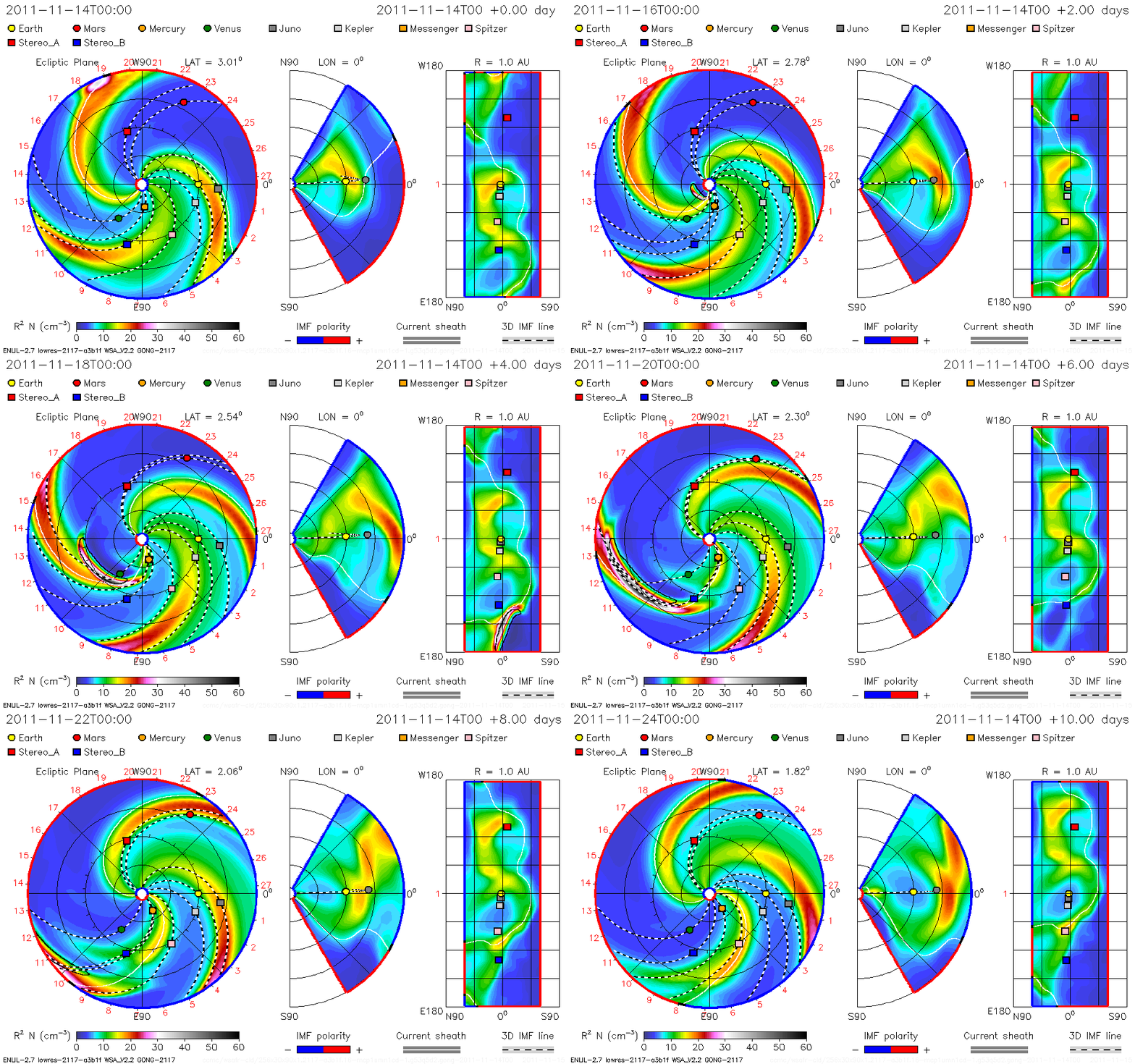
The eruption hurled a cloud of plasma (CME) toward Venus. According to a forecast track created by analysts at the Goddard Space Weather Lab, the cloud should reach the second planet on Nov. 17th. Venus has no global magnetic field to protect it from CMEs. The impact will likely strip a small amount of atmosphere from the planet’s cloudtops.

from: spaceweather.com