fr/Phoenix Rising Star on Emergency Readiness

offered here as an “fyi” for those who are interested:

The Art and Science of Emergency Preparedness

By Phoenix Rising Star

This article is not meant to instill fear, but rather awareness.

Let’s face it.

The world has been seeing more natural and man-made disasters lately.

Tsunami’s, earthquakes, tornadoes, floods, nuclear radiation, solar flares, you name it.

It’s easy to say, oh, that only happens to someone else. It can’t happen to me!

But why couldn’t it?

And more importantly, what would you do if a disaster did happen to you?

Are you ready for any eventuality?

I always listen to my angels. And when they told me, “It’s time to stock-pile.” I listened.

I don’t have a clear idea why I’m stock piling. I just sense that there will be interruptions in power and transportation, leading to shortages, limitations, and lack.

It was interesting to me how I was not the only one to receive this information at this time. Friends and clients began calling me, asking me if I received the same message. We’re all sensing a six to nine month period of time where things will not be as we have known them — and that in order to prepare for this eventuality, it would be helpful to have food and water supplies. Maybe a separate emergency power supply and alternative methods of food preparation.

That’s when I began to do some research. There are different kinds of preparedness just as there are different kinds of emergencies.

There are evacuation emergencies, such as when you need to leave your home immediately, taking only what you can carry. These include tornados, fires (home or wildfire), tsunami’s, floods, volcano’s, earthquakes, storms, etc.

There are long-term emergencies, where the power is out for an indefinite amount of time and it’s not possible to buy food for a variety of reasons. Water is cut off. While any evacuation emergency could cause this, there are also solar flares, terrorism, or government shut downs that could contribute.

Again, I am here not to create fear, but awareness. These things happen. And when they happen to me, I want to know I’ve done everything I can to create ease and grace. Not hardship.

As I discussed the generalities with like-minded friends, I found a variety of responses of readiness. One friend said, “Well, I would run to the nearest hardware store and stock up on seeds.”

I thought for a moment and replied, “To do what? Eat sprouts for 90 days while you wait for the plants to grow?” I figured that would be too late.

Another friend said, “Well, I have all the containers I ever used for my clothes storage. You know, the plastic tubs? I’m going to store rice in them.”

I knew enough to say, “Yes, but those plastic tubs, if they’re not food-grade, have pesticides built into them. Are you sure you want to store your food in there?”

Still another said, “I think I’ll just go to the drugstore and stock up on nuts.”

I had to tell her, “Yes, but those are likely to have been roasted in a poor grade of oil, such as cottonseed, which is high in pesticides and insecticides. Do you want to depend on that as your sole source of nutrition? How long do you think that will last?”

There is so much to learn, it’s almost overwhelming. Where does one start?

The best piece of advice I found was: Make a list of all the food you prepare at home for one month, and list the ingredients. Make sure this list is only the foods you like the most. Once you have that list, you’ll know what to stock-pile.

If you don’t prepare food for yourself, maybe it’s time to learn.

An interesting piece of advice I found was: most doctors agree that healthy humans can go up to eight weeks without food as long as they have water. Assuming you’re in reasonable shape and in ideal conditions – that is, not in the heat or cold and not exerting, a human can probably live for about 3 to 5 days without any water. Healthier humans can live another day or so longer.

Oh great. Somehow that doesn’t make me feel very good. Angels, what exactly is going on here anyway?

So, while I was figuring out what I eat on a regular basis and listing ingredients, I did some additional research on water.

Assuming water supplies become scarce, contaminated, or dependent on my stock-piling, what do I need to know in order to survive?

For evacuation emergencies, it’s important to have portable amounts of stored, safe, clean water. There are ‘boxed water’ kits that provide water in juice-like boxes, easy to carry, store in a backpack and also can last five years in this format if necessary.

Now that’s what I call preparedness!

I can’t vouch for the taste, but it’s good to know. Here’s a good place to order them:www.quakekare.com.

And advice from the experts is that for a long term emergency plan you need two things: one is a way to make water safe for drinking and the other is a way of replenishing the water.

Ways to make safe drinking water include purification such as boiling, disinfecting or ultraviolet light. A combination of these will just about kill off anything that might make you sick or die, but boiling and ultraviolet light rely on some type of fuel source.

* Note to self: have a backup plan for your emergency plan.

If there’s no fuel, what type of disinfecting would take care of almost anything? Bleach, Chlorine Dioxide, Iodine, or Silver. For more information on this, visit this website:http://beprepared.com

Water filtration can also create safe drinking water. Using a filter or filter device, units strain the impurities from water. The larger the impurity, the easier it is to remove. The smaller, the harder it is to remove. And of course, the problem with filters is their short term use and need for replacement.

One unit I have found that both purifies and filters without replacement filters is the Clayton Nolte Natural Action Technologies unit. Complete with a life-time guarantee, these units structure water back to life, surround and shield anything that does not promote life, and thus prevent the body from taking on harmful elements. In talking with Clayton about a new prototype meant for small cities, he casually mentioned trying the prototype on sludgy, sewer water. He ran the sewer water one time through his unit, and proceeded to drink the clean, clear water that came through it without any ill effects.

Now that’s preparedness!

Unfortunately that particular unit is not available for the public yet, but you can still get a portable unit for evacuation or long term storage. More information may be found atwww.spiritofwater.org.

* Note to self: Begin with the cleanest water possible.

Regarding water storage, 14 gallons per person is recommended, both stationary and portable. Water weighs eight pounds per gallon. You do the math. Figure out what containers you might need for stationary and find smaller, lighter ones for portable.

Food grade materials, such as plastic are recommended, but not to be stored in sunlight. Barrels range from 14 to 55 gallons. More information on water storage can be found here:

http://beprepared.com Storage Options
and here: www.quakekare.com/emergency-water-supplies-c-15_17.html

Basically, don’t recycle milk containers for water containers. They don’t inhibit bacterial or algae growth. If you do use recycled soda pop containers, make sure they are clean and stored in a dark place. Use clean sturdy containers that protect against light penetration. BPA free. Glass is not recommended because it breaks easily during an emergency.

If you treat with bleach, use 2-4 drops of unscented per quart of water. For all other disinfectants, follow the directions provided with the product. If you are using tap water, and there’s chlorine in your water, you probably don’t need to add any other disinfectant.

Water free of microorganisms, in a tightly closed food grade container and kept from sunlight, will remain safe indefinitely.

How does one replenish water if the water supply has been cut off?

Rainwater collection or harvesting, storm water collection, ground water collection (from sump pumps), condensate from dehumidifiers (although if there’s no power…), reusing gray water (slightly used water such as shower water for toilets, landscapes, etc.), and solar stills (collecting water from organic sources while using a plastic or glass barrier to create a green-house effect).

* Note to self: start collecting rainwater now.

For information on rainwater collection products, I liked this site: http://raintankdepot.com. The prices are good, and they understand how to keep water fresh and potable through solar and other options.

More information on gray water can be found here: http://tlc.howstuffworks.com Find out why you shouldn’t use gray water on your vegetable or herb garden.

More information on solar stills can be found here: www.solaqua.com Solar stills have been around since the 1500’s!

By now, most of you are convinced I’m crazy, have already stopped reading this, and/or are reading this with a big question mark in your mind. Where is she going with all this? Is this for real?

For me it is real. I believe in angels. And when they tell me to prepare, that’s what I do.

Now you know how to prepare to stay alive with water.

You are creating preparation for food storage.

You might also build a basic supply kit for emergencies.


Choose from this list:

a three day supply of non-perishable food

a three day supply of water, 1 gallon per person, per day

flashlight and batteries

portable, battery powered radio or tv and batteries

cash

photocopies of important information

matches, lighters

first aid supplies

extra clothing

kitchen utensils for food, water

special needs accessories such as contact solutions, prescriptions, glasses, hearing aid batteries

items for infants and children

extra blankets (there are incredibly light weight ones available online)

anything else to meet your needs for three days

You can check out different survival packs from retailers such as REI (www.rei.com) to give you an idea of what to put in yours. Or purchase a ready-made one if you prefer. Be sure to shop around as different retailers offer a variety of emergency supplies for a variety of prices.

Just when I thought all I had to do was stock-pile food, water and an emergency pack, Drunvalo starts talking about the solar flares. They are becoming more and more intense and are expected to be so great by 2013, they may pose the greatest threat to humanity in a long time. They potentially interrupt computers and could potentially erase all hard drives, shutting down transportation, power, and literally everything. When solar flares hit the earth, people lose control because of the interruption in their personal fields.

* Note to self: Follow Drunvalo’s recommendations.

Drunvalo’s recommendation: Program your Merkaba for two programs.

1. God will protect me.

2. When solar flares occur, my MerKaBa field maintains my magnetic field I’m used to and slowly creates a re-alignment in my magnetic field that my bodies can handle with grace and ease.

With awareness, preparation, and empowerment
I am Phoenix

from:   http://www.spiritofmaat.com/aug11/emergency_preparedness.html

LED Lights — Green Power

Alternative LED Lighting Combats Energy Crisis

Jacob Gersh, DOE ARPA-E
Date: 11 November 2011 Time: 11:17 AM ET


behind the scenes, bts, national science foundation, nsf, LED, LED lighting, light, energy, downlights, Cree TrueWhite technology, Cree LED Lighting, Jacob Gersh, ARPA-E, led lighting versus fluorescents, led lighting versus traditional, what's good about
Cree LR6 LED downlights illuminate the dining room of a Denny’s restaurant in Colorado Springs, Co. More than 400 LR6 downlights were installed in the dining rooms five area restaurants, cutting approximately $15,500 per year in energy costs
CREDIT: Cree, Inc.

This Behind the Scenes article was provided to LiveScience in partnership with the National Science Foundation.

Alternative lighting is emerging as a potent method to combat the energy crisis. Light-emitting diode lighting technologies could provide an innovative way to save energy and make wasteful lighting obsolete.

Cree LED Lighting is manufacturing such a technology in Durham, North Carolina. Cree focuses on the production of light-emitting diode (or LED) lighting, powerand communications devices, all of which are supported by advancements in silicon carbide semiconductor technology.

Silicon carbide chips are more durable and perform better than traditional silicon semiconductors. Cree discovered these properties of carbide chips while working with the University of Arkansas in 2001 on a grant from the National Science Foundation. They designed computer modeling methods to simulate silicon carbide semiconductors under extreme conditions. Cree then worked on a 2007 National Science Foundation grant to develop microwave technology to rapidly process silicon carbide semiconductors.

LEDing the way

Although Cree’s work led to semiconductor applications for power and radio technology, Cree’s most successful products to date are LED lights using their silicon carbide semiconductors.

If widely adopted, the potential impact of LED lights on national energy consumption could be enormous. “On average, LED lighting can save up to 85 percent of the electricity used by incandescent bulbs, since most of the energy emitted from those lights is converted to heat instead of light,” said Michelle Murray, Director of Communications at Cree. “For fluorescents, depending on whether you compare LED lighting to compact fluorescents or fluorescent tube lighting, LEDs can save between 20 and 50 percent of the energy used by those lighting sources.”

In addition to LED lighting’s energy benefits, it holds mechanical advantages over standard fluorescent and incandescent lights.

“LEDs do not have fragile filaments like incandescent bulbs, or special gases inside, like fluorescents,” said Murray.

The best choice

The filaments in most incandescent bulbs not only limit each bulb’s life, they can generate large amounts of waste heat. Fluorescent bulbs are more efficient than incandescent bulbs, but contain potentially harmful mercury. When fluorescent bulbs expire, the toxic mercury has to be properly managed in order to protect both human health and the environment.

behind the scenes, bts, national science foundation, nsf, LED, LED lighting, light, energy, downlights, Cree TrueWhite technology, Cree LED Lighting, Jacob Gersh, ARPA-E, led lighting versus fluorescents, led lighting versus traditional, what's good about
Cree’s CR6 LED Energy Star certified downlight powered by Cree TrueWhite technology.
CREDIT: Cree, Inc.

“Any lighting system is only as good as its weakest part,” said Murray. “So good quality solid-state lighting [like LED based bulbs] has a system-level design approach — the LEDs, the optics, the driver and the thermals are all optimized for their specific application. This allows LED lighting to last for years — even decades.”

LED lights are not given a lifetime based on failure, like incandescent or fluorescent bulbs. Instead, LED lights are considered in need of replacement when they only provide 70 percent of their original efficacy. The LED technology developed by Cree is engineered to last a minimum of 50,000 hours before requiring replacement, which is greater than the 40,000-hour lifetime of many fluorescent bulbs.

Failing fluorescents

Fluorescent bulbs are given an estimated lifetime based upon the failure rate of the bulb: After 40,000 hours of use, 50 percent of fluorescent lights will have broken and will require replacement. According to the DOE Caliper 9 Summary Report, because of that high failure rate, some fluorescent bulbs are advertised at a more practical lifetime of 24,000 hours — less than half the lifetime of a silicon carbide semiconductor-based LED.

In June 2011, President Barack Obama visited Cree to tour the company’s Durham, N.C. manufacturing facilities as well as meet with the Jobs and Competitiveness Council to discuss the direction of American business. The President highlighted Cree technology as a driving force in leading a clean energy revolution and aiding American manufacturing, but LED lighting is still not yet a familiar technology to the public.

“Awareness is the biggest challenge,” Murray said. “Awareness about how to buy good quality LED lighting products, and awareness that they already are on the market.”

Murray also highlights challenges in educating the public to understand the up-front cost of LED lighting versus the potential payback over the life of a fixture. Initially LED lights cost more than fluorescent and incandescent bulbs, but the savings in energy and bulb replacement typically pay for the LED’s higher cost over time.

from:    http://www.livescience.com/16997-cree-led-lighting-nsf-bts.html

Recycle Project for Hotel Soap

Kristi York Wooten

Founder of SustenanceGroup.org, Music and Culture Critic, Women’s Activist

Recycling 100 Tons of Hotel Soap to Keep Kids Healthier

Have you ever wondered what happens to all those little bars of soap in hotels? You use them once or twice during a stay and then they’re discarded the next day. Thanks to Global Soap Project, an Atlanta-based nonprofit founded by humanitarian worker Derreck Kayongo, more than 100 tons of soap has been collected from hundreds of U.S. hotels and recycled into new bars that are sent to the people who need it most. The process, which involves collecting soaps from hotels and scraping, pulverizing, heating, and repurposing them into new bars, also includes lab testing to ensure purity before they’re shipped to vulnerable populations in places like Haiti and Africa. GSP, which started in Kayongo’s basement a few years ago, is now receiving national attention, thanks to his recent nomination as a 2011 CNN Hero. Below, I caught up with the Hero nominee to find out more about his livesaving suds.

How did you first get the idea to re-process soap?


I grew up in Uganda watching my father make soap, and unfortunately we got a war that forced us to become refugees in Kenya. While in Kenya, I saw firsthand what it means not to have amenities like soap, and that stayed with me. Years later, when I came to the USA and checked into a hotel, there in the room I saw three bars of soap. This did not include all the shampoos! After going through a refugee experience of not having amenities like soap and then landing in a country that throws soap away to the tune of 800,000 million bars a year, the idea of recycling the soap was birthed in my mind.

Why is soap necessary and important to vulnerable populations?


Soap is the first line of defense against “opportunistic” diseases such as diarrhea. Even the CDC says that if you put a bar of soap in the hands of a child and an adult you could mitigate deaths from diarrhea by about 40%! These diseases can be fatal, especially when they find vulnerable populations like HIV/AIDS patients who have weak immune systems. Simply put, soap is a very important tool in public health.

2011-11-10-AP_Story_Photo1.jpg

Derreck Kayongo in his soap collection warehouse in Atlanta. Photo by Eric Guthrie. Photo courtesy of Global Soap Project.


Is it expensive to ship the soap?


Not for Global Soap, because we partner with organizations that already have containers going to places like Ghana, where we’ve shipped 20,000 bars of soap to the jails there. So the key is to work with NGOs like Medishare or churches that have missionaries taking goods to Africa, which doesn’t cost GSP a dime.

Would you also consider teaching people in developing countries the soap-making process?


GSP would love to grow into that space some day of teaching, for example, women’s groups how to make soap so they can also self-actualize. At this point, however, we are working hard to develop an “airtight” process of recycling soap from the hotels and ensuring its safe delivery to the relevant populations that need it.

How did your background in humanitarian work prepare you for this?


This is an important question, because it speaks to the technical side of the story. I am not just a passionate individual, I have been fortunate to work for such great organizations like CAREand Amnesty International, where I’ve learned to analyze the root causes of poverty and find ways of empowering communities through innovation. One needs a serious skill set in order to build a serious institution to fight the issue at hand. CARE, especially, has taught me that — and I am so thankful.

What have you learned from the CNN Heroes experience so far?


I have learned that when you don’t give up on an issue, it has a chance to be understood and recognized in the public eye. When you start your journey, know that there are people out there who are willing to join your journey and help you out. Those people, for me, have been the redoubtable board members who’ve stood by me through thick and thin, as well as my family, who’ve sacrificed their time and money to let me develop this vision into a practical idea.

for more, go to:    http://www.huffingtonpost.com/kristi-york-wooten/africa-soap-_b_1086072.html?ref=impact

Crusader’s Arabic Inscription Translated

Crusader’s Arabic Inscription No Longer Lost in Translation

Jeanna Bryner, LiveScience Managing Editor
Date: 14 November 2011 Time: 06:24 PM ET
christian crusader's arabic inscription engraved in marble
The 800-year-old inscription was created with special Arabi characters, making it tricky to translate.
CREDIT: courtesy of the Israel Antiquities Authority

A rare Arabic inscription from the Crusades has been deciphered, with scientists finding the marble slab bears the name of the Holy Roman Emperor Frederick II, a colorful Christian ruler known for his tolerance of the Muslim world.

Part of the inscription reads: “1229 of the Incarnation of our Lord Jesus the Messiah.”

The 800-year-old inscription was fixed years ago in the wall of a building in Tel Aviv, though the researchers think it originally sat in Jaffa’s city wall. To date, no other Crusader inscription in the Arabic language has been found in the Middle East.

“He was a Christian king who came from Sicily, the emperor of the Holy Roman Empire, and he wrote his inscription in Arabic,” said Moshe Sharon, of the Hebrew University of Jerusalem, adding that it would be like the U.S. president traveling to a region and leaving an inscription in that area’s language.

Tricky translation

Until now, others who had examined the inscription had suggested it came from a 19th-century gravestone, not realizing the date in the last line referred to the Christian calendar, according to Sharon.

“It’s not so easy to read Arabic inscriptions, and particularly this one, which was written in an unusual script, and it is on stone and it is 800 years old,” Sharon said of the difficulty in translating the engraving.

Though Frederick II, who was known to have a deep familiarity with Arabic, may not have directly engraved the stone, “it was written by an artist and this artist decided to create a special script for this royal inscription and it took us a very long time until we were able to find out that, in fact, we were reading a Christian inscription,” Sharon said during a telephone interview.

Sharon and Hebrew University colleague Ami Shrager are preparing to submit a manuscript describing the work to the scientific journal Crusades.

“The emperor gives his name, and he lists all the countries in which he rules, which is not usual in inscriptions, although we find it in literary sources,” Sharon said.

A peaceful crusader

The Crusades were religious wars whose goal was to restore Christianity to holy places in and near Jerusalem, with the First Crusade beginning in 1095 and the Seventh and Eighth Crusades ending in 1291.

Frederick II led the Sixth Crusade, and succeeded without resorting to violence, it seems.

“Basically, the emperor went as a crusader to the Holy Land in 1228 in order to conquer that part of the Holy Land,” Sharon told LiveScience, “but instead of fighting they discussed things and in the end of the story the sultan of Egypt ceded to the emperor all these territories including the city of Jerusalem, which was fantastically unusual.”

Before signing the agreement, the emperor fortified the castle of Jaffa, and, it now appears, left in its walls two inscriptions, one in Latin and the other in Arabic. The small bit of the Latin inscription that remains was previously attributed to Frederick II, Sharon said.

In the Arabic inscription, Frederick II refers to himself as the king of Jerusalem, suggesting that although Pope Gregory IX had excommunicated him for not starting the Crusade earlier, Frederick II came to power with consent from the sultan, Sharon said.

“It was all diplomacy, which is very interesting,” Sharon said, adding, “Although he got the home of Jerusalem, what he didn’t get or want was a temple mount, he thought it was a Muslim sanctuary and should remain in the Muslim hands.”

As for Frederick II’s colorful personality, Sharon said that in addition to opening a zoo and a university, the ruler had a harem that included a Muslim woman.

from:    http://www.livescience.com/17027-crusader-arabic-inscription-translated.html

Unusual Solar Activity

REMARKABLE SOLAR ACTIVITY: There haven’t been any strong solar flares in days. Nevertheless, some impressive activity is underway on the sun. For one thing, an enormous wall of plasma is towering over the sun’s southeastern horizon. Stephen Ramsden of Atlanta, Georgia, took this picture on Nov. 11th:

“Solar forums all over the world are buzzing with Sun-stronomers proclaiming this to be the biggest prominence that many of them had ever witnessed,” he says.

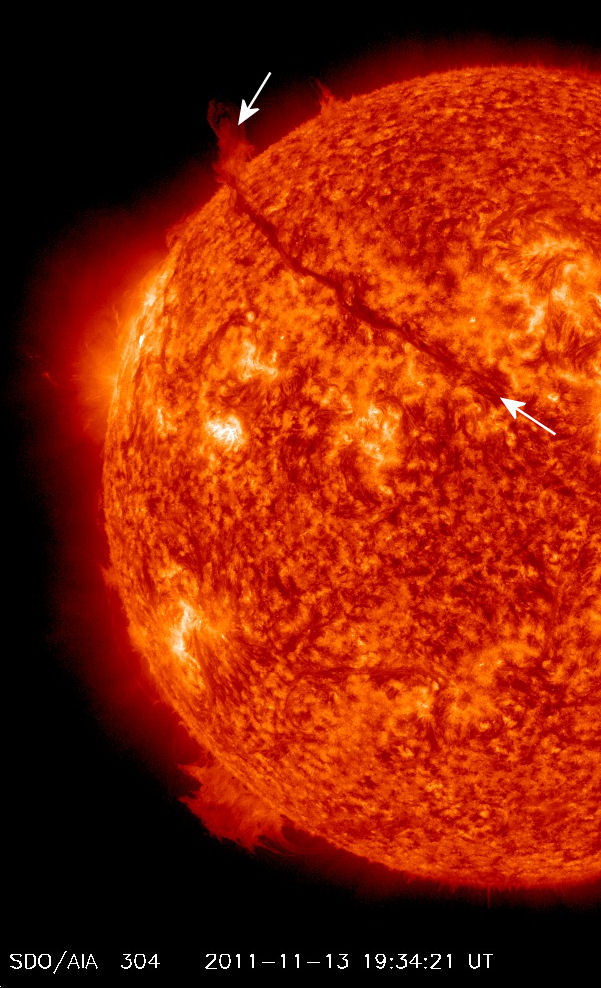
Remarkably, though, this is not the biggest thing. A dark filament of magnetism is snaking more than halfway around the entire sun: SDO image. From end to end, it stretches more than a million km or about three times the distance between Earth and the Moon. If the filament becomes unstable, as solar filaments are prone to do, it could collapse and hit the stellar surface below, triggering a Hyder flare. No one can say if the eruption of such a sprawling structure would be Earth directed.

“I cant help but wonder what could possibly come next since we are still over a year away from the forecasted Solar Maximum,” adds Ramsden. “There’s never been a better time to own a solar telescope than now!”

from: spaceweather.com

Solar Filament

GRAND FILAMENT: A filament of magnetism more than 700,000 km long is curling around the sun’s northeastern limb. NASA’s Solar Dynamics Observatory photographed the vast structure during the early hours of Nov. 12th:

The filament is weighted down by solar plasma. If it erupts–as such filaments are prone to do–it could fall to the stellar surface below, setting off an explosion called aHyder flare. Or it might fly upward, hurling fragments of itself into space. Amateur astronomers with solar telescopes are encouraged to monitor the region for developments.

fr/spaceweather.com

Alexandra David-Neel in Tibet

The Amazing Tibetan Adventures of Alexandra David-Neel

n 1965 Lawrence Durrell, on assignment from a popular woman’s magazine, interviewed the 96-year-old Alexandra David-Neel at her home in Digne, in the south of France. Famous for her earlier adventures in India, China and Tibet, and the books recording these, Alexandra is best known for her daring journey to Lhasa over the Trans-Himalayas in midwinter 1924. Accompanied by her adopted son Lama Yongden, she was disguised as a beggar/pilgrim and eluded soldiers, brigands and officials of the British Empire. David-Neel became the first European woman to reach Tibet’s forbidden capital, and she remains the most accurate, extensive source on the arcane Buddhist practices of a nearly vanished world. Durrell called her “the most astonishing woman of our time.”

When we interviewed the renowned novelist in a Greek neighborhood in the South Bronx, while researching our biography, “The Secret Lives of Alexandra David-Neel,” he fondly recalled her eternally youthful air. Although worn down by the hardship of her travels, Alexandra kept a radiance that had drawn countless admirers, including generals and heads of state. She was born Alexandrine Marie David (a distant relation of the artist David) in Paris in 1868 to a left-leaning father, a publisher and a puritanical mother. Alexandra began her career as a lovely opera singer, complimented by Massenet. When her voice broke, she became a strongly feminist writer, while her interest in Eastern philosophy matured. In 1904 she married Philip Neel, manager of the French railways in Tunisia. It was a marriage of convenience for both parties, and Alexandra soon took off for India. Her one significant love affair, with Sidkeong Tulku, the young, handsome, reforming Maharaja of Sikkim, ended tragically when he died in pain, poisoned, in 1914.

Alexandra, for solace and enlightenment, turned to the Gomchen of Lachen, the Hermetic master of a small monastery in a mountain village near the Tibetan border. Stout and ugly, the locals believed he could fly through the air, kill men by a glance and command demons. But the British authorities respected him, and with this wizard Alexandra seemed to magically learn Tibetan. His occult knowledge formed the basis of her “Magic and Mystery in Tibet,” translated round the world. The practices the Gomchen taught her — such as tumo, breathing to create heat to ward off the piercing cold of the snows — permitted David-Neel to succeed on her journey via unexplored country to Tibet’s capital. Her “My Journey to Lhasa,” published in New York, London and Paris in 1927, became an instant classic of travel and adventure.

Above Lachen was the Gomchen’s cave, at 12,000 feet, where he spent most of his time in meditation. Along with her adopted son, 15-year-old Lama Yongden, Alexandra took up residence in a nearby, sparsely furnished cave, to which she adjoined her tent, cooking utensils and her bathing tub. She agreed to become the Gomchen’s disciple and promised him obedience. For the next two years, in cave, tent or cell, she studied tantric Buddhism with the Gomchen by conversation, reading texts, practice and telepathy. The Gomchen and Alexandra would sit together in silence, focused on the imagined aspects of a deity — perhaps Vajrapani, the protector — their goal being an entirely unified mental state. Afterward the Gomchen would quiz his pupil, who became sufficiently adept that in her trek to Lhasa she could receive messages “written on the wind.”

Alexandra became adept at tumo breathing, involving meditation on the fire within. For a final exam she bathed in a mountain stream on a moonlit night, then sat naked, meditating until dawn. She caught a cold, but tumo would save her life on the journey to Lhasa. First, she visited the Panchen Lama, second in the hierarchy to the Dalai Lama, at Shigatse, Tibet, crossing the forbidden border. She was impressed by the Panchen’s erudition, and she realized that in Tibet she was coming in contact with a wise, civilized people. In contrast, the British Political Officer, Sir Charles Bell, despite being a Tibet enthusiast, had Alexandra expelled from both Tibet and Sikkim.

Undaunted, Alexandra headed for Kum Bum monastery in Eastern Tibet via China. The Manchu dynasty had collapsed, China was in turmoil, but Alexandra pushed on past brigands and warlords and immersed herself in the monastic life and the study of rare manuscripts at Kum Bum. She observed the practices of Bon, an ancient faith, and she engaged in some of their occult practices. In August 1922, with the help of another learned British official, Sir George Pereira, Alexandra began her zigzag journey to Lhasa. Alexandra was 55 when, along with Yongden, she defeated the fierce Himalayan winter and rugged terrain to achieve her goal.

The epic story of Alexandra and Yongden’s reaching Lhasa is too incredible to summarize here. Victorious, Alexandra descended to India, flaunted her triumph before British officials, and sailed for France. She made her home at Digne at the foot of the Basses-Alpes, which she joked were “Himalayas for pygmies.” She stocked her villa Samten Dzong (fortress of meditation) with a collection of tankas, masks, prayer rugs, manuscripts and photos — a miniature Tibet. She even brought home a necklace of gold coins, a gift from Sidkeong. She had refused to spend even one, no matter how desperate her need.

to read more, go to:   http://www.huffingtonpost.com/barbara-foster/alexanda-david-neel-adventures_b_1082451.html?ref=religion

Bowser Beer for Dogs

OK, so maybe your pooch likes to hang out on the couch and watch the game, now there is something for the thirsty guy:

 Bowser Beer For Dogs Earns World Record

First Posted: 11/8/11 06:49 PM ET Updated: 11/8/11 06:49 PM ET

If ever there was an achievement that deserved a toast, a beer for dogs would certainly be it.

And the makers of Bowser Beer, a brand brewed specifically for pooches, have double the cause to enjoy a little hair of the dog: Their achievement has been officially as honored as the first beer for dogs by World Records Academy, an online database of offbeat achievements.

Bowser Beer, which unlike human beer has no hops, no carbonation and no alcohol, has been around since 2007, but the honor still gives spokeswoman Jenny Brown a reason to hoist a glass in celebration — even as she’s trying to comprehend the complete magnitude of having official recognition for making the first beer specifically for dogs.

“I’m surprised it didn’t show up in my Google alerts,” she told HuffPost Weird News when informed of the honor.

The concept of a beer brewed for dogs sounds potentially dangerous since hops, alcohol and carbonation are all bad for canine tummies, but Brown insists her pooch pilsners and labrador lagers are safe for dogs and their owners.

“Hops are toxic, so our beer is flavored with a sweet malt barley,” she said. “It’s human grade, which is good because some people drink it by accident.”

The beer is currently made near Phoenix, but the whole brouhaha first began four years ago when Brown was living in Washington, D.C., and created some pretzel treats for some dogs for a holiday party.

After so many customers scooped them up, she decided to offer them at a Pet Expo. Then it hit her, “What goes better with pretzels than beer?”

The obvious answer was “nothing,” so Brown and family brewed up a beef-and-malt-barley-flavored non-alcoholic beverage that she gave to her dogs to sample.

After four prototypes, there was a clear winner and that became the basis of Bowser Beer. Since that auspicious beginning, Brown and her brewing brood have added a chicken flavor called “Cock-A-Doodle Brew.”

Bowser Beer is currently available in more than 40 states and Brown has a team of taste-testing terriers — among other breeds — to ensure quality control.

“Some dogs like it straight from the bottle, others like it over food and others like it frozen,” she said.

Although Brown makes sure to inform potential customers that her hound hooch won’t get schnauzers soused, she admits some people are disappointed by that.

“Some people say, ‘Oh, I’d like to get my dog drunk,’ and I say, ‘But who’s going to walk you home?'” she said. “There was one guy who told me, ‘My dog prefers double malt scotch to single,’ and I thought, ‘How sad that he knows the difference.'”

for the video, go to from whence the article came(th):   http://www.huffingtonpost.com/2011/11/08/cheers-bowser-beer-first-beer-for-dogs_n_1071762.html?ref=weird-news

Einstein’s Ghosts


Do Einstein’s Laws Prove Ghosts Exist?

Benjamin Radford, Life’s Little Mysteries Contributor
Date: 09 November 2011 Time: 11:31 AM ET
FOLLOW US
Albert Einstein ghosts proof

Every night, amateur ghost-hunting groups across the country head out into abandoned warehouses, old buildings and cemeteries to look for ghosts. They often bring along electronic equipment that they believe helps them locate ghostly energy.

Despite years of efforts by ghost hunters on TV and in real life, we still do not havegood proof that ghosts are real. Many ghost hunters believe that strong support for the existence of ghosts can be found in modern physics. Specifically, that Albert Einstein, one of the greatest scientific minds of all time, offered a scientific basis for the reality of ghosts.

A recent Google search turned up nearly 8 million results suggesting a link between ghosts and Einstein’s work covering the conservation of energy. This assertion is repeated by many top experts in the field. For example, ghost researcher John Kachuba, in his book “Ghosthunters” (2007, New Page Books), writes, “Einstein proved that all the energy of the universe is constant and that it can neither be created nor destroyed. … So what happens to that energy when we die? If it cannot be destroyed, it must then, according to Dr. Einstein, be transformed into another form of energy. What is that new energy? … Could we call that new creation a ghost?”


This idea shows up — and is presented as evidence for ghosts — on virtually all ghost-themed websites as well. For example, a group called Tri County Paranormal states, “Albert Einstein said that energy cannot be created or destroyed, it can only change from one form to another. When we are alive, we have electrical energy in our bodies. … What happens to the electricity that was in our body, causing our heart to beat and making our breathing possible? There is no easy answer to that.” [6 Paranormal Videos Debunked]

In fact, the answer is very simple, and not at all mysterious. After a person dies, the energy in his or her body goes where all organisms’ energy goes after death: into theenvironment. When a human dies, the energy stored in his or her body is released in the form of heat, and transferred into the animals that eat us (i.e., wild animals if we are left unburied, or worms and bacteria if we are interred), and the plants that absorb us. If we are cremated, the energy in our bodies is released in the form of heat and light.

When we eat dead plants and animals, we are consuming their energy and converting it for our own use. Food is metabolized when digested, and chemical reactions release the energy the animal needs to live, move, reproduce, etc. That energy does not exist in the form of a glowing, ghostly ball of electromagnetic energy, but rather in the form of heat and chemical energy.

Many ghost hunters say they can detect the electric fields created by ghosts. And while it’s true that the metabolic processes of humans and other organisms actually do generate very low-level electrical currents, these are no longer generated once the organism dies. Because the source of the energy stops, the electrical current stops — just as a light bulb turns off when you switch off the electricity running to it.

Most of the “energy” that any dead person leaves behind takes years to re-enter the environment in the form of food; the rest dissipates shortly after death, and is not in a form that can be detected years later with popular ghost-hunting devices like electromagnetic field (EMF) detectors. Ghost hunters who repeat the claim that Einstein’s theories provide a sound basis for ghosts reveal less about ghosts than they do about their poor understanding of basic science. Ghosts may indeed exist, but neither Einstein nor his laws of physics suggests that ghosts are real.

Benjamin Radford is deputy editor of Skeptical Inquirer science magazine and author of “Scientific Paranormal Investigation: How to Solve Unexplained Mysteries.” His website is www.BenjaminRadford.com.

from:    http://www.livescience.com/16951-einstein-physics-ghosts-proof.html