Protest Washington – Koch Industries


Occupy DC: Protest Of Koch Industries’ Downtown Office Planned

Occupy Dc

WASHINGTON — Occupy DC protesters are planning a protest of Koch Industries‘ downtown offices Tuesday evening. Jeffrey Light, an attorney involved with the protesters, told The Huffington Post that protesters will meet in McPherson Square at 5 p.m. before heading over to Koch’s offices at 600 14th St NW.

“It might be closer to 5:30,” Light said. “But we’re telling people to be here at 5. We’re going to march down there and protest outside their building for a little bit.”

Light said the group is expecting 20 to 30 people to show up for the early-evening protest, which is inspired by Bloomberg News’ recent expose of Koch Industries and its owners. At 6 p.m., after the protest, Occupy DC will be holding a General Assembly meeting — one of the twice-daily meetings during which consensus is sought about every detail of the group’s existence and purpose, from food to philosophy — when they’ll talk about who and what to protest tomorrow. A protest of former Vice President Dick Cheney’s planned appearance at the Newseum could be in the works, Light said.

They’ll also be talking about whether to keep their camp going at all, given the complementary — but separate — Stop the Machine protest scheduled to begin on Oct. 6 in Freedom Plaza, six blocks away.

Light told The Huffington Post that Occupy DC is discussing the possibility of merging with Stop the Machine. He isn’t yet sure if the merge will happen; it’ll depend on what the General Assembly decides.

http://www.huffingtonpost.com/2011/10/04/occupy-dc-protesting-koch-industries_n_994288.html

Phoenix Rising Star on Remedies in case of Emergency

EMERGENCY PREPAREDNESS REMEDIES

By Phoenix Rising Star

If you’ve been reading the past few issues of Ma’at, you’ll see a pattern of emergency preparedness. When I began this, I had no idea how extensive this topic was, nor did I realize how many people, websites, practitioners, groups, organizations, and non-organizations are currently practicing their version of preparedness. I have received feedback from people with great suggestions, people also feeling guided to stockpile, and people with ideas to share and learned so much from everyone. A compilation of this feedback will be featured in November. If you’ve been holding back any ideas, suggestions, questions, or anything else and would like to be considered for contribution, please send your emergency preparedness related writings to sedonaheartwalk@yahoo.com attn. Phoenix.

This month features two practitioners for which I have great admiration. These practitioners love their work, live their life work, love to share their knowledge and expertise, and are excellent resources for alternative healing. When I initially contacted them for assistance in this article, I just said, “Send me your top ten remedies for emergency situations.” Each in her unique manner singled out and compiled more than ten, which I consider a bonus. May you find help and support from these suggestions for emergencies, as I did.

Aromatherapy for Emergencies.

For those unfamiliar with aromatherapy, these plant based remedies are diffused from different plant parts. Leaves, flowers, and roots are distilled leaving a residue that is one hundred percent healing power. The residue is called essential oil. Essential meaning necessary and life providing. Oil meaning blood or life-force that floats on top of water. Not necessarily sticky, like olive oil.

Aromatherapy may be used topically, by placing a few drops directly on the skin. Different sources may recommend mixing the essential oils with a carrier oil or lotion to prevent burning the skin. Aromatherapy may also be inhaled. Inhalation of the oils causes the healing power to move to the bloodstream efficiently and quickly. Medicinal grade essential oils may be taken internally, but please consult an aromatherapist before you do this. One or two drops go a long way, and not all essential oils on the market are medicinal grade.

Rhonda Phillips of Pure Elements Wellness Spa in Idaho has years of experience with the healing essences of plants. As an H.H.P, L.M.T. and Traditional Spiritual Leader, Rhonda has developed and dedicated her business to sharing and teaching the sacred essences of the plants through aromatherapy. She believes this is her pathway to living her truth, and assisting others with achieving peace and harmony. Rhonda’s website is www.pureelementsonline.com.

Her aromatherapy reference guide is organized according to types of complaints. Individual oils are listed first, with her blends second. All these oils may be ordered through her website listed above. With essential oils, more is not necessarily better, so use discretion.

Common complaints and their essential oil remedies:

1. HEADACHE, MIGRAINE: Peppermint, Lavender, Chamomile, Rosemary, Lemon, BLENDS:Clove”n”Limes, Basil with Lavender.

2. COLDS & FLU: Lavender with Lemon or Peppermint, Peppermint, Chamomile, Ginger, Oregano, Thyme, Tea Tree, Eucalyptus, Myrrh, Rosemary, Ravintsara, Myrtle, Eucalyptus, BLENDS: Ancient Remedy, Breathe Ease, Defense

3. SORE THROATS: Ravintsara, Eucalyptus, Lemon, Peppermint, Tea Tree, Rosemary, BLENDS:Breathe Ease, Gentle Healer, Ancient Remedy

4. EARACHE: Tea Tree, Lavender, Helichrysum. BLENDS: Purify, Gentle Healer

5. TOOTHACHE: Clove, Tea Tree. BLENDS: Ancient Remedy, Gentle Healer

6. SHOCK: Lavender, Tea Tree, Rosemary, Helichrysum with Basil or Peppermint.
BLENDS: Trauma Free, Courage, Balance, Neroli Blend, Wisdom

7. NOSEBLEED: Helichrysum, Lavender, Cypress, Lemon

8. BLEEDING: Helichrysum, Lavender, Cypress. BLENDS: Heart & Soul, Pain Ease

9. PAIN: Helichrysum, Clove, Peppermint, Birch Bark, Wintergreen, Rosemary,
Chamomile. BLENDS: Freedom, Pain Ease, Clove”n”Limes

10. STOMACH ACHE: Peppermint, Ginger, Fennel, Lavender, Bergamot, Rosemary, Chamomile, Tarragon, Spearmint, Lemongrass, Lemon. BLENDS: Comfort

11. STRESS: Bergamot, Chamomiles, Lavenders, Sandalwoods, Neroli, Rose, Frankinscence, Mandarin, Ylang Ylang, Clary Sage. BLENDS: Tranquility, Connect, Create, Empower, Relate, Express, Imagine, Enlighten.

12. INSECT BITES, STINGS: Lavender, Tea Tree, Chamomiles. BLENDS: Purify, Gentle Healer

Jana Shiloh MA, CCH has been practicing homeopathy for 30 yrs ; She has taught nationally and internationally and been named “Honorary Clinical Homeopathic Associate” to the physician to the Queen of England.

She has written three books, the last of which is “HeartFusion™ the Magic of Imprinting Water” which has been endorsed by the coordinator of research for Heartmath Institute.

Her website is http://www.healthrays.com.

Jana’s first aid notes include these suggestions for homeopathic remedies:

1. Use very small amounts. This is “energy” medicine. The quantity of pellets is irrelevant, but the number of times that you administer them is crucial. GIVE ONE DOSE OF THE REMEDY AND WAIT 2 HOURS. The dosage frequency may be increased in extreme emergencies to every 15 minutes..

2. IF SYMPTOMS ARE IMPROVING STEADILY or GET DRAMATICALLY BETTER – STOP. To repeat a dose under those conditions could reverse the curative process.

3. REPEAT ONLY IF: There is no appreciable change (try 1-2 times more); if there was a change, but symptoms have returned; or, if progress is slow. If the patient improves, but continues to relapse, it may mean they need a higher potency. (Contact your homeopath)

Alternate different remedies if necessary about 1-2 hours apart at first, then 3-4 hours apart.

4. IF SYMPTOMS GET WORSE and aren’t a relapse after a prior improvement, DISCONTINUE USE. This may be a temporary aggravation, or it may not be the right remedy. If an improvement does not quickly follow, you may try another remedy and/or call your homeopath.

5. DO NOT GIVE REMEDIES MORE THAN ONCE EVERY 2-4 HOURS (UNLESS IT IS A VERY SERIOUS INJURY, AFTER A SEVERE ACCIDENT. IF SO ARNICA COULD BE REPEATED EVERY 10-15 MINUTES AT FIRST- THEN ACCORDING TO PAIN AS SEVERITY DECREASES) FOR AT MOST ONE DAY. By the second day, improvement should be underway. Increase the time between remedy repetitions as the healing progresses. If more than one remedy is needed for injury it is preferable to alternate remedies- separate them by 10 minutes to 2 hours.

6. Do not touch the remedy, to avoid contamination; instead, place a pellet directly into the mouth or onto a clean spoon. Let the pill dissolve in the mouth. One is actually enough.

7. AVOID COFFEE or CAMPHOR products (Noxzema, lip balm, Vick’s, or “Deep Heat” or Menthol or strong mint). They should not be used for at least 24 hours after the remedy. They antidote the effect of the remedy, and you may notice a return of the symptoms.

8. LAST, BUT NOT LEAST: Do all the other sensible things: i.e., first-aid, medical consultation when appropriate, resting, and not overworking a recently recuperated body or limb.

Suggested Homeopathic remedies for emergencies:

ACONITE: For Shock due to EMOTIONAL TRAUMA, terror, and all physical symptoms deriving from a traumatic incident like, rape, mugging, or a car or other accident. It is different from the Arnica shock which is more dazed: rather you usually see a fearful or even terrified look. Restless. For eye injuries with cuts, abrasions and wounds. For heat exhaustion or stroke if person is dull with an outward pressing headache and is worse sitting up.

APIS: For bee stings or stings of all kind that are worse with heat; hot and swollen. Allergic reactions may be helped, also anaphylactic shock.

ARNICA: This is the first remedy for injury to soft tissues, muscles, tendons and joints. For a sore, lame or bruised feeling in any part of the body from injury. For sprains and muscle strains (to be followed by Rhus Tox. or Ruta if necessary). Arnica will help reduce swelling and discoloration after injury. For shock – if the patient is dazed and/or confused. Also good after tooth extractions, and any other surgeries. Helpful in jet lag and for physical exhaustion. For broken bones, use Arnica first and then alternate with Ruta; after swelling goes down use Symphytum. For injuries from blows around the eye. Use as the first remedy for concussions, and after birthing to prevent swelling.

BELLADONNA: For heat exhaustion or stroke with violent bursting head pains, momentary unconsciousness, extreme relaxation with jerking in the limbs and with more burning in the skin. Headache is better from bending the head backwards. (see Glonoine)

BELLIS PERENIS: very much like Arnica.

Overwork, exhaustion, affinity for female organs, injury to breast and uterus.

For deep wounds from blunt objects, or: pain after surgery (deep surgeries like open heart) when Arnica and Hypericum do not remove all of the pain.

BRYONIA: After giving Arnica, use Bryonia for injuries feeling worse with the slightest movement. For constipation if there is no urging. All symptoms are worse from motion. For cracked ribs or wrenched or sprained knees.

CALENDULA Tincture: Use topically as an antiseptic to clean a wounded area. Hot applications preferable for abscesses. Use compresses for internal inflammations (lung, etc) 1oz to 1 pint or 10 drops to 1/4 cup water. Also buy the non-alcoholic spray for open wounds. Promotes healing too. Great after tooth extractions. For raw, inflamed, stinging wounds.

CANTHARIS: For severe pain of burns and all 3rd-degree burns and burning blisters.

CAUSTICUM: For the pain of burns, if they are milder burns; or sunburns; this can be diluted in water and applied locally. Also used for paralytic weakness of muscles from being over-strained and/or chilled. Contraction of tendons.

HYPERICUM: Injury to nerves – smashed fingertips and fingernails or toenails; injury to elbows or to the tailbone (from falls or during childbirth). Injuries to the spine. Shooting pains, along nerves especially; or when pain originates with a laceration or a bite. Blood poisoning with red streaks up the limb. Useful alternating with Arnica, in pain after surgery. Also for nerve pain after dental work- (after first giving Arnica) following drilling.

IGNATIA: This remedy is a very common one for acute grief. Use after a loss such as a death, a divorce or broken heart, it is even useful for animals when their owners leave them to go on vacation. This remedy is very sensitive to mint, even in toothpaste, so be sure to avoid it. One dose of a 200c is advisable, or a few doses of 30c. then usually nothing more is needed. Remember though, there are other remedies for grief, if Ignatia doesn’t work, consult a homeopath.

LACHESIS: For poisonous spider bites (Brown Recluse and others).

LEDUM: Useful in injuries with pain, puffiness and coldness of affected part. Black and blueness not completely removed with Arnica (as in a black eye or sprained kle). Wounds that feel better from cold water or ice. It is good for puncture wounds. It often antidotes insect stings and spider bites, especially if the wounded part feels cold. ( For a black eye).

RHUS TOX: Stiffness and pain in the muscles (sprains) and joints (rheumatic) on first beginning to move, improving with movement as the part loosens up, later getting weak if overly-used. Worse in cold damp weather. Restlessness, worse at night in bed. Pains in the back and shoulders as well, with stiffness. Stiffness from rising from seat,

RUTA: Strains of tendons from over-exertion Sprains (after administering Arnica first) if any pain persists. Weakness and pain in the legs, ankles and wrists. Spine and limbs are weak, especially after back sprain. Sciatica, if worse lying down at night. Often helpful in eyestrain from close work: eyes are red and hot, followed by headaches. Pains from injury to covering of bone (periosteum) where the skin is thin, i.e., shins. For formation of deposits in the bone, bone sheath, tendons, joints, and wrist where cold makes the symptoms worse. Carpel Tunnel syndrome.

SILICA: Ejects foreign objects from the body (thorns, splinters, glass, even bullets!).Must use low potency i.e. 6 or 12c

THESE REMEDIES ARE FOR FIRST-AID In addition to these remedies, follow traditional first-aid procedures. When in doubt, and if relief is not prompt, see your doctor. Homeopathic remedies still work when taken in conjunction with pharmaceutical drugs. Ultimately, when serious accidents occur, talk with a homeopath as higher potencies than normally available may be needed.

to read more, go to:   http://www.spiritofmaat.com/oct11/remedies.html

Comet Hits Sun – Raises Questions

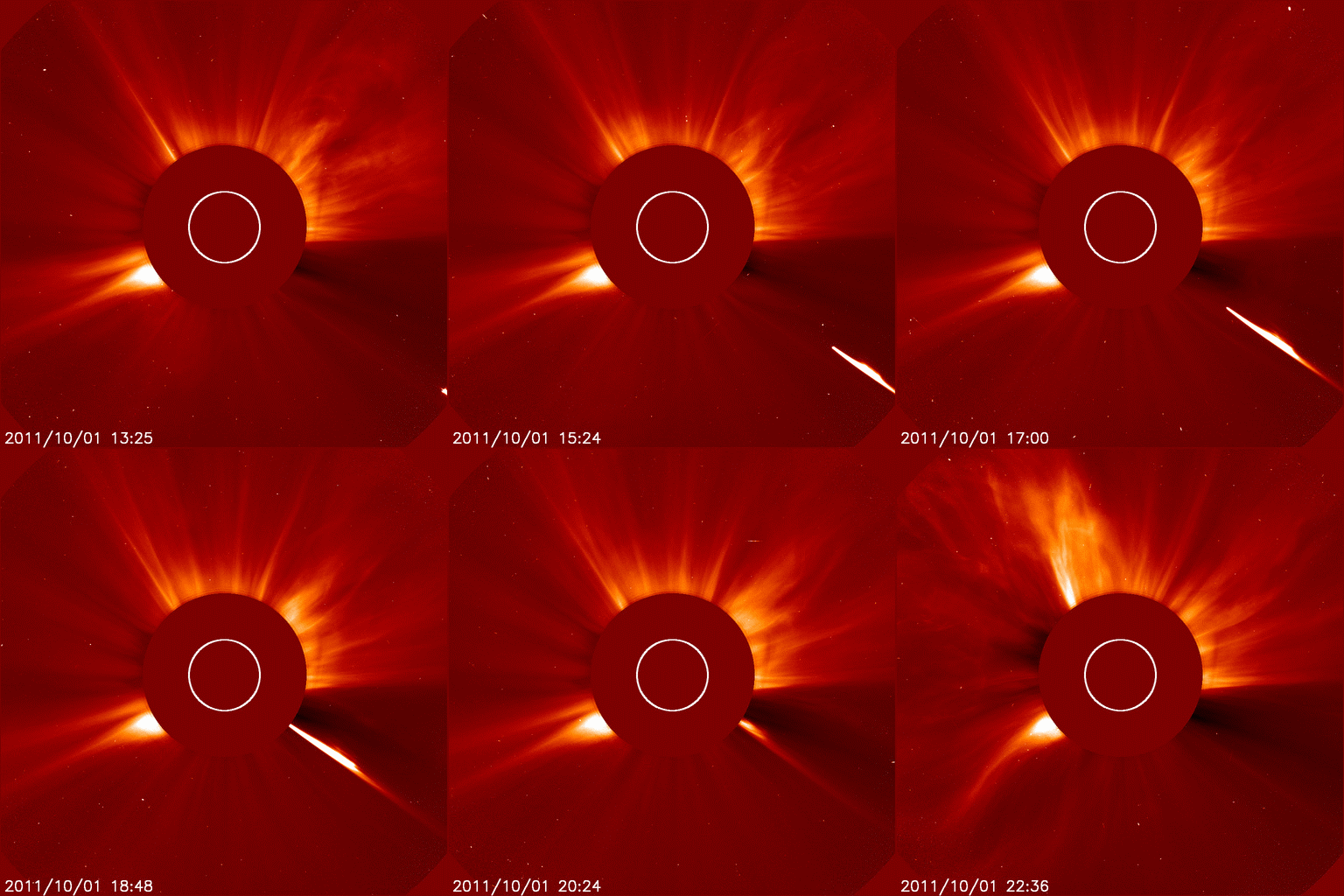
COMET AND CME: A comet discovered by amateur astronomers on Friday, Sept. 30th, disintegrated in spectacular fashion the very next day when it plunged into the sun. The Solar and Heliospheric Observatory recorded the comet’s last hours. The end was punctuated by an unexpected explosion:

Watch the movie again. The timing of the CME so soon after the comet dove into the sun suggests a link. But what? There is no known mechanism for comets to trigger solar explosions. Before 2011 most solar physicists would have discounted the events of Oct. 1st as pure coincidence–and pure coincidence is still the most likely explanation. Earlier this year, however, the Solar Dynamics Observatory (SDO) watched another sungrazer disintegrate in the sun’s atmosphere. On July 5, 2011, the unnamed comet appeared to interact with plasma and magnetic fields in its surroundings as it fell apart. Could a puny comet cause a magnetic instability that might propagate and blossom into a impressive CME? The question is not so crazy as it once seemed to be.

fr/spaceweather.com

Romanian Earthquake

Deep moderate Vrancea earthquake worries Romania

Last update: October 4, 2011 at 2:27 pm by By 

Also written by Szombath Balazs
Earthquake overview : At 05:40 on October 4 a Vrancea deep earthquake measuring 4.7 magnitude made the Romanian people nervous. The epicenter was located in a wilderness area near Plostina. Biggest cities in the area are Focsani and Brasov. The earthquake was also well Felt in the capital Bucharest.


Seismic Hazard map courtesy USGS


Update 14:12 UTC : Some Romanian press is predicting another magnitude 6 earthquake later this year. Earthquake-Report.com condemns such predictions as NOBODY IN THE WORLD can with a great certainty predict earthquakes. Science is making progress but we are far from a better than a lottery prediction. DO NOT BELIEVE earthquake predictions but BE PREPARED to survive them if it happens.  Your telephone will NOT ring to announce an earthquake.
Au inceput sa apara stiri care prevestesc un cutremur mai puternic anul acesta in Romania. Cele mai multe dintre ele fac referire la un cutremur de cel putin 6 grade magnitudine. Earthquake-Report.com condamna astfel de predictii din simplul motiv ca NIMENI IN LUMEA ASTA nu poate sa spuna cand sau unde va lovi un cutremur. Stiinta face pasi in aceasta privinta dar suntem departe de Loterii stiintifice. NU CREDETI in aceste predictii dar FITI PREGATITI pentru cutremure pentru a trece cu bine prin ele!

UPDATE 13:20 UTC:  Cutremurul s-a produs s-a produs in jurul orei 5:40, la o adancime de 134 km. Epicentrul a fost aproape de Focsani, la o distanta de 52 km de oras. A fost simtit si in capitala, Bucuresti. Sepcific zonei Vrancea cutremurele de mare adancime sunt simtite pe o arie larga. Zona Gura Teghii a fost activa in aceasta perioada prin seisme produse la adancimi mai mari de 130 km. Magnitudinea a fost diferita in statiile seismice deoarece propagarea este neuniforma. Acceleratia din Bucuresti a fost mai mare fata de inregistrarile din Vrancea. Seismul este important pentru ca s-a produs in zona de neliniaritate a energiei. Multumim I.R.S.A. (Institutul Roman de Seismologie Aplicata) pentru informatii.

UPDATE 9:24 UTC: The site of NIEP (National Institute for Earth Physics) gives a magnitude of 4.8 at 134 km depth. The site was down for a while due to high traffic.

Today’s earthquake’s hypocenter was at 128.4 km at a normal expected depth for Romanian Vrancea earthquakes. Contrary to most other earthquake locations in Europe, Romania has a specific deep faulting zone.

The epicenter was located right in the highest seismic hazard area (see map at right (dark red). This area has the biggest peak ground acceleration in Romania.

to read more, go to:    http://earthquake-report.com/2011/10/04/deep-moderate-vrancea-earthquake-worries-romanians/


Jeff Masters on Ozone Hole, Phillipe, New Tropical Storm

nprecedented Arctic ozone hole in 2011; a Florida tropical storm next week?
Posted by: JeffMasters, 2:01 PM GMT on October 04, 2011 +8
An unprecedented ozone hole opened in the Arctic during 2011, researchers reported this week in the journal Nature. Holes in the Antarctic ozone layer have opened up each spring since the early 1980s, but the Arctic had only shown modest springtime ozone losses in the 5% – 30% range over the past twenty years. But this year, massive ozone destruction of 80% occurred at altitudes of 18 – 20 kilometers in the Arctic during spring, resulting in Earth’s first known case of twin ozone holes, one over each pole. During late March and portions of April, the Arctic ozone hole was positioned over heavily populated areas of Western Europe, allowing large levels of damaging ultraviolet rays to reach the surface. UV-B radiation causes skin damage that can lead to cancer, and has been observed to reduce crop yields in two-thirds of 300 important plant varieties studied (WMO, 2002.) The total loss of ozone in a column from the surface to the top of the atmosphere reached 40% during the peak of this year’s Arctic ozone hole. Since each 1% drop in ozone levels results in about 1% more UV-B reaching Earth’s surface (WMO, 2002), UV-B levels reaching the surface likely increased by 40% at the height of this year’s hole. We know that an 11% increase in UV-B light can cause a 24% decrease in winter wheat yield (Zheng et al., 2003), so this year’s Arctic ozone hole may have caused noticeable reductions in Europe’s winter wheat crop.


Figure 1. Left: Ozone in Earth’s stratosphere at an altitude of approximately 12 miles (20 kilometers) in mid-March 2011, near the peak of the 2011 Arctic ozone loss. Right: chlorine monoxide–the primary agent of chemical ozone destruction in the cold polar lower stratosphere–the same day and altitude. Image credit: NASA/JPL-Caltech.

What caused this year’s unprecedented Arctic ozone hole?
Earth’s ozone holes are due to the presence of human-emitted CFC gases in the stratosphere. The ozone destruction process is greatly accelerated when the atmosphere is cold enough to make clouds in the stratosphere. These polar stratospheric clouds (PSCs) act like ozone destruction factories, by providing convenient surfaces for the reactions that destroy ozone to occur. PSCs only form in the 24-hour darkness of unusually cold winters near the poles; the atmosphere is too warm elsewhere to support PSCs. Stratospheric temperatures are warmer in the Arctic than the Antarctic, so PSCs and ozone destruction in the Arctic has, in the past, been much less than in the Antarctic. In order to get temperatures cold enough to allow formation of PSCs, a strong vortex of swirling winds around the pole needs to develop. Such a “polar vortex” isolates the cold air near the pole, keeping it from mixing with warmer air from the mid-latitudes. A strong polar vortex in winter and spring is common in the Antarctic, but less common in the Arctic, since there are more land masses that tend to cause large-scale disruptions to the winds of the polar vortex, allowing warm air from the south to mix northwards. However, as the authors of the Nature study wrote, “The persistence of a strong, cold vortex from December through to the end of March was unprecedented. In February – March 2011, the barrier to transport at the Arctic vortex edge was the strongest in either hemisphere in the last ~30 years. This unusual polar vortex, combined with very cold Arctic stratospheric temperatures typical of what we’ve seen in recent decades, led to the most favorable conditions ever observed for formation of Arctic PSCs. The reasons for this unusual vortex are unknown.


Figure 2. Global lower stratospheric departure of temperature from average since 1979, as measured by satellites. The large spikes in 1982 and 1991 are due to the eruptions of El Chicon and Mt. Pinatubo, respectively. These volcanoes ejected huge quantities of sulphuric acid dust into the stratosphere. This dust absorbed large quantities of solar radiation, heating the stratosphere. Stratospheric temperature has been generally decreasing in recent decades, due to the twin effects of ozone depletion and the accumulation of greenhouse gases in the lower atmosphere. During Jan – Aug 2011, Earth’s stratosphere had its 3rd coldest such period on record. Image credit: National Climatic Data Center.

Greenhouse gases cause stratospheric cooling
When ozone absorbs UV light, it heats the surrounding air. Thus, the loss of ozone in recent decades has helped cool the stratosphere, resulting in a feedback loop where colder temperatures create more PSCs, resulting in even more ozone destruction. However, in 1987, CFCs and other ozone-depleting substances were banned. As a result, CFC levels in the stratosphere peaked in 2000, and had fallen by 3.8% as of 2008, according to NASA. Unfortunately, despite the fact that CFCs are falling in concentration, the stratosphere is not warming up. The recovery of the ozone layer is being delayed by human emissions of greenhouse gases like carbon dioxide and methane. These gases trap heat near the surface, but cause cooling of the stratosphere and increased formation of the PSCs that help destroy ozone. We need only look as far as our sister planet, Venus, to see an example of how the greenhouse effect warms the surface but cools the upper atmosphere. Venus’s atmosphere is 96.5% carbon dioxide, which has triggered a hellish run-away greenhouse effect. The average surface temperature on Venus is a sizzling 894 °F, hot enough to melt lead. Venus’s upper atmosphere, though, is a startling 4 – 5 times colder than Earth’s upper atmosphere. The explanation of this greenhouse gas-caused surface heating and upper air cooling is not simple, but good discussions can be found at Max Planck Institute for Chemistry andrealclimate.org, for those unafraid of radiative transfer theory. One way to think about the problem is that the amount of infrared heat energy radiated out to space by a planet is roughly equal to the amount of solar energy it receives from the sun. If the surface atmosphere warms, there must be compensating cooling elsewhere in the atmosphere in order to keep the amount of heat given off by the planet the same and balanced. As emissions of greenhouse gases continue to rise, their cooling effect on the stratosphere will increase. This will make recovery of the stratospheric ozone layer much slower.

Greenhouse gases cause cooling higher up, too
Greenhouse gases have also led to the cooling of the atmosphere at levels higher than the stratosphere. Over the past 30 years, the Earth’s surface temperature has increased 0.2 – 0.4 °C, while the temperature in the mesosphere, about 50 – 80 km above ground, has cooled 5 – 10 °C (Beig et al., 2006). There is no appreciable cooling due to ozone destruction at these altitudes, so nearly all of this dramatic cooling is due to the addition of greenhouse gases to the atmosphere. Even greater cooling of 17 °C per decade has been observed high in the ionosphere, at 350 km altitude. This has affected the orbits of orbiting satellites, due to decreased drag, since the upper atmosphere has shrunk and moved closer to the surface (Lastovicka et al., 2006). The density of the air has declined 2 – 3% per decade the past 30 years at 350 km altitude. So, in a sense, the sky IS falling due to the greenhouse effect!

Since any increase in solar energy would heat both the lower and upper atmosphere, the observed drop in upper atmospheric temperatures in the past 30 years argues against an increase in energy coming from the sun being responsible for global warming. The observed cooling of the upper atmosphere is strong evidence that the warming at Earth’s surface is due to human-emitted greenhouse gases that trap heat near the surface and cause compensating cooling aloft. It should also give us additional confidence in the climate models, since they predicted that this upper atmospheric cooling would occur. Keep in mind, also, that 2010 was tied for Earth’s hottest year on record, and the amount of energy coming from the sun during 2009 – 2010 was the lowest since satellite measurements began in the late 1970s. There has been no long-term increase in energy coming from the sun in recent decades, and the notion that global warming is due to an increase in energy coming from the sun simply doesn’t add up.

Commentary
The development of an ozone hole in the Arctic is a discouraging reminder that humans are capable of causing harmful and unexpected planetary-scale changes to the environment. A 2002 assessment of the ozone layer by the World Meteorological Organization concluded that an Arctic ozone hole would be unlikely to occur, due to the lack of a strong Arctic vortex in winter, and the fact CFCs levels had started to decline. “Day-to-day temperatures in the 2010 – 11 Arctic winter did not reach lower values than in previous cold Arctic winters,” said lead author Gloria Manney of NASA’s Jet Propulsion Laboratory in Pasadena, Calif., and the New Mexico Institute of Mining and Technology in Socorro. “The difference from previous winters is that temperatures were low enough to produce ozone-destroying forms of chlorine for a much longer time. This implies that if winter Arctic stratospheric temperatures drop just slightly in the future, for example as a result of climate change, then severe Arctic ozone loss may occur more frequently.” I might add that its a very good thing CFCs were banned in 1987, or else the Arctic ozone hole would have opened up much sooner and would have been far worse. It is highly probable that we will see future nasty climate change surprises far more serious than the Arctic ozone hole if we continue on our present business-as-usual approach of emitting huge quantities of greenhouse gases. Humans would be wise to act forcefully to cut emissions of greenhouse gases, as the cost of inaction is highly likely to be far greater than the cost of action.

References
Manney, G.L., et al., 2011, Unprecedented Arctic ozone loss in 2011, Nature (2011), doi:10.1038/nature10556

Weather Underground Ozone Hole FAQ

World Meteorological Organization (WMO), “Scientific Assessment of Ozone Depletion: 2002 Global Ozone Research and Monitoring Project – Report #47”, WMO, Nairobi, Kenya, 2002.

Zheng, Y., W. Gao, J.R. Slusser, R.H. Grant, C. Wang, “Yield and yield formation of field winter wheat in response to supplemental solar ultraviolet-B radiation,” Agricultural and Forest Meteorology, Volume 120, Issues 1-4, 24 December 2003.


Figure 3. Morning satellite image of Tropical Storm Philippe. Philippe has a Central Dense Overcast (CDO) of high cirrus clouds characteristic of a tropical storm nearing hurricane strength.

Tropical Storm Philippe no threat to land
In the middle Atlantic, Tropical Storm Philippe has managed to grow a bit more organized in the face of high wind shear of 20 – 30 knots. Satellite loops show Philippe is a small system with a modest amount heavy thunderstorm activity, with the surface circulation partially exposed to view by wind shear. Wind shear will remain high today, but is expected to relax to the moderate range on Wednesday as Philippe recurves to the northeast. This may allow Philippe to intensify into a hurricane, as predicted by several of the intensity forecast models. It is unlikely that Philippe will trouble any land areas.

A Florida tropical storm next week?
Recent runs by all of the computer forecast models predict that an area of low pressure will develop near Florida this weekend or early next week. The counter-clockwise flow around this low will bring strong winds and heavy rains to Northeast Florida and the Georgia coast, and it is possible this storm will develop into a tropical or subtropical storm. The situation is similar to Subtropical Storm Four of October 4, 1974, according to the latest extended forecast discussion from NOAA’s Hydrometeorological Prediction Center. That storm brought 10 – 14 inches of rain to the east coast of Florida and strong onshore winds of 30 – 40 mph that caused beach erosion and coastal flooding. The exact formation location of this weekend’s storm is still in doubt, with the ECMWF and UKMET models predicting the storm will form in the Gulf of Mexico off the west coast of Florida, and the GFS model predicting formation over the Bahamas. We’ll have to wait for future model runs before we can get a better handle on where and when this storm will most likely develop.

Jeff Masters

Monthly Earth Changes Update fr/Aquarian Solutions


October 2011 will host extreme weather, volcanic eruptions, super jor quakes, hurricanes, severe cold fronts, hyper solar actvity, tsunamis, floods, perilous cyclones, sink holes, strong deluge of water, land and mudslides, extreme weather around the world
floods will continue along with droughts, still chances for dangerous tornadoes,while weather records will broken.
The month was actually kicked off with a New Moon in Libra on September 27th @ 11:09 AM UT
which continues to initiate major weather events from typhoons to hurricanes along with seismic and volcanic eruptions
Then on October 11th a fiery Full Moon in Aries @ 19 degrees on 7:06 PM PDT or 10:06 PM EDT leads to massive seismic and volcanic events.
Events will happen quickly after the Full Moon:
Mercury will enter Scorpio on Oct. 13th. the same day that the Sun meets Saturn in Libra bringing in cold winter weather
Venus already in Scorpio by Oct. 8th. will oppose Jupiter on October 14th. for major storms and seismic events
Then a double whammy with Mercury opposing Jupiter in Taurus on October 17th.
The month ends with the Scorpio New Moon on October 26th in the 4th degree of Scorpio occuring @ 12:56 PM PDT or 3:56 PM EDT –
for more, go to:    http://www.aquasoul.com/index2.html

SakuraJima Volcano Erupts

Explosive eruptions and information on SakuraJima volcano, Japan + video’s

Last update: October 3, 2011 at 3:52 pm by By 

The webcam videos below are from October 1 and October 3, 2011. They show a couple of explosive eruptions.
Sakurajima’s activity became prominent in 1955, and the volcano has been erupting almost constantly ever sinceThousands of small explosions occur each year, throwing ash to heights of up to a few kilometers above the mountain.
The Sakurajima Volcano Observatory was set up in 1960 to monitor these eruptions.

(to see the current videos, go to:    http://earthquake-report.com/2011/10/03/explosive-eruptions-and-information-on-sakurajima-volcano-japan-videos/)

1914 eruption of Sakurajima


Image courtesy TANAKA Juuyoh – CC-By-3.0

The 1914 eruption was the most powerful in twentieth-century JapanLava flows filled the narrow strait between the island and the mainland, turning it into a peninsula. The volcano had been dormant for over a century until1914.The 1914 eruption began on January 11.Almost all residents had left the island in the previous days, in response to several large earthquakes that warned them that an eruption was imminent. Initially, the eruption was very explosive, generating eruption columns and pyroclastic flows, but after a very large earthquake on January 13, 1914 which killed 35 people, it became effusive, generating a large lava flow.  Lava flows are rare in Japan—the high silica content of the magmas there mean that explosive eruptions are far more common but the lava flows at Sakurajima continued for months.


Pre-eruption earthquakes killed at least 35 people; caused an evacuation and significant changes to the local topology.

The island grew, engulfing several smaller islands nearby, and eventually becoming connected to the mainland by a narrow isthmus. Parts of Kagoshima bay became significantly shallower, and tides were affected, becoming higher as a result.

During the final stages of the eruption, the centre of the Aira Caldera sank by about 60 centimetres (24 in), due to subsidence caused by the emptying out of the underlying magma chamber. The fact that the subsidence occurred at the centre of the caldera rather than directly underneath Sakurajima showed that the volcano draws its magma from the same reservoir that fed the ancient caldera-forming eruption. The eruption partly inspired a 1914 movie, Wrath of the Gods, centering around a family curse that ostensibly causes the eruption.

to read more on this, see the videos, etc., go to:    http://earthquake-report.com/2011/10/03/explosive-eruptions-and-information-on-sakurajima-volcano-japan-videos/

Ozone Hole in Arctic

Earth’s First Arctic Ozone Hole Recorded

Wynne Parry, Senior Writer LiveScience
Date: 02 October 2011 Time: 01:01 PM ET
stratosphere clouds over Arctic
Stratospheric clouds above the Arctic.
CREDIT: Ross J. Salawitch, University of Maryland

The high atmosphere over the Arctic lost an unprecedented amount of its protective ozone earlier this year, so much that conditions echoed the infamous ozone hole that forms annually over the opposite side of the planet, the Antarctic, scientists say.

“For the first time, sufficient loss occurred to reasonably be described as an Arctic ozone hole,” write researchers in an article released Oct. 2 by the journal Nature.

Some degree of ozone loss above the Arctic, and the formation of the Antarctic ozone hole, are annual events during the poles’ respective winters. They are driven by a combination of cold temperatures and lingering ozone-depleting pollutants

The reactions that convert less reactive chemicals into ozone-destroying ones take place within what is known as the polar vortex, an atmospheric circulation pattern created by the rotation of the Earth and cold temperatures. This past winter and spring saw an unusually strong polar vortex and an unusually long cold period.

This year’s record vortex persisted over the Arctic from December to the end of March, and the cold temperatures extended down to a remarkably low altitude, the researchers write.

At altitudes of about 11 to 12 miles (18 to 20 kilometers), more than 80 percent of the ozone present in January had been chemically destroyed by late March.

The same dynamics create the infamous ozone hole over Antarctica. But above the South Pole, ozone is essentially completely removed from the lower stratosphere ever year. Above the North Pole, however, ozone loss is highly variable and has, until now, been much more limited, writes the international research team led by Gloria Manney of the California Institute of Technology.

Countries agreed to end their production of the substances ultimately responsible for destruction of the ozone in 1987 with the Montreal Protocol. However, these pollutants, including chlorofluorocarbons, still linger in the atmosphere. Ozone loss is expected to improve in the coming decades as atmospheric levels of these chemicals decline.

On the Earth’s surface, ozone is a pollutant, but in the stratosphere it forms a protective layer that reflects ultraviolet radiation back out into space. Ultraviolet rays can damage DNA and lead to skin cancer and other problems

to rea more, go to:   http://www.livescience.com/16337-arctic-ozone-hole.html

10/01 Double Sunspot Eruption

DOUBLE ERUPTION: On October 1st around 10:17 UT, widely-spaced sunspots 1302 and 1305 erupted in quick succession, revealing a long-distance entanglement which was not obvious before. NASA’s Solar Dynamics Observatory (SDO) recorded the double blast:

Since it was launched in 2010, SDO has observed many “entangled eruptions.” Active regions far apart but linked by magnetic fields can explode one after another, with disturbances spreading around the stellar surface domino-style. Saturday’s eruption appears to be the latest example.

The part of the eruption centered on sunspot 1305 hurled a coronal mass ejection toward Earth. The relatively slow-moving (500 km/s) cloud is expected to reach our planet on Oct. 4th or 5th, possibly causing geomagnetic storms when it arrives. High-latitude sky watchers should be alert for auroras.

fr/spaceweather.com