X-Flare Potential…

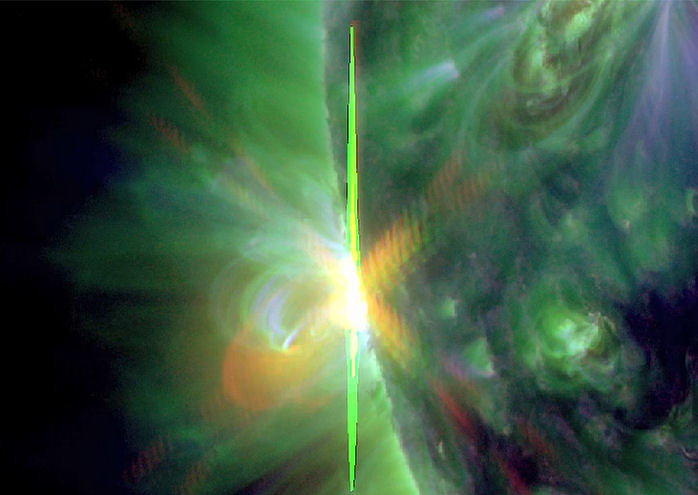
ALMOST-X FLARE: Today at 1814 UT, Earth-orbiting satellites detected an impulsive M9-class solar flare. The source was an active region just behind the sun’s southeastern limb. NASA’s Solar Dynamics Observatory recorded the extreme ultraviolet flash: image. Radio blackouts and ionization waves in the upper atmosphere are possible on the dayside of Earth as a result of this event. Stay tuned for updates.

from:    spaceweather.com

Background of Maine Earthquake

The Facts Behind the Maine Earthquake

Douglas Main, OurAmazingPlanet Staff Writer
Date: 17 October 2012
A USGS map showing, in blue, where people reported feeling the Maine earthquake (on Oct. 16, 2012).
CREDIT: USGS

How unusual was the magnitude-4.0 earthquake that struck southern Maine yesterday (Oct. 16)?

U.S. Geological Survey geophysicist Julie Dutton said it was larger than most but not too out of the ordinary for New England, where one or two minor earthquakes can be felt somewhere every year.

It’s unclear what exactly caused the quake, Dutton told OurAmazingPlanet. “To pinpoint which fault it was — we don’t have that information and we may never have that information,” she said. The area lacks the extensive network of seismometers present in more tectonically active areas. There are many faults in the area, and the fault that was active yesterday was probably small and may never be active again, Dutton said.

The East Coast is riddled with old faults, buried miles deep in the ancient crust of the North American plate, the tectonic plate that underlies the United States and Canada. But most of these fissures haven’t been active in a long time, and very few of them are well-studied or understood.

Stress naturally builds up within tectonic plates and is periodically released in earthquakes like this one, Dutton said.

As in other East Coast quakes, the vibrations Tuesday could be felt over a wide area – as far south as Long Island, N.Y., and as far north as southeastern Ontario, she said.

In North America, feeling shaking over such a larger area is unique to the East Coast. The crust of the eastern part of continent isn’t as fractured as elsewhere, which allows vibrations to travel long distances. That explains how last year’s 5.8-magnitude earthquake, centered in Virginia Aug. 23, was felt by nearly a third of the United States.

Last night’s temblor came from a rupture 4 miles (6 km) underground and struck at 7:12 p.m. local time (23:12 UTC), the USGS reported. The epicenter was about 21 miles west of Portland, Maine.

The earthquake shook houses in Boston and Connecticut, but it apparently did not cause any injuries or damage, according to news reports.  “A magnitude-4 can knock stuff off shelves and that kind of thing, but isn’t likely to cause major structural damage,” Dutton said.

The last earthquake to cause moderate damage in New England was a magnitude-5.6 temblor in New Hampshire in 1940, she said. The largest earthquake in recorded history in New England struck New Hampshire in 1638 and had an estimated magnitude of 6.5, according to the USGS.

Many parts of the country, including California and much of the Southeast, will be holding an earthquake drill tomorrow morning as part of the Great American Shakeout.

from:    http://www.livescience.com/24058-maine-earthquake-facts.html

Russia To Quit Kyoto Protools?

Russia hints plans to quit Kyoto Protocol October 18, 2012 Russian Prime Minister Dmitry Medvedev Enlarge Russia on Thursday hinted that it may refuse to sign up to a new round of targeted carbon cuts that could see the Kyoto environmental protection treaty extended beyond its end of 2012 expiry date. “One has to admit that we never got any real commercial gain from the Kyoto Protocol,” news agencies quoted Prime Minister Dmitry Medvedev, pictured on October 12, as telling a government meeting. Russia on Thursday hinted that it may refuse to sign up to a new round of targeted carbon cuts that could see the Kyoto environmental protection treaty extended beyond its end of 2012 expiry date.
“One has to admit that we never got any real commercial gain from the Kyoto Protocol,” news agencies quoted Prime Minister Dmitry Medvedev as telling a government meeting. “That does not mean that we have to try and drag it (the treaty) out any further,” Medvedev added. European diplomats at the May G8 summit in France said that Russia along with Japan and Canada had confirmed plans not to join the second round of carbon cuts. Russia ratified the treaty in 2004. It has since argued that its terms harm developing nations. Medvedev noted that he had said on repeated occasions in the past that “if the world community fails to agree on Kyoto, we would wave it goodbye.” He said he was thinking of extending the treaty’s terms with EU nations alone. “But considering our uneasy relations with the European Union, I am not sure how likely this scenario will be,” he said. A range of EU nations are probing Russian energy natural gas giant Gazprom for price-fixing and other unfair practices under its new Energy Charter Treaty. Medvedev did not explain his reasoning beyond the mention of Russia’s failure to tap into the profits it could have earned had it sold other nations unused carbon emission credits from its domestic producers. (c) 2012 AFP

Read more at: http://phys.org/news/2012-10-russia-hints-kyoto-protocol.html#jCp

Neil Kramer — Autodidact

The Path Of One

17/02/2011Posted in: Essays

The world of academia does not resonate too strongly with many who walk the path of conscious and spiritual growth. This is, perhaps, understandable when one considers that many entrenched academic concepts of institutional consensus, received wisdom and logical criteria for truth, can seem rather opposed to the trajectory of authentic conscious deepening. Not only that, but from a shadow perspective, it’s relatively straightforward to hijack the academic edifice. After all, if you can sequester the system, you can effectively steer all those who study under it.

In the West, the academic paradigm is still perceived as the ultimate hub for establishing scholarly credibility and continues to serve as the empirical arbitrator of accomplishment and consensus reality. Here in the US, I have noted that there’s still a great deal of fuss made about sticking Dr. in front of someone’s name. Billboards, TV and radio commercials, books and business cards are plastered with such academic titles. Dr Somebody is wheeled in as a talking head for some garish infotainment show, so as to offer an ‘expert’ view of politics, science, history or whatever. Many people buy it, hook, line and sinker. The alternative community is not immune to such occasional haughtiness either. Someone who got a PhD in Floral Management will leverage their title when publicizing their work in the Mysteries Of The Lost Aztec Kingdom. The irrelevance of their qualification does little to affect the credibility curve in the minds of many.

To put it bluntly, lots of people from many different walks of life believe that academic qualifications = authority. After all, who knows better?

Faith in the academic edifice is beginning to crack in some European countries, most notably England. The grandeur of someone’s bachelors or masters degree, or even doctorate, is not quite what it used to be. This is largely due to the fact that people have realized that the whole process of going to university and getting certain qualifications is getting easier and easier. In addition, the connection between one’s degree and the actual career path undertaken, is becoming increasingly divergent. For the last 40 years, successive UK Governments (Conservative and Labour) have resolutely pursued a campaign of getting more and more people into university and making sure they graduate. The annual charade of ever-escalating school and university pass rates is roundly derided by all with eyes to see. The result? Everyone and their dog has a degree now.

Speaking of declining standards in the US educational system, comedian George Carlin said: “They lower the passing grades so more kids can pass. More kids pass, the school looks good, everybody’s happy, the IQ of the country slips another two or three points and pretty soon all you’ll need to get into college is a fucking pencil.”

Perhaps academia has never quite been the glorious testament to human achievement that it presents itself to be. Even the most serious, free-thinking and well-intended scholars will often find themselves pulled into a vortex of insularity, prejudice and separatist specialization. It is the way of things in academia, particularly if you need approved funding for your work. You have to play the game, or else risk getting sidelined or even booted out. Collectivism is rewarded over independence; compliance over distinctiveness. Of course, this naturally balances out and improves over time, especially as the old guard fade away and the new crowd emerges, amongst which there’s always a healthy sliver of maverick and pioneering attitudes. But it takes a good long while to filter through. In the meantime, in such a rapidly changing and disinformation-saturated world, we cannot rely on academia to assist with our knowing. We have to do it for ourselves.

Dawn Of The Autodidact

An autodidact is someone who is largely self-taught. The autodidactic impulse is often characterized by a commitment in the individual to be a self-directed and life-long learner. There is an inherent appreciation that real knowledge is best transmitted direct to the discerning student, without any requirement for official mediation. Famous autodidacts include: William Blake, HP Lovecraft, Leonardo Da Vinci, Michael Faraday, Joseph Campbell, Nikola Tesla, George Bernard Shaw, Ernest Hemmingway, Frank Lloyd Wright, Edgar Alan Poe, Doris Lessing, Benjamin Franklin, Jakob Bohme, Abraham Lincoln, the Wright Brothers, Walt Whitman, Stanley Kubrick, Frank Zappa, John Cage, Arthur C Clarke, Joseph Conrad and Thomas Edison.

Being an autodidact does not mean having no formal education at all. It simply means that it is not the chief source of one’s learning. In the above examples, as it happens, many actually never did see the inside of a classroom. But even for those who did, they either dropped out, or relegated their formal education to mere background noise, from which their own autonomous learning sprang forth, far beyond the intellectual or temporal reach of any institution.

In my own life, I have routinely acknowledged that the most insightful people I have met have all been autodidacts. In some instances, the breadth and penetration of their knowing totally eclipses any apparently corresponding academic mindset. The opposite side of this equation has also proven true; the professors and Cambridge graduates that I have conversed with, at length, have been some of the least discerning and most blinkered folk imaginable. They particularly mark themselves out in this negative aspect by way of their own claims of achievement and authority. Very disagreeable. Of course, this is purely anecdotal and constitutes little more than a broad generalization. However, it does draw one’s attention to certain facets of the autodidactic method that warrant a closer look.

The great privilege of the autodidact is that they have a totally free hand to do whatever they want. Nobody can censor, prejudice or divert them from their own chosen areas of study. They can go where they want, when they want. No concept is too far out, no subject is taboo, no creative tangents are considered a waste of time and belief systems are often gratifyingly upgraded or even totally jettisoned. With correct alignment, all this information processing acts as a jumpgate for transmutation into the felt-experience of real wisdom.

Close on the heels of this freedom comes a distinct responsibility: self-discipline. It is incumbent on the independent scholar to hone a range of skills to endow their studies with the integrity, balance and penetration required to formulate empowering knowledge. Specifically – the ability to employ critical reason and discernment; to correlate and corroborate; to weigh any given idea against the consensus reality tunnel and one’s own personal reality tunnel; to use intuition; to watch how a notion moves through our belief systems and intellectual apparatus. What remains? What changes?

Another key difference between autodidacticism and academia is the value placed on direct felt experience. Who can walk the talk? If you physically meet a person, you can tell if they’re the real deal in the space of a few minutes. Even remotely, from just the spoken or written word, you can figure it out with a little heightened sensitivity. Anyone can read books, hunch over a laptop, visit a few temples, libraries and museums. But none of this constitutes real, juiced-up, direct encounter. The autodidact naturally places a far greater emphasis on the practical application of their knowledge than the academic. After all, they’re playing very different games. Self acceptance, rather than group acceptance, brings about a very different arc of learning. It must be said that there are, of course, some fine ground-breaking academics and there are some bloody awful independent scholars. There’s also no reason why one could not be both autodidactic and academic. Rare, but possible. There are many paths.

Creative Epistemology

Ascertaining the truth of a thing is always a strange and slippery business. Terence McKenna used to say that Austrian philosopher Ludwig Wittgenstein would deal with such problems by saying that something could be “true enough”. One interpretation of this being that if everything is relative, there’s little point in declaring something to be totally 100% true for everyone, in every situation, all the time. I am inclined to agree with this, albeit from an objective standpoint. Subjectively speaking however, we can feasibly say that something is true for ourselves. We can overlay a thing against our inner knowing and feel the essential veracity of it; judge its usefulness as a positive tool for perceiving and articulating our own reality tunnel. To call something ‘true’ in this way, is simply a piece of functional shorthand.

So what happens when the trueness of a thing diminishes? When it became clear that many of Carlos Castaneda’s accounts of his sorcerer’s apprenticeship with Don Juan Matus were factually inaccurate and even total fabrications – it changed the nature of his work for many people. Believers were disheartened. Skeptics were delighted. When I first read his works, it was very pre-Internet, and I had no idea of any of this. I read the classic six books and thoroughly enjoyed them. They spoke deeply to me. I have re-read them many times over the years. To this day, what is remarkable about them is how full of real gnosis they are. Despite the lo-fi anthropological value, I nevertheless find them to be truer than most other texts I’ve ever read. Just how the hell Castaneda came across such fabulous wisdom is still a mystery. Perhaps it was all an intentional double-bluff from the beginning, orchestrated to protect the real source of his teaching? Who knows. I’m just glad he put pen to paper, and decided to share it.

Since the late 1980’s, when I first came across Castaneda, I have had hundreds of experiences that have compelled me to explore the powerful overlay of the imaginal; positioned as it is so provocatively over both the real and the unreal. The further I walk down my own path, the wider I have to set the boundaries for what is real. It works both ways. What was fantasy, becomes actual; what was solid reality, becomes incongruous fakery. 911 being a textbook example. Most people don’t want to seriously study the events of 911, because in the back of their minds, they can feel the latent domino effect of collapsing belief systems. The real story of 911 is so off the map, that even the solemn ramifications of prior-knowledge and high-level treachery, pale compared to the issues of wider reality manipulation. Too weird.

Certainly, as we become more conscious, we become less susceptible to illusion; garbage constructs begin to fade and eventually dissolve altogether, with very little ‘mechanical’ effort from us. Even more significantly, with heightened awareness and a cleaner mental platform, we are able to channel greater resolutions of energy. We can go deeper with our knowing. Deeper into ourselves. Deeper into the universe.

It’s intriguing to watch how a thing can move from one reality filter to another with such fluidity; contravening the human boundaries of truth, belief and existence as if they didn’t exist at all. As I stated in an essay from May 2009, diverting all ones energies into the question of whether a given phenomenon is authentic or fake, may be missing the point. Many of the dozens of phenomenological koans that are routinely investigated in the alternative/esoteric field, go right to the heart of our complicity in the simulated reality construct we labor under. They exist to teach us not to judge whether something is real or not – but rather how it interacts with our own consciousness. As in quantum physics, consciousness itself changes the nature of the thing perceived. We really do have to take a long hard look at the operational value of consensus, received wisdom, peer acceptance and criteria for truth. This plays to the strengths of the autodidact, unshackled as they are from the chains of academic accord or the dreary guidelines of normality.

The real discipline of the independent thinker and the spiritual warrior, lies not in their scholarly capabilities and education, nor even in the anchoring of their knowledge into felt experience – it is in their willingness to transform their own consciousness. To change. This means letting go of things that we think we need, things we have become attached to, things we suspect might even be essential parts of us. More than anything else, it is this clinging to self that prevents us from moving forward. We sometimes forget that we are not the avatar.

The higher aspect of our being, our spirit if you will, never leaves the higher dimensional space. It is not plunged into the 3D as ‘we’ are. It remains effortlessly bulletproof and untainted in its purity, knowing, power and divinity. It is only the avatar that suffers the battle scars of earthly trauma and triumph. Yet this avatar is so lucid, so hi-resolution, so persuasive in its day-to-day consistency, that we forget it’s not actually us. A dream it may be, but one of no more or less reality than a dream from which we awaken in tears of rapture, or sadness, or longing. Undeniably, it moves us deeply.

Establishing a relationship between the avatar and the higher spirit – who we really are – is what certain occultists call the conversation of the Holy Guardian Angel. Hindu spiritual philosophers consider it as making contact with Atman (cognate with the Greek ‘asthma’, curiously enough, meaning to breathe). It is the Daemon of the ancient Greeks, with which Socrates himself documented his own intimate communion. It is in cultivating this relationship between self and spirit, that we transmute our inner knowing from merely acquiring navigational tools for the avatar, to the extraordinary ascendant journey of spiritualization. It is a natural path; elegant, innate, fulfilling and as real as you can imagine.

* Image: Deer Caller, by Susan Seddon Boulet.

from:    http://neilkramer.com/the-path-of-one.html
Fireball Graces Bay Area

BAY AREA FIREBALL: Last night, Oct. 17th, many people near San Francisco saw a slow-moving fireball exploding in the sky around 07:45 pm PDT. Witnesses report bright flashes of light and sonic booms that shook houses. Using a wide-field camera, Wes Jones caught the meteor disappearing behind the trees in the city of Belmont:

“We don’t know yet if the end point [of the meteor’s flight] was over land or water,” says meteor expert Peter Jenniskens of the NASA Ames Research Center. Jenniskens operates a network of Cameras for All-sky Meteor Surveillance (CAMS) near the Bay Area. “Data from the CAMS system should give us an answer [about landfall]. We’re analyzing the data now.” Stay tuned.

Note: Although Earth is nearing a stream of debris from Halley’s Comet, source of the Orionid meteor shower, this fireball was probably not an Orionid. The timing and direction of the meteor do not seem to match the Orionids.

fr/Spaceweather.com

Keep Your Blog Safe from Trolls

Protect Free Speech

freespeech.jpeg
Although we have a constitutionally protected right to free speech, legal trickery can still bypass this ostensibly impenetrable right. With the right lawyer, anyone can slap a bogus lawsuit on you for things you had every right to say publicly.

Matthew Inman, creator of humor website The Oatmeal, was a victim of what is called Strategic Lawsuit Against Public Participation (SLAPP). Targeted by a rival website, he was demanded to pay $20,000 for articles he had written that criticized them. He could either pay settlement fees, or face a lengthy court battle.

The Electronic Frontier Foundation (EFF) helped Matthew fight off the legal threat. However, independent bloggers that find themselves in a similar predicament may not be able to afford the legal counsel necessary to defend their right to online free speech. They could be forced to pay settlement fees, remove articles, or even shut down their blog entirely.

The EFF and the Public Participation Project are calling on congress to support federal anti-SLAPP legislation called the PETITION act. A blogger that is threatened with a SLAPP lawsuit for legitimate online content can file a motion to get the case dismissed quickly, without having to pay legal fees.

Laws like this exist in twenty-eight states, but it’s important to have a federal law passed so that this becomes a non-issue for not only bloggers, but every person, every where.

Help stop anti-speech bullies. Tell Congress to protect free expression both online and off through the PETITION act – click here
Image by ElectronicFrontierFoundation, courtesy of Creative Commons licensing. 


from:    http://www.realitysandwich.com/protect_free_speech

Sunspot Eruption

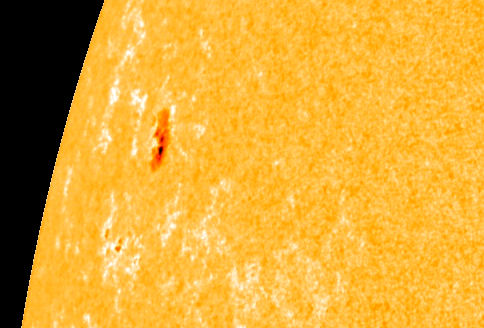
LIGHTBULB ERUPTION: Sunspot AR1593, now emerging over the sun’s northeastern limb, doesn’t look very impressive. Yet two days ago it unleashed a very impressive eruption. NASA’s Solar Dynamics Observatory recorded a glowing bulb of plasma more than 100,000 miles across on Oct. 14th:

The eruption occurred while AR1593 was still on the farside of the sun, so Earth was not in the line of fire. Next time could be different. AR1593 will spend the next ~12 days facing our planet, setting the stage for geoeffective blasts if the sunspot erupts again.

fr/spaceweather.com

Indian Ocean Tectonic Breakup

Unusual Indian Ocean earthquakes hint at tectonic breakup

April 2012 quakes occurred away from plate edges, suggesting formation of a new boundary.

At least four faults within the Indo-Australian plate ruptured simultaneously in April 2012, resulting in two magnitude-8 earthquakes within two hours. (Red stars indicate the epicentres.)

Keith Koper, University of Utah Seismograph Stations

Geological stresses rending the Indo-Australian plate apart are likely to have caused the magnitude-8.6 and magnitude-8.2 quakes, which broke along numerous faults and unleashed aftershocks for 6 days afterwards, according to three papers published online today in Nature1–3.

Seismologists have suspected since the 1980s4 that the Indo-Australian plate may be breaking up. But the 11 April earthquakes represent “the most spectacular example” of that process in action, says Matthias Delescluse, a geophysicist at the Ecole Normale Supérieure in Paris and lead author of the first paper1. Worldwide, “it’s the clearest example of newly formed plate boundaries,” he says.

According to prevailing theories of plate tectonics, the Indo-Australian plate began to deform internally about 10 million years ago. As the plate moved northwards, the region near India crunched against the Eurasian plate, thrusting the Himalayas up and slowing India down. Most scientists think that the Australian portion forged ahead, creating twisting tensions that are splitting the plate apart in the Indian Ocean.

Delescluse and his team inferred the presence of these seismic stresses by modelling stress changes from shortly before the 2012 earthquakes. They found that two earlier earthquakes along the eastern plate boundary — the magnitude-9.1 tremor in 2004 that unleashed a massive tsunami across the Indian Ocean, and another quake in 2005 — probably triggered the 2012 event by adding to pent-up stresses in the plate’s middle region.

Gregory Beroza, a seismologist at Stanford University in Palo Alto, California, says that the model is a likely explanation. “The 2004 and 2005 earthquakes by themselves would not have caused this other earthquake. There had to be other stresses,” he says.

Slip-sliding away

Most large earthquakes occur when two plates collide at their boundaries, and one plate slides beneath the other. By contrast, when plates or portions of plates slip horizontally along a fault line, this usually results in smaller, ‘strike-slip’ earthquakes.

However, the first 11 April event defied expectations as the largest strike-slip earthquake on record, and one of the strongest to occur away from any conventional plate boundaries.

In the second study2, researchers found that the accumulated stresses spread over the plate’s interior broke free in the first 11 April event, resulting in one of the most complex fault patterns ever observed. Unlike most earthquakes that shake along a single fault, this one ruptured along four faults, one of which slipped as much as 20–30 metres.

“This earthquake, it was a ‘gee whiz’,” says study author Thorne Lay, a seismologist at the University of California, Santa Cruz.

Previous work had already identified multiple strike-slip faults for the magnitude-8.6 earthquake5, but no other study had analysed the slip amounts in such detail. Beroza says that Lay and his team “do a splendid job of picking apart this very important earthquake” in their paper.

Lasting impressions

Although much attention has focused on how the earthquakes played out, some researchers are also studying the after-effects of the giant tremor. In a third study3, scientists found that for six days following the event, earthquakes of magnitude 5.5 and greater occurred at almost five times their normal rate all around the world.

“Aftershocks are usually restricted to the immediate vicinity of a main shock,” says lead author Fred Pollitz, a geophysicist at the US Geological Survey in Menlo Park, California. He says that the 11 April example should challenge conventional definitions of how soon and how close aftershocks can occur to large earthquakes.

“Every earthquake is important to study, but this earthquake is rather unique,” says Hiroo Kanamori, a seismologist at the California Institute of Technology in Pasadena. With so many unusual characteristics to examine, the 11 April earthquake sequence may continue for some time to expand researchers’ ideas of how earthquakes can occur.

from:    http://www.nature.com/news/unusual-indian-ocean-earthquakes-hint-at-tectonic-breakup-1.11487


Dutch Sinse Report on Continued Fracking

10/9/2012 — Fracking earthquakes return? Oklahoma 3.0M @ frac well

Now that the plate (over in indonesia) is breaking apart — officially announced at the end of September 2012:

http://www.bbc.co.uk/news/science-environment-19732681

http://www.nature.com/news/unusual-indian-ocean-earthquakes-hint-at-tectonic-breakup-1.11487

Pictured below:

Last 14 days of 5.0M and greater showing the area around the Indo-Australia plate breaking apart:

This explains the West Pacific “unrest” that I’ve been showing in all the earthquake updates for the past year+.

The “spillover” effect is occurring at volcanoes, and adjacent plates to the Indo-Australian plate.. causing an uptick in large earthquakes (compensation for the indo-australian plate demise) around the entire planet… specifically the Pacific ring of fire.

All this activity has lead to the North American Craton, Laurentia, to be ‘moved’ from the WEST.. causing pressure to build upon the N. American craton.. thus, we are seeing activity at ANY spot with deep shaft construction — whether it be dormant volcanoes, fracking/injection well/drilling operations, and even some springs/aquifers !   Not to mention areas having major ‘movement’ problems .. like Bayou Corne, Louisiana — salt dome sinkhole collapse.

It all begins to make sense once you understand OUR plate (north american craton laurentia) is being displaced by the Pacific plate… which itself is being displaced by the Indo-Australian plate breaking apart.

To confirm most of these North American sites are indeed what I say they are… Just look up the coordinates of each greater than 2.5M earthquake in North America via http://earth.google.com to confirm .

from:    http://sincedutch.wordpress.com/


———————————————

It isTime to Label GMO’s Prop 37

Defeat Monsanto — Vote YES on Prop 37

15th October 2012

By Jack Adam Weber

Contributing Writer for Wake Up World

On November 6th this year all of us that despise GMOs and Monsanto will be waiting with bated breath for the outcome of one single proposition that, if passed, could topple the GMO empire in the United States and trickle down to other countries around the world.

Proposition 37, the California Right to Know Genetically Engineered Food Act,

is a citizen generated ballot initiative for mandatory labeling of GMO products in California. If Proposition 37 is voted in, it will:

a) Require labeling on raw or processed food offered for sale to consumers if the food is made from plants or animals with genetic material changed in specified ways.

b) Prohibit labeling or advertising such food as “natural.”

c) Exempt from this requirement foods that are “certified organic; unintentionally produced with genetically engineered material; made from animals fed or injected with genetically engineered material but not genetically engineered themselves; processed with or containing only small amounts of genetically engineered ingredients; administered for treatment of medical conditions; sold for immediate consumption such as in a restaurant; or alcoholic beverages.”

Friends, this is the moment we have been waiting for. This is our most promising opportunity to achieve what we have all been working so hard for, for so long. If we don’t win this, we may never have the chance again.

According to the Organic Consumers Association, we are currently ahead 3 to 1 in California on this vote (passing Prop 37). But we can’t rest easy. Monsanto and other biotech companies know how big this is. Recent statistics show they have already contributed some 37 million dollars to television ads full of misinformation and lies as a last-ditch effort to defeat Proposition 37. They have succeeded with these tactics in the past in other states.

We cannot let them win this time.

Many states have tried to adopt GMO labeling legislation in the past and failed because the legislation was not citizen generated and government officials cowered under threats of a lawsuit by Monsanto. The most recent was Vermont. California is the eighth largest economy in the world, if it were considered a country. Passing this legislation will set a precedent for GMO labeling in other states. Many experts say that if Prop 37 passes in California, GMO labeling might as well be a national law. This is what we want.

Believe it or not, many Americans still don’t even know what a GMO is.

When foods are labeled as GMO, even Monsanto admits it is equivalent to putting a skull and crossbones on it. Sales will plummet; the good word on bad GMOs will spread like wildfire. This is what we want, and now is our chance to deliver the fatal blow to the GMO horror machine.

90% of Americans want GMO labeling. Why don’t we have it? You know the answer—power, greed, money, lies, and corruption at the expense of our health. Let’s all do our part now to make sure the majority of Californians know what’s up. We don’t want Monsanto and friends to have any chance at winning. Here is what you can do; please do this today so that we have as much time as possible for the word to spread:

1. Send an email to everyone you know in California and tell them to vote YES ON PROP 37.

2. Post this on your FB page, along with this link to this article:

  • California friends, please vote YES on Prop 37 this November for the mandatory labeling of GMOs in our food.
  • Please tell all your California email and Facebook contacts to vote “YES on Prop 37.

3) Please join GEM (GMO Eradication Movement).

It is safe to say that the future of food, our own health, and the health of our planet hinges on this vote, now less than one month away. If we don’t win this, we will have lost a crucial chance, and perhaps our last good chance for a while. If we do win this, we will have the biggest party ever!

Please do your part, today. WE need YOU.

from:    http://wakeup-world.com/2012/10/15/defeat-monsanto-vote-yes-on-prop-37/