Ubehebe in Death Valley – Volcano Risk

As if Death Valley wasn’t dangerous enough… geologists discover that one of its volcanoes is due to go off

By TED THORNHILL

Death Valley in California has plenty of hazards, ranging from searing temperatures to flash floods, rock falls, rattlesnakes and scorpions.

Now geologists say that one of its volcanoes is actually far younger and more active than previously thought and is due to go off, because it last exploded in 1200 and has an eruption cycle of 1,000 years or less.

A team based at Columbia University’s Lamont-Doherty Earth Observatory found that the half-mile-wide Ubehebe Crater, formed by a prehistoric volcanic explosion, was created just 800 years ago – and not 6,000 years ago as previously estimated.

Explosive: The half-mile-wide Ubehebe Crater in Death ValleyExplosive: The half-mile-wide Ubehebe Crater in Death Valley

The researchers used isotopes in rocks blown out of the 600-foot crater to show that it formed around the year 1200.

That geologic youth means it probably still has some vigour, with the scientists certain that there is still enough groundwater and magma around for another reaction.

Ubehebe is the largest of a dozen such craters, or maars, clustered over about three square kilometres of Death Valley National Park.

The violent mixing of magma and water, resulting in a so-called phreatomagmatic explosion, blew a hole in the overlying sedimentary rock, sending out superheated steam, volcanic ash and deadly gases such as sulphur dioxide.

Study co-author Brent Goehring says this would have created an atom-bomb-like mushroom cloud that collapsed on itself in a donut shape, then rushed outward along the ground at some 200mph, while rocks hailed down.

Any creature within two miles or more would be fatally thrown, suffocated, burned and bombarded, though not necessarily in that order.

‘It would be fun to witness – but I’d want to be 10 miles away,’ said Goehring of the explosion.

Study: Geochemists dated the crater by analysing rocks thrown out when it exploded. Pictured is researcher Peri Sasnett contemplating a sampleStudy: Geochemists dated the crater by analysing rocks thrown out when it exploded. Pictured is researcher Peri Sasnett contemplating a sample

The team began its work after Goehring and Lamont-Doherty professor Nicholas Christie-Blick led students on a field trip to Death Valley.

Noting that Ubehebe remained poorly studied, they got permission from the park to gather some three to six-inch fragments of sandstone and quartzite, part of the sedimentary conglomerate rock that the explosion had torn out.

They pinpointed the dates to when the stones were unearthed to between 800 and 2,100 years ago and noted that this happened in clusters.

The scientists interpreted this as signalling a series of smaller explosions, culminating in the big one that created the main crater around 1200.

A few other dates went back 3,000 to 5,000 years – these are thought to have come from earlier explosions at smaller nearby craters.

Christie-Blick said the dates make it likely that magma is still lurking somewhere below.

He pointed out that recent geophysical studies by other researchers have spotted what look like magma bodies under other parts of Death Valley.

‘Additional small bodies may exist in the region, even if they are sufficiently small not to show up geophysically,’ he said.

He added that the dates give a rough idea of eruption frequency – about every thousand years or less, which puts the current day within the realm of possibility.

‘There is no basis for thinking that Ubehebe is done,’ he said.

The scientists stress that there are currently no signs of it waking up, which would be preceded by shallow earthquakes and the opening of steam vents, events that could go on for years before anything bigger happened.

The study appears in the current issue of the journal Geophysical Research Letters.

Read more: http://www.dailymail.co.uk/sciencetech/article-2091130/Death-Valleys-Ubehebe-volcano-say-Columbia-University-researchers.html#ixzz1kUnYdsmr

Northern Italy — Series of Earthquakes

2 moderate earthquakes are shaking Northern Italy – slight damage in Parma reported

January 25, 2012 By 

Earthquake overview : A moderate but shallow and thus moderately dangerous earthquake occurred only 13 km from Parma, Italy.

Minor damage (fallen stones, objects etc)

Update 13:39 UTC : This experience report just arrived in our website, it gives a good description of what happened when the earthquake occurred :

We were at school, everything normal until I felt a light shake. I was the first in class to feel it So I backed up my chair but felt nothing anymore, then, a few seconds later (10 seconds) there was a bigger one and everyone immediately went under their desk. Then the teacher cried; ‘no time for that! Get out quick!’ so we got out and went to hallways. Shortly after, there was the alarm therefore everybody quickly went down the stairs to go outside. There were little 4-year-old girls crying and policemen going in the building. We stayed there for 1hour+ until parents came to get us.
ER comment : This teacher should know that what he ordered could make victims. The first pupils action was by far the best (look for cover under desks when the shaking starts). More people are being killed by falling objects than bu collapsed houses. Only evacuate when the shaking stops. This is an advice of almost all of the Preparedness Agencies in the world.

Update 10:43 UTC : INGV, the Italian  local seismological service has reported a magnitude of 4.9. The earthquakes epicenter was located in the valley of the River Po, one of the Italian main rivers. As far as we could follow up the present reporting NO signs yet of any serious damage or injuries although it is too soon to make a final balance.

Update : Max. reported shaking at USGS is a V to VI MMI (moderate to strong shaking). Minor injuries from falling objects like tiles, stones etc cannot be excluded.

Update : experience report just in from Parma says : it lasted about 30-40 seconds.  strong shaking. things falling off of shelves and walls.  pictures broken.

Update : schools in and around Parma have been evacuated

Update : The actual epicenter of this earthquake has been located near the villages of Lentigione, Corte Godi and Enzano.

Update : local reports are mentioning some collapsed chimneys and a lot of panic in the streets of Parm. Also reports of rubble in the streets of Parma

For aftershocks click here and refresh the page regularly

A first weaker 4.1 magnitude earthquake shook Northern Italy at 00:54 local time. It was experienced by a lot of people as a light to weak shaking. The epicenter of this earthquake was close to Verona.

Most important Earthquake Data:
Magnitude : 5.1
UTC Time : Wednesday, January 25, 2012 at 08:06:35 UTC
Local time at epicenter :  Wednesday, January 25, 2012 at 09:06:35 AM at epicenter
Depth (Hypocenter) : 10.2 km
Geo-location(s) :
13 km (8 miles) NE of Parma, Italy
75 km (46 miles) SSW of Verona, Italy

to read more and for updates, go to:    http://earthquake-report.com/2012/01/25/2-moderate-earthquakes-are-shaking-northern-italy-slight-damage-in-parma-reported/

Analysis of Tokyo’s Earthquake Risk

Tokyo sees high quake probability, scientists warn

By Elizabeth Yuan, CNN
updated 7:17 AM EST, Tue January 24, 2012
Japan's highest mountain, Mount Fuji, rises behind Tokyo's skyscraper skyline, as the sun sets in this photo last year.
Japan’s highest mountain, Mount Fuji, rises behind Tokyo’s skyscraper skyline, as the sun sets in this photo last year.

STORY HIGHLIGHTS
  • Forty-two million people live in Tokyo metropolitan area
  • University researchers cited findings on increase in small tremors
  • Government put 70% probability of magnitude-7 quake in region within 30 years
  • March 11 quake and tsunami left more than 15,700 dead, government says

(CNN) — Tokyo faces the possibility of being hit by a massive earthquake within the next four years, according to Japanese researchers.

The University of Tokyo’s Earthquake Research Institute predicts there is a 70% probability that the capital’s metropolitan area will experience a magnitude-7 quake within four years and a 98% probability within the next 30 years.

Nearly one year ago, a magnitude 9.0 quake struck off Japan’s central Pacific coast, triggering a devastating tsunami and aftershocks that left more than 15,700 dead, according to a government report in December on Japan’s recovery from the catastrophe. About 4,500 were listed as missing.

Nearly 700 aftershocks registering magnitude 5 or greater followed last year’s quake, the government report said.

The March 11 earthquake — dubbed “Tohoku” after the region in which it occurred — also damaged the Fukushima Dai-ichi nuclear power station, where three reactors experienced full meltdowns, creating a nuclear crisis for a country already grappling with disaster.

Quake, tsunami debris threaten coastlines

The research institute cited for its findings the Gutenberg Richter Law, which states that an increase in small tremors will likely increase the number of larger earthquakes. According to another paper published in September, the institute concluded that the quake ruptured a fault area nearly 500 kilometers in length and 200 kilometers wide offshore.

The fourth strongest quake recorded in history, Tohoku caused abrupt stress changes in the upper plate and triggered widespread seismic activity throughout the Japanese island. The northern part of Ibaraki Prefecture, in particular, saw a significant increase of shallow seismicity after the quake compared with the extremely low rate eight years prior, the researchers said.

Should Tokyo’s inhabitants be worried?

The research institute’s findings carry great consequences for the 42 million people who live in the Tokyo metropolitan area. The Central Disaster Management Council has estimated that a large-scale earthquake in the next few decades could result in 11,000 deaths and an economic loss of 112 trillion yen (US$1 trillion). Its goal is to halve the estimated death toll and reduce the estimated economic loss.

How precise are seismic forecasts?

Gary Gibson, a seismologist at Australia’s Seismology Research Centre Seismology Research Centre, called the Earthquake Research Institute’s findings “not at all unexpected,” given the level of seismic activity and their model.

“Seismologists cannot predict with certainty when, where and how large the next big earthquake will be,” he wrote in an e-mail to CNN. “However, it is possible to forecast the probability of an earthquake in a particular time range (e.g. the next four years), location area (e.g. the Tokyo region), and magnitude range (e.g. greater than magnitude 7.0).

“Long-term forecasts use average activity levels from past earthquakes, geological data from fault displacements, and data about plate movement and deformation from very precise GPS measurements and other methods to determine these probabilities.”

What is the government saying?

The government’s Headquarters for Earthquake Research Promotion had put a 70% probability of a magnitude-7 quake in Kanto region, which encompasses Tokyo and Yokohama, within 30 years, based on long-term seismicity and hazard studies.

Scientists have already dubbed as “Tokai” an expected 8.0 quake near Suruga Bay, where large quakes have historically struck every 100-150 years, according to the Japan Meteorological Agency. The last one, a magnitude-8.4 quake, occurred in 1854 — nearly 160 years ago.

According to Gibson, the seismologist, the enhanced seismicity in the area affected by the Tohoku quake may fall towards normal levels and could affect the research institute’s findings. Results for the six-month period after the quake would become available after this coming March 11, the quake’s anniversary, he noted.

Why is Japan so prone to earthquakes?

The Japanese archipelago and neighboring areas rest on or around four tectonic plates — the Pacific, Philippine Sea, North American and Eurasian plates — whose movements account for one of the most seismically active places on earth.

Can Tokyo withstand a 7.0 quake?

Gibson said that while the area is a very active one seismically, building standards are high, therefore reducing the damage caused by earthquakes. Buildings in Tokyo held up well in the face of the “Tohoku” quake. Reinforced concrete and anti-seismic systems in buildings are among features that have helped absorb shocks when earthquakes occur.

Watch Tokyo’s quake-proof communities

“A magnitude 7.0 earthquake is very much smaller than the magnitude 9.0 Tohoku earthquake,” he wrote. “It would need 1,000 magnitude-7.0 earthquakes to release as much strain energy as the magnitude 9.0. The fault rupture size is tens of kilometers, rather than hundreds of kilometers, and the fault displacement two to three meters rather than 20 to 30 meters.”

Serious damage could be limited, if it occurs offshore, he added. And the shallower the quake, such as within 10 kilometers of the surface, the more localized the damage.

CNN’s Junko Ogura contributed to this report.

this story comes from:    http://www.cnn.com/2012/01/24/world/asia/tokyo-quake-forecast/index.html?hpt=hp_t3
Amazing Images of Recent Auroras


Auroras spark awe across the north


AuroraMAX / Canadian Space Agency

The northern lights take on a weird, rippling shape in a super-wide-angle view captured Sunday night by the Canadian Space Agency’s AuroraMAX webcam in Yellowknife, capital of the Northwest Territories. There’s more from AuroraMAX at the project’s website and on Twitpic.

By Alan Boyle

Is it “auroras” or “aurorae”? The dictionary prefers the former, but either way, there was a multiplicity of auroral awesomeness this weekend — thanks to a solar storm that swept past Earth’s magnetic field over the weekend. During the past few days, we’ve shown off a few stunning images from Norway and Canada, and there’s a new crop to share today.

First, a little explanation for what you’re looking at:

Auroral lights arise when electrically charged particles from the sun interact with atoms and ions high up in Earth’s atmosphere, 60 to 200 miles up. The interaction sets off emissions in wavelengths ranging from blue, to green (the most common color), to red. The colors depend on the energy of the particles in question. To get the full story on that, check out the explanations from the“Causes of Color” website and the University of Alaska at Fairbanks.

This weekend’s auroras were particularly bright because ofa strong solar outburst that occurred on Thursday. There’s an interval between the outburst and the displays because the particles that are ejected from the sun travel at far less than the speed of light. But they’re still pretty speedy — the velocity is on the order of a million miles an hour.

Solar outbursts, known more formally as coronal mass ejections or CMEs, have the potential to disrupt electrical grids or satellite communications. There could be radiation effects on astronauts in orbit or passengers on high-altitude, pole-traversing airplane flights. Thursday’s outburst dealt Earth’s magnetic field a glancing blow, and no significant negative impact has been reported. However, an even stronger CME is currently on its way toward Earth and may force the rerouting of polar flights. Once again, electric-grid managers and satellite operators will be on alert, as will aurora-watchers.

Observers in northern latitudes can look forward to enhanced auroras over the next couple of nights — and the rest of us can look forward to more images like these:

Bjorn Jorgensen

Bjorn Jorgensen’s view of the aurora was captured on Sunday at Grotfjord, close to Tromso in north Norway. “This was amazing,” he told SpaceWeather.com. “It was a wonderful experience to see these stunning auroras.” The bird-of-prey picture was taken with a Nikon D3S camera equipped with a Nikkor 14-24mm lens. Exposure for the pictures in Jorgenson’s set was ISO 2200 at five and six seconds. Check out SpaceWeather.com andArcticPhoto.no for more views.

Chad Blakley / Lights Over Lapland

Chad Blakley said on Sunday that he had “an unbelievable night” at Sweden’s Abisko National Park. “As soon as the sun went down I realized that we were about to experience something special,” he told SpaceWeather.com. “The auroras have been dancing all night long and show no sign of stopping! I only came in because 32 gigabytes of memory cards were full and all three batteries were dead!” Click on over to Blakley’s Vimeo page for a time-lapse video version of this imagery, and check out SpaceWeather.com for more from Abisko.

for more amazing picture of these auroras, go to the story at:   http://photoblog.msnbc.msn.com/_news/2012/01/23/10217788-auroras-spark-awe-across-the-north

Incoming CME Effects

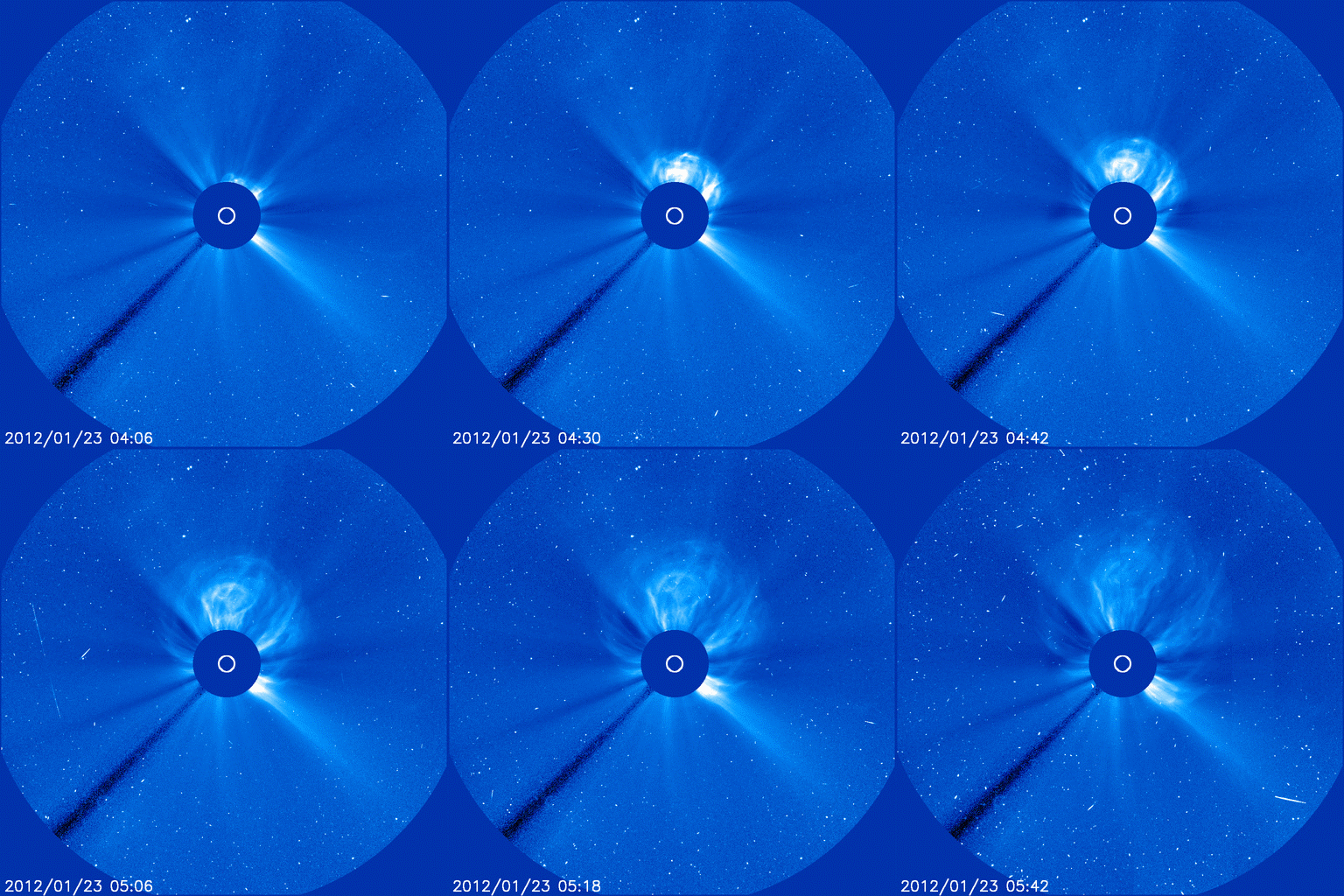
ALMOST-X FLARE AND CME (UPDATED): This morning, Jan. 23rd around 0359 UT, big sunspot 1402 erupted, producing a long-duration M9-class solar flare. The explosion’s M9-ranking puts it on the threshold of being an X-flare, the most powerful kind. NASA’s Solar Dynamics Observatory captured the flare’s extreme ultraviolet flash:

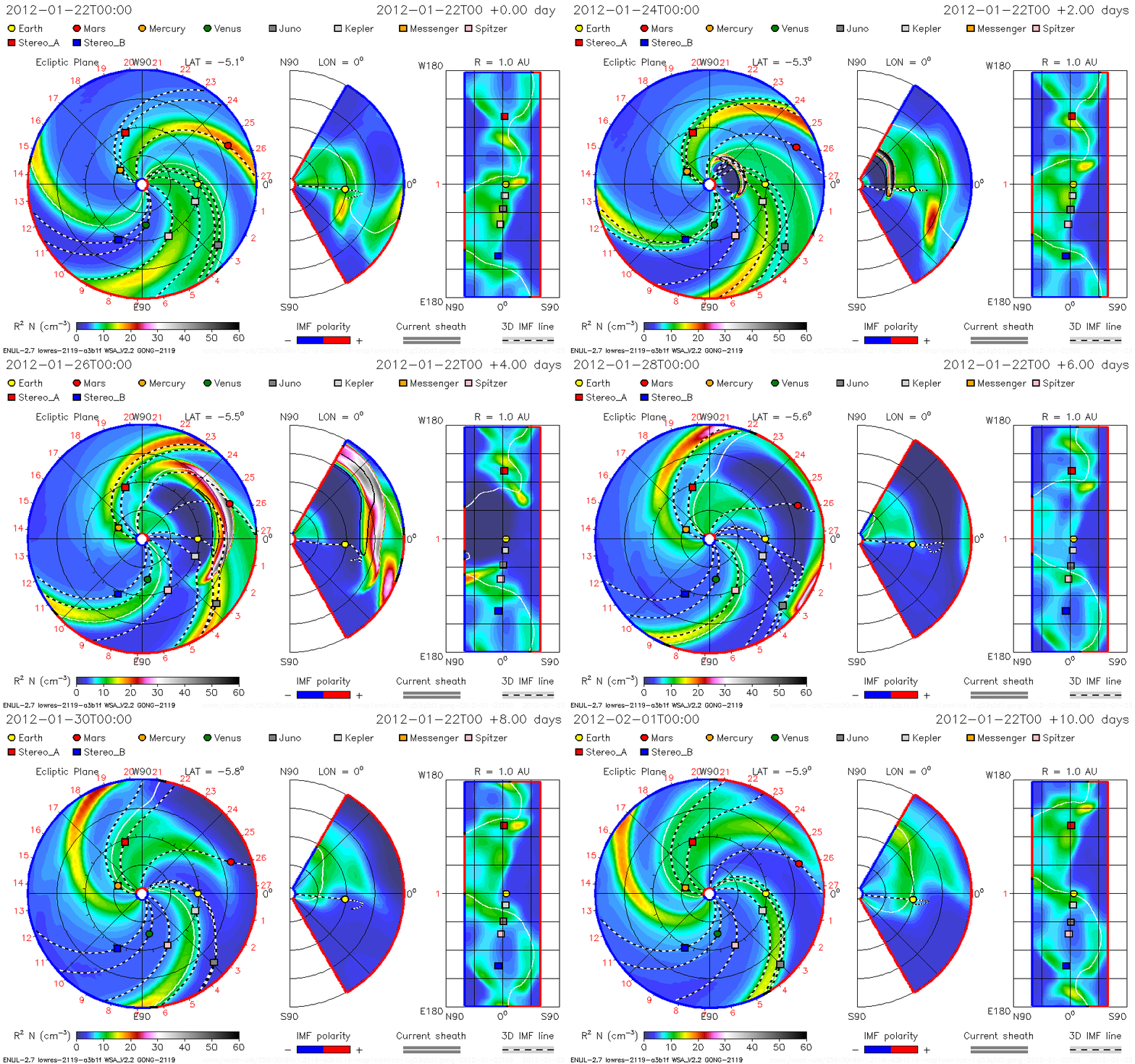
The Solar and Heliospheric Observatory (SOHO) and NASA’s STEREO-B spacecraft detected a CME rapidly emerging from the blast site: movie. Analysts at the Goddard Space Weather Lab say the leading edge of the CME will reach Earth on Jan. 24 at 14:18UT (+/- 7 hours). Their animated forecast track shows that Mars is in the line of fire, too; the CME will hit the Red Planet during the late hours of Jan. 25.

This is a relatively substantial and fast-moving (2200 km/s) CME. Spacecraft in geosynchronous, polar and other orbits passing through Earth’s ring current and auroral regions could be affected by the cloud’s arrival. In addition, strong geomagnetic storms are possible, so high-latitude sky watchers should be alert for auroras

from: spaceweather.com

Current Radiation Storm

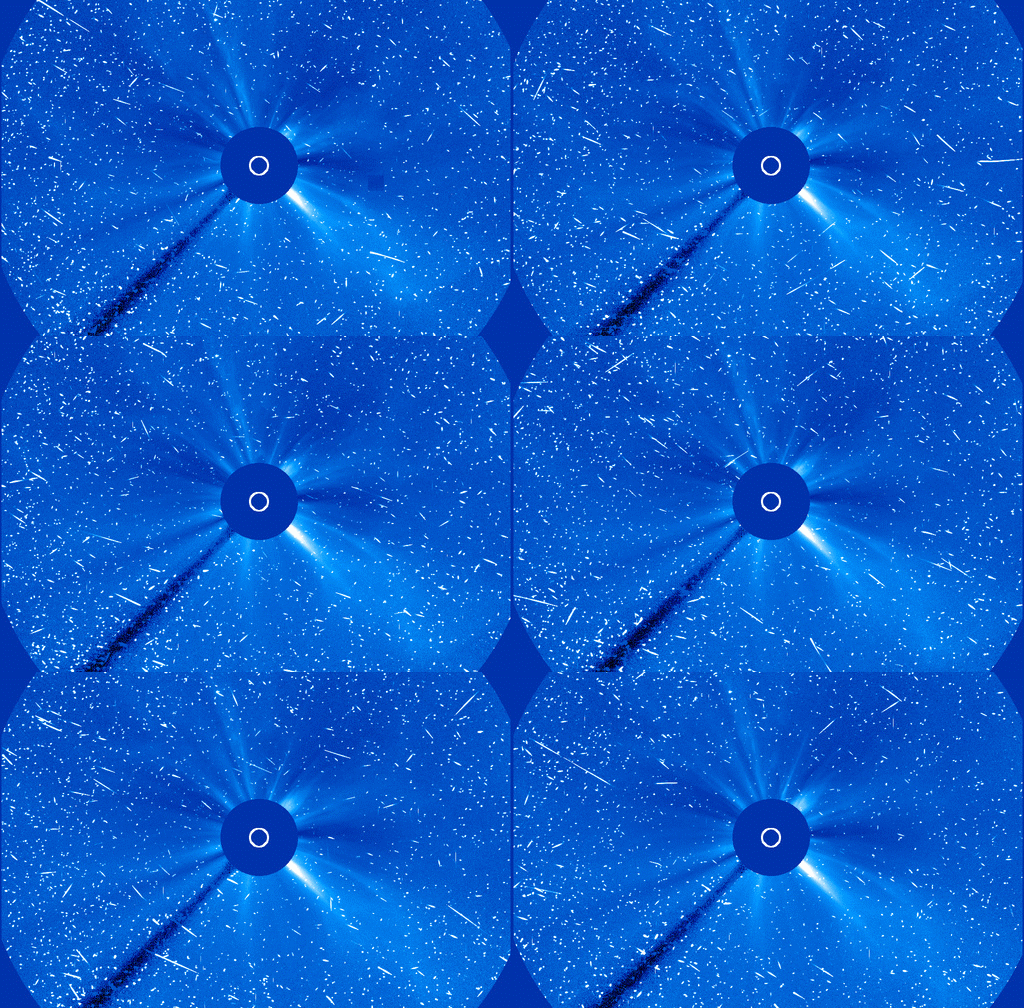
RADIATION STORM IN PROGRESS: Solar protons accelerated by this morning’s M9-class solar flare are streaming past Earth. On the NOAA scale of radiation storms, this one ranks S3, which means it could, e.g., cause isolated reboots of computers onboard Earth-orbiting satellites and interfere with polar radio communications. An example of satellite effects: The “snow” in this SOHO coronagraph movie is caused by protons hitting the observatory’s onboard camera.

from: spaceweather.com

More Unusual Tornadic Activity 1/23

1/23/2012 — FURTHER expansion of Tornado threat watch = AL, GA, SC, NC, VA, WV, MI

Posted on January 23, 2012

Watch the video alert here:

————————————————-

BE PREPARED if you live in any of these states!

currently 1230am CST — there have been several tornadic outbreaks with damaging winds / hail… in Arkansas, Illinois, Tennessee, Louisiana, Missouri, Kentucky, Ohio, Alabama, Mississippi, Indiana, Louisiana, and Michigan…

Areas to watch out for next will most likely be Alabama, Georgia, South Carolina, North Carolina, Virginia, and West Virginia.

Illinois and Michigan are getting hit with hail and damaging winds– also possible tornadoes detected:

By 6am EST 1/23/2012 — look in the area marked below for severe weather to develop:

Watch the east coast states (new england)… it is up for debate as to whether severe will hit these areas.. or will the cooler weather kill the storm when it arrives in the north east?

I would venture a guess that AT LEAST damaging winds will reach New York. Be prepared as always.

for the rest of the story and more information, go to:http://sincedutch.wordpress.com/

CME and Aurora Photo

JAN. 22ND CME IMPACT: Arriving a little later than expected, a coronal mass ejection (CME) hit Earth’s magnetic field at 0617 UT on Jan. 22nd. According to analysts at the Goddard Space Weather Lab, the CME strongly compressed Earth’s magnetic field and briefly exposed satellites in geosynchronous orbit to solar wind plasma. For the next 24 hours, Earth’s magnetic field reverberated from the impact, stirring bright auroras around the Arctic Circle. Bjørn Jørgensen observed this display from Tromsø, Norway:

“This was amazing,” he says. “It was a wonderful experience to see these stunning auroras.”

NOAA forecasters estimate a 10% – 25% chance of continued geomagnetic storms tonight as effects from the CME impact subside. The odds will increase again on Jan. 24-25 as a new CME (from today’s M9-clare) approaches Earth. High-latitude sky watchers should remain alert for aurorasfr/ spaceweather.com

On Getting Rid of Plastic Bags

Cities Take Up the “Ban the Bag” Fight

Why new policies across the nation could mean the end of plastic bags.
posted Dec 19, 2011


Plastic Bag photo by Kate Ter Haar

Photo by Kate Ter Haar.

Environmental activists are reducing plastic waste pollution by tackling disposable plastic bags, one city at a time. About 20 U.S. cities and towns have passed disposable bag reduction laws, including San Francisco and Washington, D.C.

Whether they impose a nominal fee for single-use, disposable bags, or ban them altogether, the laws encourage consumers to develop habits to replace disposable bags, particularly those made from plastic.

The most recent city to join the effort to ban the bag is Portland, Ore., which has banned single-use plastic bags at the checkouts of large retailers. The change was met with overwhelming support from most Portlanders, says Stiv Wilson of 5 Gyres Institute, who helped give out free reusable bags at grocery stores to ease the transition for shoppers on October 15, when the ban took effect.

The Portland ordinance, unanimously approved by Portland City Council, was the culmination of a four-year campaign by the Surfrider Foundation Portland Chapter, 5 Gyres Institute, and the Oregon League of Conservation Voters. It reflects growing public concern about the environmental impact of disposable plastic.

“Plastic bags typically have a low recycling rate, seem to be littered often and have an easy alternative in reusable bags,” says Bill Hickman, coordinator of the Surfrider Foundation’s “Rise Above Plastics” program. “We hope that people understand some of the unintended consequences that go along with a disposable lifestyle.”

plastic bag still
The Majestic Plastic Bag
The epic journey of a plastic bag from its release into the wild to ultimate destination in the middle of the Pacific Ocean.

Disposable shopping bags are a significant source of plastic pollution in the oceans, where scientists have identified five huge gyres of “plastic soup.” “We’ve reached a tipping point where we can’t keep up with the stuff that’s in the ocean,” says Wilson, who has visited three of the gyres for research. “I’ve seen it firsthand, and it’s startling.”

Proponents of ban-the-bag ordinances have faced powerful industry-backed counter-campaigns. The American Chemistry Council, a trade group representing plastics manufacturers, defeated legislation for a statewide ban on single-use bags in California, and spent $1.4 million in Seattle in 2008 to defeat a referendum that would have imposed a 20-cent fee on disposable grocery bags. Plastic bag manufacturer and recycler Hilex Poly Company funded a campaign that defeated Oregon’s proposed statewide ban earlier this year.

Campaigners hope the success of municipal ordinances will motivate grocers to support statewide bans in the near future.

from:    http://www.yesmagazine.org/issues/the-yes-breakthrough-15/cities-take-up-the-ban-the-bag-fight

Worldwide Volcano Webcams – List

/1/2012 — All the Volcano Webcams of the world

Posted on January 2, 2012

(mirrored from big think) just in case their site ever goes down

Pacific

Hawai’i (United States) 

Haleakala – info – webcam

Kilauea – info – webcams: Pu’u O’o | All HVO webcams | Halema`uma`u Crater from HVO | Halema`uma`u Crater overlook |

Mauna Kea – info – webcam

Mauna Loa – info – webcam

Mariana Islands (United States)

Anatahan – info – webcam

Western/Southern Pacific

Japan – The Japanese Meteorological Agency has a page of 40+ webcams, but the names are all in Japanese

Asama – info – webcams: one | two | three

Aso – info – webcams: one | two | three | four – multiple views | five

Bandai – info – one | two

Chokai – info – webcam

Daisetsu – info – webcam

Fuji – info – webcams: one | two | Shimiza port | Fujinomiya City | Lake Tanuki | Lake Saiko | Lake Kawaguchi | Mt. Mitsutoge | Fujiyoshida City | Oshino | Gotemba

Hiuchi – info – webcam

Iwate – info – webcams: one | two

Kirishima – info – webcams: one (sixth and seventh from bottom on right menu) | two |three

this list is quite extensive, and I have included just the few at the start.  To get to the source, the whole list compiled by Dutch Sinse, go to:    http://sincedutch.wordpress.com/2012/01/02/112012-all-the-volcano-webcams-of-the-world/