Massive Flooding on the Yangtze and now snow in Beijing. Are we seeing weather manipulation?
from: https://www.youtube.com/watch?v=ZP4UcWt1qW4
Massive Flooding on the Yangtze and now snow in Beijing. Are we seeing weather manipulation?
from: https://www.youtube.com/watch?v=ZP4UcWt1qW4
Months ago we highlighted how Argentina has long sought to push a massive fleet of foreign fishing vessels, mostly Chinese, out of its Exclusive Economic Zone (EEZ), which are eager to at night illegally sweep up squid and other abundant fish just off the South American coast line.
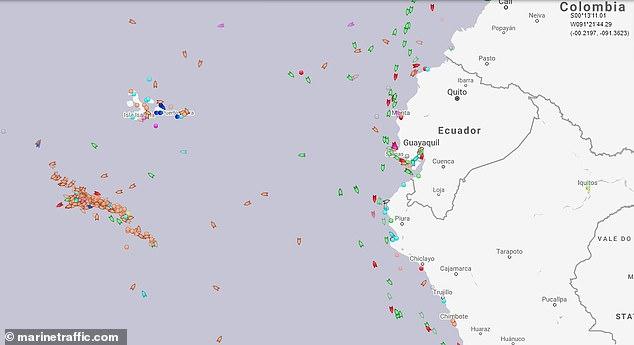
Now Ecuador is dealing with the same problem, but it’s gaining increased international attention given Chinese fishing vessels are said to be encroaching around the protected and ecologically rich Galapagos Islands off Ecuador’s coast.

For years these foreign vessels have been source of controversy, especially following a 2017 incident wherein a Chinese ship was caught inside the Galapagos Marine Reserve with a 300 ton load of mostly sharks, especially the extinction-threatened hammerhead.
A new FOX report describes that “A large fleet of some 260 Chinese fishing vessels has been spotted in the waters surrounding the Galápagos Islands off the coast of Ecuador, the country’s navy officials said last week.”
Like other countries which has a sprawling South American coastline, crucial for the local economy, the Ecuadorian Navy has remained on high alert for illegal fishing conducted by foreign vessels.

“We are on alert, conducting surveillance, patrolling to avoid an incident such as what happened in 2017,” Ecuador’s Defense Minister Oswaldo Jarrin announced this week.
“There is a corridor that is international waters, that’s where the fleet is located,” he added.

The nine-island archipelago made famous in the 19th century by naturalist Charles Darwin’s scientific discovery travels have for decades been listed as a protected Unesco world heritage site, as well as a 188-mile radius surrounding it.
Ecuadorian reports suggest the massive Chinese fishing fleet is sitting just 12 miles off this designated boundary.
Vamos a trabajar en una postura regional para defender y proteger la Zona Económica Exclusiva alrededor de la Reserva Marina de Galápagos, una de las áreas más ricas de pesca y un semillero de vida para el planeta entero. #SOSGalápagos pic.twitter.com/GzHWBZrT57
— Lenín Moreno (@Lenin) July 25, 2020
Ecuadorian officials have slammed the large fleet as “aggressive” and “a threat” to the delicate marine life ecosystem of the Galapagos
Interestingly, even US Southern Command took note and tweeted about it via its official account:marine life
WATCH: About 260 Chinese fishing boats have been detected in the ocean surrounding the #Galápagos islands off #Ecuador, according to the country’s navy. The ships, found just outside a protected zone, raise the prospect of damage to the marine ecosystem. https://t.co/OnoHFCwtFb
— U.S. Southern Command (@Southcom) July 28, 2020
“Unchecked Chinese fishing just on the edge of the protected zone is ruining Ecuador’s efforts to protect marine life in the Galápagos,” former Ecuadorian environment minister, Yolanda Kakabadse, stated this week.
In response, Ecuador is leading an international push to have its exclusive economic zone expanded to include a 350-mile radius out from the islands, in order to give its navy greater authority to push foreign vessels further from Galapagos waters.
from: https://www.zerohedge.com/geopolitical/ecuadorian-navy-high-alert-260-strong-chinese-fishing-fleet-encroaches-protected

(TMU) – While most of us have only experienced jungles and their wild inhabitants through documentaries and social media, which, thankfully, has brought the wonders of nature into our homes.
Wildlife photographer Mithun, based in India, is one such person dedicated to bringing the mysteries of the jungles to life for those who may never be fortunate enough to experience the wild first-hand.
Born in the jungles of South India, Mithun grew up fascinated by wildlife and had a passion for big cats, leopards in particular.
He worked on ‘The Real Black Panther’ for Nat Geo Wild, which undoubtedly fueled his passion for the jungle and the big wild cats further. He now uses his knowledge in tracking big cats as well as leading exclusive, personalized private safaris.
Viewers were enthralled by his photograph of a leopard with a black panther standing behind her, and his post went viral quickly. The two wild cats are seemingly staring into the camera quite calmly, and was captured in a way that makes the panther appear to be the leopard’s shadow.
In an interview on social media, Mithun said: “I can still close my eyes and relive that moment every single day of my life. You don’t see that often. Probably an once-in-a-lifetime opportunity. There was certainly a lot of waiting and patience that went into it. I had waited 6 days for this in the same spot since I could hear the panther and Cleopatra mating about 100 meters away in the thick undergrowth, but could not see them due to limited visibility. They had made a large kill and would not move until it was over. That is where the knowledge and years of experience of following and tracking the panther came in handy. I just had to wait at one of his favorite paths, since that was the place he would get her, since that was the edge of his territory, and this he did after 6 days. It was a fruitful wait, though. I could wait for 6 years for a moment like this.”
He explained that the element of surprise is what he loves most about wildlife photography: ‘’You never know what you are going to encounter at the next bend. The woods are mysterious, and to unlock that is my passion. You could be waiting for days and months and years for that perfect shot. But when it happens, those few seconds are magical, and to live for after all that time. That is the beauty of wildlife photography.’’
Mithun’s life changed in 2009, when he got his first camera and captured a huge, magnificent male tiger, swimming through a flowing river. ‘’That was the moment I decided my way forward in life,” he said and continued:
“Although I love every form of wildlife and love my birds as well, big cats were always a fascination from the beginning. Leopards, in particular, were my first love. The agility, the grace of this feline on the trees just fascinated me to no end. I would spend hours watching them lazing on a tree with their little ones. Have named and followed their individual journey in Kabini for the last 12 years now. It all started with one of my favorite Leopards whom I called ‘Monk’ (a big male) and ‘Moon’ (the female), and their generation still going strong now.”
Wildlife photography is certainly not for the faint of heart. Indeed, apart from having your camera at the ready, plenty of patience is a must and having knowledge of your subject and the terrain provides a great advantage. Mithun’s advice: “It definitely has some dangers associated for sure. But if you know your limits and study animal behavior, which is the most important facet, then you have won half the battle. These beautiful creatures are generally more scared and shy than we think. Give them space and let them get comfortable with you and you realize how close and personal you can get with their world. The secret is patience and respect.”
Through his work, the photographer also became a conservationist and his mission is to support and create awareness for the conservation of leopards in particular because, he says, ‘’They are the most neglected of the big cats across the world and in danger because of conflict with humans on the edges of the forests. People need to realize the beauty and grace of this amazing feline and their very important role in the ecosystem.”
from: https://themindunleashed.com/2020/07/this-wildlife-photographer-waited-6-days-for-perfect-leopard-black-panther-shadow-shot.html
Posted by Julie Celestial on

Crop yields for major crops such as apples, blueberries, and cherries across the U.S. are being limited by a lack of pollinators due to the decline of the wild bee population, according to new research, which was the most comprehensive study of its kind. Researchers noted that as most of the world’s crops depend on honeybees and wild bees for pollination; declines in both populations also raise a concern about global food security.
“We found that many crops are pollination-limited, meaning crop production would be higher if crop flowers received more pollination,” said senior author Rachael Winfree, a professor in the Department of Ecology, Evolution, and Natural Resources in the School of Environmental and Biological Sciences at Rutgers University-New Brunswick.
The research is said to be the most comprehensive study of its kind to date.
“We also found that honey bees and wild bees provided similar amounts of pollination overall,” she added.
“Managing habitat for native bee species and/or stocking more honey bees would boost pollination levels and could increase crop production.”
Pollination by wild and managed insects is crucial for most crops, including those essential for food security. In the U.S., the production of crops that depend on pollinators produces more than 50 billion dollars a year.
Recent evidence shows that European honeybees and some native wild bee species are declining. Scientists gathered data on insect pollination of crop flowers and yields at 131 farms across the U.S. and British Columbia in Canada.

Image credit: Flickr
The yields included apples, highbush blueberries, sweet cherries, tart cherries, almond, watermelon, and pumpkin. Crops that showed evidence of being limited by pollination were apples, sweet cherries, tart cherries, and blueberries, indicating that yields are lower than what they would be with full pollination. Wild bees and honey bees provided the same amount of pollinations for most crops.
The yearly production value of wild pollinators for all seven crops was approximately 1.5 billion dollars in the U.S. The value of wild bee pollination for all crops dependent on pollinator would be much greater, the researchers said.
“Our findings show that pollinator declines could translate directly into decreased yields for most of the crops studied.”
The results indicate that adopting practices that conserve wild bees– like enhancing wildflowers and using managed pollinators other than honey bees– may possibly boost yields. Meanwhile, increasing investment in honey bee colonies would be another alternative.
Reference
Crop production in the USA is frequently limited by a lack of pollinators – Reilly, J. R. et al. – Proceedings of the Royal Society B: Biological Sciences – DOI: 10.1098/rspb.2020.0922
Most of the world’s crops depend on pollinators, so declines in both managed and wild bees raise concerns about food security. However, the degree to which insect pollination is actually limiting current crop production is poorly understood, as is the role of wild species (as opposed to managed honeybees) in pollinating crops, particularly in intensive production areas. We established a nationwide study to assess the extent of pollinator limitation in seven crops at 131 locations situated across major crop-producing areas of the USA. We found that five out of seven crops showed evidence of pollinator limitation. Wild bees and honeybees provided comparable amounts of pollination for most crops, even in agriculturally intensive regions. We estimated the nationwide annual production value of wild pollinators to the seven crops we studied at over $1.5 billion; the value of wild bee pollination of all pollinator-dependent crops would be much greater. Our findings show that pollinator declines could translate directly into decreased yields or production for most of the crops studied, and that wild species contribute substantially to the pollination of most study crops in major crop-producing regions.
Featured image credit: Flickr
from: https://watchers.news/2020/07/30/bee-population-decline-threatens-major-crop-yields-in-u-s-and-global-food-security/
Posted by Julie Celestial on (2 days ago)
Categories: Editors’ picks, Research, Seismic activity, Solar activity

A new study published in the Nature Scientific Reports on July 13 suggests that powerful eruptions on the Sun can trigger large earthquakes on Earth. In the paper, the authors analyzed 20 years of proton density and velocity data, as recorded by the SOHO satellite, and the worldwide seismicity in the corresponding period, as reported by the ISC-GEM catalogue. They found a clear correlation between proton density and the occurrence of large earthquakes (M > 5.6), with a time shift of one day.
The Sun may seem relatively docile, but it is constantly bombarding the solar system with energy and particles in the form of the solar wind.
Sometimes, eruptions on the Sun’s surface cause coronal mass ejections that hurtle through the solar system at extremely fast rates.
The new study suggests that particles from eruptions like this may be responsible for triggering groups of powerful earthquakes.
“Large earthquakes all around the world are not evenly distributed– there is some correlation among them,” said co-author Giuseppe De Natale, research director at the National Institute of Geophysics and Volcanology in Rome, Italy.
“We have tested the hypothesis that solar activity can influence the worldwide [occurrence of earthquakes].”
Scientists noted a pattern in some massive earthquakes around the planet– they tend to occur in groups, not randomly. This indicates that there may be some global phenomenon triggering these worldwide tremors.
To address this, researchers searched through 20 years of data on both earthquakes and solar activity– specifically from NASA-ESA’s Solar and Heliospheric Observatory (SOHO) satellite– seeking any probable correlations.

Image credit: NASA/SDO
SOHO, located about 1.45 million km (900 000 miles) from our planet, monitors the Sun, which helps scientists track how much solar material strikes the Earth.
By comparing the ISC-GEM Global Instrumental Earthquake Catalogue– a historical record of powerful tremors– to SOHO data, the researchers noticed more strong earthquakes happened when the number and velocities of incoming solar protons increased.
When protons from the Sun peaked, there was also a spike in earthquakes above M5.6 for the next 24 hours.
“This statistical test of the hypothesis is very significant,” said De Natale. “The probability that it’s just by chance that we observe this, is very, very low– less than 1 in 100 000.”
After noticing there was a correlation between solar proton flux and strong earthquakes, the researchers went on to propose a mechanism called the reverse piezoelectric effect.
Compressing quartz rock, something common in the Earth’s crust, can produce electrical pulse through a process called the piezoelectric effect. The researchers think that such small pulses could destabilize faults that are nearing rupture, triggering earthquakes. Signals from electromagnetic evens, such as earthquake lightning and radio waves, have been recorded occurring alongside quakes in the past.
Some scientists think these events are caused by the quakes themselves, but other studies have spotted strong electromagnetic anomalies before huge earthquakes and not after, so the exact nature of the correlation of earthquakes and electromagnetic fields is still debated.
Meanwhile, this new explanation suggests that electromagnetic anomalies are not the result of earthquakes, but cause them instead. As positively charged protons from the Sun hit the Earth’s magnetic bubble, they generate electromagnetic currents that propagate across the world. Pulses created by these currents go on to deform quartz in the crust, ultimately triggering earthquakes.
Reference
“On the correlation between solar activity and large earthquakes worldwide” – Marchitelli, V. et al. – Scientific Reports – https://doi.org/10.1038/s41598-020-67860-3 – OPEN ACCESS
Large earthquakes occurring worldwide have long been recognized to be non Poisson distributed, so involving some large scale correlation mechanism, which could be internal or external to the Earth. Till now, no statistically significant correlation of the global seismicity with one of the possible mechanisms has been demonstrated yet. In this paper, we analyze 20 years of proton density and velocity data, as recorded by the SOHO satellite, and the worldwide seismicity in the corresponding period, as reported by the ISC-GEM catalogue. We found clear correlation between proton density and the occurrence of large earthquakes (M > 5.6), with a time shift of one day. The significance of such correlation is very high, with probability to be wrong lower than 10–5. The correlation increases with the magnitude threshold of the seismic catalogue. A tentative model explaining such a correlation is also proposed, in terms of the reverse piezoelectric effect induced by the applied electric field related to the proton density. This result opens new perspectives in seismological interpretations, as well as in earthquake forecast.
Featured image credit: NASA/SDO
from: https://watchers.news/2020/07/16/study-finds-correlation-between-solar-activity-and-large-earthquakes-worldwide/

After over 78 environmental and agricultural organisations signed a letter this week calling for a moratorium on gene drive technology, EURACTIV took a closer look at the controversial technology to find out about what it is and the implications it holds.
The letter, which was sent on Tuesday (30 June), urges the European Commission to outlaw the release of so-called ‘gene drive organisms’ (GDOs), calling the technology “incompatible” with the Commission’s proposed EU strategy on biodiversity protection. But scientists say the technology holds enormous potential for eradicating some of the world’s deadliest diseases.
Synthetic gene drives are a new form of genetic engineering, created via the genetic engineering method CRISPR/CAS9, and are intended to permanently modify or eradicate populations, or even whole species, in the wild.
They are currently defined as a system where genetic elements or traits have more than the usual 50% chance of being inherited, irrespective of whether they benefit or harm the organism inheriting them.
The idea of gene drive technology is to force the inheritance of detrimental genetic traits. In this way, scientists hope to reprogramme or eradicate species such as disease-carrying insects and invasive species.
This is a key distinction between GDOs and genetically modified organisms (GMOs), which are explicitly designed to contain the spread of modified traits.
Debate about if and how GDOs could be safely employed is proceeding. As it currently stands, GDOs fall under the EU GMO directive but an EFSA expert working group, mandated by the Commission, is currently developing recommendations for regulations on gene drive modified organisms, expected by the end of 2020.
While it may sound far fetched, this is far from mere conjecture, with experiments already well underway both in the EU and elsewhere.
from: https://www.euractiv.com/section/health-consumers/news/ngos-call-for-moratorium-on-controversial-gene-drive-organisms/
Posted by Teo Blašković on

A new tropical cyclone is organizing off the coast of North Carolina, U.S. on July 9, 2020. Environmental conditions are conducive for development, and a tropical or subtropical cyclone will likely form later today or tonight — NHC gives it 80% chance of formation in the next 48 hours.
If it gets named — next name in line is Fay — it will be the earliest 6th named storm formation in the Atlantic Ocean on record. The current record holder is Franklin on July 22, 2005.
Just a couple of days ago, on June 6, the basin had another record-breaker — Tropical Storm “Edouard” – the earliest 5th named storm in the Atlantic on record. The previous record-holder for the 5th named storm was Emily on July 12, 2005.
According to Dr. Philip Klotzbach, a meteorologist at CSU specializing in Atlantic basin seasonal hurricane forecasts, the first 5 Atlantic named storms of 2020 generated a measly 6.7 ACE (Accumulated Cyclone Energy — ACE — an integrated metric that accounts for intensity and duration).
Only 2 Atlantic hurricane seasons on record (since 1851) have had less ACE from 1st 5 storms of the year: 2017 and 1988.
Basically, the first 5 Atlantic named storms of 2020 have been quite weak and of relatively short duration, Klotzbach noted.
The Colorado State University (CSU) has chosen six analogs for its July seasonal hurricane forecast: 1966, 1995, 2003, 2008, 2011, and 2016. All of these years had above-average Atlantic hurricane activity and were generally characterized by cool neutral ENSO or La Nina conditions and warm tropical Atlantic.
Another reason for the active CSU Atlantic hurricane season forecast is odds of El Nino this summer/fall are extremely low. Tropical eastern and central Pacific remain cooler than normal. Atmospheric circulation is looking more La Nina-like with suppressed convection near the dateline.

Low pressure off the coast of North Carolina at 12:10 UTC on July 9, 2020. Credit: NOAA/GOES-East, RAMMB/CIRA
At 12:00 UTC on July 9 (08:00 EDT), the low pressure area (expected to become Tropical Cyclone “Kay”) was located about 96 km (60 miles) east of Wilmington, North Carolina. The National Hurricane Center (NHC) has given it 80% chance of formation through the next 48 hours.
An Air Force Reserve Hurricane Hunter aircraft is scheduled to investigate this system later today.
The thunderstorm activity is currently located well east and northeast of the low’s center, but only a small increase in organization or a reformation of the center closer to the thunderstorm activity could result in the formation of a tropical or subtropical cyclone later today or tonight, NHC forecaster Brown noted.
The low is expected to move northeastward or north-northeastward near or just offshore of the North Carolina Outer Banks later today and then along the mid-Atlantic coast tonight through Friday night (local time), July 10.
Regardless of development, the system is expected to produce locally heavy rainfall that could cause some flash flooding across portions of eastern North Carolina, the coastal mid-Atlantic, and southern New England during the next few days.
Gusty winds are also possible along the North Carolina Outer Banks today, and along the mid-Atlantic and southern New England coasts Friday and Saturday.
Featured image: Low pressure off the coast of North Carolina at 12:10 UTC on July 9, 2020. Credit: NOAA/GOES-East, RAMMB/CIRA
from: https://watchers.news/2020/07/09/tropical-cyclone-organizing-off-north-carolina-expected-to-break-another-2020-atlantic-hurricane-season-record/

Jack Fox-Williams, New Dawn
Waking Times
For centuries, Western philosophy has viewed animals and plants as unthinking automatons. The famous 17th (century) scientist and philosopher, Rene Descartes, maintained that non-human organisms cannot reason or feel pain; they are robotic machines that purely act on impulse.1
While science has recently proven that animals are intelligent creatures, capable of logical thinking and emotional experience, the notion that plants possess a similar kind of intelligence is largely disregarded by the scientific community. It is assumed that because plants do not possess a brain, they have no conscious experience.
Goethe and other thinkers through history observed that plants constitute an intelligent life-form, develop symbiotic relationships with other organisms, and can respond to complex changes in the environment. While the scientific community explains the intelligence of plant behaviour in terms of electrical and chemical responses to sensory stimuli, others believe that plants could provide a valuable insight into other forms of consciousness.
One of the most famous scientists to observe plant intelligence was the English naturalist, geologist and biologist, Charles Darwin.2 While Darwin is most prominently known for the theory of evolution, he was deeply fascinated by the behaviour of plants and made a valuable contribution to the botanical sciences. Unlike many of his contemporaries, Darwin maintained that plants are not unthinking automatons but highly complex and receptive organisms. In one of his last works, The Power of Movement in Plants, published in 1880, Darwin suggests that the root of the plant operates in a similar way to the neural networks found in lower animals, receiving information about the external environment and communicating it to other areas of its structure, writing:
“It is hardly an exaggeration to say that the tip of the radicle thus endowed (with sensitivity) and having the power of directing the movements of the adjoining parts, acts like the brain of one of the lower animals; the brain being seated within the anterior end of the body, receiving impressions from the sense-organs and directing the several movements.”3
Unfortunately, Darwin’s observations were rejected by leading scientists of the time, particularly the eminent plant physiologist Julius Sachs. He labelled Darwin an amateur scientist who performed careless experiments and acquired misleading results. However, in-depth analysis of plants is beginning to reveal they possess highly developed neural systems and even utilise the same neurotransmitters we do.
While it is easy to dismiss these findings as pseudoscience, more and more scientists are recognizing that plants exhibit brain like-functions and make sentient decisions. In 2009, researchers Dieter Volkmann, Stefano Mancuso, Peter W Barlow and Frantisek Baluska, published an article in the journal Plant Signal Behaviour entitled “The ‘root-brain’ hypothesis of Charles and Francis Darwin” in which they examined Darwin’s root hypothesis and whether current scientific literature supports his theory.
Based on complex analysis of scientific data, they concluded that “recent advances in chemical ecology reveal the astonishing complexity of higher plants as exemplified by the battery of volatile substances which they produce and sense in order to share information with other organisms about their physiological state.”4 According to the paper, plants can recognise self from non-self and roots, even secrete signalling exudates that “mediate kin recognition.” Moreover, plants are “capable of a type of plant-specific cognition, suggesting that communicative and identity re-cognition systems are used, as they are in animal and human societies, to improve the fitness of plants and so further their evolution.”
… One of the most interesting scientists to have undertaken research into plant intelligence is Monica Gagliano, associate professor at the University of Western Australia. In 2014, she conducted a series of experiments using Mimosa Pudicas plants to work out whether plants ‘memorize’ changes in their environment.
In order to test her hypothesis, she placed the plants in pots and then loaded each one onto a specially designed plant-dropping device. Each plant was dropped from a height of six inches, sixty times in a row at five second intervals. The plants would fall onto a soft foam to prevent them from bouncing, with the drop quick enough to cause the plants to curl up their leaves. Since the plants were not harmed in any way, Gagliano wondered whether they would eventually realize the drop did not signify an external danger. After a short amount of time, she found that “some individuals did not close their leaves when fully dropped.”The plants realized that falling from six inches would not cause them any harm and no longer curled their leaves.
Members of the scientific community were cynical of Gagliano’s findings, suggesting the plants merely became exhausted. Gagliano disproved this theory by taking a group of plants and placing them in a shaker in order to deplete them of energy. She found that the plants still curled their leaves, indicating they only became unguarded when dropped from a height to which they had become accustomed.5
Gagliano’s research has significant implications in terms how we see plants. The fact that they respond differently to situations that present no harm to those that do, implies plants recall sensory information and ‘memorise’ changes around them. While there is much uncertainty as to how plants recall this information, Gagliano believes it could be representative of a distributed intelligence operating entirely different to the mammalian brain.
This corresponds with Rupert Sheldrake’s ‘morphic resonance’ hypothesis that memories are not stored in the brain but in a universal informational field. … Examples like this suggest memory may not be an entirely neurological phenomenon but exists in other forms; this may explain why plants are able to memorise information without possessing a physical brain structure.6
The notion that plants operate within a wider intelligence network is supported by recent experiments in plant communication. …
The belief that plants constitute an intelligent life form is commonplace in shamanic cultures, particularly those found in South America. As Michael Winkelman, Associate Professor at Arizona State University states, “the self-identifications with the broader universe, particularly personification of the sentient cosmos which is a hallmark of ecopsychology, is a fundamental aspect of shamanism.”
… Many people who have ingested Ayahuasca, an entheogenic brew made from the Banisteriopsis caapi vine in South America, report telepathic communication with plants, animals and people during the experience; the natural world becomes personified as an animated fractal intelligence that is constantly adapting, changing and evolving. …
In this sense, recent experiments into plant intelligence prove what shamanistic cultures have known all along – that plants are intelligent, sensitive and sentient life-forms.9 By observing their behaviour, we can learn more about the natural world and the complexity of all living things. Although modern science provided us with tremendous technological innovation and development, the reductionist belief that animals and plants are ‘mechanical’ in their nature, rather than a dynamic expression of intelligence and consciousness, has disconnected us from our environment and thus ourselves.
There are significant social, philosophical and religious implications for plant intelligence. It challenges the anthropocentric and monotheistic view that humans are the only species with a mind and a soul – we are not the most important entity in the universe but part of an interconnected web of life.
…(he independent scholar, author, teacher, and speaker on sacred plant medicine Stephen) Buhner notes:
“The older, reductive, mechanistic paradigm that looked at the earth as a ball of non-sentient resources, we do with as we please, has reached its limits. It is destroying the ability of most life forms to endure, and the eco-systems of the planet. Younger and less mentally restrictive scientists in every field are finding that the world around us is far different than the picture that reductionists have created and taught us to believe. All life is intelligent, none of it is mechanical, and you cannot use the ecosystems of the planet as resources for unlimited extraction.”11
Plant intelligence also forces us to reconsider the nature of consciousness. Mainstream science currently posits the idea that consciousness is an epiphenomenon of the brain (it is generated by the brain). When we die, the brain ceases to operate, and consciousness switches off. In this reductionist perspective, plants and animals possess a very limited consciousness since their brains are not as neurologically complex. But the fact of the matter stands that modern science does not understand the mystery of consciousness and the process by which neural pathways, which are non-conscious, become self-aware as a complex web of connections in the brain. If plants have the ability to recall sensory information, socially communicate with each other, and respond to complex changes in the environment, we are forced to rethink our current models of consciousness. It may be the case that the human brain constitutes a very specific expression of consciousness, and intelligence manifests across a broad spectrum of life with plants possessing their own unique form of awareness which modern science does not currently understand.
To conclude, there is increasing evidence suggesting plants are an intelligent life-form. Recent scientific experiments indicate that plants are able to retain sensory information, respond to complex changes in their environment and even communicate with one another via complex biological networks. While we have yet to fully understand how plant intelligence works, these experiments challenge the orthodox scientific view that plants are non-sentient, and intelligence only emerges via neural pathways in the brain.
…
An interview with Stephen Harrod Buhner accompanies this article and can be read inside the same issue of New Dawn.
from: https://www.wakingtimes.com/2020/07/01/the-science-of-plant-intelligence-takes-root/
Posted by Teo Blašković on (1 day ago)

A new study published in Nature Communications shows that previous changes in the direction of Earth’s magnetic field reached rates that are up to 10 times larger than the fastest currently reported variations of up to one degree per year. The authors combined computer simulations of the field generation process with a recently published reconstruction of time variations in Earth’s magnetic field spanning the last 100 000 years.
Study authors, Dr. Chris Davies from the University of Leeds – School of Earth and Environment and Catherine Constable from the Scripps Institution of Oceanography, UC San Diego, in California, demonstrate that these rapid changes are associated with local weakening of the magnetic field.
This means these changes have generally occurred around times when the field has reversed polarity or during geomagnetic excursions when the dipole axis — corresponding to field lines that emerge from one magnetic pole and converge at the other — moves far from the locations of the North and South geographic poles.
The clearest example of this in their study is a sharp change in the geomagnetic field direction of roughly 2.5 degrees per year 39 000 years ago. This shift was associated with locally weak field strength, in a confined spatial region just off the west coast of Central America, and followed the global Laschamp excursion – a short reversal of the Earth’s magnetic field roughly 41 000 years ago.
Similar events are identified in computer simulations of the field which can reveal many more details of their physical origin than the limited paleomagnetic reconstruction.


This detailed analysis indicates that the fastest directional changes are associated with the movement of reversed flux patches across the surface of the liquid core. These patches are more prevalent at lower latitudes, suggesting that future searches for rapid changes in direction should focus on these areas.
“We have very incomplete knowledge of our magnetic field prior to 400 years ago. Since these rapid changes represent some of the more extreme behavior of the liquid core they could give important information about the behavior of Earth’s deep interior,” Dr. Davies said.


“Understanding whether computer simulations of the magnetic field accurately reflect the physical behavior of the geomagnetic field as inferred from geological records can be very challenging,” Professor Constable said.
“But in this case, we have been able to show excellent agreement in both the rates of change and general location of the most extreme events across a range of computer simulations.”
“Further study of the evolving dynamics in these simulations offers a useful strategy for documenting how such rapid changes occur and whether they are also found during times of stable magnetic polarity like what we are experiencing today.”
All images courtesy Christopher J. Davies & Catherine G. Constable, Nature Communications
Reference:
“Rapid geomagnetic changes inferred from Earth observations and numerical simulations” – Christopher J. Davies & Catherine G. Constable – July 6, 2020 – Nature Communications volume 11, Article number: 3371 (2020) – DOI: 10.1038/s41467-020-16888-0 – OPEN ACCESS
Abstract
Extreme variations in the direction of Earth’s magnetic field contain important information regarding the operation of the geodynamo. Paleomagnetic studies have reported rapid directional changes reaching 1° yr−1, although the observations are controversial and their relation to physical processes in Earth’s core unknown. Here we show excellent agreement between amplitudes and latitude ranges of extreme directional changes in a suite of geodynamo simulations and a recent observational field model spanning the past 100 kyrs. Remarkably, maximum rates of directional change reach ~10° yr−1, typically during times of decreasing field strength, almost 100 times faster than current changes. Detailed analysis of the simulations and a simple analogue model indicate that extreme directional changes are associated with movement of reversed flux across the core surface. Our results demonstrate that such rapid variations are compatible with the physics of the dynamo process and suggest that future searches for rapid directional changes should focus on low latitudes.
Featured image credit: Christopher J. Davies & Catherine G. Constable, Nature Communications
from: https://watchers.news/2020/07/06/rapid-reversal-earth-magnetic-field-study/
We are having a Full Moon Lunar Eclipse in Capricorn on July 5th in most of the world, and on the night of July 4th in the Americas. Similarly to the Full Moon that occurred a month prior, it will be a penumbral eclipse which only has a subtle shade on the Moon. It will be visible (weather permitting) wherever it will be nighttime in part or all of its duration. This includes most of North America, most of Africa, Western Europe, parts of Central Europe, New Zealand, and all of South America.
This is the third of three eclipses occurring back to back, with this one following a more powerful annular Solar Eclipse in Cancer during the recent Solstice and a penumbral Lunar Eclipse in Sagittarius on June 5th. This one is also the last of a series of Eclipses occurring in the Cancer-Capricorn axis which began in 2018. This specific eclipse season marks the transition into the Gemini-Sagittarius polarity.
Eclipses reflect evolutionary changes in specific areas of our lives which can play out over the following 6 months and can begin up to 6 weeks prior. However, they are also part of a 1.5-2 year process in which the Lunar Nodes and most Eclipses are in the same signs. The changes that occur are connected to the sign they are in, the planets they are configured to, and how this all lines up with our individual astrological blueprint.
This eclipse is the final one of a process in which we have been experiencing a collective recalibration in how Cancer and Capricorn energies are expressed. This slightly began in summer of 2018 but kicked in more strongly later that year and in 2019.
 This eclipse puts an emphasis on Capricorn themes as it is near the South Node which has recently entered Sagittarius. This indicates changes associated with Capricorn that can have a decreasing effect in how its energies are expressed, however, negative expressions of this sign can also come up more so to bring it to our attention.
The shifts that could occur, both challenges and developments, are more about changes or what we need to let go of, in relation to the energies of Capricorn to help facilitate a different balance with Cancer. Capricorn energies and aspects of life can be more constructive when they are expressed towards a Cancerian focal point. The areas of life in which it manifests also depends on how it is interacting with your natal astrology chart/blueprint.
Capricorn is the sign of ambition, career, duty, business, achievement, responsibility, discipline, mastery, and authority. It can be calculated, strategic, practical, orderly, conservative, realistic, authoritative, controlling, cautious, and worldly. It is a social climber and concerned with status. It is also associated with governing and banking structures with this eclipse opposing the Sun of the United States, similarly to 1982 and 2001 in the months before 9/11.
Negatively, Capricorn energy can be serious, cynical, cold, unrelenting, and seek power over others. It can be overly focused on work and/or materialism while creating an imbalance with emotional, personal and domestic areas of life which is where the focal point has been considering previous North Node eclipses in Cancer.
Now and in recent weeks, Jupiter and Pluto (also in Capricorn) are in their second exact conjunction of 2020 which is strong until July 10th, but gets triggered by the Sun from July 13th-16th. However, this energy is a part of the backdrop until late in the year with this eclipse highlighting it as well.
As mentioned in previous articles, this energy can be revealing of hidden matters or perhaps issues connected to abuse, control, manipulation, obsessions, shadows, or power dynamics. However, it can also be a time of acquiring deeper perspectives and can have transformational potential as well. Considering that this is a South Node eclipse, it can be a time of releasing or changing negative qualities of this energy.
Saturn, the ruler of Capricorn, is not too far from these planets in the same sign. The combination of the three (especially Saturn-Pluto) in close proximity reflects the heavy energy of 2020. Saturn brings a level of seriousness and minimizes the expansiveness of Jupiter with restrictions and limitations, especially as Saturn rules the sign that they are both in.
Mars in Aries is approaching Chiron which will be exact around July 13th and 14th. This is also in a T-square with the Full Moon Eclipse (and Mercury Retrograde) carrying its themes for an extended period. This reflects similar energy in the lunations of previous months.
Mars’ conjunction with Chiron (configured to the eclipse) can reflect action and assertiveness that is healing, integrating, bridging, whole-istic, unorthodox, and addressing wounds. With it being in Aries, it could be connected to identity, individualism, or individuality. It can also be about addressing negative expressions of Mars such as anger, aggression, or abuse.
 The square to Mars can play out as conflicts, competitiveness, and intensity. We have already been seeing this on a collective level as the eclipse a month prior was also in a square with Mars. In the following 5-6 month window of this current eclipse season, Mars will be going retrograde which reinforces the energy of these Mars flavoured eclipses.
This eclipse is in a trine with Uranus in Taurus which can be innovative, inspiring, original, revolutionary, rebellious, and good for shaking things up. It is also in a sextile with Neptune, although this isn’t too strong, it can be supportive in a compassionate, creative, spiritual, or idealistic way.
Mercury has been retrograde since mid-June and will be going direct a week following this eclipse. It is in Cancer reflecting a time of adjustments and re-orientations around home/domestic life, family, security, land/property, emotional comforts, caregiving, and emotional connections with others. As it begins to move forward in the days after July 12th and over the following weeks, we may see that we are proceeding in an adjusted way around Cancerian matters or developments that have come up since early June.
Venus ended its retrograde on June 25th and we are now in a time in which we are progressing differently around Venus ruled areas that have been playing out since the first half of April. It can be connected to relationships, love, values, social dynamics, desires, worth, aesthetics, art, or perhaps financial matters.
What have been some of the major themes for you over the past 1.5 years and what are they leading you towards? What area(s) of life do you need to let go of negative ways of expression? differently? What aspects of your ambitions do you need to release? Where should you be applying yourself in a healing way? Are there fragmented parts of your life that should be integrated to bring more harmony into your life? How can you achieve this?
These are just some examples of what can be playing out for you but not limited to these either. Keep in mind that the themes of this specific eclipse will play out until the Fall. It is best to try to tune into this energy as it happens and pay attention to your feelings to help you in decisions you need to make in the future.
astrology
The two weeks following this eclipse can be a good time to initiate any sort of releasing process if you feel necessary. The eclipse begins at 3:07am Universal Time on July 5th with it peaking at 4:30am and finishing at 5:52am. The Moon begins to wane after 4:44am GMT. You can click here to see when the peak will be in your time zone.
from: https://www.collective-evolution.com/2020/07/04/lunar-eclipse-in-capricorn/