Dolphins And Math Skills


Dolphins May Be Math Geniuses

The brainy marine mammals could be far more skilled at math than was ever thought possible before.

By Jennifer Viegas
Tue Jul 17, 2012
THE GIST

  • Complex, nonlinear math appears to explain a primary dolphin hunting technique.
  • The math involves addition, subtraction, multiplication and ratio comparisons.
  • It is possible that dolphins possess remarkable inborn math skills.
bottlenose dolphins

Bottlenose dolphins swimming. Analysis of a dolphin hunting technique suggests the animals may be natural math geniuses.
Corbis

Dolphins may use complex nonlinear mathematics when hunting, according to a new study that suggests these brainy marine mammals could be far more skilled at math than was ever thought possible before.

Inspiration for the new study, published in the latest Proceedings of the Royal Society A, came after lead author Tim Leighton watched an episode of the Discovery Channel’s “Blue Planet” series and saw dolphins blowing multiple tiny bubbles around prey as they hunted.

“I immediately got hooked, because I knew that no man-made sonar would be able to operate in such bubble water,” explained Leighton, a professor of ultrasonics and underwater acoustics at the University of Southampton, where he is also an associate dean.

“These dolphins were either ‘blinding’ their most spectacular sensory apparatus when hunting — which would be odd, though they still have sight to reply on — or they have a sonar that can do what human sonar cannot…Perhaps they have something amazing,” he added.

Leighton and colleagues Paul White and student Gim Hwa Chua set out to determine what the amazing ability might be. They started by modeling the types of echolocation pulses that dolphins emit. The researchers processed them using nonlinear mathematics instead of the standard way of processing sonar returns. The technique worked, and could explain how dolphins achieve hunting success with bubbles.

The math involved is complex. Essentially it relies upon sending out pulses that vary in amplitude. The first may have a value of 1 while the second is 1/3 that amplitude.

“So, provided the dolphin remembers what the ratios of the two pulses were, and can multiply the second echo by that and add the echoes together, it can make the fish ‘visible’ to its sonar,” Leighton told Discovery News. “This is detection enhancement.”

But that’s not all. There must be a second stage to the hunt.

NEWS: Dolphins, Humans Share ‘Brainy’ Genes

“Bubbles cause false alarms because they scatter strongly and a dolphin cannot afford to waste its energy chasing false alarms while the real fish escape,” Leighton explained.

The second stage then involves subtracting the echoes from one another, ensuring the echo of the second pulse is first multiplied by three. The process, in short, therefore first entails making the fish visible to sonar by addition. The fish is then made invisible by subtraction to confirm it is a true target.

In order to confirm that dolphins use such nonlinear mathematical processing, some questions must still be answered. For example, for this technique to work, dolphins would have to use a frequency when they enter bubbly water that is sufficiently low, permitting them to hear frequencies that are twice as high in pitch.

“Until measurements are taken of wild dolphin sonar as they hunt in bubbly water, these questions will remain unanswered,” Leighton said. “What we have shown is that it is not impossible to distinguish targets in bubbly water using the same sort of pulses that dolphins use.”

If replicated, the sonar model may prove to be a huge benefit to humans. It might be able to detect covert circuitry, such as bugging devices hidden in walls, stones or foliage. It could also dramatically improve detection of sea mines.

“Currently, the navy uses dolphins or divers feeling with their hands in such difficult conditions as near shore bubbly water, for example in the Gulf,” he said.

How Stuff Works: Dolphins

In terms of dolphin math skills, prior studies conducted by the Dolphin Research Cetner in Florida have already determined that dolphins grasp various numerical concepts, such as recognizing and representing numerical values on an ordinal scale. Marine biologist Laela Sayigh of the Woods Hole Oceanographic Institution said, “In the wild, it would be very useful (for dolphins) to keep track of which areas were richer food sources.”

While dolphins are among the animal kingdom’s most intelligent animals, they are not likely the only math champs.

Parrots, chimpanzees and even pigeons have been shown to have an advanced understanding of numerical concepts. The studies together indicate that math ability is inborn in many species, with number sense, mathematical skills and verbal ability perhaps being separate talents in humans that we later learn to combine.


from:    http://news.discovery.com/animals/dolphins-math-geniuses-120717.html

Magellanic Penguin Deaths in Brazil

Magellanic Penguin Deaths In Brazil Being Investigated

July 16, 201

redOrbit Staff & Wire Reports – Your Universe Online

Biologists are investigating the deaths of hundreds of penguins that were discovered washed up on the beaches at Brazil’s southern Rio Grande do Sul state, various media outlets reported over the weekend.

Officials with the Center of Coastal and Marine Studies (Ceclimar) told AFP reporters on Friday that the 512 Magellanic penguin bodies were found on the coast between the towns of Tramandai and Cidreira.

They added that samples from the deceased birds had been taken to Porto Alegre University for further study. The results of that analysis were expected to be released in approximately one month’s time.

According to Nick Allen of the Telegraph, the penguins, which were migrating north from Argentina in order to find food in warmer waters, showed no signs of injury, hunger or oil stains. The massive amount of the dead birds coupled with the lack of injury or signs of exhaustion have veterinarians puzzled, he added.

“Autopsies are being conducted on some of the birds to determine the cause of death,” BBC News reported on July 13. “Similar incidents in the past have been blamed on shifting ocean currents and colder temperatures.”

“Last week dozens of young penguins were rescued from beaches in Rio de Janeiro after straying far beyond their normal range,” the British news organization added. “The birds delighted beach-goers, but scientists said their health was suffering in the tropical waters.”

Magellanic penguins are named after the Magallenes region in which they breed, and they typically mate in large colonies in southern Argentina and Chile, the AFP reported. Between March and September, they tend to migrate along the Rio Grande do Sul coast to head up to Sao Paulo, and their diet is made up mostly of tiny fish and marine crustaceans. Their primary foe, the French news agency said, is the southern sea lion.

from:    http://www.redorbit.com/news/science/1112656677/magellanic-penguin-deaths-in-brazil-being-investigated/

El Hierro Update

El Hierro Volcano : Green and Yellow alert – New M3.4 earthquake tonight

Last update: July 14, 2012 at 9:20 pm by By

Update 14/07 – 21:13 UTC
– At 19:52 UTC, El Hierro got another (but luckily isolated) strong M 3,4 earthquake. The epicenter was at the usual lighthouse area and the depth was reported at 20 km. People at El Hierro are reporting that they have felt this earthquake.
– This last earthquake brings the total number listed by IGN today on 9.
– Joke did her best to show our readers how El Hierro looked today.  Click on the images to watch the photos in their real size.

Update 14/07 – 15:53 UTC
– 7 earthquakes so far. Depth 18 to 24 km.

Update 14/07 – 14:02 UTC
– 4 earthquakes since midnight. The strongest being a M2,5 earthquake at 13:13 UTC. Depth 18 km.

Update 14/07 – 10:26 UTC
– Only 1 very weak M0.6 earthquake at 01:52 UTC – depth : 20 km
Vertical deformations as showed in Univ. of NagoyaGPS station graphs are generally down, another sign of the decreasing to halted activity
– Based on what we have seen the last couple of days, we can conclude that the current activity is over. We will (of course) continue to follow up what will happen in the coming days and weeks as a new swarm maybe possible.


Update 13/07 – 21:50 UTC
– 15 earthquakes so far today
– The latest earthquake listed by IGN occurred at 09:44 UTC!
– Joke Volta made 3 pictures today + a report that there was nothing to report. How events can change in such a short time!

Update 13/07 – 07:29 UTC
– Yesterday has ended with a total of 12 “deep” earthquakes (17 to 23 km).
– Today was “earthquake-free” until 05:05. This period was followed by a weak new swarm of 8 earthquakes varying from M1,9 until M2,2. The epicenters were all located in the Las Calmas sea to the south of the lighthouse.
– In our Daily volcano activity report from yesterday July 12, we gave more information about volcanoes in Colombia, Mexico, Ecuador, Indonesia, Papua New Guinea, Nicaragua and the USA. Click here to read it.


Update 12/07 – 23:08 UTC
– The day will probably end with 10 earthquakes, the smallest number since June 24.  Unless something exceptional will happen, we can conclude that the swarm is over without creating a big risk for an eruption.

Update 12/07 – 15:00 UTC
– 9 earthquakes so far today. NO change in depths or epicenter areas.
– New images from Joke Volta from a couple of hours ago. No special news to report.

Update 12/07 – 08:34 UTC
– 3 earthquakes so far today. The swarm looks to have been ended completely
– A rather strong M3,0 earthquake occurred at 05:30 this morning
– Deformations are or stabilized or are decreasing in the vertical component
– yesterday, the day ended with 22 earthquakes
– the depth never changed fundamentally and may have been the main reason why the recent eruption lava tubes were not found by the new magma feeders

for more information and updates, go to:    http://earthquake-report.com/2011/09/25/el-hierro-canary-islands-spain-volcanic-risk-alert-increased-to-yellow/

Earthquake — India/Myanmar Border

Dangerous (shallow ?) earthquake near the India / Myanmar border (Manipur province)

Last update: July 14, 2012 at 10:03 pm by By

Earthquake overview : A dangerous extremely shallow strong earthquake occurred at 01:25 AM approx. 20 km from the Myanmar border in India. What looks like a moderate earthquake becomes dangerous because of the shallow depth of the hypocenter (6,5 km) reported by USGS.

Most important Earthquake Data:
Magnitude : M 5,6 (USGS), M5,5 (EMSC and GFZ) and M5,3 (CENC)
UTC Time : Saturday, July 14, 2012 at 19:55:12 UTC
Local time at epicenter : Sunday, July 15, 2012 at 01:25:12 AM at epicenter
Depth (Hypocenter) :
Geo-location(s) :
24 km (14 miles) S of Phek, India
43 km (26 miles) ESE of Kohima, India
57 km (35 miles) S of Zunheboto, India

Update : Phek, the village at 24 km from the epicenter has a population of 12863 (last census). One of the greatest dangers in the area will be the potential for landslides. Depending on the weather and the deforestation, which is common in India, landslides can easily occur. The city of Kohima has endured a MMI V , moderate shaking and counts 92000 people (we do not think however that major damage has occurred in this city). We have almost no data from the Myanmar side of the border, but we know that the area is very sparsely populated.

Update : Due to the darkness and the kind of terrain (very hilly forested area) it will take several hours before we expect to hear more news.

Update : 66000 people are living in the area which earthquake-report.com calls at risk, mainly because of the building methods in the area (a lot of brick and adobe houses) and because of the occurrence of the shaking in the middle of the night. A lot of the houses are also in wood and bamboo and can resist strong shaking.

Update : Based on the USGS data (M5,6 @ 6,5 km depth), 19000 people will have experienced a MMI VII very strong shaking. 91000 people a strong shaking.

Update : If the CENC and USGS data are right (even with the lower CENC Magnitude), we call an area of 20 km around the epicenter as highly vulnerable for damage and injuries.

Update : We did hesitate to start up an in-depth earthquake report because of the confusing data. A 6 km deep earthquake (USGS and CENC) and 40 to 45 km (GFZ and EMSC) can be related to “very dangerous” to “harmless)

This is what we wrote in our daily (major) earthquake overview : What looks like a moderate earthquake becomes dangerous because of the shallow depth of the hypocenter (6,5 km) reported by USGS. This depth is preliminary and has been contradicted by GFZ and EMSC who are stating an intermediate depth of 45 and 60 km. We have set the color of this earthquake to Orange because of this uncertainty. It would be green by 60 km and red by 6,5 km. The coming hours will tell us more about this! Indian seismologic agency has no live Internet data.
CENC, The Chinese seismological agency who is very reliable in this area reports a M5,3 at a depth of 6 km. If CENC data are correct, we will have to maintain the orange color of moderately dangerous.

for more information and updates, go to:    http://earthquake-report.com/2012/07/14/dangerous-shallow-earthquake-near-the-india-myanmar-border-manipur-province/

Bulgaria — Aftershock

Moderate earthquake (aftershock) in Bulgaria

Last update: July 14, 2012 at 1:07 pm by By

EMSC Bulgaria Jul 14 12:52 PM 4.5 10.0

Moderate earthquake (aftershock) in Bulgaria
The earthquake will be probably harmless as based on our experience in Bulgaria the Magnitude has stayed just below damaging levels.
Todays aftershock proves that the fault area has not reached its stabilization.
Today’s epicenter gain in the immediate vicinity of Pernik. Pernik is one of the major Bulgarian cities and is located very close to Sofia, were people will have felt this aftershock very well

from:    http://earthquake-report.com/2012/07/13/major-earthquakes-list-july-14-2012/


Dr. Jeff Masters on Hurricane Outlook

July Atlantic hurricane outlook
Posted by: Dr. Jeff Masters, 12:55 PM GMT on July 13, 2012 +21

It’s mid-July, and we have yet to see a named storm form in the Atlantic this month. The computer models are not predicting any development through at least July 20, and if we make it all the way to the end of the month without a named storm forming, it will be the first July since 2009 without a named storm. Since the current active hurricane period began in 1995, 13 of 17 years (76%) have had a named storm form during July. The busiest July occurred in 2005, when five named storms and two major hurricanes formed. These included Hurricane Dennis and Hurricane Emily–the strongest hurricanes ever observed so early in the season. Only eight major hurricanes have formed in July since record keeping began in 1851. As seen in Figure 1, most of the last half of July activity occurs in the Gulf of Mexico and waters off the Southeast U.S. coast. These type of storms form when a cold front moves off the U.S. coast and stalls out, with the old frontal boundary serving as a focal point for development of a tropical disturbance (as happened for Alberto, Beryl, Chris, and Debby in 2012.) There will be at least two cold fronts moving off the U.S. Mid-Atlantic coast over the next two weeks. The first of these fronts will push offshore around July 20, and we will need to watch the waters offshore of North Carolina for development then. Formation potential will be aided by ocean temperatures that are about 0.7°C (1°F) above average along the U.S. East Coast.


Figure 1. Tracks of all tropical storms and hurricanes 1851 – 2006 that formed July 16-31. The U.S. coast from North to Texas are the preferred strike locations. Only a few storms have formed in the tropical Atlantic and Caribbean in July. Wind shear is typically too high and SSTs too cool in July to allow African waves in the Caribbean and tropical Atlantic to develop into tropical storms. However, a few long-track “Cape Verdes” hurricanes have occurred in July, spawned by tropical waves that came off the coast of Africa. African tropical waves serve as the instigators of about 85% of all major hurricanes.


Figure 2. The seasonal distribution of Atlantic hurricane activity shows that July typically has low activity. Image credit: NHC.

Sea Surface Temperatures: slightly above average
The departure of Sea Surface Temperatures (SST) from average over the tropical Atlantic between Africa and Central America was about 0.3°C above average during June (Figure 3.) This figure has not changed much over the first two weeks of July. These temperatures are not warm enough to appreciably affect the odds of a July named storm or hurricane. The strength of the Azores-Bermuda high has been near average over the past two weeks, driving near-average trade winds. The latest 2-week run of the GFS model predicts continued average-strength trade winds through late-July, so SSTs should remain about 0.3°C above average during this period, due to average amounts of cold water mixing up from below due to the wind action on the water.


Figure 3. Sea Surface Temperature (SST) departure from average for July 12, 2012. SSTs were 0.3°C above average over the tropical Atlantic’s Main Development region for hurricanes, from Africa to Central America between 10° and 20° North Latitude. Note the large region of above average SSTs along the Equatorial Pacific off the coast of South America, the hallmark of a developing El Niño episode. Image credit: NOAA/NESDIS

El Niño on the way?
For two consecutive weeks, ocean temperatures 0.5 – 0.6°C above average have been present in the tropical Eastern Pacific, which is right at the threshold for a weak El Niño episode. NOAA’s Climate Prediction Center has issued an El Niño Watch, and gives a 61% chance that El Niño conditions will be present during the August – September – October peak of the Atlantic hurricane season. The likely development of a full-fledged El Niño episode means that Atlantic hurricane activity will probably be suppressed in 2012, due to the strong upper-level winds and high wind shear these events typically bring to the tropical Atlantic.


Figure 4. Sea Surface Temperature (SST) departure from average for the the equatorial Eastern Pacific (the area 5°N – 5°S, 120°W – 170°W, also called the “Niña 3.4 region”). El Niño conditions exist when the SST in this region rises 0.5°C above average. As of July 9, 2012, SSTs in the Niño 3.4 region had risen to 0.5°C above average. To be considered an “El Niño episode”, El Niño conditions must occur for five consecutive months, using 3-month averages. Image credit: NOAA Climate Prediction Center.

Wind shear: above average
Wind shear is usually defined as the difference in wind between 200 mb (roughly 40,000 foot altitude) and 850 mb (roughly 5,000 foot altitude). In most circumstances, wind shear above 20 knots will act to inhibit tropical storm formation. Wind shear below 12 knots is very conducive for tropical storm formation. High wind shear acts to tear a storm apart. The jet stream has two bands of strong high-altitude winds that are currently bringing high wind shear to the Atlantic. The southern branch (subtropical jet stream) is bringing high wind shear to the Caribbean, and the northern branch (polar jet stream) is bringing high wind shear to the waters offshore of New England. This configuration often leaves a “hole” of low shear between the two branches, off the Southeast U.S. coast and over the Gulf of Mexico. The jet stream is forecast to maintain this two-branch pattern over the coming two weeks. Wind shear has been about 10 – 20% higher than average over the first two weeks of July, and is predicted to be mostly above average for the coming two weeks. This will cut down on the odds of a July storm.


Figure 5. Vertical instability over the Caribbean Sea in 2012 (blue line) compared to average (black line.) The instability is plotted in °C, as a difference in temperature from near the surface to the upper atmosphere. Thunderstorms grow much more readily when vertical instability is high. Instability has been lower than average, due to an unusual amount of dry air in the atmosphere, reducing the potential for tropical storm formation. Image credit: NOAA/NESDIS/CIRA.

Dry air: above average
As seen in Figure 5, there has been an unusual amount of dry, stable air in the Caribbean this year creating low levels of vertical instability. This has occurred due to a combination of dry air from Africa, and upper-atmosphere dynamics creating large areas of sinking air that dry as they warm and approach the surface. The Gulf of Mexico and tropical Atlantic between the coast of Africa and the Lesser Antilles have also seen low vertical instability this summer. June and July are the peak months for dry air and dust coming off the coast of Africa, and the Saharan dust storms have been quite active over the past two weeks. Expect dry air to be a major deterrent to any storms that try to form in the tropical Atlantic during July.

Steering currents: average
The predicted steering current pattern for the next two weeks is a typical one for July. We have an active jet stream bringing many troughs of low pressure off the East Coast of the U.S. These troughs are frequent enough and strong enough to recurve any tropical storms or hurricanes that might penetrate north of the Caribbean Sea. Steering current patterns are predictable only about 3 – 5 days in the future, although we can make very general forecasts about the pattern as much as two weeks in advance. There is no telling what might happen during the peak months of August, September, and October–we might be in for a repeat of the favorable 2010 and 2011 steering current pattern, which recurved most storms out to sea–or the unfavorable 2008 pattern, which steered Ike and Gustav into the Gulf of Mexico.

Summary: a below average chance of a July tropical storm
Given that none of the computer models are forecasting tropical storm formation in the coming seven days, SSTs are only slightly above average, and wind shear and vertical stability are above average, I’ll go with a 30% chance of a named storm forming in the Atlantic during the remainder of July.


Figure 6. Hurricane Emilia over the Eastern Pacific at 20:35 UTC July 10, 2012. At the time, Emilia was a Category 3 hurricane with 125 mph winds. Emilia peaked earlier in the day as a Category 4 storm with 140 mph winds–the strongest hurricane in the East Pacific so far in 2012. Image credit: NASA.

An active Eastern Pacific hurricane season
It’s been a very active start to the Eastern Pacific hurricane season, where we’ve already had six named storms, four hurricanes, and three intense hurricanes. A typical season has 4 named storms, 2 hurricanes, and 0 intense hurricanes by July 14. The formation of Tropical Storm Fabio on July 12 marks the 4th earliest formation of the Eastern Pacific’s season’s sixth storm. The record is held by the year 1985, when the season’s sixth storm formed on July 2. Record keeping began in 1949.

Have a great weekend, everyone, and I’ll be back Monday with a new post.

Jeff Masters

from:    http://www.wunderground.com/blog/JeffMasters/comment.html?entrynum=2152

Incoming X-Flare — Geomagnetic Storms Possible

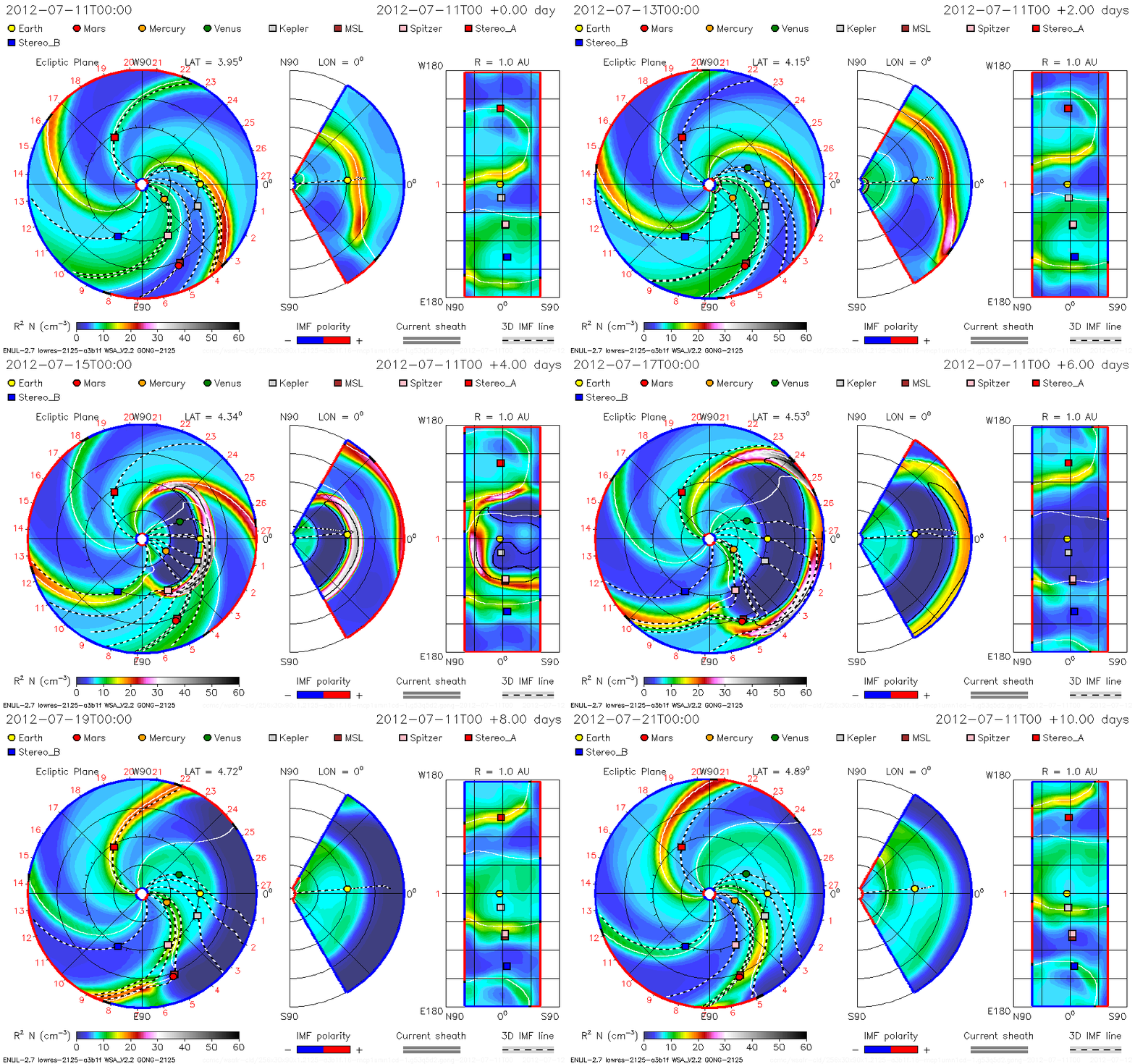
X-FLARE! Big sunspot AR1520 unleashed an X1.4-class solar flare on July 12th. Because the sunspot is directly facing Earth, everything about the blast was geoeffective. For one thing, it hurled a coronal mass ejection (CME) directly toward our planet. According to a forecast track prepared by analysts at the Goddard Space Weather Lab, the CME will hit Earth on July 14th around 10:20 UT (+/- 7 hours) and could spark strong geomagnetic storms. Sky watchers should be alert for auroras this weekend.

The explosion also strobed Earth with a pulse of extreme UV radiation, shown here in a movie recorded by NASA’s Solar Dynamics Observatory:

The UV pulse partially ionized Earth’s upper atmosphere, disturbing the normal propagation of radio signals around the planet. Monitoring stations in Norway, Ireland and Italy recorded the sudden ionospheric disturbance.

Finally, solar protons accelerated by the blast are swarming around Earth. The radiation storm, in progress, ranks “S1” on NOAA space weather scales, which means it poses no serious threat to satellites or astronauts. This could change if the storm continues to intensify.

fr/spaceweather.com

Clif High on the Nummo and the Dogon

CLIF HIGH – THE NUMMO AND THE DOGON

What a smart guy! Here’s his latest Wujo. This time Clif is here to give us insight into the movie, ‘Prometheus’, shining a light on its connection to the myths of the Dogon, and the Nummo. In a 55 minute audio presentation, he also makes reference to Alex Jones, and Shannon Dorey. If curiosity calls you to take your research a little deeper, I highly recommend that you check out Alex’s take on the subject, and make a point to tune in to Shannon Dorey’s interview on ‘Red Ice’ Radio.


from:    http://www.spiritofmaat.com/jul12/conscious_media_showcase_jul12.html

On the Volcanoes of Columbia

The Volcanoes of Colombia: More Active or Just More Watched?

  • By Erik Klemett
  • It wasn’t too long ago that Galeras was the only show in town in Colombia. After Nevado del Ruiz settled from its eruptions during the 1980s, there wasn’t much other volcanic activity in the South American nation than the ever-active Galeras near Pasto. However, now it seems that more volcanoes are getting the attention of the INGEOMINAS (the Colombian Geological Survey). With all this news of Colombian volcanoes, I thought I’d offer a brief tour of the action. Remember, Colombia has a few dozen potentially active volcanoes, so this activity shouldn’t be too surprising. You can check out this page to see what each of the INGEOMINAS alert status mean.

A webcam capture of the June 30, 2012 eruption of Nevado del Ruiz in Colombia. Most of the volcano is obscured by clouds, but the grey-brown ash plume spread ash across the countryside. Image courtesy of INGEOMINAS.


Nevado del Ruiz

After an almost 2o year slumber, Nevado del Ruiz has sprung back to life this year, with multiple small, ashy explosions (see above) and constant seismicity that might be leading to more vigorous eruptions (or might not). A few thousand people have needed to evacuate the slopes of the snow-covered volcanoes, mostly due to the threat of lahars generated by these explosions and rapid melting of snow and ice at the summit. Ash continues to fall on areas around the volcano as the activity waxes and wanes as well. The latest update from INGEOMINAS on the activity at Ruiz has the volcano at Orange Level II status, meaning eruptions should be expected in days to weeks.

Machín

Machín, a neighbor of Ruiz, has also seen elevated levels of seismicity over the past few years. Nothing has occurred beyond earthquakes that suggest rock fracturing  that could be hydrothermal or magma movement under the volcano. Machín hasn’t erupted in over 1100 years and not much is known about the dome complex that sits within a 3-km caldera. INGEOMINAS currently has the volcano at Yellow Alert III due to the continued seismicity.

Huila

After over 450 years of quiet, Nevado del Huila came back to life in 2008 with a series of small explosions that has produced ash falls, lahars and lava domes at the summit of the volcano (totally a VEI 3 eruption so far). The eruption is considered to be ongoing, although right now the volcano is merely steaming from fumaroles at the summit and experienced tens to hundreds of small earthquakes each week. Huila currently sits at Yellow Alert III.

The steaming summit of Cumbal seen on August 1, 2010. Fumarolic activity such as this is common at Cumbal, but increased seismicity has prompted an increase in the alert level. Image courtesy of INGEOMINAS.

Cumbal

The latest volcano to join the parade of elevated activity is Cumbal (see above), a composite volcano that last erupted in 1926. A report that was issued yesterday (July 11) from INGEOMINAS has raised the alert status to Yellow Alert III after noticing increases in earthquake swarms under the volcano, along with an increase in the temperature of fumaroles at the summit of Cumbal. There has also been reports of noises coming from the volcano in the past few week as well. Much like Machín, not much is known about Cumbal, with only one other known eruption (in 1877). However, Cumbal has rumbled before without producing any eruption.

Sotará

Even less is known about Sotará, a small volcano near Popayán. There have been no known historic eruptions of Sotará, however in late June, seismometers recorded a swarm of over 900 small earthquakes under the volcano. INGEOMINAS did not raise the alert status for Sotará after the swarm, and the swarm seems to be very transitory in nature – not much activity before and after the June 30 swarm.

Galeras

The southernmost volcano in Colombia, Galeras continues to sit at Yellow Alert III. The volcano has not been as eruptively active over the last few months than in recent years, but seismicity continues as does sulfur dioxide emissions. INGEOMINAS describes the current activity as “a reflection of an evolving process that initiated mainly by the intrusion of magmatic material that began to emerge in mid-March 2012″ – that suggests a period of slow dome growth at Galeras right now.

Does all this activity mean that volcanism is on the rise in Colombia? Probably not – in fact, this might be a great case on how increased volcano monitoring helps us become more aware of how restless volcanoes can be when they aren’t erupting or about to erupt. Many of the volcanoes on Yellow Alert III status, like Cumbal and Machin, are only experiencing earthquakes are no one on the surface would even notice. So before many of these volcanoes were wired with seismometers, they could have experienced activity like this and no one would notice. The same can be said for volcanoes worldwide – we can capture so much more subtle information about volcanic activity today than we could even 15 years ago. This can give that false impression that there is more volcanic activity, but rather, we’re just getting more information about what volcanoes do all the time.

from:    http://www.wired.com/wiredscience/2012/07/the-volcanoes-of-colombia-more-active-or-just-more-watched/#more-120011

Afghanistan Earthquake

Strong but luckily deep earthquake in Afghanistan

Last update: July 12, 2012 at 2:22 pm by By

Afghanistan-tajikistan Border Region Jul 12 14:44 PM 5.0 138.0

At the current reported depth, we do not think that this earthquake will be damaging.
This earthquake has been felt in Afghanistan, India, Pakistan, Tajikistan, etc.
All the reporting and to be trusted seismological agencies are reporting depths of +150 km.
The risk on landslides will however be present in this high mountain area.
Closest city to the epicenter : Fayzabad, Afghanistan.

from:    http://earthquake-report.com/2012/07/11/major-earthquakes-list-july-12-2012/