Mammatus Clouds over Minnesota

Fr/spaceweather.com

MAMMATUS OVER MINNESOTA: On May 10th, a severe storm captured national attention when it dumped golf-ball-sized hail on a Minnesota Twins baseball game. “I missed the hail,” reports John Rogers of New Hope, Minnesota, “but I got a nice view of the clouds that formed after the storm passed.” He snapped this picture in waning twilight at 8:30 pm local time:

These are mammatus clouds. Named for their resemblance to a cow’s underbelly, they sometimes appear at the end of severe thunderstorms when the thundercloud is breaking up. Researchers have called them an “intriguing enigma,” because no one knows exactly how and why they form. The clouds are fairly common but often go unnoticed because potential observers have been chased indoors by the rain. If you are one of them, dash outside when the downpour stops; you could witness a beautiful mystery in the sky.


For Friday the 13th — Superstitions

13 Common (But Silly) Superstitions

Stephanie Pappas, LiveScience Senior Writer
Date: 12 May 2011 Time: 06:29 PM ET
Cat in tree

We humans are a superstitious lot, believing that Friday the 13th is bad luck and finding a penny is good luck.

Many superstitions stem from the same human trait that causes us to believe in monsters and ghosts: When our brains can’t explain something, we make stuff up. In fact, a study last year found that superstitions can sometimes work, because believing in something can improve performance on a task.

Here, then, are 13 of the most common superstitions.

to read more go to:    http://www.livescience.com/14141-13-common-silly-superstitions.html


God Particle Found?

Scientists Abuzz Over Controversial Rumor that God Particle Has Been Detected

Mike Wall, Senior Writer
Date: 22 April 2011 Time: 05:37 PM ET
God particle
This track is an example of simulated data modelled for the CMS detector on the Large Hadron Collider (LHC) at CERN. Here a Higgs boson is produced and then decays into two jets of hadrons and two electrons. The lines represent the possible paths of particles produced by the proton-proton collision in the detector while the energy these particles deposit is shown in blue.
CREDIT: CERN

A rumor is floating around the physics community that the world’s largest atom smasher may have detected a long-sought subatomic particle called the Higgs boson, also known as the “God particle.”

The controversial rumor is based on what appears to be a leaked internal note from physicists at the Large Hadron Collider (LHC), a 17-mile-long particle accelerator near Geneva, Switzerland. It’s not entirely clear at this point if the memo is authentic, or what the data it refers to might mean — but the note already has researchers talking.

to read more go to:    http://www.livescience.com/13853-higgs-boson-signal-lhc-cern.html

Best Visual Illusion of 2011

Best Illusion of 2011 Reveals Visual Quirk

Wynne Parry
Date: 10 May 2011 Time: 04:44 PM ET
Invisibly Changing Dots: The 2011 Best Visual Illusion
In an animated version of this image, the rotation of the whole ring obscures the changing colors of the dots. See below for the video.
CREDIT: Jordan Suchow and George Alvarez of Harvard University

A mysterious illusion that illustrates how motion can render color changes invisible won the “Best Illusion of the Year” for 2011, and it also taught researchers something they didn’t know.

“It is a really beautiful effect, revealing something about how our visual system works that we didn’t know before,” said Daniel Simons, a professor at the University of Illinois, Champaign-Urbana. Simons studies visual cognition, and did not work on this illusion. Before its creation, scientists didn’t know that motion had this effect on perception, Simons said. [Eye Tricks: Gallery of Visual Illusions]

A viewer stares at a speck at the center of a ring of colored dots, which continuously change color. When the ring begins to rotate around the speck, the color changes appear to stop. But this is an illusion. For some reason, the motion causes our visual system to ignore the color changes. (You can, however, see the color changes if you follow the rotating circles with your eyes.) [See Video of Illusion Winner]

To read more go to:    http://www.livescience.com/14097-visual-illusion-contest-motion-perception-change-blindness.html


Mysterious Egyptian Petroglyphs

Mysterious Ancient Rock Carvings Found Near Nile

Owen Jarus, LiveScience Contributor
Date: 13 May 2011 Time: 11:29 AM ET
rock art showing a crescent moon
Here a rock etched with patterns forming a crescent moon and orb, an example of another piece of rock art discovered at Wadi Abu Dom in northern Sudan.
CREDIT: Courtesy of Tim Karberg/Westfälische Wilhelms-Universität Münster.

An archaeological team in the Bayuda Desert in northern Sudan has discovered dozens of new rock art drawings, some of which were etched more than 5,000 years ago and reveal scenes that scientists can’t explain.

The team discovered 15 new rock art sites in an arid valley known as Wadi Abu Dom, some 18 miles (29 kilometers) from the Nile River. It’s an arid valley that flows with water only during rainy periods. Many of the drawings were carved into the rock faces — no paint was used — of small stream beds known as “khors” that flow into the valley.

Some of the sites revealed just a single drawing while others have up to 30, said lead researcher Tim Karberg, of the Westfälische Wilhelms-Universität Münster in Germany.

to read more go to: http://www.livescience.com/14149-mysterious-ancient-rock-art-nile-river.html


Sun-Diving Comet

fr/spaceweather.com

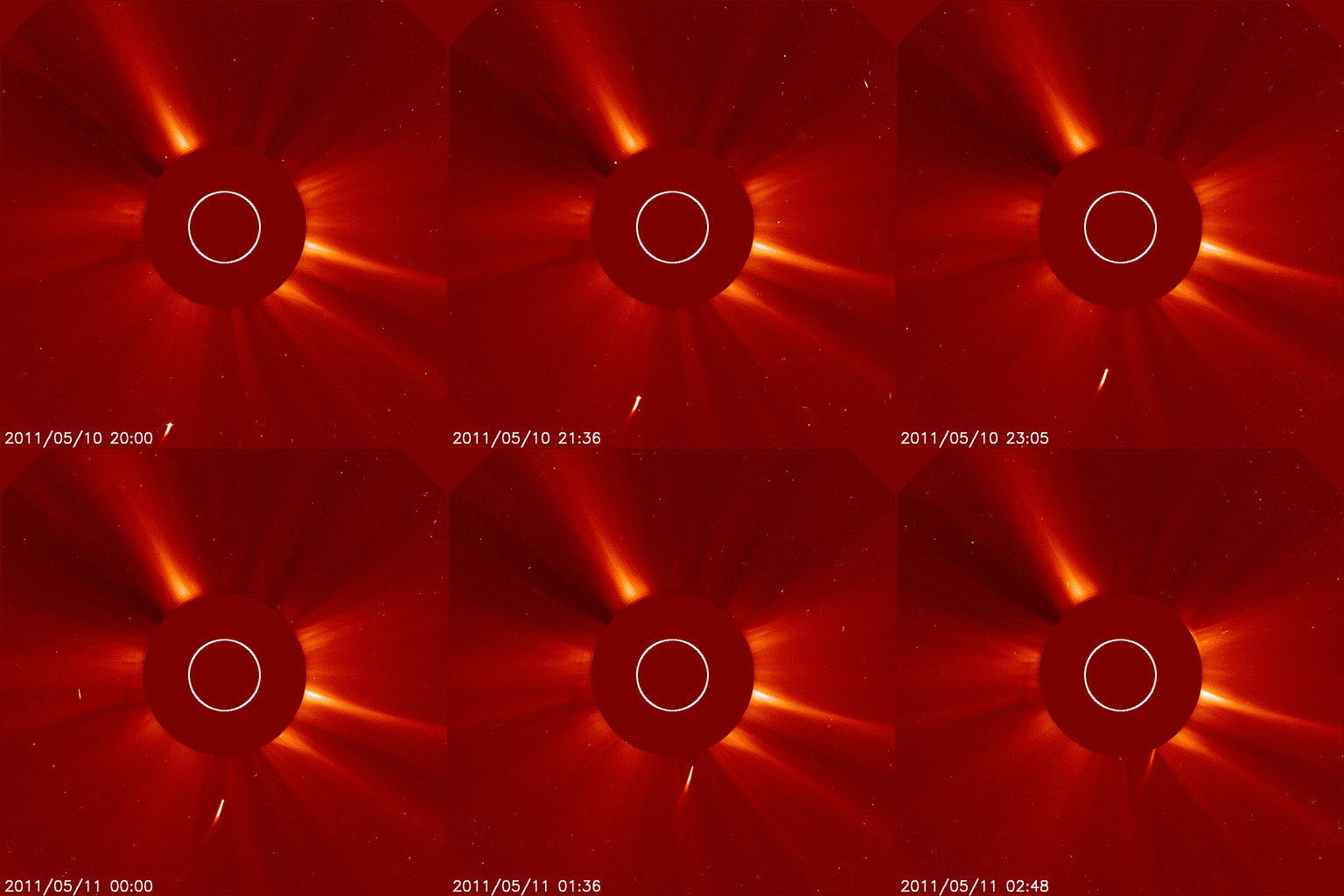
SUNDIVING COMET: A comet just discovered by amateur astronomer Sergey Shurpakov is diving past the sun today, and it will probably not survive. Click here to view a movie of the death plunge recorded by the Solar and Heliospheric Observatory–and check back for updates in the hours ahead.

Japan’s Coastal Towns Flood at High Tide Due to Quake

Quake shifted Japan; towns now flood at high tide

(AP) – 1 day ago

ISHINOMAKI, Japan (AP) — When water begins to trickle down the streets of her coastal neighborhood, Yoshiko Takahashi knows it is time to hurry home.

Twice a day, the flow steadily increases until it is knee-deep, carrying fish and debris by her front door and trapping people in their homes. Those still on the streets slosh through the sea water in rubber boots or on bicycle.

“I look out the window, and it’s like our houses are in the middle of the ocean,” says Takahashi, who moved in three years ago.

The March 11 earthquake that hit eastern Japan was so powerful it pulled the entire country out and down into the sea. The mostly devastated coastal communities now face regular flooding, because of their lower elevation and damage to sea walls from the massive tsunamis triggered by the quake.

In port cities such as Onagawa and Kesennuma, the tide flows in and out among crumpled homes and warehouses along now uninhabited streets.

A cluster of neighborhoods in Ishinomaki city is rare in that it escaped tsunami damage through fortuitous geography. So, many residents still live in their homes, and they now face a daily trial: The area floods at high tide, and the normally sleepy streets turn frantic as residents rush home before the water rises too high.

“I just try to get all my shopping and chores done by 3 p.m.,” says Takuya Kondo, 32, who lives with his family in his childhood home.

Most houses sit above the water’s reach, but travel by car becomes impossible and the sewage system swamps, rendering toilets unusable.

Scientists say the new conditions are permanent.

To read more and view images, go to:

http://www.google.com/hostednews/ap/article/ALeqM5g31xAce2wgkCARS9xY7KlRVOpbpg?docId=5497a108a13f4a6391243ee6e156debf
 

Solar Activity

fr/spaceweather.com

APPROACHING ACTIVE REGION: A sunspot located just behind the sun’s eastern limb erupted during the waning hours of May 9th, hurling a spectacular coronal mass ejection into space: movie. NASA’s Solar Dynamics Observatory photographed hot magnetic loops towering over the edge of the sun in the aftermath of the explosion: must-see. Earth was not in the line of fire this time, but the active region is approaching the Earthside of the sun, so future blasts could be geoeffective.

Social & Economic Impacts of Severe Space Weather

Severe Space Weather–Social and Economic Impacts

(fr.2009, but still interesting and of note)

January 21, 2009: Did you know a solar flare can make your toilet stop working?

see captionThat’s the surprising conclusion of a NASA-funded study by the National Academy of Sciences entitled Severe Space Weather Events—Understanding Societal and Economic Impacts. In the 132-page report, experts detailed what might happen to our modern, high-tech society in the event of a “super solar flare” followed by an extreme geomagnetic storm. They found that almost nothing is immune from space weather—not even the water in your bathroom.

Right: Auroras over Blair, Nebraska, during a geomagnetic storm in May 2005. Photo credit: Mike Hollingshead/Spaceweather.com.

The problem begins with the electric power grid. “Electric power is modern society’s cornerstone technology on which virtually all other infrastructures and services depend,” the report notes. Yet it is particularly vulnerable to bad space weather. Ground currents induced during geomagnetic storms can actually melt the copper windings of transformers at the heart of many power distribution systems. Sprawling power lines act like antennas, picking up the currents and spreading the problem over a wide area. The most famous geomagnetic power outage happened during a space storm in March 1989 when six million people in Quebec lost power for 9 hours: image.


According to the report, power grids may be more vulnerable than ever. The problem is interconnectedness. In recent years, utilities have joined grids together to allow long-distance transmission of low-cost power to areas of sudden demand. On a hot summer day in California, for instance, people in Los Angeles might be running their air conditioners on power routed from Oregon. It makes economic sense—but not necessarily geomagnetic sense. Interconnectedness makes the system susceptible to wide-ranging “cascade failures.”To estimate the scale of such a failure, report co-author John Kappenmann of the Metatech Corporation looked at the great geomagnetic storm of May 1921, which produced ground currents as much as ten times stronger than the 1989 Quebec storm, and modeled its effect on the modern power grid. He found more than 350 transformers at risk of permanent damage and 130 million people without power. The loss of electricity would ripple across the social infrastructure with “water distribution affected within several hours; perishable foods and medications lost in 12-24 hours; loss of heating/air conditioning, sewage disposal, phone service, fuel re-supply and so on.”

“The concept of interdependency,” the report notes, “is evident in the unavailability of water due to long-term outage of electric power–and the inability to restart an electric generator without water on site.”

see caption

Above: What if the May 1921 superstorm occurred today? A US map of vulnerable transformers with areas of probable system collapse encircled. A state-by-state map of transformer vulnerability is also available: click here. Credit: National Academy of Sciences.

to read more, go to:http://science.nasa.gov/science-news/science-at-nasa/2009/21jan_severespaceweather/