Khalilov on Sounds Heard in The Sky

As always, posted FYI.  Draw your own conclusions, but do the research

STRANGE SOUNDS IN THE SKY EXPLAINED BY SCIENTISTS

First published 1/28/2012 at geochangemag.org

Mr. Khalilov, what is the nature of the unusual very low-pitched sounds reported by a great number of people in different parts of the planet since the summer of 2011? Many call them “The Sound of the Apocalypse”. Information about that comes from all over the world: US, UK, Costa Rica, Russia, Czech Republic, Australia, etc.

We have analyzed records of these sounds and found that most of their spectrum lies within the infrasound range, i.e. is not audible to humans. What people hear is only a small fraction of the actual power of these sounds. They are low-frequency acoustic emissions in the range between 20 and 100 Hz modulated by ultra-low infrasonic waves from 0.1 to 15 Hz. In geophysics, they are called acoustic-gravity waves; they are formed in the upper atmosphere, at the atmosphere-ionosphere boundary in particular. There can be quite a lot of causes why those waves are generated: earthquakes, volcanic eruptions, hurricanes, storms, tsunamis, etc. However, the scale of the observed humming sound in terms of both the area covered and its power far exceeds those that can be generated by the above-mentioned phenomena.

In that case, what could be causing this humming in the sky?

In our opinion, the source of such powerful and immense manifestation of acoustic-gravity waves must be very large-scale energy processes. These processes include powerful solar flares and huge energy flows generated by them, rushing towards Earth’s surface and destabilizing the magnetosphere, ionosphere and upper atmosphere. Thus, the effects of powerful solar flares: the impact of shock waves in the solar wind, streams of corpuscles and bursts of electromagnetic radiation are the main causes of generation of acoustic-gravitation waves following increased solar activity.

Given the surge in solar activity as manifested itself in the higher number and energy of solar flares since mid-2011, we can assume that there is a high probability of impact of the substantial increase in solar activity on the generation of the unusual humming coming from the sky. It should be pointed out that solar activity began to rise sharply since early 2011, with its amplitude significantly higher than all forecasts given by a number of influential scientific institutions in 2010 and 2011. Meanwhile, the observed increase in solar activity is fully consistent with the forecast of the International Committee GEOCHANGE published in the Committee’s Report in June 2010. If this growth rate of solar activity continues, its amplitude by the end of 2012 will be higher than the amplitude of 23rd solar cycle, and in 2013-2014 the solar activity will reach its peak the amplitude of which was predicted by us to be 1.5 – 1.7 times higher than the amplitude of the 23rd cycle.

But you said that the cause of the “sky hum” can lie within Earth’s core as well, what does it mean?

There is one more possible cause of these sounds and it may lie at the Earth’s core. The fact is that the acceleration of the drift of the Earth’s north magnetic pole which increased more than fivefold between 1998 and 2003 and is at the same level today points to intensification of energy processes in the Earth’s core, since it is processes in the inner and outer core that form the Earth’s geomagnetic field. Meanwhile, as we have already reported, on November 15, 2011 all ATROPATENA geophysical stations which record three-dimensional variations of the Earth’s gravitational field almost simultaneously registered a powerful gravitational impulse. The stations are deployed in Istanbul, Kiev, Baku, Islamabad and Yogyakarta, with the first and last one being separated by a distance of about 10,000 km. Such a phenomenon is only possible if the source of this emanation is at the Earth’s core level. That huge energy release from the Earth’s core at the end of the last year was some kind of a start signal indicating the transition of the Earth’s internal energy into a new active phase.

Intensification of the energy processes in the Earth’s core can modulate the geomagnetic field which, through a chain of physical processes at the ionosphere – atmosphere boundary level, generates acoustic-gravity waves the audible range of which has been heard by people in the form of a frightening low-frequency sound in different parts of our planet.

In both cases, even though the causes of acoustic-gravity waves are of a quite understandable geophysical nature, they are indicative of the expected significant increase in solar activity and the geodynamic activity of our planet. There is no doubt that processes in the core rule the internal energy of our planet, therefore, we should expect by the end of 2012 a sharp rise in strong earthquakes, volcanic eruptions, tsunamis and extreme weather events with peak levels in 2013 – 2014.

Thank you for your answers.

WOSCO International News Agency

www.wosco.org

from:    http://www.spiritofmaat.com/may12/strange_sounds_in_sky_explained.html


See also a video about the strange sounds at Youtube: http://www.youtube.com/watch?v=M0BvIySscEY

Eta Aqauarid Meteor Shower In Progress

METEORS FROM HALLEY’S COMET: Earth is entering a stream of debris from Halley’s Comet, source of the annual eta Aquarid meteor shower. The shower peaks this weekend; the best time to look is during the hours before sunrise on Sunday, May 6th. Because the shower’s radiant is located below the celestial equator, southern hemisphere observers are favored, but even northerners should be able to see a few flecks of Halley-dust disintegrating in the atmosphere. Super-bright moonlight will cap the meteor rate at about 30 per hour.

In recent nights, NASA’s all-sky meteor network has picked up a number of early eta Aquarid fireballs. This one was bright enough to shine through the glow of sunrise and clouds over Tullahoma, Tennessee, on April 29th:

According to analysts at NASA’s Meteoroid Environment Office, this particular speck of comet dust hit the atmosphere traveling 62 km/s (139,000 mph) and disintegrated about 84 km (52 mi) above Earth’s surface.

The full Moon of May 5-6, 2012, with interfere with the visibility of the eta Aquarid peak.

fr/spaceweather.com

Acoustics at Stonehenge

The Stones Speak: Stonehenge Had Lecture Hall Acoustics

Wynne Parry, LiveScience Senior Writer
Date: 02 May 2012
No one knows why ancient people built Stonehenge.
CREDIT: Pete Strasser | nasa.gov

The stone slabs of England’s Stonehenge may have been more than just a spectacular sight to the ancient people who built the structure; they likely created an acoustic environment unlike anything they normally experienced, new research hints.

“As they walk inside they would have perceived the sound environment around them had changed in some way,”said researcher Bruno Fazenda, a professor at the University of Salford in the United Kingdom. “They would have been stricken by it, they would say, ‘This is different.'”

These Neolithic people might have felt as modern people do upon entering a cathedral, Fazenda told LiveScience.

Fazenda and colleagues have been studying the roughly 5,000-year-old-structure’sacoustic properties. Their work at the Stonehenge site in Wiltshire, England, and at a concrete replica built as a memorial to soldiers in World War I in Maryhill, Wash., indicates Stonehenge had the sort of acoustics desirable in a lecture hall

Stonehenge itself is no longer complete, so Fazenda and colleagues used the replica in Maryhill as a stand-in for the original structure. At both locations, they generated sounds and recorded them from different positions to see how the structure influenced the behavior of the sound.

At the replica, they found a reverberation time of just less than one second, the amount of time optimal for a lecture hall. Unlike an echo, which is a single response created when sound waves reflect off something, reverberation occurs when a sound is sustained by a quick succession of reflections arriving at different times.

Modern cathedrals can have reverberation times of about 10 seconds or more, while concert halls are designed so reverberation in them will last between two and five seconds, Fazenda said.

About one second of reverberation is “just enough for us to start becoming aware of it,” he said.

Based on their work at Maryhill, the researchers believe the many stones within Stonehenge would have diffracted and diffused sound waves, creating reverberation. The large amount of diffusion and diffraction would have also lead to good sound quality regardless of where the listener was standing in relation the source of sound within the structure.

“What we found in Maryhill as a model for Stonehenge was you could almost stand behind a stone and keep talking with a good level of voice, and people would be able to hear you somewhere else,” he said.

For the Neolithic people who built this structure, this sort of acoustic environment was likely quite unusual. They appear to have lived in smaller, thatched-roof homes made of wood, which would not have reflected sound as effectively. And the region around Stonehenge has no significant geographical features, like high cliffs, which are associated with echoes, or large caves, which are associated with reverberation, Fazenda said.

While some have suggested that Stonehenge was designed to create certain acoustic effects, Fazenda said he sees no evidence for this.

Rather than search for an acoustic motivation behind the construction of this mysterious structure, this research is intended to help better understand how the ancient people might have used the structure, he said.

Fazenda collaborated with Rupert Till of the University of Huddersfield in the UK and with archaeologist Simon Wyatt on this project.

from:   http://www.livescience.com/20044-stonehenge-acoustics.html

Quantum Entanglement May Jump Time

Weird! Quantum Entanglement Can Reach into the Past

Clara Moskowitz, LiveScience Senior Writer
Date: 30 April 2012 Time: 09:42 AM ET
Wackyphysics-banner
Scientists have entangled particles in such a way that a future decision can affect the past states of the particles.
CREDIT: Jon Heras, Equinox Graphics Ltd.

Spooky quantum entanglement just got spookier.

Entanglement is a weird statewhere two particles remain intimately connected, even when separated over vast distances, like two die that must always show the same numbers when rolled. For the first time, scientists have entangled particles after they’ve been measured and may no longer even exist.

If that sounds baffling, even the researchers agree it’s a bit “radical,” in a paper reporting the experiment published online April 22 in the journal Nature Physics.

“Whether these two particles are entangled or separable has been decided after they have been measured,” write the researchers, led by Xiao-song Ma of the Institute for Quantum Optics and Quantum Information at the University of Vienna.

Essentially, the scientists showed that future actions may influence past events, at least when it comes to the messy, mind-bending world of quantum physics.

In the quantum world, things behave differently than they do in the real, macroscopic world we can see and touch around us. In fact, when quantum entanglement was first predicted by the theory of quantum mechanics, Albert Einstein expressed his distaste for the idea, calling it “spooky action at a distance.”

The researchers, taking entanglement a step further than ever before, started with two sets of light particles, called photons.

The basic setup goes like this:

Both pairs of photons are entangled, so that the two particles in the first set are entangled with each other, and the two particles in the second set are entangled with each other. Then, one photon from each pair is sent to a person named Victor. Of the two particles that are left behind, one goes to Bob, and the other goes to Alice.

But now, Victor has control over Alice and Bob’s particles. If he decides to entangle the two photons he has, then Alice and Bob’s photons, each entangled with one of Victor’s, also become entangled with each other. And Victor can choose to take this action at any time, even after Bob and Alice may have measured, changed or destroyed their photons.

“The fantastic new thing is that this decision to entangle two photons can be done at a much later time,” said research co-author Anton Zeilinger, also of the University of Vienna. “They may no longer exist.”

Such an experiment had first been predicted by physicist Asher Peres in 2000, but had not been realized until now.

“The way you entangle them is to send them onto a half-silvered mirror,” Zeilinger told LiveScience. “It reflects half of the photons, and transmits half. If you send two photons, one to the right and one to the left, then each of the two photons have forgotten where they come from. They lose their identities and become entangled.”

Zeilinger said the technique could one day be used to communicate between superfast quantum computers, which rely on entanglement to store information. Such a machine has not yet been created, but experiments like this are a step toward that goal, the researchers say.

“The idea is to create two particle pairs, send one to one computer, the other to another,” Zeilinger said.”Then if these two photons are entangled, the computers could use them to exchange information.”

from:    http://www.livescience.com/19975-spooky-quantum-entanglement.html


More Solar Flares Possible

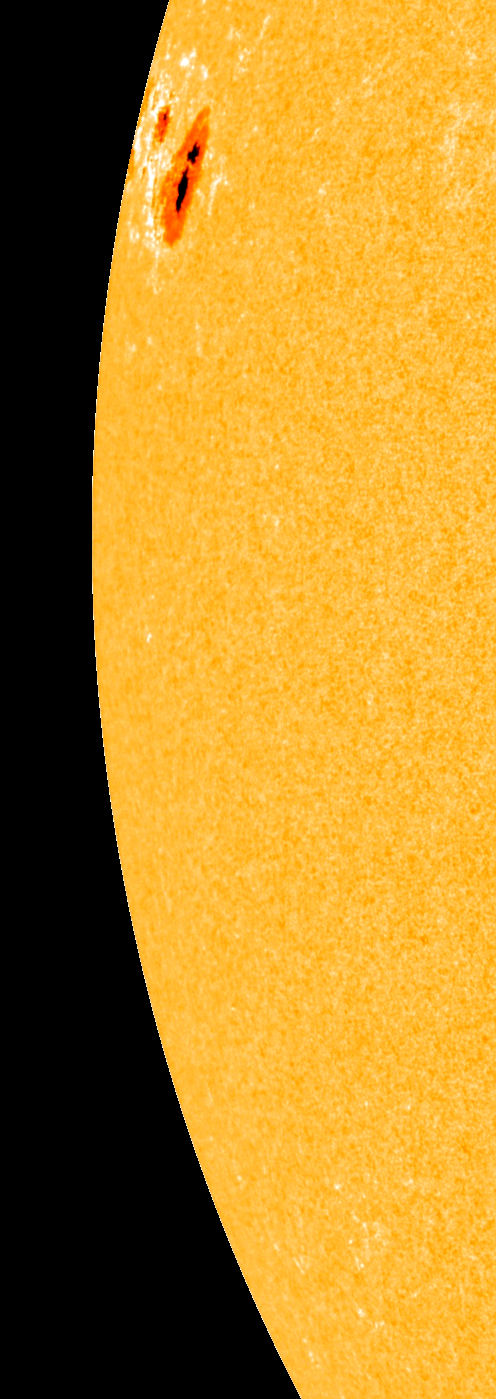
CHANCE OF FLARES: Sunspot AR1465 has developed a ‘beta-gamma-delta’ magnetic field that harbors energy for strong flares. NOAA forecasters estimate a 20% chance of M-class eruptions during the next 24 hours. Because the active region is located on the Earthside of the sun, any flares from AR1465 will likely be geoeffective.

Even without a strong eruption from AR1465, ionization waves are already rippling through Earth’s upper atmosphere. Dave Gradwell of Birr, Ireland, recorded a series of sudden ionospheric disturbances (SIDs) on April 27th:

Low-level flares from several sunspot groups (especially 1465, 1466 and 1467) are strobing the atmosphere with ionizing radiation. Using a VLF receiver, Gradwell detected their effect on the propagation of radio signals transmitted from France. So far the disturbances have been relatively weak, but this could change if AR1465 unleashes a more potent eruption over the weekend

from:    spaceweather.com

If This is A ‘Quiet Sun”, Then What is An Active One?

If you can get it, check out this video of solar activity: for April 24 to 26:

http://sdo.gsfc.nasa.gov/data/aiahmi/browse/

(If that link does not work, go to this one from dutchsinse.com:

: Linked below is the SDO (solar dynamics observatory):

http://sdo.gsfc.nasa.gov/data/aiahmi/

Select the date of April 24, 2012 — through April 26 2012 ..  search the AIA 131 “teal” images.

oh, and scroll down there for some amazing sun shots.)

Here is one still from the video:

hmm, doe not look like a “Quiet Sun” to me

Sun’s Farside in Motion

fr/spaceweather.com:

FARSIDE ACTIVITY: For more than a week, solar activity has been low. On April 26th around 0600 UT, an active region on the farside of the sun broke the calm with a powerful eruption. NASA’s Solar Dynamics Observatory recorded a massive cloud of plasma flying over the sun’s southwestern limb:

The same active region has since hurled three CMEs into space. The clouds will certainly miss Earth, but they might hit Mercury, which appears to be in the line of fire.

Fireball in the Sierra Nevadas

SIERRA FIREBALL DECODED: On Sunday morning, April 22nd, just as the Lyrid meteor shower was dying down, a spectacular fireball exploded over California’s Sierra Nevada mountain range. The loud explosion rattled homes from central California to Reno, Nevada, and beyond. According to Bill Cooke, head of NASA’s Meteoroid Envronment Office, the source of the blast was a meteoroid about the size of a minivan.

“Elizabeth Silber at Western University has searched for infrasound signals from the explosion,” says Cooke. “Infrasound is very low frequency sound which can travel great distances. There were strong signals at 2 stations, enabling a triangulation of the energy source at 37.6N, 120.5W. This is marked by a yellow flag in the map below.”

“The energy is estimated at a whopping 3.8 kilotons of TNT, so this was a big event,” he continues. “I am not saying there was a 3.8 kiloton explosion on the ground in California. I am saying that the meteor possessed this amount of energy before it broke apart in the atmosphere. [The map] shows the location of the atmospheric breakup, not impact with the ground.”

“The fact that sonic booms were heard indicates that this meteor penetrated very low in atmosphere, which implies a speed less than 15 km/s (33,500 mph). Assuming this value for the speed, I get a mass for the meteor of around 70 metric tons. Hazarding a further guess at the density of 3 grams per cubic centimeter (solid rock), I calculate a size of about 3-4 meters, or about the size of a minivan.”

“This meteor was probably not a Lyrid; without a trajectory, I cannot rule out a Lyrid origin, but I think it likely that it was a background or sporadic meteor.”

fr/spaceweather.com