Going with the Qi Gong Flow

The Three Taoist Treasures of the Energy Body

Jing Qi ShenDylan Charles, Editor
Waking Times

A fundamental difference between Eastern and Western medicine is that many of the Eastern traditions include practices that help one to develop and achieve optimal health and wellness before the onset of disease, infection and emotional problems. Prescribing Qi Gong to prevent and cure illnesses of the body, mind and spirit is quite typical for Chinese medicine practitioners, but anything similar is almost unheard of in Western healthcare.

In Chinese medicine and philosophy, Qi is thought of as “the natural force which fills the universe,” and while there are many ways of defining Qi, it may be generally thought of as any and all types of energy which are “able to demonstrate power and strength,” including the power to animate objects with life. [1]

“It is known that all diseases arise from the upset of qi: Anger pushes the qi up, joy makes the qi slacken, grief disperses the qi, fear brings the qi down, terror confuses the qi, and anxiety causes the qi to stagnate. Anger harms the liver, joy the heart, anxiety the spleen, grief the lungs, and fear the kidneys.” – The Nei Jing

Primarily handed down from generation to generation by word of mouth and in actual practice, not in written texts, the ancient Chinese practices of Qi Gong can vary wildly between teachers and schools of thought. It can be many things including physical exercises (both standing and seated), forms that resemble martial arts, breathing exercises, visualizations and, or, meditations.

The system is incredibly diverse, however, the science behind the flow of energy in and around the body has been well documented for thousands of years, and many schools of thought are in concurrence about many of the basic and even more esoteric concepts and terms involved. Among the most important concepts in Qi Gong training is an understanding of what are known as ‘San Bǎo’ (三), or, The Three Treasures.

Jing (Essence), Qi (Internal Energy), and Shen (Spirit), are the Three Treasures, The Three Foundations, or The Three Origins, and are the root of life.

“In Qi Gong training, a practitioner learns how to ‘firm his jing,’ and how to convert it into Qi. This is called ‘Lian Jing Hua Qi,’ which means to ‘to refine the Jing and convert it into Qi.’ Then he learns how to lead the Qi to the head to onvert it into Shen. This is called ‘Lian Qi Hua Shen,’ which means ‘to refine the Qi and convert it into (nourish) the Shen.’ Finally the practitioner learns to use his energized Shen to govern the emotional part of his personality. This is called, ‘Lian Shen Liao Xing, or ‘to refine the Shen to end human (emotional) nature.’” -Dr. Yang, Jwing-Ming [1]

Jing Qi Shen 2

Jing means a number of things and as a word it can be used as a noun, a verb or an adjective. It is considered the essence, the original source from which a thing is made, and also the refining process by which a person’s essence is polished or sharpened. Jing is the energy given to you at birth that enables you to grow and to develop strength. Many believe it to be the most important part of a you because it is considered to be the root energy to Qi and Shen. Learning first how to conserve and firm your original Jing is critical to Qi Gong training.

Qi is, again, the energy that fills the universe. There really is no clear explanation of how it works or of the vessels in the body which provide for the flow of Qi, but it can be distinctly felt as an energizing and healing force that can be manipulated and moved by the mind and body. Qi supplies the energy your organs need to function, and much like electricity in a factory that provides differing levels of current for different machines, the flow of Qi must be consciously regulated in order for the body to function optimally.

Shen is more difficult to describe in Western terms, but it may be considered to be spiritual or mental energy, the supernatural, the divine, the immortal soul, or the cosmic energy that drives and elevates consciousness. Shen is also the emotional mind, the part of us that governs our mood and behavior, the force that collects and utilizes wisdom. In order to raise your Shen you must first nourish and fill the brain with Qi, which is how dedication to the practices of Qi Gong can lead to a very real spiritual awakening.

“Buddhists and Daoists believe that when you are alive you may use your Jing and Qi to nourish the Shen… When this is built up to a high level, your will is able to lead it to seperate from the physical body even while you are alive. When you have reached this stage, your physical body is able to live for many hundreds of years. People who can do this are called ‘Xian,’ which means ‘god,’ ‘immortal,’ or ‘fariy…’ The ‘Xian’ is a living person whose Shen has reached the stage of enlightenment or Buddhahood.”-Dr.  Jwing-Ming Yang, The Root of Chinese Qi Gong: Secrets for Health, Longevity and Enlightenment

Final Thoughts

The roots of depression, anxiety, fear and other negative emotions are found within the energy body, and in our modern world of stress, over-work, over-stimulation, and constant hustle, the nervous and emotional systems of the body are the first to breakdown.

Qi Gong is itself a true treasure for those seeking physical and mental wellness, as well as happiness in our short, beautiful lives. It is the most practical method of strengthening and building life force energy within the body, mind and spirit, and catalyzing meaningful personal transformation. The presence and experience of Qi is universal to human beings and can be directly experienced with Qi Gong.

Anyone can develop the presence, awareness and sensitivity to come to know The Three Treasures. And what a treasure it is to see a happy, healthy person.

from:    http://www.wakingtimes.com/2016/08/06/the-three-toaist-treasures-of-the-energy-body/

Looking at Disempowerment

Free Will, Determinism and the War on Consciousness

by Zen Gardner

What really makes up who we are? What influences are controllable or uncontrollable or actually alterable in ourselves? How much can we be in charge of ourselves?

This may seem to have obvious answers, but if you’re a searcher, self-realizer on the path, or just curious about what’s really going on here, this is something we wonder about.

The pat answers we’ve been told have to do with genetic make up and environment, within an inbred context of fatalism. The parameters we’re given from birth are very containing, with only a small margin allowed for potential change in our lifetimes.

It’s very subtle, but social engineers and programmed lower dimensional thinking have laid a very restrictive and disempowering groundwork, with only seemingly exceptional people breaking free from the supposed confines we’re born into.

So What Really Makes People Different?

Clearly genetics and environment play a major role in the formation of our characters. What’s obviously missing are spiritual, conscious and cosmic influences, which science and especially religions and belief systems try to thwart, contain, minimalize and explain away as best they can.

Why? Because according to the imposed structure we need to be controlled, not released into our fullness. That would blow their whole plan. There might be true freedom, abundance, and uncontained happiness and true efficient and conscious societal development. Then who would use their banks and manipulated money system, buy their oil, need their useless products or polluting education, media and entertainment industries?

However, in this lower density reality we face very real repercussions from their corrupt systems from the outset. Beginning at birth and on through childhood and adolescence we develop deep co-dependencies based on abandonment and abuse issues. Unaddressed and unchecked, these become ingrained into our personalities and how we project ourselves. Our reflexive behaviors and misplaced expectations then extrapolate into complex action-reaction, craving-aversion syndromes that seem inescapable, even in later years.

In most cases we develop highly fractured personalities that adapt according to the situations in which we find ourselves. Different personas (literally masks) evolve behind these façades while we act out what we feel is expected of us.

This is where people feel helplessly trapped in what they’ve come to understand is a deterministic outlook, where we are the victims of our make up and environment with an ominous sense of inescapability. And in a mad world run by lofty, distant oligarchs and figures in supposed authority this cultivated sense of disempowerment flourishes.

When in fact, our true selves are thriving beneath this engineered rubble just waiting to be released into their fullness.

Enter free will…

TheHand

Free Will vs Determinism

This has been a major area of discussion in philosophical and scientific circles for a long time but it’s important for this discussion and reveals the controllers’ non-intuitive nor empathic, and extremely arrogant and suppressive mindset.

Here’s a brief description of this seeming paradox:

“The determinist approach proposes that all behavior is caused by preceding factors and is thus predictable. The causal laws of determinism form the basis of science.

Free will is the idea that we are able to have some choice in how we act and assumes that we are free to choose our behavior, in other words we are self determined.” (source)

It’s quite revealing that “the causal laws of determinism form the basis of science”. At least mainstream, settled science. The shift now underway taking consciousness and multi-dimensional aspects into account in science is therefore quite profound in its potential effect on human thought and awareness. But don’t wait for them to get it.

In an article entitled “The Great Debate” this seeming conflict between free will and determinism is laid out quite clearly:

1 The Doctrine of Determinism

“Determinism is a far-reaching term affecting many areas of concern, that most widely and radically states that all events in the world are the result of some previous event, or events. In this view, all of reality is already in a sense pre-determined or pre-existent and, therefore, nothing new can come into existence.

This closed view of the universe and of our world holds all events to be simply the effects of other prior effects. This has radical and far-reaching implications for morality, science, and religion. If general, radical, determinism is correct, then all events in the future are unalterable, as are all events in the past. A major consequence of this is that human freedom is simply an illusion.

2. Genetic Determinism

“One area of contemporary discourse in science that relates to the issue of human freedom is the notion of genetic determinism. Here, the concept of determinism is linked directly to the genes in the DNA of a person. Because we already know that aberrations in certain genes can lead to various forms of physical and mental disease in humans, we can say with some certainty that people are physically determined by their genes.

But genetic determinists want to extend this further, by claiming that even our behaviour is determined by our genes. In this line of thinking, we are but victims of our genetic makeup, and any effort to change our moral nature or behavioural patterns is useless. This is sometimes termed “puppet determinism,” meaning metaphorically that we dance on the strings of our genes.” (end excerpt)

howdareyouz

The War on Free Will and Consciousness

Put in context, these deterministic dogmas are clearly foundational underpinnings for social engineers. But they only operate on the mind and body-memory level. Our essence is way beyond this and we know it, and that knowledge is exactly what causes the conflict we feel from childhood as we long for fulfillment and true expression.

That the parasitic manipulators want to control, contain and even usurp and utilize our consciousness is no new concept. The energy vampires of many dimensions have been around a long time and have been described in a multiplicity of ways throughout the ages.

The question is, how will we respond, knowing this is the game at play? Will we continue to lay down and take it, or respond in a powerful assertion of our conscious awareness, stepped up to degrees humanity has yet been able to experience and utilize and on such a wide scale?

This is where we stand.

Conclusion

This article is designed to give some historical perspective as to how we’ve been disempowered, but again it’s one of a variety of vectors aimed at the crippling of humanity.

It’s been proven we can change our own DNA, or very vibrational nature, and offset anything set in motion by previous influences, besides the fact that we can transcend all of this consciously.

That is knowledge and empowerment to an extreme. Let’s run with it and shift this reality by each of our own decisions and our deep resolve to be who we truly are.

That is the only answer.

The rest will follow. It’s an individual choice.

Let’s just do it and let the chips fall where they may. Whatever the cost – the rewards are inestimable!

Now is the hour. It always has been, but it’s now more than ever.

Much love always, Zen

from:    http://www.zengardner.com/free-will-determinism-war-consciousness/

Some Treatments to Look At

5 Medical Hoaxes You Probably Believe Are True

5 Medical Hoaxes You Probably Believe

10th August 2016

By Dr. Sameer Ather, MD, PhD, FACC

Guest writer for Wake Up World

The sheer volume of medical findings that have been published during the recent decades is absolutely staggering. As such, it is difficult, if not impossible to test each and every one of them independently. Many contain errors, or even flat out lies.

There are plenty of reasons why this would be the case. Chief amongst them is the fact that scientists and researchers need money to conduct their experiments. Those who provide the funding might have their own agenda, when it comes to results, and will want the findings to reflect that agenda. In other cases, projects run out of funding, or need to be published quickly, to secure more money. In these situations, tests are often conducted improperly, or the results are not thoroughly verified.

Sometimes, a medical journal will publish preliminary, inconclusive results that will get picked up by the media and announced as if they were hardcore facts. If the news is a hit, they will often forget to mention the follow-up research that proved the initial results were incorrect.

1. Any Sort of “Scientifically Tested” Weight Loss Treatment

The truth is we’ve known how to lose weight for a very long time. Regular exercise, and a strict diet are enough to the trick in most situations. There are many different body types out there, so losing weight to the point where you look like an underfed fashion model might not be an option, regardless of how much you try.

However, losing weight the healthy way is a long, and difficult process, and a lot of people are looking for quick fixes to their problems. Popping a pill to slim down sounds like a great alternative to many.

Some products include an asterisk few people bother to check. If there is an actual medical test involved, the sample size of people is often so small it barely qualifies as a sample at all. But it’s enough that get that label attached to your product.

2. Flu Medicine that Actually Cures the Flu

It’s surprising anyone still believes that cold treatments actually work. Anyone who’s ever had the flu knows that it takes at least a few days for the symptoms to go away, even if you’re taking medicine.

The fact of the matter is, it’s not the flu medicine that’s working. At best, these treatments only alleviate the symptoms, but they don’t do anything against the actual virus. Next time you decide to buy pills that are advertised as being effective against the common cold, check their ingredients. You’ll notice they’re the same as those of common painkillers, or anti-inflammatory drugs.

The reason these drugs are marketed as flu medicine is to raise their price. It makes buyers feel like they’re going to be more effective than other drugs against influenza. And that’s going to make them willing to pay more.

3. Cancer Rates Have Increased Dramatically During the Past Decades

You’d think the numbers wouldn’t lie. And looking at statistics, it would seem that there’s a real cancer epidemic going on. While the number may or may not be true, the story that surrounds them is wildly exaggerated, to say the least.

In reality, there have been some major changes in our way of life, during the past decades. People tend to live longer. Since cancer is a disease related to aging, statistically, more people are expected to develop some form of cancer.

Secondly, people are much more aware of what cancer looks like, and medics have gotten better at detecting it. We no longer live in an age when things like ‘catching the evil eye’ can kill you. Now we can identify some of the causes that lead to diseases, and death.

So, why are the stories about soaring cancer rates so popular? It all comes down to money. The scarier the condition seems, the more funding researchers are going to receive.

4. Animal Testing Is a Good Way to Measure the Effectiveness of a Drug

Results of animal testing have very limited applicability when it comes to humans. Mice are usually preferred because they share certain genetic similarities with humans, but the truth is there similarities are not nearly enough to warrant a medical comparison.

The unreliability of animal testing, unfortunately, is often ignored. Drugs and treatments that have only been used on animals are marketed as being scientifically proven to work.

5. The “Talking Cure” Is an Effective Way to Deal with Trauma

Psychologists everywhere never cease to praise the merits of talking about a traumatic experience when it comes to depression, anxiety, and other diseases of the modern age. But patients’ testimonies seem to disprove these assessments. In some cases, the “talking cure” might actually do more harm than good. Some professionals might be so desperate to prove that the method works, that they actually convince patients that they have a deep, underlying issue they are not aware of, when that’s not the case.

And unfortunately, most antidepressants have been proven to be ineffective as well, which means more research should be done on a cure that actually works, rather than trying to prove that the old methods do have some value.

We often hear the phrase ‘Science still has a long way to go’, but rarely is used when it comes to ethics and reliability. It is true that the scientific community still has a lot to offer. But rather than always looking forward, to the next big discovery, it should take care to look to the past as well, and reanalyze the things it takes for granted, for whatever reason.

from:    http://wakeup-world.com/2016/08/10/5-medical-hoaxes-you-probably-believe-are-true/

Powerful Women Pre-Columbian

Ancient remains discovered at ‘America’s first city’ reveal women held high-power positions

  • Cahokia is an ancient Native American city just outside modern St. Louis 
  • Earlier analyses suggested the city ran under ‘male dominated hierarchy’
  • It was thought that remains in a ‘beaded burial’ were high status men
  • But new analysis reveals there were women and even a child in the burial 

Almost 50 years ago, archaeologists excavating an ancient city just outside of St. Louis discovered a mass burial site with an unusual central feature – two bodies arranged atop a bed of beads, with several other bodies encircling them.

It was once thought that the elaborate ‘beaded burial’ structure at Cahokia was built as a monument to male power – but now, researchers suggest this is not the case.

A new analysis of the remains reveals that one of these central bodies is actually female, and researchers say the discovery of similar male-female pairs and the remains of a child indicates that women played an important role in society.

It was once thought that the elaborate ¿beaded burial¿ structure at Cahokia was built as a monument to male power ¿ but now, researchers suggest this is not the case. In a new study, they discovered female remains in this central structure. The ancient city is pictured above

It was once thought that the elaborate ‘beaded burial’ structure at Cahokia was built as a monument to male power – but now, researchers suggest this is not the case. In a new study, they discovered female remains in this central structure. The ancient city is pictured above

WHAT THEY FOUND

While earlier studies reported that there had been six bodies at the beaded burial, the researchers found there were actually 12, with one of the central figures being a woman.

According to physical anthropologist Kristin Hedman, the discovery of females in this structure was ‘unexpected.’

And, they found other similar pairs on top of and near the beaded area, with some laid out as fully articulated bodies, and others among bundles of bones gathered for burial.

Along with this, the team found the remains of a child.

In the new study, published to the journal American Antiquity, researchers with the Illinois State Archaeological Survey at the University of Illinois and colleagues found that there are both male and female remains buried at the site of the Native American city, Cahokia.

Cahokia is said to be North America’s first city, and is the largest pre-Columbian settlement north of Mexico.

Now known as ‘Mound 72,’ the massive burial site discovered by archaeologist Melvin Fowler in 1967 contains 270 bodies, with five mass graves each containing at least 20 bodies, and some exceeding 50.

Later analysis revealed that the burials occurred between the years 1000 and 1200 during the rise and peak of Cahokia.

Some of the bodies were laid on cedar litters, suggesting these individuals were of high-status in their lives.

‘Mound 72 burials are some of the most significant burials ever excavated in North America from this time period,’ said ISAS director Thomas Emerson.

‘Fowler’s and others’ interpretation of these mounds became the model that everybody across the east was looking at in terms of understanding status and gender roles and symbolism among Native American groups in this time.’

It was thought that the beaded burial involved two high-status males, with their servants surrounding.

And, the beads were thought to be the remains of a cape or blanket in the shape of a bird, which is associated with warriors and supernatural beings in some Native American traditions.

While earlier studies reported that there had been six bodies at the beaded burial, the researchers found there were actually 12, with one of the central figures being a woman. Along with this, the team found the remains of a child

While earlier studies reported that there had been six bodies at the beaded burial, the researchers found there were actually 12, with one of the central figures being a woman. Along with this, the team found the remains of a child

Almost 50 years ago, archaeologists excavating the pre-Columbian Native American city, Cahokia discovered a mass burial site with an unusual central feature. The city sits just outside of what is now St. Louis 

Almost 50 years ago, archaeologists excavating the pre-Columbian Native American city, Cahokia discovered a mass burial site with an unusual central feature. The city sits just outside of what is now St. Louis

THE BEADED BURIAL

The central feature of Mound 72 is a ‘beaded burial.’

In this structure, two bodies are arranged atop a bed of beads, with several other bodies encircling them.

It was thought that the beaded burial involved two high-status males, with their servants surrounding.

And, the beads were thought to be the remains of a cape or blanket in the shape of a bird, which is associated with warriors and supernatural beings in some Native American traditions.

According to the new study, however, one of these central bodies is actually female.

‘One of the things that promoted the concept of the male warrior mythology was the bird image,’ Emerson said.

Because of this, Cahokia was thought to be a ‘male-dominated hierarchy,’ the researcher explained.

In the new study, the researchers analyzed early maps, notes, reports, and skeletal remains.

While earlier studies reported that there had been six bodies at the beaded burial, the researchers found there were actually 12, with one of the central figures being a woman.

According to physical anthropologist Kristin Hedman, the discovery of females in this structure was ‘unexpected.’

And, they found other similar pairs on top of and near the beaded area, with some laid out as fully articulated bodies, and others among bundles of bones gathered for burial.

Along with this, the team found the remains of a child.

According to the researchers, the materials often symbolized life renewal, fertility, and agriculture. Artifacts discovered at the ancient site are pictured above

According to the researchers, the materials often symbolized life renewal, fertility, and agriculture. Artifacts discovered at the ancient site are pictured above

‘The fact that these high-status burials included women changes the meaning of the beaded burial feature,’ Emerson said.

‘Now, we realize, we don’t have a system in which males are these dominant figures and females are playing bit parts.

‘And so, what we have at Cahokia is very much a nobility. It’s not a male nobility. It’s males and females, and their relationships are very important.’

The researcher explains that these findings are more in line with other materials from Cahokia than the scenarios presented by earlier studies.

‘For me, having dug temples at Cahokia and analyzed a lot of that material, the symbolism is all about life renewal, fertility, agriculture,’ Emerson said.

Now known as ¿Mound 72,¿ the massive burial site discovered by archaeologist Melvin Fowler in 1967 contains 270 bodies, with five mass graves each containing at least 20 bodies, and some exceeding 50

Now known as ‘Mound 72,’ the massive burial site discovered by archaeologist Melvin Fowler in 1967 contains 270 bodies, with five mass graves each containing at least 20 bodies, and some exceeding 50

‘Most of the stone figurines found there are female. The symbols showing up on the pots have to do with water and the underworld. And so now Mound 72 fits into a more consistent story with what we know about the rest of the symbolism and religion at Cahokia.’

By focusing on warrior symbolism, Emerson explains that previous studies have misinterpreted the culture of Cahokia, and this time period.

‘When the Spanish and the French came into the southeast as early as the 1500s, they identified these kinds of societies in which both males and females have rank,’ says Emerson.

‘Really, the division here is not gender; it’s class.’

‘People who saw the warrior symbolism in the beaded burial were actually looking at societies hundreds of years later in the southeast, where warrior symbolism dominated, and projecting it back to Cahokia and saying: ‘well, that’s what this must be. And we’re saying: ‘No, it’s not.’’

Perks of Long Hair

The Negative Effects Of Cutting Your Hair

The Negative Effects Of Cutting Your Hair

by PL Chang

Back in the old days and the ancient times, many cultures embraced people with long hair, because they believed that long hair was a sign of strength and spiritual maturity.

The Native Americans and the Chinese are just a few examples of the many cultures that value long hair, which was why the men and women of these cultures back then rarely cut their hair.

Even though back then many cultures believed that having long hair was beneficial to the body, is there evidence today that supports the belief that long hair can make a person more intuitive?

How long hair can make you more intuitive

Back in the old days and the ancient times, many cultures embraced people with long hair, because they believed that long hair was a sign of strength and spiritual maturity.

The Native Americans and the Chinese are just a few examples of the many cultures that value long hair, which was why the men and women of these cultures back then rarely cut their hair.

Even though back then many cultures believed that having long hair was beneficial to the body, is there evidence today that supports the belief that long hair can make a person more intuitive?

The Negative Effects Of Cutting Your Hair

If you study Nature deeply enough, you should know that Nature would never create something that has no role to play in the evolution of a system, such as the human body.

Once you comprehend this, you should know that the human hair isn’t only for looks, but also plays specific roles for helping the human body to function at its optimal level.

One of the ways that your hair helps your body to perform better is by acting like an antenna to help you sense the energy of your environment more effectively. This is why when you are scared, all the short hair on your body point straight up, strengthening your intuitive senses.

Hair can be viewed as an extension of the nervous system, because it has the ability to absorb information in the environment and then transmit it to the brain for processing.

Besides absorbing information, hair also has the ability to emit energy patterns and frequencies into the environment. This has been seen in hair experiments that involve Kirlian photography.

Many spiritual gurus believe that having long hair can help stimulate the kundalini energy in the body more effectively, which in turn causes an increase in vitality, intuition, and tranquility. Could this be one the main reasons why women are more intuitive than men?

One of the most effective ways to stimulate the kundalini energy in your body is through positive sexual intercourse. During sexual intercourse, both sexual partners are constantly exchanging sexual energy, causing the kundalini energy to rise towards the brain.

Once the kundalini energy of one of the partners reaches the climax state, he or she will usually experience an orgasm. The sexual energy that is transferred during sex is important for balancing the masculine and feminine energy.

However, negative sexual intercourse, such as rape, violent sex, or uncaring sex often causes sexual energy blockages, leading to sexual problems.

Because hair acts like an antenna, it is my belief that pubic hair allows sexual energy to transfer between sexual partners more efficiently. This can lead to better sexual experiences and a stronger bond between sexual partners.

The negative effects of cutting your hair

Centuries ago, many cultures discouraged people to cut their hair, because they viewed long hair as a sign of health, beauty, strength, freedom, and spiritual maturity. Because of these views, both of the sex of these cultures kept their hair long and often cut the hair of their enemies as a sign of slavery and to weakened their intuitive senses.

The Controllers (the Elites) are also aware of the health benefits of long hair, which is why they support the idea of keeping the hair of the male population short.

This is why when men join the military, which is a corporation controlled by the Controllers, they are required to cut their hair very short. Most people in the military will often tell the common people that when men join the military, they are required to cut their hair very short due to safety or health reasons.

Those claims may be true but the convert reasons for requiring them to cut their hair very short are to weaken their intuitive senses and to mark them as slaves of the military-industrial complex.

As described at 3HO.org:

As whole tribes or societies were conquered, cut hair became so prevalent that the importance of hair was lost after a few generations, and hairstyles and fashion grew to be the focus.

The science of hair was one of the first technologies given by Yogi Bhajan when he came to America.

“When the hair on your head is allowed to attain its full, mature length, then phosphorous, calcium, and vitamin D are all produced, and enter the lymphatic fluid, and eventually the spinal fluid through the two ducts on the top of the brain. This ionic change creates more efficient memory and leads to greater physical energy, improved stamina, and patience.”

Yogi Bhajan explained that if you choose to cut your hair, you not only lose this extra energy and nourishment, but your body must then provide a great amount of vital energy and nutrients to continually re-grow the missing hair.

In addition, hairs are the antennas that gather and channel the sun energy or prana to the frontal lobes, the part of the brain you use for meditation and visualization. These antennas act as conduits to bring you greater quantities of subtle, cosmic energy. It takes approximately three years from the last time your hair was cut for new antennas to form at the tips of the hair.

Why the Native Americans back then kept their hair long

Some hair researchers suggested that during the Vietnam War, certain special forces of the United States military were ordered to infiltrate the reservations of Native Americans to look for men with amazing tracking abilities.

They found that many Native American men had extraordinary tracking abilities, but after they were recruited and their hair was cut short, they lost their extraordinary tracking abilities.

When asked about their lack of tracking performance, the Native American men often replied that their intuition no longer was reliable, because they lost the ability to effectively communicate with their intuition.

Also see: 10 Herbs For Hair Growth

Whether this experiment is true or not is hard to say. However, when you study how hair works beyond conventional methods, it becomes clear that hair does play an important role for helping the body to sense the energy of the environment.

from:    http://www.bodymindsoulspirit.com/the-negative-effects-of-cutting-your-hair/

How DO You Spell “Berenstein Bears”?

What’s Behind the Meteoric Rise of the Mandela Effect

Written by August 8, 2016

Unless you’ve been on an extended retreat, you’ve likely heard the term “Mandela Effect” recently. ” While many are surprised by the recent surge of interest in the “Mandela Effect,” those of us who have been researching and writing about this phenomenon of reality shifts and alternate histories have long been anticipating just such a rise of interest. The “Mandela Effect” is named after South African anti-apartheid revolutionary Nelson Mandela, who became a topic of interest in the year 2010 by people noticing with surprise that he was alive at that time–since many people remembered him having died while incarcerated. I had published similar accounts of the dead being observed alive again in my 1999 book, Reality Shifts, and reporting first-hand accounts on the RealityShifters website from people all around the world noticing many dead people alive again. Observations of dead people alive again are just one of many types of Mandela Effects, with other notable examples including changes to song lyrics, movie dialogue, movie scenes, physical geography, physiological anatomy, and product names.

The Mandela Effect is one of those things most people won’t believe in until it happens to them. Like falling in love or going through heartbreak, the Mandela Effect is something you have to experience in order to fully embrace. And even then, it often takes more than one or two experiences to break through the resistance most of us have to accepting the existence of something that fundamentally challenges our unspoken foundational assumption that facts and historical events don’t change. This bias has been poetically expressed in the Rubaiyat of Omar Khayyam:

“The moving finger writes; and, having writ, moves on:
nor all thy piety nor wit shall lure it back to cancel half a line,
nor all thy tears wash out a word of it.” 

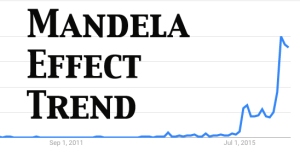
MandelaEffectTrendGraph

Google trend graph for “Mandela Effect”

When we encounter something indicating evidence that in fact, history has changed–it feels shocking to discover some of the lines have been canceled and washed out! We seem to be approaching ‘tipping point’ where it’s getting harder for scoffers to say there’s no such thing as the Mandela Effect / reality shifts / alternate histories. The term “Mandela Effect” originated with blogger Fiona Broome in 2010 after she attended a conference where many people talked with her about remembering how Nelson Mandela had died many years earlier–though official recorded history at that time indicated no such thing had actually occurred.

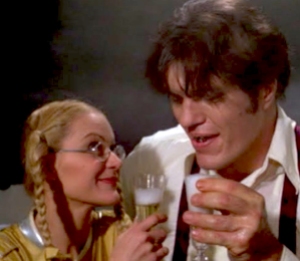
MoonrakerJawsGirl

Dolly and Jaws in “Moonraker”

Thanks to articles written by some Mandela Effect experiencers, the Mandela Effect shows evidence of increasing in popular awareness. Mandela Effect articles have been written by experiencers including the Lewiston Sun Journal’s Mark LaFlamme (“The Mandela Effect is Freaking Me Out“) who noticed a change on which side of his father he’s standing by in an old family photo;the New Zealand Herald’s Karl Puschmann (“Berenstein or Berenstain? The Riddle Making Book Lovers Mad“) who is certain the popular children’s books ought to be spelled “Berenstein” and not the way they’ve supposedly ‘always been spelled’ as Berenstain; and San Diego City Beat’s Tom Siebert (“Technology and Memory Down the Rabbit Hole“) who noticed a change to a memorable scene in a James Bond movie, “Moonraker,” in which the girl with the braces who fell in love with another character with shining teeth no longer has braces. I watched The James Bond film “Moonraker” several times while in college, and also remember the memorable scene in which the blonde girl named “Dolly” who wears glasses and braids shares a cheesy moment with Richard Kiels’ character, “Jaws,” when they notice how his shiny teeth complement the shiny braces on her teeth. Except now, she doesn’t have any braces on her teeth.

Taken individually–the way such observations of discrepancies between what we remember and recorded historical evidence have always been noted up until now–a single person feeling unsettled by noticing such a change would have been chalked up to their having made some kind of cognitive error. When such “mis-remembered” recollections are considered collectively, we are presented with the possibility that we are witnessing collectively agreed-upon awareness of differently remembered historical facts that we can start to take notice of.

Some scoffers have leapt to the conclusion that Mandela Effect experiencers who are noticing long-familiar words in movies, TV shows, books, and products are most likely suddenly sharing ‘false memories,’ due to the fact that human memories are not fully reliable. Such an explanation allows us to leave unquestioned some old assumptions that have quietly started to crumble at their very foundations since the advent of quantum physics just over a hundred years ago. While quantum physics shows us there can be no such thing as an objective observer, and now that two thirds of physicists recently surveyed agree that you and I and everything that exists does so in a superposition of states–we clearly need to revise both our scientific methodology and our assumptions about reality.

While I agree with the observation that human memories often do not match current historical records, it’s clear that stopping the thought process at that point is premature, and does not match what we are learning about the primacy of quantum logic in the natural world.

I’ve been researching this phenomena since the 1990s. It was originally called “reality shifts,” and first appeared in print in the book “Future Memory” by PMH Atwater to describe common (yet strange) experiences that near-death experiencers frequently have. I have been reporting on individual recollections of alternate histories involving everything from changes in books, to dead people alive again, to changes in the way motor memory works since 1999, in the earliest edition of my first book on this subject, Reality Shifts: When Consciousness Changes the Physical World, and in my free monthly Realityshifters ezine. I’m currently pursuing this Mandela Effect / reality shift topic in interviews with experts in the fields of quantum biology such as JohnJoe McFadden, quantum cognition such as Jerome Busemeyer, and quantum cosmology such as Yasunori Nomura on my blog and “Living the Quantum Dream” radio show. What I’m noticing is that this phenomenon appears to not be new, but rather we have reached a point in society where for the first time we are able to share memories with others that are different from the collective whole–and sometimes our memories show the same kind of alternate pasts that physicists such as Stephen Hawking have told us exist.

When we consider the matter of “confabulation” and “false recollections” at this dawning of the new Quantum Age, we see that we may eventually call such things “alternate recollections,” in recognition of awareness of the fact that we know that each and every one of us exists in a superimposed state, with access to many possible alternate histories, presents, and futures. The idea that the many worlds of quantum physics might be one and the same as the multiverse has been proposed by such esteemed physicists as Dr. Yasunori Nomura and Dr. Raphael Bousso of UC Berkeley, and increasing numbers of scientists are feeling optimistic that we might yet find evidence that we indeed live in a multiverse.

Finding Evidence of Many Worlds in Alternate Histories

There is an exciting human side to the subject of alternate histories and parallel worlds. While we don’t yet have technology to show photos from your past with evidence of parallel universes impinging on the very fabric of reality since the day you were born, we can look to see what kinds of evidence we are able to collect more easily. If we were feeling the effects of parallel universes, we would expect to occasionally notice that history doesn’t stay put. Occasionally, we’d have very different ideas of what happened than we’ve had before, or than others have had before. What would such alternate histories be like?

JFKcar1963nov22Dr. Robert A. Burton recounts a fascinating experience in his book, On Being Certain, of attending a medical school reunion dinner in which conversation turned to where people were when they heard the news that Kennedy was assassinated. Burton and his classmates had all been in their second year of medical school, attending similar classes and hanging out together. An argument broke out amongst the reunion attendees as a urologist thought they were all at lunch, an internist remembered they’d been in the lab, and a pathologist remembered being at a pub down the street from the med center. With classmates turning to Burton to be the tie-breaker, setting history straight, the pathologist and urologist both agreed on one thing as they announced in unison, “Everyone remembers the Kennedy assassination.”

If this was the first time such differences of memory related to significant events occurred, we might dismiss it as a humorous aside. But the fact of the matter is that researchers are increasingly becoming aware of what they call “false recollections.” With the advent of the Quantum Age, we may eventually call them “alternate recollections,” indicating awareness of the fact that we know that each and every one of us exists in a superimposed state, with access to many possible alternate histories, presents, and futures.

Challenger_1AUlric Neisser and Nicole Harsch conducted studies of Emory University students’ accuracy of recollections of events at the time of the Challenger space shuttle explosion, starting by collecting first-hand accounts from 106 students the day after the disaster detailing how they’d heard of the explosion, what they’d been doing at the time, where they were, and how they felt. The researchers followed up with the same students two and a half years later, and were startled to find that students achieved a mean score of 2.95 compared to a perfect score of 7. Less than 10% of the students were able to exactly match their original recollection of events, and over half of the students got a score less than 2.

The most noteworthy findings in this “flashbulb” memory study were student reactions when confronted with conflicting accounts. Many students persisted in confidently claiming that their current memories of events were completely accurate, even when confronted with their own hand-written journal entries. One student summed up what happened succinctly,

“That’s my handwriting, but that’s not what happened.”

It’s important to note that in this new Quantum Age, such cases of alternate histories are to be expected. They provide evidence of the superposition of states that we and everything around us exists within, so we can expect to occasionally see documented records from the past that differ from what we recall. In the Quantum Age, we understand that seeing our own handwritten notes that aren’t at all what we remember is one way that alternate histories become known.

Physicists Agree: You’re in a Superposition of States

When we understand that our belief structures are creations of our minds, we start noticing how varied individual belief structures can be from person to person. What one person considers to be realistic and matter-of-fact might seem outrageously peculiar to another. Even the idea that other people actually see images in their minds may seem outlandish to some people, let alone what those people see. When enough people shift their belief structures to look at the world in fresh, new ways, cultural paradigms shift.

Staying current with new scientific findings can help. While most non-physicists would likely see a solid physical object such as a table or a chair as only what it currently appears to be, a remarkable 2/3 majority of physicists interviewed in 2011 stated they believe that all objects can exist in superimposed states—much the way we know quantum ‘particles’ exist as energetic probabilities as much as physical particles we can measure and observe. University of Portland, Oregon, physics professor, Maximilian Schlosshauer summarized this remarkable agreement thus,

“More than two-thirds believed that there is no fundamental limit to quantum theory—that it should be possible for objects, no matter how big, to be prepared in quantum superpositions like Schrödinger’s cat. So the era where quantum theory was associated only with the atomic realm appears finally over.”

A Scientific Basis for Instantaneous Adaptation in Stressful Times

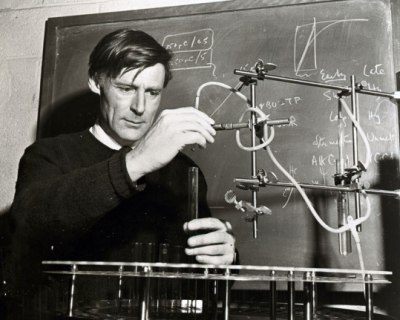
JohnCairns

John Forster Cairns

The scientific assumption that organisms experienced random mutations was seriously shaken by Harvard professor John Forster Cairns 1988 proposal that the organisms themselves were preferentially producing beneficial mutations. Cairns conducted experiments with E. coli bacteria that demonstrated that in times of stress, when the bacteria were starved from food they were capable of digesting, they made “adaptive mutations” to be able to receive nutritive sustenance from a food source they’d never been able to consume before. This phenomenon in which E. coli mutated exactly the most optimal genes precisely when that mutation was required had no known basis nor explanation from established theories in genetics–and indeed seemed to contradict one of the central dogmas of molecular biology, that information only flows in one direction during transcription from DNA out to proteins to a cellular organism environment. John Cairns and Julie Overbaugh and others proposed a mechanism that what might be happening is that “the cell could produce a highly variable set of mRNA molecules and then reverse-transcribe the one that made the best protein.”

If reverse-engineering mutations by bacteria in times of starvation so they can start digesting lactose sounds crazy, it might help to know there exists a similar proven case of successful quantum biological adaptation: photosynthesis. Those who expect modern human technology to be faster and more efficient than the rustic natural world are quite surprised to learn that our best photovoltaic cells are only 20% efficient, compared with photosynthesizing plants and bacteria that regularly achieve 95% efficiency rates for transforming sunlight into energy. Plants have existed on Earth for millions of years, so it’s not too surprising to find that their natural process of photosynthesis likely utilizes quantum coherence to speed things up. In decades past, scientists believed that excited electrons carried energy randomly through photosynthetic systems in plants, hopping from one molecule to the next. More modern measurements of energy in the new field of quantum biology studying photosynthesizing plants indicates something much more efficient is going on. What appears to be happening is that electrons take advantage of the fact that energy can move not just in the material form, but in pure energy form, too, and entire systems of molecules can become entangled to allow the formation of a coherent wave that tries out different pathways simultaneously, until the most efficient route is very quickly determined. The quantum magic happens in each of a photosynthetic cell’s millions of antenna proteins that are surprisingly efficient and robust at routing energy with very little lost in transit.

University of Toronto biophysicist Greg Scholes published his findings of room-temperature quantum coherence behavior in common marine algae in Nature. Scholes describes an analogy of driving home through rush hour traffic to explain what these cells are doing:

“… you have three ways of driving home through rush hour traffic. On any given day, you take only one. You don’t know if the other routes would be quicker or slower. But in quantum mechanics, you can take all three of these routes simultaneously. You don’t specify where you are until you arrive, so you always choose the quickest route.”

Advantages of experiencing alternate realities

My point is that everyone is experiencing reality shifts that usually get brushed aside with the assumption from most social settings being that there has been confusion or misperception (with both parties assuming the other has made some kind of mental mistake). The reason I raise the topic of flashbulb memories in my book, Quantum Jumps, is to share the extraordinary findings of researchers who asked college freshmen immediately following the Challenger space shuttle explosion to write down where they were, what they were doing, and who they were with when they heard the news of this disaster very soon after it first occurred. Then some time later, these same students were again asked the same question before they were allowed to look at their own hand-written accounts. As some put it, “That’s my handwriting, but that’s not what happened.” Thanks to this research and stunning placebo effect results, we now have an opportunity to acknowledge that rather than explaining such reality shifts away as ‘memory lapses’ or confusion, we have always been witnessing the way quantum phenomena occurs at ALL levels of reality, and not only below the so-called “von Neumann cut.” I have a sense that research in these fields is about to lead us to a new level of awareness that facts can change–yet understanding of our true identity as being consciousness can help us best find our way forward in experiencing various possible realities.

What Would You Notice if You’re in a Superposition of States?

What would it feel like to exist in a superposition of states? How could you tell? You might notice things like: markedly different childhood memories from your siblings; spontaneous or speedy healing from illness or injury; different movie dialogue, writing in books, product names, song lyrics, TV shows, and celebrities alive again after being reported dead. In fact, this is precisely what people are reporting with such commonly recognized examples as:

BerensteinBearsBerenstein Bears VS Berenstain Bears

SnowWhiteQueenMirror

• “Mirror mirror on the wall” VS “Magic mirror on the wall”

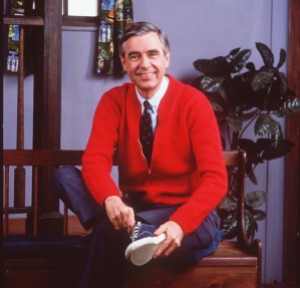
• Mr. Rogers sings, “It’s a beautiful day in THE neighborhood” VS “It’s a beautiful day in THIS neighborhood”

DarthVaderLuke

• Darth Vader says to Luke Skywalker, “Luke, I am your father” VS “No, I am your father”

Mandela Effect Reports on the Rise

In addition to some of these commonly reported shared experiences of alternate histories, some people are also remembering other things differently, such as: “If you build it, they will come” instead of now, “If you build it, he will come” and “Jiffy” peanut butter instead of “Jif.” As increasing numbers of honest reporters and authors start running into their own experiences with the Mandela Effect–both the private experiences that only they recognize, and the more publicly shared varieties–we will continue the growing conversation about the Mandela Effect, and why increasing numbers of people are noticing it now.

And in the meantime, I recommend that you keep asking “How good can it get?” to harness imagination and your ability to provide yourself with self-guidance from your highest levels of consciousness. Asking this question helps ensure we are honoring a longer-term, fuller and more harmoniously interconnected optimal experience. We can trust our highest, largest, most comprehensive levels of consciousness, and in so doing we will continue to experience different pasts and instantaneous transformations as we move through these stressful times to more optimal realities.

from:    http://consciouslifenews.com/whats-behind-meteoric-rise-mandela-effect/11124116/

The End of Cash?

Why I’ve cut up my contactless bank card…and you should too, says ROSS CLARK – they are driving up prices and killing off cash

By Ross Clark for the Daily Mail

The other day, my bank sent me a new ‘contactless’ debit card. Immediately, I cut it up with a pair of scissors.

Banks and credit card issuers might like to try to tell us that the future lies in the ‘cashless society’, in which we will make even the smallest purchases such as a cup of coffee or a daily newspaper by card, but I don’t want anything to do with it.

I am not a Luddite — I just like and trust cash.

If cash were to disappear we would find us at the mercy of the banks and their infernal transaction fee

If cash were to disappear we would find us at the mercy of the banks and their infernal transaction fee

If I am buying a week’s grocery shopping, or I am buying an airline ticket over the internet, true, I am quite happy to pay using my debit card, because it is by far the most efficient way of making the transaction.

But when I hear about banks and payment companies such as Visa and MasterCard doing their best to eliminate cash from our lives, I am deeply cynical about their motives.

I fear they are trying to engineer a future world where we can never buy or sell anything without using their services.

Contactless cards are the most recent ‘innovation’ as part of this insidious revolution.

They contain a tiny radio receiver which — when waved within a couple of inches of a ticket machine or terminal at a shop checkout — can be used to make a payment instead of the buyer having to tap in a PIN number.

It isn’t hard to imagine the power that the banks would wield if we lost the option of paying for items in cash and of keeping our savings in a hidey-hole at home.

They would use it as an excuse to ditch free banking in an instant. All kinds of charges would spring up for the simple reason it would be impossible for anyone to avoid them.

Of course, banking isn’t really free, even now. While most current account holders don’t pay a fee whenever they buy something with a debit card, retailers are paying for the service. They must pay to hire the terminals on which payments are made — and a percentage charge on the transaction.

In the case of a debit card, this charge is typically 8p per £100 spent by customers. For credit cards, the fee rises tenfold to 80p per £100. And for premium/reward cards, it doubles again, to £1.60 for every £100 spent.

Ultimately, though, it is we who pay for this — as well as all the air miles and other ‘goodies’ which are offered as accessories for the privilege of having such cards, because retailers inevitably pass the cost on to us in higher prices.

What’s more, banks and payment companies have been making ever-increasing sums from card payments.

In 2014, the Payments Council —the trade body for card-issuers, since renamed Payments UK — boasted that the number of card payments had overtaken that of cash payments for the first time.

As a country, we now make 48 per cent of our purchases with cash and the other 52 per cent by card or some other cashless method.

In some cases, we no longer have an option to pay in cash. For example, fast-food chain Tossed recently announced that it was phasing out the option of cash payments from its outlets altogether, forcing customers to pay by card.

Were cash to disappear, it isn’t hard to see what would happen to these transaction fees — they would soar, as banks exploited their monopoly.

While most of us don’t directly pay fees for using our debit cards in Britain, there are punitive charges for using them abroad.

I recently realised how much cheaper it would be for me to buy everything with cash when I am on holiday abroad.

Every time I use my debit card abroad, my bank, the Halifax, charges a flat rate ‘non-sterling purchase’ of £1.50 plus a ‘non-sterling transfer fee’ of 2.75 per cent. It soon mounts up, especially if you make a lot of small purchases.

A woman pays in a butcher's shop with a contactless credit card

A woman pays in a butcher’s shop with a contactless credit card

But the charges we pay now are nothing compared with what we will have to pay if the banks ever get their way and cash is abolished.

When, last Thursday, the Bank of England cut its base rate to 0.25 per cent — the lowest level ever — this raised the spectre of negative interest rates. Ten days ago, NatWest and the Royal Bank of Scotland — part of the same, largely publicly owned banking group — wrote to business customers warning them that there might soon come a time when they would have to start levying interest on deposits.

That, of course, is the opposite of what we are used to.

For years, we have earned interest on money we deposit in a bank account, just as we expect to pay interest when we borrow it.

The rate of interest on our savings might not always be exciting — current accounts pay virtually nothing, which is another way in which banks make money out of us.

But if we had to pay interest on our savings, it would mean that if we left our nest eggs untouched, they would be whittled away year by year. Whereas if we left them under the mattress, they would have retained their value!

So far, NatWest and the RBS have said they have no plans to charge negative interest on individuals’ accounts. At the moment, they wouldn’t dare, because they fear the inevitable consumer backlash.

Undoubtedly, huge numbers of us would walk into branches and withdraw our savings in protest — leading to a bank run just like the one which brought Northern Rock to its knees in 2007.

I know I am not the only consumer or saver to have reached this conclusion. While the banks and payment companies continue to push for the cashless society, the British population is putting up fierce resistance.

For, it can be no coincidence that the closer we get to negative interest rates, people are increasingly hoarding more money.

Pokemon Gotcha!

Pokémon Go, the CIA, “Totalitarianism” and the Future of Surveillance

pokemon ciaBy Steven MacMillan

If anyone doubted that a percentage of the global population are akin to zombies, the incidents following the release of Pokémon Go have surely convinced you. Despite the game only being released in early July, we have already seen a man driving into a tree and a women getting locked in a graveyard whilst chasing these furry little creatures.

Pokémon describes the game on their website in the following way:

Travel between the real world and the virtual world of Pokémon with Pokémon GO for iPhone and Android devices. With Pokémon GO, you’ll discover Pokémon in a whole new world—your own! Pokémon GO is built on Niantic’s Real World Gaming Platform and will use real locations to encourage players to search far and wide in the real world to discover Pokémon… In Pokémon GO, the real world will be the setting!

Pokémon Go, Google, the State Department, the CIA and the DoD

The company behind Pokémon Go is a San Francisco software developer called Niantic, Inc, which was formed in 2010 as an internal startup at Google. The founder and current CEO of Niantic is John Hanke, a man who has connections both to the State Department and the CIA.

Before moving to San Francisco to study at the University of California, Hanke previously worked for the US State Department in Myanmar. Hanke also founded Keyhole, Inc in 2001, a company which specialized in geospatial data visualization applications. Google acquired the company in 2004, with many of the applications developed by Keyhole being instrumental in Google Maps and Earth. In 2003, the CIA’s venture-capitalist firm, In-Q-Tel, invested in Keyhole, with the CIA’s own website proudly detailing this investment:

The CIA-assisted technology probably most familiar to you is one many of us use on a regular basis: Google Earth. In February 2003, the CIA-funded venture-capitalist firm In-Q-Tel made a strategic investment in Keyhole, Inc., a pioneer of interactive 3-D earth visualization and creator of the groundbreaking rich-mapping EarthViewer 3D system. CIA worked closely with other Intelligence Community organizations to tailor Keyhole’s systems to meet their needs. The finished product transformed the way intelligence officers interacted with geographic information and earth imagery.

One of the other intelligence organizations the CIA worked alongside was the National Geospatial-Intelligence Agency (NGA), which is partly under the control of the US Department of Defense (DoD).

So we have a somewhat enigmatic former State Department employee with connections to the CIA and the DoD, being the CEO of a company that created what seems to be a silly, harmless game. What’s going on?

Selling and Sharing Your Data

Like so many new technologies in our digital age, Pokémon Go is constantly gathering information on the user and then openly admitting that they will share this data with anyone who wants it.

As James Corbett pointed out in his article titled: “The CIA’s ‘Pokémon Go’ App is Doing What the Patriot Act Can’t,” the privacy policy of the app states that Niantic will share all the information they gather (which is a lot) with the state and private organizations:

We cooperate with government and law enforcement officials or private parties to enforce and comply with the law. We may disclose any information about you (or your authorized child) that is in our possession or control to government or law enforcement officials or private parties as we, in our sole discretion, believe necessary or appropriate.

Corbett also details how the game requires the user to give excessive access to Niantic/CIA/NGA/DoD (including access to the users’ Google account and camera).

Oliver Stone on PG: “Totalitarianism” and a “New Level of Invasion”

Speaking at this year’s Comic-Con, Oliver Stone – the award winning filmmaker and director of the new film on Edward Snowden – had some very insightful views on the new craze and the growing business of data-mining. As Vulture magazine reported in a recent article, Stone denounced the game as a “new level of invasion” and a new form of “totalitarianism:”

I’m hearing about it too; it’s a new level of invasion. Once the government had been hounded by Snowden, of course the corporations went into encryption, because they had to for survival, right? But the search for profits is enormous. Nobody has ever seen, in the history of the world, something like Google – ever! It’s the fastest-growing business ever, and they have invested huge amounts of money into what surveillance is; which is data-mining.

Stone continues:

They’re data-mining every person in this room for information as to what you’re buying, what it is you like, and above all, your behavior. Pokémon Go kicks into that. It’s everywhere. It’s what some people call surveillance capitalism; it’s the newest stage. You’ll see a new form of, frankly, a robot society, where they will know how you want to behave and they will make the mockup that matches how you behave and feed you. It’s what they call totalitarianism.

Predicting Human Behavior

It is interesting that Stone doesn’t just warn about the commercial aspect of data-mining, but the fact that the more data governments and private corporations collect on the citizens of the world, the easier it becomes to predict their behavior. It is not just Stone that is warning about this reality, however. At the start of last year, the UK governments own surveillance commissioner, Tony Porter, revealed how data obtained from CCTV cameras can be used to “predict behavior.”

As we progress through the 21st century and more advanced algorithmic systems are developed to process the tsunami of data, intelligence agencies and governments will increasingly be able to predict (and manipulate) the behavior of their populations and the populations of foreign countries. We are already far along this path, will the trajectory for the future heading straight towards levels of surveillance far beyond even what George Orwell envisaged; with the fight for digital privacy being a major battleground in this century for those who value freedom.

Pokémon Go looks more like a Trojan horse of the CIA and the wider intelligence-security-data-mining-Big-Brother complex, than just a silly, innocent game. With all these connections to the State Department, the CIA and the DoD, no wonder some countries are reportedly considering banning the game.

Steven MacMillan is an independent writer, researcher, geopolitical analyst and editor of The Analyst Report, especially for the online magazine “New Eastern Outlook”.

from:    http://www.activistpost.com/2016/07/pokemon-go-cia-totalitarianism-future-surveillance.html

Finding Peace Within

How To Master Inner Peace

July 30, 2016

How To Master Inner Peace

by Melind

I have learned in the past couple of years that nothing ever stays the same. Even after we start practicing mindfulness, we have our good and bad days.

People often tell me that sometimes they are still anxious, even after practicing peace for such a long time. They feel bad for it and want to eliminate it completely. But the truth is that anxiety, just like any other human feeling, cannot be eliminated completely. Because it is natural. And there’s nothing wrong with it, just like there’s nothing wrong with any other human feeling.

I have my own set of fears, just like everybody else does. Sometime I feel like my mind just picks a random worry off its big shelf of worries to bother me with. The shelf is never empty, it always has something to throw at me. I don’t think it will ever be empty. And that’s okay.

What I realized is that it doesn’t matter. It doesn’t matter that the shelf is full. It doesn’t matter what the mind throws at you. And I’m going one step further: It doesn’t even matter what life itself throws at you. Because there is only one thing that matters, one thing that determines life.

And that is how we react to it.

This was one of the very first reminders I’ve written in my meditation diary: “Life is determined by our reactions to it.” Because many things are out of our control, even our thoughts sometimes. But what will always remain in our control is our reactions. And through our reactions, we make life.

Let’s look at an example. Imagine a person who is scared of public speaking because of what people might think about her. That’s a very common fear. Now imagine that person going up to speak and messing up in the worst possible way. This is our main situation. There are two ways to go from there.

She either collapses mentally and scolds herself for being so stupid, never really getting over it, making it into one of her most horrible memories. Or she can shrug it off, accept with peace that it happened and move on. Will anyone in the audience care? No, everyone will forget after a short time. Of course they will, because it’s not a big deal. It’s nothing in the grand scheme of things.

Nothing is nearly as big of a deal as our minds make it out to be. It’s good to remember that, so when the time comes, we can choose to react with peace. What happens doesn’t matter as long as we choose to react to it with peace. Because whatever we react to in such a way will become a peaceful experience.

This is one of the most important things I’ve learned and I still remember what a freeing experience it has been to realize it. I don’t have to suffer. I don’t have to panic. I don’t have to worry. I can choose to react with peace. To anything. Inside and outside of me.

“Pain is inevitable, suffering is optional,” is one of my favorite quotes. Because it’s so true. Things will happen, everyone goes through pain, hardship, bad thoughts, uncomfortable feelings. But those don’t determine a life. What determines a life is how we react to all these things. Because that makes all the difference in the world.

(A guided meditation on the same topic can be found here:

“Life is 10 percent what happens to you and 90 percent how you respond to it.” – Lou Holtz

from:    http://in5d.com/how-to-master-inner-peace/

Native Americans in Politics

A Political Turning Point for Native Americans

Who will be Indian Country’s Obama? Look to the states. Her name will be Paulette, Peggy, or Denise.
Trahant Main Art 650px.jpg

This is the first of a two-part series on this political turning point for Native Americans. Read Part 2 here.

Joe Garry was president of the National Congress of American Indians in an era when tribal rights were under assault from Congress. House Concurrent Resolution 108, passed in August 1953, declared that the federal government should “terminate” its responsibilities toward Native Americans, essentially breaking promises made through solemn treaties.

The threat was real. In a period of 30 years, more than a hundred tribes were disbanded and the tribal governments dissolved. The result was huge losses of land and natural resources in Oregon, Utah, Wisconsin, Oklahoma, Nebraska, and Texas.

The strongest weapon in this battle is the power to vote.

Garry’s plan to counter that threat included the addition of more Native American voices to the country’s conversations. The strongest weapon in this battle is the power to vote, Garry said. So I’ll begin the story of Native America’s growing political voice in Idaho, where Garry was the chairman of the Coeur d’Alene tribe. He ran for the Idaho House of Representatives and was elected in 1957. Later, he won a seat in the the Idaho Senate, and in 1960 sought the Democratic Party’s nomination for the U.S. Senate.

Idaho is a surprising birthplace for Joe Garry’s legacy. Not many Native Americans live in Idaho, where they comprise roughly 1 percent of the population. Garry’s successes showed that someone from a tribal community could be a leader for all of the citizens in a state.

Joe Garry

In 1975, Garry’s niece Jeanne Givens became the first Native woman elected to the Idaho House of Representatives. Like her uncle, she challenged the status quo with a bid for Congress in 1988. Givens lost, but four years ago another Coeur d’Alene tribal member, Paulette Jordan, ran for the Idaho House seat. She lost that attempt but won in 2014, illustrating what may be the most important lesson in politics: You have to run to win—sometimes more than once. Jordan describes Givens as a mentor who has taught her much about politics. Both have earned the legacy of Joe Garry.

Larry Echo Hawk won a seat in the Idaho Legislature in 1992. After serving two terms he ran for and won election as the Bannock County prosecuting attorney—another first. Then, in 1990 he was elected attorney general of Idaho and became one of the few Native Americans to ever win a statewide office. Four years later he ran for governor, but he lost.

When a state like Idaho has a history of electing Native Americans to public office, you have to wonder, “Where else?” It has almost been a story of success-by-stealth.

There is a win in Arizona, another in Kansas. And when you add them up, there are at least 73 American Indians, Alaska Natives, and Native Hawaiians serving in 19 state legislatures.

When a state like Idaho has a history of electing Native Americans to public office, you have to wonder, “Where else?”

Why hasn’t the scope of this story been told before? Because each race is local; no one has ever collected all of the data that make a complete picture. So at the start of the election season I set out to build a complete list of Native Americans running for state and federal office. My list is always changing, but there are seven candidates for the U.S. House of Representatives, one for the U.S. Senate, and some 80 state legislative candidates. (What I really like is that it’s crowdsourced: Every time I publish the latest candidate charts at TrahantReports.com, readers let me know who I have missed.)

I’d love to proclaim this to be a record year, but there’s nothing to measure against. We don’t know how many Native Americans have taken the plunge in previous election cycles. We do know, however, who has won.

One source for that information is membership in the National Caucus of Native American State Legislators. This is an association of people already elected, so it tells us more about what happened in 2014 than in 2016. Still, it’s important for three reasons: First, if you look at the body of work of these state senators and representatives, you’ll find that they advocate for better services, more funding, and improving relationships between tribal nations and state governments. Second, there is a mechanism to share information with each other about what works (and what does not). And third, this association is the talent pool for federal posts, from Congress to the White House.

Remember, it was just 1996 when Barack Obama was elected to the Illinois Senate.

To see the growing influence of Native Americans elected to office we need only to look at Montana.

Right now, the big story there is Denise Juneau, the state’s superintendent of public instruction, who is running for the U.S. House of Representatives. She’s a member of the Mandan and Hidatsa tribes and grew up in the Blackfeet Nation in Browning, Montana. She has already won two statewide contests, so she knows what it takes to win Montana’s only U.S. House seat. If successful, she (along with Arizona congressional candidate Victoria Steele) would be the first American Indian woman in Congress.

To see the growing influence of Native Americans elected to office we need only to look at Montana.

Yet the Montana story is richer than just Juneau. Some 20 years ago, Montana was much like any other state with a significant Native American population with only one or two Native Americans serving in the state Legislature. But in 1997, a third Native American candidate won. And again in 2003. By 2007, Native Americans in Montana occupied 10 seats in the state Legislature—6.6 percent of that body. Montana’s population is 7.4 percent Native American.

Today there are three Native Americans in the Montana Senate and five in the Montana House of Representatives, some 5.3 percent of the state Legislature. This is the highest percentage of Native American representation in the country.

Let’s put the Montana percentages in national terms: If Congress were 5.3 percent Native American, that would be five U.S. Senators and 21 members of the U.S. House of Representatives. Even if you adjust for population, the number of Native American members of Congress would have to more than double to equal the representation found in Montana.

Native American Candidates Seeking Office

YES! Infographic by Tracy Loeffelholz Dunn.

After the 2016 election, Montana’s state-level Native representation is likely to grow. There are 11 Native American candidates on Montana’s ballot this year, including Juneau.

Montana’s Native American legislators are in office to raise overlooked issues that are important to their constituents. According to the Montana Budget and Policy Center, this past session produced a number of innovative laws, including Medicaid expansion (a financial boost to the Indian health system) and laws that will improve funding for tribal colleges, support for tribal languages, and streamline Indian business ventures. The success rate of Native American legislators to push through policy changes was less than perfect, but their voices were heard. It’s likely that during the next session many of the ideas that failed to pass will be back on the agenda.

Native voters and elected officials are only at the beginning of a demographic trend.

At nearly 1 percent nationwide, the Native American rate of representation in state legislatures still trails that of the nation’s overall population of American Indians, Alaska Natives, and Native Hawaiians. But that’s more than half of the 1.7 percent that make up the Native American population in the United States. Compare that to Congress, where only two elected Native Americans equal only 0.33 percent. Compare that to the federal judiciary, where only one Native American judge equals a representation of about 0.1 percent.

Then consider the young and growing Native American population. Native voters and elected officials are only at the beginning of a demographic trend. The American Indian and Alaska Native population is younger and growing faster than the general population. About one-third of all Native Americans are under the age of 18 (compared to 24 percent for the total population), and the median age for Native Americans is 26 (compared to 37 for the nation).

While it’s overdue for America’s first citizens to have a voice in how governments are run and how the country’s future is shaped, it is happening now. Just imagine what it could mean for climate change policy decisions, for example, to hear from people who think about the future in terms of a 10,000-year history. Imagine also the healing message for a new generation of Native Americans—and for the country as a whole—to finally see in positions of power the people who suffered loss of both lands and culture and genocide.

Native Americans in State Government

YES! Infographic by Tracy Loeffelholz Dunn.

This is a story that has been unfolding slowly, chapter by chapter. It started even before Joe Garry, when 19th century tribal treaty negotiators demanded a seat in Congress (a promise never kept). It’s a legacy that is infused with presidential politics, especially when candidates like Jesse Jackson, Barack Obama, Bernie Sanders, and Hillary Clinton campaign in tribal communities. The election of Obama elevated the possible. He kept his promises to include tribal nations in his government and in his actions. His rise from community organizer representing poor Black communities illuminated a path to meaningful politics.

This is a story that’s been unfolding slowly, chapter by chapter.

It’s also a progressive legacy, of which Minnesota Rep. Peggy Flanagan of the White Earth Ojibwe tribe is an excellent example. Flanagan told The Circle when she was elected, “I have been clear that for myself personally as an Ojibwe woman and mother—but also what I’ve heard from my constituents—is that Minnesotans believe in protecting our land and water. That’s why people live here in the first place. Indian or non-Indian, we live in a really beautiful state, and to throw it all away for short-term financial gain is really troubling to me.”

It’s hard to look across the country and not be optimistic about the quality, and the growing quantity, of Native American political voices. We know the story won’t end here because history tells us that state legislatures are the route that leads the next generation of leaders into Congress—and one day the White House.

So if you want to know who will be Indian Country’s Barack Obama, look to the states. Her name will be Paulette Jordan, Peggy Flanagan, or Denise Juneau.

And whoever she is, she will represent Joe Garry’s legacy.

from:     http://www.yesmagazine.org/people-power/a-political-turning-point-for-native-americans-20160726