TS Dorian, TS Flossie, European Heat Wave,

In the Central Pacific, Tropical Storm Flossie, a strong tropical storm with 65 mph winds, is headed west at 20 mph towards Hawaii. Satellite images show that Flossie is maintaining a modest area of heavy thunderstorms that are well-organized. The storm is over waters of 25°C, which is about 1°C below the water temperature typically needed to sustain a tropical storm. Flossie peaked in intensity Saturday morning, when the storm had 70 mph winds. As Flossie approaches the Big Island of Hawaii on Monday, these waters will warm to 26°C, but wind shear is expected to be in the moderate range, which should keep Flossie from strengthening. Dry air aloft will likely cause some weakening before landfall Monday morning, and Flossie will likely have top winds of 45 – 55 mph when is passes through the Hawaiian Islands. Flossie’s main threat will be heavy rains, with 6 – 10″ expected over The Big Island and Maui County, and 4 – 8″ in Oahu. Rains of this magnitude are capable of causing dangerous flash flooding and mudslides. Sunday’s 11 am EDT wind probability forecast from the Central Pacific Hurricane Center gave Hilo on the Big Island a 33% chance of experiencing sustained tropical storm force winds of 39 mph or greater from Flossie. These odds were 32% for Honolulu and 41% for Kahului.


Figure 1. MODIS satellite image of Tropical Storm Flossie taken at approximately 5 pm EDT Saturday July 27, 2013. At the time, Flossie had top winds near 50 mph. Image credit: NASA.

Tropical storms are uncommon in Hawaii
On average, between four and five tropical cyclones are observed in the Central Pacific every year. This number has ranged from zero, most recently as 1979, to as many as eleven in 1992 and 1994. August is the peak month, followed by July, then September. Tropical storms and hurricanes are uncommon in the Hawaiian Islands. Only eight named storms have impacted Hawaii in the 34 year period 1979–2012, an average of one storm every four years. Since 1949, the Hawaiian Islands received a direct hit from just two hurricanes–Dot in 1959, and Iniki in 1992. Both hit the island of Kauai. Only one tropical storm has hit the islands since 1949–an unnamed 1958 storm that hit the Big Island. A brief summary of the three most significant hurricanes to affect Hawaii in modern times:

September 1992: Hurricane Iniki was the strongest, deadliest, and most damaging hurricane to affect Hawaii since records began. It hit the island of Kauai as a Category 4 on September 11, killing six and causing $2 billion in damage.

November 1982: Hurricane Iwa was one of Hawaii’s most damaging hurricanes. Although it was only a Category 1 storm, it passed just miles west of Kauai, moving at a speed of nearly 50 miles per hour (80 km/h). Iwa killed one person and did $250 million in damage, making it the second most damaging hurricane to ever hit Hawaii. All the islands reported some surf damage along their southwest facing shores, and wind damage was widespread on Kauai.

August 1959: Hurricane Dot entered the Central Pacific as a Category 4 hurricane just south of Hawaii, but weakened to a Category 1 storm before making landfall on Kauai. Dot brought sustained winds of 81 mph with gusts to 103 mph to Kilauea Light. Damage was in excess of $6 million. No Dot-related deaths were recorded.


Figure 2. Tracks of all tropical storms and hurricanes to pass within 100 miles of the Hawaiian Islands, 1949 – 2012. During that time span, the Hawaiian Islands received a direct hit from just two hurricanes–Dot in 1959, and Iniki in 1992. Both hit the island of Kauai. One tropical storm also hit, and unnamed 1958 storm that hit the Big Island of Hawaii. Image credit: NOAA/CSC.

Remains of Dorian are worth watching
The remains of Tropical Storm Dorian will be passing just north of northern Lesser Antilles Islands today and just north of Puerto Rico tonight. Satellite images show no signs of a surface circulation, and just a moderate area of heavy thunderstorms associated with the storm. AIr Force hurricane hunter aircraft are on call to investigate Dorian’s remains on Sunday afternoon and Monday afternoon, if necessary. In their 8 am EDT Tropical Weather Outlook, NHC gave Dorian’s remains a 20% chance of regenerating by Tuesday.

Extreme heat wave in Europe
An extreme heat wave is baking Europe today, and at least five countries have a chance at setting a new all-time national heat record. The most likely candidate is Liechtenstein, where the forecast for Balzers Sunday calls for a high of 95°F. According to wunderground’s International Records database maintained by our weather historian, Christopher C. Burt, the current all-time heat record for Liechtenstein is 36°C (96.8°F) set at Vaduz on August 13, 2003.

from:    http://www.wunderground.com/blog/JeffMasters/show.html

Monsanto Looks to Patenting Conventional Crops

Europe

Monsanto gives up on GM crops in Europe, pursues patenting of conventional crops

Wednesday, July 24, 2013 by: Jonathan Benson, staff writer


(NaturalNews) The world’s most evil corporation, Monsanto, has announced it will cease trying to introduce any new genetically-modified (GM) crops into Europe following years of widespread public opposition to the controversial and untested technology. Instead, the multinational biotechnology behemoth will re-focus its efforts on controlling the conventional seed market in the European Union (EU), an outlandish move that proves the seed giant is still determined, in one way or another, to dominate global agriculture.

Monsanto’s President and Managing Director for Europe, Jose Manuel Madero, recently told Reuters in a phone interview that his company will be withdrawing all existing approval requests for new GMOs in Europe within the next few months. These include five pending approval requests for at least one new variety of GM corn (maize), as well as GM soybeans and GM sugar beets. As of this writing, there is only one GM crop, Monsanto’s MON810 maize, currently approved for cultivation anywhere in Europe.

No matter how hard Monsanto and various others in the biotechnology industry have tried in years past to force GMOs on Europe, the result has almost always been the same: failure. The people of Europe have repeatedly expressed loudly and clearly that they do not want to eat GMOs, and the European Commission (EC) has tended to align its approval process for GMOs with this public sentiment in mind. Thus, GMOs continue to remain largely absent from the European market, with the exception of widely-used animal feed.

“(The requests) have been going nowhere fast for several years,” says Brandon Mitchener, a Monsanto spokesman, about the company’s failed efforts to force GMOs on Europe. “There’s no end in sight.”

Monsanto: If we can’t force Europeans to accept GMOs, we will instead take over their conventional crops

This is good news for Europeans, of course, who will finally have the opportunity to rest a little easier as far as the integrity of their food supply is concerned — this is with the exception of GM animal feed, of course, which is currently imported into the country from places like the U.S. and South America at a rate of more than 30 million metric tons yearly, according to Reuters.

But what Europeans will now have to worry about, sadly, is Monsanto’s new pursuit of controlling their conventional crops. As we here at NaturalNews have been reporting on recently, Monsanto has been taking advantage of a little-known loophole in European patent law that allows the company to literally draw patents on natural crops like broccoli and green beans.

You can read more about this here:
http://www.naturalnews.com

“In the coming weeks, around a dozen new patents will be granted (to Monsanto), covering species such as broccoli, onions, melons, lettuce and cucumber,” explains the food freedom watchdog coalition No Patents on Seeds! about Monsanto’s new business approach. “Monsanto and Syngenta already own more than 50 percent of seed varieties of tomato, paprika and cauliflower registered in the EU.”

In other words, since it could not have its way with GMOs in Europe, Monsanto simply turned to the earth’s natural bounty and gradually claimed it as its own — and the European Patent Office (EPO) continues to facilitate this takeover of the natural food supply in Europe, mostly because the European people remain in the dark about what is actually happening to their agricultural system.

You can help fight Monsanto’s takeover of the European food supply by signing the No Patents on Seeds! online petition:
http://www.no-patents-on-seeds.org

Tropical Storm Dorian Forms

The season’s fourth named storm, Tropical Storm Dorian, is here. Born from a strong tropical wave that moved off the coast of Africa on Monday, Dorian formed unusually far east for so early in the season, at longitude 29.9°W. Only Hurricane Bertha of 2008, which became a tropical storm at 22.9°W longitude on July 3, formed farther to the east so early in the year. Satellite images show that Dorian is a small but well-organized system with a moderate amount of heavy thunderstorms. A large area of dry air lies to Dorian’s west, as seen on water vapor satellite images, but Dorian has moistened its environment enough that this dry air should not interfere with development for the next day. Dorian is under a low 5 – 10 knots of wind shear, which will tend to allow slow development. Ocean temperatures are barely adequate for maintaining strength of a tropical storm, about 26.5°C.


Figure 1. MODIS satellite image of Tropical Storm Dorian taken at approximately 8 am EDT July 24, 2013. At the time, Dorian had top winds near 50 mph. Image credit: NASA.

Forecast for Dorian
The SHIPS model predicts that wind shear will stay in the low range through Thursday, then rise to the moderate range Friday through Monday. Ocean temperatures will fall to 25 – 26°C Wednesday night through Thursday night, which may induce some weakening of Dorian. Thereafter, ocean temperatures will rise again, but wind shear will rise. This increase in wind shear will be capable of causing weakening, since there will still be a large area of dry air to Dorian’s west that the shear may be able to bring into Dorian’s core. Given its small size, Dorian is capable of relatively large changes in intensity in a short amount of time, and it would not surprise me if the storm dissipated by the end of the week–or became a Category 1 hurricane. However, the official NHC forecast of a tropical storm passing just north of the Lesser Antilles on Sunday is the most likely outcome; the 11 am wind probability forecast from NHC gave Dorian a 6% chance of being a hurricane at that time. Dorian should maintain a west-northwest track through the week, and spread heavy rains and gusty winds to the northern Lesser Antilles Islands beginning on Sunday. The usually reliable European model (ECMWF) has Dorian passing several hundred miles to the north of the Lesser Antilles Islands, while the other models show Dorian passing closer, within 100 miles. It currently appears that Dorian will be a potential threat to the Bahama Islands, Bermuda, and the U.S. East Coast next week. There will be a trough of low pressure capable of recurving Dorian out to sea before the storm reaches the Bahamas and U.S., but this trough is currently depicted as being fairly weak, reducing the chances of Dorian missing the Bahamas and U.S. East Coast.


Figure 2. Tracks of all Atlantic tropical depressions, tropical storms, and hurricanes (tropical cyclones) occurring in the months of June and July off the coast of Africa. Only Bertha of 2008 became a named storm farther east so early in the year, compared to Tropical Storm Dorian. Reliable satellite records of Eastern Atlantic tropical cyclones go back to 1966. Image credit: NOAA/CSC.

from:    http://www.wunderground.com/blog/JeffMasters/show.html

Minxian, Gansu, CHina Deadly Quake

Deadly earthquake near Minxian, Gansu, China – at least 95 killed and +1000 injured – Update July 24

Last update: July 24, 2013 at 2:22 pm by By

Update : the expected shaking at some Chinese cities based on the data from USGS (M5.9). Chinese have M6.6 but deeper than USGS which may after all have the same intensity.

Screen Shot 2013-07-22 at 02.36.57

Update : The Chinese seismological authority has reported a M6.6 at a depth of 20 km, an even grimmer perspective than the M5.9 from USGS on which the data below have been calculated. There is no reason not to believe the data from the Chinese as they are highly specialized in earthquakes.

Update : USGS expects a very strong MMI VII shaking for approx. 19,000 people, a strong shaking for 150,000 people and a moderate shaking for 379,000 people.

Screen Shot 2013-07-22 at 02.37.14

A very dangerous earthquake struck the Gansu province, China

Screen Shot 2013-07-22 at 02.33.56

13km (8mi) E of Chabu, China
151km (94mi) W of Beidao, China
154km (96mi) SE of Linxia, China
177km (110mi) SSE of Lanzhou, China
1233km (766mi) WSW of Beijing, China

Most important Earthquake Data:

Magnitude : 6

Local Time (conversion only below land) : 2013-07-22 07:45:57

GMT/UTC Time : 2013-07-21 23:45:57

Depth (Hypocenter)  : 10 km

Update 13:46 UTC : Good and important news from the earthquake region. The ministry of transportation has ended all repair work at the National and Provincial roads in the earthquake region. This will enable relief and rescue trucks to transport the necessary equipment closer to the epicenter area.

Update 12:51 UTC : Something ER just learned now in reading the earthquake responsive : Veterinary emergency task group that works closely together with the Ministry of agriculture to assess asap all animal related topics, like prevent dead animals becoming sources sickness, getting abandoned animals to their owner, helping farmers manage their stock. This service is extremely important in rural areas where animals are often the only wealth of the owner. The teams include also veterinarians.

Update 12:15 UTC : Just like it happened in the Sichuan earthquake a couple of months ago, the Central Disaster Management team has taken over the lead in the rescue and relief efforts. Premier Li Keqying will overview personally every effort going on for rescue and relief. Earthquakes in China are divided into different categories. Some do only need local county response, others Province and the very big ones are managed by the Central Government.
An earthquake which is managed buy the Central Bejing Government has all possible power to engage whatever means possible. Army, police even temporarily allocation of civilian aircraft lies in their power.
We can make sure to our readers that this response is by far the most efficient in the world. Will it be perfect ? Never, but since we cover almost every earthquake in the world who needs assistance, we know what we are talking about. Congratulations to the Chinese response teams.

Premier Li Keqying on his way to the recent Sichuan earthquake to manage relief and rescue efforts

Premier Li Keqying on his way to the recent Sichuan earthquake to manage relief and rescue efforts

Update 11:19 UTC : A video from a China News channel with a reporter in the earthquake damaged areas (can be slow to load)

Important Update 10:22 UTC :
Sad to report that the victim numbers are increasing by the hour (these are all “at least” numbers):
– 75 people are now confirmed as being killed
– 14 have been recorded as missing
– 584 people are being treated for all kinds of injuries
– Chinese seismologists have said that the shaking intensity near the epicenter must have been VIII or “severe shaking”

Update 10:30 UTC : The experts of the China Earthquake Network have given more details about the technicalities behind the quake. They speak about the influence of stronger earthquakes the last 10 years on the faults that triggered this earthquake. The fault is likely a North South direction fault. Ano no major earthquake happened in this area since 1900 (see also our bottom map), stress has accumulated and has been released now. Perfectly normal are telling the scientists. 405 aftershocks so far, some of them +5. They expect this to go on for at least a week with +5 still possible. For that reason they ask people to be super-careful and not to live in damaged houses. For those camping in the open, they ask people to be careful and look at the terrain at all sides, mainly to avoid secondary geological elements like landslides, flash floods, etc.

Update 10:15 UTC : To imagine better the destruction the earthquake has inflicted, the picture below.
At least 14 people are still missing.

Screen Shot 2013-07-22 at 12.18.06

Update 10:00 UTCWeather during and immediately after an earthquake is incredibly important both for the chance on landslides and the way rescue has to be organized and relief goods to be distributed.  Bernhard Mühr from KIT Karlsruhe has made a short study on what to expect in the earthquake area until the end of July. The conclusion of this in-depth weather forecast : very good considering the monsoon period.

Brief Meteorological and Climatological Overview
Minxian and Zhangxian Districts, Gansu, China
Issued: Monday, July 22, 2013
Climatological Overview

Screen Shot 2013-07-22 at 11.41.48

There is a strong gradient in precipitation from Lantschau southward. The districts hit by the earthquake, Minxian and Zhangxian, expect significantly more rain than Lantschau. The  monthly rain amounts during the summer months are about twice as much (~100-150 mm).
The districts in many places have rugged terrain, narrow valleys are located between mountain ranges that rise to more than 3000 meters.
Monsoon rains often are associated with thunderstorms and are of great intensity. These downpours frequently lead to sudden rise of river levels, flooding and might trigger landslides.

Screen Shot 2013-07-22 at 11.42.12

Long term average (1961-1990) mean of rain in July in south-east asia. Red rectangle indicates the earthquake region. Source: www.wettergefahren-fruehwarnung.de, Data source: Climate Research Unit

Rain forecast
The latest GFS-model run (July 22, 2013, 00 UTC) doesn’t show much rain for the next 8 days in the affected area. Widespread and large rain amounts are not to be expected. However, in unstable monsoon airmasses localized rain areas and thunderstorms might occur any time.  Their intensity can be large and thus cause problems with river levels and landslides at places.

Screen Shot 2013-07-22 at 11.40.26

RaiRRain forecast: Accumulated rain during the next 8 days until July 30, 2013. In the region hit by the earthquake (rectangle) large and widespread rain amounts are not very likely until end of month.
Source: www.wettergefahren-fruehwarnung.de; Data source: GFS model run, July 22, 2013, 00 UTC

Screen Shot 2013-07-22 at 11.39.38

Update 09:34 UTC : The number of injured persons has increased to 462 (from 412)
As we have expected it fropm almost immediately after the earthquake hit, landslides have also been triggered. At least 10 houses have been buried in Meixian, Minxian county.

Screen Shot 2013-07-22 at 11.32.47

Update 08:51 UTC : Chinese are far better pupils if it comes to earthquake preparedness than most other countries in the world. One example : once out of the building, most people evacuate to the middle of the street or in open places.

Screen Shot 2013-07-22 at 10.53.41

Update 08:47 UTC : A picture we will see more and more in the future. Death toll will decrease considerably in the future due to earthquake resistant (new) houses and apartment buildings. The villages in the rural areas do not have the money to build this way and people are in great majority still living in very old primitive houses. Conclusion : less and less fatalities in (modern) cities and only a fraction less in rural areas.

from:    http://earthquake-report.com/2013/07/21/very-strong-earthquake-gansu-china-on-july-21-2013/

Get GMO’s Labeled

Good News! Monsanto’s PR Machine Is Failing Miserably

by Dr. Mercola

Story at-a-glance

  • Mainstream press is finally starting to question the logic behind, and safety of, GE foods and genetically modified organisms (GMOs)—from crops with built-in pesticides, to salmon designed to grow abnormally large and fast
  • Some mainstream reporters have come down hard on Monsanto and their biotech allies in recent weeks, most of them highlighting the growing pest and weed resistance these crops have produced
  • A recent report illustrates the dramatic increase of pesticide use as resistance began taking hold in early 2000’s. Use of the herbicide 2,4-D (the active ingredient in Agent Orange) has also more than doubled since 2002
  • In the past few weeks, Connecticut and Maine have passed GMO-labeling bills, and 20 other states have pending legislation to label genetically engineered foods
  • In November, Washington State will vote on GMO labeling. If the Organic Consumers Association (OCA) raises $150,000 by July 27, I will match the donation

Let’s Get GMO’s Labeled!

Even though Prop 37 in California last November just missed passing, it generated enormous amounts of exposure on this issue, far more than what was spent on the campaign. That exposure will be the catalyst to our eventual victory.

In the past few weeks, Connecticut and Maine have passed GMO-labeling bills, and 20 other states have pending legislation to label genetically engineered foods. So, now is the time to put the pedal to the metal and get labeling across the country—something 64 other countries already have.

I hope you will join us in this effort. In November, Washington State will vote on GMO labeling. Please help us win this key GMO labeling battle and continue to build momentum for GMO labeling in other states by making a donation to the Organic Consumers Association (OCA).

to read the rest of the article and take action to get GMO’s Labeled, go to:   http://articles.mercola.com/sites/articles/archive/2013/07/23/press-questions-gmo-safety.aspx?e_cid=20130723_DNL_art_1&utm_source=dnl&utm_medium=email&utm_content=art1&utm_campaign=20130723

June Weather Data

From Dr. Jeff Masters of  Wunderground:

June 2013 was the 15th warmest June in the contiguous U.S. since record keeping began in 1895, said NOAA’s National Climatic Data Center (NCDC) in their latest State of the Climate report. Six Southwest U.S. states had a top-ten warmest June on record, and no states recorded a significantly below-average June for temperatures. Over three times as many record warm highs and lows occurred than record cold highs and lows during June. For the year-to-date period January – June, both temperature and precipitation over the contiguous U.S. have been above normal, ranking in the upper 33% and 23% of years, respectively.

According to NOAA’s U.S. Climate Extremes Index (CEI), which tracks the percentage area of the contiguous U.S. experiencing top-10% and bottom-10% extremes in temperature, precipitation, and drought, June extremes were about 10% below average, and the year-to-date period January – June 2013 has been 20% below average.


Figure 1. Historical temperature ranking for the U.S. for June 2013. Six Southwest U.S. states had a top-ten warmest June on record, and no states recorded a significantly below-average June for temperatures. Image credit: National Climatic Data Center (NCDC).

Wet June on the East Coast raises hurricane flood risk
It was a very June for the contiguous U.S., ranking as the 13th wettest June since 1895. New Jersey and Delaware had their wettest June on record, and sixteen other eastern states had a top-ten wettest June. The very wet June has brought some of the highest soil moisture levels ever recorded for July along much of the coast from Florida to Maine, increasing the chances of extreme flooding should this region receive a hit from a tropical storm or hurricane during the coming peak months of hurricane season. The latest 2-week forecast from the GFS model keeps the East Coast under a wetter-than-average weather pattern into early August, and the latest 1-month and 3-month precipitation outlooks from NOAA’s Climate Prediction Center also give above-average chances of wetter than average conditions. Lake Okeechobee in Florida is 1.4′ above average for this time of year, and 5′ higher than two years ago. While this still puts the lake 1.2′ below what is considered high water, Lake Okeechobee water levels will need to be watched as we head into the peak part of hurricane season.


Figure 2. Historical precipitation ranking for the U.S. for June 2013. New Jersey and Delaware had their wettest June on record, and sixteen other eastern states had a top-ten wettest June on record. Utah had its driest June on record, and Arizona, Colorado, and Wyoming had a top-ten driest June. Image credit: National Climatic Data Center (NCDC).


Figure 3. Soil moisture for July 14, 2013, expressed as percent average of the soil moisture observed between 1916 – 2004. Portions of Florida, Georgia, South Carolina, North Carolina, Virginia, Maryland, New York, Vermont, and New Hampshire are near their highest soil moisture levels on record for this time of year, increasing the odds of extreme flooding in those states should a tropical storm or hurricane hit this year. Image credit: University of Washington Variable Infiltration Capacity Macro-scale Hydrological Model, which includes soil moisture, snow water equivalent, and runoff.

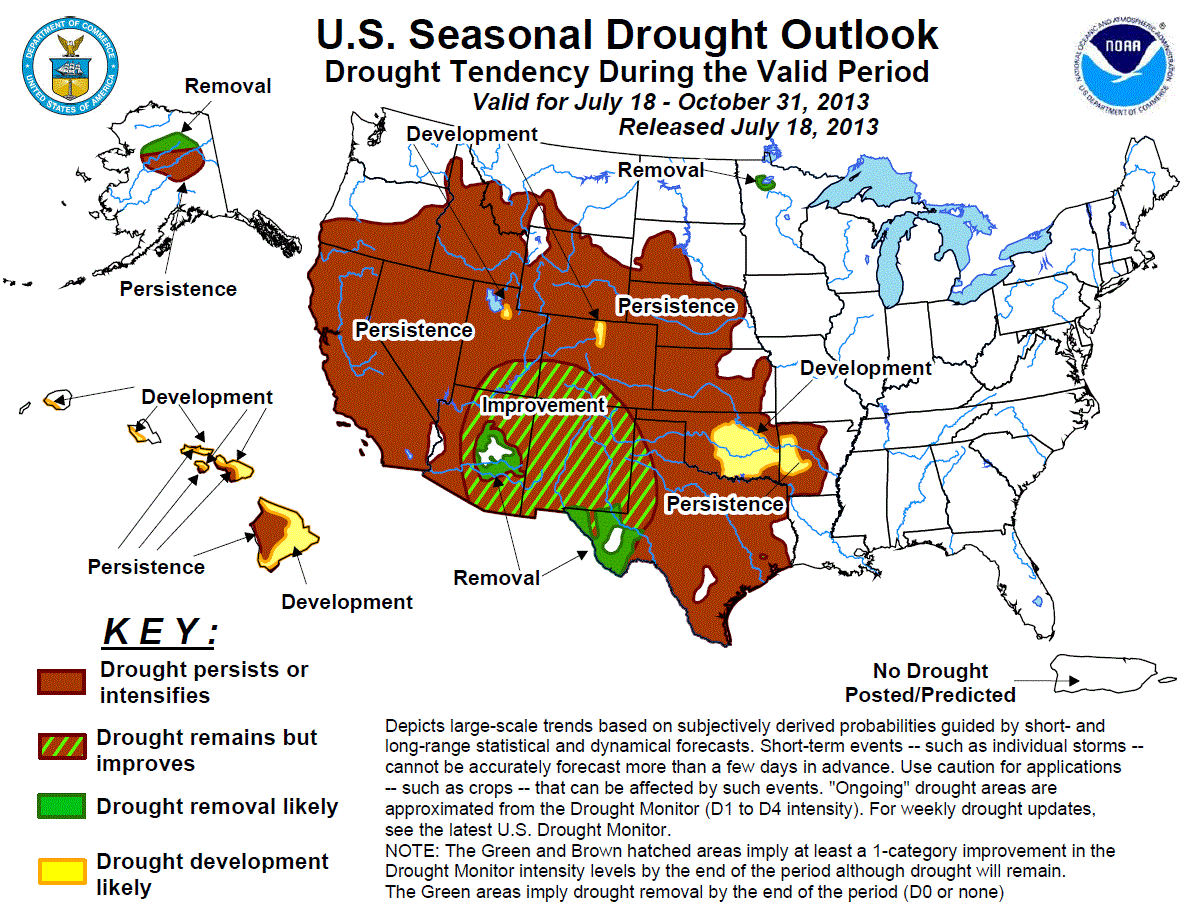
Drought conditions remained relatively unchanged during June. According to the July 9 Drought Monitor report, about 45% of the contiguous U.S. is still in moderate or greater drought, compared to 44% at the beginning of June. The U.S. Seasonal Drought Outlook issued on June 21 calls for little overall change in the U.S. area covered by drought conditions during the remainder of summer. Approximately 1.2 million acres of land burned in the U.S. during June, which is above average. However, the year-to-date total acreage burned is the second lowest in the past ten years.

Quiet in the Atlantic
There are no tropical cyclone threat areas in the Atlantic to discuss today, and none of the reliable models for tropical cyclone formation is predicting development during the coming seven days.

from:    http://www.wunderground.com/blog/JeffMasters/show.html

Southern Peru Earthquake 7/17

Sabancaya volcano area earthquake, Southern Peru – at least 3 injured and 20 collapsed houses

Last update: July 17, 2013 at 10:26 am by By

Screen Shot 2013-07-17 at 06.15.04

Update 04:09 UTC : USGS has even increased the Magnitude from 5.9 to 6 now. USGS is further expecting a MMI VII or very strong shaking directly near the volcano. Such a shaking will be very damaging and serious injuries and even fatalities cannot be excluded.

Screen Shot 2013-07-17 at 06.06.53

Update 04:03 UTC : A strange situation as IGP Peru is not confirming the M6.0 (all 3 international agencies are reporting M5.9 !), but is reporting a Ml5.1 at a depth of 15 km. This means NO direct eruption related earthquake (15 km is too deep) but one of the similar earthquakes on the volcano so far.
A big eruption of the volcano would have certainly be heard in Arequipa, a big Peruvian city. The earthquake was however well felt in Arequipa.

Update 03:51 UTC : The earthquake was not even felt in Arequipa as we expected but we ara  still worried about the people close to the volcano. We will certainly get more information when daylight arrives.
Local press thinks to now that the earlier, weaker, earthquakes today were not related to the volcano, but confirm that the M 5.9 was one very close to the volcano. The 5 earlier today were close to Arequipa.

Update 03:48 UTC : Even without the volcano erupting, this earthquake will be damaging for the surrounding villages where weaker earthquakes did inflict damage earlier this year.

Another, this time very strong, earthquake near the Sabancaya volcano in Southern Peru.

Screen Shot 2013-07-17 at 05.46.51

12km (7mi) W of Chivay, Peru
84km (52mi) NNW of Arequipa, Peru
148km (92mi) SW of Ayaviri, Peru
150km (93mi) NE of Camana, Peru
393km (244mi) WNW of La Paz, Bolivia

Most important Earthquake Data:

Magnitude : 6

Local Time (conversion only below land) : 2013-07-16 21:37:45

GMT/UTC Time : 2013-07-17 02:37:45

Update 10:23 UTC : Landslides are blocking various road in the area. People in Cabanaconde are using the Plaza de Armas as a safe retreat. We expect more news the following hours as we are getting in the morning hours in Peru (daylight)

Update 06:52 UTC : The Civil Defense services of the Caylloma province report that 20 houses collapsed, five in Huambo and 15 in Canabaconde. This news is coming out in the middle of the Peruvian night. Only at daylight the full damage impact will be visible.  We expect the damage to further increase the coming hours. Number of injured had increased from 2 to 3.

Update 05:45 UTC : El Commercio Peru reports at last 2 elderly people injured in Cabanaconde (Caylloma province). Currently we know about 15 destroyed houses and a number of collapsed walls.
The report also states that people at  Cabanaconde left their houses for a nearby local school.
We fear that the damage reports will increase further later today.
Ingemmet (Geológico Minero Metalúrgico) indicates that the increased activity in the area may be related to the Sabancaya volcano.

Update 04:45 UTC : Our Volcano specialist Rodger Wilson wrote this yesterday evening UTC : Larger magnitude earthquakes are now occurring within the current earthquake swarm at Sabancaya volcano (Peru) (station SAB). He was definitely right ! This was the seismogram from yesterday.

SAB_BHZ_PE_01.2013071612-a

Update 04:32 UTC : We consider it very good news that somebody from Chivay was able to go on the internet and tell the world that the shaking was really bad. Able to use the internet is at least that he is OK and that telecommunications are still working.

Update 04:15 UTC : We have so far NO direct news from Chivay, Peru a tourist village very close to the volcano. As the hypocenter was very shallow (USGS reports 6.6 km) the main problems might be coming from an area as narrow as 25 km around the volcano.
Based an the recent seismogram from Sabancaya, we think it did NOT erupt. NO continuous tremor can e seen on the seismogram, only the series of earthquakes.

from:    http://earthquake-report.com/2013/07/17/very-strong-earthquake-southern-peru-on-july-17-2013/

Algeria – Damaging Earthquake 7/17

Dangerous earthquake in Nord d’Algerie – 11 injured

Update 09:57 UTC  : Radio Algérienne is mentioning a report from the Protection Civile (Civil Defense) that 11 people are now recorded as treated for slight injuries. Also slight damage at an number of houses like cracks in the walls.

Update 08:37 UTC  : we are continuously searching for more news but so far only what we have reported below.

Update 06:34 UTC : According to national radio, the earthquake has so far injured seven, four in Algiers and 3 in Blida. The earthquake also caused cracks in several houses, according to the same source added that the inhabitants of Hammam Melouane (epicenter) complain about the lack of emergency services on the site. The radio reported the presence of the army and the gendarmerie in Hammam Melouane.

Update 05:20 UTC : Earthquake-report.com considers this earthquake as an ongoing reports and will add more updates as time is passing by.

Update 05:18 UTC  : CRAAG reported that the epicenter was located at 4 km from Hammam Melouane. Civil Defence groups are currently assessing the situation. So far we have 3 injuries hurt by falling objects and 2 threated for secondary shock reasons. Algeria has always been an active earthquake area as a major fault runs along the coast.

Update 04:38 UTC  : We think that more information will be available in a couple of hours, but we are almost sure that damage will be generated. So far NO news about it.

Update 03:42 UTC  : This is a VERY populated area and houses in Algeria have almost no resistance against earthquakes. Weaker earthquakes have been generating damage a few weeks ago.

Moderate to strong earthquake in Northern Algeria. Epicenter close to Chebli.
This was an early wake up call in Algeria.
Slight damage possible as this is a very populated area.

Screen Shot 2013-07-17 at 05.30.12

3km (2mi) ENE of Bouinan, Algeria
4km (2mi) W of Bougara, Algeria
4km (2mi) SSE of Chebli, Algeria
8km (5mi) SW of Sidi Moussa, Algeria
23km (14mi) S of Algiers, Algeria

Most important Earthquake Data:

Magnitude : 4.9

Local Time (conversion only below land) : 2013-07-17 04:00:56

GMT/UTC Time : 2013-07-17 03:00:56

Depth (Hypocenter)  : 10 km

from:    http://earthquake-report.com/2013/07/17/moderate-earthquake-northern-algeria-on-july-17-2013/


Latest on Volcano Popocatepetl

New Lava Dome Spotted at Mexico’s Popocatépetl

Shot of a new lava dome seen on July 7, 2013 forming within the main crater at Mexico’s Popocatépetl after a week on continuous strong ash emissions and explosions. Image: CENAPRED.

Programming Note: I’ve now entered summer crunch time. Between lab time and field work with my students over the next month along with my own projects and manuscripts that need to move forward before the start of the next school year, I am going to be busy with a capitol B. I’ve going to try to keep up with posts as events occur, but I can’t guarantee that I can update as quickly and frequently as I normally do, at least not until this stretch is over. Hopefully this helps dispel that myth that someone college faculty have the summer “off” … !

Onwards to the update!

As noted in this space last week, Popocatépetl has had an active week, to the point that a multitude of flights in/out of the international airport in Mexico City were cancelled. This huffing and puffing at Popocatépetl, with ash plumes reaching 3-4 km above the volcano, has prompted the elevation of the alert status to Yellow-Phase III. This means that the eruption at the volcano has moved from sporadic explosions (Phase II) to frequent small to intermediate explosions, usually caused by a dome collapse (that can generate pyroclastic flows). Tremor is almost constant at the volcano, along with constant emission of ash-and-steam from the summit vent.


An overflight of that vent on Sunday showed that a new lava dome has formed within the crater during the past week’s activity (see above), meaning a new sequence of dome growth (and eventual collapse) is in full swing. As magma rises up under the active vent, a plug of lava forms (as the lava dome). The pressure rises under the plug and it is eventually destroyed (either by collapse or explosion), leaving the magma underneath to feel the drop in pressure, prompting an explosive eruption. Once the vent is clear, new lava can begin to fill in the vent to form another new dome and the cycle continues.

This type of eruption is common at many arc-related volcanoes like Popocatepetl like Mount St. Helens, Soufriere Hills and Merapi. You can check out this USGS page on this same pattern that occurred at St. Helens after the catastrophic 1980 eruption or if you want to get cozy with a dome, check out this video of the dome at Mexico’s Colima taken in 2008 — rubbly piles of extruding lava within the main crater vent. The collapse of these domes can be one of the most dangerous and unpredictable events at a volcano as the extrusion of the dome isn’t particularly violent, but the collapse can generate large pyroclastic flows. A collapse of a dome at Unzen killed the famed volcanologists Maurice and Katia Krafft and Harry Glicken in 1991. The dome at Popocatepetl likely needs to get larger so it extends out of the crater at the summit vent (see above) before it can generate a large dome collapse pyroclastic flow, but all of this means that Popocatepetl needs to be taken seriously in this new phase of activity.

from:    http://www.wired.com/wiredscience/2013/07/eruption-update-for-july-8-2013-popocatepetl-iwo-torishima-white-island/#more-163580

Dr. Jeff Masters on TR Chantal

Tropical Storm Chantal is strengthening as it speeds west-northwestwards at 26 mph through the Lesser Antilles Islands. At 6:22 am AST, St. Lucia recorded a wind gust of 54 mph. Sustained winds of 38 mph, gusting to 52 mph, were observed at Martinique at 10 am AST. An Air Force hurricane hunter aircraft is in the storm, and measured top winds at their 1,000′ flight level of 80 mph at 8:41 am AST, about 20 miles north of the center. Top winds seen by the aircraft’s SFMR instrument were about 60 mph, and it is likely that NHC will bump up Chantal’s top winds to at least 60 mph in their 11 am advisory. Barbados Radar shows a large area of heavy rain that has organized moderately well into low-level spiral bands affecting much of the central Lesser Antilles Islands. Chantal is not very impressive on satellite loops, though, with only a modest amount of heavy thunderstorms that are not well-organized. Only a small amount of upper-level outflow is visible. Chantal is fighting dry air associated with the Saharan Air Layer (SAL), as seen on water vapor satellite loops. Moderate wind shear of 15 – 20 knots is driving dry air into the storm. Ocean temperatures are fairly warm, at 28°C.


Figure 1. Latest satellite image of Chantal.


Figure 2. Barbados weather radar image of Chantal taken at 9:14 am AST on Tuesday, July 9, 2013. Chantal’s center was located between St. Lucia and Martinique. Image credit: Barbados Met Service.

Forecast for Chantal
Chantal will likely continue to intensify before hitting Hispaniola on Wednesday afternoon. In their 5 am EDT wind probability forecast, NHC gave Chantal a 23% chance of becoming a hurricane before hitting Hispaniola. Working against intensification will be the fast forward speed of the storm–tropical storms moving faster than 20 mph in the deep tropics usually have trouble intensifying. In addition, the Eastern Caribbean is an area where the trade winds accelerate, helping drive sinking air that discourages tropical storm intensification. Dry air will also slow down the intensification process. Interaction with the high mountains of Hispaniola and high wind shear may be able to destroy Chantal by Thursday. The 8 am EDT Tuesday wind shear forecast from the SHIPS model calls for shear to rise to the high range, 20 – 30 knots, as the storm approaches and crosses Hispaniola on Wednesday and Thursday. On Friday and Saturday, when Chantal is expected to be in the Bahamas, lower moderate wind shear of 15 – 20 knots should allow for re-intensification of the storm–if it survives interaction with the high mountains of Hispaniola, Puerto Rico, and Eastern Cuba. The latest 06Z run of the GFS model dissipates Chantal as it crosses Hispaniola, though the 00Z run done 6 hours earlier had the storm surviving. Chantal has the potential to cause big problems for Haiti, which is highly vulnerable to flash flooding due to the lack of vegetation on the deforested mountains. However, there is a lot of dry air to the west of Chantal, which may act to keep rainfall totals in Haiti down to a manageable 2 – 4″. Over 300,000 people are still homeless and living in makeshift tent camps in Haiti, three years after the great 2010 earthquake.

Chantal’s fast west-northwest forward speed of 26 mph will slow to 20 mph by Wednesday afternoon and then 10 mph by Thursday afternoon, as the storm “feels” the presence of a trough of low pressure over the U.S. East Coast. This trough will steer Chantal to the northwest and then north-northwest across Hispaniola and into the Bahamas. The trough of low pressure pulling Chantal northwards is expected to lift out the the northeast over the weekend, leaving Chantal behind off the coast of Florida. High pressure will likely build in, potentially forcing an intensifying Chantal westwards into the Florida or Southeast U.S. coast, with a possible Monday landfall.

from:      http://www.wunderground.com/blog/JeffMasters/show.html