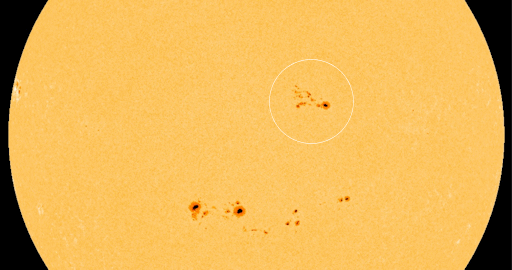
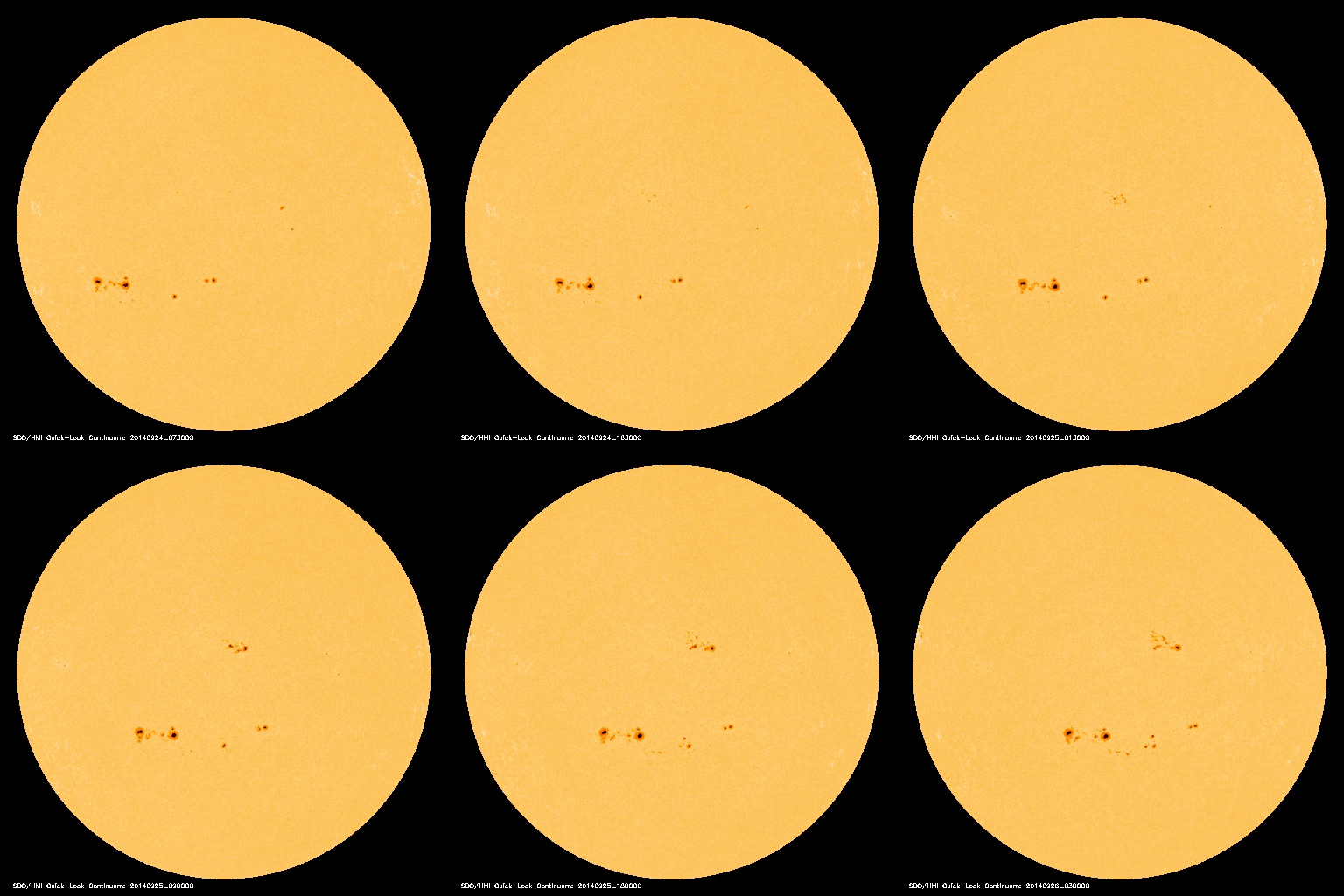
FAST-GROWNG SUNSPOT: New sunspot AR2175 didn’t exist one day ago. Now it stretches more than 100,000 km across the face of the sun with a primary dark core larger than Earth. The fast-growing region has a ‘beta-gamma’ magnetic field that harbors energy for M-class solar flares.
New Brain Tech Reveals Past Thoughts and Memories
image source
Nicholas West
Activist Post
An alarming new study (posted in full below) illustrates how fast neuroscience is developing in its attempt to uncover every aspect of the human brain. A specific brain wave called P300 has been identified by researchers as a marker that essentially encodes what we observe as we go about our daily activities. Based on this specific brain wave marker, researchers are able to conduct a Concealed Information Test. In fact, the test is already being used in Japan and Israel. Researchers are hoping that new data they have published will demonstrate that the test is reliable enough to meet the higher standard of U.S. courtrooms.
The massive influx of money into Obama’s BRAIN project, as well as similar research sponsored by the European Union , now exceeds $2 billion combined. Research continues full-steam ahead despite indications that human brain study is outpacing ethical parameters. Some scientists within the European arm of the project have recently threatened a boycott due to mismanagement and misuse along similar lines to what you will read below.
In our age of loosened constitutional standards and basic human rights that has permitted all innocent communications and movements to be tracked, traced and databased, any technology that aims to uncover our most mundane daily activities and thoughts must be heavily scrutinized for potential abuse. Moreover, I have highlighted some of the language in this press release that clearly demonstrates how this could move far beyond the courtroom and easily provide a new level of pervasive surveillance.
Bold emphasis is mine:
Brain activity can be used to tell whether someone recognizes details they encountered in normal, daily life, which may have implications for criminal investigations and use in courtrooms, new research shows.
The findings , published in Psychological Science , a journal of the Association for Psychological Science , suggest that a particular brain wave, known as P300 , could serve as a marker that identifies places, objects, or other details that a person has seen and recognizes from everyday life .
Research using EEG recordings of brain activity has shown that the P300 brain wave tends to be large when a person recognizes a meaningful item among a list of nonmeaningful items. Using P300, researchers can give a subject a test called the Concealed Information Test (CIT) to try to determine whether they recognize information that is related to a crime or other event.
Most studies investigating P300 and recognition have been conducted in lab settings that are far removed from the kinds of information a real witness or suspect might be exposed to. This new study marks an important advance , says lead research John B. Meixner of Northwestern University, because it draws on details from activities in participants’ normal, daily lives.
“Much like a real crime, our participants made their own decisions and were exposed to all of the distracting information in the world,” he explains.
“Perhaps the most surprising finding was the extent to which we could detect very trivial details from a subject’s day, such as the color of umbrella that the participant had used,” says Meixner. “This precision is exciting for the future because it indicates that relatively peripheral crime details, such as physical features of the crime scene, might be usable in a real-world CIT — though we still need to do much more work to learn about this.”
To achieve a more realistic CIT, Meixner and co-author J. Peter Rosenfeld outfitted 24 college student participants with small cameras that recorded both video and sound — the students wore the cameras clipped to their clothes for 4 hours as they went about their day.
For half of the students, the researchers used the recordings to identify details specific to each person’s day, which became “probe” items for that person.
The researchers also came up with corresponding, “irrelevant” items that the student had not encountered — if the probe item was a specific grocery store, for example, the irrelevant items might include other grocery stores.
For the other half of the students, the “probe” items related to details or items they had not encountered, but which were instead drawn from the recordings of other participants. The researchers wanted to simulate a real investigation, in which a suspect with knowledge of a crime would be shown the same crime-related details as a suspect who may have no crime-related knowledge.
The next day, all of the students returned to the lab and were shown a series of words that described different details or items (i.e., the probe and irrelevant items), while their brain activity was recorded via EEG.
The results showed that the P300 was larger for probe items than for irrelevant items, but only for the students who had actually seen or encountered the probe.
Further analyses revealed that
P300 responses effectively distinguished probe items from irrelevant items on the level of each individual participant, suggesting that it is a robust and reliable marker of recognition.
These findings have implications for memory research, but they may also have real-world application in the domain of criminal law given that some countries, like Japan and Israel, use the CIT in criminal investigations.
“One reason that the CIT has not been used in the US is that the test may not meet the criteria to be admissible in a courtroom,” says Meixner. “Our work may help move the P300-based CIT one step closer to admissibility by demonstrating the test’s validity and reliability in a more realistic context.”
Meixner, Rosenfeld, and colleagues plan on investigating additional factors that may impact detection, including whether images from the recordings may be even more effective at eliciting recognition than descriptive words – preliminary data suggest this may be the case.
Read more at http://www.activistpost.com/2014/09/new-brain-tech-reveals-past-thoughts.html#XoqIew6Z14ORLUjk.99
Can time speed up or slow down? According to Albert Einstein’s Theory of Relativity, yes it can! Time acceleration plays an important role for your health, because it can cause you to age faster or slower. In this article, I will explain some important fundamental aspects of how time works and how it relates to your health.
The strange thing about time is that it is not always constant like how we are conditioned to believe. Below is a quote from wikipedia.org.
“When two observers are in relative uniform motion, and far away from any gravitational mass, the point of view of each will be that the other’s (moving) clock is ticking at a slower rate than the local clock. The faster the relative velocity, the greater the magnitude of time dilation. This case is sometimes called special relativistic time dilation. It is often interpreted as time “slowing down” for the other (moving) clock. But that is only true from the physical point of view of the local observer, and of others at relative rest”
The quote above is basically saying that a moving object and an object at rest will experience time at a different speed. The short video clip below should help clarify this concept.
Einstein did a good job explaining how time and space were related, but he missed many important aspect of how they worked. Modern physicists have been filling some of the holes that Einstein had missed, but they still have not grasped what time really is. What most modern physicists failed to notice is that time is not linear, but simultaneous and it does not move. The idea of time being linear is an idea that is preventing modern physicists from discovering many secrets about the Universe. Fortunately, there are some physicists who are starting to realize that time works in a simultaneous fashion.
What is linear time?
When you experience linear time, you are experiencing a multidimensional and holographic illusion created by the refraction of particles and anti-particles which pulsate and spin at different speeds and angular rotations. Pulsation is an important feature of time, because the way particles pulsate at various rhythms is what gives us the illusion of time.
Below is an excerpt from my book Staradigm about linear time.
“Linear time is achieved when an observer’s consciousness moves through portions of the unified field of time. It is important to know that time does not move. It only seems to move when the observer’s consciousness moves through it. The illusion of linear time is similar to watching a movie using an old projector. When the reel of the projector is still, there are no linear actions or movements. It is only when the reel starts moving that you see the images being projected as linear actions'”
Time acceleration and your health
Time acceleration is nothing new to NASA, special groups in the military and certain engineers who design special machines that rely on energy vibration. These people knew since the early 1980s that time has been accelerating. Before 1980 Earth’s base pulse frequency, also known as Earth’s “heartbeat,” was vibrating at a constant frequency. After 1980 Earth’s “heartbeat” started to increase. This changed in frequency caused problems to certain machines that were designed to rely on Earth’s “heartbeat.” As a result, these machines had to be adjusted or their calculations would be off.
Here is another excerpt from my book Staradigm about how time acceleration affects your health.
‘The human body and mind are also attuned to mother Earth’s heartbeat. As her heartbeat accelerates, so does the human body and mind. This accelerated pulsation gives you the illusion that time is speeding up. This is why you have been experiencing this strange phenomenon since the 1980s. The increase in mother Earth’s pulsation rate can cause negative health effects on your body if you do not adjust your body’s pulsation rate to match hers. If your body cannot increase its pulsation rate to match mother Earth’s pulsation rate, this will cause accelerated cellular deterioration. Common symptoms of time acceleration are fatigue, emotional and mental problems, and stress.”
Margaret and I have just returned from a trip to beautiful Lake Shasta in Northern California. Well … it was “more” beautiful a few years ago. This year we actually walked on the bottom of the lake in knee-high water. The drought has lowered the lake’s normal water line over 150 feet from previous years. Seventy percent of the lake’s capacity has dried up due to California’s severe drought.
The fact that California is running out of water and that its contribution to the country’s food economy, which represents 53% of the US food source, is not existent, has received only minor attention in the news. Accordingly, the mass media news organizations collectively decide not to publish negative stories to which they feel the public cannot alter or actively make a response. This is the old “ostrich with its head in the sand” approach to global problems.
This “for our own good news blackout” strategy specifically applies to stories on the planet’s 6th mass extinction, a planetary upheaval we are now facing. The extinction process has profound influence on the current state of our world (see news article attached below). However, the fact is that we CAN collectively alleviate this impending devolution process, for science has recognized that human behavior is the primary cause behind today’s extinction.
This month’s news video provides some positive insights into our ability to forestall the mass extinction so that we may be able to offer our children, grand children and future generations a world in which they can thrive.
With Love and Light,
Bruce
Scientists Warn We Are Approaching The Next Mass Extinction
July 25, 2014 | by Justine Alford
Photo credit: Mary Harrsch. “Southern White Rhinocerous looks us over at Wildlife Safari
near Winston Oregon,” via Flickr. CC BY-NC-SA 2.0.
The decline of various animal populations and species loss are occurring at alarming rates on Earth, contributing to the world’s sixth mass extinction. While these deadly events may ultimately pave way for the emergence of new species, Stanford scientists have warned that if this “defaunation” that we are currently experiencing continues, it will likely have serious downstream impacts on human health. The study has been published in Science.
Biodiversity on Earth is extremely rich at present; it’s estimated to be the highest in the history of life on our planet. But scientists have been recording species abundance and population numbers for some time now and it is evident that we are experiencing a sharp downward trend. While the extinction of a species is normal and occurs at a natural “background” rate of around 1-5 per year, species loss is currently occurring at over 1,000 times the background rate.
Thanks to the fossil record, we are very familiar with large extinction events. Indeed, there have been 5 mass extinctions throughout the history of life on Earth, but there is a key difference between these past events and what is happening presently: humans are almost entirely to blame for the current mass extinction. Climate change, pollution, deforestation and overharvesting are all contributing factors. While it’s difficult to be certain of the causes of the previous mass extinctions, they have been attributed to natural events such as supervolcano eruptions and asteroid strikes.
By reviewing literature and analyzing various data sets, scientists have found that since 1500, 322 terrestrial vertebrates have become extinct. The remaining species are also suffering a 25% average decline in abundance. Invertebrates are also experiencing a huge blow with 67% of monitored populations showing 45% average abundance decline.
Among vertebrate species, it is estimated that up to 33% are threatened or endangered. Large animals, or megafauna, seem to be most affected, mirroring past mass extinctions. This is because large animals tend to have low population growth rates, produce few offspring and require large habitats to sustain viable populations.
Loss of megafauna has various downstream effects and may eventually impact human health. For example, studies conducted in Kenya where patches of land were isolated from large animals such as zebras and elephants found that the areas rapidly became plagued with rodents due to increases in food availability and shelter. Concomitantly, the levels of disease causing pathogens that they carry also increases, thus enhancing the risk of disease transmission to humans.
But it’s not just big animals that have an impact. Various insect species such as bees are valuable pollinators. According to a Cornell study, honeybees and other insects contributed $29 billion to farm income in the US in 2010. Furthermore, insects also play pivotal roles in nutrient cycling and decomposition, contributing to ecosystem productivity.
Lead author Rodolfo Dirzo hopes that raising awareness of the consequences of this ongoing mass extinction may stimulate much needed change, but acknowledges that solutions are far from simple given that approaches need to be tailored to individual areas and situations.
[Header image, “Southern White Rhinocerous looks us over at Wildlife Safari near Winston Oregon,” by Mary Harrsch, via Flickr, used in accordance with CC BY-NC-SA 2.0]
What Battlestar Galactica Can Teach Us About the Militarization of Police
“There’s a reason you separate the military and the police. One fights the enemy of the state, the other serves and protects the people. When the military becomes both, then the enemies of the state tend to become the people.”
In Battlestar Galactica there’s a scene where President Laura Roslyn and chief military Commander William Adama debate how to respond to the potential rioting of civilians. In the absence of a police force capable of handling the situation, Roslyn wants the military to police the civilians. Adama tells her the military won’t be her cops.
“There’s a reason you separate the military and the police,” he says. “One fights the enemy of the state, the other serves and protects the people. When the military becomes both, then the enemies of the state tend to become the people.”
It’s difficult to imagine a more succinct warning for what’s unfolding in Missouri right now. The images coming out of Ferguson show police who are militarizing their policing tactics because they believe they cannot maintain law and order through regular policing. Police cars and batons have been traded for armored vehicles, tear gas, and assault weapons.
It is worth asking: Do Americans consider this behavior within the acceptable range of police enforcement?
This unfolding military-style policing highlights how difficult it is to determine what reasonable limits we should expect from our civilian police forces. Police do not possess absolute authority, nor do they wield the powers of the military. Yet many ordinary people are unsure what limits are, or should be, in place to restrict police behavior—or what lines should be drawn to protect citizens from the police.
Recent events have proved Adama is right.
The phrase “Hands Up Don’t Shoot” reflects the growing disparity between what citizens consider acceptable behavior from our police forces and what police forces often consider to be within their power.
For the past two weeks, we have seen images of police in camouflage aiming assault rifles at citizens, arresting journalists, and using tear gas on protesters. It is worth asking: Do Americans consider this behavior within the acceptable range of police enforcement?
Pew recently asked this question, and the response shows a clear division: Among African Americans, 65 percent of respondents said police response in Ferguson has “gone too far,” and 32 percent of white respondents agreed. So there’s no consensus on what the limits of police behavior should be. This makes determining the limits of American policing complicated.
Perhaps this is why popular culture so frequently explores these questions. The militarization of civilian police and the role of protests in police states are subjects that arise regularly in movies and television—especially in science fiction.
Here are four scenes that question the corrupting power of police authority.
1. Battlestar Galactica
In “Water,” the second episode of Season 1, a sleeper Cylon (Cylons are the robots that destroyed human civilization) who is secretly embedded on the central military battleship (Galactica) places explosives near the water tanks. The bombs detonate, the holding tanks explode, and 60 percent of water reserves are lost. The lost water means that one-third of the civilian population will run out of water in two days. Adama, the military commander, immediately orders the civilian ships to begin emergency water rationing.
The second in command predicts this action will create riots. “Civilians don’t like hearing they can’t take a bath, wash their clothes, or drink more than a thimble a day,” he warns. And he turns out to be right.
President Roslyn implores Adama to police the riots with military forces:
President Roslyn: Rioting broke out on the cruise ship when they reduced water rations. We need to demonstrate an ability to maintain order, and we need to do it now. Commander Adama: We don’t have extra manpower for fleet security. Roslyn: You have the only armed, disciplined force available. Adama: Yeah, but I’m not going to be your policeman. There’s a reason you separate the military and the police. One fights the enemy of the state, the other serves and protects the people. When the military becomes both, then the enemies of the state tend to become the people. Roslyn: I appreciate the complexity of the issue, and I won’t let that happen.
Over the next four seasons of Battlestar, the role of the military in civil society is explored in exceptional detail. The show, which debuted in 2004, addresses the rise of terrorism and the control of Homeland Security, a fear of foreign peoples, the wars in Iraq and Afghanistan, restrictions on the press, and military-style policing.
The Hunger Games: Catching Fire
In the Hunger Games series, the people of Panem already live in a militarized police state. Order is maintained by “Peacekeepers” through any means necessary, including lethal force and public execution.
On a “victory tour” after winning the Hunger Games, victors Katniss Everdeen and Peeta Mellark pay tribute to a young girl named Rue from District 11, who aided Katniss in the competition before she was eventually killed by another player.
In a show of solidarity, a man from District 11 makes the three-fingered salute, an illegal hand-gesture Katniss used in the Games. Soon, the rest of the district follows suit. The police, recognizing the dissent unfolding, seek to quell any further disobedience.
They drag the elderly black man who sparked the dissent in front of the crowd. Then, the cops shoot him.
The brief moments of rebellion that unfold in this moment are seen through the eyes of Katniss, and her horror of this execution reveals much what The Hunger Games are built on: the abuse of power, the subjugation of the poor, and the division of people by race and employment. These divisions are upheld by a police force with absolute power and enforced on people who have become enemies and slaves.
The Dark Knight
It is hard to imagine a stronger justification for the abuse of power over citizens than the beating and torture of a “bad guy” in custody.
In a very real sense, the central question of Christopher Nolan’s Dark Knight Trilogy is about the very same question William Adama raises: How far we are willing to let our protectors go to keep us safe?
The Dark Knight Trilogy is filled with scenes that warn against the militarization of police forces. Batman Begins starts with police (paid by the mob) using brutal tactics to patrol the streets; The Dark Knight Rises ends by asking what it means to protect a city and its people from a madman.
But no scene raises the point more clearly than the interrogation (torture, really) of the Joker by Batman in The Dark Knight. It is hard to imagine a stronger justification for the abuse of power over citizens than the beating and torture of a “bad guy” in custody.
The Joker has abducted two people: District Attorney Harvey Dent, and Dent’s fiancee, Rachel Dawes. He has since been arrested by Gotham PD. To find out what the Joker has done with Rachel and Harvey, Police Chief Jim Gordon has locked the Joker in an interrogation room and handed the room over to the Batman.
“You have all these rules,” the Joker says, taunting Batman. “The only way to live in this world is without rules.” The Joker rightly predicts that Batman will go apeshit on him.
Batman reaches so far beyond the dictates of acceptable superhero behavior (at one point spying on every Gotham resident simultaneously) that even his allies question whether he has lost his moral tether to his position as hero.
Others have noted these themes in The Dark Knight trilogy. The philosopher Slavoj Zizek has considered how the series engages an era of anxiety over capitalism, terrorism, and the Occupy movement. He notes the irony of handing over the protection of society to a mega-rich arms dealer moonlighting as a moral authority figure.
But Zizek also notes the necessary “event” underlying the actions of the series, which is the power of the people reclaiming authority over society, wrested out the hands of villains and heroes.
Minority Report:
In Minority Report, a film based on Philip K. Dick’s 1956 short story, the police have access to a group pre-cognitive psychics who can predict murder. The Pre-Crime unit of the police force uses this information to stop murders before they occur. With absolute authority, they capture murderers before they act, place them into a catatonic state, and imprison them underground.
But herein lies the same old question about the limits of law enforcement: If you arrest a murderer before a murder is committed, did you not just arrest an innocent civilian?
If it didn’t happen, how can you be guilty? What right do the police have to seize an innocent man?
Early in Minority Report, this question is addressed by Detective John Anderton of the Pre-Crime unit, and Danny Witwer, a Department of Justice official sent to investigate the program.
Witwer asks whether the police have the right to arrest a man before his crime is committed. In response, Anderton rolls a ball off the edge of his desk. Witwer catches it.
Anderton: Why did you catch it? Witwer: Because it was going to fall. Anderton: You’re certain? Witwer: Yes. Anderton: But it didn’t fall. You caught it. The fact that you prevented it from happening doesn’t change the fact that it was going to happen.
Thus the authority of the Pre-Crime unit is established. The question of individual guilt has been determined in the minds of the guilty before they even reach the crime scene.
The police are meant to serve and protect. But here, preventative lock-up is used as a tool to keep the “inevitably guilty” off the streets and away from the law-abiding public, in a justice system that provides police an almost absolute authority to clean up the streets. That hardly sounds like science fiction.
The protests underway in Ferguson have already begun to calm, and the images of dramatic military policing will in time fade from our screens. But the importance of such moments in the public imagination should not likewise disappear.
We are constantly faced with the civic and moral questions surrounding police forces. Anytime, the events in Ferguson could unfold in the lives of American citizens anywhere.
Which makes wrestling with these questions all the more necessary.
Science fiction has long been a place to wrestle with collective social complexities. As we remember what happened in Ferguson, let’s also draw from the stories that caution us against turning our civil rights over to an unrestricted power.
The megaliths of Stonehenge, which were raised above England’s Salisbury Plain some 5,000 years ago, may be among the most extensively studied archaeological features in the world. Still, the monument is keeping secrets.
Scientists have just unveiled the results of a four-year survey of the landscape around Stonehenge. Using non-invasive techniques like ground-penetrating radar, the researchers detected signs of at least 17 previously unknown Neolithic shrines.
“Stonehenge is undoubtedly a major ritual monument, which people may have traveled considerable distances to come to, but it isn’t just standing there by itself,” project leader Vincent Gaffney, an archaeologist at the University of Birmingham in the U.K., told Live Science. “It’s part of a much more complex landscape with processional and ritual activities that go around it. That’s very different from how this has been viewed before. The important point is Stonehenge is not alone. There was lots of other associated ritual activity going on around it.”
cholars still aren’t sure why Stonehenge was built, as the monument’s Neolithic creators left behind no written records. But the ruins, which align with the sun during the solstices, stand as an impressive feat of prehistoric engineering. The biggest stones at the site, known as sarsens, are up to 30 feet (9 meters) tall and weigh 25 tons (22.6 metric tons); they are believed to have been dragged from Marlborough Downs, 20 miles (32 kilometers) to the north.
At the newfound satellite shrines around Stonehenge, Gaffney and his team revealed underground impressions, presumably left by wooden post holes, stones and ditches — some of which extend up to 13 feet (4 m) deep. Images created with geophysical prospecting tools show that some of these smaller monuments had a concentric circle design, much like Stonehenge.
The researchers also peered inside the Cursus, an immense prehistoric enclosure to the north of Stonehenge that dates back to about 3500 B.C. Stretching about 1.8 miles (3 km) long and 330 feet (100 m) wide, the Cursus had been deemed a barrier to Stonehenge, but it was so big that no one really knew what was inside of it, said Gaffney.
When the researchers surveyed this area, they found a large pit buried on the eastern end of the Cursus. This pit was aligned with Stonehenge’s “avenue,” a processional path that lines up with the sun at dawn during the mid-summer solstice. The team also found a matching pit at the other end of the Cursus. This pit is aligned with the Heel Stone at the entrance to Stonehenge, which is aligned with sunset during the solstice, Gaffney said.
“Suddenly, you’ve got a link between this very large monument and Stonehenge through two massive pits, which appear to be aligned on the sunrise and sunset on the mid-summer solstice,” Gaffney said.
The researchers also mapped dozens of burial mounds in the area, including a long barrow that dates back to an era before Stonehenge. The team detected a timber building buried inside the mound, and the project leaders think this structure might have been used for the ritual inhumation and defleshing of the dead.
Gaffney said it will take his team about a year just to process all the data they collected during their 120 days of fieldwork over the span of four years. And then it will likely be up to English Heritage (the government body in charge of archaeological and historic sites) to decide which features to dig up in a more traditional excavation. Further study should help reveal the ages of these monuments, pits and burial mounds, and help explain how Stonehenge evolved over time.
(Check out link below for Smithsonian Video.)
The findings were revealed as part of the British Science Festival and will be featured in a new BBC Two series, “Operation Stonehenge: What Lies Beneath,” which will air in the U.K. Thursday (Sept. 11) at 8 p.m. BST. A U.S. version of the special, dubbed “Stonehenge Empire,” will air on the Smithsonian Channel Sept. 21 at 8 p.m. ET/PT. The Stonehenge Hidden Landscapes Project is led by the University of Birmingham with the Ludwig Boltzmann Institute for Archaeological Prospection and Virtual Archaeology.
STORM WARNING (UPDATED): Among space weather forecasters, confidence is building that Earth’s magnetic field will receive a double-blow from a pair of CMEs on Sept. 12th. The two storm clouds were propelled in our direction by explosions in the magnetic canopy of sunspot AR2158 on Sept. 9th and 10th, respectively. Strong geomagnetic storms are possible on Sept. 12th and 13th as a result of the consecutive impacts. Sky watchers, even those at mid-latitudes, should be alert for auroras in the nights ahead. Aurora alerts:text, voice
EARTH-DIRECTED X-FLARE AND CME: Sunspot AR2158 erupted on Sept. 10th at 17:46 UT, producing an X1.6-class solar flare. A flash of ultraviolet radiation from the explosion (movie) ionized the upper layers of Earth’s atmosphere, disturbing HF radio communications for more than an hour. More importantly, the explosion hurled a CME directly toward Earth. The Solar and Heliospheric Observatory photographed the expanding cloud:
Updated: Radio emissions from shock waves at the leading edge of the CME indicate that the cloud tore through the sun’s atmosphere at speeds as high as 3,750 km/s. By the time it left the sun’s atmosphere, however, the cloud had decellerated to 1,400 km/s. This makes it a fairly typical CME instead of a “super CME” as the higher speed might suggest.
Even with a downgrade in speed, this CME has the potential to trigger significant geomagnetic activity when it reaches Earth’s magnetic field during the mid-to-late hours of Sept. 12th. NOAA forecasters estimate an almost-80% chance of polar geomagnetic storms on Sept. 12-13.
Another Dead Scientist To Add To List! What Did He Know That ‘They’ Don’t Want Us To Know?
By Susan Duclos
Yet another scientists has been found dead after mysteriously disappearing and just happens to have worked at the National Institutes of Health in Maryland, specializing in tropical diseases, particularly malaria. This death alone, despite the mysterious circumstances, normally wouldn’t be of note if it wasn’t for the long… very long list of dead scientists already documented since 2004, found here.
Martin John Rogers was found “near” his wrecked car down in an embankment in western Maryland on Thursday, September 4, 2014, after disappearing on August 21, 2014 when he left home for work at the world-renowned research center near Washington, D.C. No word yet on the cause of death, an autopsy will be performed to determine the manner of death, according to LA Times’ The Baxter Bulletin.
Here is where the mystery comes in. According to the report the search for Rogers didn’t start until a “few days after he failed to show up for work,” but on the day he disappeared he is seen on a surveillance and used a credit card at a Motel 8 a few hours after he left home. Two days later there is a report of a sighting of Rogers on a “local trail,” which authorities have deemed “likely credible.”
“The detective working on the case has found 583 missing people in his career. He told us that why a person leaves often helps them find out where they went,” Conner said. “But when the detective went through all the normal reasons a person leaves — money problems, work problems, trouble at home, a girlfriend — none of that matched John.”
Police said surveillance video captured Martin checking into a hotel in La Valle, Maryland, looking “stressed out.” Last week, police received multiple reports of possible sightings along the C&O Canal towpath, including by Edwards Ferry, near Poolesville, Violettes Lock near Darnestown, and as far away as Cumberland.
Rogers wife is also a scientist with a PhD in molecular biology.
In the video below by They Live You Sleep, the videographer talks about the massive number of scientists that have turned up dead as well as replaying an older Coast to Coast interview where Steve Quayle speaks of the evergrowing list of dead scientists which he has been carefully documenting, which is linked above.
37 lies Americans tell themselves to avoid confronting reality
Sunday, September 07, 2014
(NaturalNews) Have you noticed the incredible detachment from reality exhibited by the masses these days? The continued operation of modern society, it seems, depends on people making sure they don’t acknowledge reality (or try to deal with it). “Denial” is what keeps every sector of civilization humming along: medicine, finance, government, agriculture and more.
The trouble with the denial approach is that eventually the lies collide with reality. Until that day comes, however, happy-go-lucky Americans are merrily enjoying their courtship with self delusion, repeating the following 37 lies to themselves as if they were true:
Lie #1) All FDA-approved medications are safe to consume in any combination, because the FDA protects the public.
Lie #2) Food prices keep going up because inflation is a natural force that can’t be halted.
Lie #3) The mainstream media is telling me the truth when it reports on world events.
Lie #4) Chemical food additives are tested for their safety before being widely used across the food supply.
Lie #5) We can all pump groundwater out of the ground forever, and it will never run out.
Lie #6) We can also pump fossil fuels out of the ground forever, and they will never run out, either. Why worry?
Lie #7) If anything bad happens in terms of a national emergency or natural disaster, the government will take care of me.
Lie #8) It doesn’t matter where my food comes from as long as it’s cheap and delicious.
Lie #9) GMOs must be safe to eat because a bunch of scientists paid by the biotech industry all tell each other that GMOs are safe and therefore have reached “scientific consensus.”
Lie #10) Government debt doesn’t matter because the government can simply create more money any time they want.
Lie #11) Mercury in vaccines must be safe to inject into children, otherwise the CDC and FDA wouldn’t allow it to be used in vaccines.
Lie #12) Organic produce is a waste of money. I’ll buy conventional produce treated with pesticides and herbicides because the cost of all the cancer treatments I’ll need 20 years later will be covered by Obamacare anyway.
Lie #13) The history taught to children in public schools is a true and accurate history. Columbus was best friends with the Indians, too!
Lie #14) Swallowing fluoride chemicals is good for babies and children, and that’s why cities put fluoride into public water supplies.
Lie #17) The global ecosystem can handle unlimited human pollution without any negative consequences. We can all continue to dump unlimited toxins into the environment.
Lie #18) Cell phone radiation is harmless. The reason we know that is because the cell phone companies hired scientists to say so.
Lie #19) If everybody else is doing something, it must be the right thing to do. After all, how could so many people be wrong?
Lie #20) We don’t need to store food for emergencies because there will always be more food available at the grocery store.
Lie #21) There’s no need to be concerned about Ebola or other infectious diseases in America because the vaccine companies can always and instantly create a new vaccine that works 100% of the time, with zero side effects.
Lie #22) Local police departments need battlefield military weapons, armored cars and body armor because the drug war demands it.
Lie #23) If I buy something at Whole Foods, it must be healthy and free from contaminants like toxic heavy metals. (Or is it really?)
Lie #24) My vote really counts in national elections. We live in a democracy where the People have power over the government.
Lie #25) My checking and savings accounts are perfectly safe no matter what happens because my bank is FDIC insured.
Lie #26) Raw dairy products are dangerous and deadly because the FDA told me so. Those horrible farmers selling raw dairy products should be locked away in prison.
Lie #27) My oncologist recommends chemotherapy treatment for me only because he cares about my wellbeing, not because his clinic sells the chemotherapy drugs at a huge profit.
Lie #28) The government isn’t secretly recording my phone calls or reading my emails. Why would they? I’ve done nothing wrong!
Lie #29) Commercial dog food is healthy and nutritious for dogs. Dog treats made in China are also trustworthy and free from contaminants like lead.
Lie #30) The only way to prevent infectious disease is with a vaccine. Vitamin D and healthy immune support have nothing to do with it.
Lie #31) After I pay off my house, I own it free and clear. (Think again: Property taxes mean you’re only “leasing” it from the county. Stop paying those taxes and you’ll find out very quickly who really owns your home.)
Lie #32) Google will do no evil, and the fact that the company is developing humanoid battlefield robots, autonomous drones and super-human quantum computing brain chips is nothing to worry about.
Lie #33) Cancer is caused entirely by bad luck (or smoking) and has nothing to do with the food I eat or chemicals in my personal environment.
Lie #34) The radiation release from Fukushima wasn’t that bad. Sure, it was many times larger than the Chernobyl disaster, but authorities say we have nothing to worry about.

 Margaret and I have just returned from a trip to beautiful Lake Shasta in Northern California. Well … it was “more” beautiful a few years ago. This year we actually walked on the bottom of the lake in knee-high water. The drought has lowered the lake’s normal water line over 150 feet from previous years. Seventy percent of the lake’s capacity has dried up due to California’s severe drought.


 Sunday, September 07, 2014