We The People Without Representation

Who Represents Us When Our Political Parties Represent Only Corporations?

Our future depends on bridging the partisan divide that elevates corporate interests above our personal well-being.
money-politics.jpg

We the people of the United States find ourselves in a political crisis and resurgent tribalism that pits left against right, hard-left against moderate-left, and extreme-right against everyone else. The result is a political impasse that leaves us unable to address our own needs domestically and has stripped us of credibility globally.

The crisis has a simple explanation, and it didn’t start with the current occupant of the Oval Office. Irrespective of where we fall on the political spectrum, a great many of us don’t trust our own political system. Nor should we: It represents power that is captive to interests quite at odds with our own.

Two recent news stories brought this home to me in a way that might help us find common cause across the political spectrum.

The first story was about a meeting of the World Health Organization. Ecuador introduced a resolution calling on governments to “protect, promote and support breast-feeding” and to restrict promotion of food products found to have deleterious effects on young children. Now what could be more unassailable than that?

Breastfeeding is a wholly natural process and scientific studies confirm that breast milk is the best food source for infants. While most all the national representatives rallied behind the initiative, the United States’ representatives stood firmly in opposition. They even threatened Ecuador with trade sanctions and a cutback in military aid.

Their stance surely did not represent the interests or preferences of the American people. The U.S. representatives left those present with no doubt that they were representing the interest of transnational corporations that sell infant formula.

Within days of the breastfeeding incident, President Trump was attacking the U.S.’s NATO allies in Europe for spending too little on their militaries. At first mention his argument seemed reasonable. Surely our allies should pay their fair share for our common defense.

But then a deeper reality hit home for me. Collapsing environmental and social systems are the greatest current threat to U.S. and world security. The more of Earth’s resources we use preparing for and conducting wars, the less we attend to the needs of our own people and the greater a burden humanity bears. That means we deprive more people of a means of living, more places on Earth become rendered uninhabitable, and a greater the number of people are forced to flee their homes as desperate refugees, or are turned in fear and hatred to terrorism against real and imagined enemies.

The biggest share of U.S. military expenditure goes to preparing for war with another world power—specifically, Russia or China. Russia may tamper with our elections and China is beating our socks off as a global economic competitor, but both have much to lose and nothing to gain from starting a 20th century-style conventional war with the United States that would be fought with 21st century weapons. They are aware such a war would have devastating consequences for all—worst of all if it involved nuclear weapons.

Since the disintegration of the Soviet Union, Russia has not threatened us and our interests nearly so much as we have threatened Russia’s interests. We’ve integrated former members of the Soviet Union into NATO right up to the borders of Russia. China’s economic expansion is simply following the U.S. example, but doing so far more competently.

Our military, however, has not been idle. We have wasted many lives and caused much damage to people, infrastructure, and nature pursuing pointless wars in Vietnam, Iraq, and Afghanistan. Our drone strikes inflict further pain and terror on helpless innocents in more countries than we know.

Our problem is not that we and our allies are spending too little on war, but that we are spending far too much. The parallel to the U.S. stance on breastfeeding is clear. The interests served by bloated military budgets and endless wars against sometimes wholly imagined enemies are corporations that profit from defense contracts.

The misguided corporatist loyalty of the U.S. political establishment did not begin with the Trump presidency. Defense contractors and infant formula corporations are just two examples of the abuse of unaccountable institutional power in which both Republican and Democratic parties have been complicit for decades. Not all Republican and Democratic politicians are willing corporate shills, but the dynamics of the political process force most of them to fall into line with corporate interests—especially at the national level.

The political establishment’s sellout to corporate interests is reflected in every aspect of policy from military, to health care, to financial regulation, to education, the environment and much else. And the sellout is not exclusive to the Republican Party. We experienced it as well with the Clinton and Obama administrations—which explains why so many didn’t trust Hillary Clinton in the 2016 election.

When two corrupt parties control the political system, debating which is the more corrupt simply diverts attention away from addressing the source of the corruption. In this case, the source is extreme inequality combined with a system of law that allows for a virtually unlimited concentration of corporate power. At the same time, corporations are granted more rights than people are, and are exempted from accountability to the communities in which they do business and from liability for the harm they cause.

The corporate establishment has been winning this battle for decades by keeping us divided between those who place the blame on business and the market and those who place the blame on government.

Responsible businesses and accountable governments are essential institutions, as are fair and ethical markets. All could be corrupted if the electorate allows for concentrations of unaccountable monopoly power. All institutions require an ethical frame and a clear order of accountability.

Government must be accountable to the electorate. Businesses must be accountable to accountable governments. And markets must function within an ethical framework and agreed rules that are fairly enforced by those accountable governments.

Unaccountable corporations protected from public accountability by unaccountable governments leads to certain disaster. And yet, here we are.

President Trump’s unintended gift to the nation and the world may be to awaken us to the reality that, far from being the global model for democracy and a community-centric market economy, the United States’ political system is fundamentally corrupt and destructive to the common good.

Our future depends on bridging the artificially cultivated political divide that serves only interests fundamentally contrary to our common well-being. In the short-term, only the richest of the rich are served by the concentration of wealth and power that in the long term serves none of us. We must all, including the principled wealthy, work to dismantle the institutional instruments of monopoly power while creating truly democratically accountable institutions and markets that advance the equitable redistribution of wealth.

United we stand, divided we fall is a rallying cry for our time. We must do this together.

from:    https://www.yesmagazine.org/new-economy/who-represents-us-when-our-political-parties-represent-only-corporations-20180723

Glyphosate – Safe?? Really???

Benicia man dying of cancer testifies in weed-killer suit against Monsanto

Photo of Bob Egelko

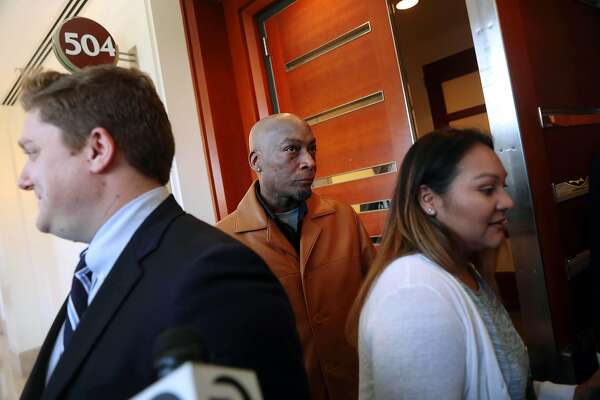
Dewayne Johnson (center), former groundskeeper for the Benicia Unified School District, leaves Department 504 with his wife Araceli Johnson (right) behind attorney Brent Wisner (left) at Superior Court of California during the Monsanto trial on Monday, July 23, 2018 in San Francisco, Calif.

Photo: Lea Suzuki / The Chronicle

A former school groundskeeper, diagnosed with terminal cancer, told a San Francisco jury Monday that he called a Monsanto Co. hotline twice — once before his diagnosis, once after — and asked whether the herbicide he was spraying on the job, the most widely used weed killer in the world, could cause harm to humans.

Both times, Dewayne “Lee” Johnson said, the person at the other end of the line listened to his account of being accidentally doused with the herbicide glyphosate, and said someone would call him back. No one ever did.

“I would never have sprayed the product around school grounds or around people if I thought it would cause them harm,” Johnson told a Superior Court jury hearing his suit against Monsanto. “They deserve better.”

Johnson, 46, of Vallejo, was a groundskeeper and pest-control manager for the Benicia Unified School District from 2012 until May 2016. He was diagnosed with non-Hodgkin lymphoma in October 2014 and with what his lawyers described as a more aggressive form of the cancer in March 2015.

Even after the latter diagnosis, Johnson said he continued to spray Monsanto’s product, a high-concentration brand of glyphosate called Ranger Pro, until he became convinced that it was dangerous and refused to use it in his final months on the job.

His damage suit, now into its third week, is the first of about 4,000 nationwide to go to trial against Monsanto, now a subsidiary of Bayer. The company markets glyphosate, the world’s leading herbicide, as Roundup, and in higher concentrations, as Ranger Pro. In 2015, the World Health Organization’s International Agency for Research on Cancer classified glyphosate as a probable human carcinogen.

Monsanto disputes the assessment, noting that the U.S. Environmental Protection Agency has never classified glyphosate as a carcinogen or restricted its use. The company’s lawyers also said Johnson’s primary treating physicians have not determined the cause of his cancer.

Earlier Monday, his wife and a physician described Johnson’s deteriorating condition, although he did not appear frail on the witness stand, speaking calmly in a deep, resonant voice. But jurors saw photos of the painful welts and lesions — on his legs, arms, face, and even his eyelids — that have arisen while he undergoes radiation treatment and chemotherapy. Johnson is scheduled for another round of chemotherapy next month and said he would next turn to a bone-marrow transplant.

He has self-published two books and is working on a third — “about people and how they’re judged by their faces” — and hopes he’ll get to finish it. He tries to shield the couple’s two sons, aged 13 and 10, from his bouts of depression and tears, and said that despite a grim prognosis, “I’ll keep fighting till my last breath.”

Araceli Johnson, his wife of 13 years and a nurse practitioner, said she now works 14 hours a day at two jobs to support them. “My world shut down” when her husband told her he had cancer, she told the jury.

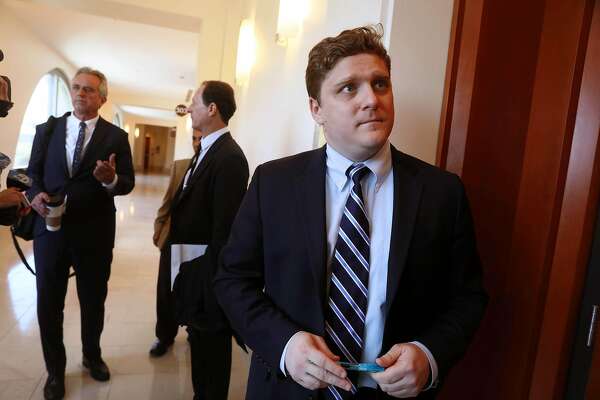
Attorney Brent Wisner answers questions from the media at Superior Court of California on Monday, July 23, 2018, in San Francisco, Calif.

Photo: Lea Suzuki / The Chronicle

Johnson started working for the Benicia schools as a delivery driver but then applied to become the district’s first pest-control manager and passed a licensing exam. “I liked the job a lot,” he said, recalling how some students gave him a poster for ridding their school of a skunk.

He said the district told him to use the Ranger Pro form of glyphosate because Roundup wasn’t strong enough to remove all the weeds from hillsides on district-owned property. A supervisor told him the product was safe as long as he wore long-sleeved shirts, pants, shoes and socks.

In addition, Johnson said, he wore a sturdy jacket, rubber gloves, goggles and a face mask while he mixed the herbicide with water in 50-gallon drums and sprayed it 20 to 30 times a year for two to three hours a day, mostly during summer months. But he said he couldn’t fully protect his face from wind-blown spray. And twice, he said, he got drenched with herbicide, once when a spray hose became detached from a truck that was hauling it, and another time when the chemical somehow leaked onto his back. He said he had no access to a shower until much later in the day.

It was after the first exposure, Johnson said, that he started noticing rashes on his skin and called the company hotline.

“I had this uncontrollable situation on my skin, which used to be as perfect as this table,” he said, pointing to the brown witness stand. “It was a very scary, confusing time.”

During cross-examination, Monsanto lawyer Sandra Edwards asked Johnson about his past statement to his doctors that he had first developed a skin rash in the autumn of 2013, before he was accidentally doused with glyphosate. The company has contended that the sequence of events suggests other causes for Johnson’s illness.

“It’s hard to remember all that way back,” said Johnson, whose wife testified that her husband has sometimes suffered memory lapses since his diagnosis. That appeared to be on display early in his testimony Monday, when he said he had stopped working for the school district about five years ago, then was shown a document noting that he had worked there until May 2016.

Jurors also heard from Dr. Ope Ofodile, a dermatologist who coordinated Johnson’s medical treatment at Kaiser Health Care in Vallejo from 2014 through mid-2016. She said she saw him more than 25 times, removed one of his lesions, administered radiation, and wrote a letter in 2015 asking the school board not to expose Johnson to airborne chemicals.

“He was not responding (to treatment). He was heading in the wrong direction,” she said. But “he was very much motivated to get better.”

Bob Egelko is a San Francisco Chronicle staff writer. Email: begelko@sfchronicle.com

from:    https://www.sfchronicle.com/bayarea/article/Benicia-man-dying-of-cancer-testifies-in-Roundup-13098953.php

Dealing With the Plastic Problem

New Studies Raise Hopes for Making Plastic Safer

Plastic debris in the stomach of an albatross chick. (Chris Jordan, USFWS / Wikimedia Commons)

The good news is that safe plastic is not an impossible dream: novel ways to tackle the tide of discarded material engulfing the planet are under development.

One scheme absorbing US chemists will turn natural waste into natural polymers. Some day the crabmeat sandwiches in your packed lunch could be safely wrapped in transparent packaging fashioned from crushed crab shells and discarded wood chippings.

The protective wrapping would have all the strength of the polyethylene-based packaging that comes with millions of supermarket products, with one big difference. It will decompose naturally. Polyethylene is the most common form of plastic, with global demand expected to reach almost 100m tonnes in 2018.

Plastic polymer compounds are products of the petroleum industry and have changed lives the world over. But because plastic polymers are all but indestructible, they also promise to change lives everywhere for the worse, as empty plastic cups, soft drinks bottles and supermarket shopping bags amass in the oceans, along shorelines, and in what would otherwise be natural wilderness.

Researchers have already warned that long after humanity becomes extinct, a geological stratum rich in fragmented plastic toys, drinking straws and yoghurt pots could bear witness to the brief tenure of Homo sapiens.

Plastic detritus threatens to swamp the entire planet. Particles have been found in the Arctic ice, and plastic flotsam could carry dangerous infections to the most distant coral reefs.

But as the world’s nations falteringly begin to address the challenges of global warming and climate change, driven by profligate human use of fossil fuels, laboratories around the world have been working on possible solutions, both by finding ways to use energy more efficiently, and by exploiting natural wastes.

The latest study in ingenuity is described in the American Chemical Society’s journal ACS Sustainable Chemistry and Engineering.

Soil Additive

Researchers sprayed layers of the natural polymer chitin – the substance that provides the exoskeleton of the lobster or the locust – and the plant polymer cellulose to make a thin, flexible, transparent material that could one day replace PET, or polyethylene terephthalate. Cellulose is by far the most common natural polymer – unlike money, it really does grow on trees. Chitin may be the second most common: it is made by shellfish, insects and fungi.

But in the form of alternating layers, made by nanotechnologists – scientists who work in scales of a billionth of a metre – and then dried, the new product becomes strong, flexible and transparent, and something you could throw into the compost heap and watch turn back into nourishing soil.

Such a product is a long way from any commercial manufacture: a lot more needs to be achieved, and many hurdles have to be cleared. But such studies are once again evidence that the chemists and engineers are thinking hard.

“We have been looking at cellulose nanocrystals for several years and exploring ways to improve those for use in lightweight composites as well as food packaging, because of the huge market opportunity for renewable and compostable packaging, and how important food packaging overall is going to be as the population continues to grow,” said Carson Meredith, of Georgia Institute of Technology’s school of chemical and biomolecular engineering.

“Our material showed up a 67% reduction in oxygen permeability over some forms of PET, which means it could in theory keep foods fresher, longer.”

Tim Radford / Climate News Network

from:    https://www.truthdig.com/articles/there-is-a-way-to-make-plastic-safe/

Even in Buddhism – Abuse

The ‘King’ of Shambhala Buddhism Is Undone by Abuse Report

Image
A photo of Sakyong Mipham Rinpoche, the leader of Shambhala International, sits on a throne reserved for him inside the group’s New York center, but he has taken leave amid charges of sexual abuse.CreditGabriella Angotti-Jones/The New York Times

In a shrine on the sixth floor of a Manhattan office building, a photo of a man in golden robes hangs above an altar. Another photo of him sits upon a throne.

He is the head of one of the largest Buddhist organizations in the West, Shambhala International, a network of more than 200 outposts in over 30 countries where thousands come for training in meditation and mindfulness and some delve into deeper mysteries.

The man is Mipham Rinpoche. He is known as the Sakyong, a Tibetan word that translates roughly as king, and his students take vows to follow him that are binding across lifetimes. These days, they are feeling sad, confused, angry and betrayed.

Late last month, a former Shambhala teacher released a report alleging that the Sakyong had sexually abused and exploited some of his most devoted female followers for years. Women quoted in the report wrote of drunken groping and forcefully extracted sexual favors. The report said that senior leaders at Shambhala — an organization whose motto is “Making Enlightened Society Possible” — knew of the Sakyong’s misconduct and covered it up.

The Sakyong apologized a few days before the report was formally released, admitting to “relationships” with women in the community, some of whom “shared experiences of feeling harmed as a result.” Followers and Shambhala groups around the world demanded more action.

On Friday, it came: The governing council of Shambhala International, which is based in Halifax, Nova Scotia, resigned en masse, “in the interest of beginning a healing process for our community.”

That night, the Sakyong, 55, took leave from running Shambhala as an outside firm investigates abuse allegations against him and other Shambhala teachers. He would, the announcement stated, “enter a period of self-reflection.”

The Sakyong is not only another executive or religious leader dethroned by #MeToo, but the sole holder of the most sacred teachings in a custody chain that goes back centuries, the only one who can transmit them, according to the traditions of his lineage.

A few days before the Sakyong stepped aside, Ramoes Gaston, a volunteer at the Manhattan center, on West 22nd Street, who has studied Shambhala for eight years, said the revelations had ripped his world apart.

“I don’t want it to be exposed,” Mr. Gaston said. “But it has to be exposed.”

The downfall of a Buddhist leader in the West accused of sexual impropriety has become its own sorry tradition. Last year, Lama Norlha Rinpoche, who founded a monastery in Wappingers Falls, N.Y., retired after allegations of sexual misconduct. So did Sogyal Rinpoche, author of “The Tibetan Book of Living and Dying,” who was accused of decades of sexual assaults and violent rage. In the Zen tradition, fallen masters include Joshu Sasaki and Eido Shimano, two of the leading proponents of Zen in America.

In Shambhala, bad behavior runs in the bloodline. The organization was founded by the Sakyong’s Tibet-born father, Chögyam Trungpa, a wildly charismatic man, brilliant teacher and embodiment of the concept known as “crazy wisdom” whose alcoholic exploits and womanizing were well known. He died in 1987. In between Chögyam Trungpa and the Sakyong, Shambhala was led by an American-born Buddhist who is mainly remembered for having sex with students even after he knew that he had AIDS.

The hyperconcentration of authority in the most revered teachers of Tibetan Buddhism lends itself to abuse, said Lama Tsultrim Allione, one of the first American women to be ordained a Tibetan Buddhist nun and a former member of Chögyam Trungpa’s group who knew the Sakyong when he was a child.

“One is told that one must see the lama as the Buddha and that anything the lama does is perfect and that whatever might seem wrong with it, that is your impure vision. This can be a transformative practice, but only when the lama is truly awake,” said Lama Tsultrim, who leads a Buddhist center in Colorado and just published a book, “Wisdom Rising: Journey Into the Mandala of the Empowered Feminine.”

Image
The Sakyong, with his fiancée, Khandro Tseyang, in 2006, has apologized to his followers, admitting to “relationships” with women in the community. He said he would enter “a period of self-reflection.”CreditAndrew Vaughan/CP, via Associated Press

In Shambhala, Lama Tsultrim said, “the level of institutionalized hierarchy is quite extraordinary,” with the Sakyong functioning “sort of like a divine king.” His inner circle, with its ministers and attendants, is called the “court.” He has a personal flag that local centers can buy for $350, to fly when he visits.

The woman behind the exposé, Andrea Winn, grew up in the Shambhala community in Halifax and says that she and many other children were sexually abused by adults in the community.

In early 2017 — months before #MeToo became a cultural phenomenon — she began a yearlong effort, “Project Sunshine,” to gather accounts by survivors of the abuse. The resulting report, published in February, prompted Shambhala International to announce “an effort to address issues of past harm in our community.”

The Sakyong praised survivors for “bravery and courage” in speaking out, without mentioning any misconduct of his own. But the report also prompted women who said they had been abused by the Sakyong to come forward, providing material for the second report, released June 28.

One woman wrote that for years, before he was married, the Sakyong would kiss and grope her when he got drunk. Like many women around the Sakyong, she desperately hoped to become his wife, she wrote, and she rationalized his boorishness by telling herself that the Sakyong was trying to show her “the patterns of my own poverty mentality and grasping.”

Another woman wrote that the Sakyong summoned her one night and when she refused to have sex with him, he pushed her face toward his penis and said, “You might as well finish this.” She wrote, “I was so embarrassed and horrified I did it.” A third woman wrote that the Sakyong groped her in 2011, after his daughter’s first birthday party.

Yet another woman came forward on Tuesday and said that at a dinner in Chile in 2002, a drunken Sakyong pulled her into the bathroom and locked and blocked the door.

“He started to grope me and try to undress me,” the woman said by phone, speaking on the condition of anonymity. “I was like ‘No, no, I have a boyfriend.’ He said, ‘It doesn’t matter.’” She said the Sakyong grabbed her hand and put it on his penis through his robe before she escaped.

With the exception of the 2011 episode, the allegations against the Sakyong date from before 2006. They were vetted by a retired employment lawyer, Carol Merchasin, who contacted Ms. Winn after the first report was released. Ms. Merchasin said she found all the accounts to be credible.

The Sakyong would not comment on the accounts “out of respect for the integrity of the independent investigation,” said his lawyer, Michael Scott.

Ms. Winn, 50, a leadership coach based in Halifax, said of the council’s resignation and the Sakyong’s stepping aside: “It came as a surprise, and as a huge relief. Now I feel that there’s this possibility for healing.”

Local centers are dealing with the fallout in their own ways. At a center in New Haven, the Sakyong’s photo has been taken down.

At a meeting at the New York center last week, several people who had found refuge in Shambhala from their own histories of addiction and sexual abuse said they no longer felt safe, and a teacher, Kevin Bogle, resigned in protest.

“I have been livid this entire week from the news that has been reported and the harm that has been committed,” he told the gathering.

Many of the Sakyong’s followers are praying for him. Mr. Gaston of the New York center said that when he sees the Sakyong’s photo above the altar, he thinks about the pain the Sakyong must have been in that would have led him to cause such harm to others. “With every breath I exhale,” he said, “I hope that some of my mercy is communicated to him.”

from:    https://www.nytimes.com/2018/07/11/nyregion/shambhala-sexual-misconduct.html

5G & You

Questions Raised About 5G Health Risks Months Before Sacramento Launches Service
2018-05-29, CBS (Sacramento, CA affiliate)

Posted: 2018-07-29 16:25:09

Sacramento will be the first city in the country to get 5G cell service later this summer, but health concerns are now being raised about the equipment. 5G uses high frequency waves and is supposed to be 100 times faster than the current cell phone service. However, the 5G waves don’t travel as far as current wireless frequencies so instead of large cell phone tower equipment spread far apart, the 5G requires small cell sites closer together. The FCC does set exposure limits for cell site antennas that transmit signals to phones. According to the National Cancer Institute, “A limited number of studies have shown some evidence of statistical association of cell phone use and brain tumor risks.” Firefighters in San Francisco have reported memory problems and confusion after the 5G equipment was installed outside of fire stations. The firefighters claim the symptoms stopped when they relocated to stations without equipment nearby. The City of Sacramento partnered with Verizon to offer 5G. Sacramento issued a statement to CBS13- reading in part: “The City currently has six 5G sites active. The City does not/cannot regulate wireless devices.” Some cities, including Santa Rosa, have put their 5G plans on hold while health concerns are addressed.

Note: According the the CBS video at the link above, 5G towers are planned to be installed every 1,000 feet. Learn how cities can be sued if they question health concerns of 5G technology in this CBS news article. Real also on the website of the International Association of Firefighters a statement opposing the place of cell phone towers near fire stations because of safety concerns. For more along these lines, see concise summaries of deeply revealing news articles on the risks and dangers of wireless technologies.

from:    https://www.wanttoknow.info/newsstories

DisQUIETing Skies

Image: Passengers stand in line outside a Transportation Security Administration checkpoint

A surveillance program that monitors Americans on domestic flights, even if they are not suspected of a crime or having ties to terrorism, is being questioned by civil liberties advocates.

“The whole thing is just absurd on so many levels,” said Hugh Handeyside, senior staff attorney with the American Civil Liberties Union’s National Security Project.

The program — dubbed “Quiet Skies” by the Transportation Security Administration — has been in existence since 2010 but was disclosed for the first time this past weekend by The Boston Globe.

The Globe said “Quiet Skies” tracks U.S. citizens who have been flagged to the TSA based on their affiliations or travel histories. One businesswoman who had recently traveled to Turkey, for example, was tracked.

If a passenger is selected for such secret tracking, a federal air marshal monitors him or her during the flight. The air marshal notes in a “behavior checklist” whether the individual slept, shaved or changed clothes mid-flight, or boarded last, among other criteria. The air marshal also takes note of whether the passenger has a “cold penetrating stare” or is fidgeting, the Globe reported.

The data is then sent to the TSA, although it’s not clear what happens to the information afterwards.

In a statement to NBC News, the TSA described “Quiet Skies” as a “practical method of keeping another act of terrorism from occurring at 30,000 feet.” It compared it to other common practices in law enforcement, like stationing a police officer in an area vulnerable to crime.

“They haven’t demonstrated any need for it or whether it’s effective.”

But legal experts slammed the program.

“They haven’t demonstrated any need for it or whether it’s effective,” said Faiza Patel, co-director of the Brennan Center’s Liberty and National Security Program, noting that the TSA has yet to reveal whether “Quiet Skies” has stopped any security threats. “We certainly need to have more information, but I think the concerns that they are profiling are pretty high.”

Patel said every aspect of the program poses concerns: how the TSA chooses which passengers to track; what data the TSA is collecting; and then what becomes of the data. Keeping such information may be a violation of the Privacy Act, a federal law that governs how personal identifiers are collected and used.

“As far as I know, this data collection hasn’t been specifically authorized by Congress, and even if it was, they would have to publish a notice that they’re collecting this information and keeping it in a database — which we haven’t seen at all,” she said.

“Quiet Skies” also raises questions of whether the TSA has continued to use passenger-screening methods that were discredited more than a year ago.

Last February, the American Civil Liberties Union criticized another behavior detection program that the TSA had been using to flag certain travelers for additional inspection, finding it to be unscientific and rife with racial and religious profiling.

Some American travelers tracked in ‘Quiet Skies’ government surveillance program

JUL.29.201801:46

“A lot of those behaviors reflect what may be consistent with stress or anxiety, and if they’re looking for stress or anxiety in an airport, they’ll find it,” he said.

The surveillance has also received criticism from within the TSA, according to the Globe, which reported that multiple unnamed air marshals felt the work was time-consuming, costly and a distraction from more important law enforcement work.

John Casaretti, president of the Air Marshal Association, the federal air marshals’ union, echoed that.

“The American public would be better served if these [marshals] were instead assigned to airport screening and check-in areas so that active shooter events can be swiftly ended,” he said in a statement.

from:    https://www.nbcnews.com/news/us-news/tsa-s-quiet-skies-program-raises-legal-civil-liberty-questions-n895806

What’s In Your Water?

As always, DO YOUR RESEARCH and think about getting a good water filter. (I like the BIG BERKEY):

What’s in your water: 6 Reasons why you should never drink from the tap

Image: What’s in your water: 6 Reasons why you should never drink from the tap

(Natural News) While the tap seems like an easy and hassle-free way to drink water, it’s anything but. Tap water is filled to the brim with dangerous contaminants that have no business being anywhere near your body. Every time you turn on the tap and fill your glass, you risk drinking any of the thousands of chemical toxins that have been found in our nation’s tap water.

In California, sewer water is now being recycled into tap water. “New regulations approved Tuesday by the California State Water Resources Control Board allow treated recycled water to be added to reservoirs, the source of California municipal drinking water,” reports the San Francisco Gate. “The regulations specify the percentage of recycled water that can be added and how long it must reside there before being treated again at a surface water treatment facility and provided as drinking water.”

Listed below are some of the most common and prolific toxins found in municipal water:

  1. Fluoride — Because it’s believed to prevent tooth decay, water fluoridation has been practiced for the last 50 years. Unfortunately, not only is fluoride totally unnecessary, it also does more damage than you think. According to FluorideAlert.org, fluoride can harm tooth enamel, negatively impact thyroid and pineal gland function, and weaken bones. The dose is not controlled, and it is known to accumulate in the body, interfering with digestion, hormones, and neurotransmitters. This array of health issues is why countries such as Belgium, Sweden, and Hungary have either banned or rejected water fluoridation.
  2. Chlorine  Turns out chlorine isn’t just for the pool; water treatment facilities make use of this chemical as well. The problem with chlorine is that it’s so effective a disinfectant that drinking it destroys beneficial gut bacteria. In turn, this makes you more susceptible to digestive issues and ailments such as asthma and food allergies. Moreover, chlorine is believed to be highly carcinogenic in even small amounts.
  3. Arsenic — This naturally-occurring element can seep into groundwater and water wells, which is usually how you become exposed to it. On top of it being extremely carcinogenic, arsenic has been known to raise the chances of developing cardiovascular disease, diabetes, and cognitive development disorders in young children.
  4. Heavy metals — Pipes contain heavy metals that make their way into our water whenever water passes through them. Lead is the most well-known of these heavy metals, and has been connected to neurological and developmental difficulties in young children. Other heavy metals like aluminum can damage your nerves, kidneys, and brain. And don’t make the mistake of thinking that having new plumbing fixtures makes you safe. As per NRDC.org, even new brass faucets and fixtures can still have a relevant amount of lead in them.
  5. Hexavalent chromium  This probable human carcinogen can result in reproductive harm, severely damage the liver and kidneys, and bring about eye and respiratory irritation. Hexavalent chromium is so dangerous that even drinking it over a short period of time has been shown to cause health issues.
  6. Pharmaceutical drugs — From being flushed down the toilet to being passed through bodily waste, there are several ways that pharmaceutical drugs can end up in our drinking water supply. And the kinds of medication that have been found in drinking water is nothing short of shocking: painkillers, antidepressants, blood thinners, antibiotics, and hormones are just some of them. This means that your local water supply could be harboring a deadly cocktail of pharmaceuticals with disastrous health effects.

from:    https://www.naturalnews.com/2018-08-03-whats-in-your-water-6-reasons-why-you-should-never-drink-from-the-tap.html

New Light on the Pyramids

Scientists discover Great Pyramid of Gizacan can focus electromagnetic energy through its hidden chambers

  • New analysis shows pyramid concentrates electromagnetic energy in chambers
  • This includes two chambers inside, and a third unfinished one beneath the base
  • Scientists say breakthrough could lead to more efficient nanoparticle designs

The remarkable electromagnetic properties of the Great Pyramid of Giza could soon inspire nanoparticle designs for highly efficient sensors and solar cells.

Scientists have found that the famous pyramid can concentrate electric and magnetic energy in its chambers and below its base, giving rise to distinct pockets of higher energy.

While the 481-foot pyramid built thousands of years ago for Pharaoh Khufu has long drawn intrigue for its purported mythical qualities, the study is among a growing body of research attempting to finally get to the bottom of its physical properties.

Scroll down for video 

Scientists have found that the famous Great Pyramid of Giza can concentrate electric and magnetic energy in its chambers and below its base, giving rise to distinct pockets of higher energy

‘Egyptian pyramids have always attracted great attention,’ says Dr Andrey Evlyukhin, scientific supervisor and coordinator of the research

‘We as scientists were interested in them as well, so we decided to look at the Great Pyramid as a particle dissipating radio waves resonantly.’

The researchers from ITMO University modelled the distribution of electromagnetic fields inside the pyramid, investigating the interactions with waves of resonant length, ranging from 200 to 600 meters.

Given the lack of reliable information about the pyramid’s properties, however, the team says they had to fill in the blanks for some factors.

‘We had to use some assumptions,’ Evlyukhin says.

‘For example, we assumed that there are no unknown cavities inside, and the building material with the properties of an ordinary limestone is evenly distributed in and out of the pyramid.

‘With these assumptions made, we obtained interesting results that can find important practical applications.’

A multipole analysis shows the pyramid concentrates electromagnetic energy in its hidden chambers.

A multipole analysis shows the pyramid concentrates electromagnetic energy in its hidden chambers. The distributions of electric (a)–(e) and magnetic (f)–(j) field magnitude in the Pyramid and its supporting substrate is shown above

A multipole analysis shows the pyramid concentrates electromagnetic energy in its hidden chambers. The distributions of electric (a)–(e) and magnetic (f)–(j) field magnitude in the Pyramid and its supporting substrate is shown above

This includes the chamber thought to contain Pharaoh Khufu’s remains and that made for his wife, along with a third unfinished chamber beneath the base.

When considering the pyramid on a substrate – such as the limestone plateau – the researchers say it focuses the energy through the empty spaces to the substrate.

‘In the case of the Pyramid on the substrate, at the shorter wavelengths, the electromagnetic energy accumulates in the chambers providing local spectral maxima for electric and magnetic fields,’ the researchers explain in a paper on the study.

‘It is shown that basically the Pyramid scatters the electromagnetic waves and focuses them in to the substrate region.’

A multipole analysis shows the pyramid concentrates electromagnetic energy in its hidden chambers. Distributions of electric (top row) and magnetic (bottom row) field magnitudes  in the free space are shown

A multipole analysis shows the pyramid concentrates electromagnetic energy in its hidden chambers. Distributions of electric (top row) and magnetic (bottom row) field magnitudes in the free space are shown

While the 481-foot pyramid built thousands of years ago for Pharaoh Khufu has long drawn intrigue for its purported mythical qualities, the study is among a growing body of research attempting to finally get to the bottom of its physical properties

While the 481-foot pyramid built thousands of years ago for Pharaoh Khufu has long drawn intrigue for its purported mythical qualities, the study is among a growing body of research attempting to finally get to the bottom of its physical properties

THE PYRAMID OF GIZA

The Great Pyramid, also known as Khufu's Pyramid, is the sole survivor of the ancient Seven Wonders of the World

The Great Pyramid, also known as Khufu’s Pyramid, is the sole survivor of the ancient Seven Wonders of the World

For more than 4,500 years, Egypt’s pyramids have kept their secrets hidden deep within the labyrinth of passages and chambers that lie inside their towering stone structures.

But the long-running row over whether the Great Pyramid of Giza is hiding a network of previously undiscovered tunnels behind its stone walls has now been answered.

The researchers confirmed the find using cosmic particles known as muons to scan the Great Pyramid of Giza.

They used the scans to create maps to reveal the internal structure of the 479 feet (146m) high pyramid.

Last year thermal scanning identified a major anomaly in the Great Pyramid, the largest and oldest of the pyramids at Giza and one of the seven Wonders of the Ancient World.

Those scans identified three adjacent stones at its base which registered higher temperatures than others.

Those scans identified three adjacent stones at its base which registered higher temperatures than others.

This led to theories that they may be hiding a secret chamber that had yet to be discovered.

A team of experts then set up the ScanPyramid’s project to use muons, tiny subatomic particle that are typically produced by cosmic rays smash into atoms on Earth, to peer through the pyramid’s huge stone blocks, some of which weight up to 15 tons.

Dr Hawass has in the past been sceptical of the usefulness of conducting such scans.

He recently clashed publicly with British Egyptologists over their theory that a secret burial chamber may be hidden behind the walls of Tutankhamun’s tomb in his pyramid in the Valley of the Kings.

The discovery isn’t just important for our understanding of the ancient, mysterious pyramid.

According to the researcher, the way electromagnetic energy distributes in the pyramid could make for efficient nanoparticle designs.

‘Choosing a material with suitable electromagnetic properties, we can obtain pyramidal nanoparticles with a promise for practical application in nanosensors and effective solar cells,’ Polina Kapitainova, Ph.D., a member of the Faculty of Physics and Technology of ITMO University.

Scan the Pyramid project uncovering secrets of Egypt’s wonders

How DOES amazon Do It?

Accidents at Amazon: workers left to suffer after warehouse injuries

Workers pack and ship customer orders at the Amazon fulfillment center Romeoville, Illinois on 1 August 2017. Photograph: Scott Olson/Getty Images

Guardian investigation reveals numerous cases of Amazon workers being treated in ways that leave them homeless, unable to work or bereft of income after workplace accidents

by

Vickie Shannon Allen, 49, started working at Amazon as a counter in a fulfillment warehouse at Haslet, Texas, in May 2017. At first, like many employees, Allen was excited by the idea of working for one of the fastest growing corporations in the world. That feeling dissipated quickly after a few months.

“I noticed managers would ask you questions all the time about any bathroom breaks, performance and productivity. What they do is code your time, and they are allowed to change it at will. To me, that’s how they get rid of people,” Allen said.

Amazon is now the world’s most valuable retailer. Its customers are served by over 140 fulfillment centers like the one where Allen worked across the US. The revenues from these centers have made founder Jeff Bezos the world’s richest man – Bezos’ net worth recently crossed the $150bn, making him the wealthiest person in history, according to the Bloomberg Billionaires Index.

In the meantime, Allen has become homeless after a workplace accident left her unable to do her job.

Nor is Allen alone. A Guardian investigation has revealed numerous cases of Amazon workers suffering from workplace accidents or injuries in its gigantic warehouse system and being treated in ways that leave them homeless, unable to work or bereft of income.

Allen’s story began on 24 October last year when she injured her back counting goods on a workstation that was missing a brush guard, a piece of safety equipment meant to prevent products from falling onto the floor. She used a tote bin to try to compensate for the missing brush guard, and hurt her back while counting in an awkward position. The injury was the beginning of an ongoing ordeal she is still working to amend at Amazon. Over the course of a few weeks, Amazon’s medical triage area gave her use of a heating pad to use on her back, while Amazon management sent her home each day without pay until Allen pushed for workers compensation.

“I tried to work again, but I couldn’t stretch my right arm out and I’m right-handed. So I was having a hard time keeping up. This went on for about three weeks,” Allen said. Despite not getting paid, Allen was spending her own money to drive 60 miles one way to the warehouse each day just to be sent home.

Once on workers compensation, Allen started going to physical therapy. In January 2018, she returned to work and injured herself again on the same workstation that still was not fixed.

Allen went back on medical leave and took an additional two weeks of unpaid leave because she didn’t have the money to drive to work. In April 2018, an MRI scan showed her back was still injured, but just five days after her diagnosis, she claims Amazon’s workers compensation insurer, Sedgwick, had the company doctor drop her as a patient.

“By June 2018, they finally had that station fixed. It took them eight months to put one little brush guard on this station,” Allen said. On 2 July, she met with management at the Amazon fulfillment center, who offered her a week of paid leave for the issues she had to deal with over the past nine months.

“They’re also going to pay me for 24 more hours for last week. They haven’t said anything else,” Allen explained. ”They offered me a buyout, only for $3,500, which meant I would have to sign a non-disclosure agreement to not say anything derogatory about Amazon or my experience.”

Pinterest

Allen said she rejected the buyout offer to speak out against Amazon’s treatment of her. She currently lives out of her car in the parking lot of the Amazon fulfillment center. “They cost me my home, they screwed me over and over and I go days without eating.”

Allen’s case is one of numerous reports from Amazon workers of being improperly treated after an avoidable work injury. Amazon’s warehouses were listed on the National Council for Occupational Safety and Health’s “dirty dozen” list of most dangerous places to work in the United States in April 2018. The company made the list due to its pattern of unsafe working conditions and its focus on productivity and efficiency over the safety and livelihood of its employees. Amazon’s emphasis on fulfilling a high demand of orders has resulted in unsafe working conditions for its warehouse employees.

In April 2018, 43-year-old Bryan Hill of Seffner, Florida filed a lawsuit against Amazon, alleging managers fired him for hurting his back on the job and failed to file a workers compensation claim once his injury was reported. “It’s been scheduled for mediation in September, and we’re in a holding pattern until then,” said Miguel Bouzas, the attorney representing Hill in the lawsuit. According to the lawsuit, Hill was told by a manager he was too young to have back problems, and he was fired before Amazon Human Resources would authorize a doctor visit.

At an Amazon Fulfillment Center in Pennsylvania, one former employee was fired five weeks after getting injured on the job. “I was on a ladder and someone came flying into the area I was in, hit the ladder causing me to fall, and I landed on my back and left leg,” said Christina Miano-Wilburn. Her back is permanently injured from the incident. “They refused to give me the paperwork for workmen’s comp. They cut my short term disability after five weeks. I was supposed to get it for 26 weeks.”

Miano-Wilburn was notified of her job termination through a letter in the mail in May 2017 after working at Amazon for two years. She lost her home shortly after being fired from Amazon.

Other Amazon employees succumb to the fatigue and exhaustion of the fulfillment center work environment and quit before getting injured. “I felt they thought I was faking. I was dehydrated and dizzy,” said Lindsai Florence Johnson, who was taken away in an ambulance in April during a hot day while working at an Amazon fulfillment center in San Bernardino, California. She quit in May 2018 over mistreatment after starting in June 2017. “Not all people report injuries because they are scared to get taken off their job or told they can’t work over there anymore. I have many times come home with bruises from work at Amazon and I experienced my first hernia there.”

In many cases, Amazon workers are left to deal with the temp agency that hired them, shifting the burden of responsibility to a third party and making it more difficult for workers to receive proper treatment and compensation. For nearly three years, Michael Yevtuck has been in and out of court over a workers compensation claim against Integrity Staffing, who hired him to work in a Robbinsville, New Jersey based Amazon fulfillment center.

“I was squatting full speed and going up the step ladder as many times as I could an hour to try to hit the rates. All that squatting hurt my left knee, so I favored the other one and hurt that one,” said Yevtuck, who hurt his knees in November 2015.

An Amazon company doctor recommended he return to work on light duty and gave him braces for each knee. Yevtuck provided documents corroborating his medical diagnoses from Amazon company doctors and private doctors. “As soon as I came back, the supervisor returned me back to a job that was full duty and I reinjured both knees.”

He added Amazon told him to return to work, or work a light duty job if he signed a form stating his injuries occurred prior to working at Amazon. An MRI he received in April 2016 from a private doctor noted he tore the meniscus in his left knee, but Amazon would not pay his medical fees or accept his workers compensation filing. His next court date in his legal efforts to obtain workers compensation and medical reimbursement from Amazon is in September 2018.

Amazon meanwhile insists that ensuring the safety of its workers is a priority and that it was “proud” of its record.

“Amazon has created over 130,000 jobs in the last year alone and now employs over 560,000 people around the world. Ensuring the safety of these associates is our number one priority,” said Amazon spokesperson Melanie Etches in an email, who also pointed to the firm’s Safety Leadership Program as an example of being proactive on the issue.

“Operational meetings, new hire orientation, process training and new process development begin with safety and have safety metrics and audits integrated within each program … While any serious incident is one too many, we learn and improve our programs working to prevent future incidents,” Etches said.

  • This article was amended on 30 July 2018 to correct the name of the city of Haslet, Texas.

from:    https://www.theguardian.com/technology/2018/jul/30/accidents-at-amazon-workers-left-to-suffer-after-warehouse-injuries

After All, It Comes Down to You

Gary Lachman on Dark Star Rising, Trump, and the Occult


We interviewed Gary Lachman to discuss his new book, Dark Star Rising: Magic and Power in the Age of Trump, and explored what Pepe the frog has to do with “hypersigils,” how magical traditions were co-opted, adapted, and electronically remixed for nefarious purposes in the recent US election, and what Steve Bannon was on about with the occult politics of Julius Evola. Most importantly, Lachman suggests ways to move forward through this new, occult battleground.

First of all, what is the “occult connection” with Trump, chaos magic, and the alt-right?

It seems that some figures on the far right claimed to have “willed” Trump into office. This is what Richard Spencer, founder of the alt-right, declared at the meeting of the National Policy Institute held soon after Trump’s election. He opened the meeting by declaring “Hail Trump. Hail our victory. We made this happen. We made this dream our reality. We willed Trump into office.” He called it their “victory of the will.” The audience responded with cheers and Nazi salutes.

This caught the media’s attention and was widely reported on. But one report pointed something out. Harvey Bishop, a New Thought blogger, remarked that “making dreams a reality” is the essence of New Thought. New Thought is a generic name for different philosophies of mind that share the belief that “thoughts are causative,” that through sheer mental intention, the mind can affect reality. The reality the alt-right wanted to affect was the 2016 US presidential election.

 How they went about doing this – if they did –  was by using the internet as a way to create or alter reality. This leads to your second question.

The weird recesses of the internet very much seem to have conjured memes into reality, like the warped iconography of Pepe (a relatively harmless meme turned alt-right icon), or the chilling story of the tulpa-like Slenderman attributed to a case of real life attempted murder. What’s the magical link here between the internet and culture, reality and virtuality?

What seems to have happened is that people noticed strange coincidences taking place between things posted on the internet and the “real” world. It was rather as if the sort of “meaningful coincidence” that Jung called “synchronicty” – a coincidence that is so meaningful that we can’t ignore it – was happening between internet memes and reality. The story is that some people posting on 4chan noticed some odd coincidences between memes they had posted about film The Dark Knight Rises and the 2015 German Wings Flight 9525 crash in the Alps. They had posted about the scene where Bain, the villain, takes over the plane flying him to prison, escapes and crashes it. There seemed to be some similarities between this scene and the German Wings crash. The crash happened in the Alps near a town called Bains. One of the crash site investigators was named Bruce Robin. The pilot crashed the plane, just as Bain does in the film. Did their posts somehow make the crash happen?  The idea that it may have appealed to their morbid sense of humor. Those who thought it was possible christened the phenomena “synchromysticism,” which means when something on the net bleeds into the “real” world and effects it in some way. It is a techno retread of Jung’s synchronicity, where instead of one’s consciousness or inner world, the “meaningful coincidence” happens between the internet and the world. If we think of the internet as a kind of exteriorized collective imagination, we can see how it could work.

 If it happened by chance, could it happen on purpose? Could one intentionally use internet memes to “make things happen”? The idea of using memes for magical purposes suggests that meme magic is an offshoot of chaos magic, a kind of Do It Yourself approach to magic that started in the 1970s. Briefly, instead of relying on the traditional magical implements – wands, circles, spells, etc. – the chaos magician relies on imagination, initiative, and will, and makes use of whatever is at hand. Chaos magic has a long history of adopting elements of pop culture in its practice – the famous eight pointed chaos star comes from Michael Moorcock’s Eternal Champion series of novels, which charts a never-ending battle between the forces of Order and Chaos. Nowadays, what is at hand are internet memes.

The meme in question here is Pepe the Frog. Pepe started out as an amphibian slacker but he was abducted by the dark side – the alt-right and Trump supporters – and became their mascot. But he was something more than a mascot. The idea was that Pepe would become a sigil – a hyper-sigil, in fact, a magical symbol charged with imagination and intent – the intent being to put Trump in office. Pepe appeared alongside Trump, as Trump, as one of the Deplorables, even as Aleister Crowley, a magician with whom some feel Trump has much in common. Then the weirdness started.

Posts on 4chan are anonymous, but each one receives an eight digit number. Pepeists began to notice that they seemed to be getting double, triple, or even quadruple numbers in their eight digit tag. It seemed that their posts about Pepe or Trump were being acknowledged in some way and approved of. They began to bet whether a post would receive a “dub” or a “trip”. But who or what was acknowledging them?

The answer to that question came from two incongruous sources: the World of Warcraft video game and ancient Egypt.

4channers were fond of World of Warcraft and they were aware of a strange glitch in the program. Whenever they wanted to write LOL it invariably came out KEK. Oddly enough, this had something to do with the Korean language. In any case, they eventually just went with it, and so whenever anything tickled them – like one of Trump’s tweets – they burst out kekking.

The odd thing is that Kek happens to be the name of an ancient Egyptian frog headed deity of – chaos.

So it seemed that the Pepeists were getting approval from Kek, ancient god of Chaos, who had been incarnated among them – at least electronically – in the form of Pepe.

If that wasn’t enough, in the book I suggest that although he most likely never heard of it, Trump is a kind of natural born chaos magician. Certainly chaos is something many people associate with him. And one of the odd coincidences I came across is that positive thinking, New Thought, and chaos magic share one central element: they are all results driven. They each want to make things happen.

The occult, historically, has had forward-thinking traditions (progressive, radical and experimentally left) as well as conservative. Can you give a brief summary of the Traditionalist occult impulse that influenced Trump’s ascendancy? For instance, Steve Bannon name-dropping Julius Evola or Rene Guenon.

One of the odder things following Trump’s election was an article published in the New York Times in February 2017, about a speech Bannon had given to a select group of Vatican churchmen in 2014. Amidst the usual rhetoric about the Global Tea Party movement, the war on Islamic Fascism, and the immigration crisis, the Times reporter noted that Bannon had mentioned Julius Evola. Julius Evola was an Italian esoteric philosopher who had far right political leanings. In the 1920s and 30s, he tried to ingratiate himself first with Mussolini and then with Hitler, with modest success. Post WWII he was a kind of intellectual éminence grisefor different Italian neo-fascist groups. Today he  is one of the ideological heavy weights the alt-right point to, to differentiate themselves from white power skinheads and rednecks. He is an incisive thinker and is the most readable of the Traditionalist school.

Traditionalism was founded in the early twentieth century by the French scholar René Guénon. It’s central belief is that, in the dim past, mankind was given a fundamental revelation about the nature of reality and the relationship between God, man, and the cosmos. This revelation is at the heart of all the great religions, but over time it has been obscured until by now it is practically forgotten. History, Guénon believed, has been all downhill since that initial revelation. We have declined from the Golden Age to the Age of Iron. In Hindu terms, we are smack in the Kali Yuga, a very dark time. Guénon loathed the modern world and so did Evola. But where Guénon was a priest, Evola was a warrior – or at least he liked to think of himself as one. He wanted to actively help bring the west down – the liberal, democratic west – and build a Traditionalist society in its place. This would be based on an organic, caste-like vision of society, a true “body politic,” rather than the atomized self-seeking decadent democracies of the modern world.

Oddly enough, Evola practiced a kind of mental science or New Thought himself, and he also tried to have a magical influence on contemporary events. In the 1920s he contributed several articles under different pseudonyms to the UR journal, the publication of the UR group, an esoteric society to which he belonged. Evola contributed several articles about how the mind can alter and even create reality, through sheer will and imagination. And he and others in the group performed rituals with the intent of instilling the ancient Roman virtues into Mussolini’s fascists – Evola thought they were frankly rather poor material to work with. So just as Spencer, a reader of Evola, is supposed to have used magic to help Trump, Evola did the same in order to help Mussolini.

Alexander Dugin has been described as “Putin’s brain” (Foreign Affairs) or the “Russian Mystic”  behind the alt-right (HuffPost). He seems to be a believer in Atlantis and has a rather esoteric history of the world, including a future where “Eurasia” becomes the center of a new spiritual, planetary civilization. I was struck by how radically different this is from the “planetary culture” in our own left-leaning consciousness community here in the West (on Reality Sandwich, no less), or even the experimental futurist communities like Auroville in Pondicherry, India. What is Dugin all about here?

 It was in fact in the context of alluding to Dugin that Bannon name dropped Evola. While speaking of Putin and expressing admiration for his embrace of “traditional values,” Bannon remarked that he, Putin, had in his orbit a follower of Traditionalism, someone who read Julius Evola. This someone was Dugin. Dugin has had an interesting career. He started out as an anti-Soviet punk dissident; he was arrested in the early 1980s, before perestroika, for singing an anti-Soviet song at a party. He then drifted into a strange, far-right, occult, science-fiction bohemia in Moscow, where he blended an interest in National Socialism with occultism, Guénon and Evola, and assorted other oddities. An important book at this time was The Morning of the Magicians, a wonderful grab bag of esoteric misinformation. Then, with collapse of the Soviet Union in the early 90s, he realized he was really a “Soviet man,” and combined his fascist aesthetic with a nostalgia for Stalin. He continued through several ideological quick-changes and by the 2000s, emerged as an eccentric but respected authority on geopolitics.

His central idea is that with the collapse of the USSR, the world has become “unipolar,” meaning there is really only one superpower, the US. Opposed to this he wants to create a multipolar world, meaning one in which another superpower is able to oppose the increasing global dominance of the West. For him there is really only one fundamental struggle at work throughout history, what he sees as the clash between the sea-faring Atlanticist cultures – the US, UK, EU – who want to turn the planet into a global market place, and the mother of all continents, Eurasia, the single largest land mass on the planet. (Evola readers will see the basic clash between “becoming” and “being” here.) Where the Atlanticists are liberal, democratic, market oriented, and ‘free’, the Eurasianists prefer a traditional, authoritarian, highly ordered, organic society, that is based on values other than those of individual liberty, so prized in the west. Eurasia is the name Dugin gives to the new planetary culture that will arise from Russia in this century. It rejects the idea that Russia is a backward cousin of Europe, failing to catch up with it. Instead it is a new, original, unique civilization, with its roots in the East – the Mongols and Tatars – which will come into its own in the years ahead. He adopts Spengler’s idea that there is no linear progression of history and civilizations. Civilizations are organic; they are born, grow, and die. Spengler’s masterpiece is called The Decline of the West. For Dugin, it’s about time. He even suggests that we – those who agree with him – should help it along.

What’s the lesson here for counter-culturalists, esotericists, occultists, and the consciousness culture communities that have previously championed a leftist, admittedly utopian, move towards building a more spiritual civilization? Have our traditions been irrevocably co-opted by the alt-right, and is there a positive or constructive way to move forward?

Personally I’ve never thought working toward utopia was a good idea. The road to hell, we know, is paved with good intentions, and pretty much every attempt to force or impose a “better world” on the one we have now has ended in creating more suffering than anything else. I place my bets on the individual. Any real change has to start with you or me becoming more conscious, more awake, more alert, and getting a tighter grasp on reality. It’s depending on us. Times of disruption also bring opportunities. We need to be prepared for them.

What are you working on next?

A book about the return of Holy Russia.

Thank you, Gary. We’re looking forward to that one.

from:    http://realitysandwich.com/323117/gary-lachman-dark-star-rising-trump-occult/