
Interesting discussion of 9/11, trauma, security, beliefs, conspiracy, the role of government, etc. Here it is for your consideration: http://www.youtube.com/watch?v=mEGgAk1AbA4&feature=player_embedded#!
Category Archives: Of Interest
500 Years of Women Portraits
500 Years Of Female Portraits In Western Art (VIDEO)
First Posted: 9/19/11 11:48 PM ET Updated: 9/19/11 11:48 PM ET
New to us at HuffPost Arts, Philip Scott Johnson‘s “500 Years Of Female Portraits In Western Art” is intriguing in its ability to trace how representations of women have changed throughout art’s history. Watch as Johnson delicately weaves together famous portraits to show what traits and characterisitcs of the female figure have been deemed ‘ideal’ from epoch to epoch. See this list for all the paintings used in the video.
Women In Art from Philip Scott Johnson on Vimeo.
for more, and to see the video, go to: http://www.huffingtonpost.com/2011/09/19/500-years-of-female-portr_n_970727.html
Dogs Doin’ The “SHAKE”
Sit. Shake a Paw. Now Just Shake.
By KERRI MACDONALD
Before she begins a photo shoot, the fine-art photographer Carli Davidson spends time getting to know her models.
“I have my dialogue,” said Ms. Davidson, 30. “I want to talk to them before I get a portrait so I get a sense of the person.”
Ms. Davidson spends very little time working with models of the “person” variety these days. The subjects of her ongoing project “Shake” are not perfect. They’re not entirely graceful. They tend to drool.
Since photographer and subject can’t necessarily converse with one another, Ms. Davidson plays with each one before its 15 minutes of fame. The shake, when it comes, is usually provoked by a squirt of water.
It doesn’t always work. Models can, after all, be divas. “It’s not something that you have a lot of control over,” Ms. Davidson acknowledged with a laugh.
Ms. Davidson grew up in New York. Two of her early jobs — working on a nature preserve and later as a photo assistant — have converged in her career. She majored in sociology at Evergreen State College in Olympia, Wash., and interned at the Oregon Zoo in Portland, where she was hired to work with the zoo’s birds of prey.
But when she was injured in a car accident a couple of years ago, Ms. Davidson began making photos for the zoo, instead.
“Shake” is in its early stages. The series is an offshoot of a book project onpets with disabilities. While working on that, Ms. Davidson tested some new high-speed mono lights on a round-faced Bordeaux. “I uploaded the photos and I was cracking up,” she said.
 Carli Davidson
It would be remiss not to mention the project’s ugly duckling, a 3-week-old kitten that had yet to perfect the “shake” motion. But at this point, the work is fairly dog-centric. Ms. Davidson has 10 canine subjects lined up over the next month and a half. Among them: a corded poodle — pleasantly dreadlocked — and a bug-eyed pug, “just one of the most hideously adorable dogs,” she said.
from: http://lens.blogs.nytimes.com/2011/08/16/sit-shake-a-paw-now-just-shake/?hp
An ISS View of Flight Over the Earth
Check this out for an amazing look at Earth from the International Space Station:
http://www.youtube.com/watch?v=74mhQyuyELQ&feature=player_embedded
Huge Increase in Recent UFO Reports
UFO Reports Spiked this Summer
Benjamin Radford, Life’s Little Mysteries Contributor
Date: 17 September 2011 Time: 07:52 PM ET
 |
| Promotional poster for the 1950 film ‘The Flying Saucer.’ CREDIT: Colonial Productions |
According to an organization that tracks UFO reports, this summer has been an especially busy period for UFO sightings. The Mutual UFO Network (MUFON) noted that sightings increased over the past six weeks, with some states more than doubling their normal numbers.
Are we on the cusp of an alien invasion? Or maybe people just have more time on their hands to spot — and report — strange things in the sky?
“It’s pretty exciting,” said Clifford Clift, the international director of MUFON. “When you average 500 a month [nationwide] and go to 1,013 in one month, that’s an interesting spike in sighting reports.
Clift told Life’s Little Mysteries that he’s not sure what to make of the data at this point. It could be the start of something big, or it could merely be a computer glitch that accidentally counted some reports twice. Another possibility is that we’re simply in the midst of a “UFO flap,” one of many periodic increases in sightings over the years.
There are several reasons UFOs might appear in flaps, or clusters. One is that objects in the sky are usually seen by many people, especially when they appear over urban areas. UFOs typically don’t hover close to Earth or in someone’s back yard; instead, they are often sighted high in the sky — just far enough away so that we can’t see details or get sharp photos. Thus, whatever a particular UFO really is — a plane, a comet, an extraterrestrial spacecraft, or something else — that one object or strange light in the sky could trigger hundreds, or even thousands, of reports. And even reports of the same object will probably differ depending on the reporter’s perspective.
Thus, if there were hundreds of UFO reports in a state during a given period, it’s important to know how those reports were categorized because it might mean hundreds of different UFOs were sighted by single individuals, or that one UFO was sighted by hundreds of people.
There are also psychological and social explanations. Sightings are often fueled by the mass media; people read about mysterious things or see TV shows about them, and interest or concern about them spreads from person to person. It’s not that anyone is hoaxing or making up sightings: Research has shown that if you tell people what to look for (a phenomenon called “priming”), people will often see what they are looking for — whether those things exist or not.
As Clift noted, “It’s likely that the media and [alien-themed] movies that are coming out, like ‘Apollo 18‘ and ‘Paul,’ are piquing people’s interest in UFOs.” People hear about UFOs, and for a while they tend to look at the sky more often, wondering if they might have their own sighting. And precisely because people are spending more time looking at the sky, they will for the first time notice (normal) lights and objects that have always been there.
So it may not be that UFOs are actually appearing more often, but instead we’re noticing them more. An identical process can be found in the medical field, where an increase in reports of a disease may not represent an increase in the actual number of cases, but instead reflects more public awareness of the disease or better screening techniques. In other words, scientists know that just because more people report a phenomenon does not necessarily mean the phenomenon is occurring more often. [Could NASA Launch a Secret Moon Mission?]
Why might UFOs be seen more often in the summer months? One possibility is that people spend more time outdoors; we spend warm nights outside at parties and barbecues, thus we have more opportunity to notice things in the sky than in the winter when we’re inside watching television. That said, Clift pointed out that his organization doesn’t normally see such dramatic seasonal increases in reports.
Whether the increase in sightings is rooted in reality, a computer glitch, or psychological and social influences remains to be seen. One thing is certain: This is not the first time that UFO reports have increased, and it won’t be the last.
This story was provided by Life’s Little Mysteries, a sister site to LiveScience.
Benjamin Radford is deputy editor of Skeptical Inquirer science magazine and author ofScientific Paranormal Investigation: How to Solve Unexplained Mysteries. His website is www.BenjaminRadford.com.
this report comes from: http://www.livescience.com/16112-ufo-sightings-reports-spike-august-summer.html
Dolphin Communication
Dolphins ‘Talk’ Like Humans, New Study Suggests
Jeanna Bryner, LiveScience Managing Editor
Date: 07 September 2011 Time: 09:32 AM ET
 |
| New research suggests the whistles of bottlenose dolphins aren’t whistles at all. CREDIT: © Chris Johnson – earthOCEAN |
Dolphins “talk” to each other, using the same process to make their high-pitched sounds as humans, according to a new analysis of results from a 1970s experiment.
The findings mean dolphins don’t actually whistle as has been long thought, but instead rely on vibrations of tissues in their nasal cavities that are analogous to our vocal cords.
Scientists are only now figuring this out, “because it certainly sounds like a whistle,” said study researcher Peter Madsen of the Institute of Bioscience at Aarhus University in Denmark, adding that the term was coined in a paper published in 1949 in the journal Science. “And it has stuck since
The finding clears up a question that has long puzzled scientists: How can dolphins make their signature identifying whistles at the water’s surface and during deep dives where compression causes sound waves to travel faster and would thus change the frequency of those calls.
To answer that question, Madsen and his colleagues analyzed recently digitized recordings of a 12-year-old male bottlenose dolphin (Tursiops truncatus) from 1977. At the time, the researchers had the dolphin breathe a mixture of helium and oxygen called heliox. (Used by humans, heliox makes one sound like Donald Duck.)
The heliox was meant to mimic conditions during a deep dive since it causes a shift up in frequency. When breathing air or heliox, the male dolphin, however, continued to make the same whistles, with the same frequency.
Rather than vocal cords, the dolphins likely use tissue vibrations in their nasal cavities to produce their “whistles,” which aren’t true whistles after all. The researchers suggest structures in the nasal cavity, called phonic lips, are responsible for the sound.
The dolphins aren’t actually talking, though.
“It does not mean that they talk like humans, only that they communicate with sound made in the same way,” Madsen told LiveScience.
“Cetean ancestors lived on land some 40 million years ago and made sounds with vocal folds in their larynx,” Madsen said, referring to the group of mammals to which dolphins belong. “They lost that during the adaptations to a fully aquatic lifestyle, but evolved sound production in the nose that functions like that of vocal folds.”
This vocal ability also likely gives dolphins a broader range of sounds.
to read more, go to: http://www.livescience.com/15928-dolphins-whistles-talk-humans.html
Comet Dives Into Sun
UNDIVING COMET: A comet is diving into the sun today. Discovered just yesterday by amateur comet hunters Michal Kusiak of Poland and Sergei Schmalz of Germany, the icy visitor from the outer solar system is expected to brighten to first magnitude before it disintegrates during the late hours of Sept. 14th. Click to view an updated movie of the comet’s death plunge:
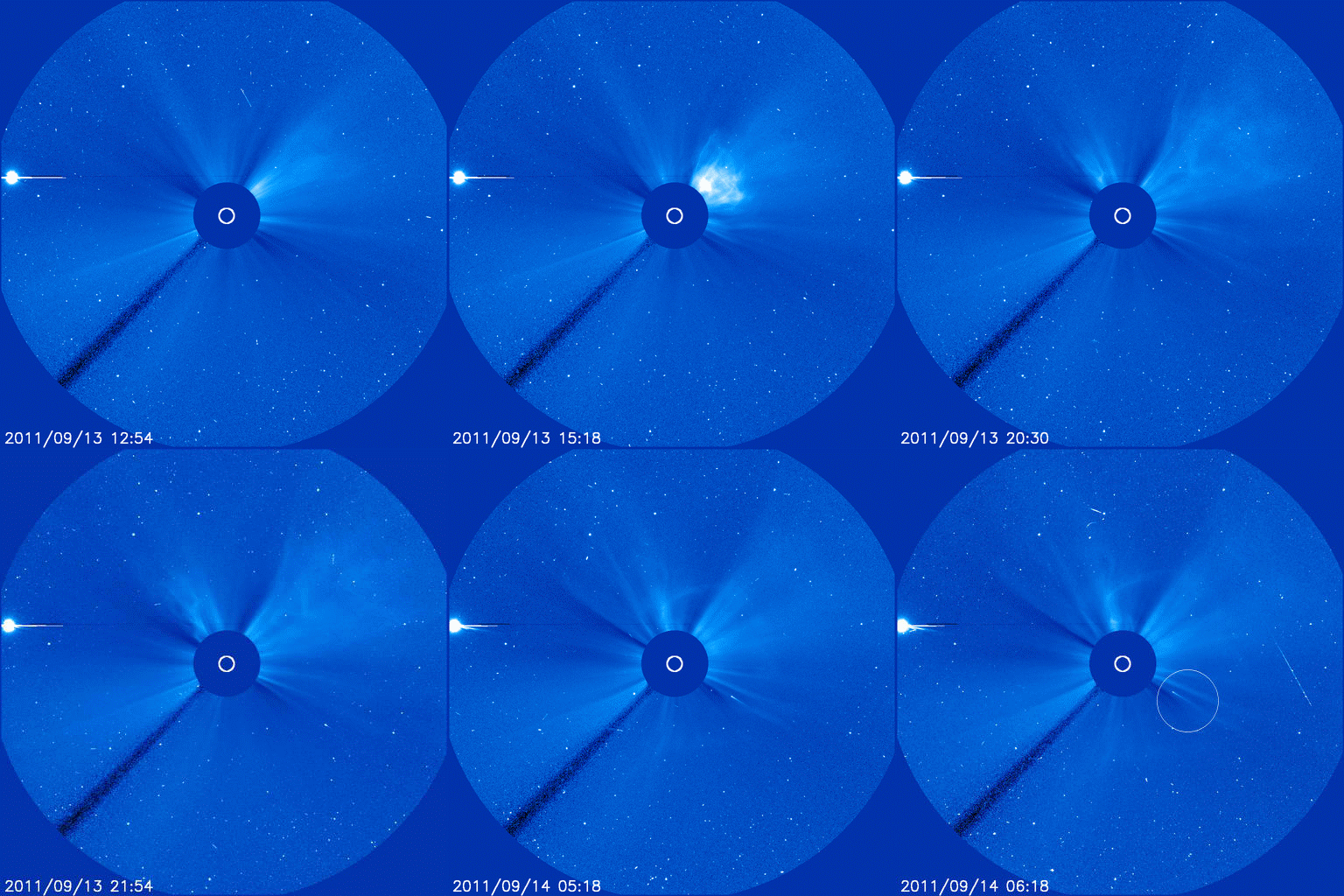

The doomed comet appears to be a member of the Kreutz family. Kreutz sungrazers are fragments from the breakup of a single giant comet many centuries ago. They get their name from 19th century German astronomer Heinrich Kreutz, who studied them in detail. Several Kreutz fragments pass by the sun and disintegrate every day. Most, measuring less than a few meters across, are too small to see, but occasionally a big fragment like this one attracts attention.
from: spaceweather.com
New Active Sunspot
ACTIVE SUNSPOT: New sunspot AR1295 is emerging over the sun’s northeastern limb and crackling with solar flares. The strongest so far, a C9.9-category blast, did something remarkable. Click on the arrow to watch an extreme ultraviolet movie from NASA’s Solar Dynamics Observatory:

In the movie, the underlying explosion (marked by the flash of extreme UV radiation) hurls material upward. The ejecta crashes into a loop of magnetism above the sunspot, stretching the loop until the material breaks free. Coronagraph images from the STEREO-A spacecraft confirm that a cloud of plasma (a CME) left the scene.
This sunspot will not turn toward Earth for several days. Until then, CMEs leaving AR1295 should continue to miss our planet.
from: http://spaceweather.com
Microwave Replacements?
Nanoscale Spin Waves Can Replace Microwaves
ScienceDaily (Sep. 10, 2011) — A group of scientists from the University of Gothenburg and the Royal Institute of Technology (KTH), Sweden, have become the first group in the world to demonstrate that theories about nanoscale spin waves agree with observations. This opens the way to replacing microwave technology in many applications, such as mobile phones and wireless networks, by components that are much smaller, cheaper, and that require less resources. The study has been published in the scientific journal Nature Nanotechnology.

Spin waves spread from a magnetic nanocontact like rings on water. (Credit: Image courtesy of University of Gothenburg)
We have been in competition with two other research groups to be the first to confirm experimentally theoretical predictions that were first made nearly 10 years ago. We have been successful due to our method for constructing magnetic nanocontacts and due to the special microscope at our collaborators’ laboratory at the University of Perugia in Italy,” says Professor Johan Åkerman of the Department of Physics, University of Gothenburg, where he is head of the Applied Spintronics group.
The aim of the research project, which started two years ago, has been to demonstrate the propagation of spin waves from magnetic nanocontacts. Last autumn, the group was able to demonstrate the existence of spin waves with the aid of electrical measurements, and the results were published in the scientific journal Physical Review Letters.
The research group has used one of the three advanced spin wave microscopes in the world, at the university in the Italian town of Perugia, to visualise the motion. The microscope makes it possible to see the dynamic properties of components with a resolution of approximately 250 nanometre.
The results have opened the way for a new field of research known as “magnonics,” using nanoscale magnetic waves.
to read more, go to: http://www.sciencedaily.com/releases/2011/09/110907075750.htm
New Sunspot To Watch
UNSPOT CONJUNCTION: A new sunspot (AR1289) is growing rapidly in the sun’s eastern hemisphere. The International Space Station drew attention to it this morning when the solar-paneled spacecraft flew almost directly in front of the sunspot’s dark core:

Maximilian Teodorescu took the picture from Magurele, Romania. “The space station made a very nice couplet with sunspot AR1289,” he says. “This was the second ISS transit of the sun in three days for my location.”