On the Number 5

The Number Five

31st May 2012

By Jelle U. Hielkema

Guest Writer for Wake Up World

‘Penta’ = 5/23 = ‘Nature’

In Music, to which’ condition all Life aspires as the Universe is a musical symphony, the so-called ‘Perfect Fifth’ is the most consonant (stable) musical interval within tone ladder. Both the names ‘perfect’ and ‘fifth’ have the same ‘26’ “Partnerships” vibration of also the name ‘Pythagoras’ so little wonder that He came up with this first ‘String Theory’! And, ‘A Perfect Fifth’ is a ‘17’ “The Magic Star of Venus” like the word ‘Music’ itself as well as ‘Logic’. What’s more, “Music’-‘Logic’- ‘Life” = ‘33’ = ‘Aspiration’!

The word ‘SUN’, ‘spelled’ as ‘365’ is a 5/14, called “Movement and Challenge”, like the following selection: ‘GOD’ ‘ALL LIGHT’ ‘QUANTIZATION OF LIGHT ENERGY’  ‘ELECTROMAGNETIC FIELD THEORY OF LIGHT’ ‘ELECTROMAGNETISM’ ‘TIME’’ ‘MIND’ ‘BRAINS’ ‘TEN’ ‘ALL THOUGHT’ ‘EYES’ ‘IDEAS’ ‘TEAM’ ‘DAY ONE’ ‘BIRTH’   ‘MYTH’ ‘GALAXY’ ‘ALL THERE IS’  ‘PHI’ ‘QUASAR’ ‘QUBIT’ ‘BIG BANG THEORY’ ‘BIG BANG MACHINE’ ‘ALL IS ENERGY’ ‘MASS-ENERGY’ ‘BINARY MODE’ and Albert Einstein’s immortal formula ‘E=MC^2’,  and, funny and good enough, ‘LUCK’, ‘JUNK’ ‘PHILOSOPHY OF NATURE’ ‘META’ ‘MAYAN CULTURE’ ‘COSMOTHEOLOGY’ ‘ALL BEING’ ‘A SUPREME BEING’ ‘ROYAL’ ‘A STEADFAST BEING’ ‘TELECOMMUNICATION’ ‘CHAKRA’ ‘MULTIPLICATION BY TIME’  ‘THE TRUTH IS IN THE HANDS OF NATURE ONLY’ and ‘THE TRUTH IS IN THE HANDS OF GOD ONLY’ and ‘IN GOD WE TRUST’ ‘SMILE AT LIFE AND LIFE WILL SMILE AT YOU’  ‘PHILOSOPHY OF MIND’  ‘PERFECTIONING THE WHEEL’ and ‘IN NATURE WE TRUST’  ‘A TRANSCENDENTAL EVOLUTION’  and….. ‘IN THE BEGINNING’, ‘A MATTER OF TIME’  ‘EVERYTHING HAS ITS TIME’ ‘A MOMENT IN TIME’  ‘A MATTER OF PERSPECTIVE’ ‘BIG TURN’ ‘IN REALITY’ ‘SAY YES’ ‘BACK TO BASICS’  ‘MAKE A DIFFERENCE’ and….’MATHEMATICS IS NOT AN OPINION’ and  ’CONSCIOUSNESS MATTERS’ and ’A THEORY OF EVERYTHING’

It is to be recalled that Baruch de Spinoza, renowned Dutch-Portuguese philosopher of the 17th Century, with great foresight ‘formulated’ the nature of the Cosmos in three words: MODES, a 5/23; SUBSTANCE, a 5/32 and ATTRIBUTES, also a 5/32 as well. These are all Mercury vibrations, the planet closest to the Sun and first recipient of its ‘information’! As to the obvious question why all of this comes out of the woodwork right now, as you probably know, all of us are about to leave the ‘Age of Pisces’ and on 23 January 1999 we  have  arrived on the threshold of the much sung-about  astronomical ‘Age of Aquarius’.  A Kabbalah numerological analysis of this and related facts yields the following rather circumstantial evidence in connection with the above, to start with a selection of the 5/23 vibration:

‘URANUS’, the Aquarian Ruler, ‘MERCURY’ ‘THE MESSENGER OF THE GODS’  ‘TEN NUMBERS’ ‘DNA AS NUMBERS’ ‘ALL IS ONE GEOMETRY’ ‘PENTA’  ‘NATURE’ ‘OUR COMMON NATURE’ ‘MASS-ENERGY-CONSCIOUSNESS’ ‘A LANGUAGE OF THOUGHT’ ‘LOGIC AND REASON’ ‘MORAL UNIVERSE’  ‘I EXIST, THEREFORE I AM’    =     ‘I AM, THEREFORE I EXIST’ ‘HUMAN BRAIN’  ‘NATURAL CREATIVITY’ ‘GOOD IDEA!’  ‘FANTASY’  ‘WORLD SOUL’ ‘SYMBOLS’  ‘COSMIC BALANCE’  ‘COSMIC VIBRATION’  ‘COSMIC ORDER’  ‘HUMAN INITIATIVE’ ‘PLATO’ ‘A SHARED VISION FOR A BETTER WORLD’   ‘DEALISTIC THOUGHT’  ‘REALISM AND DEALISM’  ‘THE WORLD WE LOVE’ ‘TIME TO RETHINK EVERYTHING’  ‘MIND AND HEART’ ‘MORALITY’  ‘HEALTH’ ‘ETHICS CULTURE’  ‘GLOBAL PEACE’  ‘CIVIC LIBERTY’ ‘MY HOUSE IS MY CASTLE’ ‘TALKING ABOUT A REVOLUTION’  ‘HEAL THE WORLD’  ‘THE LIVING PLANET’ ‘THE POWER OF SIMPLICITY’  ‘SO ABOVE, SO BELOW, SO ABOVE’  ‘THE HUMAN EMERGENCY’ and ‘THINK DIFFERENT’…..‘THINKING OUT OF THE BOX’!

Followed by these clearly connected 5/32’s which carry the name “Communication”:

‘THE AGE OF AQUARIUS’ ‘THE GUARDIAN OF LIGHT’  ‘THE TRUTH IN NUMBERS’ ‘MATHEMATICAL  NATURE’  ‘THE MAGIC OF NUMBERS’  ‘MOTHER NATURE’ ‘QUANTUM MIND’ ‘NUMBERS A LANGUAGE OF THOUGHT’ ‘THE ORIGIN OF LANGUAGE IS SOUND’ ‘NATURE SPEAKS WITH A THOUSAND VOICES’  ‘DOWN TO EARTH’ ‘INTUITION AND INTELLECT’  ‘ALL LIVING FORMS ARE IN FLUX’  ‘DEGREES OF FREEDOM’  ‘IT IS THE TONE THAT MAKES THE MUSIC’  ‘VIBRATIONS’’ and ‘GOOD, GOOD, GOOD VIBRATIONS’  ‘MUSIC IS THE SPIRIT OF REALITY’  ‘THE TRUTH IS OUT THERE’ ‘BEING TOUCHED BY NATURE’  ‘TRANCENDENCE’  ‘AWESOME POWER’  ‘SEIZING THE MOMENT’ ‘COLLECTIVE DNA’ ‘NATURE IS CONSTANT’ SMALL IS STILL BEAUTIFUL’  ‘FREE AS THE BIRDS’         ‘THE ART OF THE LONG VIEW’ ‘NATURE AND HUMANITY PARTNERSHIP’ ‘THINGS SHOULD BE CLEAR AND SIMPLE’ ‘AND NEW PHILOSOPHY PUTS ALL IN DOUBT’   ‘PYTHAGOREAN THINKING’         ‘THE COLOURS OF THE RAINBOW, SO PRETTY IN THE SKY’ ‘WHAT YOU SAY IS WHAT YOU ARE’ ‘TAKE IT OR LEAVE IT’  ‘THE TRUTH IS ALWAYS IN THE MIDDLE’ ‘THE TRUTH AND NOTHING BUT THE TRUTH’  ‘SPINOZA’ ‘SPEAK SOFTLY BUT CARRY A BICK STICK’ ‘FUNDAMENTAL CHANGE’ ‘NEUROSCIENCE’ ‘NEUROLOGICAL CAPACITY’ ‘SYNCHRONICITY’ ‘SPIRALS AND DOUBLE HELIX’ ‘THE THEORY OF CELESTIAL INFLUENCE’ ‘COUNT TO BE COUNTED!’  ‘PYTHAGORAS AND PLATO’ ‘BORN TO BE ALIVE’  ‘BLESSING IN THE SKIES’ ‘THE UNIVERSE IS A SYMPHONY’ ‘MUSIC IS THE VERY ESSENCE OF THE UNIVERSE’ ‘MUSIC IS OUR NATURE’  and ‘FOOD FOR THOUGHT’!

Take that in on 31 May 2012, by the digits of the date a ‘14’ like the ‘365’ of ‘SUN!

About the Author

Jelle U. Hielkeman is of Dutch/Frisian farmer’s origin (1947) and has lived in Rome since 1975, where he has been working for the United Nations for thirty years in the field of Earth Observation from space in the context of global Food Security. His frequent travels across the globe spanning five continents, coupled with a keen interest in the interaction among philosophy, science, religion, and politics, enabled him to make a wide range of observations on the relationship among names, language, and numbers with rather amazing findings.
More about these Thoughts and what to possibly do with them can be found on rainbow21122012.org andgci.org.uk

from:    http://wakeup-world.com/2012/05/31/the-number-five/

Oh, Those Scientifically Attuned Infants!

Babies Are Born With “Intuitive Physics” Knowledge

27th January 2012

University of Missouri

While it may appear that infants are helpless creatures that only blink, eat, cry and sleep, one University of Missouri researcher says that studies indicate infant brains come equipped with knowledge of “intuitive physics.”

“In the MU Developmental Cognition Lab, we study infant knowledge of the world by measuring a child’s gaze when presented with different scenarios,” said Kristy vanMarle, an assistant professor in the Department of Psychological Sciences in the College of Arts and Science. “We believe that infants are born with expectations about the objects around them, even though that knowledge is a skill that’s never been taught. As the child develops, this knowledge is refined and eventually leads to the abilities we use as adults.”

In a review of related scientific literature from the past 30 years, vanMarle and Susan Hespos of Northwestern University found that the evidence for intuitive physics occurs in infants as young as two months – the earliest age at which testing can occur. At that age, infants show an understanding that unsupported objects will fall and that hidden objects do not cease to exist. Scientific testing also has shown that by five months, infants have an expectation that non-cohesive substances like sand or water are not solid. In a previous publication, vanMarle found that children as young as 10 months consistently choose larger amounts when presented with two different amounts of food substance.

“We believe that infants are born with the ability to form expectations and they use these expectations basically to predict the future,” vanMarle said. “Intuitive physics include skills that adults use all the time. For example, when a glass of milk falls off the table, a person might try to catch the cup, but they are not likely to try to catch the milk that spills out. The person doesn’t have to consciously think about what to do because the brain processes the information and the person simply reacts. The majority of an adult’s everyday interactions with the world are automatic, and we believe infants have the same ability to form expectations, predicting the behavior of objects and substances with which they interact.”

While the intuitive physics knowledge is believed to be present at birth, vanMarle believes parents can assist skill development through normal interaction, such as playing and talking with the child and encouraging him/her to interact with objects.

“Despite the intuitive physics knowledge, a parent probably cannot do much to ‘get their child ahead’ at the infant stage, including exposing him or her to videos marketed to improve math or language skills,” vanMarle said. “Natural interaction with the child, such as talking to him/her, playing peek-a-boo, and allowing him/her to handle safe objects, is the best method for child development. Natural interaction with the parent and objects in the world gives the child all the input that evolution has prepared the child to seek, accept and use to develop intuitive physics.”

The study, “Physics for infants: characterizing the origins of knowledge about objects, substances and number,” is published in the January issue of WIREs Cognitive Science

 from:    ttp://wakeup-world.com/2012/01/27/babies-are-born-with-“intuitive-physics”-knowledge/

Tips for Watching the Venus Transit June 5-6

Transit of Venus on June 5 Is Last for 105 Years: How to Watch

by Geoff Gaherty, Starry Night Education
Date: 30 May 2012 Time: 07:30 AM ET
Venus Transit 2012 Sky Map
The transit of Venus will take place June 5-6, 2012.
CREDIT: Geoff Gaherty

On Tuesday, June 5, skywatchers in North America will have their last chance to see Venus pass in front of the sun for over a century. Because of the International Date Line, this event will occur on Wednesday June 6 in Asia, Australia, Africa, and Europe.

This event, called a transit of Venus, is one of the rarest sights in astronomy. Transits of Venus occur in pairs 8 years apart, each pair separated from the next by over a century. The last pair occurred in 1881 and 1889, and the next pair will occur in 2117 and 2125. This week’s transit is paired with a transit which occurred on June 8, 2004.

This graphic shows Venus position in its orbit on June 5, 2012, the day of the transit of Venus.
On Tuesday June 5, 2012, Venus will be exactly between the Earth and the sun. Venus’ orbit (shown in grey in this edge-on view) is tilted 3.4 degrees to the Earth’s orbit (shown in green).
CREDIT: Starry Night Software

Why are transits of Venus so rare?

As the graphic associated with this guide shows, Venus’ orbit is tilted by 3.4 degrees as compared to the Earth’s orbit. As a result, most of the time Venus passes either above or below the sun when Venus is inferior conjunction with the sun (between the sun and Earth). Only when both Venus and Earth are at the points where the two orbits cross can we see Venus in front of the sun.

Venus transit observing safety

WARNING: It is always dangerous to stare directly at the sun!The sun’s heat, when concentrated by your eye’s lens on your eye’s retina, can literally cook your sensitive retinal cells. The result can be a permanent blind spot in your eye. You only get one pair of eyes, so don’t risk permanently damaging them.

There are only two safe ways to observe the transit of Venus

One way is to block the sun’s damaging rays with a dense filter. The only safe filters are a #14 welder’s glass, sold only by specialized welder’s supply stores, or “eclipse shades”: special glasses available only from telescope stores and astronomy clubs. Either of these cost less than a couple of dollars, so there’s no excuse to endanger your eyes.

The only other safe way to observe the sun is with a “pinhole camera.”

This can be made from a large cardboard box, such as a mover’s “two-cube.” Make a small hole in one end of the box, about a millimeter or two in diameter, which acts as the “lens,” and place a white sheet of paper in the opposite end to serve as the viewing screen. Place the box over your head resting on your shoulders, and watch the transit on the screen. [Video: How to Make a Pinhole Camera]

Much simpler pinhole cameras can be improvised from any object with a small hole, but the advantage of using a large box is that it keeps stray light off the screen, allowing you to use a smaller pinhole, for a sharper image.

If you’re observing with binoculars or a small telescope, there is no substitute for a proper full-aperture solar filter. Unless you block the sunlight from entering the telescope, you run the risk of concentrating the sun’s light.

It was once common for solar observers to use their telescopes to project an image of the sun with an eyepiece. That was in the days when telescopes were made of metal and glass. Nowadays there is much plastic, and even cardboard, used in making telescopes and eyepieces, so that you run the risk of “meltdown” or even fire. It’s just not safe.

Venus Transit 2012 World Visibility Map
World visibility of the transit of Venus on 5-6 June 2012. Spitsbergen is an Artic island – part of the Svalbard archipelago in Norway – and one of the few places in Europe from which the entire transit is visible. For most of Europe, only the end of the transit event will be visible during sunrise on 6 June.
CREDIT: Michael Zeiler, eclipse-maps.com (via ESA)

The 2012 transit of Venus: How to watch

So, when is the best time to observe the transit?

In North America the best time will be in the hours before sunset on Tuesday afternoon. In Europe, Africa, and Australia, Venus will be in transit as the sun rises on Wednesday morning (June 6). In most of Asia and across the Pacific Ocean, any time during Wednesday should work. Detailed times are shown in the table accompanying this guide.

Astronomers chronicle Venus transits in terms of “contact.” First contact is when Venus first touches the outer edge of the sun. Second contact is when Venus is first entirely on the sun. Similarly, third contact is when Venus touches the sun’s edge from the inside, and fourth contact is when it is totally off the sun.

This chart shows the times of "contact" between Venus and the sun during the transit of Venus on June 5, 2012.
This chart shows the times of “contact” between Venus and the sun during the transit of Venus for major cities on June 5, 2012.
CREDIT: Starry Night Software

What will you see?

For most observers, Venus will be a tiny round black disk, but large enough to be clearly visible with the unaided eye, properly protected by eclipse glasses or welder’s glass. If you’re viewing with a telescope, the most interesting times will be as Venus is entering or leaving the sun’s disk.

One of the things to look for is the so-called “black drop” effect.

Here’s an example: Hold up your thumb and forefinger in front of a bright background so that they are almost touching. You will see an interesting optical illusion whereby a black ligament appears to bridge the gap.

For the Venus transit, a similar illusion occurs just after second contact and just before third contact, when a dark ligament appears to join Venus to the dark sky. But is this entirely an optical illusion? Remember that Venus has a dense atmosphere which could contribute to this effect.

Many observers have reported seeing Venus as a bright ring just before it enters the sun’s disk and justafter it leaves. Mikhail Lomonosov, who organized the observations of the transits in the 1760s, correctly deduced from this that Venus had an atmosphere, illuminated from behind by the sun.

One difference between this transit and the one eight years ago is that many amateur astronomers now have telescopes which allow them to view the sun in hydrogen alpha light. It should be possible to see Venus silhouetted against prominences and the corona, before it moves in front of the chromosphere.

from:    http://us.mg6.mail.yahoo.com/neo/launch?.rand=191d426aj86r5

Getting Ready for the Venus Transit

CANVAS FOR A TRANSIT: In only 6 days, Venus will pass in front of the sun, marking the solar disk like the tip of a black-dipped paint brush drawn slowly across the stellar surface. If the transit is indeed like a painting, here is the canvas:

Alan Friedman took the picture from his backyard observatory in Buffalo, NY, on May 28th. “I was getting my ducks in a row for a trip west to observe the transit of Venus, practicing with a new camera and new laptop on the Memorial Day sun,” he says. “There was lots of activity to see, including an ejection of plasma from active region 1492.”

from:  space weather.com

Some Myths About the Sun

Fiery Folklore: 5 Dazzling Sun Myths

Stephanie Pappas, LiveScience Senior Writer
Date: 18 May 2012 Time: 10:33 AM ET
A partial solar eclipse seen from space.
Remind anyone of a favorite arcade game? The new moon passes over the sun in this Feb. 21 image taken by NASA’s Solar Dynamics Observatory. The partial eclipse was visible only from space.

The next partial solar eclipse Earthlings will be able to see will occur May 20, with views visible from Asia, the Pacific and western North America.
CREDIT: NASA/SDO

On Sunday (May 20), a solar eclipse will blot out the sun for viewers across much of Asia, the Pacific and western North America. These days, eclipses aren’t a big mystery — they occur when the moon passes between Earth and the sun. But throughout history, the sun’s significance, along with its mysteriousness, have yielded an array of solar myths.

From the fearsome figures that try to devour the sun to nine lost suns of the Chinese sky, here are the stories that have sought to explain our nearest star.

How Hou Yi shot the sun

In ancient Chinese mythology, the sky had not one, but 10 suns. Every day, the solar goddess Shiho would pick up one of these suns (also her sons) and wheel him across the sky in her chariot. In the meantime, the other nine would play among the leaves of the mythical Fusang tree, believed to be more than 10,000 feet tall.

This system worked well until the day that the suns grew bored of their responsibility. They decided to run across the sky all at once, planning to generate enough light and heat so that they could all take a few days off. Instead, this solar scamper dried up rivers, scorched the Earth and led to widespread drought.

Taking pity on suffering mortals, the sun god Dijun called in the expert archer Hou Yi. With 10 magic arrows, the story goes that Hou Yi was to discipline the irresponsible suns. The archer stalked and killed nine suns and would have snuffed out the last as well if a young boy hadn’t stolen his final arrow, saving Earth from perpetual darkness.

Ancient Chinese myth also holds that solar eclipses were caused by a demon or dragon devouring the sun, leading to a tradition in which people would play drums or bang pots to scare the sun-eater away. In actuality, Chinese astronomers seemed to understand eclipses as natural phenomena dating back at least as far as 720 B.C., with older observations scratched into bones dating back perhaps 3,000 years.

Chased by wolves

In ancient Norse legend, the sun goddess Sol travels through the sky chased by the wolf Sköll, who intends to devour her. (Sköll’s brother Hati does the same to the moon at night.) Eclipses were said to be a sign that Sköll was dangerously close to catching Sol.

In fact, the Norse believed that one day, the sun would finally be devoured. Mythology foretold a huge battle called Ragnarök, in which major gods would die and the Earth would be engulfed in a massive flood. This apocalypse would wipe the Earth, clean to be repopulated by a pair of human survivors.

Sailing the sun boat

One of the most important deities in the Egyptian pantheon was Ra, the falcon-headed sun god. Legend had it that every day Ra captained a boat crewed by gods across the sky. (This boat was called Mandjet, or the “Boat of Millions of Years” — an underestimate, given that our star is actually about 4.5 billion years old.)

At night, Ra returned to the east via the underworld, bringing light to the dead. It was a treacherous journey: Apep, an evil serpent god, attempted to stop Ra by devouring him. Solar eclipses were thought to be days when Apep got the upper hand, though Ra always managed to escape.

Jealous star

According to a Cherokee legend, the sun long ago grew jealous of her brother the moon because the people of Earth always looked at her with twisted-up faces and squinted eyes, while they smiled at his gentle light. The sun’s daughter lived in the middle of sky, so every day, the sun stopped to visit her. Angry at humans for their ugly expressions, the sun began using these opportunities to send down so much heat that people began to die of fever.

The humans turned to the Little Men, who in Cherokee legend were friendly, magical spirits who dwelt in the forests. The Little Men said that the sun must die, so they turned one man into a rattlesnake and another into a fearsome antlered serpent called the Uktena.

The rattlesnake arrived at the sun’s daughter’s house to wait for her arrival. But while he was waiting, the sun’s daughter opened her door. The rattlesnake accidentally bit her, killing her. When the sun came to see her daughter, she discovered her dead and began to weep, flooding the Earth with her tears.

Desperate to please the sun and stop the weeping, the people of Earth made an attempt to rescue the dead daughter from the land of ghosts, but failed. When they returned, the sun began to weep even harder. To distract her, the people began to dance and play music until she finally became happy again.

Slowing down the sun

The Maori people of New Zealand tell a tale about a long-ago time when the days were shorter than they are now. The hero Maui often heard his brothers lamenting the lack of light during the day. He decided to solve the problem by taming the sun. Although his brothers were skeptical, they and their tribe helped Maui weave a net out of flax.

Maui and his brothers then set out to the east to find the sun’s resting place. They covered the entry to the sun’s cave with nets and smeared themselves with clay to protect against the sun’s heat. When the sun emerged, it fought and struggled in the nets, but the brothers held firm. Maui began to beat the sun — some stories say he had an ax, others a club made of the jawbone of an ancestor — until the star was so weakened that it could no longer race across the sky. According to the legend, that is why the sun travels so slowly in the sky today.

from:    http://www.livescience.com/20415-folklore-5-sun-myths.html


New CME

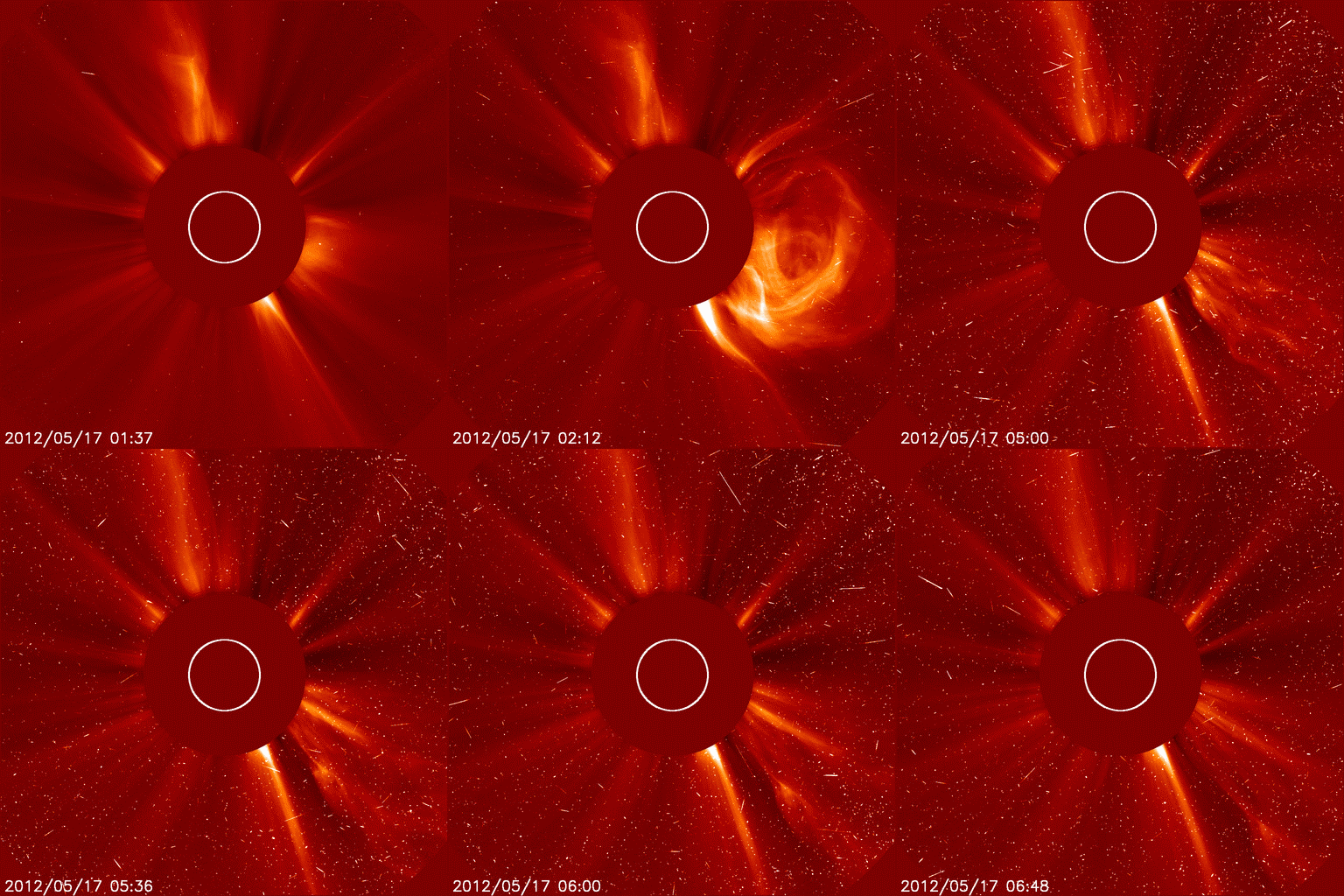
INCOMING CME? A coronal mass ejection (CME) that flew off the sun’s western limb on May 17th might hit Earth after all. NOAA forecasters say a shock wave from the blast could deliver a glancing blow to Earth’s magnetic field on May 18th or 19th. The CME, pictured below, was propelled by an M5-class solar flare from departing sunspot AR1476.

The speckles in the movie are caused by energetic protons hitting the observatory’s detector. Those protons may have been accelerated in part by the shock wave en route to Earth.

According to NOAA, there is a 40% chance of minor geomagnetic storms and a 15% chance of strong storms when the shock arrives. High-latitude sky watchers should be alert for auroras.

fr/spaceweather.com

Solar Maximum 2013

PUBLIC SERVICE ANNOUNCEMENT: Solar maximum is coming in 2013. How will space weather affect you? To answer that question, experts from around the world are gathering for the Space Weather Enterprise Forum (SWEF) on June 5, 2012, at the National Press Club in Washington, DC. To learn more and register, please visit the SWEF web site athttp://www.nswp.gov/swef/swef_2012.html.

fr/spaceweather.com

Path of This Weekend’s Solar Eclipse

Solar Eclipse this Weekend

May 15, 2012: Something strange is about to happen to the shadows beneath your feet.

On Sunday, May 20th, the Moon will pass in front of the sun, transforming sunbeams across the Pacific side of Earth into fat crescents and thin rings of light.1

It’s an annular solar eclipse, in which the Moon will cover as much as 94% of the sun. Hundreds of millions of people will be able to witness the event. The eclipse zone stretches from southeast Asia across the Pacific Ocean to western parts of North America: animated eclipse map.

2Annular Eclipse (shadows, 558px)

Crescent sunbeams dapple the ground beneath a palm tree during an annular eclipse in January 2010. The picture was taken by Stephan Heinsius on the Indian Ocean atoll island of Ellaidhoo, Maldives. [more] [video]

In the United States, the eclipse begins around 5:30 pm PDT. For the next two hours, a Moon-shaped portion of the sun will go into hiding. Greatest coverage occurs around 6:30 pm PDT.

Because some of the sun is always exposed during the eclipse, ambient daylight won’t seem much different than usual. Instead, the event will reveal itself in the shadows. Look on the ground beneath leafy trees  for crescent-shaped sunbeams and rings of light.

2Annular Eclipse (ring of fire, 200px)

A “ring of fire” over China in 2010.

Near the center-line of the eclipse, observers will experience something special: the “ring of fire.” As the Moon crosses the sun dead-center, a circular strip or annulus of sunlight will completely surround the dark lunar disk. Visually, the sun has a big black hole in the middle.

The “path of annularity” where this occurs is only about 200 miles wide, but it stretches almost halfway around the world passing many population centers en route: Tokyo, Japan; Medford, Oregon; Chico, California; Reno, Nevada; Albuquerque, New Mexico, and Lubbock, Texas. In those locations the ring of fire phenomenon will be visible for as much as 4 and a half minutes.

“The ring of sunlight during annularity is blindingly bright,” cautions NASA’s leading eclipse expert Fred Espenak of the Goddard Space Flight Center. “Even though most of the Sun’s disk will be covered, you still need to use a solar filter or some type of projection technique. A #14 welder’s glass is a good choice. There are also many commercially-available solar filters.”

2Annular Eclipse (map, 558px)

The path of annularity cuts across the continental United States near sunset on May 20, 2012. An interactive map is also available: click here. See also the ScienceCast video.

Many astronomy clubs will have solar-filtered telescopes set up for public viewing. Through the eyepiece of such an instrument, you can see the mountainous lunar limb gliding by dark sunspots and fiery prominences. It’s a beautiful sight. Be absolutely sure, however, that any telescope you look through is properly filtered. Magnified sunlight can cause serious eye damage even during an eclipse.

A safe and fun way to observe the eclipse is to use your own body as a solar projector. For example, try criss-crossing your fingers waffle-style. Rays of light beaming through the gaps will have the same shape as the eclipsed sun.

Or just stand under that tree. The sight of a thousand ring-shaped sunbeams swaying back and forth on a grassy lawn or sidewalk is unforgettable.

For more information about the solar eclipse, please view the ScienceCast video Solar Eclipse over the USA.
Author:Dr. Tony Phillips| Production editor: Dr. Tony Phillips

from:    http://science.nasa.gov/science-news/science-at-nasa/2012/15may_sunday/