On Pets, Parasites, Prevention, and Protocols

New Parasite Prevalence Maps Help Pet Owners Prepare

July 18 2012

Story at-a-glance

  • The Companion Animal Parasite Council now provides online maps pet owners can use to see if the area they live in or plan to visit has parasite problems. The maps are a good tool to find general information about the presence of parasites in counties and states across the country. But they shouldn’t be used as a tool to scare pet owners into subjecting their animals to a barrage of potentially toxic chemicals.
  • The best way to protect pets from parasites is not to put them on monthly, year-round preventive drugs. Under certain circumstances, chemical preventives may be necessary, but they should not be used indiscriminately. They carry side effects like every drug, and their overuse is contributing to the problem of parasite resistance to these preventives.
  • No matter what parasite preventives you use, including chemical agents, your pet can still attract pests and parasites. In fact, even animals loaded with chemicals to the point of toxicosis can still acquire parasites.
  • Do all you can to avoid parasites, relying on natural preventives as much as possible, and then have your vet run a SNAP 4Dx test every six months to check for the presence of heartworm and tick borne diseases, as well as a stool sample to check for GI parasites.

By Dr. Becker

The Companion Animal Parasite Council (CAPC) has redesigned its website1 for pet owners and now features a set of maps you can check for information on parasite prevalence in a specific area.

If you’re only interested in heartworm disease, you can select your state from a drop-down menu on the right side of the home page to see the infection risk for your state. If you’d like more extensive information, you can view the entire U.S. map.

If you choose the second option, you can find out the risk for several different diseases for dogs and cats individually, by state. The maps include infection rates for:

  • Tick borne diseases (Lyme disease, ehrlichiosis and anaplasmosis)
  • Intestinal parasites (roundworm, hookworm and whipworm)
  • Heartworm

You can also click on a state and see infection rates for individual counties, then hover your mouse over a county to see its name.

According to Dr. Christopher Carpenter, executive director of CAPC, “Our unique parasite prevalence maps provide localized statistics about diseases that affect dogs and cats in consumers’ backyards, and we update them monthly.”

Keep Your Pet Safe from Overuse of Parasite Preventives

I think these maps are useful for pet owners looking for general information about the prevalence of a certain disease in a certain location. The intent of the maps is to “… help drive clinic visits,” according to Dr. Carpenter, because “People respond to and appreciate it when experts share pertinent information.”

He goes on to say that CAPC hopes veterinarians leverage the maps “… to strengthen client relationships and consistently ‘tap consumers on the shoulder’ with facts that underscore the risk of parasitic disease that exists everywhere.”

Since the Companion Animal Parasite Council is sponsored by a “Who’s Who” list of major veterinary drug manufacturers, I think it’s safe to assume the real intent of the maps is to get pet owners to buy into the belief that every dog and cat in the country should be on parasite preventives year-round.

And while I agree pet owners appreciate learning information pertinent to the health of their furry family members, I think it’s extremely irresponsible of veterinarians to encourage the overuse of parasite preventives. These drugs, like all drugs, have side effects.

Just because a drug is used as a preventive doesn’t automatically put it in the category of “better safe than sorry.” This is a lesson the traditional veterinary community is slowly learning about vaccines. Every single thing we put into or onto an animal should be carefully assessed to insure its benefits outweigh its risks.

And keep in mind that even pets loaded down to the point of toxicosis with chemical preventives still frequently wind up with pests and parasites. There is no absolutely foolproof method for keeping every single pet protected from every single pest.

Around this time last year I saw my first dog patient with Lyme disease AND heartworm disease – conditions she acquired while taking a monthly, year-round heartworm preventive drug AND a spot-on flea/tick preventive prescribed by her regular vet. This is a good illustration of the ineffectiveness of some of these drugs, as well as the fact that parasites are growing resistant to them because they are being overused.

Preventing Tick Borne Diseases

  • In the spring, summer and fall, avoid tick-infested areas.
  • If you live where ticks are a significant problem, check your pet for the little blood suckers twice each day. Look over his entire body, including hidden crevices like those in the ear, underneath his collar, in the webs of his feet, and underneath his tail. If you find a tick, make sure to remove it safely.
  • Use a safe tick repellent like Natural Flea and Tick Defense. If you live in a Lyme endemic region of the U.S., your veterinarian will probably recommend you use a chemical repellent. Remember: it’s important to investigate the risks and benefits of any medication before you give it to your pet. Natural repellents are NOT the same as toxic preventives … they are not a guarantee your pet won’t be bitten by ticks….they only reduce the likelihood of infestation. So frequent tick checks are really important.
  • Create strong vitality and resilience in your dog or cat by feeding a species-appropriate diet. Parasites are attracted to weaker animals. By enhancing your pet’s vitality, you can help her avoid the ill effects of a tick borne disease.

Preventing Intestinal Parasites

  • Puppies and kittens can get intestinal parasites from an infected mother – either across the placenta or from their mother’s milk.
  • Beyond that, most pets acquire intestinal worms by eating infected poop. So the best way to prevent infection is to make sure your pet’s environment is clean and ‘feces-free.’ Pick up your pet’s poop and make sure she doesn’t have access to infective feces from wild or stray animals around your property or anywhere else outdoors.
  • Whipworm eggs in the environment are extremely resilient and resistant to most cleaning methods and freezing temperatures as well. They can be dried out with strong agents like agricultural lime, but the best way to decontaminate a whipworm-infested area is to replace the soil with new soil or another substrate.
  • Keep your pet’s GI tract in good shape and resistant to parasites by feeding a balanced, species-appropriate diet. I also recommend either periodic or regular probiotic supplementation to insure a good balance of healthy bacteria in your pet’s colon, as well as a good quality pet digestive enzyme.
  • Have your vet check a sample of your pet’s stool twice a year for GI parasites.

What You Need to Know About Heartworm Disease Prevention

According to heartworm preventive dosing maps, there are only a few areas of the U.S. where dosing your dog with 9 months to year-round heartworm medicine might be advisable. Those locations are in Texas and Florida, and a few other spots along the Gulf coast. The rest of the country runs high exposure risk at from 3 to 7 months. The majority of states are at 6 months or less.

Preventives don’t actually stop your dog from getting heartworms. What these chemicals do is kill off the worm larvae at the microfilaria stage. These products are insecticides designed to kill heartworm larvae inside your pet. As such, they have the potential for short and long-term side effects damaging to your canine companion’s health.

To reduce your pet’s risk of exposure to heartworms, control mosquitoes:

  • Use a non-toxic insect barrier in your yard and around the outside of your home.
  • Don’t take your pet around standing water. Eliminate as much standing water as possible around your home and yard by cleaning your rain gutters regularly and aerating ornamental ponds and decorative water gardens.
  • Stay out of wet marshes and thickly wooded areas.
  • Keep your pet indoors during early morning and early evening hours when mosquitoes are thickest.
  • Make liberal use of a safe, effective pet pest repellent like my Natural Flea and Tick Defense.

If You MUST Use a Chemical Heartworm Preventive …

If you live in an area of the U.S. where mosquitoes are common and you know your pet’s risk of exposure to heartworm disease is significant, here are my recommendations for protecting your precious furry family member:

  • With guidance from a holistic vet, try using natural preventives like heartworm nosodes rather than chemicals. Make sure to do heartworm testing every 3 to 4 months (not annually) as natural heartworm preventives can’t guarantee your pet will never acquire the disease.
  • If your dog’s kidneys and liver are healthy, try using a chemical preventive at the lowest effective dosage. This could mean having the drug compounded if necessary for dogs weighing in at the low end of dosing instructions. Give the treatment at 6-week intervals rather than at 4 weeks, for the minimum number of months required during mosquito season.
  • Remember, heartworms live in your pet’s bloodstream, so natural GI (gastrointestinal) dewormers, such as diatomaceous earth, and anti-parasitic herbs (such as wormwood and garlic) are not effective at killing larvae in your pet’s bloodstream.
  • Avoid all-in-one chemical products claiming to get rid of every possible GI worm and external parasites as well. As an example, many heartworm preventives also contain dewormers for intestinal parasites. Remember – less is more. The goal is to use the least amount of chemical necessary that prevents heartworm. Adding other chemicals to the mix adds to the toxic load your pets’s body must contend with. Also avoid giving your pet a chemical flea/tick preventive during the same week.
  • Follow up a course of heartworm preventive pills with natural liver detox agents like milk thistle and SAMe, in consultation with your holistic vet.
  • Always have your vet do a heartworm test before beginning any preventive treatment. A protocol I put in place in my clinic last year is to run a SNAP 4Dx blood test every 6 months on dogs that spend a lot of time outdoors during warmer weather. The 4Dx tests for heartworm and tick borne diseases. Because parasites are becoming resistant to overused chemical preventives, the sooner you can identify infection in your pet, the sooner a protocol can be instituted to safely treat the infection with fewer long-term side effects.


from:    http://healthypets.mercola.com/sites/healthypets/archive/2012/07/18/pets-parasite-infection.aspx?e_cid=20120722_SNL_TPA_1

Ancient Mysteries Still Confound Scientists

10 Insane Ancient Achievements that Science Can’t Explain

July 21, 2012


10 Insane Ancient Achievements that Science Can’t Explain

Out-of-place artifact (OOPArt) is a term coined by American naturalist and cryptozoologist Ivan T. Sanderson for an object of historical, archaeological, or paleontological interest found in a very unusual or seemingly impossible context that could challenge conventional historical chronology. The term “out-of-place artifact” is rarely used by mainstream historians or scientists. Its use is largely confined to cryptozoologists, proponents of ancient astronaut theories, and paranormal enthusiasts….

In this article we present our selection of Top 10 OOPArts. There are many more (you can find them by exploring our website).

1. Tiwanacu and Puma Punku

Tiwanaku (Spanish: Tiahuanaco and Tiahuanacu) is an important Pre-Columbian archaeological site in western Bolivia, South America. Pumapunku also called “Puma Pumku” or “Puma Puncu”, is part of a large temple complex or monument group that is part of the Tiwanaku.   Tiahuanaco is an example of engineering so monumental that it dwarfs even the work of the Aztecs. Stone blocks on the site weigh many tons. They bear no chisel marks, so the means by which they were shaped remains a mystery. The stone itself came from two different quarries. One supplied sandstone and was situated 10 miles away. It shows signs of having produced blocks weighing up to 400 tons. The other supplied andesite and was located 50 miles away, raising the question of how the enormous blocks were transported in an age before the horse was domesticated in South America. Close examination of the structures shows an unusual technique behind their building. The stone blocks were notched, then fitted together so that they interlocked in three dimensions. The result was buildings strong enough to withstand earthquakes.

Gateway of the Sun, Tiahuanaco, Bolivia

Puma Punku  site has many finely cut stones –  some weighing over 100 tonnes. The processes and technologies involved in the creation of these temples are still not fully understood by modern scholars. Raad More >>

Monolithic stone blocks with precisely cut elements. Puma Punku, Bolivia

2. Nazca Lines

The high desert of Peru holds one of the most mystifying monuments of the known world—the massive-scale geoglyphs known as the Nazca Lines.  The “lines” are ranging from geometric patterns to “drawings” of different animals and stylized human-like forms.

The ancient lines can only be truly taken in, their forms discerned, from high in the air, leaving generations mystified as to how these precise works could’ve been completed long before the documented invention of human flight. Who built them and what was their purpose? Are the lines signs left by an alien race? Ancient “crop circles”?  Landing strips for alien gods/astronauts?  Relics of a ancient people far more advanced—capable of human flight—then previously imagined? Or perhaps a giant astronomical calendar?  Read More >>

3. Sacsayhuaman

Sacsayhuamán (also known as Sacsahuaman) is a walled complex near the old city of Cusco, at an altitude of 3,701 m. or 12,000 feet. The site is part of the City of Cuzco, which was added to the UNESCO World Heritage List in 1983.

Giant walls of Sacsayhuaman

They are three parallel walls built in different levels with lime-stones of enormous sizes.  Zigzagging walls are made of boulders used for the first or lower levels are the biggest; there is one that is 8.5 m high (28 ft.) and weights about 140 metric tons. Those boulders classify the walls as being of cyclopean or megalithic architecture.  There are no other walls like these. They are different from Stonehenge, different from the Pyramids of the Egyptians and the Maya, different from any of the other ancient monolithic stone-works.  Scientists are not certain how these huge stones were transported and processed to fit so perfectly that no blade of grass or steel can slide between them. There is no mortar.  The stones often join in complex and irregular surfaces that would appear to be a nightmare for the stonemason.   Read more >>
[subject related:  Evidence of Vitrified Stonework in the Inca Vestiges of Peru ]

4. Stonehenge

Stonehenge is a megalithic monument on the Salisbury Plain in Southern England, composed mainly of thirty upright stones (sarsens, each over ten feet tall and weighing 26 tons), aligned in a circle, with thirty lintels (6 tons each) perched horizontally atop the sarsens in a continuous circle. There is also an inner circle composed of similar stones, also constructed in post-and-lintel fashion.

Stonehenge is angled such that on the equinoxes and the solstices, the sun rising over the horizon appears to be perfectly placed between gaps in the megaliths. This is doubtless not an accident, and probably contributed to the stories of its mysterious origins.

Gerald Hawkins, a Professor of Astronomy, concluded that Stonehenge was a sophisticated astronomical observatory designed to predict eclipses (Stonehenge Decoded). The positioning of the stones provides a wealth of information, as does the choice of the site itself. If you can see the alignment, general relationship, and the use of these stones then you will know the reason for the construction. The author, and other astronomers, discovered the 56-year cycle of eclipses by decoding Stonehenge!  The movement of stones once each year from an initial fixed position allows to predict accurately every important lunar event for hundreds of years. This computer would need resetting about once every 300 years by advancing the stones by one space. Mankind generally used the cycle of the moon as a unit of timekeeping.

Read more:

5. Costa Rica Stone Spheres

One of the strangest mysteries in archaeology was discovered in the Diquis Delta of Costa Rica. Since the 1930s, hundreds of stone balls have been documented, ranging in size from a few centimetres to over two meters in diameter. Some weigh 16 tons. Almost all of them are made of granodiorite, a hard, igneous stone. These objects are monolithic sculptures made by human hands.  Read More >>

Balls in the Courtyard of National Museum, San José, Costa Rica. Photo courtesy of John W. Hoopes. Copyright ©2001 John W. Hoopes. All rights reserved.

6. Trilithon at Baalbeck

The mysterious ruins of Baalbek. One of the great Power Places of the ancient world. For thousands of years its secrets have been shrouded in darkness, or bathed in an artificial light by those who would offer us a simplistic solution to its mysteries.

The Temple of Jupiter is one of the most impressive Temples in Baalbeck. It measures 88×48 meters and stands on a podium 13 meters above the surrounding terrain and 7 meters above the courtyard. It is reached by a monumental stairway. One of the most amazing engineering achievements is the Podium which was built with some of the largest stone blocks ever hewn. On the west side of the podium is the “Trilithon”, a celebrated group of three enormous stones weighing about 800 tons each.

Some archaeologists might well wish that Baalbek had been buried forever. For it is here that we find the largest dressed stone block in the world – the infamous Stone of the South, lying in its quarry just ten minutes walk from the temple acropolis. This huge stone weighs approximately 1,000 tons – almost as heavy as three Boeing 747 aircraft.

The large stone at Baalbek, known as the Stone of the Pregnant Woman. Copyright by Ralph Ellis (source: Wikipedia)

Read More:

7. Great Pyramid of Giza

The Great Pyramid of Giza (also called the Khufu’s Pyramid, Pyramid of Khufu, and Pyramid of Cheops) is the oldest and largest of the three pyramids in the Giza Necropolis bordering what is now Cairo, Egypt, and is the only one of the Seven Wonders of the Ancient World that survives substantially intact. It is believed the pyramid was built as a tomb for Fourth dynasty Egyptian King Khufu (Cheops in Greek) and constructed over a 20 year period concluding around 2560 BC. The Great Pyramid was the tallest man-made structure in the world for over 3,800 years.

Originally the Great Pyramid was covered by casing stones that formed a smooth outer surface, and what is seen today is the underlying core structure. Some of the casing stones that once covered the structure can still be seen around the base. There have been varying scientific and alternative theories regarding the Great Pyramid’s construction techniques. Most accepted construction theories are based on the idea that it was built by moving huge stones from a quarry and dragging and lifting them into place.

Read More:

8. Shroud of Turin

The Shroud of Turin is reputedly Christ’s burial cloth. It has been a religious relic since the Middle Ages. To believers it was divine proof the Christ was resurrected from the grave, to doubters it was evidence of human gullibility and one of the greatest hoaxes in the history of art. No one has been able to prove that it is the burial cloth of Jesus of Nazareth, but its haunting image of a man’s wounded body is proof enough for true believers.

The Shroud of Turin, as seen by the naked eye, is a negative image of a man with his hands folded. The linen is 14 feet, 3 inches long and 3 feet, 7 inches wide. The shroud bears the image of a man with wounds similar to those suffered by Jesus.

One theory is simply that the Shroud is a painting . It has been proposed that it was painted using iron oxide in an animal protein binder. The STURP scientists have concluded from their studies that no paints, pigments, dyes or stains have been found to make up the visible image. Could the image have been produced by a burst of radiation (heat or light) acting over short period of time which would have scorched the cloth? Scientists have not been able to duplicate the characteristics of the Shroud using this method just like the painting hypothesis. Also the color and ultraviolet characteristics of the Shroud body image and a scorch are different. The shroud body image does not fluoresce under UV light but scorches like the burns from 1532 do fluoresce under UV light. Thus many scientists rule out the radiation theory.  Read More >>

9. Star Child Skull

In the 1930?s, in a small rural village 100 miles southwest of Chihuahua, Mexico, at the back of a mine tunnel, two mysterious remains were found: a complete human skeleton and a smaller, malformed skeleton. In late February of 1999, Lloyd Pye was first shown the Starchild skull by its owners. Nameless then, it was a highly anomalous skull.

Front view of the Starchild skull (on the left) and the human skull (on the right). Compare striking differences between depth of eye sockets and shape of temporal area just behind outer edges of eyes.

The long-standing Star Being legends of Central and South America provide a plausible mechanism for how a highly abnormal skull (relative to humans) might have been biologically created rather than genetically or congenitally malformed, or physically manipulated by deliberate deformation (binding).
Such immense deformation across the entire occipital (rear) and parietal (upper side) areas of the skull could not result from binding without deformation being visible in the frontal area, which is not evident.
Birth defects across the entire occipital and parietal areas, while not impossible, seem highly unlikely because of the remarkable symmetry exhibited in all areas of the skull, including those effected by the deformations.
The terrain of the bone in the eye sockets contains incredibly subtle indentations and ridges that are perfectly symmetrical in both sockets, which simply have to have been formed by genetic directions rather than by deformations.

Read More:

10. The Antikythera Mechanism

The device, made of bronze and encased in wood, was found by divers off the Mediterranean island Antikythera in 1900.

“This device is just extraordinary, the only thing of its kind,” says Mike Edmunds  (Cardiff University, Wales) one of  the scientists  investigating this amazing artefact. “The design is beautiful. The astronomy is exactly right. The way the mechanics are designed just makes your jaw drop.”

Image Copyright © 2001-2012, Anthony Ayiomamitis

Nothing like this instrument is preserved elsewhere. Nothing comparable to it is known. from any ancient scientific text or literary allusion. On the contrary, from all that we know of science and technology in the Hellenistic Age we should have felt that such a device could not exist. Some historians have suggested that the Greeks were not interested in experiment because of a contempt-perhaps induced by the existence of the institution of slavery-for manual labor. On the other hand it has long been recognized that in abstract mathematics and in mathematical astronomy they were no beginners but rather “fellows of another college” who reached great heights of sophistication. Many of the Greek scientific devices known to us from written descriptions show much mathematical ingenuity, but in all cases the purely mechanical part of the design seems relatively crude. Gearing was clearly known to the Greeks, but it was used only in relatively simple applications. They employed pairs of gears to change angular speed or mechanical ad- vantage, or to apply power through a right angle, as in the water-driven mill.  Read More >>

for more, go to the source:    http://blog.world-mysteries.com/science/10-insane-ancient-achievements-that-science-cant-explain/


Is SKYPE Watching You?

Did Microsoft Give Skype The Ability To Snoop On Calls?

Lee Rannals for redOrbit.com – Your Universe Online

Microsoft is stuck in another swarm of controversy again, with reports claiming that it now has the ability to spy on its users via Skype.

Reports suggest that since Microsoft purchased Skype, the online video chat company, it has shifted its answer when asked whether it could conduct wiretaps.

Skype has been known in the past to go on record saying it could not conduct wiretaps due to its “peer-to-peer architecture and encryption techniques,” which has effectively frustrated law enforcements who have wanted to use the service for their benefit.

However, since its May 2011 Microsoft purchase, the language Skype uses to answer questions about whether its technology is used for wiretaps has changed.

Microsoft has switched some of the peer-to-peer network technology to work on its dedicated Linux servers instead, making it easier to “wiretap” conversations.

With a peer-to-peer network, each user is a “node” that helps to connect other users, while some users are “supernodes” that hold more responsibility for traffic. Some of the “supernodes” have been switched to the Linux servers instead.

Some hackers claim that Microsoft is re-engineering these supernodes to make it easier for law enforcement to monitor calls.

It is essentially a man-in-the-middle attack, and it is made all the easier because Microsoft—who owns Skype and knows the keys used for the service’s encryption—is helping,” Tim Verry of ExtremeTech wrote in a story earlier in July.

Mark Gillett, Skype’s Corporate VP of Product Engineering & Operations, told Verry that the changes were made to “improve the Skype user experience.”

“We believe this approach has immediate performance, scalability and availability benefits for the hundreds of millions of users that make up the Skype community,” he told Verry.

However, a December 2009 Microsoft patent application describes “recording agents” that legally intercept VoIP phone calls. The patent application is said by Slashdot to be one of Microsoft’s more elaborate and detailed patent papers.

The document provides Microsoft’s idea about the nature, positioning and feature set of recording agents that silently record the communication between two or more parties,” Slashdot shows in a post. This patent was granted to Microsoft a month after Skype was purchased, in June 2011.

Ryan Gallagher of Slate wrote that when he tried asking Microsoft whether it could facilitate wiretap requests, it would not confirm or deny the question, saying that Skype “co-operates with law enforcement agencies as much as is legally and technically possible.”

from:    http://www.redorbit.com/news/technology/1112662597/skype-snooping/
redOrbit (http://s.tt/1iTmI)

What Do You Do With A Smoking Orangutan?

How Do You Help An Orangutan Quit Smoking?

July 7, 2012

HOLY SMOKING MONKEYS!

Michael Harper for redOrbit.com – Your Universe Online

Anyone who has tried to kick the cigarette habit knows that it can be incredibly difficult. Adding to the difficulty and frustration are all the little cliches and tips offered by well-meaning co-workers, family and friends.

“Once you get past the third day, you’re in the clear,” say some, while others hold that it takes one week to completely get over the hardest hurdle.

Others will suggest taking up a new habit, such as chewing gum or chewing on toothpicks imbued with tea tree oil. I don’t recommend this tactic, however. Splinters hurt even more when lodged in your gums and lips.

There’s also the eternal debate between quitting cold-turkey and slowly weaning yourself from the nicotine habit. Is it better to stamp out your last cigarette with a self-righteous punctuation, claiming to never again put a smoke to your lips, or is it more prudent to step down from 1 pack a day to a half a day? To quote a popular candy commercial, The world may never know.

As hard as it is for a human to quit smoking, it must be even harder for an orangutan to kick the habit.

For over a decade, Tori the Indonesian orangutan has been bumming cigarettes from passersby, enjoying the kind of smooth satisfaction a primate can only find in taking a long, slow draw from a ciggy. Indonesia, as it turns out, is a very “smoker-friendly” kind of country. In fact, nearly 70% of Indonesian men over 20 are smokers.

One day, nearly 10 years ago, one of these smokers haplessly tossed a lit cigarette into Tori’s cage. The rest, as they say, is smoky history.

Since it’s pretty entertaining to watch a monkey smoke, this has become a sort of trick Tori performs for her guests. She’ll hold up two fingers, indicating that she wants to share a smoke with her friends. Someone will light one up and toss it in her cage. She’ll then run over, pick it up, and take a deep draw, blowing the smoke out of her nostrils. The Indonesians just love it.

“It is very common in Indonesian zoos for people to throw cigarettes or food [at animals] even though there are signs to not feed or give cigarettes,” says Hardi Baktiantoro for the Centre of Orangutan Protection (COP). “It happens all the time. [In Tori’s case], people will throw cigarettes in, watch her smoke, start laughing and take pictures,” he told the Guardian.

It’s always fun and daring at first, of course. You meet a new friend, you decide to do something daring and reckless, and you have a smoke or two at the bar, more as a decadence than anything. Then one day you realize you’re hooked. It’s a scary time.

Now, some activists have decided it’s time for Tori to give up her habit and, with the help of the COP, she’ll go Cold Turkey. They’ll be moving her to another part of the zoo in a mesh-covered cage to prevent visitors from throwing their butts Tori’s way. It’s likely Tori won’t take too kindly to this move however, as she already becomes quite agitated when people don’t throw her their smokes when she asks. The COP will also start to watch Tori’s health, starting with a test on Saturday to measure how much 10-years worth of smoking have affected Tori’s health.

Indonesia’s Zoos aren’t bastions of animal health, apparently, as it was reported 2 years ago that 25 animals were dying prematurely every month. Just last March, a giraffe died after it ate a nearly 40 pound ball of plastic which was thrown into its pen by a visitor.

While any death of an animal is terrible, it’s worth pointing out that the giraffe did not die from smoking.

fro

redOrbit (http://s.tt/1h8sS)

Genetically Modified Children


Dozens of Genetically Modified Babies Already Born – How Will They Alter Human Species?

July 17 2012

Story at-a-glance

  • As of 2001, 30 children genetically modified children had been born, courtesy of a process in which genes from a female donor are inserted into a woman’s eggs before being fertilized. Two children that were later tested were found to have DNA from three parents—two women and one man
  • No one really knows what the ramifications of having DNA from three parents might be for the individual, or for their subsequent offspring
  • Many follow-up reports continue to tout the high success of this method of treating infertility. But some do warn about the dangers and risks of this procedure. Researchers have found a link between chromosomal anomalies and oocytes manipulation, and one of the babies was diagnosed with Pervasive Developmental Disorder, a spectrum of autism-related diagnoses, at the age of 18 months

By Dr. Mercola

When I first read that genetically modified humans have already been born, I could hardly believe it. However, further research into this story featured in the UK’s Daily Mail1 proved it to be true. They’ve really done it… they’ve created humans that nature could never allow for, and it’s anyone’s guess as to what will happen next.

Even more shocking was the discovery that this is actually old news!

The Daily Mail article was not dated, and upon investigation, the experiments cited actually took place over a decade ago; the study announcing their successful birth was published in 20012.

While I typically comment on recent findings and health related news, in this case I will make an exception, because I think many of you may be as surprised by this information as I was. I do not propose to have any answers here as this is out of my scope of expertise.

At best, I hope I can stir you to ponder the implications of this type of genetic engineering, and I invite you to share your perspective in the vital votes’ comment section below. As reported in the featured article:

“The disclosure that 30 healthy babies were born after a series of experiments in the United States provoked another furious debate about ethics… Fifteen of the children were born… as a result of one experimental program at the Institute for Reproductive Medicine and Science of St Barnabas in New Jersey.

The babies were born to women who had problems conceiving. Extra genes from a female donor were inserted into their eggs before they were fertilized in an attempt to enable them to conceive.

Genetic fingerprint tests on two one-year- old children confirm that they have inherited DNA from three adults—two women and one man.”

Human Germline Now Altered… What Happens Next?

Today, these children are in their early teens, and while the original study claims that this was “the first case of human germline genetic modification resulting in normal healthy children,” later reports put such claims of absolute success in dispute. Still, back in 2001, the authors seemed to think they had it all under control, stating:

“These are the first reported cases of germline mtDNA genetic modification which have led to the inheritance of two mtDNA populations in the children resulting from ooplasmic transplantation. These mtDNA fingerprints demonstrate that the transferred mitochondria can be replicated and maintained in the offspring, therefore being a genetic modification without potentially altering mitochondrial function.”

It’s relevant to understand that these children have inherited extra genes—that of TWO women and one man—and will be able to pass this extra set of genetic traits to their own offspring. One of the most shocking considerations here is that this was done—repeatedly—even though no one knows what the ramifications of having the genetic traits of three parents might be for the individual, or for their subsequent offspring.

Based on what I’ve learned about the genetic engineering of plants, I’m inclined to say the ramifications could potentially be vast, dire, and completely unexpected.

As a general, broad-strokes rule, it seems few scientists fond of gene-tinkering have a well-rounded or holistic view of living organisms, opting instead to view the human body as a machine. And as demonstrated with the multi-varied problems that have arisen from genetically engineered foods—from the development of superweeds and superpests, to the creation of a never-before-seen organism now linked to miscarriage and infertility—such a view is bound to lead you to the wrong conclusions…

Surprise, Surprise… “Unpredictable Outcomes” Reported

As it turns out, this type of genetic modification, called cytoplasmic transfer, is actually a hot topic among geneticists, but it’s rarely published or discussed in the lay press, if at all—as evidenced by my own surprise when reading this decade-old piece of news.

Many follow-up reports continue to tout the high success of this method of treating infertility. But some, including a book put out by Cambridge Press, warns of the dangers and risks of this procedure. For example, the following excerpts from a report3 delivered during the 2003 World Congress on Controversies in Obstetrics, Gynecology & Infertility in Berlin raises questions about the less than thoughtful implementation of this technology, and some of the problems encountered:

“… Cytoplasmic control of preimplantation development is not a “new” concept, but ooplasm transfer have been amazingly rapidly applied in humans, with relative success, in the absence of extensive research to evaluate the efficacy and the potential risks of the method, resulting in some publications highlighting the potential dangers (Winston and Hardy 2002, DeRycke et al 2002, Templeton 2002), and unpredictable outcomes (Cummins 2001, 2002).

… A frank follow-up of ooplasmic transplantation pregnancies and infants reports that two out of 17 fetuses had an abnormal 45, XO karyotype. The authors assume the hypothesis of a link between chromosomal anomalies and oocytes manipulation, and reveal that one of the babies has been diagnosed at 18 months with Pervasive Developmental Disorder, a spectrum of autism-related diagnoses.” [Emphasis mine]

So it didn’t take long—less than two years, in fact—for reports of “unpredictable outcomes” to crop up. I for one am not surprised. It’s somewhat disconcerting that so much of this research is taking place without open discussion about the ethical questions associated with it.

The US FDA appears to have begun looking at the ethics of ooplasmic transplantation, and in one powerpoint4 it is pointed out that an 18-month-old child born from this procedure has been diagnosed with autism (PDD), and that the incidence of chromosomal anomalies is known to be higher in children born from the procedure than the rate of major congenital abnormalities observed in the natural population.

The document also states that lack of testing and long-term follow-up of the children born from the procedure so far is a significant shortcoming, making evaluation of the safety and effectiveness of the technique very difficult. The genetic modification of humans appears to have been running alongside the genetic engineering of plants, being just a few years behind in terms of the technology being unleashed, and the lack of proper evaluation of health effects is apparently on par as well, which is to say near non-existent…

Could They Create Patentable Humans? Perhaps…

Another horrific side effect that has nothing to do with health per se, is the potential that making this procedure widely available may trigger a “patent” war; meaning these genetically modified humans could become patentable property.

Sound crazy?

You bet! But it’s not outside the realm of possibility. The world is already embroiled in discussions about which genetically engineered life forms can and cannot be patented5, and biotech companies have secured patents on everything from genetically modified seeds to engineered animals of various kinds. Even human genes have already been patented!

As explained by the American Civil Liberties Union (ACLU)6:

“The U.S. Patent and Trademark Office (USPTO) grants patents on human genes, which means that the patent holders own the exclusive rights to those genetic sequences, their usage, and their chemical composition. Anyone who makes or uses a patented gene without permission of the patent holder – whether it be for commercial or noncommercial purposes – is committing patent infringement and can be sued by the patent holder for such infringement. Gene patents, like other patents, are granted for 20 years.

For example, Myriad Genetics, a private biotechnology company based in Utah, controls patents on the BRCA1 and BRCA2 genes [two genes associated with hereditary breast- and ovarian cancer]. Because of its patents, Myriad has the right to prevent anyone else from testing, studying, or even looking at these genes. It also holds the exclusive rights to any mutations along those genes. No one is allowed to do anything with the BRCA genes without Myriad’s permission.

A 2005 study found that 4,382 of the 23,688 human genes in the National Center for Biotechnology Information’s gene database are explicitly claimed as intellectual property.  This means that nearly 20% of human genes are patented. In addition to the BRCA genes, genes associated with numerous diseases, both common and rare, are patented, including Alzheimer’s disease, asthma, some forms of colon cancer, Canavan disease, hemochromatosis, some forms of muscular dystrophy, Long QT Syndrome, and many others.”

If this sounds outrageous, illegal, and nonsensical, it’s because it’s all of those things. The ACLU claims to be engaged in a noble lawsuit against the US Patent and Trademark Office to stop the practice of issuing patents that are contrary to the law, which states only inventions can be patented—not naturally occurring parts of the human body. Still, the precedent has been clearly set. So what’s to stop a company from eventually claiming patent rights on an entire individual?

Human Cloning Next?

to read more, go to:    http://articles.mercola.com/sites/articles/archive/2012/07/17/first-genetically-modified-babies-born.aspx?e_cid=20120717_DNL_artNew_1

Sunspot Forming

AROUND THE BEND? The Earth-facing side of the sun is mostly blank and quiet. This could change in the days ahead as a new sunspot emerges over the sun’s southeastern limb. NASA’s Solar Dynamics Observatory can see the active region’s magnetic canopy, which is towering over the limb in advance of the sunspot itself:

The core of the active region should show itself no later than Tuesday. Meanwhile, solar activity is low. NOAA forecasters estimate a mere 1% chance of M- or X-class solar flares.

from:    spaceweather.com

Radiation Blast From the Sun

RADIATION STORM: A low-level radiation storm is underway as solar protons swarm around our planet. Ranked S1 on NOAA space weather scales, the storm poses no serious threat to astronauts or satellites. Nevertheless it is a nuisance. Minor radiation storms can cause occasional reboots of computers onboard spacecraft and add “snow” to spacecraft imaging systems. This SOHO coronagraph image of the sun, taken during the early hours of July 20th, is a good example:

Each of the speckles in the image (a handful are circled) are caused by protons hitting the spacecraft’s CCD camera. During minor storms it is possible to see through this kind of snow. During severe storms, such images become practically opaque.

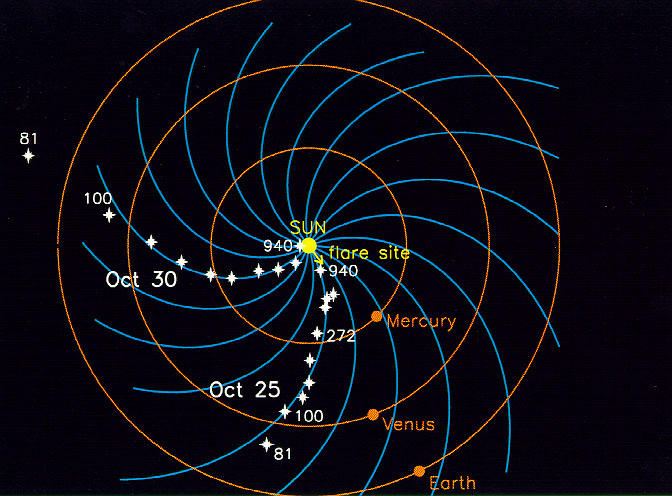
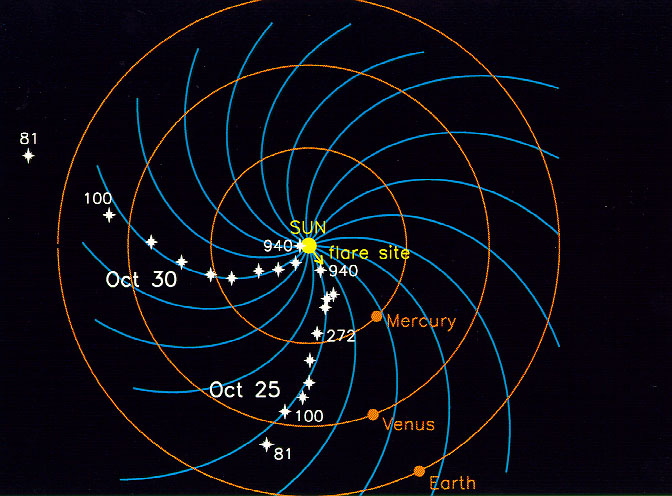
The protons were accelerated toward Earth by an M7-class solar flare on July 19th. Although the blast site (sunspot AR1520) was on the farside of the sun, the protons were able to reach Earth anyway, guided toward our planet by backward-spiralling lines of magnetic force.

from:    spaceweather.com

Solar Activity and Consciousness

Research: Solar Activity Directly Affects Human Consciousness

17th July 2012

By Susanne Posel – Occupy Corporatism

Researchers have made a startling correlation between the rise and fall of solar activity and the human consciousness.

Professor Raymond Wheeler of the University of Kansas has come to the same conclusions that Russian scientist Alexander Chizhevsky discovered in 1915.

Solar storms directly cause conflict, wars and even death among humans on Earth.

The sun’s activity, as it interacts with the Earth’s magnetic field, effect extensive changes in human being’s perspectives, moods, emotions and behavioral patterns.

During solar minimums and maximums the geomagnetic fields begin to intensify. The magnetic fields interact with human electrochemically within the brain. It affects psychological mechanisms creating anomalous hormonal swings and significantly mutated brain-wave activity.

Wheeler expanded on Chishevsky’s work by studying violence during 1913; measuring the time between battles and severity. These findings were compared with the sun’s 11 year sunspot cycle.

The results showed that as the sun cycle peaked, there was a rise in human unrest, uprisings, rebellions, revolutions, and wars between nations. As the magnetic fields intensified, the reaction within the human brain was a mixture of deadly emotional tantrums and unadulterated killing sprees.

As Wheeler further compared his findings with human history, he found a startling pattern that could be traced back 2,500 years.

In solar cycle 22, at the sun’s maximum we experienced Iraq invading Kuwait and the US entering the first battle against Saddam Hussein.

Just eleven years later, as the sun became active again, 9/11 and the wars in Afghanistan and Iraq ensued.

In the latter half of 2010, the sun reached another peak that affected the Earth’s magnetic field; we witnessed dissent in Tunisia, Egypt and Yemen.

Those global uprisings spread to Syria, Libya, Iran and China as riots continued across the European landscape.

This civil unrest has now reached its influence across the modernized world and even into Middle Eastern countries, Africa and Asia.

It is projected, based on Wheeler’s research, as the sun’s activity increases, so will the violence on Earth.

We are now entering the 24th solar cycle.

A surge in solar activity by 50 times more than previously recorded is anticipated. NASA and other space agencies have been warning of this fact.

Through 2011 and onto 2012, the X-flares are expected to endure toward their maximum. As this incredible activity is being witnessed, we are assured that more wars, toppling countries and populations will be displaced.

In 2012 we are seeing these events coming to pass; with only more intensification to come.

Wheeler’s predecessor was a man named Dr. Robert Becker. Becker was an author, expert in biological electricity and a professor with State University. In 1963, Becker, along with his colleague, Dr. Freedman, discovered that there was a marked correlation between solar activity and psychotic outbreaks of mass insanity on Earth.

Becker and Freedman made their most dire predictions of incredible violence to culminate in the years 2012 and 2013.

So far, history has proven them correct.

from:    http://wakeup-world.com/2012/07/17/research-solar-activity-directly-affects-human-consciousness/

Sunspot AR1520-1521 Erupts Again

ALMOST X-FLARE : Sunspot complex AR1520-1521 erupted again on July 19th, this time producing an M7-class solar flare that almost crossed the threshold into X-territory. NASA’s Solar Dynamics Observatory recorded the extreme ultraviolet flash:

The explosion produced a bright coronal mass ejection. The cloud should miss Earth.

Although the explosion occured on the other side of the sun’s western limb, our planet could feel some effects. The blast site is magnetically connected to Earth by backward-spiralling lines of magnetic force. Protons accelerated by the flare are being guided to us by those lines of magnetism, and a mild radiation storm is underway.

from:  spaceweather.com

Freedom of Speech, Psychics, Lies, and Entertainment

Fortunetelling Verdict Raises Thorny Questions

Analysis by Benjamin Radford
Tue Jul 17, 2012

Psychicblog
Last week a federal judge in Alexandria, Louisiana, overturned a law banning fortunetelling on the basis that it is free speech protected by the First Amendment.

U.S. District Judge Dee Drell struck down an ordinance outlawing fortunetelling, astrology, palm reading, tarot, and other forms of divination on the grounds that the practices are fraudulent and inherently deceptive. The case involved a fortuneteller named Rachel Adams who sued to overturn the law and won.

About one in seven Americans have consulted a psychic or fortuneteller, and their services are in high demand, especially during hard economic times. This curious case raises issues about the boundary between freedom of speech and fraudulent (or at least unproven) claims.

There are, of course, exceptions to free speech that go beyond yelling fire in a crowded theater. People who lie on their tax returns can be convicted of tax evasion, and those who lie in a court of law can be convicted of perjury, which under federal law is a felony. Companies, also, are legally prohibited from making false statements about their merchandise; Ford cannot claim its cars get 200 miles per gallon, and vitamin manufacturers cannot advertise that their pills cure cancer. But other cases are murkier.

Free Speech and The Right to Lie

Last month the Supreme Court ruled that Xavier Alvarez, a public official who falsely claimed that he had received the Medal of Honor, could not be prosecuted under the Stolen Valor Act, a 2006 law that made it a crime to falsely claim “to have been awarded any decoration or medal authorized by Congress for the Armed Forces of the United States.” Alvarez admitted that his statements were false, but claimed that his lies were free speech protected by the First Amendment. The Supreme Court agreed and overturned the law.


The First Amendment freedom to lie and misrepresent matters of fact was even invoked by top Wall Street credit rating companies including Standard & Poor’s, Moody’s Investors Service, and others. In the months and years leading up to the global financial crash, these companies routinely inflated the ratings of billions of dollars worth of investments they bought and sold. When investors and investigators demanded to know why companies that were given stellar confidence ratings one day went bankrupt the next, the agencies claimed that their investment ratings were merely “opinions” not necessarily based on truth or fact, and as such were protected by the First Amendment.

Psychics and fortunetellers try a similar strategy, often offering their services “for entertainment only,” a tacit acknowledgement that the information they provide may not be reliable. Yet the fact is that—like clients of credit rating companies—the clients of psychics often do take the advice they get seriously, making life, love, and career decisions based upon fortunetelling. If clients truly are seeking only entertainment, for the $40 to $100 per hour psychics typically charge there are far cheaper ways to be entertained.

Some fortunetellers offer readings for fun and pleasure, and for the most part it’s not palm reading per se that police are concerned about, it’s the confidence schemes, theft by deception, and fraud that often accompany fortunetelling. One common scam involves luring clients in with inexpensive readings, then convincing them that a recent misfortune is the result of a curse put on them by an enemy. The imaginary curse can be lifted but it won’t come cheap, and some victims have been robbed of tens of thousands of dollars. In one recent case a “psychic” misused the influence and trust placed in him to sexually exploit several women.

How Stuff Works: Pet Psychics

The issue of fortunetelling is a tricky legal and ethical area. Although psychic powers and prediction have never been proven to exist (and indeed have failed in well-controlled scientific tests), psychics themselves often genuinely believe in their powers. Other professions can at least provide concrete proof of ability: a mechanic can prove to clients he can fix a transmission by doing it; a doctor can prove to patients she can perform heart surgery by being certified (and doing it). Psychics, on the other hand, cannot prove they can accurately predict the future; if they could, they should be making a killing on Wall Street or in highly-paid positions protecting national security.

Is it ethical to accept money for a service you cannot scientifically prove you can provide, even if you believe you can? How is that different than a lawyer who takes on a case knowing she can’t win (but pretending she can), and gets paid either way? Perjury and fraud only make it a crime to knowingly lie or misrepresent matters of fact, and fortunetellers—like Wall Street credit rating firms—can always say that their claim to psychic abilities is their (Constitutionally protected) opinion. Caveat emptor.

Photo Credit: Corbis

from:    http://news.discovery.com/human/fortunetelling-free-speech-120717.html