Fuego Volcano in Guatemala – Large Eruption

Fuego in Guatemala has Largest Eruption in Years

El Hierro Overview

The 2011 submarine volcanic eruption in El Hierro (Canary Islands), Spain – Eruption overview

Last update: May 18, 2012 at 6:19 pm by By 

With special thanks to Dr. Carracedo (Geovol) allowing us to publish his report and Joke Volta for facilitating.

Dr. Juan Carlos Carracedo Gómez – ULPGC

Forty years after the Teneguía Volcano (La Palma, 1971), a submarine eruption took place off the town of La Restinga, south of El Hierro, the smallest and youngest island of the Canarian Archipelago. Precursors allowed an early detection of the event and its approximate location, suggesting it was submarine. Uncertainties derived from insufficient scientific information available to the authorities during the eruption, leading to disproportionate civil protection measures, which had an impact on the island’s economy based primarily on tourism, while residents experienced extra fear and distress.

El Hierro, 1.12 million years old, is the youngest of the Canary Islands. Located at the western end of the archipelago together with the neighboring island of La Palma, El Hierro rests on a ca. 3500 m-deep ocean bed.
The principal configuration of El Hierro is controlled by a three-armed rift zone system that gives rise to three ridges that extend from the center of the island in a characteristic ‘Mercedes star’ geometry(Carracedo, 1994), and host the larger part of El Hierro’s subaerial eruptions (Fig. 1A).
This triple-armed shape of El Hierro is further enhanced by the scars of several massive gravitational landslides that truncate all three flanks. The collapse of the north flank, that formed the spectacular El Golfo bay with an almost vertical 1400 m-high escarpment, is the youngest landslide of the entire Canary Archipelago with an age of less than 100 ka. Rift zones, however, also continue underneath the sea surface. The south rift stretches as a submarine ridge for more than 40 km (Fig. 1B), indicating that recent submarine eruptions have occurred there as well.

Fig. 1. A. Geological map of El Hierro (from Carracedo et al., 2001). B. colour shaded relief image of El Hierro viewed from above (from Masson et al., 2002). The subaerial and submarine parts of the South rift are indicated.

During the German research cruise Meteor 43/1 in 1998, lava samples were dredged from the submarine prolongations of the southern rift zones of La Palma and El Hierro. El Hierro samples taken close to the present eruptive site (<3 km distant) included fresh picrites and alkali-basalts and variably altered lapillistones and hyaloclastites. Further dredging along the submarine north-west and north-east rift zones during the Poseidon 270 cruise in 2001 recovered fresh alkali basalts from 21 young volcanic cones at depths of 800 to 2300 m together with ocean bottom sediments having a strong volcaniclastic component.
It appears overall that the density of seemingly young volcanoes on El Hierro’s submarine rifts is comparable to that on land, emphasizing the relevance of submarine eruptions during the growth of oceanic islands.

Precursors to the 2011 eruption

Numerous earthquakes were recorded by the Spanish Instituto Geográfico Nacional (IGN) from July 2011 onwards, the greater part of them insignificant from a hazard point of view, but were clearly precursors of a volcanic eruption. In particular, seismicity, initially of low magnitude (M < 3.0) and focused north of the island, increased while migrating southward. The greater part of the hypocentres were initially concentrated within the lower oceanic crust (Fig. 2), at depths of 8–14 km (ca. 200–400 MPa pressure), which is in agreement with pressure estimates from microscopic fluid inclusions in xenoliths from north-western El Hierro and phenocrysts from a recent eruption. The seismic and petrological data are thus in-line with a scenario of a magma batch becoming trapped as an intrusion horizon, near the base or within the subisland oceanic crust. Shifting seismic foci suggest that magma progressively accumulated and expanded laterally in a southward direction, causing a vertical surface deformation of about 40 mm at that time.
During this initial phase, the system remained active but showed no sign of having overcome the resistance of the oceanic crust. Hypocenters thereafter migrated south-east, approaching the submarine prolongation of the active South rift zone. From there, the magma progressed rapidly towards the surface, as indicated by the first time occurrence of shallow (< 3 km) earthquakes on 9 October 2011.
The scenario changed dramatically at about 4 am on 10 October, when the now frequent and strong seismicity (up to M 4.4) ceased and was rather abruptly replaced by a continuous harmonic tremor, indicating the opening of a vent and thus the onset of a submarine eruption.

Fig. 2. Seismic hypocentres beneath El Hierro between 19 July and 10 October 2011. Hypocentres migrated from North towards the South rift zone of the island, where they became shallower (< 3 km). The eruption commenced on 10 October. Most of the time, seismicity remained stable at the base of the oceanic crust (data from IGN, http://www.ign.es/ign/resources/ volcanologia/ html/eventosHierro. html)

The submarine eruption

On October 10, patches of pale-colored water that smelled of sulfur and were associated with dead fish, were found floating one mile south of the coast confirming the opening of a vent on the flank of the submarine part of the South rift zone. The surface expression of this eruption, including green and bright discoloration of seawater, was clearly observed in high-resolution satellite images featuring a large stain(locally known as ‘la mancha’) visible on the surface of the Las Calmas Sea (Fig. 3A). The eruption formed aNE–SW trending fissure outlined by strong bubbling and degassing (Fig. 3B), occasionally 10–15 m high, loaded with juvenile volcanic ash and pyroclasts (Fig. 3C).
However, information on the depth and precise location of the submarine vent was lacking in the first two weeks of the eruption because of the unavailability of adequate means for submarine surveying.
On October 24, the RV Ramón Margalef of the Instituto Español de Oceanografía (IEO) carried out the first survey of the area, previously mapped in 1998 by the Spanish RV Hespérides (Fig. 4A). Comparison of present and 1998 bathymetry outlined a 700 m-wide, 100 m-high new volcanic cone resting at about 350 m depth in a canyon on the flank of the South Rift submarine extension (Fig. 4B). On 4 December 2011, the eruption apparently waning, the RV Ramón Margalef carried out another campaign, detecting significant growth of the volcanic edifice. The initial single eruptive center (Fig. 4A,B) had now evolved to three cones of similar height, with their summit 180–160 m below the sea surface (Fig. 4D), still below the critical value to generate significant surtseyan explosions (about 100 m below sea level).
Lava flows and pyroclasts, confined by the canyon walls, caused the greater part of the erupted volume to flow downslope towards deeper parts of the ocean floor.

Fig. 3. A. Plume of dissolved magmatic gases and suspended matter producing green and bright discolouration of seawater (locally known as ‘la mancha’) commencing on 10 October 2011 and continuing for several kilometres to the south-west before drifting off into the Atlantic (Satellite image by RapidEye). Fig. 3. B. Plumes of gas on ocean surface showing a N–S trend, indicating a submarine eruptive fissure. Inset: Expansion of steam with decreasing water depth (modified from Schmincke, 2004). C, strong degassing with abundant rock fragments generated large ‘bubbles’, some of them 10–15 m-high, bursting to the surface off the nearby village of La Restinga (8 November 2011).


Fig. 4. A. DEM showing the pre-eruptive submarine canyon where the 2011 eruption nested (image taken from the RV Hespérides, 1998). B. DEM of the same area taken on 24 October by the RV Ramon Margalef after the onset of underwater activity. C. Geological map of the submarine eruption from the first DEM obtained on 24 October 2011 by the RV Ramon Margalef. D. Geological map of the same area on 4 December 2011.

Floating stones off El Hierro

Abundant rock fragments resembling lava bombs on a decimeter scale (Fig. 5) and characterized by glassy basaltic crusts and white to cream-colored interiors, were found floating on the ocean surface during the first days of the eruption. The interiors of these floating rocks are glassy and vesicular (similar to pumice), with frequent mingling between the pumicelike interior and the enveloping basaltic magma (Fig. 5B).These floating rocks have become known locally as ‘restingolites’ after the nearby village of La Restinga. Their nature and origin remained elusive at first, with suggestions from the scientific community including: (1) the floating bombs are juvenile and potentially explosive high-silica magma; (2) they are fragments of marine sediment from the submarine flank of El Hierro; and (3) that they are relatively old, hydrated volcanic material. However, none of these interpretations provides a satisfying fit to the available observation since for instance, high-silica volcanism is uncommon on El Hierro, and magmatic minerals (either grown in magma or as detritus from erosion) are entirely absent in the ‘restingolites’. Given that the involvement of highly evolved, high-silica magmatism would have implications for the explosive potential of the eruption, it was important to clarify the nature of the ‘restingolites’ swiftly in order to fully assess the hazards associated with the ongoing El Hierro eruption. Furthermore, should the ‘restingolites’ be shown not to originate from high-silica magma, then unraveling their genesis will most likely provide unique insights into the volcano–magma system beneath El Hierro.
All ‘restingolite’ samples are glassy and light in color and most are macroscopically crystal-free. However, occasional quartz crystals, jasper fragments, gypsum aggregates and carbonate relicts have been identified in hand specimens. X-Ray diffractograms mainly indicate the presence of quartz, mica and/or illite, and glass. There is a notable absence of primary igneous minerals from the XRD data. Microscopic quartz crystals have also been identified and analysed using a field emission electron probe micro-analyser (FE-EPMA), as well as the composition of the glass matrix, which ranges between ~65 and 90 per cent SiO2.
The high silica content coupled with overall low incompatible trace element concentrations, the occurrence of mm-sized relict quartz crystals and the lack of igneous minerals, plus the occurrence of carbonate, clay, jasper and gypsum relicts are all  ncompatible with a purely igneous origin for the cores of the floating stones. Igneous rocks on El Hierro do not contain any free (primary) quartz crystals (nor do igneous rocks on any of the other Canary Islands).
A potential source of the quartz crystals found in the floating rocks from El Hierro is likely to be the sediments of layer 1 of the pre-island ocean crust. These contain quartz crystals transported from Africa by both wind and turbidity currents and are characterized by a lack of igneous minerals due to their pre-island age.

Fig. 5. A. ‘floating rocks’ observed in October 2011 off El Hierro. B. ‘restingolite’ sample displaying typical features, such as a crust of basalt, primary sedimentary bedding, folding, high vesicularity, and mingling structures. C. hollow basaltic bomb of the late stages of the eruption. D. similar bomb from the Serreta Oceanic Volcano, Terceira, Azores (photograph by Ulrich Küppers).

The floating rocks found at El Hierro are thus most probably the products of magma–sediment interaction beneath the volcano (Fig. 6). Ascending magma mixes with the pre-volcanic sediments and the ‘restingolites’ were carried to the ocean floor during eruption while being melted and vesiculated during transport in magma. Once erupted onto the ocean floor, some of them were able to separate from the erupting lava and floated to the sea surface due to their low density (Fig. 6).

for more information and updates, go to:    http://earthquake-report.com/2012/05/18/the-2011-submarine-volcanic-eruption-in-el-hierro-canary-islands-spain-eruption-overview/

Ferrara, Italy — Earthquake

Earthquake Ferrara, Italy : 6 fatalities, 50 injured and a lot of damage, no more missing people + many updates

Last update: May 20, 2012 at 6:20 pm by By 

Most important Earthquake Data:
Magnitude : M6.0
UTC Time : Sunday, May 20, 2012 at 02:03:52 UTC
Local time at epicenter : Sunday, May 20, 2012 at 04:03:52 AM at epicenter
Depth (Hypocenter) : 5.1 km
Geo-location(s) :
7 km NW Finale emilia (pop 15,337)
30 km W Ferrara (pop 131,771)
36 km (22 miles) NNW of Bologna, 

Update 18:20 UTC :  Mantua, Modena, shelters, highways
-150 people have been listed by the Mantua authorities for shelter for the night. They are unable to return to their damaged houses
– Modena has installed temporary shelters for 2000 homeless people
– The regional highway authority was happy to tell the press that NO problems were reported in their regional network of more than 400 bridges, viaducts, tunnels, etc

Update 18:13 UTC :  Rovigo churches,  firefighter,  cultural heritage
– Churches have been closed for further inspection in the Rovigo province.
– A firefighter who fell from a roof when the building he was inspecting during an aftershock collapsed is conscious again. Good news, but a further proof that these people are taking great risks to get close to unstable buildings.
– The vast cultural heritage in between Modena and Ferrara and especially in Emilia Finale has been suffered enormously.

Update 17:54 UTC :  aftershocks, hospital, PM Monti
– We have just counted 64 aftershocks since the mainshock at 02.03 UTC
– Civil protection will be helping with the evacuation of the hospital in Finale Emilia
– Prime Minister Monti, currently in Chicago for the G8 meeting, has said that he will do everything in his power to cope with the situation.  He is constantly updated by the responsible presidents of the damaged provinces.
– The Sant’Agostina area has suffered seriously from the M5.1 aftershock from this afternoon.

Update 17:13 UTC :  anti-looting, missing persons
– Police have organized anti-looting patrols to take care of unattended houses and buildings
– The president of Emilia Romagno has said to the press that nobody is missing anymore, making it probable that the current list of killend and injured people will remain as it is

KEEP FOLLOWING OUR NEWS REPORTS – EARTHQUAKE-REPORT.COM is probably the only specialized earthquake reporting website in the world combining scientific information with human impact information.

Update 16:21 UTC :  displaced people, additional damage after aftershock, power, animals
– Because of some cracks in Mantua’s Palazzo Ducale, the fire department has decided to close the building for the public
– The number of displaced people (people who cannot return to their houses) is currently estimated to be 3,000.
– The M5.1 aftershock was responsible for the additional collapse of a still standing part of the Sant’Agostine town hall
– ENEL, the main Italian power company, said that besides some isolated cases, all users have electricity again.
– Misery for a number of animals too. A number of stables have been collapsed and at least a herd of cows and breeding pigs have been covered by the rubble. We expect more livestock to be in trouble as everybody knows that stables are often in a bad condition.

Update 16:00 UTC : prisoners evacuated, telecommunications and Railway line working again
– Italian Railways have reopened the Bologna – Verona railway route.
– The Modena province has asked the national government to take urgent measures to help the owners of damaged houses and businesses. An extension in time to enter tax forms isd one of them.
– The 200 users cutoff from Telecommunications at Finale Emilia have been reconnected
– 500 prisoners have been evacuated from the Ferrara prison. Some of the prisoners were maffia linked and had to be kept away from others because of testimony programs.

Update 15:27 UTC : Damage will be huge!
Earlier in this article, we have reported to believe that the damage would go into the hundreds of millions of Euro’s. We will have to boost this damage considerably as a lot of factories and buildings may be found unstable to continue producing goods.  This economic damage will be added on top of the structural damage to buildings. James Daniell, an earthquake damage specialist working at Cedim Germany, will certainly be able to produce a very good estimate by tomorrow afternoon.

Update 15:21 UTC : Strong aftershock
A M5.1 aftershock struck the epicenter area at 13:18 UTC (15:18 local time). The depth of the hypocenter was at 8.9 km following USGS. INGV, Italy seismological institute, reports the same Magnitude but a depth of 5.1 km.
These continuous aftershocks are bad news for the people in the greater earthquake area as they will go on for many hours and will last at least until tomorrow, meaning that a lot of people will have to spend the night outside their own houses.  The aftershocks will gradually weaken, but the situation will be at least unstable for a limited number of days. The epicenter of the last aftershock was very close to Ferrara, much closer than the mainshock.  Normally, a M5.1 earthquake is not really damaging, but in combination with already unstable buildings, such shocks will be capable to increase the amount of damage considerably.

Update 15:19 UTC : 300,000 cheeses probably lost
300000 cheeses have been destroyed (buried under rubble etc.). These are mostly the popular Grana Padanoand Parmigiano Reggiano cheese types. The total of this damage will be around 50 million euros. At least 10 million kilos of the cheese are estimated to be under the rubble.Luckily, noone was killed, as these cheeses weigh between 36 and 38 kilos each.
 The total damage from the event has been estimated around 250 million euros. The stacked cheeses fell and have been covered by debris. How much is salvageable is unknown
The cheese factory and storage is located in Mantovano. The damage from this factory alone is estimated to be 250 million euros.

List of the deceased (5 in the Ferrara province and 1 in Bologna province)
– Nicholas Cavicchi, 35, resident of San Martino (Ferrara) and killed while working in factory in Sant’Agostino
– Ansaloni Leonardo, 51, resident of Reno Centese (Ferrara) and killed in the same factory as Mr. Cavacchi
– Gerardo Cesaro, 59, resident of Moline.
– Tarik Naouch, 29, residing in Crevalcore. Mr. Naouch was killed in the Ursa factory in Ponte Rodoni di Bondeno
– Nerina Balboni, 103, got a heart attack when she was buried partly by debris
– 37 year old German woman died of a heart attack in Bologna (we are still searching for her identity)
Earthquake-Report.com pays his respects to the family of all the deceased.

Update 12:19 UTC :
-The President of the National Council of Engineers has said that all efforts have now to be invested in more earthquake-resistant buildings. He mentioned especially the need to further stabilize historic buildings, one of the main damaged building types during this earthquake.
– The President of the Lombardy province, Mr. Roberto Formigoni, has joined the plea of the President of Emilia Romagna to call the State of Emergency in the earthquake damaged areas. Mantua, another seriously hit area is part of Lombardy.
– Schools will be closed tomorrow as inspection of school buildings will take place

Update 11:31 UTC :
– The number of people killed directly or indirectly remains the same
– Fifty people have been reported as injured
– The body of Gerardo Cesaro, worker at the Tecopress company has been recovered from below the rubble
– Italian President Napolitano has send his sympathy to the family of the killed people and has also send words of thanks to the  SAR people and all people involved in helping the victims of the earthquake. President Napolitano is constantly updated from the situation by the Italian Civil protection.
– Aftershocks are continue to strike the area.  At 11:13 a M4.2 aftershock made it very clear that the dangerous hours are not over yet. Stronger aftershocks are very exceptional but occur from time to time.
– The President of Emilia-Romagna has asked the National Government to call the state of National Emergency for the area.

Image courtesy INGV Italia – Yellow star : mainshock – yellow circle : M4.1 foreshock – big red circles : aftershocks in between M4 to M5

Update 09:55 UTC : Mr. Gabrielli, chief of the regional Civil Protection has declared that the situation is “under control”. Mr. Gabrielli told the press that he has overflown the greater earthquake area and that he has not seen serious problematic areas. Traffic is going smoothly, infrastructure is almost intact and damage is not widespread.

Update 09:47 UTC :
– Italian Civil Protection is organizing shelters for people who’s houses have been damaged by the earthquake.
– tens of people have been injured during the earthquake. The devastation is not widespread. Only isolated houses and buildings have suffered serious damage. We expect not earthquake-resistant building methods to be one of the major reasons that such serious damage has been inflicted.
– The collapse, partial collapse and damaged historic buildings are currently visited by Civil Protection and Local authorities to become a clear picture of the amount of damage.
– Earthquake-Report.com is increasing the expected amount of damage into the hundreds of millions Euros.  This amount not only includes damage to buildings and historic sites but also to the economy.

Update 09:23 UTC : INGV has reported 41 aftershocks so far, the strongest being a M4.9 at 03:02 UTC (05:02 local Italian time). 5 aftershocks measured M4 or higher and 14 aftershocks in between M3 and M4.

Update 09:15 UTC : The Mantua area was also seriously damaged. The church of Felonica in Mantua was damaged.

Update 09:11 UTC : Many people in the greater epicenter area remain in the streets fearing for aftershocks.

Important Update 08:56 UTC : The death toll has increased to 6 when a worker was found under the rubble of the Tecopress factory at St. Augustine (Ferrara). 4 are considered in earthquake terms as shaking deaths, 2 people have been killed indirectly (see below).

Update 08:47 UTC : Click on the pictures below to see more images of the damage inflicted by this deadly earthquake.

Images courtesy and copyright La Repubblica – Click on the images to see more of them

Update 08:35 UTC :  The Chief of Civil Protection from the Ferrara province has just arrived at the Prefecture office and is now leading an assessment and operations meeting with his staff.
– Based on the many images we have seen so far, the damage will run into at least tens of millions of Euro’s, probably a lot more. Some historic buildings have collapsed completely, others partially. Industrial warehouses have been damaged. So far we have NO immediate numbers of injured, but a lot of people living in damaged houses must have at least minor injures.

Update 08:26 UTC :  To give our readers an idea of the extend of the damage, we have combined a “before” and “after” image of the Castle of Finale Emilio. The angle is not the same, but you can see very good that the towers have almost completely collapsed.  Images courtesy and copyright of its owners, damaged castle from Gianluca Diegoli via twitter and the “before” picture from animoweb.it.

Update 08:18 UTC :  The earthquake was also felt in the neighboring countries. We got I Have Felt It reports from the Alps region, Slovenia and the Cote d’Azur (France).

Update 08:09 UTC :  2 helicopters of the Italian Police are overflying the earthquake hit areas and are trying to locate and to guide SAR forces (Search and Rescue forces) to eventual collapsed or heavily damaged buildings. These overflying helicopters are especially looking for old abandoned houses were often poor families are residing.

Update 08:01 UTC : The Palace of Venice, an historic building in Finale Emilia, badly hit by the earthquake, is partially collapsed. The 11 people from three families who lived there were rescued by SAT personnel.

Update 07:58 UTC : It is still not sure how many people have exactly perished during this earthquake. We have counted 4 so far, but the number may increase slightly. Let us make an overview.
– 2 indirect fatalities (a 37 year old ill woman died probably of an heart attack and a 100 year old person probably from the same)
– a Moroccan worker died in Ponte Rodoni, Bondeno. He worked at Ursa, a polystyrene foam company, and his shift would end at 5.  He was killed when a support beam collapsed on his head.
– 2 Italian workers were killed when a roof from a ceramics manufacturing company collapsed on them. Theur work shift would have ended at 6.
3 shaking deaths and 2 indirect killed people is the sad result so far.

Update 07:45 UTC : A 5 year old child was rescued out of the rubble in a collapsed building in Finale Emilia !

Historic earthquakes map courtesy INGV – earthquake in between M6 and M7

Update 07:32 UTC : The earthquake’s epicenter was located in a area which has no damaging earthquakes since a long time.  We have to go back to 1570 for a major earthquake nearFerrara and to even 1346 for another M6 to M7 earthquake at a distance of approx. 20 km from the current epicenter. From 2002 to 2008 6 smaller earthquakes (less than M4) occurred within a radius of 20 km.

Update 07:17 UTC : A lot of people are asking themselves why an earthquake with (only) a M5.9 Magnitude can inflict such a lot of serious damage.  Not only was this earthquake very shallow (close to the surface), but one of the main factors is that the earthquake occurred in a relatively soft soil area. Soft ground layers are propagating the earthquake waves a lot stronger than areas with harder rocky layers.

Update 06:41 UTC : 2 earthquake of respectively M4.1 and M2.2 were precursors of the damaging M6 mainshock. Since that mainshock, INGV has recorded 12 aftershocks!

Important Update 06:39 UTC : We are sad to tell that a 4th fatality has been reported. We have also a few more details on the killed people. All of the death people are coming from the Ferrara area. 2 people died in a pottery factory in Ferrara. A third person died in the Ferrara Bondeno industrial zone and the 4th victim was a 37 year ill woman who died of an heart attack.

Update : The video below shows the damage to a couple of buildings in the Ferrara area.  The shaking must have been very strong to inflict this kind of damage.

Update : The video below is mainly a picture from a damaged building combined with an interview with the Governor of the Ferrara province (in Italian). The governor talks about a lot of damage to bridges, schools, historic buildings etc. She calls the situation very serious.

Update 06:35 UTC : In San Felice sul Panaro, near Modena, the tower of the fortress collapsed. Another tower went down in Finale Emilia, and a nursing home was evacuated.

Update : Mostly historic buildings have been damaged in the quake. Click here for series of images from La Repubblica.  Some churches and older buildings collapsed completely.

Damage in Northern Italy after the May 20 earthquake – Images courtesy and copyright La Repubblica – Please click on these pictures to see more of them in La Repubblica

Update : The 3 killed people are believed to be 3 farm workers in the Ferrara area

Update : The heavy shaking lated for about 20 seconds

Update : As what can be expected, everybody ran to the streets after feeling the shaking.

Update : A church bell collapsed in Ferrara, in Finale Emilia a church steeple was reported damage, in San Felice Parano a segment of a castle collapsed.

Update : USGS has upgraded the earthquake to 6.0 at a depth of only 5km. The updated PAGER says 73,000 people would felt a severe shaking!! and 178,000 a very strong shaking. Avery bad sign.

Update :  An also strong aftershock M5.1 occurred 59 minutes later

Shaking map courtesy USGS

Update :  The village who has been hit most (MMI VIII) was Camposanto, a little town with 3,000 inhabitants.

for more information, and updates, go to:    http://earthquake-report.com/2012/05/20/very-strong-shallow-earthquake-kills-at-least-3-people-in-the-mantua-ferrara-and-modena-area-italy/

Final Words from Ernest Callenbach

Epistle to the Ecotopians: Last Words to an America in Decline

[This document was found on the computer of Ecotopia author Ernest Callenbach (1929-2012) after his death.]

To all brothers and sisters who hold the dream in their hearts of a future world in which humans and all other beings live in harmony and mutual support — a world of sustainability, stability, and confidence. A world something like the one I described, so long ago, in Ecotopia and Ecotopia Emerging.

As I survey my life, which is coming near its end, I want to set down a few thoughts that might be useful to those coming after. It will soon be time for me to give back to Gaia the nutrients that I have used during a long, busy, and happy life. I am not bitter or resentful at the approaching end; I have been one of the extraordinarily lucky ones. So it behooves me here to gather together some thoughts and attitudes that may prove useful in the dark times we are facing: a century or more of exceedingly difficult times.

How will those who survive manage it? What can we teach our friends, our children, our communities? Although we may not be capable of changing history, how can we equip ourselves to survive it?

I contemplate these questions in the full consciousness of my own mortality. Being offered an actual number of likely months to live, even though the estimate is uncertain, mightily focuses the mind. On personal things, of course, on loved ones and even loved things, but also on the Big Picture.

But let us begin with last things first, for a change. The analysis will come later, for those who wish it.

Hope. Children exude hope, even under the most terrible conditions, and that must inspire us as our conditions get worse. Hopeful patients recover better. Hopeful test candidates score better. Hopeful builders construct better buildings. Hopeful parents produce secure and resilient children. In groups, an atmosphere of hope is essential to shared successful effort: “Yes, we can!” is not an empty slogan, but a mantra for people who intend to do something together — whether it is rescuing victims of hurricanes, rebuilding flood-damaged buildings on higher ground, helping wounded people through first aid, or inventing new social structures (perhaps one in which only people are “persons,” not corporations). We cannot know what threats we will face. But ingenuity against adversity is one of our species’ built-in resources. We cope, and faith in our coping capacity is perhaps our biggest resource of all.

Mutual support. The people who do best at basic survival tasks (we know this experimentally, as well as intuitively) are cooperative, good at teamwork, often altruistic, mindful of the common good. In drastic emergencies like hurricanes or earthquakes, people surprise us by their sacrifices — of food, of shelter, even sometimes of life itself. Those who survive social or economic collapse, or wars, or pandemics, or starvation, will be those who manage scarce resources fairly; hoarders and dominators win only in the short run, and end up dead, exiled, or friendless. So, in every way we can we need to help each other, and our children, learn to be cooperative rather than competitive; to be helpful rather than hurtful; to look out for the communities of which we are a part, and on which we ultimately depend.

Practical skills. With the movement into cities of the U.S. population, and much of the rest of the world’s people, we have had a massive de-skilling in how to do practical tasks. When I was a boy in the country, all of us knew how to build a tree house, or construct a small hut, or raise chickens, or grow beans, or screw pipes together to deliver water. It was a sexist world, of course, so when some of my chums in eighth grade said we wanted to learn girls’ “home ec” skills like making bread or boiling eggs, the teachers were shocked, but we got to do it. There was widespread competence in fixing things — impossible with most modern contrivances, of course, but still reasonable for the basic tools of survival: pots and pans, bicycles, quilts, tents, storage boxes.

We all need to learn, or relearn, how we would keep the rudiments of life going if there were no paid specialists around, or means to pay them. Every child should learn elementary carpentry, from layout and sawing to driving nails. Everybody should know how to chop wood safely, and build a fire. Everybody should know what to do if dangers appear from fire, flood, electric wires down, and the like. Taking care of each other is one practical step at a time, most of them requiring help from at least one other person; survival is a team sport.

Organize. Much of the American ideology, our shared and usually unspoken assumptions, is hyper-individualistic. We like to imagine that heroes are solitary, have super powers, and glory in violence, and that if our work lives and business lives seem tamer, underneath they are still struggles red in blood and claw. We have sought solitude on the prairies, as cowboys on the range, in our dependence on media (rather than real people), and even in our cars, armored cabins of solitude. We have an uneasy and doubting attitude about government, as if we all reserve the right to be outlaws. But of course human society, like ecological webs, is a complex dance of mutual support and restraint, and if we are lucky it operates by laws openly arrived at and approved by the populace.

If the teetering structure of corporate domination, with its monetary control of Congress and our other institutions, should collapse of its own greed, and the government be unable to rescue it, we will have to reorganize a government that suits the people. We will have to know how to organize groups, how to compromise with other groups, how to argue in public for our positions. It turns out that “brainstorming,” a totally noncritical process in which people just throw out ideas wildly, doesn’t produce workable ideas. In particular, it doesn’t work as well as groups in which ideas are proposed, critiqued, improved, debated. But like any group process, this must be protected from domination by powerful people and also over-talkative people. When the group recognizes its group power, it can limit these distortions. Thinking together is enormously creative; it has huge survival value.

“We have even evolved, spottily, a global understanding that democracy is better than tyranny, that love and tolerance are better than hate, that hope is better than rage and despair, that we are prone, especially in catastrophes, to be astonishingly helpful and cooperative.”

Learn to live with contradictions. These are dark times, these are bright times. We are implacably making the planet less habitable. Every time a new oil field is discovered, the press cheers: “Hooray, there is more fuel for the self-destroying machines!” We are turning more land into deserts and parking lots. We are wiping out innumerable species that are not only wondrous and beautiful, but might be useful to us. We are multiplying to the point where our needs and our wastes outweigh the capacities of the biosphere to produce and absorb them. And yet, despite the bloody headlines and the rocketing military budgets, we are also, unbelievably, killing fewer of each other proportionately than in earlier centuries. We have mobilized enormous global intelligence and mutual curiosity, through the Internet and outside it. We have even evolved, spottily, a global understanding that democracy is better than tyranny, that love and tolerance are better than hate, that hope is better than rage and despair, that we are prone, especially in catastrophes, to be astonishingly helpful and cooperative.

We may even have begun to share an understanding that while the dark times may continue for generations, in time new growth and regeneration will begin. In the biological process called “succession,” a desolate, disturbed area is gradually, by a predictable sequence of returning plants, restored to ecological continuity and durability. When old institutions and habits break down or consume themselves, new experimental shoots begin to appear, and people explore and test and share new and better ways to survive together.

It is never easy or simple. But already we see, under the crumbling surface of the conventional world, promising developments: new ways of organizing economic activity (cooperatives, worker-owned companies, nonprofits, trusts), new ways of using low-impact technology to capture solar energy, to sequester carbon dioxide, new ways of building compact, congenial cities that are low (or even self-sufficient) in energy use, low in waste production, high in recycling of almost everything. A vision of sustainability that sometimes shockingly resembles Ecotopia is tremulously coming into existence at the hands of people who never heard of the book.

___________________

Now in principle, the Big Picture seems simple enough, though devilishly complex in the details. We live in the declining years of what is still the biggest economy in the world, where a looter elite has fastened itself upon the decaying carcass of the empire. It is intent on speedily and relentlessly extracting the maximum wealth from that carcass, impoverishing our former working middle class. But this maggot class does not invest its profits here. By law and by stock-market pressures, corporations must seek their highest possible profits, no matter the social or national consequences — which means moving capital and resources abroad, wherever profit potential is larger. As Karl Marx darkly remarked, “Capital has no country,” and in the conditions of globalization his meaning has come clear.

The looter elite systematically exports jobs, skills, knowledge, technology, retaining at home chiefly financial manipulation expertise: highly profitable, but not of actual productive value. Through “productivity gains” and speedups, it extracts maximum profit from domestic employees; then, firing the surplus, it claims surprise that the great mass of people lack purchasing power to buy up what the economy can still produce (or import).

Here again Marx had a telling phrase: “Crisis of under-consumption.” When you maximize unemployment and depress wages, people have to cut back. When they cut back, businesses they formerly supported have to shrink or fail, adding their own employees to the ranks of the jobless, and depressing wages still further. End result: something like Mexico, where a small, filthy rich plutocracy rules over an impoverished mass of desperate, uneducated, and hopeless people.

Barring unprecedented revolutionary pressures, this is the actual future we face in the United States, too. As we know from history, such societies can stand a long time, supported by police and military control, manipulation of media, surveillance and dirty tricks of all kinds. It seems likely that a few parts of the world (Germany, with its worker-council variant of capitalism, New Zealand with its relative equality, Japan with its social solidarity, and some others) will remain fairly democratic.

The U.S., which has a long history of violent plutocratic rule unknown to the textbook-fed, will stand out as the best-armed Third World country, its population ill-fed, ill-housed, ill-educated, ill-cared for in health, and increasingly poverty-stricken: even Social Security may be whittled down, impoverishing tens of millions of the elderly.

As empires decline, their leaders become increasingly incompetent — petulant, ignorant, gifted only with PR skills of posturing and spinning, and prone to the appointment of loyal idiots to important government positions. Comedy thrives; indeed writers are hardly needed to invent outrageous events.

We live, then, in a dark time here on our tiny precious planet. Ecological devastation, political and economic collapse, irreconcilable ideological and religious conflict, poverty, famine: the end of the overshoot of cheap-oil-based consumer capitalist expansionism.

If you don’t know where you’ve been, you have small chance of understanding where you might be headed. So let me offer a capsule history for those who, like most of us, got little help from textbook history.

At 82, my life has included a surprisingly substantial slice of American history. In the century or so up until my boyhood in Appalachian central Pennsylvania, the vast majority of Americans subsisted as farmers on the land. Most, like people elsewhere in the world, were poor, barely literate, ill-informed, short-lived.  Millions had been slaves. Meanwhile in the cities, vast immigrant armies were mobilized by ruthless and often violent “robber baron” capitalists to build vast industries that made things: steel, railroads, ships, cars, skyscrapers.

Then, when I was in grade school, came World War II. America built the greatest armaments industry the world had ever seen, and when the war ended with most other industrial countries in ruins, we had a run of unprecedented productivity and prosperity. Thanks to strong unions and a sympathetic government, this prosperity was widely shared: a huge working middle class evolved — tens of millions of people could afford (on one wage) a modest house, a car, perhaps sending a child to college. This era peaked around 1973, when wages stagnated, the Vietnam War took a terrible toll in blood and money, and the country began sliding rightward.

In the next epoch, which we are still in and which may be our last as a great nation, capitalists who grew rich and powerful by making things gave way to a new breed: financiers who grasped that you could make even more money by manipulating money. (And by persuading Congress to subsidize them — the system should have been called Subsidism, not Capitalism.) They had no concern for the productivity of the nation or the welfare of its people; with religious fervor, they believed in maximizing profit as the absolute economic goal. They recognized that, by capturing the government through the election finance system and removing government regulation, they could turn the financial system into a giant casino.

“Through the distorted lens of our corporate media, we possess only a distorted view of what the country is really like now. In the next decades, we shall see whether we indeed possess the intelligence, the strength, and the mutual courage to break through to another positive era.”

Little by little, they hollowed the country out, until it was helplessly dependent on other nations for almost all its necessities. We had to import significant steel components from China or Japan. We came to pay for our oil imports by exporting food (i.e., our soil). Our media and our educational system withered. Our wars became chronic and endless and stupefyingly expensive. Our diets became suicidal, and our medical system faltered; life expectancies began to fall.

And so we have returned, in a sort of terrible circle, to something like my boyhood years, when President Roosevelt spoke in anger of “one third of a nation ill-housed, ill-fed, ill-clothed.” A large and militant contingent of white, mostly elderly, Anglo-Saxon, Protestant right wingers, mortally threatened by their impending minority status and pretending to be liberty-lovers, desperately seek to return us still further back.

Americans like to think of ours as an exceptional country, immune through geographical isolation and some kind of special virtue to the tides of history. Through the distorted lens of our corporate media, we possess only a distorted view of what the country is really like now. In the next decades, we shall see whether we indeed possess the intelligence, the strength, and the mutual courage to break through to another positive era.

No futurist can foresee the possibilities. As empires decay, their civilian leaderships become increasingly crazed, corrupt, and incompetent, and often the military (which is after all a parasite of the whole nation, and has no independent financial base like the looter class) takes over. Another possible scenario is that if the theocratic red center of the country prevails in Washington, the relatively progressive and prosperous coastal areas will secede in self-defense.

Ecotopia is a novel, and secession was its dominant metaphor: how would a relatively rational part of the country save itself ecologically if it was on its own? As Ecotopia Emerging puts it, Ecotopia aspired to be a beacon for the rest of the world. And so it may prove, in the very, very long run, because the general outlines of Ecotopia are those of any possible future sustainable society.

“Let us embrace decay, for it is the source of all new life and growth.”

The “ecology in one country” argument was an echo of an actual early Soviet argument, as to whether “socialism in one country” was possible. In both cases, it now seems to me, the answer must be no. We are now fatally interconnected, in climate change, ocean impoverishment, agricultural soil loss, etc., etc., etc. International consumer capitalism is a self-destroying machine, and as long as it remains the dominant social form, we are headed for catastrophe; indeed, like rafters first entering the “tongue” of a great rapid, we are already embarked on it.

When disasters strike and institutions falter, as at the end of empires, it does not mean that the buildings all fall down and everybody dies. Life goes on, and in particular, the remaining people fashion new institutions that they hope will better ensure their survival.

So I look to a long-term process of “succession,” as the biological concept has it, where “disturbances” kill off an ecosystem, but little by little new plants colonize the devastated area, prepare the soil for larger and more complex plants (and the other beings who depend on them), and finally the process achieves a flourishing, resilient, complex state — not necessarily what was there before, but durable and richly productive. In a similar way, experiments under way now, all over the world, are exploring how sustainability can in fact be achieved locally. Technically, socially, economically — since it is quite true, as ecologists know, that everything is connected to everything else, and you can never just do one thing by itself.

Since I wrote Ecotopia, I have become less confident of humans’ political ability to act on commonsense, shared values. Our era has become one of spectacular polarization, with folly multiplying on every hand. That is the way empires crumble: they are taken over by looter elites, who sooner or later cause collapse. But then new games become possible, and with luck Ecotopia might be among them.

Humans tend to try to manage things: land, structures, even rivers. We spend enormous amounts of time, energy, and treasure in imposing our will on nature, on preexisting or inherited structures, dreaming of permanent solutions, monuments to our ambitions and dreams. But in periods of slack, decline, or collapse, our abilities no longer suffice for all this management. We have to let things go.

All things “go” somewhere: they evolve, with or without us, into new forms. So as the decades pass, we should try not always to futilely fight these transformations. As the Japanese know, there is much unnoticed beauty in wabi-sabi — the old, the worn, the tumble-down, those things beginning their transformation into something else. We can embrace this process of devolution: embellish it when strength avails, learn to love it.

There is beauty in weathered and unpainted wood, in orchards overgrown, even in abandoned cars being incorporated into the earth. Let us learn, like the Forest Service sometimes does, to put unwise or unneeded roads “to bed,” help a little in the healing of the natural contours, the re-vegetation by native plants. Let us embrace decay, for it is the source of all new life and growth.

© 2012 Ernest Callenbach
Ernest Callenbach

Ernest Callenbach, author of the classic environmental novelEcotopia and Ecotopia Emerging, among other works, founded and edited the internationally known journal Film Quarterly.  He died at 83 on April 16th, 2012 — leaving behind this final unpublished document on his computer.


from:  http://www.commondreams.org/view/2012/05/07-0 


More on GMO’s

GMO Alert: Startling New Research

18th May 2012

By Jack Adam Weber

Time for a little GMO update and heckling of our nemesis, Monsanto and friends. New research demonstrates what most of us have suspected for years: GMOs and the poisons used on them are bad for everything on the planet. For ethical reasons, as well as the obstruction of research by Monsanto, little comprehensive GMO research has been done on humans. But finally, we are beginning to see more hard evidence showing the dangerous effects of the GMO industry.

A little over a year ago, the journal Reproductive Toxicology published the results of a study done In Quebec, Canada. It showed that Bt toxin, the pesticide now routinely genetically engineered into GE corn and cotton, was found in the blood of pregnant women and in their fetuses, as well as in non-pregnant women. This same study also discovered that glyphosate, the active ingredient in RoundUp, was found in the blood of non-pregnant women. This is not good news.

Until recently, the Quebec study has been one of the few pieces of sound scientific evidence demonstrating the absorption of Bt-toxin into human blood, an occurrenceMonsanto reportedly claimed would not occur when they proposed their nasty little invention for approval some years ago. Are we surprised that they were proven wrong? Not at all. Does this stop them? Not in the least. So we have to. Read on.

A brand new scientific study now shows that the Bt-toxin, known as Cry1Ab toxin, kills human embryonic kidney cells. If you think this is alarming, there’s more. The study also shows that combining Bt-toxins Cry1Ab and Cry1Ac with RoundUp (as is now commonly done on GMO crops) can delay apoptosis, which can promote cancer. Apoptosis, by the way, is the normal and natural death of cells that occurs as a routine and controlled part of an organism’s growth or development. This study also found that glyphosate, the active ingredient in RoundUp, on its own causes necrosis, a.k.a. the death of tissue, in amounts lower than that used in agriculture.

I imagine that everyone reading this article adores ladybugs, also known as ladybeetles. Ladybugs have a shiny red shell with little white polka dots on them and cute little black heads. They are in my orchard here in Hawaii and sometimes they randomly land on me while I am working or walking around. These magical little creatures are often employed for natural pest management in organic gardens and orchards, with no side-effects, mind you!

Well, guess what? The GMO industry is killing our ladybugs. Yet another scientific study shows that Bt-toxin increases the mortality rate (death rate) of infant ladybugs, known as larvae. This research was conducted at the Swiss Federal Institute of Technology, and published in the journal Environmental Sciences Europe.

Onto honeybees, our other beloved insect friends. It is widely believed that pesticides in general, and particularly a class of pesticides called neonicotinoids, are a major contributing factor to CCD, or Colony Collapse Disorder, of honeybees worldwide. Some countries in Europe have already banned them; namely France, Germany, and Italy. The hundreds of millions of extra pounds of pesticides sprayed on pesticide-dependent GMO crops are also believed to be contributing to the very sad fate of honeybees. I don’t like Big Ag messin’ with the bees or the ladybugs.

So, if you are not yet on the bandwagon to stop supporting GMOs and their destruction of so many aspects of our biosphere, please jump on. Don’t buy GMO foods. Especially, don’t feed them to your children. Don’t use RoundUp, ever. Or any pesticides, fungicides or herbicides, for that matter. And please join GEM, our movement to eradicate GMOs from the face of the Earth, and learn more about dismantling the GMO machine. Bless the bees, ladybugs and each and every innocent human being on the planet now being impacted by GMOs. Bless you for taking action. From the farm here on Big Island, Hawai’i…thank you for being part of the solution.

About the Author

Jack Adam Weber is a licensed acupuncturist, master herbalist, author, organic farmer, celebrated poet, and activist for Earth-centered spirituality. He integrates poetry, ancient wisdom, holistic medicine, and depth psychology into passionate presentations for personal fulfillment as a path to planetary transformation. His books, artwork, and provocative poems can be found at his website PoeticHealing.com. Jack can be reached at Jack@PoeticHealing.com

from:    http://wakeup-world.com/2012/05/18/gmo-alert-startling-new-research/

It’s A Car! It’s A Motorcycle! Wait, What is it?

New Vehicle Cuts Typical Electric Cars In Half

by 04/27/12

Lit Motors' C-1 VehicleLit Motors’ C-1 two-wheeled vehicle is an engineering feat that could revolutionize the way we travel. Photo: Jennifer Berry, Earth911

Is it a motorcycle? A car? Or something in-between? Meet the C-1 by San Francisco start-up Lit Motors.

The fully enclosed motorcycle/auto uses hypersensitive gyros to balance. It puts out over 1,300 pounds per foot of torque; Lit’s Founder and CEO, Daniel Kim, told Reuters that “It takes a baby elephant to knock it over.”

The C-1 is fully electric and capitalizes on the fact that most people commute to work alone. The smaller and more compact design, plus its emission-free engine, make it more economical to drive. More importantly, its design requires fewer resources to manufacture it in the first place (its electric battery is about one-third the size of a conventional electric car battery). It can hit speeds of 120 miles per hour and has an estimated 200-mile range.

Even though the vehicle is small, I had the chance to sit inside the C-1 at the Fortune: Brainstorm Green Conference. It was surprisingly roomy – even for others who top my 5-foot-1-inch height whom I watched give it a try. A second rider can snag a seat in the back for a short ride.

You can toss your cell phone in the recycling bin as well, because the C-1 is enabled to bring traffic, construction, and adverse weather condition information straight to the vehicle so you can decide on a different route.

The C-1 will not be the final name of Lit Motors’ approximately $24,000 creation, so while you’re waiting for it to hit the showroom in 2014, you can suggest a name in the comments below.

from:    http://earth911.com/news/2012/04/27/new-vehicle-cuts-typical-electric-cars-in-half/


Some Myths About the Sun

Fiery Folklore: 5 Dazzling Sun Myths

Stephanie Pappas, LiveScience Senior Writer
Date: 18 May 2012 Time: 10:33 AM ET
A partial solar eclipse seen from space.
Remind anyone of a favorite arcade game? The new moon passes over the sun in this Feb. 21 image taken by NASA’s Solar Dynamics Observatory. The partial eclipse was visible only from space.

The next partial solar eclipse Earthlings will be able to see will occur May 20, with views visible from Asia, the Pacific and western North America.
CREDIT: NASA/SDO

On Sunday (May 20), a solar eclipse will blot out the sun for viewers across much of Asia, the Pacific and western North America. These days, eclipses aren’t a big mystery — they occur when the moon passes between Earth and the sun. But throughout history, the sun’s significance, along with its mysteriousness, have yielded an array of solar myths.

From the fearsome figures that try to devour the sun to nine lost suns of the Chinese sky, here are the stories that have sought to explain our nearest star.

How Hou Yi shot the sun

In ancient Chinese mythology, the sky had not one, but 10 suns. Every day, the solar goddess Shiho would pick up one of these suns (also her sons) and wheel him across the sky in her chariot. In the meantime, the other nine would play among the leaves of the mythical Fusang tree, believed to be more than 10,000 feet tall.

This system worked well until the day that the suns grew bored of their responsibility. They decided to run across the sky all at once, planning to generate enough light and heat so that they could all take a few days off. Instead, this solar scamper dried up rivers, scorched the Earth and led to widespread drought.

Taking pity on suffering mortals, the sun god Dijun called in the expert archer Hou Yi. With 10 magic arrows, the story goes that Hou Yi was to discipline the irresponsible suns. The archer stalked and killed nine suns and would have snuffed out the last as well if a young boy hadn’t stolen his final arrow, saving Earth from perpetual darkness.

Ancient Chinese myth also holds that solar eclipses were caused by a demon or dragon devouring the sun, leading to a tradition in which people would play drums or bang pots to scare the sun-eater away. In actuality, Chinese astronomers seemed to understand eclipses as natural phenomena dating back at least as far as 720 B.C., with older observations scratched into bones dating back perhaps 3,000 years.

Chased by wolves

In ancient Norse legend, the sun goddess Sol travels through the sky chased by the wolf Sköll, who intends to devour her. (Sköll’s brother Hati does the same to the moon at night.) Eclipses were said to be a sign that Sköll was dangerously close to catching Sol.

In fact, the Norse believed that one day, the sun would finally be devoured. Mythology foretold a huge battle called Ragnarök, in which major gods would die and the Earth would be engulfed in a massive flood. This apocalypse would wipe the Earth, clean to be repopulated by a pair of human survivors.

Sailing the sun boat

One of the most important deities in the Egyptian pantheon was Ra, the falcon-headed sun god. Legend had it that every day Ra captained a boat crewed by gods across the sky. (This boat was called Mandjet, or the “Boat of Millions of Years” — an underestimate, given that our star is actually about 4.5 billion years old.)

At night, Ra returned to the east via the underworld, bringing light to the dead. It was a treacherous journey: Apep, an evil serpent god, attempted to stop Ra by devouring him. Solar eclipses were thought to be days when Apep got the upper hand, though Ra always managed to escape.

Jealous star

According to a Cherokee legend, the sun long ago grew jealous of her brother the moon because the people of Earth always looked at her with twisted-up faces and squinted eyes, while they smiled at his gentle light. The sun’s daughter lived in the middle of sky, so every day, the sun stopped to visit her. Angry at humans for their ugly expressions, the sun began using these opportunities to send down so much heat that people began to die of fever.

The humans turned to the Little Men, who in Cherokee legend were friendly, magical spirits who dwelt in the forests. The Little Men said that the sun must die, so they turned one man into a rattlesnake and another into a fearsome antlered serpent called the Uktena.

The rattlesnake arrived at the sun’s daughter’s house to wait for her arrival. But while he was waiting, the sun’s daughter opened her door. The rattlesnake accidentally bit her, killing her. When the sun came to see her daughter, she discovered her dead and began to weep, flooding the Earth with her tears.

Desperate to please the sun and stop the weeping, the people of Earth made an attempt to rescue the dead daughter from the land of ghosts, but failed. When they returned, the sun began to weep even harder. To distract her, the people began to dance and play music until she finally became happy again.

Slowing down the sun

The Maori people of New Zealand tell a tale about a long-ago time when the days were shorter than they are now. The hero Maui often heard his brothers lamenting the lack of light during the day. He decided to solve the problem by taming the sun. Although his brothers were skeptical, they and their tribe helped Maui weave a net out of flax.

Maui and his brothers then set out to the east to find the sun’s resting place. They covered the entry to the sun’s cave with nets and smeared themselves with clay to protect against the sun’s heat. When the sun emerged, it fought and struggled in the nets, but the brothers held firm. Maui began to beat the sun — some stories say he had an ax, others a club made of the jawbone of an ancestor — until the star was so weakened that it could no longer race across the sky. According to the legend, that is why the sun travels so slowly in the sky today.

from:    http://www.livescience.com/20415-folklore-5-sun-myths.html


More on this Weekend’s Solar Eclipse

SOLAR ECLIPSE THIS WEEKEND: On Sunday, May 20th, the Moon will pass in front of the Sun, producing an annular solar eclipse visible across the Pacific side of Earth. The path of annularity, where the sun will appear to be a “ring of fire,” stretches from China and Japan to the middle of North America:

An animated eclipse map prepared by Larry Koehn of ShadowandSubstance.com shows the best times to look. In the United States, the eclipse begins at 5:30 pm PDT and lasts for two hours. Around 6:30 pm PDT, the afternoon sun will become a luminous ring in places such as Medford, Oregon; Chico, California; Reno, Nevada; St. George, Utah; Albuquerque, New Mexico, and Lubbock, Texas. Outside the narrow center line, the eclipse will be partial. Observers almost everywhere west of the Mississippi will see a crescent-shaped sun as the Moon passes by off-center.

Because this is not a total eclipse, some portion of the sun will always be exposed. To prevent eye damage, use eclipse glasses, a safely-filtered telescope, or a solar projector to observe the eclipse. You can make a handy solar projector by criss-crossing your fingers waffle-style. Rays of light beaming through the gaps will have the same shape as the eclipsed sun. Or look on the ground beneath leafy trees for crescent-shaped sunbeams and rings of light.

fr/spaceweather.com

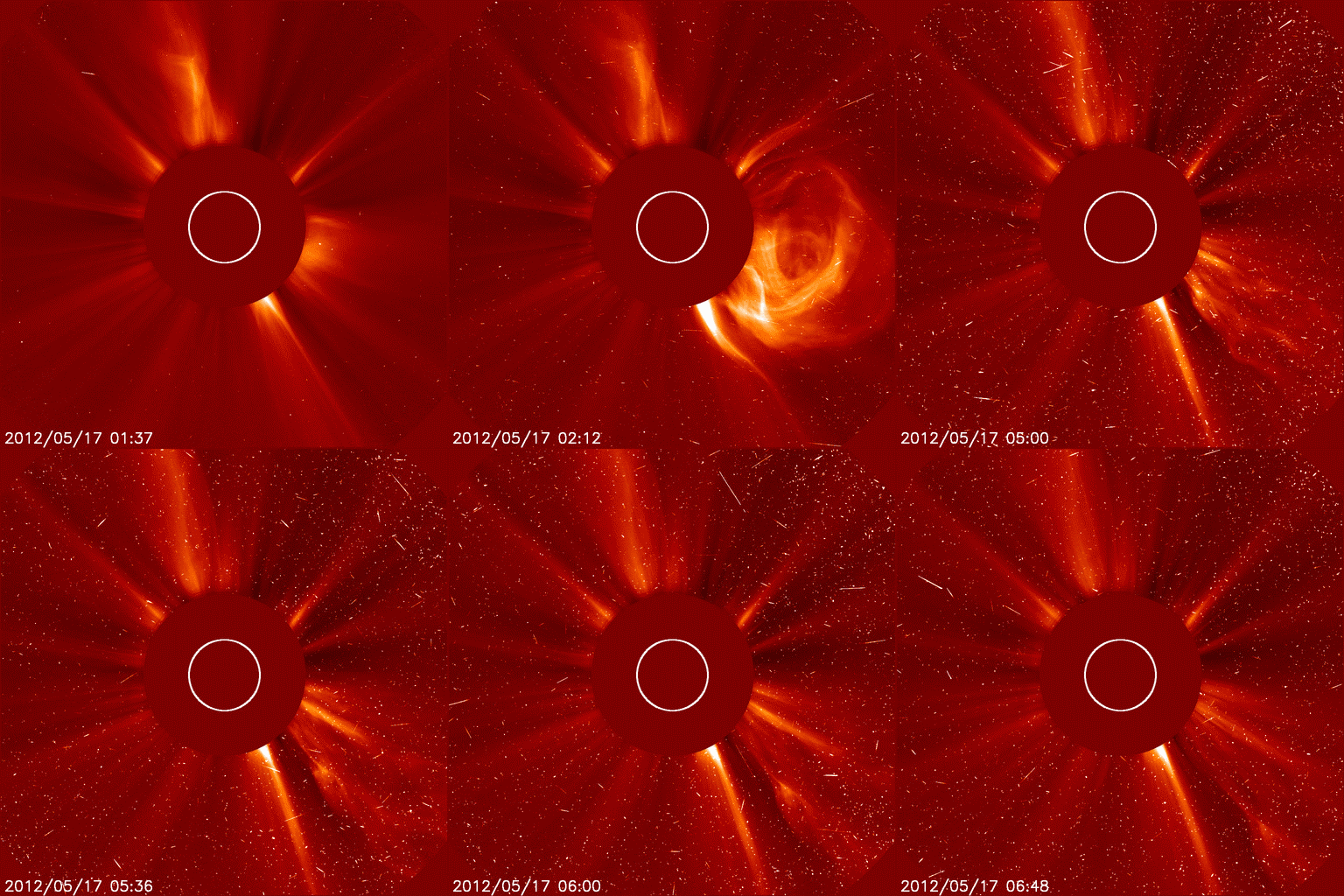
New CME

INCOMING CME? A coronal mass ejection (CME) that flew off the sun’s western limb on May 17th might hit Earth after all. NOAA forecasters say a shock wave from the blast could deliver a glancing blow to Earth’s magnetic field on May 18th or 19th. The CME, pictured below, was propelled by an M5-class solar flare from departing sunspot AR1476.

The speckles in the movie are caused by energetic protons hitting the observatory’s detector. Those protons may have been accelerated in part by the shock wave en route to Earth.

According to NOAA, there is a 40% chance of minor geomagnetic storms and a 15% chance of strong storms when the shock arrives. High-latitude sky watchers should be alert for auroras.

fr/spaceweather.com

5/18 Earthquakes – Algeria, Afghanistan, Japan, Chile

May 18, 2012 – Moderate earthquakes in Afghanistan and Algeria

Algeria earthquake
The earthquake is very shallow (if preliminary data will be confirmed). Epicenter is approx. 20 km from Brida and approx. 30 km from Aflou.  Brida has a population of 5,742 (1998 cencus) and Aflou has a population of 48,000 inhabitants. Earthquake-Report.com has no certainty at all about the faith of this 2 villages.  The epicenter location given by seismological agencies has almost always an error margin of +10 km. We do not see major problems if the epicenter will be confirmed where it is located now, but when closer to one of both villages or towns,  damage cannot be excluded.
– The earthquake happened in the Sahara Atlas at a approx. altitude of 1,400 meter.
Update 13:39 UTC : EMSC has changed its parameters from M5.1 to M4.7 and from a depth of 2 km to a depth of 5 km. These latest values are far better (less dangerous) than the initial ones.

Moderate earthquake relatively close to Kabul, Afghanistan
The epicenter of this earthquake was only at 38 km from Afghanistan. EMSC and USGS data versions are completely different in focal depth at the time of writing (13:25 UTC).  EMSC reports a depth of 80 km and USGS a depth of 10 km. This kind of difference in focal depth is almost like early morning and sunset !

Moderate earthquake shakes the interior of Honshu, Japan
We have a sudden surge in people from Japan, which indicates mostly an earthquake
We have NO earthquake data yet, but max. JMA intensity is 4 so far.
– The epicenter of this earthquake was in between Sano and Tsukuba, inland. The depth of the hypocenter makes it a far away felt earthquake. The way people felt this earthquake is another proof that similar magnitudes and similar depths are being felt completely different from one area to another.
– The earthquake has been well felt in Tokyo too (see experience reports).
– JMA 4 intensity (scale from 0 to 7) at Ibaraki-ken Nambu, Tochigi-ken Nambu, Saitama-ken Hokubu and Saitama-ken Nambu. Earthquake-report.com uses 5+ as a potentially damaging intensity. The greater Tokyo area was reported as a JMA 3 intensity

Strong (harmless) earthquake off the coast of Chile
The epicenter was located at more than 500 km out of the coast.  The Magnitude is totally harmless to generate a tsunami.  The hypocenter depth is 10 km and indicates that the earthquake was generated by tensions in a separating oceanic plate (separating Nazca and Antarctic plates area).  The satellite map below shows the dividing area very well.

http://earthquake-report.com/2012/05/17/major-earthquakes-list-may-18-2012/