TS Leslie – Latest fr/Dr. Jeff Masters

Disorganized Leslie headed towards Bermuda

Published: 4:18 PM GMT on September 03, 2012

Tropical Storm Leslie continues to struggle with moderately high wind shear of 15 – 20 knots, due to strong upper-level winds out of the northwest. The shear is keeping heavy thunderstorms confined to the southeast quadrant of the storm. These thunderstorms are as far removed from the center as we’ve so far with Leslie, as seen on satellite loops. According to the latest SHIPS model forecast, the shear is expected to stay moderately high through Tuesday night, then drop to the low category, 5 – 10 knots, by Wednesday night. At that time, Leslie will be over warm ocean waters of 29°C, and the reduction in shear and warm waters should allow Leslie to intensify into at least a Category 1 hurricane by Friday, as predicted by most of the intensity forecast models. Intensification to a stronger storm may be hampered by its slow motion, which will cause Leslie to churn up cool water from the depths that will slow intensification. Once Leslie begins moving more quickly on Saturday, this effect will diminish, and Leslie could be at Category 2 strength on Saturday, as predicted by the HWRF and LGEM models. Steering currents for Leslie are expected to be weak on Tuesday – Friday, as Leslie gets stuck between two upper level lows. The latest guidance from our top computer continues to show Leslie making a very close pass by Bermuda on Saturday, and that island can expect a 3-day period of rough weather Friday through Sunday. Leslie will stay stuck in a weak steering current environment until a strong trough of low pressure approaches the U.S. East Coast on Saturday. This trough should be strong enough to pull Leslie quickly to the north on Saturday and Sunday, and Leslie may be close enough to the coast that the storm will make landfall in Canada on Monday, September 10. None of the reliable models have shown that a direct hit on New England will occur, but we can’t rule that possibility out yet. The most likely long-term fate of Leslie will be for it to miss land entirely and brush by the coasts of Nova Scotia and Newfoundland, but any forecast of what a tropical cyclone might do a full seven days in advance is pretty speculative. Regardless, Leslie will bring an extended period of high waves to Bermuda, the U.S. East Coast, and Nova Scotia and Newfoundland this week. These waves will be capable of causing significant beach erosion and dangerous rip currents.


Figure 1. Morning satellite image of Tropical Storm Leslie. The low-level circulation center is fully exposed to view, thanks to strong northwest winds creating 15 – 20 knots of wind shear.

Invest 99L in the Central Atlantic
A small extratropical low pressure system that got cut off from the jet stream and is now spinning away in the Central Atlantic, near 26°N 42°W, (Invest 99L), is headed west at 10 mph, and has developed a small amount of heavy thunderstorm activity. This storm is not a threat to any land areas, and in their 8 am EDT Tropical Weather Outlook on Monday, NHC gave 99L a 30% chance of developing into a tropical cyclone by Wednesday morning.

Jeff Masters on Conundrums, Drought, Isaac, Kirk, & Leslie

Unanswered questions concerning Hurricane Isaac

Published: 4:35 PM GMT on August 31, 2012

The top winds of Tropical Depression Isaac have fallen to 25 mph, but the storm continues to be a potent rain-maker as it heads north-northwest at 11 mph into Missouri. Isaac has spawned up to 20 suspected tornadoes, brought storm surges as high as 13.6′ to the coast (in Lake Borgne, LA), and dumped 20″ of rain at one station in New Orleans. The 13.27″ of rain that fell at Hattiesburg, MS broke the record for wettest August in the city’s history (previous record: 13.03″ in 1987.) Major flooding is occurring on seven rivers in Louisiana and Mississippi. Isaac is being blamed for at least four deaths in the U.S., 24 in Haiti, and five in the Dominican Republic.

A few notable rainfall totals from Isaac, through 11 am EDT on Friday:

20.08″ New Orleans, LA
15.02″ Marion, MS
13.99″ Pascagoula, MS
13.27″ Hattiesburg, MS
10.85″ Gulfport, MS
10.39″ Slidell, LA
10.17″ Biloxi, MS
9.85″ Mobile, AL
7.38″ Pine Bluff, AR
5.95″ Baton Rouge, LA

A major reason for Isaac’s heavy rainfall totals has been its very slow motion. This slow speed was due to the fact Isaac has been bumping into a ridge of high pressure that is unusually strong, due to the intense drought over the center of the U.S.; strong drought-amplified high pressure areas are very resistant to allowing any low pressure areas to intrude into their domain. The high pressure area was strong enough this week to allow several all-time records for heat this late in the year to be set:

112° on August 29 at Winner, SD
108° on August 29 at Valentine, NE
107° on August 29 at Corpus Christi, TX
97° on August 29 at Denver, CO (2nd highest so late in the year)


Figure 1. Nighttime view of Hurricane Isaac taken at 1:57 am CDT August 29, 2012, by the Visible Infrared Imaging Radiometer Suite (VIIRS) on the Suomi-NPP satellite. The VIIRS day-night band detects light in a range of wavelengths from green to near-infrared, and uses light intensification to enable the detection of dim signals. In this case, the clouds of Isaac were lit by moonlight. Image credit: NASA.

Isaac’s beneficial rains falling in drought-stricken regions
Hurricanes get a lot of attention because of the billions in damage they cost, and the lives they disrupt. AIR Worldwide estimated today that insured damage from Isaac would cost up to $2 billion. This does not include damage to infrastructure or uninsured damage, so the final price tag of Isaac’s rampage will be more like $3 – $5 billion. However, Isaac is now dumping beneficial rains over Arkansas, Missouri, Illinois, Indiana, Ohio, and Kentucky–regions stricken by the worst drought since the 1950s or 1930s, depending upon the exact location. These regions need 9 – 18 inches of rain to pull them out of drought. Isaac’s 3 – 6 inches of rain will not end the drought, but will put a pretty good dent in it. I expect that 3 – 6 inches of rain for a wide swath of prime agricultural land in extreme drought is probably worth at least $5 billion, when you consider that a recent estimate by a Purdue economist put the cost of the great drought of 2012 at more than $77 billion. Only Hurricane Katrina ($146 billion) and the drought of 1988 ($78 billion) have been more expensive disasters, according to NOAA’s National Climatic Data Center. Unfortunately, Isaac’s arrival is poorly timed, as the storm is arriving during harvest season. The strong winds associated with the storm will flatten many crops, making it more difficult to harvest them, and Isaac’s winds may cost farmers several hundred million dollars due to unharvestable crops. Still, the rains from Isaac will be highly beneficial for the success of the upcoming winter wheat season, and for next year’s growing season.


Figure 2. Predicted precipitation for the five-day period ending on Tuesday evening shows that Isaac is expected to bring a large region of 3 – 6 inches of rain (red, orange, and brown colors) to Arkansas, Missouri, Illinois, Indiana, Ohio, and Kentucky. Image credit: NOAA/HPC.


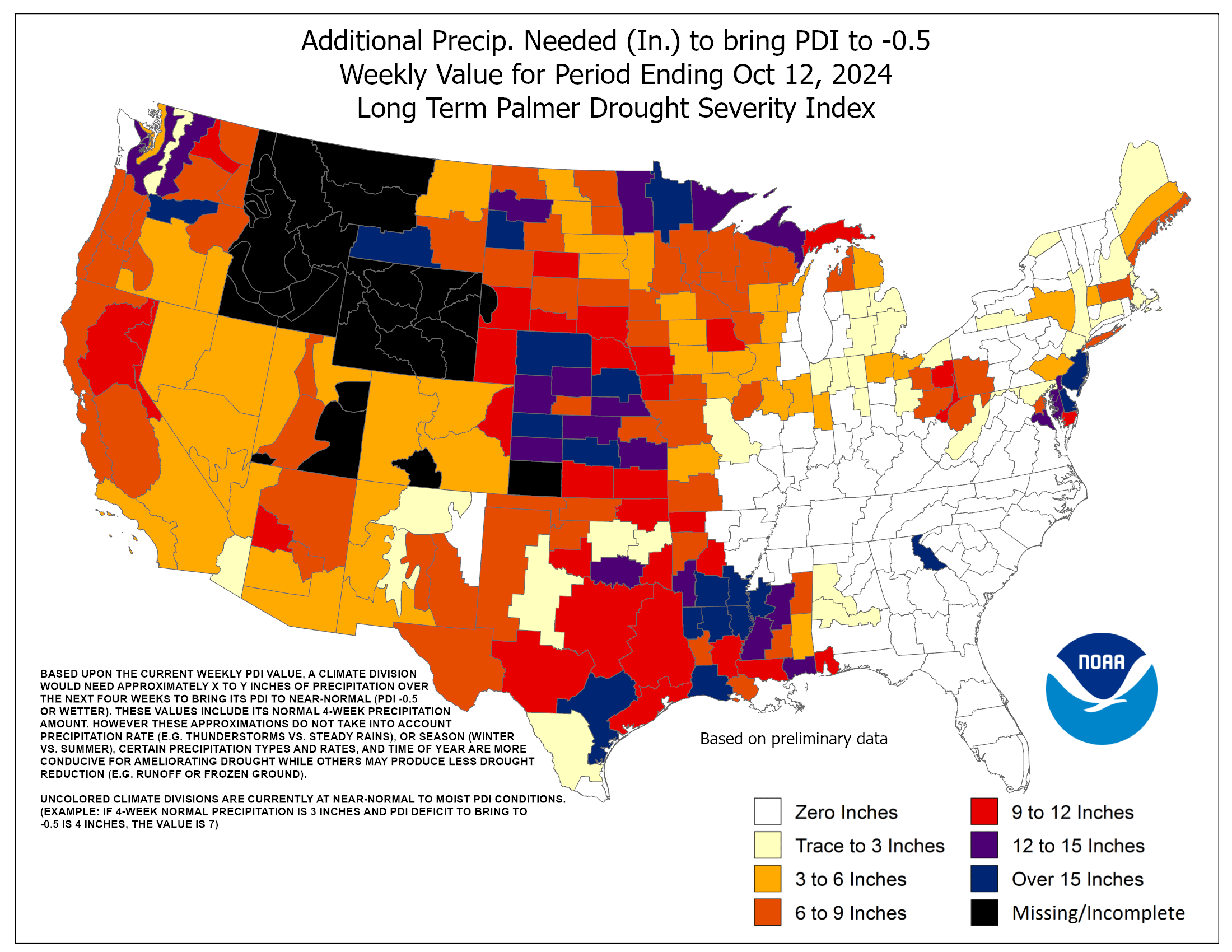
Figure 3. The great drought of 2012 has brought so little rain to the Midwest that some areas require over 15″ of rain (dark purple colors) to end the drought. Image credit: NOAA/CPC.

Unanswered questions about Hurricane Isaac

1. Did the passage of Hurricane Isaac stir up oil from the Deepwater Horizon oil spill? Isaac was the first hurricane to pass over the site of the 2010 Deepwater Horizon oil spill. We know that large hurricanes are capable of creating currents in deep water at the bottom of the Gulf of Mexico; Hurricane Ivan caused upwelling currents of 0.5 cm/s at a depth of about 500 meters. In an August 28 article in the Huffington Post, Nick Shay, professor of meteorology and physical oceanography at the University of Miami, said: “Winds will push water away from the center of a storm, which causes an upwelling as the ocean tries to adjust. It brings whatever is near the bottom up higher in the water column and currents can then push it towards the coast.” Up to 1 million barrels of oil from the spill are estimated to still be present in the deep water sediment, on beaches, and in the marshes of Louisiana, and it is possible some of this oil will wash up on the Gulf Coast in coming months. The storm surge of Isaac also likely flushed out oil lodged in the coastal marshes of Louisiana, but it is unknown how much of a concern this might be.

2. What’s the deal with these super-sized Category 1 and 2 hurricanes that have been hitting the U.S.? The past three landfalling hurricanes in the U.S.–Isaac (2012), Irene (2011), and Ike (2008)–have all been exceptionally large, among the top ten on record for horizontal extent of tropical storm-force winds. Each of these storms had an unusually low pressure characteristic of a storm one full Saffir-Simpson category stronger. Is this the new normal for U.S. hurricanes?

3. Did the new $14.5 billion upgrade to the New Orleans levee system cause worse flooding elsewhere? Whenever a new levee or flood control structure is created, you make someone else’s flood problem worse, since the water has to go somewhere. Where did the water was stopped by the new $1.1 billion, 1.8 mile-long Lake Borgne flood barrier on the east side of New Orleans go? Did it flow south and contribute to the overtopping of the levees near Braithwaite? Or did it go north and contribute to the 36 hours of storm surge in excess of 5′ observed along the Mississippi coast at Waveland? I posed this question to NHC’s storm surge expert Jaime Rhome, and he said it was impossible to know without doing detailed storm surge modeling studies.

4. Can only hurricanes beginning with the letter “I” hit the U.S. now? Isaac (2012), Irene (2011), and Ike (2008) are the last three hurricanes to hit the U.S. It turns out that hurricanes that begin with the letter “I” and “C” have more names on the list of retired hurricanes than any other letter (nine each.) I’m thinking Isaac will get its name retired, letting storms beginning with “I” take over sole possession of first place on the retired storms list.

Hurricane Kirk in the Central Atlantic
Hurricane Kirk intensified into a 105 mph Category 2 hurricane this morning, becoming the 2nd strongest hurricane of the 2012 Atlantic hurricane season. Hurricane Gordon was the only stronger storm; Gordon hit sustained winds of 110 mph just before reaching the Azores Islands on August 18. Kirk has probably peaked in intensity, and is about to move over colder waters and gradually decay. Kirk is not a threat to any land areas.


Figure 4. Morning satellite image of Tropical Storm Leslie.

Tropical Storm Leslie a long-range threat to Bermuda, Canada, and the U.S. East Coast
Tropical Storm Leslie formed on Thursday in the Central Atlantic. Leslie’s formation date of August 30 puts 2012 in 2nd place for earliest formation date of the season’s 12th tropical storm. Only 1995 had an earlier formation date of the season’s 12th storm. With records dating back to 1851, this year is only the second time 8 total storms have formed in August. The other year was 2004, when the first storm of the season formed on August 1 (Alex), and the 8th storm (Hermine) formed on August 29th. Satellite loops show that Leslie has a modest amount of heavy thunderstorm activity, and respectable low-level spiral bands and upper-level outflow. Conditions appear ripe to allow Leslie to intensify into a Category 2 hurricane by Sunday. Fortunately, Hurricane Kirk is weakening the ridge of high pressure to the north of Leslie, and Leslie is expected to turn to the northwest and miss the Lesser Antilles Islands. However, steering currents for Leslie are expected to collapse early next week, as Leslie gets stuck between two upper level lows. The storm will then slowly meander over the open ocean for many days, potentially threatening Bermuda. Leslie will stay stuck until a strong trough of low pressure approaches the U.S. East Coast around September 8. This trough should be strong enough to pull Leslie to the north and then northeast by September 9. At that time, Leslie may be close enough to the coast that the storm will make landfall in New England, Canada, or the Mid-Atlantic states. Leslie could also miss land entirely; this all depends upon the timing and strength of the September 8 trough of low pressure. Regardless, Leslie is expected to bring an extended period of high waves to the U.S. coast. According to NOAA’s Wavewatch III model, large swells from Leslie will reach Bermuda by Monday, and arrive along the U.S. East Coast on Tuesday. These waves will be capable of creating dangerous rip currents and beach erosion.

Portlight disaster relief charity responds to Issac
The Portlight.org disaster relief charity, founded and staffed by members of the wunderground community, are in Mississippi, helping out with Isaac relief efforts. You can check out their progress or donate to Portlight’s disaster relief fund at the portlight.org website.

from:    http://www.wunderground.com/blog/JeffMasters/article.html
Dangerous Earthquake — Phillipines

Massive earthquake hits Philippines with tsunami warning – 1 dead

Last update: August 31, 2012 at 3:26 pm by By

Most important Earthquake Data:
Magnitude : Mw7.6 (USGS), Ml7.7 (PHIVOLCS)
UTC Time : 31st August, 2012 – 12:47:34 UTC

Local time at epicenter : 31st August, 2012 – 20:47:34 UTC
Depth (Hypocenter) :  34.9 km (USGS), 10km (PHIVOLCS)
Geo-location(s) : 96km (60mi) E of Sulangan, Philippines

Phivolcs was predicting:-

Intensity 7 in Guian, Oras, Sulat, Borongan City, Eastern Samar;

Intensity 6 in Siargao, Surigao del Norte; Tacloban City; Palo Leyte; Saint Bernard, S. Leyte;

Intensity 5 in Mati City; Compostela; Compostela; Legaspi City; Iloilo City; Beilig City; Iligan City;

Intensity 4 in Butuan City, Catbalogan City, Butuan  City, Cagayan De Oro City;

Intensity 3 in Cotabato City, Mambajao, Camiguin, General Santos City; and

Intensity 2 in Marawi, Sipalay City

UPDATE:- NDRRMC is expecting damage from an earthquake of this size, but still waiting on more damage reports.

1 person has been killed through a house collapse in Southern Cagayan de Oro city on the South Island of Mindanao killing a 54-year-old woman and injuring her 5-year old grandson.

The center in Philippines said that very small tsunami waves of 3 centimeters meters (just over an inch) were recorded along the eastern Philippine coast near Legazpi city and another nearby location indicating a possible escape from a major tsunami.

The quake knocked out power in several other towns and cities across the central and southern Philippines, though it was restored in some areas later Friday.

SUMMARY:- A massive earthquake has hit off the East coast of the Philippines. It has been felt up to an intensity VII onshore through USGS.

The tsunami was due to hit Eastern Samar Island and also the following other locations –  Northern Samar, Leyte, Southern Leyte, Surigao del Norte, Surigao del Sur. It was due to have hit already and we are waiting on reports.

The latest PTWC ratings:- Only a local tsunami warning was enforced. Eyewitness reports in the east have seen 1.2m waves.

 SEA LEVEL READINGS CONFIRM THAT A TSUNAMI WAS GENERATED. THIS  TSUNAMI MAY HAVE BEEN DESTRUCTIVE ALONG COASTLINES OF THE REGION  NEAR THE EARTHQUAKE EPICENTER. AUTHORITIES IN THE REGION SHOULD  TAKE APPROPRIATE ACTION IN RESPONSE TO THIS POSSIBILITY. THIS  CENTER WILL CONTINUE TO MONITOR SEA LEVEL GAUGES NEAREST THE  REGION AND REPORT IF ANY ADDITIONAL TSUNAMI WAVE ACTIVITY. THE  WARNING WILL NOT EXPAND TO OTHER AREAS OF THE PACIFIC UNLESS  ADDITIONAL DATA ARE RECEIVED TO WARRANT SUCH AN EXPANSION.

 FOR AFFECTED AREAS - WHEN NO MAJOR WAVES ARE OBSERVED FOR TWO  HOURS AFTER THE ESTIMATED TIME OF ARRIVAL OR DAMAGING WAVES HAVE  NOT OCCURRED FOR AT LEAST TWO HOURS THEN LOCAL AUTHORITIES CAN  ASSUME THE THREAT IS PASSED. DANGER TO BOATS AND COASTAL  STRUCTURES CAN CONTINUE FOR SEVERAL HOURS DUE TO RAPID CURRENTS.
 AS LOCAL CONDITIONS CAN CAUSE A WIDE VARIATION IN TSUNAMI WAVE  ACTION THE ALL CLE

for more information and updates, go to:   http://earthquake-report.com/2012/08/31/massive-earthquake-hits-philippines-with-tsunami-warning/


Jeff Masters on TS Isaac, TS Kirk, & New Development

Isaac slamming Gulf Coast with damaging floods, tornadoes

Published: 4:44 PM GMT on August 30, 2012

Slow-moving Tropical Storm Isaac continues to hammer coastal Louisiana, Mississippi, Alabama, and Florida’s Panhandle with tornadoes, torrential rains, high winds, and a damaging storm surge. Over the past 24 hours, destructive tornadoes have touched down in Biloxi and Pascagoula, Mississippi, and one person was killed by a tree falling on a car in Pearl River County, Mississippi. A major flood event is occurring in Slidell, Louisiana, where Isaac’s storm surge filled Bayou Bonfouca and the W-14 Canal, inundating portions of the city with 1 – 5 feet of water. While Isaac is now a weakening minimal-strength tropical storm, it is still a potent rainmaker, and will cause damaging floods all along its path for the next three days. Major river flooding is occurring or is about to occur on a number of rivers in the landfall area. In north central Tangipahoa Parish in southeast Louisiana and southwestern Pike County in southern Mississippi, a mandatory evacuation has been ordered for all low-lying areas and along the Tangipahoa River, due to the potential failure of the Lake Tangipahoa dam. Audubon Park in New Orleans, recorded 19.30″ of rain as of 7 pm Wednesday night, and 18.7″ of rain in a 24-hour period. This is the greatest 24-hour rainfall event at any official New Orleans site, with weather records extending back to 1871, according to wunderground’s weather historian, Christopher C. Burt. A few other rainfall totals from Isaac, through 11 am EDT on Thursday:

15.02″ Marion, MS
10.09″ Hattiesburg, MS
10.15″ Gulfport, MS
9.80″ Slidell, LA
9.74″ Biloxi, MS
8.52″ Mobile, AL
5.57″ Baton Rouge, LA


Figure 1. Isaac’s winds and storm surge overcomes the seawall and floods South Beach Boulevard in Waveland, Miss., Wednesday, Aug. 29, 2012, the seventh anniversary of Hurricane Katrina hitting the Gulf Coast. (AP Photo/Rogelio V. Solis). Waveland experienced a storm surge in excess of 5′ for 36 hours.

Isaac’s storm surge winds down
Storm surge levels along the coast of Mississippi and surrounding areas are gradually receding, and the surge has finally fallen below 5′ at Waveland, which experienced a storm surge in excess of 5′ for 36 hours. Isaac’s storm surge levels were characteristic of a Category 2 hurricane, and lasted for an exceptionally long period of time. Waveland, Mississippi experienced a peak surge of 8′ and peak storm tide of 9′ (surge plus the natural high tide), which beat the levels that occurred during Category 2 Hurricane Gustav of 2008 (7′ of storm tide.) The peak 11.06′ storm surge at Shell Beach, which is in Lake Borgne, 30 miles southeast of New Orleans, exceeded the 9.5′ surge recorded there during Gustav. According to an article in nola.com, Isaac pushed a storm surge of 13.6′ into Lake Borgne, on the east side of New Orleans. This is not far from the 15.5′ storm surge Hurricane Katrina brought to the location. It is quite possible that Isaac’s storm surge might have breached levees of the east side of New Orleans, flooding areas inhabited by tens of thousands of people, had the Army Corps of Engineers not completed their $14.5 billion upgrade to the New Orleans flood defenses this year. I estimate that storm surge damage from Isaac will exceed $2 billion. Isaac has likely caused $2.5 billion in insured damage not related to flooding, insurance firm Eqecat estimated yesterday. Here were some of the peak storm surge values that were recorded at NOAA tide gauges during Isaac:

11.1′ Shell Beach, LA
8.0′ Waveland, MS
3.5′ Pensacola, FL
4.6′ Pascagoula, MS
3.8′ Mobile, AL


Figure 2. A TRMM satellite 3-D view of rainfall on Aug. 28 showed a few very powerful thunderstorms near Isaac’s eye were reaching heights of almost 17 km (10.6 miles.) Intense bands of rain around Isaac were occasionally dropping rain at a rate of over 2.75 inches per hour. Image credit: SSAI/NASA, Hal Pierce.

Isaac’s storm surge on the Mississippi River
A storm surge estimated at 12′ moved up the Mississippi in Plaquemines Parish near Port Sulphur, LA, near 8:30 pm EDT Tuesday, causing overtopping of the levees and flooding of homes in the mandatory evacuation areas behind the levees. These levees were not part of the $14.5 billion levee upgrade New Orleans got after Hurricane Katrina, and were not rated to Category 3 hurricane strength, like the levees protecting New Orleans are. Since salt water is more dense than fresh water, the surge travelled along the bottom of the river, with the fresh water flow of the river lying on top. The surge continued upriver, and before reaching New Orleans, encountered an underwater barrier in Plaquemines Parish. This barrier was constructed by the Army Corps of Engineers beginning on August 15, in order to keep salt water from moving upstream and contaminating drinking water for Plaquemines Parish and New Orleans. Salt water had made it 90 miles upriver to the outskirts of New Orleans, due to the low flow rate of the river (which had dropped 7′ below average in height due to the drought of 2012.) According to a spokesperson for the National Weather Service River Forecast Office, this barrier was probably able to completely block the flow of salt water upriver due to Isaac’s storm surge, and no salt water made it as far as New Orleans. However, the massive intrusion of ocean water into the river channel caused the mighty Mississippi’s fresh water flow to back up for hundreds of miles. Water levels were elevated by 10′ in New Orleans (103 miles upstream from the mouth of the Mississippi), 8′ in Baton Rouge (228 miles upstream), and 1.4′ at Knox Landing, an amazing 314 miles upstream.

Hurricane Kirk in the Central Atlantic
Hurricane Kirk intensified into a 75 mph Category 1 hurricane this morning, becoming the busy 2012 Atlantic hurricane season’s fifth hurricane. With the season’s mid-point of September 10 still almost 2 weeks away, we’ve already had 12 named storms and 5 hurricanes, which is close to what an entire season experiences in an average year (11 named storms and 6 hurricanes.) Kirk should stay well out to sea and not trouble any land areas.


Figure 3. Morning satellite image of Hurricane Kirk.

Tropical Depression Twelve forms in the Central Atlantic
Tropical Depression Twelve has formed in the Central Atlantic, and appears destined to become a hurricane before the week is out. Fortunately, Hurricane Kirk is weakening the ridge of high pressure to the north of TD 12, and the storm is expected to turn to the northwest and miss the Lesser Antilles Islands. In the long term, it remains unclear if TD 12 will follow Kirk and fully recurve out to sea. The latest run of the GFS model predicts TD 12 will recurve out to sea and not threaten any land areas, but the latest run of the ECMWF model predicts that the trough of low pressure pulling Kirk to the norhteast will not be strong enough to recurve TD 12 out to sea. Instead, the ECMWF predicts that a ridge of high pressure will build in early next week, forcing TD 12 more to the northwest, making the storm a potential threat to Bermuda, the Northeast U.S., and Canada.

from:    http://www.wunderground.com/blog/JeffMasters/article.html

August 31 — Blue Moon

Watch Out for the Blue Moon

August 29, 2012:When someone says “Once in a Blue Moon,” you know what they mean:  Rare, seldom, even absurd.

This year it means August 31st.

For the second time this month, the Moon is about to become full.  There was one full Moon on August 1st/2nd, and now a second is coming on August 31st.  According to modern folklore, whenever there are two full Moons in a calendar month, the second one is “blue.”

Cue up the Elvis records! “Blue Moon…. You saw me standing alone, without a dream in my heart, without a love of my own.” In song and literature, blue moons have long symbolized lost love and melancholy. Elvis set the standard for lunar heartbreak in his 1956 pop hit “Blue Moon.”

Watch Out for the Blue Moon (splash)

A new ScienceCast video explores the facts and myths of Blue Moons. Play it

But will the moody Moon of August 31st actually turn blue?  Probably not.

Most Blue Moons look pale gray and white, indistinguishable from any other Moon you’ve ever seen.  Squeezing a second full Moon into a calendar month doesn’t change the physical properties of the Moon itself, so its color remains the same.

With that caveat in mind, however, be aware that on rare occasions it can happen.

A truly-blue Moon usually requires a volcanic eruption. Back in 1883, for example, people saw blue moons almost every night after the Indonesian volcano Krakatoa exploded with the force of a 100-megaton nuclear bomb. Plumes of ash rose to the very top of Earth’s atmosphere, and the Moon … it turned blue!

Watch Out for the Blue Moon (plume, 200px)

Smoke from volcanoes and forest fires can cause the Moon to turn blue. [Blue Moon Stories]

Krakatoa’s ash was the reason. Some of the plumes were filled with particles 1 micron wide, about the same as the wavelength of red light.  Particles of this special size strongly scatter red light, while allowing blue light to pass through. Krakatoa’s clouds thus acted like a blue filter.

People also saw blue-colored Moons in 1983 after the eruption of the El Chichon volcano in Mexico. And there are reports of blue Moons caused by Mt. St. Helens in 1980 and Mount Pinatubo in 1991.

Certain forest fires can do the same trick.  A famous example is the giant muskeg fire of Sept. 1953 in Alberta, Canada.  Clouds of smoke containing micron-sized oil droplets produced lavender suns and blue Moons all the way from North America to England.

There are plenty of wildfires burning in the hot, dry USA this month.  If any of them produce smoke with an extra dose of micron-sized particles, the full Moon might really turn blue.

On the other hand, maybe it will turn red.  Often, when the moon is hanging low, it looks red for the same reason that sunsets are red.  The atmosphere is full of aerosols much smaller than the ones injected by volcanoes.  Measuring less than a micron in diameter, these aerosols scatter blue light, while leaving the red behind. For this reason, red Blue Moons are far more common than blue Blue Moons.

Sounds absurd? Yes, but that’s what a Blue Moon is all about. Step outside at sunset on August 31st, look east at the moonrise, and see what color presents itself.
Author: Dr. Tony Phillips| Production editor: Dr. Tony Phillips | Credit: Science@NASA

from:    http://science.nasa.gov/science-news/science-at-nasa/2012/29aug_bluemoon/

Arctic Earthquake

Mw6.6 earthquake hits Jan Mayen in the Arctic with some damage

Last update: August 30, 2012 at 3:25 pm by By

Most important Earthquake Data:

Magnitude : Mw6.6
UTC Time : 13:43:24 UTC on August 30th, 2012
Local time at epicenter : 12:43:24 UTC on August 30th, 2012
Depth (Hypocenter) : 8km
Geo-location(s) : 93km NW away from Olonkinbyen, Svalbard and Jan Mayen

There has been reports of some damage and a rockslide, but no injuries among the 44 people living there.

A M5.2 aftershock also hit around 8 mins after the mainshock.

UPDATE:- This is reported to be one of the largest Norwegian earthquakes on record.

In 2008, a M6.2 was reported in Svalbard.

According to NORSAR “The largest earthquakes in historical times in Norway and surrounding offshore areas occurred in the Rana region in 1819, M 5.8, in the Vøring Basin in 1866, M 5.7, in the outer Oslofjord in 1904, M 5.4 and in the Viking Graben in 1927, M 5.3. The last earthquakes above M 5 include an M 5.3 event in the Vøring Basin in 1988, in an area with almost no earlier seismicity, and an M 5.2 event in the northeastern North Sea in 1989.”

The Oslofjord earthquake of 1904 is the best known earthquake causing damage in Norway.

So it looks like another earthquake record has been broken – as will continue to occur as better recording of earthquakes through time continues worldwide leading to better hazard maps in the future.

Further damage is yet to be confirmed as well as a possible tsunami caused by underwater landslide.


Beerenberg Volcano – over 2200m above sea level (Wiki Commons) – erupted in 1970 and 1985.

SUMMARY:-

A major earthquake has hit off Jan Mayen Island in Norway in the Arctic Ocean.

The Amazing coastline of Jan Mayen with the Beerenberg Volcano

44 people currently live on the small island of which the main export is gravel and also doubles as a telecommunications base for Norway.

from:    http://earthquake-report.com/2012/08/30/mw6-6-earthquake-hits-jan-mayen-in-the-arctic-with-some-damage/


El Salvador Earthquake — Effects

Strong wave destroys turtle eggs following earthquake in El Salvador

Last update: August 30, 2012 at 3:04 pm by By

A strange set of earthquake data occurred following the El Salvador earthquake a few days ago with various agencies giving very different magnitudes for the event.

A tsunami alert was also triggered and then was cancelled.

We have brief reports that have encircled the globe that the following damage occurred due to 3 strong waves after the earthquake:

A Zoological foundation has said that 3 waves up to 3m high (not 8m as stated in some reports) washed onshore and destroyed around 45000 just hatched turtle eggs. This is around 6% of the total endangered eggs saved in the last 1.5 years. These were all of the Ridley turtle variety which is very much endangered. It also destroyed the hatcheries for turtle protection.

– The tsunami waves washed up on about 150 people collecting the eggs to protect them in special pens

– The waves injured 6 of the people who were all saved.

– No other reports of damage or a felt tsunami have been made. The earthquake was barely felt in El Salvador.

– Over 200 aftershocks have since been registered.

Kemps Ridley Sea Turtle (Wikipedia Commons)

Most important Earthquake Data:
Magnitude : Ml6.7 (SNET), Mw7.3 (USGS)
UTC Time : 04:37:20 UTC  on the 27th August, 2012
Local time at epicenter : 22:37:20 on the 26th August, 2012
Depth (Hypocenter) : 51km (SNET), 20.3km (USGS)
Geo-location(s) : 110km from the South coast of El Salvador

from:    http://earthquake-report.com/2012/08/30/strong-wave-destroys-turtle-eggs-following-earthquake-in-el-salvador/

The “Bird-Muda” Triangle

Pigeons Vanish in ‘Birdmuda Triangle’

Eli MacKinnon, Life’s Little Mysteries Staff Writer
Date: 28 August 2012
A flock of homing pigeons released and tasked with finding their way home.
A flock of homing pigeons released and tasked with finding their way home. Scientists aren’t sure why some of these racing pigeons disappear in what has been dubbed Birdmuda Triangle.
CREDIT: Gail Johnson, Shutterstock

Hundreds of racing pigeons have been disappearing over a sleepy pocket of North East England, earning the region a reputation as the “Birdmuda Triangle.”

On Saturday (Aug. 25), the Telegraph reported, one club of pigeon fanciers released a flock of 230 birds from North Yorkshire. Only 13 birds arrived at their destination in Scotland.

Some of the aggrieved hobbyists — who routinely release trained pigeons tasked with finding their way home from distances of hundreds of miles — are now considering grounding their remaining birds until the mystery is solved.

Pigeons have long baffled scientists with their uncanny navigational abilities. Earlier this year, researchers at Baylor College identified one component of the birds’ internal GPS when they showed that their brains contain a specialized group of cells that measure the strength and direction of the Earth’s magnetic field, serving as a compass.  [9 Weird Animal Facts]

But what special property of a triangular region in North East England — marked off by places called Wetherby, Corsett and Thirsk, and measuring 65 miles (105 km) on its longest side — could be capable of short-circuiting a pigeon’s sense of home?

Some racers have implicated a nearby military intelligence operation, blaming rogue signals from the Royal Air Force’s Menwith Hill satellite station for jamming their birds’ instincts.

“There’s been a fair amount of experimentation on the effect of radio signals on pigeon orientation,” said Charles Walcott, a professor of neurobiology and behavior at Cornell University who has been studying pigeons since 1962. “No one has ever seen any substantial effect.”

Others have attributed losses to unusually high levels of solar activity that they say have distorted the Earth’s magnetic field and, by extension, their pigeons’ mental maps. (Though it is merely following its normal cycle, the sun has been increasingly active lately.)

According to Walcott, researchers have shown that disruptions in the Earth’s magnetic field caused by solar flares do in fact jog pigeons’ internal compasses, changing the initial direction the birds choose to set off in when they’re first released. But a nationwide study published in the now-defunct Racing Pigeon Bulletin examined the results of pigeon races alongside variations in the Earth’s magnetic field and concluded that, in the United States at least, there was no correlation.

“But [the Racing Pigeon Bulletin study] doesn’t rule out the idea,” he told Life’s Little Mysteries. “It just says that over a big area there was no obvious effect; it doesn’t mean that there couldn’t be one in a small area.”

Walcott’s pick for the most plausible cause of England’s pigeon losses happens also to be the most likely explanation for the real Bermuda Triangle’s undue reputation as a mystical devourer of ships and men: bad weather.

The Telegraph reports that the section of North East England in question has been experiencing abnormally high rainfall, and some of the racers have proposed that missing pigeons may have been led far afield by their efforts to avoid storms.

“I think that explanation’s quite likely,” said Walcott. “Pigeons really do not like to fly in the rain because their feathers are not equipped for it, so in my experience pigeons will simply put down until the rain has passed.”

As for where last weekend’s 217 unaccounted-for racing birds headed when the sun came back out, Walcott says we may never know. He’s heard of mass disappearances at U.S. races before, and for some of the pigeon fanciers at those events, answers still haven’t surfaced.

“[T]hose pigeons that are lost, many of them find other pigeon lofts and go in. But some just plain disappear and you never see them again, and I don’t think anyone understands what’s going on,” he said.

from:    http://www.livescience.com/22783-birdmuda-triangle.html

Jeff Masters on Current ATlantic Tropical Activity

Isaac pounding Louisiana, Mississippi, Alabama, and Florida

Published: 4:01 PM GMT on August 29, 2012
Hurricane Isaac continues to lumber slowly northwestwards at 6 mph, as it pounds Louisiana, Mississippi, Alabama, and Florida’s Panhandle with torrential rains, high winds, and a damaging storm surge. The eye was partially over water for most of the 15 hours after Isaac’s official landfall at 7:45 pm EDT Tuesday night, but New Orleans radar shows the eye of the storm is now fully ashore near Houma. The radar echoes show some weakening on the west side of the eyewall, where dry air has infiltrated the storm. Wind shear remains light, and upper level outflow over Isaac is as impressive as we’ve seen so far, with a strong outflow channel to the north, and a respectable one to the south, as well. Infrared and visible satellite loops show a very large, symmetric, and well organized storm, and Isaac is going to be able to stay near Category 1 hurricane strength all day today. This will allow Isaac to drop rainfall amounts of 15 – 20″ in some areas of Louisiana before the storm is over. A few rainfall totals from Isaac through 11 am EDT:

9.26″ New Orleans Lakefront Airport
5.59″ Belle Chasse, LA
5.21″ Mobile, AL
3.65″ Hattiesburg, MS
3.42″ Gulfport, MS
2.81″ Biloxi, MS


Figure 1. Morning radar reflectivity image from New Orleans.

A dangerous storm surge event underway
Isaac is bringing a large and dangerous storm surge to the coast from Central Louisiana to the Panhandle of Florida. Late this morning was high tide along much of the coast, and the highest water levels of Isaac are likely being experienced at many locations. At 11:30 am EDT, here were some of the storm surge values being recorded at NOAA tide gauges:

8.0′ Waveland, MS
8.2′ Shell Beach, LA
2.0′ Pensacola, FL
4.6′ Pascagoula, MS
3.4′ Mobile, AL

The peak 11.06′ storm surge at 1:30 am EDT this morning at Shell Beach, which is in Lake Borgne, 20 miles southeast of New Orleans, exceeded the 9.5′ surge recorded there during Category 2 Hurricane Gustav of 2008. In general, the storm surge heights from Isaac have been more characteristic of a strong Category 2 hurricane, rather than the weak Category 1 hurricane one might suppose Isaac is, based on its top sustained winds of 75 – 80 mph. The Saffir-Simpson Scale for ranking hurricanes is only a crude measure of their potential impacts.

A storm surge estimated at 12′ moved up the Mississippi in Plaquemines Parish near Port Sulphur, LA, near 8:30 pm EDT Tuesday, causing overtopping of the levees and flooding of homes in the mandatory evacuation areas behind the levees. These levees were not part of the $14.5 billion levee upgrade New Orleans got after Hurricane Katrina, and were not rated to Category 3 hurricane strength, like the levees protecting New Orleans are. The surge continued upriver, elevating the water levels 10′ in New Orleans (103 miles upstream from the mouth of the Mississippi), 8′ in Baton Rouge (228 miles upstream), and 1.4′ at Knox Landing, an amazing 314 miles upstream. The river was 7′ low due to the great 2012 U.S. drought, and I suspect the near-record low flow rate of the river allowed the storm surge to propagate so far upstream. The salt water from the storm surge will be slow to leave the river, due to the continued winds of Isaac keeping the surge going, plus the very low flow rates of the river. One benefit of the heavy rains of 10 – 20 inches expected to fall over Louisiana over the next two days will be to increase the flow rate of the Mississippi River, helping flush the salt water out of the river. The low flow rates of the Mississippi had allowed salt water to move upriver to just south of New Orleans over the past few weeks, threatening the drinking water supply of Plaquemines Parish.


Figure 2. Tide gauge data from Waveland, Mississippi. The green line shows the storm surge. The red line is the storm tide, the height of the water above Mean Sea Level (MSL.) The storm tide at Waveland currently (9′) is 2′ higher than that of Category 2 Hurricane Gustav of 2008. Image credit: NOAA Tides and Currents.

Tropical Storm Kirk in the Central Atlantic
Tropical Storm Kirk formed Tuesday night in the Central Atlantic. Kirk’s formation at 03 UTC on August 29 puts 2012 in 4th place for earliest formation date of the season’s 11th storm. Only 2005, 1995, and 1933 had an earlier formation date of the season’s 11th storm. Kirk should stay well out to sea and not trouble any land areas.


Figure 3. Morning satellite image of Tropical Storm Kirk.

Invest 98L in the Eastern Atlantic
A tropical wave (Invest 98L) is about 750 miles west-southwest of the Cape Verde Islands, and is moving west to west-northwest at about 15 mph. In their 8 am EDT Tropical Weather Outlook, NHC gave 98L a 50% chance of developing by Friday morning. Several of the models develop 98L into a tropical depression by this weekend, but none of the reliable models foresee that 98L will be a threat to the Lesser Antilles. The storm may be a threat to Bermuda next week, but it is too early to say if it may threaten the U.S.

Jeff Masters

from:    http://www.wunderground.com/blog/JeffMasters/article.html

Latest on TS/Hurricane Isaac

Isaac approaching hurricane strength
Posted by: Angela Fritz, 9:14 PM GMT on August 27, 2012 +26

Isaac is walking the line of hurricane status this afternoon after a hurricane hunter mission investigated the storm and found winds of 80+ mph with the SFMR instrument, which looks down at the surface from the plane and estimates what wind speeds are. This instrument has a notoriously rough time in doing so when there’s heavy rain, and since the strongest winds were recorded coinciding with the strongest rain, you can imagine that this region of high wind speed could be suspect. The hurricane hunter mission is still in the storm, so I imagine they will issue a special update if needed. Currently the best estimate of wind speed within the storm is 70 mph. Isaac’s pressure has been dropping today as well and is now 981 mb. Isaac is moving northwest at 12 mph–no change since this morning. Satellite loops show that Isaac remains large, though asymmetric, with most of the strong thunderstorm activity on the west and southwest side. Isaac’s southeast side continues to struggle with dry air and wind shear, which could help to moderate Isaac’s intensity as it approaches the coast.

An oil platform in the northern Gulf of Mexico is reporting sustained winds from the north-northeast at 40 mph this afternoon. A buoy west of Tampa, Florida is recording sustained winds around 30 mph, and platforms south of Louisiana are recording winds from 35-40 mph. The widespread heavy rain of yesterday has lightened up in Florida, but a strong line of thunderstorms in one of Isaac’s outer bands is training northward along and offshore of the east coast of Florida, affecting everyone from Miami to Jacksonville.

This afternoon the AP reported that Isaac’s death toll in Haiti jumped to 19, which puts Isaac’s total death count at 21. It appears most of the deaths in Haiti were due to collapsing structures.


Figure 1. Satellite imagery of Tropical Storm Isaac around 3pm EDT on Monday.

Track forecast:
Models seem to be coming into better agreement today on where Isaac will make landfall, closing in on Louisiana and New Orleans as most likely landfall point. The ECMWF, HWRF, and UKMET all suggest New Orleans as the landfall location. The GFS is only slightly west of that. The GFDL is the farthest west, predicting landfall near the Louisiana-Texas border. Landfall timing remains Tuesday night. Beyond landfall, Isaac is expected to move north toward the Midwest through the rest of this week, however, models are showing that the system will likely slow down around landfall time, prolonging impacts like surge and inland flooding.

Intensity forecast:
The closer Isaac gets to landfall without having formed an eye, the better it is for intensity at landfall. Isaac has strengthened only modestly in the past 24 hours, and is still struggling with a less-than-conducive atmospheric environment. The HWRF remains on the high end of the intensity spectrum, suggesting Isaac will be a weak category 2 upon landfall. Other models suggest it will be a strong category 1, but the difference is splitting hairs. The National Hurricane Center’s official forecast is for Isaac to continue strengthening over the next day, reaching category 2 at landfall.


Figure 2. Tide gauge data from St. Petersburg, Florida. The green line shows the storm surge. As Isaac’s counterclockwise winds blew offshore this morning, water levels feel two feet at St. Petersburg. The winds switched to onshore this afternoon as the center of Isaac moved more to the northwest, bringing a storm surge of two feet to the city.

Storm surge observations from Isaac
This morning, as Isaac’s counter-clockwise winds brought offshore winds to the Tampa/St. Petersburg area, ocean waters fell two feet along the coast. This afternoon, winds have shifted to blow onshore, and a two foot storm surge has been observed at Naples, Fort Meyers, and St. Petersburg on the west coast of Florida. Water levels have also begun to rise along the coast of Louisiana, with a storm surge of 1.5 feet already occurring at Shell Beach on the east side of New Orleans in Lake Borgne.

from:    http://www.wunderground.com/blog/JeffMasters/comment.html?entrynum=2209