Dr. Jeff Masters on Tornadoes and Cyclones

By: Dr. Jeff Masters, 2:55 AM GMT on January 13, 2014 +39

The year 2014 has just begun, but the tropical cyclone seasons in both the Northern and Southern Hemispheres have already claimed victims. Summer is in full bloom in the Southern Hemisphere, where two Category 4 storms formed last week: Tropical Cyclone Colin, which reached sustained winds of 135 mph midway between Madagascar and Australia on January 11, and Tropical Cyclone Ian, which intensified into a powerful Category 4 storm with 145 mph winds before roaring through the South Pacific islands of Tonga over the weekend. At least one death is being blamed on the storm in the northern Ha’apai Islands of Tonga, home to 8,000 people, and 70% of the buildings were damaged or destroyed, according to the Australia Network News. Tonga is an archipelago of 176 islands, with 100,000 people living on the 36 most populated islands. The economy relies on fish exports, tourism, and money from Tongans living overseas. About 40% of the population lives in poverty.

In the Philippines, heavy rains from tropical disturbance 91W have triggered flash floods and mudslides that are being blamed for six deaths on the southern island of Mindanao on Saturday, with eight other people missing. Twenty-four hour rainfall amounts in excess of 300 mm (11.81″) fell in northeast Mindanao, according to Project NOAH. The disturbance will move slowly north over the islands through Tuesday, and bring torrential rains in excess of 5″ to the islands of Leyte and Samar, ravaged by Super Typhoon Haiyan in November.


Figure 1. MODIS image of Tropical Cyclone Ian as its eye passed over Tonga at approximately 00 UTC on January 11, 2014. At the time, Ian was a Category 4 storm with winds of 145 mph. Image credit: NASA.

First U.S. Tornadoes of 2014 hit Virginia and Georgia
A modest severe weather outbreak over the Southeast U.S. on Saturday, January 11, brought the first tornadoes of 2014: three to Virginia, and one to Georgia:

1. EF-0 tornado near Waleska in Cherokee Co, GA, 3 mile path length, downed trees, damaged fence.

2. EF-0 in Isle of Wight Co., VA, 70-75 mph, 2 mile path, 50 yards wide, trees down, roof damage to homes, no injuries.

3. EF-0 near Smithfield, VA, EF-0, 75-80 mph, 1.4 mile path, 100 yards wide, trees down onto homes, no injuries.

4. EF-0 tornado in Hampton, VA, 80 mph, 1.25 mile path, 75 yards wide; trees snapped, shingles off homes, roof off City of Hampton school maintenance compound; Fox Hill Athletic Association building destroyed.

The strongest wind gust ever recorded at Raleigh-Durham International Airport, 86 mph, occurred at 1:57 PM Saturday, when a line of thunderstorms roared through central North Carolina.

from:    http://www.wunderground.com/blog/JeffMasters/show.html

Puerto Rico Earthquake

Very strong earthquake out of the coast of Puerto Rico – also felt in the Dominican Republic

Last update: January 13, 2014 at 11:46 am by By

Update 11:43 UTC : Many people living in the coastal areas auto-evacuated their houses in search for higher ground. An idea earthquake-report.com welcomes as waiting for official alerts always has a small risk.

Update 09:17 UTC : There were also power cuts who where restored shortly after the quake. Due these power cuts the Puerto Rico Seismic Network ceased operations a few seconds after the earthquake occurred !
Many people left their houses in search for higher grounds

Understanding the January 13 Puerto Rico earthquake
The January 13, 2014 M 6.4 earthquake north of Puerto Rico occurred as a result of oblique-thrust faulting. Preliminary faulting mechanisms for the event indicate it ruptured either a structure dipping shallowly to the south and striking approximately east-west, or a near-vertical structure striking northwest-southeast. At the location of this earthquake, the North America plate moves west-southwest with respect to the Caribbean plate at a velocity of approximately 20 mm/yr, and subducts beneath the Caribbean plate at the Puerto Rico Trench.  The location, depth and mechanism of the earthquake are consistent with the event occurring on this subduction zone interface.
While the Puerto Rico Trench is known to be a significant seismic hazard, and is capable of hosting M8+ earthquakes, moderate-to-large events on the subduction zone are rare.
Over the past century, three such events have occurred nearby to the January 13, 2014 earthquake – a M 6.6 event in 1915, just to the east of the 2014 event; a M 7.0 earthquake 70 km to the west in 1917; and a M 7.6 earthquake in 1943 just northwest of the 2014 earthquake. Two earthquakes occurred in the Mona Passage approximately 100 km to the southwest of the 2014 earthquake in 1916 (M 7.0) and 1918 (M 7.3), while the 1946 M 7.9-8.0 Hispaniola earthquake struck 230 km to the west, also on the North America slab interface. The July 1943 North Mona Passage earthquake did not cause significant damage in Puerto Rico, though it did spawn a small tsunami, and was the first in a series of large events in the broader northern Caribbean region between central Hispaniola and Puerto Rico over the following decade, including the larger 1946 earthquake. The 1946 event is known to have caused significant damage in both Hispaniola and Puerto Rico, including destruction from a subsequent tsunami.

Screen Shot 2014-01-13 at 10.23.37

Update 06:53 UTC : Some minor damage is reported from Puerto Rico. Nothing serious, but people are mentioning cracks in walls.

Twitter damage image from Puerto Rico

Twitter damage image from Puerto Rico

Update 05:06 UTC : USGS has lowered the shaking intensity after recalculations. We do confirm that the new numbers are much more reflecting what our readers are telling us.

Screen Shot 2014-01-13 at 06.16.04 Screen Shot 2014-01-13 at 06.16.39Screen Shot 2014-01-13 at 06.10.49

Update 05:04 UTC : NO reports of serious damage has reached us so far. Broken falling objects are reported bu that happens often in case of moderate shaking.

Update 04:59 UTC : It would be wise NOT to swim in the ocean the next hours as strong currents could have been generated by the earthquake. Almost nobody will do so as it is night at the moment in Puerto Rico

Update 04:58 UTC : The earthquake occurred in the deep Ocean Trench. This was not the strongest earthquake in the area so far. As can be seen on our bottom map, a M7.3 Magnitude earthquake happened right below Puerto Rico in 1918!

Official Tsunami statement of the PTWC :
A DESTRUCTIVE WIDESPREAD TSUNAMI THREAT DOES NOT EXIST BASED ON  HISTORICAL EARTHQUAKE AND TSUNAMI DATA.
HOWEVER – THERE IS THE SMALL POSSIBILITY OF A LOCAL TSUNAMI THAT  COULD AFFECT COASTS LOCATED USUALLY NO MORE THAN A HUNDRED  KILOMETERS FROM THE EARTHQUAKE EPICENTER. AUTHORITIES IN THE  REGION NEAR THE EPICENTER SHOULD BE MADE AWARE OF THIS  POSSIBILITY.

Update 04:39 UTC : The pictures below are showing the theoretical shaking intensity. In general we can say that this was a lucky escape for Puerto Rico. 30 km more to the south and serious damage could have been expected at the Northern Puerto Rico coast.

Screen Shot 2014-01-13 at 05.31.07 Screen Shot 2014-01-13 at 05.31.20 Screen Shot 2014-01-13 at 05.31.35

Update : The shaking intensities as reported by our readers in Puerto Rico are leveraging a light to moderate shaking – weak shaking in the Dominican Republic

NO risk for a tsunami

Theoretical calculations from USGS are expecting a strong shaking at the northern coast of Puerto Rico

Screen Shot 2014-01-13 at 05.21.14

56km (35mi) N of Hatillo, Puerto Rico
58km (36mi) NNE of Isabela, Puerto Rico
59km (37mi) NNW of Arecibo, Puerto Rico
67km (42mi) NNW of Barceloneta, Puerto Rico
96km (60mi) NW of San Juan, Puerto Rico

Most important Earthquake Data:

Magnitude : 6.5

from:    http://earthquake-report.com/2014/01/13/strong-earthquake-hatillo-puerto-rico-on-january-13-2014/

2013 Airbus UFO Encounter

Pilot reports near miss with ‘rugby ball-shaped UFO’ near Heathrow Airport

Date
The pilot of an Airbus A320 has had a close encounter with a ball-shaped UFO.The pilot of an Airbus A320 has had a close encounter with a ball-shaped UFO. Photo: Craig Abraham

It was certainly a close encounter, but with precisely what remains a mystery.

An airline pilot has reported a near miss with a “rugby ball-shaped” UFO that passed within metres of his passenger jet near Heathrow airport.

He told aviation authorities investigating the incident last July that he was certain the object was going to crash into his aircraft and that he ducked as it headed towards him.

They have been unable to establish the identity of the mysterious craft, which apparently approached the airliner at great speed.

Advertisement

The incident occurred while the Airbus A320 was cruising at 34,000ft, around 32 kilometres west of the airport.

The investigators’ report states: “He was under the apprehension that they were on collision course with no time to react. His immediate reaction was to duck to the right and reach over to alert the FO [First Officer]; there was no time to talk to alert him.”

It adds: “The captain was fully expecting to experience some kind of impact with a conflicting aircraft.”

He told investigators the object passed “within a few feet” of the top of the jet and that it was “cigar/rugby ball-like” in shape, bright silver and “metallic” in construction. The episode was examined by the UK Airprox Board, which studies “near misses” involving aircraft in British airspace.

It checked data recordings to establish what aircraft were in the area but eliminated them all, along with meteorological balloons. Military radar operators were also unable to trace the reported object.

The sighting occurred in daylight, at around 6.35pm on July 13. It has emerged following the publication of the report, which concluded it was “not possible to trace the object or determine the likely cause of the sighting”.

The document does not name the airline or flight involved in the incident. Even though it describes the aircraft as being “just to the west of Heathrow”, aviation experts believe that at such an altitude it would be unlikely to have taken off from, or be preparing to land at, the west London airport.

Instead, the A320, which is popular with many carriers, among them British Airways and Virgin, is likely to have been travelling between a regional airport elsewhere in the UK, and another on the Continent. The aircraft typically carry about 150 passengers.

The British Ministry of Defence closed its UFO desk in December 2009, along with its hotline for reporting such sightings. Following that change, the Civil Aviation Authority took the decision that it would continue to look into such reports, from aircrew and air traffic controllers, because they could have implications for “flight safety”.

In 2012, the head of the National Air Traffic Control Services admitted staff detected around one unexplained flying object every month.

Dr David Clarke, a Sheffield Hallam academic and the UFO consultant for the National Archives, said: “The aviation authorities obviously think this is something they should continue to look into and if you are a regular air traveller, you are likely to agree.”

Dr Clarke, a sceptic on UFO issues, said: “This latest sighting is interesting, because it is detailed and clear. These pilots don’t file these reports for something and nothing. There was obviously something there.”

Chris Yates, an aviation consultant, said: “Although we assume when these things happen, a UFO is responsible, there is usually an explanation that materialises at some point.”

Read more: http://www.smh.com.au/travel/travel-news/pilot-reports-near-miss-with-rugby-ballshaped-ufo-near-heathrow-airport-20140106-30cgs.html#ixzz2qFCn2JJv

Ongoing Sinabung Eruption -Indonesia

The Eruption and Humanitarian Crisis at Indonesia’s Sinabung Continues

A woman carries her daughter in a nearby field as Mount Sinabung spews pyroclastic ash and debris on January 4, 2014 in Karo District, North Sumatra, Indonesia. Photo by Ulet Ifansasti/Getty Images

Webcam captures of Sinabung, showing (left) a pyroclastic flow and (right) the debris left from repeated pyroclastic flows, both on January 8, 2013. Image: PVMBG webcam.

In what is becoming a larger danger (and potential disaster), activity at Sinabung appears to be increasing daily, with more explosions and resultant pyroclastic flows streaming down the slopes of the volcano (see right) in North Sumatra, Indonesia. Some of these flows are reaching up to 5 km from the summit of Sinabung.

All of this activity is centered around the growing lava dome at the summit of Sinabung — that dome was filmed in low light this past weekend and it really shows the glowing dome with hot debris (the main component of the pyroclastic flows) cascading down the slopes. The pyroclastic flows are leaving a clear light grey deposit on the volcano, ominously pointed towards the location of the PVMBG webcam (see below). The plume from Sinabung is regularly reaching 4-5 km (13,000-16,000 feet) with hundreds of small-to-moderate explosions over the past week.

Looking up information on this eruption, I came across what might be the most striking image I’ve seen that brings together this volcanic eruption with the people being impacted by this activity (see above). This woman is holding her daughter in front of crops that are grown near Sinabung, all with a stunning pyroclastic flow from the volcano being erupted in the background. I can’t even fathom what it must be like to be near your home knowing that it could be destroyed by an eruption of this scale.

With eruptions such as this current activity at Sinabung, it can be easy to forget how disruptive to people’s lives they can be. Although some eruptions do have singular explosions that cause destruction, many eruptions are not simply a single event. Activity can stretch on for weeks, months, even years and the displacement of people living near the volcano can cause a crisis independent of the activity itself.

I’ve written about how significant a problem this is in a volcanically-active country like Indonesia — how does a country deal with the displacement of tens of thousands of people for an undefined time or, in some cases, forever? Two main problems arise: (1) keeping living conditions sanitary and safe at refugee camps can be very difficult and (2) long-term evacuations can cause people to become complacent and then they try to return homes/farms before it is safe. These are some of the biggest challenges during volcanic hazard mitigation.

It may have taken a few months, but currently, at least 22,000 people have been evacuated from danger zone (now defined at 5-7 km) around Sinabung. This has put a heavy strain on the refugee camps set up to deal with the influx of refugees and if the eruption continues to intensify, then these numbers will grow. We mustn’t forget that even without the “big bang” eruption, people are put in danger’s way by merely being moved

from:    http://www.wired.com/wiredscience/eruptions/

New CME On Its Way

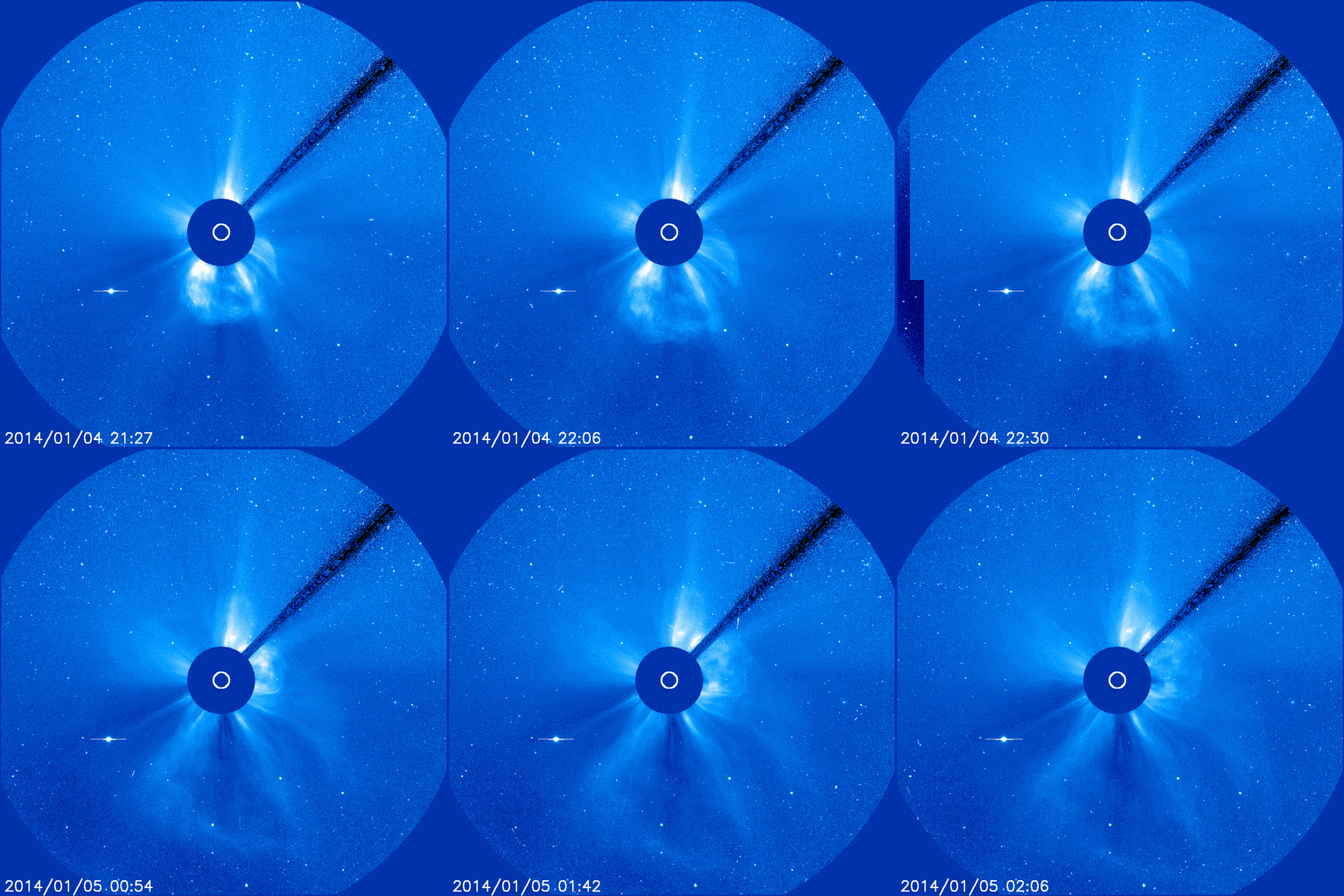
CME, POSSIBLY INCOMING: A coronal mass ejection (CME) might be heading for Earth. The cloud blasted away from the sun during the late hours of Jan 4th following a long-duration M4-class solar flare from big sunspot AR1944. SOHO (the Solar and Heliospheric Observatory) recorded the explosion:

The assymetric CME could deliver a glancing blow to Earth’s magnetic field on January 7th, possibly sparking G1-class geomagnetic storms. NOAA analysts are still processing the CME imagery for a more precise forecast.

Watch the movie again. There might be two CMEs in there. After the first cloud from sunspot AR1944 emerged, a second cloud was propelled off the sun’s western limb by departing sunspot AR1936. The mixture of CMEs complicates analysis of this event.

fr/spaceweather.com

Colombia Earthquake

Strong earthquake in Colombia at intermediate depth (felt in Cali and Medellin)

Last update: January 5, 2014 at 6:44 am by By Ashish Khanal

Update 06:39 UTC: The red cross of Colombia reports that 1 house was affected in Balboa and there are visible cracks in the fire station of  Quinchía in Risaralda .

Update 06:26 UTC: A landslide blocked the route between Yumbo and Mediacanoa.

Update 04:33 UTC :  Local sources are locating the epicenter in Sipí, Chocó. The Fire Departments of the region have not received any calls of damage yet. Based on our experience 2 to 3 hours is at least needed to assess eventual damage, although we expect NO serious damage or injuries from this earthquake

Update 04:12 UTC :  Ingeominas Colombia reports a Magnitude of M5.2 at a depth of 32 km, less than initially reported by some international agencies.

Update 04:06 UTC :  Based on the (back office) MMI shaking values people have felt the earthquake as a moderate to strong shaking in the populated areas closest to the epicenter.

Screen Shot 2014-01-05 at 05.07.37

Update 03:58 UTC : Preliminary Magnitude as reported by USGS : M5.3 at a depth of 61 km. Based on the available data at this moment, we do not think that this earthquake will generate serious damage.

Strong earthquake in Colombia at intermediate depth
The depth of the earthquake is the reason that the earthquake was felt in a wide radius.

Screen Shot 2014-01-05 at 04.52.47

USGS
40km (25mi) W of El Dovio, Colombia
51km (32mi) WNW of Roldanillo, Colombia
55km (34mi) W of La Union, Colombia
57km (35mi) W of Toro, Colombia
279km (173mi) W of Bogota, Colombia

EMSC
129 km N of Cali, Colombia / pop: 2,392,877 / local time: 22:36:41.0 2014-01-04
40 km S of Nóvita, Colombia / pop: 1,898 / local time: 22:36:41.0 2014-01-04

Most important Earthquake Data:

Magnitude : 5.4

Local Time (conversion only below land) : 2014-01-04 22:36:36

GMT/UTC Time : 2014-01-05 03:36:36

Depth (Hypocenter)  : 49 km

from:    http://earthquake-report.com/2014/01/05/strong-earthquake-colombia-on-january-5-2014/

Earthquake Lights & Rifts

Mysterious Earthquake Lights Linked To Rifts

Saturday, January 4, 2014

Rare earthquake lights are more likely to occur on or near rift environments, where subvertical faults allow stress-induced electrical currents to flow rapidly to the surface, according to a new study published in the Jan./Feb. issue of Seismological Research Letters.

An earthquake light is an unusual luminous aerial phenomenon that reportedly appears in the sky at or near areas of tectonic stress, seismic activity, or volcanic eruptions. Once commonly challenged, it was not until photographs were taken during the Matsushiro earthquake swarm in Nagano, Japan (which occurred from 1965 through 1967) that the seismology community acknowledged their occurrence.

From the early days of seismology, the luminous phenomena associated with some earthquakes have intrigued scholars. Earthquake lights (EQL) appear before or during earthquakes, but rarely after.

Earthquake lights from Tagish Lake, Yukon-Alaska border region, around the 1st of July, probably 1972 or 1973 (exact date unknown). Estimated size: 1m diameter. Closest orbs slowly drifted up the mountain to join the more distant ones.

Credit: Photo credit: Jim Conacher, used with permission

EQL take a variety of forms, including spheres of light floating through the air. Seconds before the 2009 L’Aquila, Italy earthquake struck, pedestrians saw 10-centimeter high flames of light flickering above the stone-paved Francesco Crispi Avenue in the town’s historical city center. On Nov. 12, 1988, a bright purple-pink globe of light moved through the sky along the St. Lawrence River near the city of Quebec, 11 days before a powerful quake. And in 1906, about 100 km northwest of San Francisco, a couple saw streams of light running along the ground two nights preceding that region’s great earthquake.

Continental rift environments now appear to be the common factor associated with EQL. In a detailed study of 65 documented EQL cases since 1600 A.D., 85 percent appeared spatially on or near rifts, and 97 percent appeared adjacent to subvertical faults (a rift, a graben, strike-slip or transform fault). Intraplate faults are associated with just 5 percent of Earth’s seismic activity, but 97 percent of documented cases of earthquake lights.

“The numbers are striking and unexpected,” said Robert Thériault, a geologist with the Ministère des Ressources Naturelles of Québec, who, along with colleagues, culled centuries of literature references, limiting the cases in this study to 65 of the best-documented events in the Americas and Europe.

“We don’t know quite yet why more earthquake light events are related to rift environments than other types of faults,” said Thériault, “but unlike other faults that may dip at a 30-35 degree angle, such as in subduction zones, subvertical faults characterize the rift environments in these cases.”

Two of the 65 EQL events are associated with subduction zones, but Thériault suggests there may be an unknown subvertical fault present. “We may not know the fault distribution beneath the ground,” said Thériault. “We have some idea of surface structures, but sedimentary layers or water may obscure the underlying fault structure.”

While the 65 earthquakes ranged in magnitude, from M 3.6 to 9.2, 80 percent were greater than M 5.0. The EQL varied in shape and extent, though most commonly appeared as globular luminous masses, either stationary or moving, as atmospheric illuminations or as flame-like luminosities issuing from the ground.

Timing and distance to the epicenter vary widely. Most EQL are seen before and/or during an earthquake, but rarely after, suggesting to the authors that the processes responsible for EQL formation are related to a rapid build-up of stress prior to fault rupture and rapid local stress changes during the propagation of the seismic waves. Stress-activated mobile electronic charge carriers, termed positive holes, flow swiftly along stress gradients. Upon reaching the surface, they ionize air molecules and generate the observed luminosities.

Eyewitness reports and security cameras captured a large number of light flashes during the 2007 Pisco, Peru M 8.0 earthquake. Together with seismic records obtained on a local university campus, the automatic security camera records allow for an exact timing and location of light flashes that illuminated a large portion of the night sky. The light flashes identified as EQL coincided with the passage of the seismic waves.

Thériault likes the account of a local L’Aquila resident, who, after seeing flashes of light from inside his home two hours before the main shock, rushed his family outside to safety.

“It’s one of the very few documented accounts of someone acting on the presence of earthquake lights,” said Thériault. “Earthquake lights as a pre-earthquake phenomenon, in combination with other types of parameters that vary prior to seismic activity, may one day help forecast the approach of a major quake,” said Thériault.

from:    http://beforeitsnews.com/earthquakes/2014/01/mysterious-earthquake-lights-linked-to-rifts-2483590.html

Asteroid Explodes off Venezuela

Undetected Asteroid Explodes Over The Atlantic

credit: Getty Images

Chris Carrington
Activist Post

A previously undetected asteroid entered the Earth’s atmosphere and exploded over the Atlantic Ocean, 2,200 miles off the coast of Venezuela yesterday.

The rock, the size of a car is estimated to have had an impact energy of around 750 tons of TNT. Small in cosmic terms but enough to have caused massive problems if it had hit a population center.

It has been named 2014AA, a number letter combination that indicates it was the first asteroid discovered this year, sadly it was discovered somewhat late…like after it exploded.

This incident serves to remind us all that the mission to map all space debris, junk and rocks that are likely to pose a threat to the planet is far from complete.

In other space news sunspot AR1944 is now twice the size of Earth and contains a dozen dark cores with the magnetic energy to throw off powerful flares. The spot is so big it can be seen at sunset with the naked eye.


Photo: Raymund Sarmiento of Quezon City, the Philippines

Spaceweather.com said:

The effect of any flares today will be mitigated by the fact that the sunspot is not yet directly facing Earth. However, even an off-center blast from this behemoth could produce radio blackouts and geomagnetic activity.

NOAA has increased their estimate of M-class flares to 75% and X-class to 30% over the next 24 hours.

Solar wind from the large Earth-facing coronal hole is giving rise to spectacular aurorae, such as this photographed by Chad Blakley in Sweden.

Chris Carrington is a writer, researcher and lecturer with a background in science, technology and environmental studies

from:    http://www.activistpost.com/2014/01/undetected-asteroid-explodes-over.html

Earthquake – Southern Iran

Strong dangerous earthquake in Southern Iran – At least 1 killed and 30 injured + a lot of damage

Last update: January 2, 2014 at 6:06 pm by By

Update 17:53 UTC : The following picture illustrates the power of the earthquake.

The impact of the earthquake in the epicenter area is very hight with about 60% of the houses damaged. 10% is uninhabitable. Tents and other aid are being delivered to this area. Unfortunately a lot of infrastructure (bridges, power lines and administration buildings were also damaged)

Image courtesy and copyright ISNA Iran

Image courtesy and copyright ISNA Iran

Update 10:01 UTC :

 Iran is, after China, the most dangerous country in the world for earthquakes, mainly because of the type of earthquakes.

Image courtesy and copyright frasnews.com

Image courtesy and copyright farsnews.com

Update 06:45 UTC:
30 injured people are now confirmed, from which 14 are treated outpatient. 3 people, who were buried under the debris of collapsed houses, were severely injured.
Not only Bastak (which has approx. 8000 inhabitants), but also other villages near the epicenter suffered damage. The Red Crescent is currently evaluating the exact extend of damage.

A strong and shallow earthquake hit the Iranian province Hormozgan this morning and caused extensive damage in surrounding towns and villages. According to initial reports, many houses collaped or were severely damaged. Others suffered minor damage. Esspecially the town Bastak, only a few km west of the epicenter, is affected. So far it is conformed, that one resident was killed and 15 others were injured.

Nearby Cities
47km (29mi) S of Lar, Iran
53km (33mi) SSE of Gerash, Iran
87km (54mi) NNE of Kish, Iran
89km (55mi) NNW of Bandar-e Lengeh, Iran
309km (192mi) N of Abu Dhabi, United Arab Emirates

Iran Shakemap

Most important Earthquake Data:

Magnitude : 5.3

Local Time (conversion only below land) : 2014-01-02 06:43:58

GMT/UTC Time : 2014-01-02 03:13:58

from:    http://earthquake-report.com/2014/01/02/strong-earthquake-southern-iran-on-january-2-2014/