The Science of Tsunamis

The Science Behind a Tsunami

by NANCY ATKINSON on MARCH 12, 2011

Model projections of wave heights from the Japan quake on Friday. Image from NOAA. Click image for higher resolution.

The massive magnitude 8.9 earthquake that struck off the east coast Japan’s main island on March 11, 2011 set in motion a fierce tsunami that may have claimed thousands of lives, and sent tsunami warnings all across the Pacific basin, thousands of kilometers away from the quake’s epicenter. How do earthquakes trigger such enormous tsunami events, and how can scientists predict where these massive waves might travel? Universe Today talked with Anne Sheehan, who is a professor of geological sciences at University of Colorado at Boulder, and is also affiliated with the Cooperative Institute for Research in Environmental Sciences, as well as getting input from David Admiraal, an associate professor of Engineering at the University of Nebraska Lincoln.

Universe Today: How does an earthquake trigger a tsunami?

to read the rest of the article go to:

http://www.universetoday.com/84004/the-science-behind-a-tsunami/


Video of Saturn Cassini Flyby

Using thousands of single frame images shot by the Cassini Spacecraft since 2004, researchers have assembled this impressive video ‘flyby’ of Saturn and its moons:  http://1.usa.gov/fVX1WQ

Amazing work; and some nice music, too!

Once Again-Has Atlantis Been Found

By IBTimes Staff Reporter | March 15, 2011 8:26 AM HKT

The legendary lost city of Atlantis that has found place in tales and fables and was thought to have been swallowed up by a massive tsunami in 9600 BC, may be found in the marshlands of the Dona Ana Park, southwest Spain, claim researchers…,.

Check out the link to read more:

Fr/http://hken.ibtimes.com/articles/122334/20110314/has-the-mysterious-lost-city-of-atlantis-been-found-atlantis-spain-marshland-finding-atlantis-japan.htm


The Moon did not cause the Japan Quake

Just to be Clear: The Moon Did Not Cause the Earthquake in Japan

by NANCY ATKINSON on MARCH 11, 2011

This illustration, based on Galileo spacecraft images, shows the approximate difference in apparent size between a full moon at perigee (the closest point in the lunar orbit, pictured at left) and a full moon at apogee, the farthest point in the lunar orbit. Credit: NASA

Check out the full article at

http://www.universetoday.com/83996/just-to-be-clear-the-moon-did-not-cause-the-earthquake-in-jap

Anyhow here is how it starts:

We’re getting a lot of visitors to our site today, many searching for information about earthquakes, tsunamis, and the ‘SuperMoon’ phenomenon. Just to be clear, the Moon did not cause the earthquake in Japan. Several scientists have posted articles online today clarifying the topic, and all of them, in no uncertain terms, agree that the the upcoming perigee of the Moon — where it is closer than usual in its orbit to Earth — had nothing to do with the earthquake and ensuing tsunami. Tammy discussed this yesterday, but as we often do, we’ll also point you in the direction of an article by astronomer Phil Plait about this topic, and another by Ben Goldacre, who completely debunks an article that appeared in the Daily Mail about the possibility of a connection between the two events.

In addition, Dr. Jim Garvin, chief scientist at NASA’s Goddard Space Flight Center, has provided some answers to questions about the ‘supermoon’ phenomenon, below:


Japan Earthquake Shifted Earth’s Axis

According to one USGS scientist, the recent earthquake off the northeastern coast of Japan has moved the large island’s coast by 8 feet and shifted the Earth’s axis of rotation by almost four inches (10 cm).

Other reports are stating while only about 1500 deaths have been officially acknowledged as of 36 hours after the quake the final death toll will likely be in the tens of thousands.

Source (CNN World News)

Update:  The USGS has released an earthquake dataset and browser-enabled Google Earth explorer plugin to view earthquake data in real-time.  Click here view. Interesting to see the plate movement arrows.  Looks like the Pacific plate is explanding!

X-Class Solar Flare 3/09

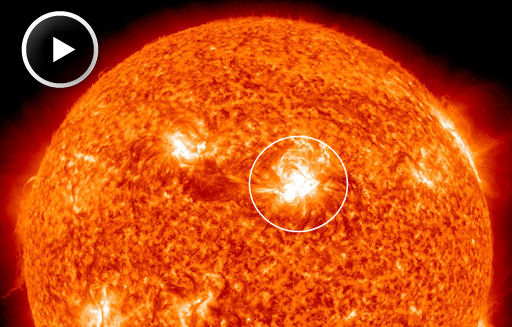
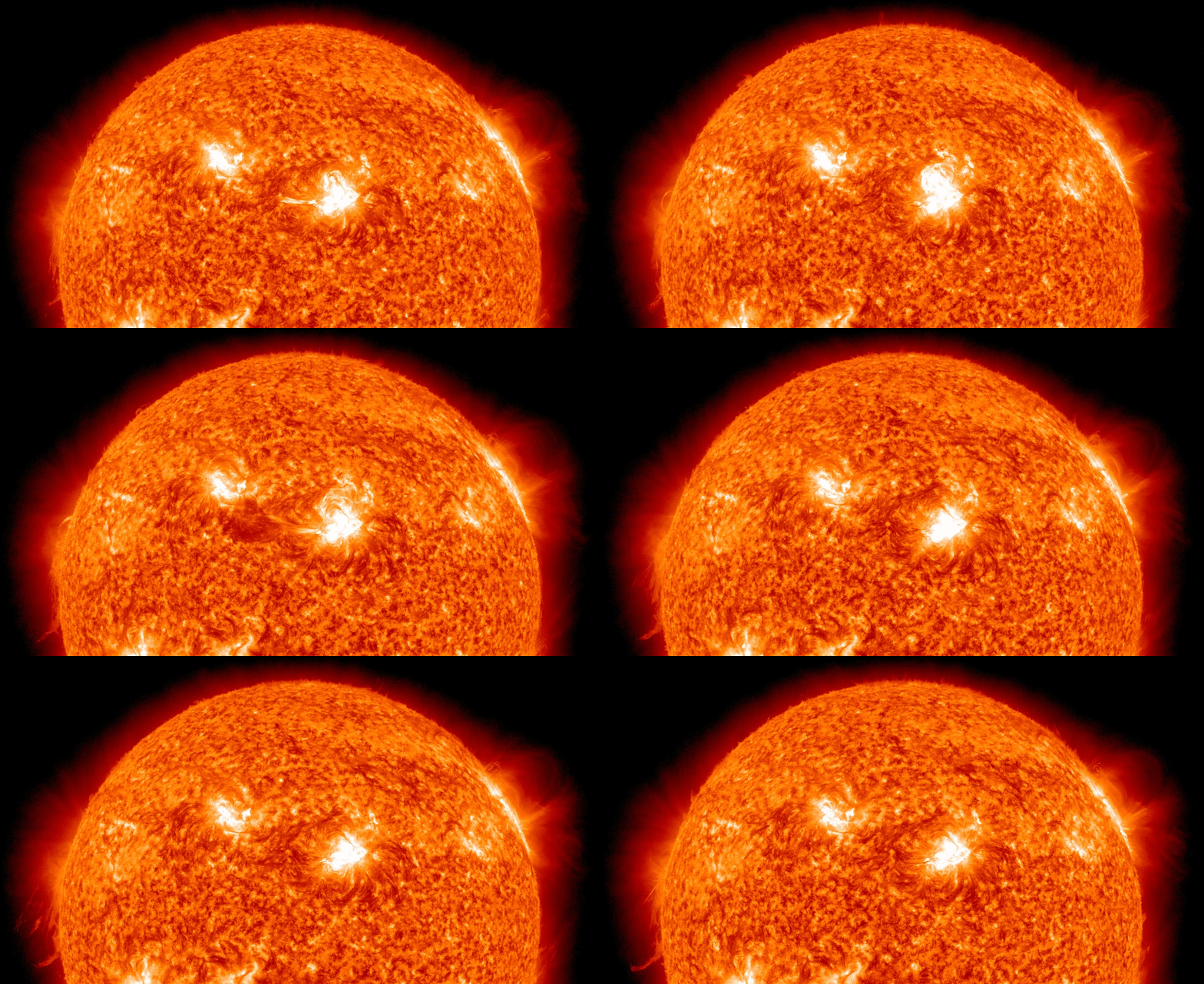
X-FLARE: March 9th ended with a powerful solar flare. Earth-orbiting satellites detected an X1.5-class explosion from behemoth sunspot 1166 around 2323 UT. A movie from NASA’s Solar Dynamics Observatory shows a bright flash of UV radiation plus some material being hurled away from the blast site:


Movie formats: 4 MB gif1.2 MB iPad0.3 MB iPhone

A first look at coronagraph images from NASA’s STEREO-B spacecraft suggests that the explosion did propel a coronal mass ejection (CME) toward Earth. This conclusion is preliminary, however, so check back later for updates.

After four years without any X-flares, the sun has produced two of the powerful blasts in less than one month: Feb. 15th and March 9th. This continues the recent trend of increasing solar activity, and shows that Solar Cycle 24 is heating up. NOAA forecasters estimate a 5% chance of more X-flares during the next 24 hours.

fr/spaceweather.com


March 8 Near Earth Asteroids

Near Earth Asteroids

Potentially Hazardous Asteroids (PHAs) are space rocks larger than approximately 100m that can come closer to Earth than 0.05 AU. None of the known PHAs is on a collision course with our planet, although astronomers are finding new ones all the time.

On March 8, 2011 there were 1204 potentially hazardous asteroids.
Recent & Upcoming Earth-asteroid encounters:
Asteroid
Date(UT)
Miss Distance
Mag.
Size
2011 EC
Mar 6
9.2 LD
34 m
2011 EO11
Mar 6
1.8 LD
15 m
2011 EY11
Mar 7
0.3 LD
9 m
2011 EC12
Mar 8
3.3 LD
28 m
2000 PN9
Mar 10
45.5 LD
2.6 km
2011 BE38
Apr 10
48 LD
1.0 km
2002 DB4
Apr 15
62.5 LD
2.2 km
2008 UC202
Apr 27
8.9 LD
10 m
2009 UK20
May 2
8.6 LD
23 m
2008 FU6
May 5
75.5 LD
1.2 km
2003 YT1
May 5
65.3 LD
2.5 km
2002 JC
Jun 1
57.5 LD
1.6 km
2009 BD
Jun 2
0.9 LD
9 m
2002 JB9
Jun 11
71.5 LD
3.2 km
2001 VH75
Jun 12
42.2 LD
1.1 km
2004 LO2
Jun 15
9.9 LD
48 m

Notes: LD means “Lunar Distance.” 1 LD = 384,401 km, the distance between Earth and the Moon. 1 LD also equals 0.00256 AU. MAG is the visual magnitude of the asteroid on the date of closest approach

fr/spaceweather.com