Solar WHAM on Its Way

WEEKEND SOLAR FLARE: Sunspot AR1429 is still erupting this weekend. On Saturday, March 10th, it produced a powerful M8-class flare that almost crossed the threshold into X-territory. During the flare, New Mexico amateur astronomer Thomas Ashcraft recorded a series of radio bursts at 21 and 28 MHz:


Dynamic spectrum courtesy Wes Greenman, Alachua County, Florida

The roaring sounds you just heard are caused by shock waves plowing through the sun’s atmosphere in the aftermath of the explosion. “There is incredible complexity in the waveforms,” notes Ashcraft. “This is a recording of one of the most turbulent events in all of Nature!”

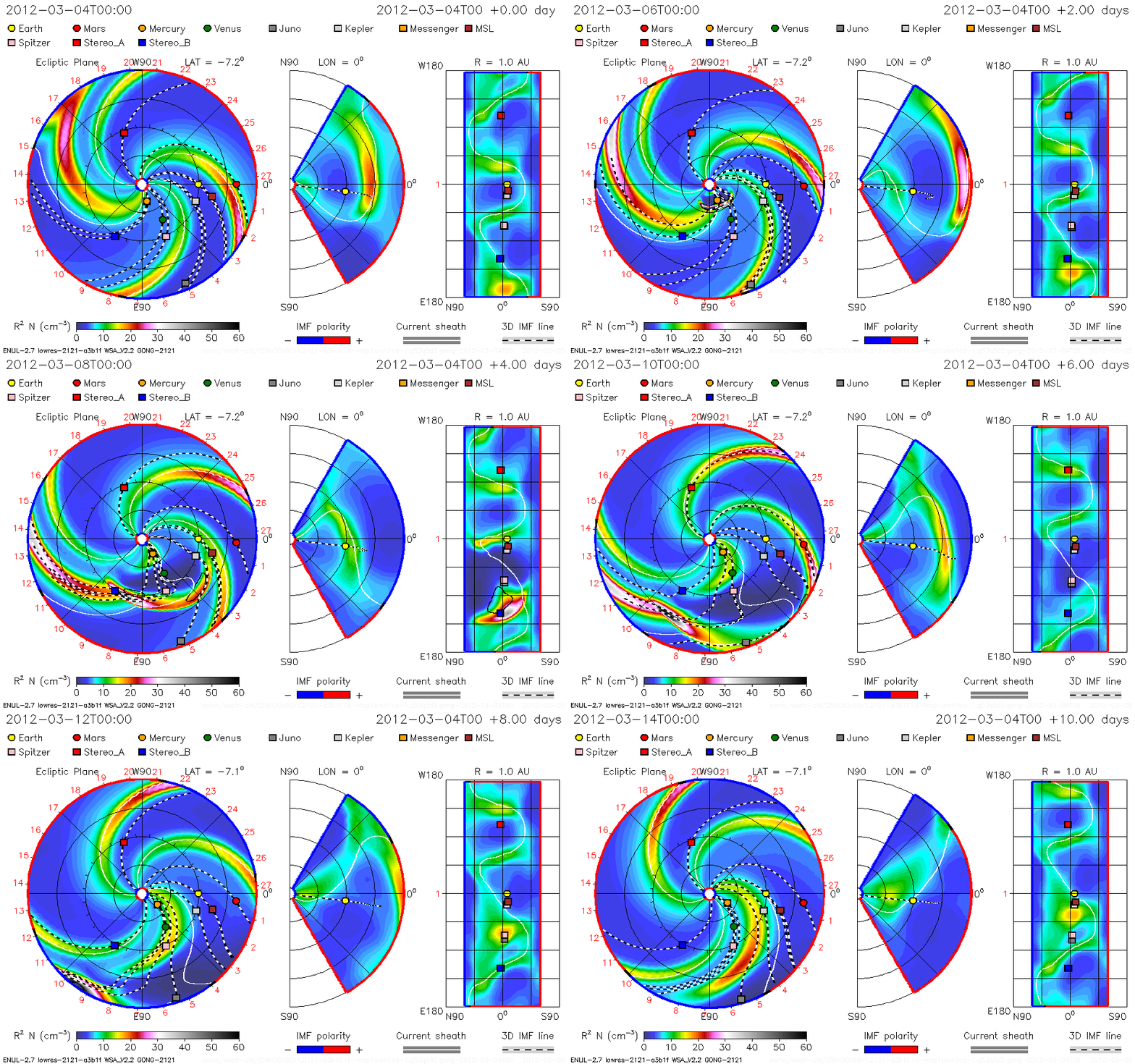
In addition, the explosion propelled yet another CME toward Earth. According to a forecast track prepared by analysts at the Goddard Space Weather Lab, the cloud will hit our planet’s magnetosphere on March 12th at 1803 UT (+/- 7 hr), possibly sparking a new round of geomagnetic storms.

After passing Earth, the CME will also hit the Mars Science Lab (MSL) spacecraft on March 13th followed by Mars itself on March 14th. Mars rover Curiosity onboard MSL might get some interesting readings as the cloud passes by.

fr/spaceweather.com

CME on the Horizon

NCOMING CME: A CME from sunspot AR1429 is nearing Earth. According to analysts at the Goddard Space Weather Lab, the cloud will arrive on March 11th at 0649 UT (+/- 7 hr). NOAA forecasters say the odds of a strong geomagnetic storm at that time is 50%.

The same eruption that hurled the CME toward Earth also produced amonsterous tsunami of plasma on the sun. NASA’s Solar Dynamics Observatory recorded the shadowy but powerful wave rippling away from the blast site:

The tsumani was about 100,000 km high and raced outward at 250 km/s with a total energy of about 2 million megatons of TNT. Such waves often underlie CMEs like the one en route to Earth now.

Animated forecast tracks show that the CME will also hit the Mars Science Lab (MSL) spacecraft on March 12th followed by Mars itself on March 13th. Mars rover Curiosity onboard MSL might get some interesting readings as the cloud passes by.

fr/spaceweather.com

Incoming Solar Flare

WEEKEND SOLAR FLARE: Sunspot AR1429 is still erupting this weekend. On Saturday, March 10th, it produced a powerful M8-class flare that almost crossed the threshold into X-territory. In New Mexico, amateur radio astronomer Thomas Ashcraft recorded a series of shortwave bursts emanating from the blast site: audio. Also, the explosion propelled yet another CME toward Earth: forecast track. The cloud is expected to hit our planet’s magnetosphere on March 12th around 1800 UT. A CME from an earlier explosion will arrive much sooner, however.

fr/spaceweather.com

Daylight Savings Times Tales

5 Crazy Chapters in the History of Daylight Saving Time

Stephanie Pappas, LiveScience Senior Writer
Date: 09 March 2012 Time: 03:11 PM ET
The sun rises over the Atlantic ocean.
The purpose of daylight saving time is to sync people’s lives with the sun.
CREDIT: Roman SigaevShutterstock

On Sunday, most Americans will wake up only to realize they’ve lost an hour of their weekend to daylight saving time — the price we pay for eight months of well-lit evenings.

Unless you live in Arizona or Hawaii, which don’t observe daylight saving, you’re probably used to this routine by now. But the history ofdaylight saving time has been anything but peaceful, from its first wartime introduction to its ongoing controversy today.

Bright idea

Ben Franklin gets credit for thinking up the idea of daylight saving time, albeit with his trademark wit. As ambassador to Paris, Franklin wrote a letter to the Journal of Paris in 1784 of his “discovery” that the sun gives light as soon as it rises, and needling Parisians for their night-owl, candle-burning ways.

Ben Franklin had the basic concept,” said David Prerau, author of “Seize the Daylight: The Curious and Contentious Story of Daylight Saving Time” (Thunder’s Mouth Press, 2005). What Franklin lacked, Prerau said, was a useful way to force everyone into living by the sun’s rules — other than some “humorous ideas” that Parisians surely wouldn’t have found very funny, including shooting off cannons at sunrise every morning.

Others took daylight saving time much more seriously, particularly William Willett, an Englishman who loved his early-morning horseback rides, Prerau told LiveScience; Willett he couldn’t believe that everyone else wanted to sleep in after the sun came up. He also touted the benefits of longer hours of daylight in the evenings.

Willett managed to get the idea of moving the clock forward during the summer months proposed in Parliament in 1908, but it was shot down.

“Willett was a steadfast guy, and so he proposed it again in 1909, 1910, 1911, and Parliament rejected it all those times,” Prerau said.

Willett might have kept this up, but he died in 1915, never to see his beloved daylight saving plan reach fruition.

Wartime rally

If Willett couldn’t convince the British populace that daylight saving time was needed, the Germans could. In 1916, with World War I ratcheting up, Germany put itself on daylight saving time to save energy for the war effort. Britain followed a month later.

When the United States got involved in the war in 1918, they too instituted daylight saving time. President Woodrow Wilson even wanted to keep the new system after the war ended. But at the time, the country was mostly rural. Farmers hated the time change, because their jobs were dependent on the sun, and daylight saving time put them out of sync with the city people who sold them goods and bought their products. Congress repealed daylight saving time, Wilson vetoed the repeal, and Congress promptly overrode his veto, a fairly rare occurrence.

“It’s been contentious,” Prerau said.

Total confusion

When World War II hit, daylight saving time came back into vogue, again to save energy for the war effort. The U.S. instituted daylight saving time less than a month after the Japanese attack on Pearl Harbor, Prerau said. This time, though, America’s increasingly industrialized population wasn’t as keen on losing their post-work daylight after the war ended. So when the national law requiring the time switch was repealed, some towns stuck with daylight saving.

It was chaos. One 35-mile bus ride from Moundsville, W.Va., to Steubenville, Ohio, took riders through no less than seven different time changes, Prerau said. At one point, the Twin Cities of Minneapolis and St. Paul were on different clocks, creating confusion for workers who lived in one city and commuted to the other.

“The suburbs didn’t know what to do at all,” Prerau said.

Uniform time

This every-town-for-itself system couldn’t last long. In 1966, Congress passed the Uniform Time act of 1966, specifying that states didn’t have to get on the daylight saving bandwagon, but that if they did, the whole state had to comply. And the federal government would determine the days of “springing forward” and “falling back,” the law stated, eliminating the problem of towns and cities setting their own daylight saving dates.

Expanding daylight saving

Since that time, Congress has expanded the length of daylight saving time three times, once in the 1970s during the country’s energy crisis, once in the 1980s, when April got brought under the daylight saving umbrella, and finally in 2007. Today, daylight saving time encompasses March into November.

The reasoning given for each of these changes was to save energy, Prerau said, but there are other benefits to springing forward. Fewer cars on the road on dark evenings mean fewer traffic accidents. And more daylight means more outdoor exercise for the after-work crowd.

On the other hand, expanding daylight saving time to encompass any more of the year might cause trouble. Russia shifted their clock to permanent daylight saving time in 2011, which worked fine until the depths of winter. Suddenly, the sun was rising at 10 a.m. in Moscow and 11 a.m. in St. Petersburg, Prerau said. People aren’t fond of starting their days in the pitch-black, he said, and now there’s talk of reversing the decision.

from:    http://www.livescience.com/18965-history-daylight-saving-time.html

Continuing Solar Storms


Solar storms causing few problems on Earth

Geomagnetic and solar radiation storms hitting Earth after Tuesday’s solar flares may not be as big as advertised, the National Oceanic and Atmospheric Administration said Thursday.

Together, such storms can affect GPS systems, other satellite systems and power grids, but none of these problems has been reported, even as the leading edge of the sun’s coronal mass ejections from Tuesday hit Earth on Thursday morning, scientists said.

The geomagnetic storm has reached only G1 intensity on a scale from G1 (weak) to G5 (extreme), and the solar radiation storm is an S3 (strong) on a similar 1-to-5 scale, NOAA’s Space Weather Prediction Center said. Earlier, NOAA had predicted a G3/S4 event.

Still, the solar radiation storm has prompted some airlines to divert planes from routes near the north pole, where radio communications may be affected and passengers at high altitudes may be at a higher than normal radiation risk.

“Today we are using alternate routes for seven westbound flights to Asia. We will monitor possible solar impact to the operation in making decisions for tomorrow and future dates,” Delta Air Lines spokesman Anthony Black said.

American Airlines put three high-polar flights  from the U.S. to Japan and China on lower-altitude routes on Thursday, spokesman Ed Martelle said. And United Airlines rerouted four flights to Asia, according to United spokesman Mike Trevino.

The geomagnetic storm still could give earthlings quite a show Thursday night. The storm is expected to produce auroras, or northern lights, that may be visible as far south as the northern United States, said Physicist Joseph Kunches with the Space Weather Prediction Center.

Tuesday’s solar eruptions included two solar flares – intense bursts of radiation from the sun – and two coronal mass ejections, which are releases of gas and magnetic fields from the outer sun. The coronal mass ejections reached Earth on Thursday.

Kunches likened the challenge of forecasting the strength of the storms to hitting a major league pitcher’s fastball.

“Like a hitter, we try (to) figure out if the pitch is coming down the middle of the plate or is low and outside,” Kunches said. “The problem is, the pitch comes from the sun from 93 million miles away.”

Forecasters also try to figure out which way the particles ejected from the sun are oriented, which has major implications on how strong the event will be.

“Like a curveball, the orientation can change. We didn’t see the spin with this event,” Kunches said.

He added that the event is not over, and the effect of the solar radiation could increase if it becomes better aligned later Thursday. By Friday morning, the solar storm should be diminishing.

The sunspot that produced the storms, however, still will be facing Earth through the weekend, and further emissions could bring new storms to the planet.

from:   http://lightyears.blogs.cnn.com/2012/03/08/radiation-from-solar-storms-begins-to-hit-earth/?hpt=hp_c2

Latest on Search for Higgs Boson

Tevatron experiments report latest results in search for Higgs boson

March 7, 2012

Tevatron experiments report latest results in search for Higgs bosonEnlargeObserved and expected exclusion limits for a Standard Model Higgs boson at the 95-percent confidence level for the combined CDF and DZero analyses. The limits are expressed as multiples of the SM prediction for test masses chosen every 5 GeV/c2 in the range of 100 to 200 GeV/c2. The points are joined by straight lines for better readability. The yellow and green bands indicate the 68- and 95-percent probability regions, in the absence of a signal.The difference between the observed and expected limits around 124 GeV could be explained by the presense of a Higgs boson whose mass would lie between 115 to 135 GeV. The CDF and DZero data exclude a Higgs boson between 147 and 179 GeV/c2 at the 95-percent confidence level.

(PhysOrg.com) — New measurements announced today by scientists from the CDF and DZero collaborations at the Department of Energy’s Fermi National Accelerator Laboratory indicate that the elusive Higgs boson may nearly be cornered. After analyzing the full data set from the Tevatron accelerator, which completed its last run in September 2011, the two independent experiments see hints of a Higgs boson.  

Physicists from the CDF and DZero collaborations found excesses in their data that might be interpreted as coming from a  with a mass in the region of 115 to 135 GeV. In this range, the new result has a probability of being due to a statistical fluctuation at level of significance known among scientists as 2.2 sigma. This new result also excludes the possibility of the Higgs having a mass in the range from 147 to 179 GeV.

Physicists claim evidence of a new particle only if the probability that the data could be due to a statistical fluctuation is less than 1 in 740, or three sigmas. A discovery is claimed only if that probability is less than 1 in 3.5 million, or five sigmas.

This result sits well within the stringent constraints established by earlier direct and indirect measurements made by CERN’s , the Tevatron, and other accelerators, which place the mass of the Higgs boson within the range of 115 to 127 GeV. These findings are also consistent with the December 2011 announcement of excesses seen in that range by LHC experiments, which searched for the Higgs in different decay patterns. None of the hints announced so far from the Tevatron or LHC experiments, however, are strong enough to claim evidence for the Higgs boson.

“The end game is approaching in the hunt for the Higgs boson,” said Jim Siegrist, DOE Associate Director of Science for High Energy Physics. “This is an important milestone for the Tevatron experiments, and demonstrates the continuing importance of independent  in the quest to understand the building blocks of nature.”

Physicists from the CDF and DZero experiments made the announcement at the annual conference on Electroweak Interactions and Unified Theories known as Rencontres de Moriond in Italy. This is the latest result in a decade-long search by teams of physicists at the Tevatron.

“I am thrilled with the pace of progress in the hunt for the Higgs boson. CDF and DZero scientists from around the world have pulled out all the stops to reach this very nice and important contribution to the Higgs boson search,” said Fermilab Director Pier Oddone. “The two collaborations independently combed through hundreds of trillions of proton-antiproton collisions recorded by their experiments to arrive at this exciting result.”

Higgs bosons, if they exist, are short-lived and can decay in many different ways. Just as a vending machine might return the same amount of change using different combinations of coins, the Higgs can decay into different combinations of particles. Discovering the Higgs boson relies on observing a statistically significant excess of the particles into which the Higgs decays and those particles must have corresponding kinematic properties that allow for the mass of the Higgs to be reconstructed.

“There is still much work ahead before the scientific community can say for sure whether the Higgs boson exists,” said Dmitri Denisov, DZero co-spokesperson and physicist at Fermilab. “Based on these exciting hints, we are working as quickly as possible to further improve our analysis methods and squeeze the last ounce out of Tevatron data.”

Only high-energy particle colliders such as the Tevatron and LHC can recreate the energy conditions found in the universe shortly after the Big Bang. According to the , the theory that explains and predicts how nature’s building blocks behave and interact with each other, the Higgs boson gives mass to other particles.

“Without something like the Higgs boson giving fundamental particles mass, the whole world around us would be very different from what we see today,” said Giovanni Punzi, CDF co-spokesperson and physicist at the National Institute of Nuclear Physics, or INFN, in Pisa, Italy. “Physicists have known for a long time that the Higgs or something like it must exist, and we are eager to finally pin this phenomenon down and start learning more about it.”

If a Higgs boson is created in a high-energy particle collision, it immediately decays into lighter more stable particles before even the world’s best detectors and fastest computers can snap a picture of it. To find the Higgs boson, physicists retraced the path of these secondary particles and ruled out processes that mimic its signal.

The experiments at the Tevatron and the LHC offer a complementary search strategy for the Higgs boson. The Tevatron was a proton/anti-proton collider, with a maximum center of mass energy of 2 TeV, whereas the LHC is a proton/proton collider that will ultimately reach 14 TeV. Because the two accelerators collide different pairs of particles at different energies and produce different types of backgrounds, the search strategies are different. At the Tevatron, for example, the most powerful method is to search the CDF and DZero datasets to look for a Higgs boson that decays into a pair of bottom quarks if the Higgs boson mass is approximately 115-130 GeV. It is crucial to observe the Higgs boson in several types of decay modes because the Standard Model predicts different branching ratios for different decay modes. If these ratios are observed, then this is experimental confirmation of both the Standard Model and the Higgs.

“The search for the Higgs boson by the Tevatron and LHC experiments is like two people taking a picture of a park from different vantage points,” said Gregorio Bernardi, DZero co-spokesperson at the Nuclear Physics Laboratory of the High Energies, or LPNHE, in Paris . “One picture may show a child that is blocked from the other’s view by a tree. Both pictures may show the child but only one can resolve the child’s features. You need to combine both viewpoints to get a true picture of who is in the park. At this point both pictures are fuzzy and we think maybe they show someone in the park. Eventually the LHC with future data samples will be able to give us a sharp picture of what is there. The Tevatron by further improving its analyses will also sharpen the picture which is emerging today.”

This new updated analysis uses 10 inverse femtobarns of data from both CDF and DZero, the full data set collected from 10 years of the Tevatron’s collider program. Ten inverse femtobarns of data represents about 500 trillion proton-antiproton collisions. Data analysis will continue at both experiments.

“This result represents years of work from hundreds of scientists around the world,” said Rob Roser,  co-spokesperson and physicist at Fermilab. “But we are not done yet – together with our LHC colleagues, we expect 2012 to be the year we know whether the Higgs exists or not, and assuming it is discovered, we will have first indications that it behaves as predicted by the Standard Model.”

Check out the source for more information and a video:    http://www.physorg.com/news/2012-03-tevatron-latest-results-higgs-boson.html


On “Sluts” and Limbaugh

Why ‘Slut’ Stings: Etymology of a Limbaugh Controversy

Stephanie Pappas, LiveScience Senior Writer
Date: 06 March 2012 Time: 01:59 PM ET
SlutWalk London march with a banner.
Reclaiming ‘slut’? Women march in London in 2011, protesting the idea that women invite assault and harassment by dressing ‘slutty.’
CREDIT: Padmayogini / Shutterstock.com


(NOTE:   I do believe that Al Franken’s description of Rush Limbaugh as “A Big Fat Idiot” is correct, and Limbaugh’s most recent gaffe seems finally to have brought that realization to others, including radio stations and sponsors.  Hopefully it can shake up some of those right wing, self-satisfied, do-(not so)gooders who left their brains where they could be scooped up and collected and controlled.)

The media stir and public outrage over conservative radio host Rush Limbaugh’s “slut statement” may have the conservative radio host eating his words — ancient words, that is. According to linguists, the word “slut” has quite a history.

Last week, Limbaugh triggered widespread outrage by calling a Georgetown law student who spoke out for contraceptive coverage in insurance a “slut” and a “prostitute.”

Limbaugh has since apologized for his “choice of words,” but his critics, including Fluke, do not see that apology as sincere. Meanwhile, at least a dozen advertisers have yanked their ads from Limbaugh’s show, and a Hawaii-based radio station has announced it will no longer air his show.

Limbaugh’s brand of intentionally inflammatory radio rhetoric has won him decades on air and millions of listeners. He’s said that Michael J. Fox, who has Parkinson’s disease, exaggerated his symptoms in a 2006 commercial, and he once joked that then-13-year-old Chelsea Clinton was the “White House dog.” But with his “slut” comments, Limbaugh seems to have stepped into a controversy with a long linguistic history.

The origins of the word slut are lost to time, but English poet Geoffrey Chaucer gets credit for being one of the first to put it in print, calling a sloppy male character “sluttish” in the late 1300s.

But if slut ever widely referred to men, it didn’t last long. By the 1400s, the word was being used to described kitchen maids and sloppy, dirty women. The sexual connotations followed not long behind.

The Oxford English dictionary serves up a variety of cringe-inducing examples, from the 1621 work “The Anatomy of Melancholy,” which refers to “a peevish drunken flurt, a waspish cholerick slut,” to a character in Charles Dickens’ “The Life and Adventures of Nicholas Nickleby” calling another a “slut, a hussy, an impudent artful hussy!”

The word’s associations with dirt and filth continue in phrases like “slut’s wool,” more genially known as “dust bunnies,” and “slut’s-hole,” a word once used to refer to garbage receptacles.

Beyond the sting of slut, Limbaugh’s comments have also drawn controversy because of the message behind the words. Limbaugh’s target, Fluke, was speaking on the hot-button topic of businesses run by religious institutions providing contraception coverage.

This issue came bundled with other big news about reproductive health, including a bill in Virginia mandating ultrasounds for women seeking abortions and  the failed Blunt Amendment, an attempt in the U.S. Senate to ensure that employers can opt out of covering health care, especially birth control, that goes against their religious or moral beliefs. With these efforts at the forefront, Limbaugh’s remarks provided a spark for outrage.

But the word slut has also had its day in the sun. Last year, Canadian women started a protest called “SlutWalk,” in response to a policeman saying that women should “avoid dressing like sluts” in order to avoid sexual assault.

“Historically, the term ‘slut’ has carried a predominantly negative connotation. Aimed at those who are sexually promiscuous, be it for work or pleasure, it has primarily been women who have suffered under the burden of this label,” protest organizers wrote on their website, SlutWalk Toronto. “And whether dished out as a serious indictment of one’s character or merely as a flippant insult, the intent behind the word is always to wound, so we’re taking it back. ‘Slut’ is being re-appropriated.”

The protests, which quickly went international, sparked a conversation about whether the word is beyond redemption. But if Limbaugh’s continued hemorrhage of advertisers, even after an apology, is any indication, the word slut is far from redeemed.

http://www.livescience.com/18864-slut-limbaugh-controversy.html

X5 Class Solar Eruption

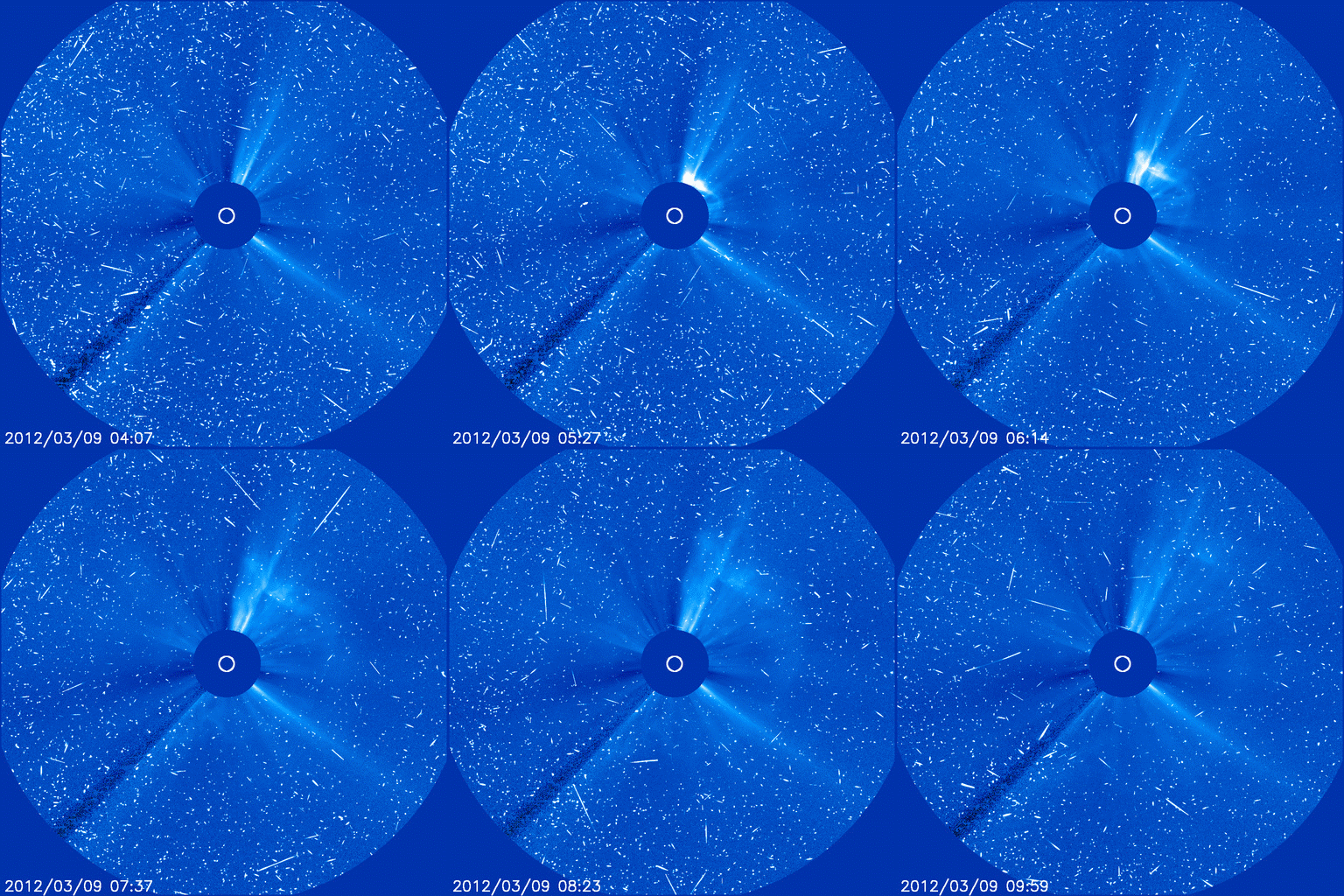
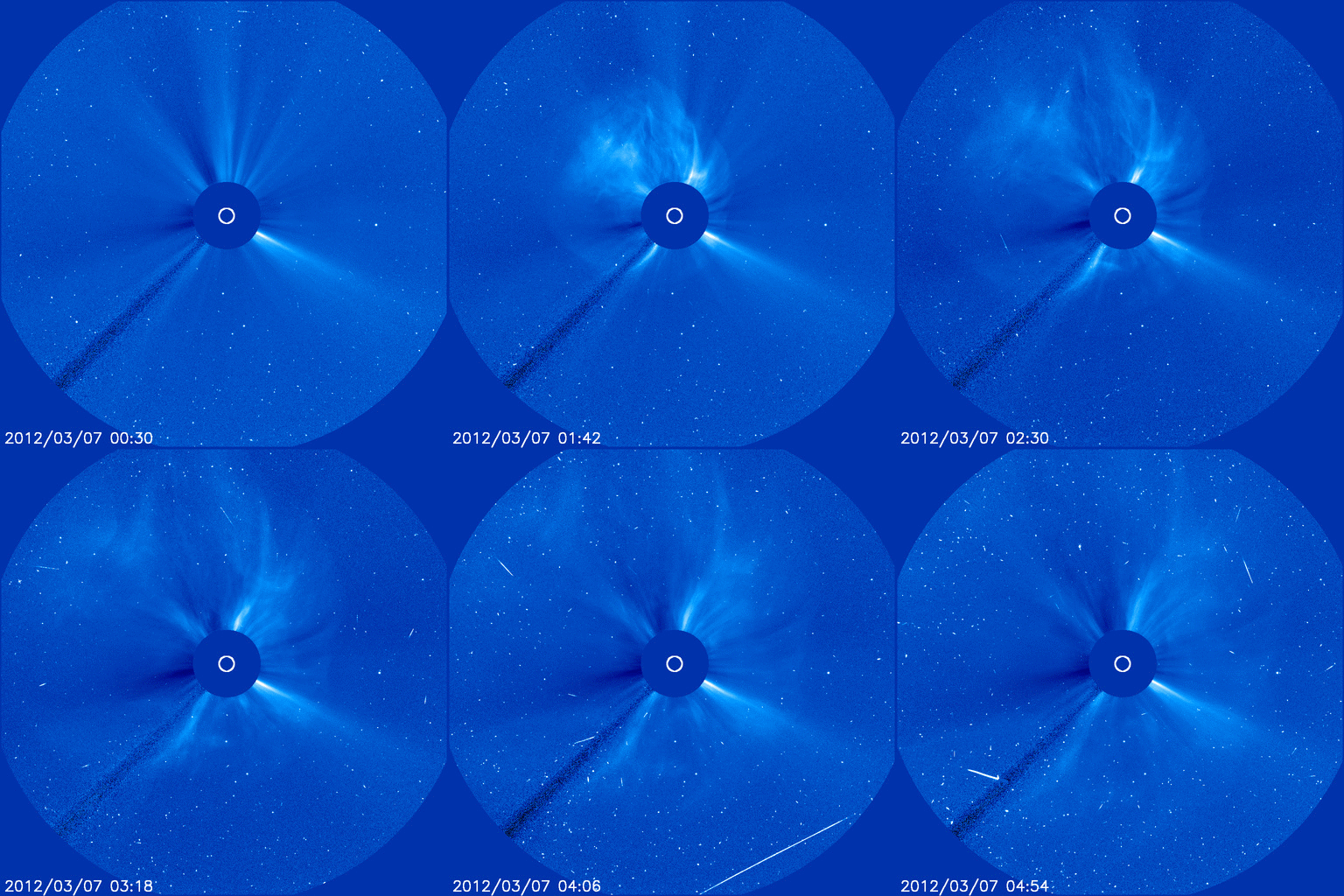
MAJOR SOLAR FLARE: Big sunspot AR1429 has unleashed another major flare. This one is the strongest yet, an X5-class eruption on March 7th at 00:28 UT. NASA’s Solar Dynamics Observatory recorded the extreme UV flash:

This eruption hurled a bright CME into space, shown here in a movie from the Solar and Heliospheric Observatory. Although the CME is not squarely Earth-directed, it appears direct enough to deliver a glancing blow to our planet’s magnetic field on March 8-9. This would add to the magnetic unrest already underway at high latitudes.

The flare also accelerated energetic protons toward Earth, triggering an S3-class solar radiation storm, in progress. Such a storm is mainly a nuisance to satellites, causing occasional reboots of onboard computers and adding noise to imaging systems.

fr/spaceweather.com

On Alchemical Symbols

Ancient Alchemy Symbols and
Universal Meanings

Ancient Alchemy Symbols and their oft times cryptic meanings began out of necessity as alchemists disguised their practices from the hugely powerful European church. At the height of its practice, alchemy was considered heretical craft by the church, punishable by death (or worse, torture). The church body at the time viewed alchemy as a way for the practitioner to ascend to salvation outside of the “traditional” church methodology.

Although ancient alchemy symbols were born out of this necessity, the foundation of alchemical practice is based on inner transformation and the achievement of that transformation. As a means for this transmutation, the alchemist utilized the changing properties of matter in addition to the philosophical meanings of the symbols themselves.

The very act of turning base metals to gold is a symbol of (wo)mans ascension and achievement of enlightenment. All things, no matter how banal, hold deeper spiritual symbolic meaning to the alchemist in all of us.

Below are some ancient alchemy symbols and their meanings.

Alchemical Abracadabra Symbol Abracadabra:
This is a Cabalistic charm with origins from Hebrew initials of the Father, Son, and Holy Spirit. This is an ancient alchemy symbol used for an antidote for illness and used to augment healing. This phrase was written on parchment and suspended from then neck by a thread in the triangular form seen here.
.
Alchemy Aleph Symbol Aleph:
This ancient alchemy symbol is derived from the “Secret Tradition” or the Cabala. The Aleph is the first letter of the Hebrew alphabet, and is the spiritual root of all harmony.
.
Alchemy Caduceus Sign Caduceus:
Also symbolic of Mercury, the Caduceus is a figure of two serpents wrapped around a center rod. The rod is a symbol of transforming alchemical power. The two serpents represent polarity or duality. Together with the sprouted wings depict the caduceus having an alchemical meaning of balance, duality and following the alchemical process leading to unity. The caduceus is also seen in medical circles. This is a logical match as the caduceus calls for unity and balance on an internal level and is hailed as a symbol for healing.
.
Alchemy Cube Symbol Cube:
The cube represents the earth in Pythagorean, Indian, and Platonic traditions. In Egypt, the Pharaoh is often depicted sitting on a cubic throne. In India, many statues of deities are shown standing on a cube – one under each foot. It is understood as a building block of all simple matter – and it is also understood that within it supernatural possibilities abound. Therefore cube represents the earth from which the spiritual king comes forth. The symbolic meaning of number four may also help you understand this symbol further.
.
Alchemical Ergon Symbol Ergon:
This is the spiritual ancient alchemy symbol for the right eye of the soul, by which it looks to the eternal. This symbol allows focus on higher, finer spiritual vibrations. It also ascertains the infinite nature of our soul, and our capability to tap into the infinite universe.
.
Alchemical Fire Fire:
“That which the fire operates is alchemy, whether in the kitchen or in the universe” as stated by the alchemical forefather Paracelsus 1493-1541. More specifically this ancient alchemy symbol represents divine energy, purification, revelation, and transformation. As such, fire was (and still is) an important sign in the alchemist’s arsenal of emblems. .
.
Alchemicy Symbol for Moon Moon:
Alchemically speaking, the moon represents Silver, the Lesser Work, or Mercury. It conjoins with the sun, or Gold in the Greater Work. In more practical terms, the moon represents fertility, resurrection, occult power, immortality and intuition. The moon is a feminine property and alchemists would incorporate it with the sun (gold) to assure balance. 
.
Alchemy Symbol for Peacock Tail Peacock Tail:
Near the end of the alchemical Operation this symbol would appear. Its many-colored surface on molten metals heralded the nearness of the final stage of transformation. Further, when the alchemical Operation came to this point, the volatile parts of the residue were transcended, and the peacock, as all winged creatures, symbolized changeability. Thus the peacock’s spiritual representation is that of smooth transition.
.
Alchemy Pentacle Symbol Pentacle:
Quite the opposite of its unfortunate reputation, the pentacle is a symbol of harmony, health and mystic powers. The Pythagoreans adopted it as a sign of health and the marriage of heaven and earth. As a sign of heaven, earth, as well as human body and mind, the pentacle holds great power. So much so, that it was used as a protective emblem among alchemists and magicians alike. Specifically, alchemists would press this symbol on hermetic books to emphasize the knowledge within as being protected and sacred.
.
Alchemy Quincunx Symbol Quincunx:
An arrangement of five figures within a square. Historically, it has infused the worlds of nature, man and the stars. As an ancient alchemy symbol, it represents the whole being more than the sum of its parts. In the alchemical mineral world, the quincunx occurs in the formation of metals, in atomic structures. Additionally the quincunx represents (wo)man’s ability to cross from four to five his/her nature. Meaning we all possess the four levels of physical matter (stone, plant, animal, man) and we are able to ascend from these four elements to the final fifth – which is godlike or enlightened stature.
.
Alchemy Symbol of the Rosey Window Rose Windows:
Gothic circular windows, shaped like a rose – mostly seen in stained glass in cathedrals. Designed by Chartres, a master craftsman, this stained glass was made from a secret recipe using antimony. The windows have a transformational effect on the contemplator. Essentially a dodecahedron, this symbol is connected with the ether, or the fifth element. By viewing it as a mandala, the rose window brings about an altered state of perception, allowing the observer to tap into the ethereal planes.
.
Alchemy Sun Symbol


Sun:
The ancient alchemy symbol of gold. Worshipped in many cultures, specifically Egypt where Amon-Ra was personified by the evening sun setting at the end of the creative process. Alchemists understood the process of creation, and utilized the symbol of the sun to focus on creating desired effects in their practice – both physically and philosophically


from:    http://www.whats-your-sign.com/ancient-alchemy-symbols.html

Incoming CME 3/6

STRONG SOLAR ACTIVITY: Solar activity is now high. Big sunspot AR1429, which emerged on March 2nd, is crackling with strong flares. This morning brought the strongest so far–an X1-class eruption on March 5th at 0413 UT. NASA’s Solar Dynamics Observatory recorded the extreme ultraviolet flash:

Update: The explosion also hurled a bright CME into space. According to analysts at the Goddard Space Weather Lab, the CME will probably miss Earth, although it will hit Mercury and Venus. An animated forecast track shows the likely progression of the cloud.

Even if this CME misses, high-latitude sky watchers should still be alert for auroras in the nights ahead. An M2-class eruption from the same sunspot on March 4th produced another, wider CME that might yet intersect Earth. The cloud is expected to deliver a glancing blow to our planet’s magnetic field on March 6th at 04:30 UT (+/- 7 hr).

fr/spaceweather.com