Our Sun is a Happy Star

Smiley Face on the Sun? New Video Shows All

by Clara Moskowitz, SPACE.com Senior Writer
Date: 02 August 2011 Time: 04:00 AM ET
Video of smiley face on the sun.
This still from a NASA video shows an apparent smiley face on the sun as seen by the Solar Dynamics Observatory. The solar happy face is seen in different wavelengths in a video posted on July 25, 2011.
CREDIT: NASA/SDO/GSFC

Our sun is apparently a happy star according to the latest video from a NASA observatory. The video shows a pattern of sunspots that, when viewed from afar, forms a vast happy face smiling across face of the sun.

Sunspots are darker, cooler patches on the sun caused when intense magnetic activity blocks heat convection. These spots are normal, but they don’t usually align to give the sun’s face such character.

The smile on the sun is visible through 11 photographs taken by NASA’s Solar Dynamics Observatory, which images the sun from Earth orbit. Each picture was taken at the same time, but through a different filter that separated out a narrow wavelength band of light. The images range from lowest temperature to highest.

for more, including the video, go to:    http://www.space.com/12502-sun-smiley-face-video-sunspots.html


Esoteric Energy Systems

Esoteric Energy Systems: Kundalini Yoga, Taoist Alchemy, and the Pineal Gland

ThirdEyeLrg.JPG

Traditions of Esoteric Energy Systems

Many spiritual traditions, particularly those of the East, have attempted to create synthesized systems that incorporate aspects of biological fact and aspects of religious belief regarding “subtle” or “astral” bodies into a functional system of medicine and health. The most well known of these today is the Chinese tradition of acupuncture, qi, and energetic meridians. Also well known are the systems of chakras and pranas in Hindu Ayurvedic medicine. Both of these remarkably comprehensive and detailed systems predate what we would consider modern medicine, and both Eastern systems are still being used today. The basic, yet extremely important, distinction between Ayurveda and Chinese medicine and contemporary Western medicine is that the theoretical system of Western medicine does not include a component of energy in the human being beyond what is materially visible in the body and its electrochemical reactions.

Both Ayurveda and traditional Chinese medicine are based on the theoretical premise that there is an energy component of the human body that transcends, yet is intimately linked to, the physical body. In Ayurveda and Kundalini yoga the idea is that prana, (which can be though of literally as breath, but also metaphorically as life energy) flows through energy centers called chakras and nadis points or nadirs, and that health is based to a large degree on the proper flow of prana through the body (1). Yogic exercises are used to promote the healthy flow of prana. In Chinese medicine we also find the idea that there is a non-physical energy component of the human body, which they call qi, that can be regulated by acupuncture and exercises like martial arts and Qigong (2). Both of these traditions, whether in Tantric ritual texts or in Taoist scripture, teach that this spiritual energy (which may or may not be easily equated with literal internal and sexual fluids) must be conserved for the spiritual development and health of the individual (3).

Intriguingly, both of these spiritual medicine systems also focus on parts of the head — particularly the space between and slightly above the eyes, and the place at the top of the head — as focal points of these “subtle energies.” Modern anatomical science has located the mysterious pineal gland as being close to the center of the brain, making it the gland nearest in proximity to the top of the head (4). The pituitary gland is nearest to the location of what has been iconographically identified as the “third eye” in Hindu traditions (5). By investigating these physical and energetic locations described in religious texts as a basis of comparison we may analyze and compare these Eastern medicine systems with known facts about human neurobiology to see what connections may be found.

to read more, go to:    http://www.realitysandwich.com/kundalini_taoist_pineal_gland

Urn Options

THIS AWESOME URN WILL TURN YOU INTO A TREE AFTER YOU DIE

Teodora Zareva on May 6, 2011, 11:50 PM

You don’t find many designers working in the funeral business thinking about more creative ways for you to leave this world (and maybe they should be). However, Spanish designer Martin Azua has combined the romantic notion of life after death with an eco solution to the dirty business of the actual, you know, transition.

His Bios Urn is a biodegradable urn made from coconut shell, compacted peat and cellulose and inside it contains the seed of a tree. Once your remains have been placed into the urn, it can be planted and then the seed germinates and begins to grow. You even have the choice to pick the type of plant you would like to become, depending on what kind of planting space you prefer.

bios2

I, personally, would much rather leave behind a tree than a tombstone.

fr/http://bigthink.com/ideas/38299

Atlantis—Real or Rumor?

  • Photo: Illustration of Atlantis

An illustration by Sir Gerald Hargreaves shows a utopian scene on a cove of the mythical land of Atlantis. Many scholars think Plato invented the story of Atlantis as a way to present his philosophical theories.

Photograph by Mary Evans Picture Library/Everett Collection

By Willie Drye

If the writing of the ancient Greek philosopher Plato had not contained so much truth about the human condition, his name would have been forgotten centuries ago.

But one of his most famous stories—the cataclysmic destruction of the ancient civilization of Atlantis—is almost certainly false. So why is this story still repeated more than 2,300 years after Plato’s death?

“It’s a story that captures the imagination,” says James Romm, a professor of classics at Bard College in Annandale, New York. “It’s a great myth. It has a lot of elements that people love to fantasize about.”

Plato told the story of Atlantis around 360 B.C. The founders of Atlantis, he said, were half god and half human. They created a utopian civilization and became a great naval power. Their home was made up of concentric islands separated by wide moats and linked by a canal that penetrated to the center. The lush islands contained gold, silver, and other precious metals and supported an abundance of rare, exotic wildlife. There was a great capital city on the central island.

There are many theories about where Atlantis was—in the Mediterranean, off the coast of Spain, even under what is now Antarctica. “Pick a spot on the map, and someone has said that Atlantis was there,” says Charles Orser, curator of history at the New York State Museum in Albany. “Every place you can imagine.”

Plato said Atlantis existed about 9,000 years before his own time, and that its story had been passed down by poets, priests, and others. But Plato’s writings about Atlantis are the only known records of its existence.

Possibly Based on Real Events?

to read more, go to:http://science.nationalgeographic.com/science/archaeology/atlantis/?source=A-to-Z

7/29 Solar Flare

fr/spaceweather.com

SOLAR FLARE: Sunspot AR1261 unleashed a brief but powerful solar flare on July 30th at 0209 UT. Registering M9 on the Richter Scale of Flares, the blast almost crossed the threshold into X-territory (X-class flares are the most powerful kind). NASA’s Solar Dynamics Observatory recorded the flare’s extreme ultraviolet flash:

Because of its brevity, the eruption did not hurl a substantial cloud of material toward Earth. No CME is visible in SOHO coronagraphs. The eruption was not geoeffective, although future eruptions could be as the active region continues to turn toward Earth.

Brain Waves to Brake your Car

Mind Over Matter: Braking Your Car With Brain Waves

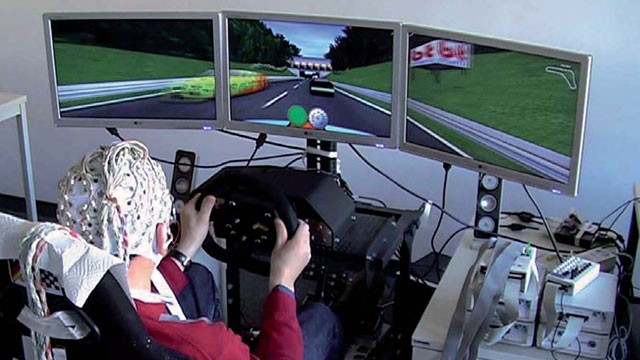
PHOTO: Braking car with mind control

July 29, 2011

It’s the future. You’re racing down the highway when, all of a sudden, the driver ahead of you slows down. You know you need to hit the brakes to avoid an accident, but your foot can’t move as fast as your brain. You’re about to rear-end the guy, except. …

… except that your car has read your mind. It picks up your brain wavesand automatically slows down. Accident averted.

This is not fantasy. Researchers in Germany have run an experiment with drivers in a car simulator, and they report in the current issue of the Journal of Neural Engineering that they were able to identify brain waves that corresponded to a driver’s wish to press the brake pedal. They tried the experiment with 18 test subjects, each of whom wore a cap wired with EEG sensors. If the drivers wanted to slam on the brakes, the car did it a crucial fraction of a second more quickly than they could.

“Waiting for the driver’s response can lead to a slow response in emergency situations,” wrote Stefan Haufe of the Berlin Institute of Technology. “Therefore, in order to obtain a faster confirmation, our study suggests that it is feasible to detect a driver’s intention to brake, which naturally precedes any observable actions.”

On average, in the study, brain waves told the car to hit the brakes 130 milliseconds faster than the driver’s foot did.

to read more, go to:    http://abcnews.go.com/Technology/mind-control-cars-brakes-bicycle-gears-worked-brain/story?id=14182510

Cowboys, Indians, & Aliens Out West

‘Cowboys & Aliens’: UFO Sightings in the Wild West

Benjamin Radford, Life’s Little Mysteries Contributor
Date: 29 July 2011 Time: 12:28 PM ET
Cowboys and Aliens
Still of Harrison Ford and Daniel Craig in Cowboys & Aliens.
CREDIT: Photo by Zade Rosenthal/Universal Studios and DreamWorks II – © Universal Studios and DreamWorks II Distribution Co. LLC

The new film “Cowboys and Aliens,” starring Harrison “Indiana Jones” Ford and Daniel “James Bond” Craig, opens today and is likely to snatch the top spot at the box office this weekend. The anachronistic sci-fi thriller tells the story of extraterrestrials who attack a small New Mexico town in search of — well, I won’t give away any spoilers.

Cowboys and aliens? Why not? Many people believe that alien contact is nothing new, and that Earth has been visited for millennia. Some, such as best-selling Swiss author Erich von Däniken, have suggested (based on flawed evidence and logic) that aliens built the pyramids in Egypt. Others believe that the giant drawings in the Nazca desert of Peru, in South America, were created by (or for) extraterrestrials in space ships. In fact, there’s good evidence that the Nazca Lines were created by the Nazca Indians, probably as part of ceremonial rituals.

But what about sightings and reports of aliens in the Old West? Surprisingly, there actually are a few reports of extraterrestrial encounters in the 1800s.

to read more, go to:

UFO on Ocean Floor?

UFO Found on Ocean Floor?

Benjamin Radford, Life’s Little Mysteries Contributor
Date: 29 July 2011 Time
UFO on ocean floor
Peter Lindberg’s team found what appears to be a crashed flying saucer on the ocean floor.
CREDIT: www.oceanexplorer.se


An ocean exploration team led by Swedish researcher Peter Lindberg has found what some are suggesting is a crashed flying saucer. Lindberg’s team, which has had success in the past recovering sunken ships and cargo, was using sonar to look for the century-old wreck of a ship that went down carrying several cases of a super-rare champagne. Instead, the team discovered what it claims is a mysterious round object that might (or might not) be extraterrestrial.

Lindberg explained to local media that his crew discovered, on the 300-foot-deep ocean floor between Finland and Sweden, “a large circle, about 60 feet in diameter. You see a lot of weird stuff in this job, but during my 18 years as a professional I have never seen anything like this. The shape is completely round.”

Adding to the mystery at the bottom of the Gulf of Bothnia, Lindberg said he saw evidence of scars or marks disturbing the environment nearby, suggesting the object somehow moved across the ocean floor to where his team found it.

to read more, go to:  http://www.livescience.com/15311-ufo-ocean-floor.html

Earthquake – Iwaki Japan

Very strong aftershock near Iwaki (Japan) – at least 7 people injured

Last update: July 30, 2011 at 11:27 pm by By Armand Vervaeck and James Daniell

Earthquake Overview : A very strong coastal earthquake at an intermediate depth and with an epicenter only 18 km from Iwaki occurred in the night of July 31 2011.  NO tsunami advisories or warnings have been published for this earthquake. Today’s earthquake is a very strong aftershock of the March 11 earthquake

Shaking map (yellow = MMI VI) – courtesy USGS

UPDATE 23:21 UTC : Official reports are indicating that at least 7 people were injured during this earthquake (1 person in Sendai, 2 in Koriyama, 2 in Mito, 1 in Hitachi Omiyma and 1 in Chikusei. No reports on damage yet.

UPDATE 21:48 UTC : As reported earlier in this article, Earthquake-Report.com fears the combination of the TORRENTIAL RAINS, overflowed rivers ( in Niigata and Fukushima prefectures) and the shaking of this aftershock.

to read more, go to:  http://earthquake-report.com/2011/07/30/very-strong-moderately-dangerous-aftershock-near-iwaki-japan/

Perils of Social Networking

Facebook and Twitter are creating a vain generation of self-obsessed people with child-like need for feedback, warns top scientist

By SARAH HARRIS

Last updated at 1:11 AM on 30th July 2011


Facebook and Twitter have created a generation obsessed with themselves, who have short attention spans and a childlike desire for constant feedback on their lives, a top scientist believes.

Repeated exposure to social networking sites leaves users with an ‘identity crisis’, wanting attention in the manner of a toddler saying: ‘Look at me, Mummy, I’ve done this.’

Baroness Greenfield, professor of pharmacology at Oxford University, believes the growth of internet ‘friendships’ – as well as greater use of computer games – could effectively ‘rewire’ the brain.

Vain generation: A top Oxford scientist has warned that repeated exposure to social networking websites could harm users. (Picture posed by model)Vain generation: A top Oxford scientist has warned that repeated exposure to social networking websites could harm users. (Picture posed by model)

This can result in reduced concentration, a need for instant gratification and poor non-verbal skills, such as the ability to make eye contact during conversations.

Read more: http://www.dailymail.co.uk/news/article-2020378/Facebook-Twitter-creating-vain-generation-self-obsessed-people-child-like-need-feedback-warns-scientist.html#ixzz1TXq5Od7
E