This Galaxy is a Real Square

Strange Square-Shaped Galaxy Discovered


6a00d8341bf7f753ef0167640033b8970b-800wi

An international team of astronomers discovered a rectangular‑shaped galaxy within a group of 250 galaxies some 70 million light years away. “In the Universe around us, most galaxies exist in one of three forms: spheroidal, disc-like, or lumpy and irregular in appearance,” said Alister Graham from Swinburne University of Technology.

He said the rare rectangular-shaped galaxy was a very unusual object. “It’s one of those things that just makes you smile because it shouldn’t exist, or rather you don’t expect it to exist. It’s a little like the precarious Leaning Tower of Pisa or the discovery of some exotic new species which at first glance appears to defy the laws of nature.”The unusually shaped galaxy was detected in a wide field-of-view image taken with the Japanese Subaru Telescope for an unrelated program by Swinburne astrophysicist Dr Lee Spitler.The astronomers suspect it is unlikely that this galaxy is shaped like a cube. Instead, they believe that it may resemble an inflated disc seen side on, like a short cylinder.

Support for this scenario comes from observations with the giant Keck Telescope in Hawaii, which revealed a rapidly spinning, thin disc with a side‑on orientation lurking at the centre of the galaxy. The outermost measured edge of this galactic disc is rotating at a speed in excess of 100,000 kilometres per hour.

“One possibility is that the galaxy may have formed out of the collision of two spiral galaxies,” said Swinburne’s Professor Duncan Forbes, co‑author of the research. “While the pre-existing stars from the initial galaxies were strewn to large orbits creating the emerald cut shape, the gas sank to the mid‑plane where it condensed to form new stars and the disc that we have observed.”

Despite its apparent uniqueness, partly due to its chance orientation, the astronomers have managed to glean useful information for modelling other galaxies.While the outer boxy shape is somewhat reminiscent of galaxy merger simulations which don’t involve the production of new stars, the disc-like structure is comparable with merger simulations involving star formation.

“This highlights the importance of combining lessons learned from both types of past simulation for better understanding galaxy evolution in the future,” said Associate Professor Graham.“One of the reasons this emerald cut galaxy was hard to find is due to its dwarf-like status: it has 50 times less stars than our own Milky Way galaxy, plus its distance from us is equivalent to that spanned by 700 Milky Way galaxies placed end-to-end.“Curiously, if the orientation was just right, when our own disc-shaped galaxy collides with the disc-shaped Andromeda galaxy about three billion years from now we may find ourselves the inhabitants of a square looking galaxy.”

The results will be published in The Astrophysical Journal.More information: Pre-publication: http://arxiv.org/p … 3.3608v1.pdf

The Daily Galaxy via Swinburne University of Technology

from:    http://www.dailygalaxy.com/my_weblog/2012/03/strange-square-shaped-galaxy-discovered.html#more

Most Ethical COmpanies

World’s Most Ethical Companies’ Revealed

David Mielach, BusinessNewsDaily Staff Writer
Date: 17 March 2012 Time: 11:41 AM ET


ethics social media misconduct
CREDIT: Dreamstime

Turns out successful businesses aren’t concerned only with their bottom line. At least that is the case for companies like Aflac, American Express,  General Electric, Patagonia and Starbucks. Those companies and 18 others have made the list of the World’s Most Ethical Companies for the sixth straight year.

In all, 145 companies from around the world appear on this year’s list.

Ethisphere Institute, which compiled the list, says it based its rankings on the following factors: ethics and compliance programs; reputation, leadership and innovation; governance; corporate citizenship and responsibility; and culture of ethics.

Notable companies on this year’s list included:

  • Gap Inc.
  • Timberland
  • Ford Motor Company
  • Microsoft
  • eBay Inc.
  • Waste Management
  • PepsiCo
  • Kellogg Company
  • Target
  • Best Buy
  • Cisco
  • UPS

The complete list can be found at the Ethisphere website.

“Each year the competition for ‘World’s Most Ethical Companies’ intensifies as the number of nominations submitted for consideration grows,” said Alex Brigham, executive director of Ethisphere. “This year’s winners know that a strong ethics program is a key component to a successful business model, and they continue to scrutinize their ethical standards to keep up with an ever-changing regulatory environment

from:    http://www.livescience.com/19132-world-ethical-companies.html


Planetary Doodles

SCINTILLATION SQUIGGLES: Everyone knows that stars twinkle but planets do not. The reason has to do with angular size. Stars are distant pinpricks smaller than the thermal irregularities in Earth’s atmosphere that refract their light. Each packet of air that passes in front of a star produces a well-defined change in color or brightness. Planets, on the other hand, are relatively nearby and wide; they span many atmospheric irregularities, which tends to smooth out the prismatic action.

Photographer Monika Landy-Gyebnar of Veszprem, Hungary, has found a kinetic way to demonstrate the effect. “When photographing a star or planet, kick the tripod during the exposure.” She’s applied this technique to many stars and planets, and the resulting collection of squiggles reveals the character of their twinkles:

“If we take a photo of a star with a shaking camera, the result is a wavy line with many colors,” she points out. “If we photograph a planet, however, there is no change; the color and width of the squiggle are nearly constant.”

The scintillation effect is greatest for stars near the horizon, which must shine through a greater distance of turbulent atmosphere. Angles noted in the image above are altitudes. The lowest-hanging stars display the strongest and most colorful twinkling.

“Demonstrating this is a ‘must-do’ thing when you give a lecture or show on astronomical observations for novices,” she concludes. Observing tips and more of Landy-Gyebnar’s “scintillation squiggles” may be found here.


from: spaceweather.com

CME on Farside of Sun

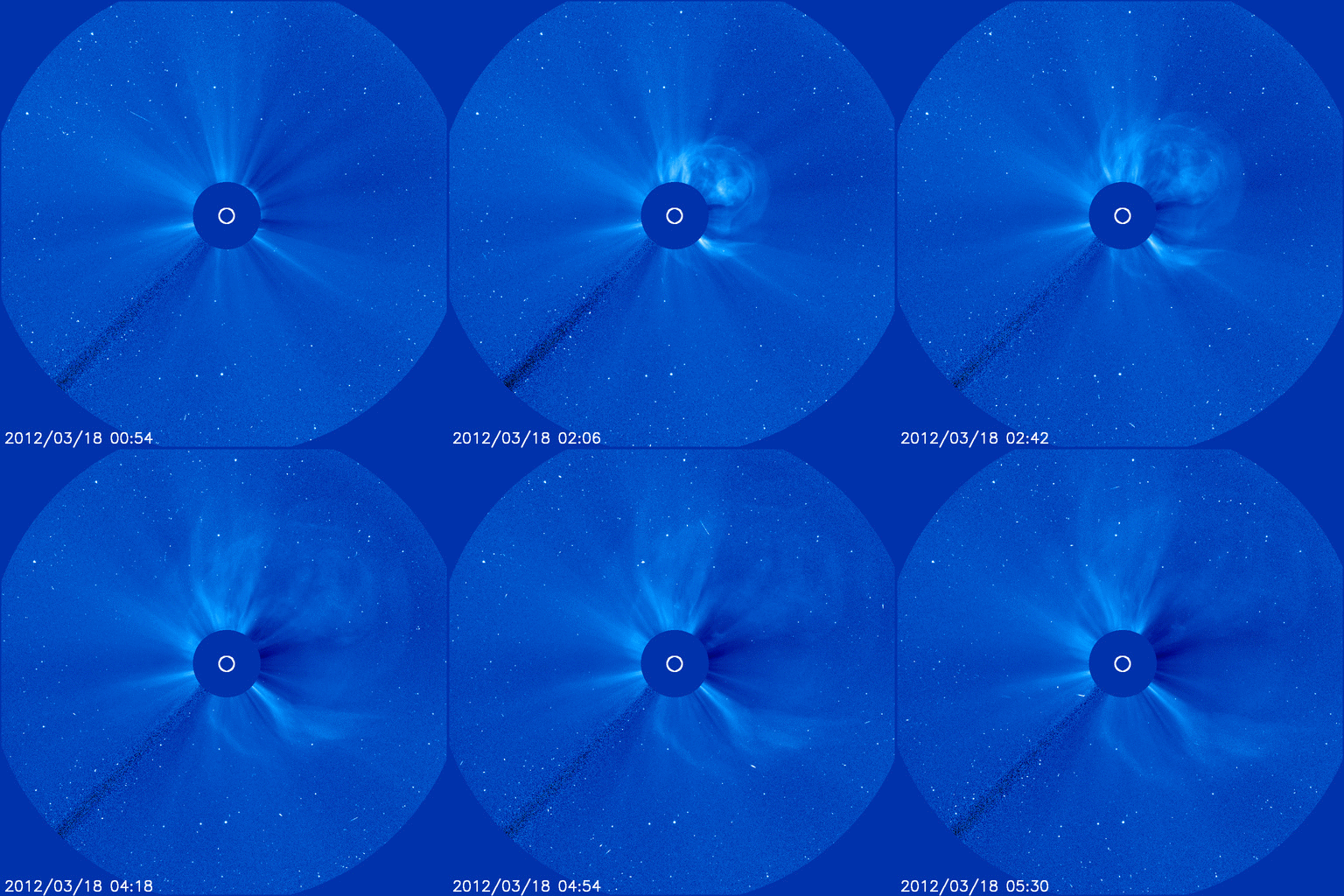
FARSIDE CME: A spectacular CME rocketed away from the sun’s northwestern limb during the early hours of March 18th: movie. The probable source was old sunspot AR1429, still active as it transits the far side of the sun. Earth will not be affected by the cloud.

fr/spaceweather.com

Victor Stenger on Science & Religion

Victor Stenger

Physicist, PhD, bestselling author

The Fall of Foolish Faith

Posted: 03/ 9/2012 1:12 pm
 From a talk on March 4, 2012 at the CFI Meeting, “Moving Secularism Forward,” Orlando.

I want to talk about a particular group of secularists — scientists — and their interaction with religion. Most scientists prefer to stay out of any conflicts with religion. They don’t want to endanger their sources of research funding and generally just don’t want to be bothered. They have better things to do, or at least they think they do.

I want to urge those of you who are not scientists to try to convince those who are to stop pussyfooting around with religion and confront the reality of what it is and always has been — a blight on humanity that has hindered our progress for millennia and now threatens our very existence.

Scientists have to help the rest of the secular community to work toward reducing the influence of religion to the point where it has negligible effect on society. I don’t believe this is impossible. Astrology and the reading of sheep entrails are no longer used to decide on courses of events, such as going to war. Why can’t we expect the same for the imagined dialogues with an ancient tribal sky god that at least one recent president has used to justify his actions?

Let’s look at some of the places where scientists have been slow to recognize the negative impact that religion is having on important scientific matters. Since the 1850s, human population has exploded causing an unsustainable exploitation of Earth’s resources. This growth cannot continue indefinitely. Only by reducing our dependence on fossil fuels and leveling population can we expect to survive.

Rather than helping, religion hinders these efforts by discouraging birth control and other absolutely essential measures needed to achieve these goals.

Already, three million people die every year from the pollution caused by fossil fuels and biomass. And this will only increase if we continue on the present path.

However, a livable future is not out of our reach. Liquid thorium nuclear reactors could provide the world with all the energy it needs for a thousand years, safely, with minimal environmental impact, and no application to nuclear weapons. If they had thorium reactors, there would have been no Three-Mile Island, Chernobyl, or Fukushima disasters. The only reason uranium and plutonium are used in nuclear reactors is you can build bombs with them. You can’t build bombs with thorium.

Solar power would already be economically competitive with oil, if the economy were to properly price oil to include the costs of its damage to the environment, human health, and the military needed to defend sources and transport. Imagine a world without oil. I can.

So why don’t we move in these directions already clearly marked out by science? Because since the late nineteenth century we have lived in a plutocracy in which petroleum and other fossil energies dominate almost every sector of our economy by virtue of the enormous wealth they bring to their producers and distributers.

Now, what does this have to do with religion? Since prehistoric times religion has served as the handmaiden to those in power, helping them to maintain that power. Tribal chiefs, kings, and emperors always had shamans and priests at their sides to assure their subjects that they led by divine right.

In America today, petro-dollars fuel a giant Christian propaganda machine that works to undermine the efforts of scientists to find solutions to the problems that face us with overpopulation, pollution, and climate change. They use techniques that were pioneered 30 years ago by the tobacco industry to suppress the evidence that smoking causes cancer and heart disease. And these techniques exploit the antiscience that is inherent in religious belief.

A new technique that in recent years has been added to the arsenal of global warming denialism is to frame climate change as a theological issue. Global warming deniers say that God would never allow life on Earth to be destroyed. After all, he gave humans dominion over the planet. Besides, the world is coming to an end soon anyway, so it doesn’t matter.

Republican politicians are in the forefront of the battle over climate change. John Shimkus, Republican of Illinois, has said that climate change is a myth because God told Noah he would never again destroy Earth by flood. All the current Republican presidential candidates have either always said climate change was a hoax or have backed off previous statements in which they agreed that warming is taking place.

The Cornwall Alliance for The Stewardship of Creation has issued what it calls “An Evangelical Declaration on Global Warming.” The statement asserts that Earth and its ecosystems are “robust, resilient, self-regulating, and self-correcting, admirably suited for human flourishing, and displaying the glory of God.” The statement denies that Earth and its ecosystems are the “fragile and unstable products of chance,” and particularly that Earth’s climate system is vulnerable to dangerous alteration because of what they call “minuscule changes in atmospheric chemistry.” The Cornwall statement claims that there is no convincing scientific evidence that greenhouse gases produced by human activity are causing dangerous global warming. It also denies that carbon dioxide is a pollutant and claims that reducing greenhouse gases cannot achieve significant reductions in future global temperatures

Approximately 500 people, including a large number of non-expert scientists and other academics, endorsed this statement. This is not simply the view of a small fringe group but that of the large majority of Evangelical Christians, who wield far more influence than their actual numbers justify.

While the petrocrats use science in every aspect of their businesses, they hypocritically exploit the antiscience that is inherent in religion in order to undermine any scientific findings that threaten their power and fortunes.

Most scientists do not realize that science and religion are fundamentally incompatible. This is not because they have thought about it. It is because they prefer not to think about it.

Fundamentalists know science and religion are incompatible, since science disputes so much of what is in the Bible, which they take as the literal word of God. To them, science is simply wrong and must be Christianized. A well-funded effort exists to do just that, while most scientists sit on the sidelines because they prefer not to get involved.

But science and religion have always been at war, and always will be. One of yesterday’s speakers said that he did not like to use the word “religion” but rather called it a “belief system.” Well, there are different kinds of belief systems. Science is a belief system based on reason and evidence. Religion is a belief system based on bullshit.

Moderate Christians claim they support science, but they still hold to beliefs that have no empirical basis. Moderates will tell you that they accept evolution, but then they insist it is still guided by God. This is not Darwinian evolution. This is intelligent design. There is no guidance, divine or otherwise, in Darwinian evolution.

A recent phenomenon is the joining of forces between the climate change deniers and evolution deniers, who have no link other than a common motivation based on religion. Several legislatures have passed bills requiring teachers to present “all sides” of the evidence on evolution and global warming. Now, that would be no problem if the arguments on all sides were presented accurately and honestly. But we know that’s unlikely to happen, since the only purpose of these bills is to create the illusion of scientific controversy on topics where, in truth, a strong consensus within the scientific community exists. It’s like demanding equal time for flat-earth geology.

Christopher Hitchens once said that he was not just opposed to organized religion, but also to religious belief. Religion would not be such a negative force in society if it were just about going to church socials and celebrating rites of passage. However, the magical thinking that becomes deeply ingrained whenever faith rules over facts warps all areas of life. It instills superficial beliefs which, having been adopted without reason, cannot be displaced by reason. Magical thinking ignores evidence and favors whatever opinion is the most convenient or socially acceptable. While scientists also tend to follow the crowd, at least they can be convinced to change their minds when the data warrant it.

Magical beliefs are not just limited to religion, but extend to economics, politics, and health. It’s not that the public lacks information. Today we’re all inundated with information, especially on the Internet. However, much of that data is untrustworthy and it takes a trained thinker to filter out the good from the bad. Magical thinking and blind faith are the worst conceivable mental system we can apply under these circumstances. They allow the most outrageous lies and stupidities to be accepted as facts.

Nowhere is this more evident than in America today where the large majority of the public hold on to a whole set of religious and pseudoscientific beliefs despite the total lack of evidence to support these beliefs, and indeed, in the face of strong evidence that denies them. This is the folly of faith and demonstrates why it must be fought. Relying on blind faith is no way to run a world.

As I have noted, religious believers are being manipulated to work against their own best interests in health and economic well-being in order to cast doubt on well-established scientific findings. This would not be possible except for the diametrically opposed world-views of science and religion.

Science and religion are fundamentally incompatible because of the opposing assumptions they make concerning what we can know about the world. Every human alive is aware of a world that seems to exist outside the body, the world of sensory experience we call the natural. Science is the systematic study of the observations made of the natural world with our senses and scientific instruments. The knowledge gained in this manner has proved effective when applied to human needs.

By contrast, all major religions, including Buddhism, teach that humans possess an additional “inner” sense that allows us to access a realm lying beyond the visible world–a divine, transcendent reality we call the supernatural. If it does not involve the transcendent, it is not religion. Religion is a set of practices intended to communicate with that invisible world and use its forces to affect things here on Earth.

The working hypothesis of science is that careful observation is our only reliable source of knowledge about the world. Natural theology accepts empirical science and views it as a means to learn about God’s creation. But religion, in general, goes much further than science in giving credence to other claimed sources of knowledge such as scriptures, revelation, and spiritual experiences.

No doubt, science has its limits. However, the fact that science is limited doesn’t mean that religion or any alternative system of thought can or does provide insight into what lies beyond those limits. For example, science cannot yet show precisely how the universe originated naturally, although many plausible scenarios exist. But the fact that science does not–at present–have a definitive answer to this question does not mean that ancient creation myths such as those in Genesis have any substance, any chance of eventually being verified.

The scientific community in general goes along with the notion that science has nothing to say about the supernatural because the methods of science, as they are currently practiced, exclude supernatural causes. I strongly disagree with this position. If we truly possess an inner sense telling us about an unobservable reality that matters to us and influences our lives, then we should be able to observe the effects of that reality by scientific means.

If someone’s inner sense were to warn of an impending earthquake unpredicted by science, which then occurred on schedule, we would have evidence for an extrasensory source of knowledge.So far we see no evidence that the feelings people experience when they perceive themselves to be in touch with the supernatural correspond to anything outside their heads, and we have no reason to rely on those feelings when they occur. However, if such evidence or reason should show up, then scientists will have to consider it whether they like it or not.

We cannot sweep under the rug the many serious problems brought about by the scientific revolution and the exponential burst in humanity’s ability to exploit Earth’s resources made possible by the accompanying technology. There would be no problems with overpopulation, pollution, global warming, or the threat of nuclear holocaust if science had not made them possible. The growing distrust of science found now in America can be at least partially understood by observing the disgraceful examples of scientists employed by oil, food, tobacco, and pharmaceutical companies who have contributed to the unnecessary deaths of millions by allowing products to be marketed that these scientists knew full well were unsafe.

But does anyone want to return to the prescientific age when human life was nasty, brutish, and short? Even fire was once a new technology, and through the ages a lot of people have died in fires. But we don’t stop lighting them. Unsafe products are more than overshadowed by drugs, foods, medical knowledge, and technologies, which have made all our lives immeasurably better than those of humans in the not-too-distant past. At least in developed countries, women now rarely die in childbirth and most children grow to adulthood. This was not the case even just a few generations ago. Unlike our ancestors, most of us lead long, fulfilling lives largely free of pain and drudgery. The aged are so numerous that they are becoming a social problem. All this is the result of scientific developments.

We can only solve the problems brought about by the misuse of science by adhering to the scientific method, and by more rational behavior on the part of scientists, politicians, corporations, and citizens in all walks of life. Religion, as it is currently practiced with its continued focus on closed thinking and ancient mythology, is not doing anything to support the goal of a better, safer world. In fact, religion actively and vigorously opposes that goal.

Religion has destroyed our trust by its repeated failure. Using the empirical method, science has eliminated smallpox, flown men to the moon, and discovered DNA. If science didn’t work, we wouldn’t do it. Relying on faith, religion has brought us inquisitions, holy wars, and intolerance. Religion doesn’t work, but we still do it.

Science flies us to the moon. Religion flies us into buildings.

Science is not going to change its commitment to the truth. And religion is not going to change its commitment to nonsense. And that is why I call upon scientists and all thinking people to focus their attention on reducing the influence of religion in the world, with the goal of the eventual fall of foolish faith. The future depends on it.

from:    http://www.huffingtonpost.com/victor-stenger/the-fall-of-foolish-faith_b_1333412.html?ref=religion-science

A Perfume ONLY for the Pope

Perfume Created For Pope Benedict XVI

The Huffington Post  |  By Tara Kelly Posted: 03/14/2012 1:32 pm Updated: 03/14/2012 4:17 pm

Perfume Created For Pope

Pope Benedict XVI smiles during his weekly general audience in St. Peter’s Square at the Vatican, Wednesday, March 7, 2012.

Sarah Jessica Parker and Jennifer Aniston may be the type of public figures expected to roll out their own signature scent. But that hasn’t stopped Pope Benedict XVI from having an eau de cologne created for His Holiness, the Telegraph reports.

Created by Italian Silvana Casoli, the cologne is infused with lemon tree blossom and the smell of spring grass, conveying the Pope’s love of nature and wildlife as well as peace and tranquility, according to the Irish Times.

Other celebrities the master perfumer has worked with include Sting,Madonna and King Juan Carlos of Spain.

Unlike other perfumes, the scent won’t be sold to the public and is to only be worn by the Pope, explains Italian newspaper Il Messaggero.

This isn’t the first Catholic scent to be created by Casoli. According to theTelegraph, she previously created two other colognes called “Water of Hope” and “Water of Faith” for the Roman Catholic Church.

from        http://www.huffingtonpost.com/2012/03/14/perfume-created-for-pope-benedict-xvi_n_1344689.html:

Gratitude of a Humpback Whale

Whale Shows AMAZING Appreciation After Being Freed From Fishing Nets

Michael Fishbach, co-founder of The Great Whale Conservancy (GWC), narrates his encounter with a young humpback whale entangled in local fishing nets.

At first, the animal appeared to be dead, yet Fishbach investigated and quickly discovered that the poor creature was tangled in a fishing net. The humans had to act fast; what began as a tragedy soon became a thrilling rescue as Fishbach and his crew labored to free the young whale. The entire encounter was caught on videotape and later narrated by Fishbach himself.

Watch as the whale named Valentina by her rescuers goes from near death to freedom, then rewards her saviours with dozens of magnificent full-body breeches and tail flips.

Indeed, this video has the power to inspire action on behalf of other beings. In ways big and small, each of us can be the one who helps another. Opportunities to be a hero for animals are all around. Where will your compassion take you next?


‘Red Deer Cave’ People — New Species?

Red Deer Cave’ people, possibly a new human species?

Newly identified partial skeletons of “mysterious humans” excavated at two caves in southwest China display an unique mix of primitive and modern anatomical features, scientists say.

“Their skulls are anatomically unique. They look very different to all modern humans, whether alive today or in Africa 150,000 years ago,” said evolutionary biologist Darren Curnoe, the lead author of the study, from the University of New South Wales in Australia.

The fossils found at excavation sites in Longlin Cave, in Guangxi Province, and the Maludong Cave, in Yunnan Province, indicate that the stone-aged people had short, flat faces and lacked a modern chin. They had thick skull bones, a rounded brain case, prominent brow ridges and a moderate-size brain.

They were dubbed the “Red Deer Cave” people because scientists say these prehistoric people hunted extinct red deer and cooked them in the cave at Maludong, where four of the five partial skeletal fossils were found.

Whether the Red Deer Cave people are indeed a new species indicating a new evolutionary line or whether they are a very early population of modern humans remains a controversial topic of discussion among scientists.

The team of Australian and Chinese researchers remains cautiously optimistic when it comes to classifying what they have unearthed.

“The evidence is quite fairly balanced at the moment. It’s weighted towards the idea that the Red Deer Cave people might represent a new population, possibly a new species,” Curnoe said.

Details of the discovery are published in the scientific journal PLoS ONE.

Archeological evidence dates these prehistoric hunters and gatherers to 14,500 to 11,500 years ago, indicating that for a sliver of time in East Asia, the Red Deer Cave people may have shared the landscape with modern-looking people who displayed the beginnings of farming.

Despite Asia being the largest subcontinent, the fossil record for human evolution remains slim. The vast majority of prehistoric archeology has focused on Europe and Africa, scientists say.

“Understanding the fossil records of East Asia is the missing link to our overall understanding of human evolution,” Curnoe said.

The Maludong site had actually been excavated the first time by the Chinese in 1989. At that time, several bags of fossils were found, but it was only in 2008 that the site was studied and the remains analyzed by Curnoe and his team of researchers.

The age of the cave sites was determined by collecting sediment samples and tested using radioactive carbon dating.

At the Longlin Cave, the remains of a lower jaw set in a bed of sediment were found by a geologist back in 1979 and rediscovered in a the basement laboratory of one of the Chinese researchers in 2009. The bones first had to be removed from the sediment rock. Then, using a CT Scan 3D, models of the skull were made, showing both the prominent primitive and modern features.

Due to the uncertainty surrounding the human fossil record, paleoanthropologists say, more conclusive DNA testing is required.

Initial DNA testing conducted on the fossils did not show evidence of human DNA, but Curnoe and his team will push forward.

“If we are successful in extracting DNA, it will give us a really accurate understanding of precisely who these people are and where they might fit in the human evolutionary tree,” he said.

“We are trying to understand the common story. What unites us all? Where do we come from? In understanding our evolutionary past, this might help us understand where we are today and where we might be going,” Curnoe added.

from:    http://lightyears.blogs.cnn.com/2012/03/15/red-deer-cave-people-possibly-a-new-human-species/

Missing Cat Leads to UFO?

Man Looks for Missing Cat, Finds a Buried ‘UFO’

Benjamin Radford, Life’s Little Mysteries Contributor
Date: 16 March 2012 Time: 03:09 PM ET


ufo

According to news reports, an Austrian farmer discovered a mysterious, deep, perfectly round hole that apparently had appeared in his field overnight. And, of course, extraterrestrial activity was assumed.

Farmer Franz Knoglinger discovered the hole while looking for a lost pet. In an interview with the Austrian Times newspaper, Knoglinger said: “I was looking for our family cat, Murlimann, when I noticed the hole. I didn’t know how deep it was, so I dropped the stone down there and heard a metallic clunk. From the time it took for the stone to reach the bottom, I realized it was very deep.”

Intrigued, Knoglinger used a rope to lower a magnet into the hole, and he concluded that whatever was at the bottom was metallic. This only deepened the puzzle, and soon the mystery drew local, national and, finally, international attention. Curiosity-seekers, geologists and UFO buffs flocked to the farm to see the hole for themselves. A buried UFO became a favorite explanation.

A few clues shed some light on the mystery. If the hole was indeed perfectly round, then the obvious source was a drill. In fact, the hole’s perfect roundness would make it less mysterious, if anything, because drills leave round holes. A perfectly square, rectangular, or even oval shape would be more extraordinary.

Perhaps a more interesting question was why, of all the possible explanations — an abandoned well, a long-forgotten underground storage tank — the idea of an underground extraterrestrial spacecraft was the one Knoglinger and others focused on.

Part of the answer is that an extraterrestrial craft has become a default explanation in recent years for any large unknown (and presumably round and/or metallic) object. For example, a large round object was recorded on sonar on the ocean floor by a Swedish archaeology team last year. The image has not been confirmed as real (and many experts suspect it’s actually a false reading), but by far the most popular explanation is that the round object is a spacecraft. Human imagination almost always creates far more exotic and interesting possibilities than reality can provide, and anything just out of reach, be it deep underwater or underground, can conjure visions of alien spaceships.

The case in Austria stumped many until a local historian decided to do a bit of digging — not in the dusty field but in the local land-use archives. It turns out the hole had not appeared overnight as Knoglinger assumed, but had been there for decades. In fact, a half-century ago an oil company had drilled there looking for oil. A large metal drill bit became stuck and broke before workers could find anything, so they left the drill bit at the bottom of the hole and never bothered to fill it in. That’s what attracted the magnet dropped down to the bottom: not a spaceship but a large metal bit stuck in rock.

Over the years the area became farmland and people stopped noticing the hole, either because it had been covered by grass or a piece of wood or simply because, with the advent of modern farming machinery, there were fewer people working in the field.

As for the missing cat, it was eventually found hiding in a cupboard.

http://www.livescience.com/19121-buried-ufo-austria.html

Is Our Universe a Hologram?

Do We Live In A Holographic Universe?

By DailyGalaxy.com

What if our existence is a holographic projection of another, flat version of you living on a two-dimensional “surface” at the edge of this universe? In other words, are we real, or are we quantum interactions on the edges of the universe – and is that just as real anyway?

Whether we actually live in a hologram is being hotly debated, but it is now becoming clear that looking at phenomena through a holographic lens could be key to solving some of the most perplexing problems in physics, including the physics that reigned before the big bang, what gives particles mass, a theory of quantum gravity.

In 1982 a little known but epic event occured at the University of Paris, where a research team led by physicist Alain Aspect performed what may turn out to be one of the most important experiments of the 20th century. You did not hear about it on the Daily Show. In fact, unless you are a physicist you probably have never even heard Aspect’s name, though increasing numbers of experts believe his discovery may change the face of science.

Aspect and his team discovered that under certain circumstances subatomic particles such as electrons are able to instantaneously communicate with each other regardless of the distance separating them. It doesn’t matter whether they are 10 feet or 10 billion miles apart.

Somehow each particle always seems to know what the other is doing. The problem with this feat is that it violates Einstein’s long-held tenet that no communication can travel faster than the speed of light. Since traveling faster than the speed of light is tantamount to breaking the time barrier, this daunting prospect has caused some physicists to try to come up with increasingly elaborate ways to explain away Aspect’s findings.

University of London physicist David Bohm, for example, believes Aspect’s findings imply that objective reality does not exist, that despite its apparent solidity the universe is at heart a phantasm, a gigantic and splendidly detailed hologram. Bohm was involved in the early development of the holonomic model of the functioning of the brain, a model for human cognition that is drastically different from conventionally accepted ideas. Bohm developed the theory that the brain operates in a manner similar to a hologram, in accordance with quantum mathematical principles and the characteristics of wave patterns.

To understand why Bohm makes this startling assertion, one must first understand that a hologram is a three- dimensional photograph made with the aid of a laser. To make a hologram, the object to be photographed is first bathed in the light of a laser beam. Then a second laser beam is bounced off the reflected light of the first and the resulting interference pattern (the area where the two laser beams conflate) is captured on film. When the film is developed, it looks like a meaningless swirl of light and dark lines. But as soon as the developed film is illuminated by another laser beam, a three-dimensional image of the original object appears.

In a recent collaboration between Fermilab scientists and hundreds of meters of laser may have found the very pixels of reality, grains of spacetime one tenth of a femtometer across.

The GEO600 system is armed with six hundred meters of laser tube, which sounds like enough to equip an entire Star War, but these lasers are for detection, not destruction. GEO600′s length means it can measure changes of one part in six hundred million, accurate enough to detect even the tiniest ripples in space time – assuming it isn’t thrown off by somebody sneezing within a hundred meters or the wrong types of cloud overhead (seriously). The problem with such an incredibly sensitive device is just that – it’s incredibly sensitive.

The interferometer staff constantly battle against unwanted aberration, and were struggling against a particularly persistent signal when Fermilab Professor Craig Hogan suggested the problem wasn’t with their equipment but with reality itself. The quantum limit of reality, the Planck length, occurs at a far smaller length scale than their signal – but according to Hogan, this literal ultimate limit of tininess might be scaled up because we’re all holograms. Obviously.

The idea is that all of our spatial dimensions can be represented by a ‘surface’ with one less dimension, just like a 3D hologram can be built out of information in 2D foils. The foils in our case are the edges of the observable universe, where quantum fluctuations at the Planck scale are ‘scaled up’ into the ripples observed by the GEO600 team. We’d like to remind you that although we’re talking about “The GEO600 Laser Team probing the edge of reality”, this is not a movie.

What does this mean for you? In everyday action, nothing much – we’re afraid that a fundamentally holographic nature doesn’t allow you to travel around playing guitar and fighting crime (no matter what 80s cartoons may have taught you.) Whether reality is as you see it, or you’re the representation of interactions on a surface at the edge of the universe, getting run over by a truck (or a representation thereof) will still kill you.

In intellectual terms, though, this should raise so many fascinating questions you’ll never need TV again. While in the extreme earliest stages, with far more work to go before anyone can draw any conclusions, this is some of the most mind-bending metaphysical science you’ll ever see

http://wakeup-world.com/2011/10/17/do-we-live-in-a-holographic-universe/