Emotional Effects of Red

Why The Color Red Makes Us Mad

Posted: 9/13/11 08:48 AM ET

When you think of red, you probably formulate strong mental images such as a ripe apple, a New England barn, the stripes on an American flag or even Dorothy’s shoes. And now, according to a recent study, red is quantified with increased physical response and velocity of that response in pinch and grip test subjects.

When presented color stimuli for response time (velocity) and force of that response, subjects reacted with higher values on these two parameters for, you guessed it, red. So, do the bullfighter’s cape and the business executive’s power tie work to the same end? Or did the color of the apple seduce Eve?

Red is the beauty of sunsets, the color of love and the life force that flows through our body — blood. We “see red” when upset. And now, as recently demonstrated, we physically react stronger and faster when we see it. But, have we not subconsciously realized this all along?

Tie in the anthropological significance of red in various settings and its myriad evocations, connect those to emotion — which some say triggers its physical response — and the evidence seems irrefutable. Red is the sports car, by urban legend, most frequently stopped by police. And red is the color of the emergency lights of an ambulance or the flashers on your car.

So, why do we increase our velocity and power of reaction when in view of red? Perhaps it is good thing, a neurological trigger that brings us to a quick halt at every traffic light or stop sign. Drivers passing through the green the world over are happy to hear of this confirmation about their fellow travelers coming to a stop. Red, indeed, seems to help us quickly apply the brakes, as the study shows. Thank goodness for red.

to read more, go to:   http://www.huffingtonpost.com/2011/09/13/effect-of-color-red_n_959189.html?1315918092

Science & Spirituality

Steven and Michael Meloan

Authors of ‘The Shroud’

 Science and Spirituality Can Transform Our World .. Together

For hundreds of years, science has illuminated the mysteries of our universe, allowing us to conquer diseases, manipulate genomes, visit other planets and explore the wonders of space and time. But as a result of these profound and inarguable successes, science has also become the de facto cultural filter through which our broader societal norms, behaviors and institutions have developed and evolved. Newtonian physics established a physical reality composed of discrete and separate objects, operating according to predictable laws of time and space — the universe as a giant billiard table. And Darwinian evolution established the biological world as a tooth-and-claw realm of scarcity, competition and “survival of the fittest.” The end conclusions of this centuries-old scientific story is that we are accidents of the cosmos, living on a lonely planet in the cold depths of space, vying for limited resources in a frequently violent and tumultuous competition for supremacy. The implicit notion that we are walking husks for “selfish genes” pervades everything, from our economic and business institutions to our day-to-day interactions.

But an increasing number of scientific, philosophical and spiritual thinkers are arriving at the conclusion that this mechanistic take on the human story is fundamentally incomplete. Darwinian narratives of “survival of the fittest,” and mechanistic Newtonian physics are increasingly being seen as elements of a far greater and richer tapestry. Quantum entanglement, or Einstein’s “spooky action at a distance,” demonstrates that our universe is interconnected in ways we might never have imagined, down to the most basic particle level. And the discovery of “mirror neurons”in humans and other primates demonstrates that simply seeing something happen to another creature lights up the same neurons as if it were happening to us. In a very real sense, we don’t entirely distinguish between “the self” and others. And this is particularly true when witnessing suffering. Compassion and empathy seem to be hard-wired into us.

While inter-species and intra-species competition is an inarguable biological fact, we are discovering compelling new examples of connection, cooperation and community. In reality, we may have even misinterpreted Darwin. In his “The Descent of Man,”published in 1871, Darwin only mentions the phrase “survival of the fittest” twice, while he mentions the word “love” 95 times. Dig beneath the surface of the natural world, and a tooth-and-claw narrative is clearly not the only one to be found. Bonobo apes, with which humans share more than 98 percent of their DNA, live in highly cooperative societies based on matriarchal structures. These and other recent scientific discoveries may prove pivotal in creating newer and more accurate cultural narratives. The Human Genome Project has revealed amazing commonalities among all living organisms, and the project has also found that there is greater genetic variability within a given race than between them. In short, in spite of superficial appearances, we are far more alike, at a fundamental genetic level, than we are different.

Even so, we retain hard-wiring from a primitive past that was directed toward survival-based judgments and assessments of others. Studies find that this programming leaves us constantly primed to gauge others as “in-group” or “out-group,” based upon such criteria as race, gender, age and perceived cultural and socio-economic status — and that such analyses occur within milliseconds. This tribalism can be surprisingly fluid and dynamic. In one study, teen boys were exposed to the art of either Kandinsky or Klee. Even though the boys were previously unfamiliar with either and had been randomly assigned to view the works of only one artist, the Kandinsky “gang” quickly showed a greater willingness to loan money to other Kandinsky in-group members. And the same proved true of the experimental Klee “gang.”

Because such tribal-bonding is so dynamic and shifting, however, it is also highly malleable. Once recognized and understood, this hard-wiring can be consciously subverted. A measurable aversion to the image of a homeless person or drug addict can be rapidly transformed by an assignment to participate in a soup kitchen and choose appropriate menu items for people in need. In this way, out-group members almost instantaneously become fellow in-group members as part of a joint undertaking. The key to such subversion of tribalistic tendencies is that cross-group members must share a larger common goal, and have the support of recognized authority figures.

While competition and tribalistic bonding are inarguable aspects of our world, science increasingly makes clear that this is only one part of an expanding conceptual landscape. Our entire universe is profoundly interconnected, in ways that we are only beginning to decipher. This is true at the elementary particle level, at the genetic level, at the organism level and at a global level via the Internet. Ultimately, the same scientific milieu that helped form our current conflict-ridden cultural narratives may now be instrumental in defining not only a more productive world view, but a more accurate one.

Steven and Michael Meloan are authors of “The Shroud,” a science-adventure novel exploring the spiritual impulse, tribalism and its manifestations in human behavior, and the intersection between science and spirituality:

from:   http://www.huffingtonpost.com/steven-and-michael-meloan/human-narrative-_b_955039.html

New Lie Detector

New emotion detector can see when we’re lying

By Hamish PritchardScience Reporter, Bradford

FaceOur faces betray a range of emotions; the thermal sensor even detects changes in blood vessels

A sophisticated new camera system can detect lies just by watching our faces as we talk, experts say.

The computerised system uses a simple video camera, a high-resolution thermal imaging sensor and a suite of algorithms.

Researchers say the system could be a powerful aid to security services.

It successfully discriminates between truth and lies in about two-thirds of cases, said lead researcher Professor Hassan Ugail from Bradford University.

The system, developed by a team from the universities of Bradford and Aberystwyth in conjunction with the UK Border Agency, was unveiled today at the British Science Festival in Bradford.

This new approach builds on years of research into how we all unconsciously, involuntarily reveal our emotions in subtle changes of expression and the flow of blood to our skin.

We give our emotions away in our eye movements, dilated pupils, biting or pressing together our lips, wrinkling our noses, breathing heavily, swallowing, blinking and facial asymmetry. And these are just the visible signs seen by the camera.

Even swelling blood vessels around our eyes betray us, and the thermal sensor spots them too.

Real-world testTraditional lie detection depends on the venerable polygraph, first developed in 1921, a much more invasive apparatus with a set of wires attached to the skin. This new device promises non-invasive, even covert truth tests in real time.

“We bring together all this well-established work on expressions, these recent developments in thermal imaging, techniques for image tracking of subjects and our new algorithms into one operational system,” said Professor Ugail.

So far, the team has only tested its lie detector on willing volunteers rather than in a real-life, high stakes situation. Later this year, though, they plan to deploy it in a UK airport, probably running alongside experienced immigration officers as they conduct security interviews. The algorithms can then be tested against the verdicts of these officers.

“In a real, high-stress situation, we might get an even higher success rate,” noted Professor Ugail, who believes he’ll eventually be able to detect around 90% of those who are lying, which is similar to the performance of the polygraph.

The researchers acknowledge, though, that these tests can never be 100% accurate.

What they detect are emotions, such as distress, fear or distrust, and not the act of lying itself. Fear can sometimes be the fear of not being believed rather than the fear of being caught.

from:    http://www.bbc.co.uk/news/science-environment-14900800

New Active Sunspot

ACTIVE SUNSPOT: New sunspot AR1295 is emerging over the sun’s northeastern limb and crackling with solar flares. The strongest so far, a C9.9-category blast, did something remarkable. Click on the arrow to watch an extreme ultraviolet movie from NASA’s Solar Dynamics Observatory:

In the movie, the underlying explosion (marked by the flash of extreme UV radiation) hurls material upward. The ejecta crashes into a loop of magnetism above the sunspot, stretching the loop until the material breaks free. Coronagraph images from the STEREO-A spacecraft confirm that a cloud of plasma (a CME) left the scene.

This sunspot will not turn toward Earth for several days. Until then, CMEs leaving AR1295 should continue to miss our planet.

from:  http://spaceweather.com

Al Gore & The Carbon Tax

Al Gore take your Global Warming to another planet you scammer

Published on September 13, 2011 12:00 am PT
– By Kevin Martin – Senior Meteorologist
– Article Editor and Approved – Ron Jackson


(TheWeatherSpace.com) — Al Gore is yet again planning on pushing the agenda for his theory on global warming with a 24 hour event on September 15th through 16th. Gore states that we are killing the planet, making it warmer.
As a meteorologist this is absurd and quite honestly the most irresponsible non-thought of theory I’ve ever seen and I’ve been following this for years. Al Gore is in it for business and money and nothing else.

Humans in business do not just push the agenda to help the cause. When will people that follow him realize that he pushes it for a cause, and the planet is not it….

Al Gore says we are killing the planet yet records have shown a warming period over 300 years ago. I do not believe the car was invented, nor factories for that matter!

The planet goes through cycles. We live on average of about 70 years, some living shorter and longer than others. However because we do not live 1000 years we cannot see the evolution of the planet’s natural cycles.

We are not the cause of this “global warming”, Al Gore’s pockets for power and money is. Al Gore cares nothing about you, or I, or anyone else for that matter. Al Gore is a businessman and cares only for what he can take from you.

Carbon Tax was the last straw with me. His companies and investments would make billions if it ever went through. Taxing you for air? Who the heck does this guy think he is? I for one would never allow it and I hope the American people reading this finally understand who Al Gore really is. Nothing more than a liar, a cheat, and a scammer..

While other networks are afraid to put out the truth in fear, I am not. Never be afraid to speak the facts staring at us in the face.

The point of this article is not to slam Al Gore for his “theory” … but to show you that Carbon Tax is absurb and you should not stand for it. I am up for theories and differed opinions but I am not up for someone scamming the world just so he can benefit off it.

from:    http://www.theweatherspace.com/news/TWS-09_13_2011_algore.html

Hurricane Katia Hits the UK

Hurricane Katia: ‘Worst storm in 15 years’ causes travel disruption across the UK

By ANDREW LEVY

Last updated at 2:57 PM on 12th September 2011

Ferry routes have been cancelled and more travel disruptions on roads and rail are expected as Britain is battered by the worst storm in 15 years.

The remnants of Hurricane Katia have crossed the Atlantic and hit Britain’s coastline with winds of up to 80mph and heavy rain, leading forecasters to put out urgent weather alerts.

Scotland, Northern Ireland, the North East, North West and parts of the Midlands and Wales will be affected as the storm prepares to make its way eastwards.


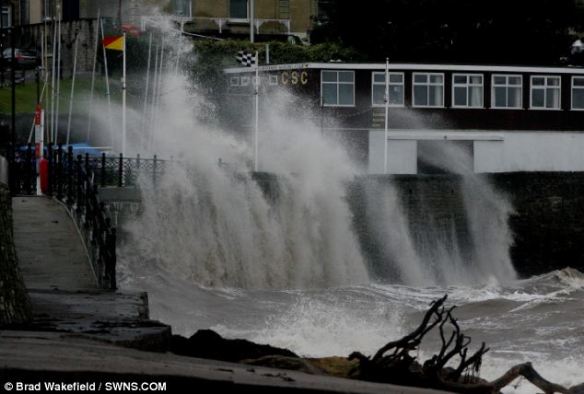
Battered: A large wave hits the sea front at Clevedon, Somerset, today as the tail end of Hurricane Katia struck the UK's coastlineBattered: A large wave hits the sea front at Clevedon, Somerset, today as the tail end of Hurricane Katia struck the UK’s coastline


the Environment Agency has also issued several flood alerts for inland and coastal areas.

Increasing wind speeds as the hurricane approached forced the cancellation of high speed ferries to France from Portsmouth.

Brittany Ferries said it was scrapping its high speed ferries on two crossings scheduled from Portsmouth to Cherbourg today.
There are more pictures and a link to a video at the site below:
Read more: http://www.dailymail.co.uk/travel/article-2036506/Hurricane-Katia-UK-Travel-chaos-ferries-cancelled-trains-high-alert.html#ixzz1XkRoppYR

Snyder, Texas Earthquake

Shallow magnitude 4.4 earthquake close to Snyder, Texas

Last update: September 12, 2011 at 2:13 pm by By 

Earthquake overview : At 07:27 AM local time, a short moderate earthquake struck the Snyder area. Too weak to create damage or injuries, but strong enough to scare people for a couple of seconds.

Update 21:56 UTC :  We have noticed 2 +2aftershocks so far :
– 20:31 UTC or  03:31 PM LT –  2.7 magnitude @ 5 km : Epicenter location
– 18:36 UTC or  01:36 PM LT –  2.5 magnitude @ 5 km : Epicenter location

Update 20:20 UTC : was this quake caused by fracking of the oil industry ?  This a a (nameless) comment we received a couple of minutes ago : “i slept thru it but i work in the oil fields near and around where the earth quake struk and i am confident in saying it was caused by man. we dig and drill and extract and frac the earth leaving cavities. This wont be the last quake we create. When we will see what we are doing is creating vast damages to our earth.”

What is fracking?
The process of drilling down and creating tiny explosions to shatter and crack hard shale rocks to release the gas inside. Water, sand and chemicals are injected into the rock at high pressure which allows the gas to flow out to the head of the well. The process is carried out vertically or, more commonly, by drilling horizontally to the rock layer. The process can create new pathways to release gas or can be used to extend existing channels.
There are also worries that the fracking process can cause small earth tremors. Currently we have a lot of discussion whether the Virginia earthquakes were also triggered by fracking.

to read more, go to:   http://earthquake-report.com/2011/09/11/shallow-magnitude-4-4-earthquake-close-to-snyder-texas/

Tropical Storm Potential for Bermuda

Tropical Storm Warning issued for Bermuda Island on Thursday from TheWeatherSpace.com

Published on September 12, 2011 2:15 am PT
– By Kevin Martin – Senior Meteorologist
– Article Editor and Approved – Ron Jackson


(TheWeatherSpace.com) — Tropical Storm Maria is on-track here at TheWeatherSpace.com. Now we admit it had potential for a threat to the United States a week ago, but things changed for it for the first write-up last Friday.
As you recall, Tropical Storm Maria’s Friday Update clearly said east of Puerto Rico, in-which TheWeatherSpace.com felt Puerto Rico did not need a Tropical Storm Watch or warning. This seemed to be the best option showing TWS’ tracking is reliable and the storm missed Puerto Rico. It will not miss Bermuda Island.

frhttp://www.theweatherspace.com/news/TWS-09_12_2011_tropicalstormwarning.html

Detoxifying your Run

Puma, Nike and Adidas Run Towards Toxin-Free Products With Greenpeace

 By  | September 7th, 2011

Did you know that your running shoes contains hazardous chemicals, some that get released every time you go out for a run?

No matter how fancy the shoe, it probably contains three components that don’t biodegrade. The decorative upper of the shoe consists of nylon, plastic or synthetic leather. The sole is more often than not, a synthetic petroleum derivative. The midsole is made of ethylene vinyl acetate. Manufacturing the soles produce byproducts like benzene, toluene, ethyl benzene, and xylene. These are usually known as the “Big Four” and act as carcinogens, endocrine disruptors, and irritants.

Some shoes with air pockets contain ozone-depleting gases. The bits of plastic contain PVC which is a hazard to both the environment and workers. The same goes for the glues that bind the outsole and the midsole. I suppose I don’t even need to talk about the tanning of leather. Now consider the rest of your sportswear…and then the rest of your wardrobe.

All this information is bound to put the latest Greenpeace toxics campaign into perspective. Greenpeace recently released a reported entitled Dirty Laundry which alleged that clothing from top brands like Adidas, Uniqlo, Calvin Klein, H&M, Abercrombie & Fitch, Lacoste, Converse and Ralph Lauren were tainted with various hazardous chemicals. Nonylphenol ethoxylates (NPEs) in particular were found which break down to form nonylphenol which has hormone-disrupting properties. NPEs are actually banned in the EU but in Asian countries like China and Vietnam where many global clothing brands have manufacturing centers, lax pollution control methods means that it is still widely employed.

As part of Greenpeace’s Detox Campaign, Puma was the first to promise a toxin free product and also to eliminate toxins from its entire supply chain and entire life-cycle by 2020. Nike  then went one step further and announced a  ”right to know”  policy where they would ensure full transparency about the chemicals being released from its suppliers’ factories. This left Adidas running behind, but it appears now that they have caught up with their own ‘toxin-free’ announcement. Adidas announced that it will be working with other brands to ensure a toxin-free product.

to read more, go to:   http://www.triplepundit.com/2011/09/puma-nike-adidas-greenpeace/?utm_source=feedburner&utm_medium=feed&utm_campaign=Feed%3A+TriplePundit+%28Triple+Pundit%29&utm_content=Google+Reader

Microwave Replacements?

Nanoscale Spin Waves Can Replace Microwaves

ScienceDaily (Sep. 10, 2011) — A group of scientists from the University of Gothenburg and the Royal Institute of Technology (KTH), Sweden, have become the first group in the world to demonstrate that theories about nanoscale spin waves agree with observations. This opens the way to replacing microwave technology in many applications, such as mobile phones and wireless networks, by components that are much smaller, cheaper, and that require less resources. The study has been published in the scientific journal Nature Nanotechnology.

Spin waves spread from a magnetic nanocontact like rings on water. (Credit: Image courtesy of University of Gothenburg)   

We have been in competition with two other research groups to be the first to confirm experimentally theoretical predictions that were first made nearly 10 years ago. We have been successful due to our method for constructing magnetic nanocontacts and due to the special microscope at our collaborators’ laboratory at the University of Perugia in Italy,” says Professor Johan Åkerman of the Department of Physics, University of Gothenburg, where he is head of the Applied Spintronics group.

The aim of the research project, which started two years ago, has been to demonstrate the propagation of spin waves from magnetic nanocontacts. Last autumn, the group was able to demonstrate the existence of spin waves with the aid of electrical measurements, and the results were published in the scientific journal Physical Review Letters.

The research group has used one of the three advanced spin wave microscopes in the world, at the university in the Italian town of Perugia, to visualise the motion. The microscope makes it possible to see the dynamic properties of components with a resolution of approximately 250 nanometre.

The results have opened the way for a new field of research known as “magnonics,” using nanoscale magnetic waves.

to read more, go to:    http://www.sciencedaily.com/releases/2011/09/110907075750.htm