On Healing fr/Jennifer Hoffman

The Many Paths of Healing

a message from Archangel Uriel channeled by Jennifer Hoffman
Monday, 11 July, 2011  (posted 14 September, 2011)

Each of you knows someone who appears to go effortlessly through life. They do not appear to have lessons to learn or have any major life issues. Their lives are not filled with worries and everything seems to be effortless for them. And they may not appear to have any spiritual connections, are not focused on their spiritual journey and yet seem to enjoy a life that you would like to create for yourself. Why, you may ask, do you have to be on a healing journey and not them? Why do you have to heal and they do not? Are they special or know something that you do not?

Each soul chooses its healing journey according to what it needs to experience in a lifetime. Each journey is unique, reflecting that soul’s lessons and learning, wounds and need for healing. And each one can choose to experience a healing path or ignore it call, as well as choosing how that path will unfold and who will be involved. From your viewpoint another’s may appear to be so much easier than yours. But you are not aware of their soul’s healing commitment in this lifetime or what they have experience in other lifetimes. These details are hidden from you, as are the details of your soul’s healing journey hidden from others. Each healing journey is a process of learning, growth, transformation and ascension and while each is different, the purpose is the same, to help each one overcome fear, find and reclaim their power and to arrive at a greater spiritual understanding.

You heal because it is what your soul is called to do. This can be a difficult and painful process or it can be easy and painless. All of its aspects are optional and of your choosing, consciously or unconsciously. You do not have to experience pain in order to heal. The person who appears to be experience a life without lessons could actually have made the choice to experience their healing journey without pain and chaos. Since you believe that healing is accompanied by pain, you choose that form of healing. You can choose other ways to heal that are far less painful and disruptive once you align your mind and spirit and make those choices.

Your healing journey also benefits everyone in your soul group. Each healing experience that you complete benefits you as well as all of those involved. Together, you have all chosen a particular healing journey. But how you experience the healing is up to you. When you choose to heal without pain, you grant the same choice to everyone in your soul group. As you learn to appreciate your lessons you can find the beauty in the healing process and you will know that you heal because it is the gift of the soul, an opportunity for you and all of humanity to learn to heal without pain, to live without fear and to move forward along your collective spiritual path. You heal because you have come to change the world and heal its emotional and spiritual wounds, which are a mirror of your own wounds. Each of you has the power to heal yourself, your soul group and the world. And you can do so without pain, gracefully, and move the world into alignment with its highest vibrations, align humanity with spirit, move into higher dimensions of being and ascend with grace and ease.

Copyright ©2011 by Jennifer Hoffman and Enlightening Life OmniMedia, Inc. This material is protected by US and international copyright now and may be distributed freely in its entirety as long as the author’s name and website, www.urielheals.com are included.

Risks of Antibiotic Creams

 Flesh-Eating Bacteria’s Rise Tied to Antibiotic Cream

Joseph Brownstein, MyHealthNewsDaily Contributor
Date: 14 September 2011 Time: 01:11 PM ET
Scanning electron microscopy of Staphylococcus epidermidis cluster.
CREDIT: Michael Otto/NIH

After getting a cut, many Americans will reach for a tube of over-the-counter antibiotic cream to ward off infection. But that widespread habit, a new paper suggests, may be contributing to the rise of one of the most concerning strains of drug-resistant bacteria.

Japanese researchers looked at 261 samples of methicillin-resistant Staphylococcus aureus (MRSA), including 21 samples of the USA300 strain, a type of MRSA that has gained attention for its spread, its frequent presence in the community as well as the hospital, and its link to necrotizing fasciitis, also known as flesh-eating disease.

They found that while other MRSA strains were somewhat susceptible to some combination of the antibiotics bacitracin and neomycin — which are typically found in over-the-counter creams — only the USA300 strains were resistant to both. The authors said this may mean that overexposure to those antibiotics is what led to USA300’s resistance.

People should understand that triple antibiotic [ointment] is not almighty, and avoid preventive or excessive use of this ointment,” said study author Masahiro Suzuki, a bacteriologist at the Aichi Prefectural Institute of Public Health in Nagoya, Japan.

How the USA300 strain arose

The origin of the USA300 strain has remained unknown, in part because, unlike other MRSA strains, it appears to have evolved outside of hospitals.

“Over the past decade or so, it’s really emerged as the leading cause of skin and soft tissue infections in the community,” said Dr. Henry Blumberg, a professor ofinfectious disease at Emory University who has studied USA300 at Grady Memorial Hospital in Atlanta.

While other antibiotic-resistant bacteria arose in hospitals, where antibiotic use is common, and then spread out into communities, USA300 was first found in community infections, and spread from there.

“Now it’s causing hospital infections,” he said. “Now the lines are a little more blurry between the community and hospital.”

Because USA300 is in the community, a number of groups are particularly susceptible to the strain, including children, gay men, prison inmates, military recruits, tattoo recipients and athletes, the study said.

But Blumberg said, “I think we’re beyond that. These groups may have higher risk, but these things spread throughout the population.”

Suzuki similarly told MyHealthNewsDaily that “all USA residents have a risk for USA300 infections anytime and anywhere, and should be careful to keep cuts and scrapes clean and covered, avoid contact with other persons’ infected skin, wash hands frequently, avoid sharing personal items to minimize risk of infection.”

Are antibiotic creams to blame?

While he agreed the bacteria are a threat, Blumberg said he was somewhat skeptical of the authors’ hypothesis that over-the-counter ointments are driving the presence of USA300.

“They have a theory that use of topical, over-the-counter creams and antibiotics select this USA300 clone and that’s why it’s emerged,” Blumberg said. “They haven’t proved it.”

Blumberg said that he is hesitant about the theory because “from my experience, most of the patients we see haven’t used topical antibiotics.” But, he said, “I think it’s an interesting theory. It would be interesting to see if this was widespread in a bigger collection of USA300 isolates.”

While USA300 is resistant to a number of drugs, it remains treatable — for now.

to read more, go to:    http://www.livescience.com/16054-flesh-eating-bacteria-rise-tied-antibiotic-cream.html

Dolphin Communication

Dolphins ‘Talk’ Like Humans, New Study Suggests

Jeanna Bryner, LiveScience Managing Editor
Date: 07 September 2011 Time: 09:32 AM ET
bottlenose dolphin in the water
New research suggests the whistles of bottlenose dolphins aren’t whistles at all.
CREDIT: © Chris Johnson – earthOCEAN

Dolphins “talk” to each other, using the same process to make their high-pitched sounds as humans, according to a new analysis of results from a 1970s experiment.

The findings mean dolphins don’t actually whistle as has been long thought, but instead rely on vibrations of tissues in their nasal cavities that are analogous to our vocal cords.

Scientists are only now figuring this out, “because it certainly sounds like a whistle,” said study researcher Peter Madsen of the Institute of Bioscience at Aarhus University in Denmark, adding that the term was coined in a paper published in 1949 in the journal Science. “And it has stuck since

The finding clears up a question that has long puzzled scientists: How can dolphins make their signature identifying whistles at the water’s surface and during deep dives where compression causes sound waves to travel faster and would thus change the frequency of those calls.

To answer that question, Madsen and his colleagues analyzed recently digitized recordings of a 12-year-old male bottlenose dolphin (Tursiops truncatus) from 1977. At the time, the researchers had the dolphin breathe a mixture of helium and oxygen called heliox. (Used by humans, heliox makes one sound like Donald Duck.)

The heliox was meant to mimic conditions during a deep dive since it causes a shift up in frequency. When breathing air or heliox, the male dolphin, however, continued to make the same whistles, with the same frequency.

Rather than vocal cords, the dolphins likely use tissue vibrations in their nasal cavities to produce their “whistles,” which aren’t true whistles after all. The researchers suggest structures in the nasal cavity, called phonic lips, are responsible for the sound.

The dolphins aren’t actually talking, though.

“It does not mean that they talk like humans, only that they communicate with sound made in the same way,” Madsen told LiveScience.

“Cetean ancestors lived on land some 40 million years ago and made sounds with vocal folds in their larynx,” Madsen said, referring to the group of mammals to which dolphins belong. “They lost that during the adaptations to a fully aquatic lifestyle, but evolved sound production in the nose that functions like that of vocal folds.”

This vocal ability also likely gives dolphins a broader range of sounds.

to read more, go to:    http://www.livescience.com/15928-dolphins-whistles-talk-humans.html

Another Human-Animal Connection

Humans Hardwired to Respond to Animals

Wynne Parry, Senior LiveScience Writer
Date: 09 September 2011 Time: 08:46 PM ET
Happy Dog Face
A specific part of your brain, your right amygdala, responds more to this animal face than that of another person, a study has found.
CREDIT: Caroline Kjall/stock.xchng

A part of your brain is hardwired to respond to animals, whether cute and fluffy or ugly and threatening, a new study has found.

A research team showed pictures of people, landmarks, animals or objects to epilepsy patients, who were already wired up so doctors could watch brain activity related to seizures. The researchers monitored the activity in the patients’ amygdalae, two roughly almond-shaped structures in the brain associated with emotions, fear and the sense of smell.

“Our study shows that neurons in the human amygdala respond preferentially to pictures of animals, meaning that we saw the most amount of activity in cells when the patients looked at cats or snakes versus buildings or people,” said Florian Mormann, lead study researcher and a former postdoctoral scholar at Caltech.

This preference extends to cute as well as ugly or dangerous animals and appears to be independent of the emotional contents of the pictures. Remarkably, we find this response behavior only in the right and not in the left amygdala,” Mormann said.

They found the activity in the right amygdala was not only greater, but neural responses were also faster for the animal pictures. The researchers then found the same response among people not suffering from epilepsy.

Past amygdala research has usually focused on human faces and fear, so it was a surprise to see that neurons in the right amygdala respond more to animals of all kinds than to human faces, according to Ralph Adolphus, a team member and professor at Caltech.

http://www.livescience.com/15996-brain-amygdala-animal-preference.html

Nazca Lines in Mideast

Visible Only From Above, Mystifying ‘Nazca Lines’ Discovered in Mideast

Owen Jarus, LiveScience Contributor
Date: 14 September 2011 Time: 10:33 AM ET
wheel stone structure in jordan
The giant stone structures form wheel shapes with spokes often radiating inside. Here a cluster of wheels in the Azraq Oasis.
CREDIT: David D. Boyer APAAME_20080925_DDB-0237

They stretch from Syria to Saudi Arabia, can be seen from the air but not the ground, and are virtually unknown to the public.

They are the Middle East’s own version of the Nazca Lines — ancient “geolyphs,” or drawings, that span deserts in southern Peru — and now, thanks to new satellite-mapping technologies, and an aerial photography program in Jordan, researchers are discovering more of them than ever before. They number well into the thousands.

Referred to by archaeologists as “wheels,” these stone structures have a wide variety of designs, with a common one being a circle with spokes radiating inside. Researchers believe that they date back to antiquity, at least 2,000 years ago. They are often found on lava fields and range from 82 feet to 230 feet (25 meters to 70 meters) across.

“In Jordan alone we’ve got stone-built structures that are far more numerous than (the) Nazca Lines, far more extensive in the area that they cover, and far older,” said David Kennedy, a professor of classics and ancient history at the University of Western Australia.

Kennedy’s new research, which will be published in a forthcoming issue of the Journal of Archaeological Science, reveals that these wheels form part of a variety of stone landscapes. These include kites (stone structures used for funnelling and killing animals); pendants (lines of stone cairns that run from burials); and walls, mysterious structures that meander across the landscape for up to several hundred feet and have no apparent practical use.

His team’s studies are part of a long-term aerial reconnaissance project that is looking at archaeological sites across Jordan. As of now, Kennedy and his colleagues are puzzled as to what the structures may have been used for or what meaning they held.

Chilean Earthquake

Strong earthquake near Valparaiso, Chile – also awakes Santiago de Chile – NO damage or injuries

Last update: September 14, 2011 at 4:36 pm by By 

Earthquake overview : At 4:04 AM Chile local time, a strong moderate earthquake occurred close to Valparaiso, Chile. Strong MMI VI shaking has been experienced near the epicenter.

U

pdate 10:02 UTC : after screening our many various sources, we are happy to report that this earthquake made NO damage or did NOT injure people (published 3 hours after the earthquake struck).

Update 08:04 UTC : Our Chile readers are fading away from our screens, which means that most of them went back to their beds after looking into the details of this earthquake. It is 05:04 AM in the Chile night.

Update 08:03 UTC : Some people report 2 weak aftershocks.

for more, go to:    http://earthquake-report.com/2011/09/14/strong-earthquake-near-valparaiso-chile/

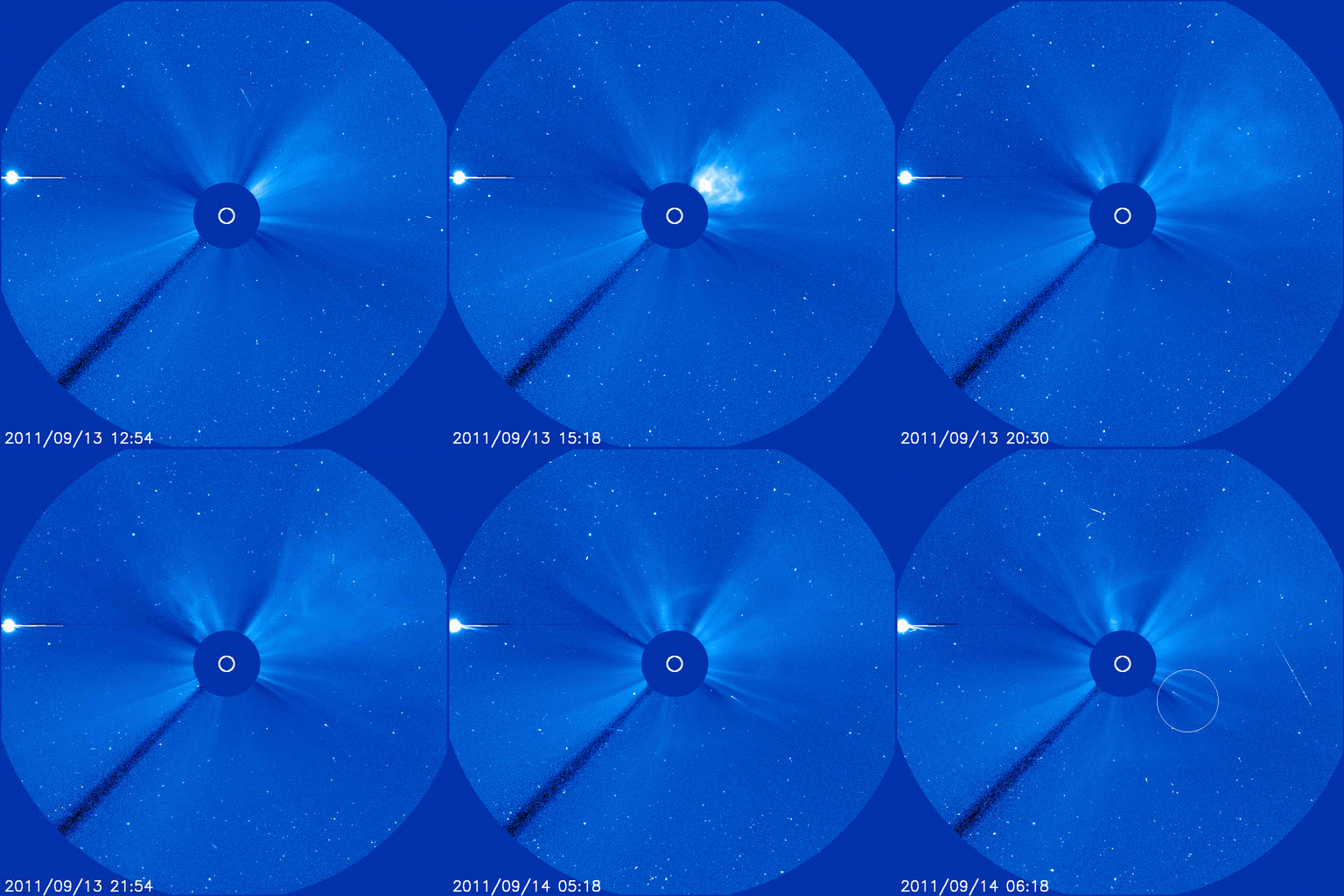
Comet Dives Into Sun

UNDIVING COMET: A comet is diving into the sun today. Discovered just yesterday by amateur comet hunters Michal Kusiak of Poland and Sergei Schmalz of Germany, the icy visitor from the outer solar system is expected to brighten to first magnitude before it disintegrates during the late hours of Sept. 14th. Click to view an updated movie of the comet’s death plunge:

The doomed comet appears to be a member of the Kreutz family. Kreutz sungrazers are fragments from the breakup of a single giant comet many centuries ago. They get their name from 19th century German astronomer Heinrich Kreutz, who studied them in detail. Several Kreutz fragments pass by the sun and disintegrate every day. Most, measuring less than a few meters across, are too small to see, but occasionally a big fragment like this one attracts attention.

from:  spaceweather.com

Eritrea Nabro Volcano — Eruption & Seismic Activity

Eritrea Nabro volcano eruption : seismic activity continues below Nabro

Last update: September 14, 2011 at 11:00 am by By 

Nabro is an Eritrean volcano with NO historic eruption record

UPDATE 14/09 – 10:16 UTC :
OGA, the Djibouti Seismological Agency reports renewed seismic activity below the Nabro volcano. Seismic activity does not mean necessarily that the volcano will erupt again (we see nothing unusual – nor visual or infrared).
The picture below shows the tremors which occurred between September 9 and September 11.
3 of the 4 quakes are too deep to be related to an eventual upcoming eruption.
The seismic activity continued now and then since the volcano calmed down several weeks ago.
The magnitude 4.3 struck below the volcano on the 10th of September. 
2011-09-11   18:53:39     3.1     Eritrea – depth 600 meter
2011-09-10   20:05:48     4.3     Eritrea – depth 5.3 km
2011-09-10   06:29:35     2.7     Eritrea – depth 10.72 km
2011-09-09   04:27:38     3.5     Eritrea – depth 8 km


Earthquake—Riverside, California

Moderate earthquake near Riverside, California, USA – NO damage or injuries

Last update: September 14, 2011 at 4:24 pm by By 

Earthquake overview :  At 7:44 a moderate shallow earthquake struck 8 km from Yucaipa and 109 km from LA downtown.

FINAL update 16:22 UTC : After screening our many sources (all Fire Department brigades and some supermarkets in the epicenter area), we are happy to report that this earthquake made NO damage, injuries or casualties

to read more, and for up dates, go to:   http://earthquake-report.com/2011/09/14/moderate-earthquake-in-greater-los-angeles-california-usa/

Earthquake Under Mt. Rainier

Weak earthquake right below Mount Rainier volcano, Washington, USA

Last update: September 13, 2011 at 7:09 pm by By 

On September 13, 2011 at 09:29:28 AM a weak tremor of 2.6 magnitude occurred below the crater of Mt Rainier, the Washington volcano.

This does not mean at all that the volcano will erupt, but this tremor below the crater is one of the strongest since many months. Activity is centered below sea level below the crater (+5,000 meter below the summit

Update : the magnitude and depth has been changed by USGS to 2.4 @ a depth of 1 km (0.6 miles)

Todays tremor is by far the biggest since many months.

Typically, up to five earthquakes are recorded monthly near the summit. Swarms of five to ten shallow earthquakes over two or three days take place from time to time, predominantly in the region of 4 km below the summit (near sea level), and are thought to be caused by the circulation of hot fluids beneath Mount Rainier.

Seismic swarms (not initiated with a mainshock) are common features at volcanoes, and are rarely associated with eruptive activity.

to read more, go to:    http://earthquake-report.com/2011/09/13/weak-earthquake-right-below-mount-rainier-volcano-washington-usa/