Antimatter Atom Measured

Revealing Our Antimatter Universe–1st Measurement Ever of an Antimatter Atom


Free_1795167

We may soon know why the universe seems to have a preference for matter over antimatter.An international team of physicists working on the ALPHA experiment at CERN near Geneva, Switzerland, has successfully used microwaves to manipulate antihydrogen atoms. Their work could help answer fundamental questions about the universe. The accomplishment, by physicists working on the ALPHA experiment at CERN near Geneva, Switzerland, is a first step towards more detailed measurements that will reveal whether matter and antimatter are true mirror images.

“This comparison is motivated in part by a question that has baffled scientists for a long time,” says Simon Fraser University physics professor Mike Hayden, lead author of the research paper published in Nature March 7. “The known laws of physics tell us that matter and antimatter should naturally exist in equal amounts. The problem is that we seem to live in a universe that is almost entirely devoid of antimatter. A possible explanation is that there might be some subtle difference between matter and antimatter, which let matter win out over time as the universe evolved. If a difference between hydrogen and anti-hydrogen is discovered, it could provide a valuable clue for solving this mystery.”

The ALPHA team trapped an atom of antihydrogen –made up of a positron – the antimatter equivalent of an electron and an antiproton– using magnetic fields. By shining microwave radiation tuned to a specific frequency on the captive atom, the team was able to flip the anti-atom’s magnetic moment, liberating it from the trap and allowing it to be detected, enabling the first spectroscopic measurement of antihydrogen.

“.

The current standard model of particle physics predicts that antimatter atoms should behave exactly the same as atoms of normal matter, and have identical properties, apart from their opposite charge, which can be verified by comparing the frequency of light emitted from excited atoms. Any difference in these spectroscopic measurements would suggest that antimatter is not an exact opposite of matter – and the assumptions the standard model is based on would be considerably weakened.

The present measurement, which was conducted by the ALPHA collaboration at CERN in Switzerland, involved irradiating magnetically-trapped anti-atoms with microwaves. Precise tuning of the microwave frequency and magnetic field enabled researchers to hit an internal resonance, kicking atoms out of the trap and revealing information about their properties.

“We have just witnessed the first-ever interactions between microwaves and trapped antimatter atoms,” says Hayden. The Daily Galaxy via Simon Fraser University. Eventually measurements may reveal clues that may help solve one of the deepest mysteries in particle physics.

The Daily Galaxy via Simon Fraser University and newscientist.com

from site:    http://www.dailygalaxy.com/my_weblog/2012/03/revealing-the-antimatter-universe-1st-measurement-ever-of-an-antimatter-atom.html#more

Black Holes Before the Big Bang? New Theory

“Some Primordial Black Holes Have Existed Before the Big Bang” — A Radical Theory Proposed


6a00d8341bf7f753ef014e885a684a970d-800wi

In recent years, cosmologists have begun to think seriously about processes that occurred before the Big Bang. Alan Coley from Canada’s Dalhousie University and Bernard Carr from Queen Mary University in London, published a paper in 2011, where they theorized that some so-called primordial black holes might have been created in the Big Crunch that came before the Big Bang, which supports the theory that the Big Bang was not a single event, but one that occurs over and over again as the Universe crunches down to a single point, then blows up again.

In some circumstances, they say, black holes of a certain mass could avoid this fate and survive the crunch as separate entities. The masses for which this is possible range from a few hundred million kilograms to about the mass of our Sun.

The theory is based on the fact that the Earth, and the rest of the known Universe is occasionally bombarded with unexplained bursts of gamma rays — something that could, according to Coley and Carr, be the result of primordial black holes running out of energy and disintegrating. These small black holes ought to evaporate away in relatively short period of time, finally disappearing in a violent explosion of gamma rays. Some cosmologists say this thinking might explain the gamma ray bursts that we already see from time to time.

Primordial black holes are thought to be of a different type than the regular kind that are formed when a supernova occurs but rather formed in the first “moments” after the Big Bang. Primordial black holes would be smaller and created by the energy of the Big Bang itself and would then have been widely dispersed as the Universe expanded.

In their theory, however, Coley and Carr suggest that some of these black holes, if they actually exist, might have been created by the collapsing Universe as part of the Big Crunch, and then somehow escaped being pulled into the pinpoint singularity comprised of everything else. And then, after the Big Bang, they simply assimilated with the newly formed Universe.

A key problem they agree on is that it would likely be impossible to tell the difference between pre- and post Big Bang primordial black holes.

The theory raises major questions for cosmologists: if the Universe contracts, then blows up, over and over, has this gone on forever? Or is it possible that our view of the Universe is so limited that we’re only seeing one tiny fraction of it, and thus, any theories or explanations we offer, are little more than guesses.

Image at the top of page shows co-orbiting supermassive black holes powering the giant radio source 3C 75. Surrounded by multimillion degree x-ray emitting gas, and blasting out jets of relativistic particles the supermassive black holes are separated by 25,000 light-years. At the cores of two merging galaxies in the Abell 400 galaxy cluster they are some 300 million light-years away.
Such spectacular cosmic mergers are thought to be common in crowded galaxy cluster environments in the distant Universe. In their final stages the mergers are expected to be intense sources of gravitational waves.

More information: Persistence of black holes through a cosmological bounce, B. J. Carr, A.A. Coley, arXiv:1104.3796v1 [astro-ph.CO] http://arxiv.org/abs/1104.3796

The Daily Galaxy via MIT Technology Review

from site:    http://www.dailygalaxy.com/my_weblog/2012/03/some-primordial-black-holes-have-existed-before-the-big-bang-a-radical-theory-says-yes.html#more


Weekly Volcano Report

Smithsonian/USGS Weekly Volcanic Activity Report 29 February – 6 March 2012 8 March 2012

Posted by admin in activity reportsAlaskaBaganaBezymiannyCanary IslandsChileClevelandEcuadoreruptionsEtnaFuegoGuatemalaHawaii,HierroItalyJapanKamchatkaKanagaKarymskyKilaueaKizimenMexico,Papua New GuineaPopocatépetlPuyehueRussiaSakura-jimaSanta María,ShiveluchSpainSuwanose-jimaTungurahuaUnited StatesWeekly Volcanic Activity Reports.
Tags: 
add a comment

The latest Smithsonian Institution and United States Geological Survey Weekly Volcanic Activity Report has been published by the Global Volcanism Program, covering the week 29 February to 6 March 2012. The report is compiled by Sally Kuhn Sennert. Some of the highlights of the volcanic week:

  • Continuing activity at Etna including strombolian eruptions, lava fountaining and lava flows
  • Explosions at Fuego produced plumes that reached 0.6 km above the crater
  • Plumes rose to 1 km above Puyehue-Cordón Caulle as low-level eruptive activity continues

SI/USGS Weekly Volcanic Activity Report 29 February - 6 March 2012

from:   http://volcanism.wordpress.com/category/weekly-volcanic-activity-reports/


Northern Pacific Volcano Update

Northern Pacific Update: Bezymianny Put on Red Alert for Eruption, Seismicity Noted at Iliamna in Alaska

The steaming dome at Bezymianny seen on June 11, 2011.

A few volcanoes along the northern Pacific rim are showing varying signs of potential eruptive activity:

BezymiannyKVERT placed this active Kamchatka volcano (right) on Red Alert status over the last few days after a sharp and sustained increasein seismic activity. They also noted a sizable increase in size and temperature of the thermal anomaly seen at the summit of the volcano (observed by satellite), suggesting that new, hot magma is very close/at the surface. Put these two things together and KVERT suggests that “strong ash explosions up to 43,000 ft (13 km) a.s.l. possible at any time during the next 24 hours.” It has been about 11 months since the last explosive eruption at Bezymianny – and if anything does occur, you can see if the Bezymianny webcam is operating to catch a glimpse.

Iliamna: Over in the lower Cook Inlet of Alaska, seismicity has increased at Iliamna, but not enough to raise the alert status at the volcano above Green. However, the Alaska Volcano Observatory did mention that they will be watching the volcano closely as it has experienced a few small earthquake swarms over the past three months. This seismicity is similar to what was observed in 1996-97, but that did not lead to an eruption and the last confirmed eruption of the volcano was back in 1876 (although there may have been smaller explosions as recently as 1952). If you like watching webicorders trace the seismicity,Iliamna does have real-time monitoring. In a related note, the state and local officials are resisting a planto consolidate all its fighter aircraft in Alaska to Joint Base Elmendorf-Richardson near Anchorage from Eielson AFB near Fairbanks. Opponents of the move point out that this would put all these aircraft in danger if one of the volcanoes near Anchorage were to erupt.

Image: Bezymianny in Kamchatka by Yu. Demyanchuk/KVERT  

from:    http://www.wired.com/wiredscience/2012/03/northern-pacific-update-bezymianny-put-on-red-alert-for-eruption-seismicity-noted-at-iliamna-in-alaska/#more-99388

Nevado del Ruiz Volcano in Colombia Heating Up

Increasing Volcanic Unrest Observed at Nevado del Ruiz in Colombia

The crater of Nevado del Ruiz in Colombia seen on March 8, 2012. The area is obviously warm and INGEOMINAS scientists noticed ash in the crater area as well.

Eruptions reader Sherine pointed me towards the recent updates from INGEOMINAS in Colombia onNevado del Ruiz. The volcano hasn’t erupted in over 20 years, but the signs are beginning to point towards a potential revival of the volcano.


INGEOMINAS scientists were able to do a flyover with the Colombian Air Force and got a number of shotsof the summit area. They also reported “ash on the glacier, near the crater rim and on the eastern flank of the same,” likely from a February 22 explosion from Ruiz. The steam plume from the main crater on the day of the flyover was ~1.4 km / 4,500 feet. That same day, a seismic signal of tremor associated with multiple small ash emissions were reported along with an increase in sulfur dioxide emissions. All of these events suggest that Ruiz is seeing heating in the summit area and likely phreatic explosions. The increased sulfur dioxide would additionally suggest new magma in the volcano. The shots of the summit area clearly show steam coming from the crater, although it is doesn’t appear to show any new material in the crater. Shots of the entire summit show ash on some of the snow-covered areas as well (see below – grey on foreground slopes of the volcano).

The summit area of Nevado del Ruiz. In the foreground a small dusting of ash can be seen on the snow. The plume seen here reaches ~1.4 km.

Most people are familiar with Nevado del Ruiz due to the eruption in 1985 that killed over 23,000 people. That disaster was caused by a lahar (volcanic mudflow) generated by a small eruption from the summit crater melting the abundance ice and snow at the summit. The most recent pictures of the summit area (see below) show that there is plenty of snow to make lahars a very real hazard if Ruiz where to begin to enter a new period of eruption.

from:    http://www.wired.com/wiredscience/2012/03/increasing-volcanic-unrest-observed-at-nevado-del-ruiz-in-colombia/#more-99578

Solar WHAM on Its Way

WEEKEND SOLAR FLARE: Sunspot AR1429 is still erupting this weekend. On Saturday, March 10th, it produced a powerful M8-class flare that almost crossed the threshold into X-territory. During the flare, New Mexico amateur astronomer Thomas Ashcraft recorded a series of radio bursts at 21 and 28 MHz:


Dynamic spectrum courtesy Wes Greenman, Alachua County, Florida

The roaring sounds you just heard are caused by shock waves plowing through the sun’s atmosphere in the aftermath of the explosion. “There is incredible complexity in the waveforms,” notes Ashcraft. “This is a recording of one of the most turbulent events in all of Nature!”

In addition, the explosion propelled yet another CME toward Earth. According to a forecast track prepared by analysts at the Goddard Space Weather Lab, the cloud will hit our planet’s magnetosphere on March 12th at 1803 UT (+/- 7 hr), possibly sparking a new round of geomagnetic storms.

After passing Earth, the CME will also hit the Mars Science Lab (MSL) spacecraft on March 13th followed by Mars itself on March 14th. Mars rover Curiosity onboard MSL might get some interesting readings as the cloud passes by.

fr/spaceweather.com

March 11-17

Overall Color for the Week:    Light Amber Orange

No, you are not going crazy.  The energies are coming together right now, old and new, and the result is confusion, chaos, and oddities.  Step back from things this week.  Use your sense of humor as a defense.  It carries a certain kindness and acceptance that will be appealing to those out there who are looking for reaction. There is a strong urge these days towards purging a lot of the old.  This can manifest itself in bouts of throwing things away or crying your eyes out or laughing hysterically.  The important thing now is to let things happen as they do and then let them go.  Not always so easy, but helpful and healthful in the long run. There can be some physical issues this week, so listen to your body and do not attempt to overdo,  You will pay for it in the end. Oh, this is not a good time for second guessing or making decisions for yourself based on other’s opinions, the lure of the media, or the spur of the moment.  There is time.  It is good to remember that.  There is time to get the important things done.  The rest, well they are not that important after all.  Mercury goes retrograde Monday. This can be a tough retrograde, so stay centered and grounded in your own knowing and personal strength, and listen to your intuition.  You are,after all, part of it all.  Please, also be aware of your power.  It is growing, perhaps with growing pains inside of you — some of those physical issues.  See things for what they have to say to you.  Again, listen to your intuition and the voices in your head.  You are connected to Universal Consciousness, and as you take time, through meditation,, centering, grounding, opening, being WHO you are, its voice, gentle and true, will speak to you. Continue reading

CME on the Horizon

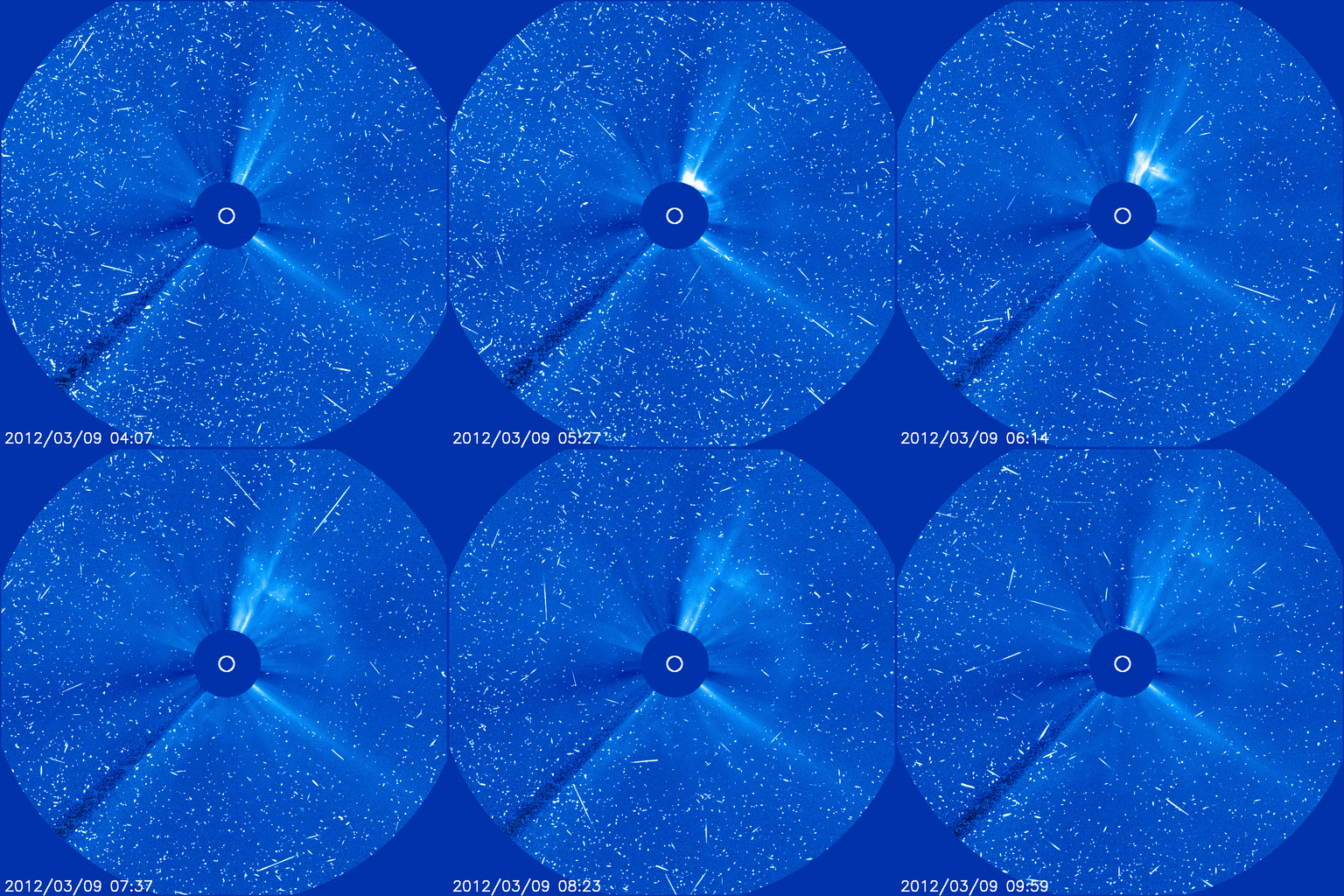
NCOMING CME: A CME from sunspot AR1429 is nearing Earth. According to analysts at the Goddard Space Weather Lab, the cloud will arrive on March 11th at 0649 UT (+/- 7 hr). NOAA forecasters say the odds of a strong geomagnetic storm at that time is 50%.

The same eruption that hurled the CME toward Earth also produced amonsterous tsunami of plasma on the sun. NASA’s Solar Dynamics Observatory recorded the shadowy but powerful wave rippling away from the blast site:

The tsumani was about 100,000 km high and raced outward at 250 km/s with a total energy of about 2 million megatons of TNT. Such waves often underlie CMEs like the one en route to Earth now.

Animated forecast tracks show that the CME will also hit the Mars Science Lab (MSL) spacecraft on March 12th followed by Mars itself on March 13th. Mars rover Curiosity onboard MSL might get some interesting readings as the cloud passes by.

fr/spaceweather.com

Incoming Solar Flare

WEEKEND SOLAR FLARE: Sunspot AR1429 is still erupting this weekend. On Saturday, March 10th, it produced a powerful M8-class flare that almost crossed the threshold into X-territory. In New Mexico, amateur radio astronomer Thomas Ashcraft recorded a series of shortwave bursts emanating from the blast site: audio. Also, the explosion propelled yet another CME toward Earth: forecast track. The cloud is expected to hit our planet’s magnetosphere on March 12th around 1800 UT. A CME from an earlier explosion will arrive much sooner, however.

fr/spaceweather.com