China has been dumping US treasuries, while Trump has been gunning for Jerome Powell at the Fed, and central bank digital currency (CBDC) was banned by Congress. Trump signed the the Guiding and Establishing National Innovation for US Stablecoins (GENIUS) Act into law. Stablecoins are a type of cryptocurrency that are backed by assets considered to be reliable such as a national currency.US-dollar backed stable coins make US dollars easier to use globally, settle transactions faster, and record transactions on a blockchain ledger. Clayton Moore said that this is how Trump plans to keep the US as the world’s reserve currency, not by printing more money, but by making the dollar more useful than anything else. There is much skepticism and Catherine Austin Fitts criticized stable coins early on, saying that they are a backdoor to central bank digital currency (CBDC).
Fitts said that stablecoin is a way to turn on helicopter money like you have never seen it turned on before. She added, “the guys who control how that money flows can literally buy up the world.” Mark Goodwin warned against the tokenization of real world assets, including land and nature.
.
[Note: Need To Know News does not endorse any investment offers]
China has been dumping US treasuries, while Trump has been gunning for Jerome Powell at the Fed, and central bank digital currency (CBDC) was banned by Congress. Trump signed the the Guiding and Establishing National Innovation for US Stablecoins (GENIUS) Act into law.
Catherine Austin Fitts criticized stable coins as a backdoor to CBDC. Here are a few short videos from Catherine Austin Fitts and Mark Goodwin:
Blockchain is simply a ledger/ accounting system. Mark Goodwin said that digital money can be traced in that public ledger and can be used as a tool for warrantless surveillance.
He explained that a cash dollar bill can only be spent by an individual once because it is given away, whereas a digital dollar could be represented on two separate ledgers that will create more money [and fraud].
Catherine Austin Fitts said that stable coins are the new tool for financial warfare and and a great land grab. She said that stable coin is a way to turn on helicopter money like you have never seen it turned on before. She added, “the guys who control how that money flows can literally buy up the world.”
Digital currencies are not tangible and can be destroyed.
Goodwin warned against the tokenization of real world assets, including land and nature.
A critic wrote, “What is the difference between between stable coin and CBDC? They’re both digital currencies, which is bad in the long term. According to the GENIUS Act, it will eliminate paper bill at the federal level. So what do you think it is going to happen later down road in state level? Cashless.”
James Li investigates whether Peter Thiel is the next Epstein—exposing his ties to private islands, youth blood infusions, and surveillance tech that’s quietly taking over the US government. Thiel had financial ties with Epstein and he held academic symposiums at Epstein’s Little St. James island. Some of the girls that Epstein brought to the island reported that they were the subjects of scientific experiments.
.
Peter Thiel was the co-founder of PayPal alongside Elon Musk. He was also the first major investor in Facebook, which was introduced the same day DARPA ended its lifelog program that was a program that sought to “trace the threads of an individual’s life in terms of events, states, and relationships.” Thiel co-founded Palantir, a data analytics and surveillance company used by many government intel and military agencies, including the CIA, NSA, ICE, and the IDF. Now, Thiel, like Epstein, was reported to have hosted “debaucherous” sex parties while in his prime that were legendary in gay circles. There are no records implicating Thiel in sexual activity with underage minors or sex trafficking.
Thiel is building his own island in French Polynesia to establish a kind of a non-governmental colony.
A podcaster revealed that Thiel held academic symposiums at Epstein’s Little St. James island. Scientific experiments were reported to have been conducted on some of the young girls Epstein brought there.
Thiel is involved in transhumanism research and development and is alleged to spend $40,000 per quarter on blood transfusions from 18-year olds.
Carbyne is an Israeli tech firm that market themselves as a next-gen 911 platform with software that gives governments and agencies the ability to access individuals’ smartphones, cameras, and mics in real time and integrates biometric tracking, geolocation, and live streaming into a single feed that is sent directly to law enforcement or intelligence hubs. This company was funded by Peter Thiel, Jeffrey Epstein and former Israeli Prime Minister Ehud Barak.
In 2015 and 2016, Epstein put $40 million into two funds managed by Veilar Ventures, a New York City venture capital firm that was co-founded by Peter Thiel!
Vice President JD Vance is a protege of Peter Thiel, who funded Vance’s US Senate campaign.
Brace For Soaring Electricity Bills: Biggest US Power Grid Sets Power Costs At Record High To Feed AI
Very soon if you want AI (and even if you don’t), you won’t be able to afford AC.
Just this morning we warned readers that America’s largest power grid, PJM Interconnect, which serves 65 million people across 13 states and Washington, DC, and more importantly feeds Deep State Central’s Loudoun County, Virginia, also known as ‘Data Center Alley‘ and which is recognized as one of the world’s largest hubs for data centers…
… had recently issued multiple ‘Maximum Generation‘ and ‘Load Management‘ alerts this summer, as the heat pushes power demand to the brink with air conditioners running at full blast across the eastern half of the U.S.
But as anyone who has not lived under a rock knows, the deeper issue is that there’s simply not enough baseload juice to feed the relentless, ravenous growth of power-hungry AI server racks at new data centers.
“There is simply no new capacity to meet new loads,” said Joe Bowring to Bloomberg, president of Monitoring Analytics, which is the independent watchdog for PJM Interconnection. “The solution is to make sure that people who want to build data centers are serious enough about it to bring their own generation.”
Well, there is another solution: crank up prices to the stratosphere.
And that’s precisely what happened. As Bloomberg reports, business and households supplied by the largest US grid will pay $16.1 billion to ensure there is enough electricity supply to meet soaring power demand, especially that from a massive buildout in AI data centers.
The payouts to generators for the year starting June 2026 topped last year’s record $14.7 billion, according to PJM Interconnection LLC, which operates the grid stretching from the Midwest to the mid-Atlantic. That puts the capacity price per megawatt each day at a record $329.17 from $269.92.
In response to the blowout payout, shares of Constellation Energy and Talen Energy surged in late trading in New York on Tuesday.
As millions of Americans will very soon learn the hard way, AI data centers are driving the biggest surge in US electric demand in decades, leading to higher residential utility bills. That’s a key reason why PJM’s auction, once only tracked by power traders and plant owners but now increasingly a topic for general consumption as electricity bills are about to hit an all time high, has also become closely watched by politicians and consumer advocates.
As Bloomberg notes, this is the first auction that included both a price floor and cap, setting the range at $177.24 to $329.17, which of course was the clearing price level reached in this auction. Why even bother pretending there is an auction: just set the price at the max and be done with it. Last year’s 600% jump in capacity prices set off a political firestorm, resulting in PJM reaching a settlement with Pennsylvania Governor Josh Shapiro to essentially cap gains for two years and make auction prices more predictable after wild swings in recent years.
Despite the increase in costs across the grid, the price cap trimmed costs for consumers who saw the biggest hikes in the last auction. Exelon’s Baltimore area utility reached a $466 last time, while Dominion Energy’s Virginia territory came in at about $444.
Payouts to generators stayed at high levels due to surging demand from big data centers coming online swiftly, said Jon Gordon, policy director of non-profit clean energy advocacy Advanced Energy United. New facilities are consuming as much power as towns or small cities, coinciding with a wave of older power plants shutting down and lagging investment in new supplies and grid upgrades, he said.
The per-megawatt price exceeding the 2024 auction, and well closing at an all time high, is bullish for independent power producers including NRG, Talen, Constellation and Vistra, Barclays analyst Nick Campenella had forecast. These generators have spent more than $34 billion so far this year on deals to mainly buy up power plants fueled by natural gas to feed the AI boom especially in PJM.
‘It will destroy this place:’ Tucker County residents fight for future against proposed data center
As a little known company has proposed a data center and natural gas plant in the tourism destination — known for its natural wonder and outdoor recreation — residents are left with questions, mounting concerns and few answers.
A complex of data centers in Ashburn, Va. The city is located in Loudoun County, which has been dubbed “Data Center Alley.” (Gerville | Getty Images)
As a child, Nikki Forrester dreamed of living in a cabin in the woods surrounded by mountains, trees, water and the outdoor opportunities that came with the natural land. In 2022 — four years after earning her graduate degree and moving to Tucker County from Pittsburgh — Forrester and her partner made that dream a reality when they bought two acres of land near Davis, West Virginia to build a home.
Forrester has thrived in the small mountain town known for its mountain biking, hiking, stargazing, waterfalls and natural scenery. She and her partner moved into their new home in February. Hiking and biking trails are right outside her front door. In the winter, she said, snow piles up making the nearby mountains look like “heaven on Earth.”
It’s been quite literally a dream come true.
“I feel like I’ve never felt at home so much before. I love being in the woods. I love this community. It’s super cheesy, but this was my childhood dream and now it’s actually come true,” Forrester said. “It felt so good to set down roots here. We knew Davis was where we wanted to start our future.”
But in March, one small public notice posted in the Parsons Advocate — noticed by resident Pamela Moe, who scrambled to find answers after seeing it — changed Forrester’s assumptions about that future.
A Virginia-based company, Fundamental Data, was applying for an air permit from the West Virginia Department of Environmental Protection for what it called the “Ridgeline Facility.” The company’s heavily redacted application showed plans to build an off-the-grid natural gas power plant between Thomas and Davis. That power plant will likely be designed to power an enormous data center just a mile out from Tucker County’s most populous and tourist-attracting areas.
Earlier this month, representatives for Fundamental Data — who did not respond to requests for comment on this article — told the Wall Street Journal that the facility could be “among the largest data center campuses in the world,” spanning 10,000 acres across Tucker and Grant counties if fully realized.
Now, Forrester said, she and her neighbors are in the middle of what feels like a “fight for [their] lives” as they attempt to learn more about the vague development plans and fight against “big data.”
Her images of the future — skiing on white snow, hiking through waterfalls, looking up at clear and starry nights all with one-of-a-kind mountain scenery below — now exist in the shadows of a looming natural gas plant, an industrial complex and the contaminants that could come with them. The fresh, mountain air that surrounds her home and community could be infiltrated by tons of nitrogen oxide (gases that contribute to smog), carbon monoxide, particulate matter and other volatile organic compounds, per the company’s air permit application.
“Honestly, I feel like if this happens, it will destroy this place. People come here because it’s remote, it’s small, it’s surrounded by nature. If you have a giant power plant coughing up smoke and noise pollution and light pollution, it puts all of those things in jeopardy,” Forrester said. “It would honestly make me question whether I would want to live here anymore, because I do love the landscapes here so much, but they would be fundamentally altered and, I think, irreparably harmed if this actually comes to be.”
Tucker United and a fight against the many ‘unknowns’
Since learning of the project in March, Forrester and dozens of other Tucker County residents have banned together and formed Tucker United. The residents — all volunteers — want answers from Fundamental Data or anyone else regarding details of the proposed Ridgeline facility.
But that fight hasn’t been easy. The state DEP has allowed Fundamental Data — a company with little to no information publicly available — to submit a redacted air permit application, omitting details regarding potential air pollutants that could come from the site.
A heavily redacted page from Fundamental Data’s air permit application to the state Department of Environmental Protection.
According to reporting in Country Roads News, local officials were unaware of the project before reporters and members of the public brought it to their attention.
Reading the Wall Street Journal article was the first time most residents were alerted about the potential size of the planned development.
Josh Nease, who lives outside of Thomas and Davis in an unincorporated part of Tucker County, said the unknowns about the project have been the most frustrating part to grapple with.
“There’s no lack of uncertainty right now, that’s for sure,” said Nease, a sixth generation West Virginian who moved to Tucker County after spending vacations there as a child growing up in Bridgeport. “I think the unknowns here are really worrying.”
If given the chance, he would want to ask representatives of Fundamental Data the following questions: Why the lack of transparency? Why does the company want to locate in Tucker County and why not further out from the towns? And why does it feel like there’s resistance against working with the local governments and community members?
Luanne McGovern, an engineer by trade who owns property in Tucker County and who sits on the board of West Virginia Highlands Conservancy, an environmental nonprofit in the region, holds similar frustrations to Nease.
Per the permit application, the Ridgeline facility — in its currently proposed form — would use gas-fueled turbines with heat recovery steam generators. Diesel would be kept on site in three 10 million gallon storage tanks as a backup power source in case of gas line interruptions. Those tanks would be 66 feet tall and 180 feet in diameter. Leaks from pumps and valves, among other pieces of equipment, are to be expected per the application. Operations for the facility should begin by 2028.
When residents started working together to make sense of Fundamental Data’s air permit application, they asked McGovern to look it over and share her thoughts. Having worked on similar permit requests before, she knew what she was looking at: A large, natural gas power plant.
What was more notable, however, was what she was unable to view.
Pollutants were listed on the request, but only in annual caps. There was no information on water usage despite some data centers using up to 5 million gallons of drinking water a day, straining resources in communities. While the heights of the diesel storage tanks were included, she said information on the turbines wasn’t.
While the DEP asked for clarification on Fundamental Data’s redactions following an influx of public comments from concerned residents, the company said it believed the omitted information met the state’s standard for confidentiality. The DEP ended up agreeing.
Fundamental Data, through its representative Casey Chapman, provided some details to the DEP in an attempt to put the public at ease: the site “does not plan” to use water from local water systems, rivers or streams and won’t discharge wastewater into them; mountains surrounding the development should “substantially limit” its visibility from populated areas and the facility “expects” to operate at noise levels that adhere with federal regulations.
But McGovern still had questions.
“Where is the water coming from? How high are these turbines? Where will they be? If we had some answers to these questions, we could do some modeling and figure out what the potential environmental impact would be, but we don’t,” McGovern said. “We’re just completely in the dark. There’s so many unanswered questions. As an engineer, there’s huge parts of this permit that are just bad. There’s no information provided, not even a level of standard of information that you would expect.”
Nease is realistic; he understands that these are complex issues and the state — as well as his region — are attempting to find new ways to bolster the economy and, hopefully, improve West Virginia’s economic standings long term.
He sees the challenges hitting Tucker County residents every day. There’s a housing shortage and short-term rentals are driving up costs for the places that do exist, pricing out residents who can’t afford to live where they work. While tourism can bring in crowds, it’s often only seasonal. The county’s population — like most of West Virginia — is declining.
“I fully understand the need to diversify the economy. I support doing that, we talk about it all the time. I guess I’m just not sure that a project like this is the solution,” Nease said. “We just don’t know enough about it. We don’t know if this is going to benefit the Tucker County economy. I sure hope it does, but all I have to rely on for that are vague statements.”
‘It feels extractive:’ West Virginia data centers to operate with no local oversight, questionable economic gains
On March 18 — the same day that Fundamental Data submitted its air permit application to the DEP — House Bill 2014 was introduced at the state Legislature to incentivize data centers to locate in West Virginia and generate their own power sources through microgrids. Senate President Randy Smith, a Republican who represents Tucker County and voted for HB 2014, did not respond to requests for comment on this article.
Despite being a key priority for Gov. Patrick Morrisey who requested its introduction, the bill was presented more than halfway through the state’s 60-day session. In back-and-forths over several weeks, lawmakers amended the bill again and again. One change removed a requirement for microgrids to use renewable energy sources, opening the door for coal and natural gas. Several other amendments changed the tax structure for any property taxes collected on the developments.
The version of the bill that now stands as law allows “high impact data centers” to curtail local zoning ordinances and other regulatory processes and establishes a certified microgrid program, which means data centers can produce and use their own power without attaching to already existing utilities.
The law creates a specialized tax structure for data centers and microgrids, which must be placed in designated districts. Local governments have little say or control over those districts, which are established at the state level.
Taxes collected on any data centers and microgrids operating in West Virginia would be split as so: 50% will go to the personal income tax reduction fund, 30% will go to the county where the data center is located, 10% will go to the remaining 54 counties split on a per capita basis using the most recent U.S. Census, 5% will be placed in the Economic Enhancement Grant Fund administered by the Water Development Authority and the final 5% will be put in the newly created Electric Grid Stabilization and Security Fund.
Initially, those taxes were going to be completely diverted away from localities where the data centers would be located, angering county commissioners and other local leaders from throughout the state.
Kelly Allen, executive director of the West Virginia Center on Budget and Policy, said the fact that 50% of any tax revenue collected going to offset the state’s personal income tax cuts is a concern, especially while only 30% will return to localities that host the data centers.
“Local governments are really limited in the ways that they can raise revenue, which is largely controlled by either the state constitution or the state legislature. So taking away a significant slice of one of the only ways that they can raise revenue — through property taxes — leaves [localities] with fewer options to fund basic services,” Allen said. “At the same time, these data centers and micro grids are probably going to increase the need for the public services that local governments pay for.”
Allen pointed to the potential risks that come with operating power plants: county fire and police services will be needed for safety at the plants and water districts may be impacted, she said.
Essentially, she said, counties will be on the hook for funding more services while only receiving a fraction of the revenue generated by the sources of those costs.
And, generally, there’s no guarantee — despite Fundamental Data’s claims for the Tucker County facility — that data centers will serve as massive employers.
Nationwide, according to the U.S. Census, jobs in data centers are increasing. But more than 40% of all jobs in 2023 existed in just three states. Per an analysis by Business Insider, most of the data center jobs available are only in construction and contracted from outside the places the centers are located.
Data centers are largely automated. Microsoft, for example, employs just 50 people per a facility. In West Virginia — because of the inclusion of microgrids, which aren’t mandated to be created for data centers — the picture could look different. But again, the lack of details from companies coming here makes the real impact difficult if not impossible to determine.
Allen said she’s wary of the state’s potential reliance on data centers for a financial boom given the state’s history of extraction-based economics.
Like with the coal economy, residents across the state will bear the aesthetic, environmental and health costs associated with living near data centers and their power plants. Most of the profits, however, may not return to them, Allen said.
“It’s not exactly identical to coal or natural gas or timber, but it feels extractive in the same way in that the benefits of the data center are borne by people outside of West Virginia, while the costs are borne by our residents,” Allen said.
Nease said that while he wants to be “pragmatic” about the potential for development in Tucker County, he can’t help but think of the state’s history in that regard either.
“I’m worried we’re going to fall into that same trap again. It’s an age old story — not just for West Virginia. Some people are going to benefit from this project, they just might not be here,” Nease said. “The company will benefit, its [shareholders] will. But will we?”
‘A race to the bottom:’ While West Virginia lawmakers want to compete with Virginia, locals say it’s not possible
While state lawmakers spent hours this legislative session debating how to craft the state’s new law to attract data centers, several couldn’t stop thinking about — or mentioning — neighboring Virginia, where the development of large, high-impact data centers have boomed.
Echoing sentiments shared by Morrisey through his “Backyard Brawl” plan to compete with neighboring states economically, delegates — including Del. Clay Riley, R-Harrison, who sits on the House Committee on Energy and Public Works, where the bill passed — said they wanted to see data center development here thrive like it has in Northern Virginia.
Loudoun County, Virginia has been dubbed “Data Center Alley.” It’s home to the largest data center market in the world.
But that development didn’t happen overnight, said Julie Bolthouse, director of land use at Piedmont Environmental Council in Virginia.
The industry started building in Northern Virginia in the 1990s and 2000s. Some of the largest data and internet providers at the time were located there. Over time, though, the market has changed.
Bolthouse said what used to be small complexes organized like business parks — featuring restaurants, shopping, day cares and more for people who lived in the region — are now large campuses with few people, no outside amenities and mostly computers and software.
And those “hyper-scaled” complexes — in Virginia and beyond — haven’t come without costs. The pollutants emitted by large centers are known to exacerbate respiratory problems and other health conditions. Residents nearby can hear the incessant buzzing and hums of the computers and generators at work. Light pollution, depending on the size and type of facility, can be impossible to ignore.
But these issues — outside of the environmental ones — vary place to place because of local ordinances.
“That is like the only thing that’s really protecting Virginia communities, because the only way that the people who live in these localities are able to get any kind of protection is because of noise ordinances, because of the lighting ordinances,” Bolthouse said.
In West Virginia under HB 2014, residents won’t have the same protections or powers due to the state’s superseding of local ordinances.
And now, decades into Virginia’s ever changing data center sector, Bolthouse and other environmentalists are seeking more regulations on the state level since the nature of these data centers has changed so much over such a short period of time.
“That’s the push we’re seeing now — for the state to come in and add additional regulations, to look at the environmental impact,” Bolthouse said. “No one is talking about taking away the ability of localities to regulate these facilities. I can’t imagine that.”
And while the landscape for data centers is evolving in Loudoun County and beyond, the reason so many large companies have decided to locate their centers in Northern Virginia goes back to the 1990s. The infrastructure for them to be developed, Bolthouse said, already existed — it wasn’t newly created like West Virginia is attempting to do.
“There’s such a robust fiber network here. These data centers are kind of like a gigantic global computer. They talk to each other, and so the closer they are to all the other cloud providers, the better,” Bolthouse said. “When you put a data center here, your data is stored in Northern Virginia and you are in spitting distance to [Amazon], Google, Microsoft, all the big co-locators … probably every big business has an operation here in Northern Virginia. So it’s like the Wall Street of the data center industry. That’s why they want to locate here.”
Bolthouse warned that without regulations, without protections and without the advantages that Virginia has through its location and infrastructure, West Virginia could be attempting to enter a new sector by inviting in the “worst players.”
“What you’re going to get if you do it this way is the worst players, the ones that didn’t need to be in Northern Virginia … the players that are wanting that lack of regulations because they didn’t want to abide by rules and didn’t want to or need to protect communities, which is worse for West Virginia and the communities,” Bolthouse said. “What West Virginia is doing is not what Virginia is doing.”
She said West Virginia needs to look at the assets it already has, not the assets others in the sector have worked with for decades.
Those assets, in Bolthouse’s words, are the same things that made Forrester feel like her childhood dreams were coming true when she built a home in Tucker County: the state’s “beautiful mountains, its rivers, its natural beauty and outdoor opportunities.”
“That’s what West Virginia should be leveraging. The state shouldn’t be trying to get something that another state has already secured the market on,” Bolthouse said. “I don’t know that West Virginia can become the next Data Center Alley. I don’t think that’s actually feasible … You’re trying to basically have a race to the bottom, and you’re only going to get the worst players.”
Last week, the BBC reminded us that we have just three years left to drastically reduce all CO2 emissions, or we risk crossing the dreaded 1.5°C warming limit set by the Paris Agreement. A persistent feature of the degreed managerial class is their arrogant refusal to learn from their past flawed predictions. Dire warnings of climate catastrophe have shaped global policy, media narratives, and public perception, resulting in the waste of hundreds of billions of dollars on technology that does not work. Predictions by climate ‘experts’ of submerged cities, the end of snow, vanishing ice caps, and dead coral formations never materialize.
Thinking that highly credentialed Ivy League professors would use science and math to destroy the man-made climate change narrative was not plausible a year ago. Yet, in this new cultural zeitgeist created after the implosion of the Democratic Party, the impossible is now possible
Their message is simple: CO2-driven warming poses no danger to the planet, while the net-zero policies designed to reduce CO2 do more harm than good. It takes a paper of serious complexity to validate such a simple message.
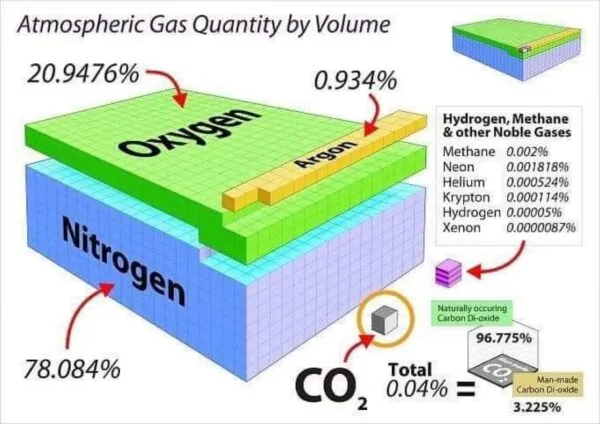
Climate experts tend to pronounce things to be so, and that’s the end of it. Yet, a basic understanding of the Earth’s atmospheric gases demonstrated that the foundation of climate alarmism was oversimplified and incorrect.
Before examining their paper, it is helpful to review a few of the forecasts that have not materialized.
In 1971, a new Ice Age was imminent
By 2000, the threat of a new Ice Age disappeared and was replaced by global warming.
Four years later, it was back to a new ice age, but this time caused by global warming.
By 2009, the event horizon was just 96 months away, prompting celebrity climate geniuses to issue hysterical, easily ignored warnings.
Four years later, the Climate Models ™ that had never been correct warned the Arctic would be ice-free in two years.
The topic demands a meme at this point.
Lindzen and Happer use physics to demonstrate that CO2’s warming effect is limited by its logarithmic absorption of infrared radiation. The warming effect of each molecule of CO2 decreases as its concentration increases. They estimate low climate sensitivity (~0.5–1.5°C per CO2 doubling), which is far below the IPCC’s range of 2.5–4°C.
They contend that Hurricanes, droughts, and floods exhibit no apparent increase in frequency driven by CO2, with natural variability dominating (e.g., NOAA’s stable hurricane frequency since 1980). They demonstrate that higher CO2 levels enhance photosynthesis, resulting in a 14% global greening trend (NASA, 1982–2015) and a 20% increase in crop yields (FAO, 2000–2020).
They then emphasize that phasing out fossil fuels, which supply 80% of global energy (IEA, 2023), will raise costs and harm developing nations, with minimal climate benefit. Their physics-based approach challenges high-sensitivity climate models, which have overestimated warming in periods such as 1998–2014. They also align with skepticism of alarmist policies, like EPA regulations, which they’ve called a “hoax” in prior work.
The premise of man-made climate change hinges on three key facts: CO2 traps heat, humans have increased CO2 levels (~420 ppm today vs. 280 ppm pre-industrial), and this drives global warming. Lindzen and Happer don’t dispute the first two but argue that the warming is minimal and benign.
They contend CO2 is not destroying the planet; it’s enhancing life on it. Across the globe, elevated CO2 levels are supercharging plant growth and delivering bountiful crop harvests at unprecedented rates.
They then explain that hypothetical climate models rest on a long sequence of assumptions, many of which are either weak, invalidated, or demonstrably false. As a result, the outputs of these models are of questionable value and cannot be taken as reliable evidence.
You would expect this well-researched paper to be big news, providing the rational cover politicians need to drive a stake through the heart of the climate alarmism scam. But that is not going to happen. The political class will ignore it, as they often do with inconvenient data. However, the momentum is shifting much faster than the political class can cope with.
Joe Rogan dealt the climate hoax a bigger setback than any Ivy League professor could hope to accomplish with a well-written, peer-reviewed study. Rogan spent a few hours talking to the hapless, profoundly ignorant Senator Bernie Sanders. Bernie didn’t seem to know much about the topics he attempted to demagogue. Frustrated by Rogan’s effective counters to his preferred narrative, he grasped at something he thought would go unquestioned. “Some people think climate change is a hoax, but it ain’t a hoax.” He stated this as if that were a self-evident fact. His ignorance of contrary facts complemented the arrogance of his statement. Rogan used a WaPo article to school the old fool.
This is the story Joe used to alert Bernie to the fact that he’s behind the times.
Today, every dogma of the neo-liberal religion is being publicly put on trial. Something in the air changed after the COVID-19 saga. COVID was a tipping point, an unmasking of the true nature of our bankrupt professional-managerial class and their bought-and-paid-for “experts.”
The progress of unraveling the climate change scam is slow but steady. Yesterday, President Trump announced he will use an executive order to end tax subsidies for the wind and solar renewable energy grift. Finally, common sense and fiscal responsibility are now evident in Washington, D.C.. Yet, the question remains: how long will it take before the global professional managerial class realizes the gig is up?
Candace Owens began her investigative series on the Epstein Files that she says is tied to the Brigitte Macron scandal and the cases lead back to the privileged political class and bloodlines. She believes that Epstein is important because he was far more than an blackmailer. She provides evidence that he is deeply linked to the Israeli Mossad. The Epstein case involves more than just corrupt politicians in the US, it is part of a network, with Israel at its core, that aims to control and influence global politics and wars through arms dealing, money laundering and espionage. She ended the video by saying that leaders and influencers are merely actors, characters who are just inserted into places to serve Israel.
The Epstein Files: Dead Men Tell No Tales | An Introduction
Candace Owens discusses Robert Maxwell, whose birth name was Abraham Lajbi Hoch and he was from Ukraine. He is the father of Epstein cohort, Ghislaine Maxwell. Robert Maxwell was a media mogul and he was a member of the UK Parliament in the House of Commons. He had been arrested at one paint as a Communist agitator, but was still allowed to join England’s Pioneer Corps and was involved with the British intelligence agency MI-6. He was the Director of the Bank of England at one time. He is also believed to have been a Soviet KGB agent. There is copious evidence that he was a Mossad agent and that his loyalty belonged to Israel.
Candace alleged that the New York Post is and Israeli outfit – it was the forst to get photos of dead Jeffrey Epstein and it it had exclusive rights to the ‘doctored’ photo of Ghislaine Maxwell at In-N-Out Burger in Los Angeles.
Former Mossad agent Victor Ostrovsky said that the Mossad loaned Maxwell the money to buy Mirror Group publishing, and once he got it, he stole employee pension funds. The money was used by the Mossad to finance many of its operations in Europe.
Ari Ben Minashe, a Mossad agent, also identified Maxwell as a fellow Mossad agent who played a role in laundering money for the Iran Contra Affair weapons deals. Minashe said that Ghislaine Maxwell fell for Epstein in the 1980s and he identified them both as incompetent Mossad agents who were able to obtain blackmail material on American leaders and influencers.
The Epstein case involves more than just corrupt politicians in the US, it is part of a network, driven by Israel, to control and influence global politics and wars through arms dealing and money laundering. Some of the affected nations include the US, UK, France, Iran, Russia and more.
The Epstein Files: The Midas Touch | Ep 1
Candace Owens said that key indicators of deep corruption include identity laundering, the Midas touch, sexual deviancy, theater, and historical revisionism.
Candace gave a timeline of Jeffrey Epstein’s life that began in Brooklyn in 1953. Donald Barr, father of former Attorney General Bill Barr and head of the prestigious Dalton School, hired Jeffrey Epstein as a math teacher despite Epstein not having graduated from college. Donald Barr wrote a book, Space Relations, about sexual blackmail and abuse of children. Donald Barr was a member at that time of the Office of Strategic Services in America, the OSS, that became the CIA.
Alan Greenberg, the CEO of Bear Stearns, made Epstein a junior assistant on the trade floor in 1976 and he was elevated to partner within 4 years. Epstein left Bear Stearns under a cloud as insider trading was being investigated. He became involved with Edward Bronfman, the head of the World Jewish Conference, in 1981 during the Iran Contra Affair.
Epstein donated tens of millions of dollars to Harvard University, which Candace believes is running a Mossad operation.
It was reported that Epstein had operated on behalf of the Saudi arms dealer Adnan Khashoggi, who was reported to have been an agent of the Israeli Mossad.
Epstein was associated with the Tower Financial Corporation that perpetrated the largest ponzi scheme in US history at that time. Steven Hoffenberg, the CEO, went to prison for 18 years for his crimes. He claimed that Epstein was the mastermind behind the company’s money laundering, espionage and arms trafficking crimes. He tried to sue Epstein three times.
Candace wrapped up the segment on Epstein and mentioned that President Trump’s son-in-law, Jared Kushner, who was a very influential advisor to Trump during his first term in office, received a whopping $2 billion for his investment company from Saudi Arabia to invest. Some of the investment money went to Israel.
She ended the video by saying that leaders and influencers are merely actors, characters who are just inserted into places to serve Israel.
** In March 2025, following the pager explosions against Hezbollah in Lebanon, a masked ex-Mossad whistleblower smugly described Mossad’s operations as “a global production company” where “we write the screenplay, we’re the directors, we’re the producers, we’re the main actors. And the world is our stage.”
Several scientists and researchers questioned the design of the trial for the CVXGA1 nasal vaccine, suggesting the trial did not examine “if shed materials can be spread to others.” The trial also included just 72 participants and lacked an unvaccinated control group.
A sprayable intranasal mRNA COVID-19 vaccine demonstrated effectiveness in its Phase 1 clinical trial, according to a study published last week in the journal Science Advances.
However, critics questioned the trial’s design and limited sample size. And some suggested that the sprayable vaccine — CVXGA1, produced by CyanVac LLC — could pose a risk to the public.
Investigative journalist Sonia Elijah noted that CVXGA1, which enters the mucus membranes and lungs through the nose, has the “potential for shedding viral particles through intranasal secretions, which could expose unvaccinated individuals.”
Elijah said the study didn’t examine if shed materials can be spread to others. “This raises significant safety concerns about replication and shedding risks,” she said.
Karl Jablonowski, Ph.D., senior research scientist for Children’s Health Defense, said the platform CVXGA1 uses as a vector is parainfluenza virus type 5, a “communicable respiratory virus between humans and non-human animals that is evading our immune system.”
Jablonowski said this platform exacerbates the risk of shedding. “Since it is self-spreading, there is no informed consent or medical precautions as the ‘vaccine’ may infect infants, children, pregnant women, immunocompromised or medically frail.”
Karina Acevedo Whitehouse, Ph.D., professor of microbiology at the Autonomous University of Querétaro in Mexico, agreed. Citing studies involving similar vaccines, Whitehouse said there are “high chances” this vaccine will result in “persistent shedding.”
Whitehouse cited a 2023 study of an intranasal RSV (respiratory syncytial virus) vaccine, which detected virus shedding in 17% of participants.
CVXGA1 produces the SARS-CoV-2 virus spike protein — which was also contained in the mRNA COVID-19vaccines produced by Pfizer and Moderna.
“Genetically modifying an infectious respiratory virus to express a spike protein is a familiar and really bad idea,” Jablonowski said. “The immune system will be antagonized by the presence of the spike protein.”
Clinical trial flawed, experts say
According to the CVXGA1 Phase 1 study, CVXGA1 “is a potentially effective intranasal COVID-19 vaccine” that produces an immune response with minimal adverse reactions.
The clinical trial included just 72 participants, ages 12-53, split into two groups. One group received a “high dose” of the vaccine, the other received a smaller dose.
Findings showed the high-dose group demonstrated “Significantly lower rates of symptomatic COVID-19 infection” and that the vaccine was “well tolerated without serious adverse events (AEs) or fever reported.”
However, several scientists and researchers noted that the trial lacked an unvaccinated control group.
“There is absolutely no way that this paper can be considered evidence that this intranasal gene-therapy based product is safe or effective,” Whitehouse said. “No group was used as a control with which to compare the results … as well as adverse events. This in itself invalidates any interpretation of safety and effectiveness of this product.”
According to Elijah, the lack of a control group and the small sample size “weakens the trial’s ability to accurately assess safety and immunogenicity,” but these aren’t the only flaws.
Elijah said:
“The study lacks data on RNA detection levels and did not perform infectivity assays to confirm if shed materials can be spread to others.
“The lack of specific safety and immunogenicity data for the adolescent group raises concerns about the vaccine’s effects in younger individuals.
“The open-label design, where both participants and researchers knew who received the vaccine, introduces potential bias in reporting and assessing outcomes, such as adverse events.”
Whitehouse noted that the study’s researchers claimed they didn’t identify any serious adverse events. However, they tracked adverse events only “during a limited time frame,” which “reduces the chances of detecting serious events that may occur after this time period.”
Researchers plan to enroll 10,000 participants for the next phase of the clinical trial.
According to immunologist and biochemist Jessica Rose, Ph.D., if clinical trials for CVXGA1 are deemed a success, “this could be used to push gene-based (mRNA, RNA and DNA) products on us via intranasal (breathing) routes.”
Clinical trial site previously hosted Pfizer COVID vaccine trials for adolescents
Experts also noted that the clinical trials were not performed independently but were fully funded by CyanVac.
According to the study’s disclosure statement, several of the researchers are CyanVac employees or equity holders, are under contract with the company, or have received research grants from other pharmaceutical companies, including COVID-19 vaccine manufacturers AstraZeneca, Moderna and Pfizer.
Elijah noted that Cincinnati Children’s Hospital ran the trial and Dr. Paul Spearman, the hospital’s vice chair of clinical and translational research and education, led it. The hospital was one of the sites for adolescent clinical trials of Pfizer’s COVID-19 vaccine.
In 2021, a participant in one of those trials, 12-year-old Maddie de Garay, was severely injured after she received the second dose of the Pfizer vaccine. She sustained several serious adverse events and ended up in a wheelchair.
According to Elijah, doctors at the hospital dismissed any connection between de Garay’s injuries and the Pfizer vaccine, and instead classified her injuries as “neuralgia and functional abdominal pain.”
This week, we witnessed another sledgehammer taken to the pharmaceutical empire—not in theory, but caught in confession.
In an undercover video, a senior regulatory scientist at Johnson & Johnson admitted their COVID-19 injection was neither “safe” nor “effective.” He freely admitted they didn’t follow standard testing protocols and laughed as he confessed,
“Do you have any idea the lack of research that was done on those products? People wanted it; we gave it to them.” This 6-minute video tells it all.
Let that sink in….then share this substack and video with your family and friends that called you a conspiracy theory nut during COVID-19. This is straight from the horse’s mouth.
A scientist, hired to ensure safety and compliance, said out loud what we a were thinking: they rushed it, they skipped the testing, they released the jab on February 27, 2021.
Only 45 days later, on April 13, 2021, the FDA and CDC recommended an immediate pause in J&J shots due to rare but serious cases of cerebral venous sinus thrombosis (CVST) combined with low platelets (TTS), primarily seen in women. After a review, the pause was lifted on April 23, 2021, with an enhanced warning added to the label.
But then, in May 2022, due to ongoing risks and concerns, the FDA narrowed the authorized age of use to individuals aged 18 and over who had no access to, or had contraindications for, the mRNA vaccines (Pfizer/Modera). As demand lessened, the remaining doses expired on May 7, 2023, and the CDC instructed providers to dispose of them, essentially removing them from the market.
However, an estimated 19 million people in the US were injected with the Johnson & Johnson jab. Many said, “I’ll take the J&J because I only have to get one shot instead of three,” assuming that was somehow less dangerous. People trusted that the shot was at least tested for safety. It was not. The product that led to myocarditis, neurological issues, menstrual disruption, and—yes—death… was pulled from the market a mere 70 days after it was unleashed on the people of the world.
And yet, J&J remains protected by the PREP Act, which grants immunity from liability, no matter how grievous the injury, unless the injured can prove the manufacturer had actually intended to harm them (called willful misconduct). The countermeasure manufacturers are protected by a piece of legislation corruptly passed into law in 2005. Further protection has been provided by the silenced media and social media censorship.
“Safe and Effective.” The Lie That Launched Millions of Injuries.
I’ve said for years that the mantra of “safe and effective” was not science—it is a slogan. Repeated. Marketed. Weaponized. And now, one of their own—an insider—confirming what many of us have been vilified for saying:
“We didn’t test it like we should’ve. But they wanted it out fast.”
What is the proper term for that? Negligence? Malpractice? Fraud?
I’ll tell you what it’s not: it’s NOT science.
The Timing Is No Coincidence.
The day after this footage dropped, Rep. Thomas Massie introduced a bill to repeal the PREP Act—the law that gave Big Pharma blanket immunity from legal consequences. Here’s the full press release of the announcement of the PREP Repeal Act. I wrote extensively about the PREP Act and the horrors of the unfunded Countermeasure Injury Compensation Program (CICP) in my book “Zero Accountability.”
Another disruptive bill was introduced on September 26, 2024 by Congressman Paul Gosar: H.R. 9828 – the End the Vaccine Carveout Act . This bill sought to repeal the liability shield currently granted to vaccine manufacturers under the National Childhood Vaccine Injury Act (NCVIA). In doing so, it would restore the right of individuals to pursue legal recourse in state or federal courts if injured by a vaccine. Word has it, this bill is going to be reintroduced sometime this fall.
The veil is thinning. Accountability is coming…and it must be carried out in the public square. If Massie’s bill passes, we may finally see justice for the families whose lives have been forever altered. It means Johnson & Johnson, AstraZeneca, Pfizer, Moderna—and their enablers—could finally be put on trial. No more hiding behind emergency declarations. No more shielded boardrooms.
A second case that should be screamed about in the mainstream but is being kept under wraps is happening in a Dutch Court. The case involved Bill Gates, Klaus Schwab, Ursula von der Leyen (the president of the EU), Albert Bourla (CEO of Pfizer), and Mark Rutte (Secretary General of NATO and previous prime minister of the Netherlands). All are named and accused of conspiracy, bioterrorism, and crimes against humanity. Nearly 200 documents have been entered into the court dockets. A judgement is due in six weeks. As reported by @JimFergusonUK on X.com, it could trigger criminal prosecutions of the global leaders are the highest level, perhaps at the International Criminal Court. It is being called Nuremberg 2.0. The world is watching. Justice must be served.
Where Do We Go From Here?
First, we remember.
The mandates. The lockdowns. The job losses. The silenced doctors. The ignored VAERS reports. The unfunded CICP. The injured. The families who will never be whole again. Those who died.
Second, we act.
Support this bill. Call your representatives, repeatedly. Share the video. Speak the truth, louder now than ever before.
Finally, we prepare.
The exposure of corruption doesn’t mean they’re done. It means they’re desperate. And desperate systems get reckless. We have much more work to do.
This isn’t just about J&J.
This is about restoring medical ethics, revoking blanket immunity, and rebuilding trust from the ground up.
To the injured: We see you.
To the silenced: We hear you.
To the ones who knew better and did it anyway: We’re exposing the truth—and the accountability that follows.
The campaign to convince women to get screened for breast cancer never ends.
The importance of early detection is relentlessly promoted.
But some facts are left in the dark.
For example:
“…we estimated that breast cancer was overdiagnosed (i.e., tumors were detected on screening that would never have led to clinical symptoms) in 1.3 million U.S. women in the past 30 years. We estimated that in 2008, breast cancer was overdiagnosed in more than 70,000 women; this accounted for 31% of all breast cancers diagnosed.”
The tumors found would never have led to clinical symptoms. In other words, there would have been no health problems. In 31% of all breast cancers diagnosed in a year.
Where did this explosive revelation come from? A bunch of alternative doctors angry at the medical establishment? A Podunk medical publication no one pays any attention to?
No.
It comes from: “Effect of Three Decades of Screening Mammography on Breast-Cancer Incidence,” The New England Journal of Medicine, November 22, 2012.
The New England Journal is one of the most prestigious medical journals in the world.
And yet, did the mainstream press cover the story and press hard for explanations from doctors and hospitals and cancer foundations and the FDA?
No.
Roughly a third of all breast cancer diagnosed were meaningless…but obviously led to TREATMENT.
Like mastectomy. Cutting off breasts.
Or radiation.
Business as usual.
Devastating business.
Obviously, thousands of doctors read the New England journal study. Did ANY of them get up on their hind legs and start a ruckus? Demand action? Give interviews in which they excoriated the cancer establishment? Accuse cancer groups of a cover-up?
No.
I think the deafening silence qualifies as a RICO crime. Continuing criminal enterprise.
If the press had covered the story as a massive scandal, week after week, month after month, don’t you think a few hundred, a few thousand women who’d had their breasts cut off—NEEDLESSLY—would have joined together in a class action lawsuit?
Author and researcher Nick Bryant said that he never saw prosecutors try so hard to throw a case as he did in the prosecution trial against Sean “Diddy” Combs. For example, he said that there were five private lawsuits filed against Diddy and two of the plaintiffs were minors when Diddy allegedly molested them, but the feds did not prosecute those cases.US Attorney Damian Williams, who was slated to prosecute Diddy’s case, resigned from office and Maureen Comey, daughter of disgraced former FBI Director James Comey, was appointed to prosecute the trial instead. Maureen Comey was also the lead prosecutor in the Epstein-Maxwell case.
Peter Soros was on a board that gave Damian Williams $90,000 to go to Yale Law School. Bryant compared to the payment for Williams’ education to the movie ‘The Departed’ that features a gangster grooming a boy from childhood to infiltrate the police department. Bryant said that he believes the hot new young socialist politicians have been funded and sent to school to do the bidding of billionaires and oligarchs.
.
Deep dive on government corruption and sex trafficking with Nick Bryant on the Michael Franzese show recorded in February 2025.