Dr. Jeff Masters on North Atlantic Storms

99L a heavy rainfall threat for Jamaica, Haiti, and Eastern Cuba

Published: 2:35 PM GMT on October 21, 2012

A tropical wave embedded in a large trough of low pressure (Invest 99L) covers a large portion of the Central Caribbean between Hispaniola and the northern coast of South America. This storm has the potential to be a dangerous rainfall threat for Haiti, Jamaica, and eastern Cuba. The disturbance is headed west at less than 5 mph, is over very warm waters of 29°C, and is in a moist environment. 99L has a large area of heavy thunderstorms that have a good degree of spin. These thunderstorms are beginning to organize into spiral bands, as seen on visible satellite loops. However, the amount of heavy thunderstorm activity is about the same as yesterday, and there are no signs of a surface circulation. An Air Force hurricane hunter aircraft is scheduled to investigate 99L this afternoon, but I expect this flight will be rescheduled for later.


Figure 1. Morning satellite image of Invest 99L.

Forecast for 99L
Wind shear is a low 5 – 10 knots, and is forecast to be in the low to moderate range, 5 – 20 knots, through Tuesday. This should allow for some steady development of 99L, and there has been a good deal of model support for 99L becoming a tropical depression by Wednesday. Steering currents favor a continued slow westward movement for 99L through Tuesday. On Wednesday, a strong trough of low pressure to the north of 99L is expected to turn the storm to the north or north-northeast, which should put 99L in the vicinity of Jamaica on Wednesday and Eastern Cuba on Thursday. By Friday, 99L should be in the Central or Eastern Bahamas. It is unclear at this point whether or not the trough pulling 99L to the north will be strong enough to pull the storm all the way out to sea to the northeast; a narrow ridge of high pressure has the potential to build in over 99L late this week and force the storm west-northwest, with a potential threat to the western Bahamas and U.S. East Coast by next weekend. In their 8 am EDT tropical weather outlook, NHC gave 99L a 70% chance of developing into a tropical cyclone by Tuesday morning. 99L will be capable of bringing heavy rains of 5 – 10 inches, with isolated amounts of up to 15 inches in mountainous areas, to Jamaica and Haiti, Monday through Wednesday. Heavy rains will begin on Tuesday in Eastern Cuba, and spread northwards into the Central and Eastern Bahamas by Wednesday.

Invest 90L in the middle Atlantic
A tropical wave (Invest 90L) about 830 miles east-northeast of the northernmost Lesser Antilles Islands is headed west-northwest at about 10 mph. The disturbance has a small amount of heavy thunderstorms, as seen on visible satellite images, and has gotten tangled up with an upper-level low pressure system. This upper-level low is providing 90L the spin it needs to become a tropical cyclone, but is also pumping cool, dry air into the disturbance, which will keep any development slow over the next few days. Wind shear is a moderate 10 – 20 knots, and is forecast to remain in the moderate range until Tuesday. This may allow for some slow development of 90L before it encounters high wind shear of 20 – 30 knots on Tuesday night through Thursday. None of the reliable computer models develop 90L into a tropical cyclone, and it’s unlikely that 90L will affect any land areas. In their 8 am EDT tropical weather outlook, NHC gave 90L a 30% chance of developing into a tropical cyclone by Tuesday morning.

The next name on the list of Atlantic tropical storms for 2012 is Sandy.

from:    http://www.wunderground.com/blog/JeffMasters/article.html

California Earthquake 10/20

Strong shallow earthquake in Central California (near King City and Greenfield)

Last update: October 21, 2012 at 3:48 pm by By

Earthquake overview : 5 minutes to midnight a strong shallow earthquake struck at close distance from King City, California. The earthquake was felt in a wide area.

Update 15:46 UTC : So far the area has been hit  by 5 aftershoks ranging from M2.5 to M3.5

Update 15:30 UTC : Until now, good news, as we have heard nothing about damages or injuries.

Update :  – The population in this region resides in structures that are highly resistant to earthquake shaking, though some vulnerable structures exist.
– Recent earthquakes in this area have caused secondary hazards such as landslides and liquefaction that might have contributed to losses

Update : The people living in King City and Greenfield are expected to have felt a moderate shaking or MMI V
29000 people will have felt a moderate shaking
194000 people a light MMI IV shaking
1.73 million people a weak to very weak shaking

Update : There are NO reports of damage

Update : The epicenter has been set at 26 km from King City, the closest significant community. The area is mainly a wilderness area.

Update : Epicenter below a wilderness area near State route 198. Closest community King City (based on preliminary data)
The earthquake occurred at 11:55 local time.

Shaking map courtesy USGS

A rather strong earthquake just occurred 60 km east of Monterey, California
Closest cities Soledad and Coalinga. In a broader view in between Monterey and Fresno, California
The preliminary Magnitude of M5.5 has been weakened to M5.1. Normally a M5.3 in California at a depth of 9.4 km may only lead to minor damage like fallen objects, cracks in walls, etc.
This is the strongest earthquake in many months in this part of California.

Most important Earthquake Data:
Magnitude : M5.3
UTC Time : 2012-10-21 06:55:09 UTC
Local time at epicenter : 2012-10-20 23:55:09 UTC-07:00 at epicenter
Depth (Hypocenter) : 9.4 km
Geo-location(s) :
26km (16mi) ENE of King City, California
34km (21mi) E of Greenfield, California
48km (30mi) WNW of Coalinga, California

from:   http://earthquake-report.com/2012/10/21/strong-shallow-earthquake-in-central-california-near-king-city-and-greenfield/

Trump Announcement on Obama??????

Donald Trump: Major Obama Announcement Next Week

Donald Trump: Major Obama Announcement Next Week | in5d Alternative News | in5d.com |by Gregg Prescott, M.S.
www.in5d.com
www.maya12-21-2012.com
www.HolisticCancerResearch.com

Last updated on October 20, 2012 at 3:40 am EDT by in5d Alternative News

In a Twitter tweet, Billionaire Donald Trump stated, ‘I’ll be making a major announcement on President Obama next week–stay tuned!’

Trump has been on the record for exposing President Barack Obama’s alleged birth certificate fraud, so speculation would infer that his tweet has something to do with this issue.

Donald Trump: Major Obama Announcement Next Week | in5d Alternative News | in5d.com |

The timing of Trump’s tweet coincides with the current presidential debate sessions between Democrat Obama and Republican Mitt Romney.

Donald Trump is a registered Republican in the State of New York.

In this writer’s opinion, this “announcement” is “smoke and mirrors” to keep the general public distracted from what is really going on behind the scenes, which may involve some sort of false flag perhaps involving the Federal Reserve as their 100 year charter expires at the end of the year or some kind of false flag in the Middle East.

The following video might be a possible false flag scenario that’s being covered up by the smoke and mirrors of Trumps latest tweet:


from:    http://in5d.com/trump-major-obama-announcement-next-week.html


Soak those Beans…..

Why You Should Soak Your Grains, Beans, Nuts and Seeds

Soaking Nuts18th October 2012

Guest Writer for Wake Up World

The prevailing nutritional wisdom nowadays is that whole grains and foods made from whole grains are better for you than anything made with refined white flour. But really, this is only a half-truth.What this mainstream nutritional dogma fails to take into account is that unless grains (along with beans, nuts and seeds) are properly prepared, these “healthy” foods can actually wreak havoc on your health.

Grains, beans, nuts and seeds have long been staples in traditional diets throughout the world for a simple reason: They can be stored for relatively long periods of time without going bad. This is because they are essentially all seeds. Each individual seed contains all of the nutrients and enzymes needed to produce a living plant, but remains dormant until the conditions for germination are just right.

What prevents seeds from becoming plants is something called phytic acid, a compound that inhibits phytase, an enzyme involved in the germination process. Phytic acid not only keeps seeds from sprouting — it also helps to protect them from predators. Its enzyme-inhibiting activity blocks digestive enzymes so that seeds stay intact as they pass through the digestive system of animals that eat them.

Phytic acid is considered an anti-nutrient because it binds to minerals like magnesium, calcium, zinc, copper and iron in the intestines, blocking their absorption and carrying them out of the body. Ruminants (cattle, bison, sheep, deer, etc.) are the only animals that possess phytase, which allows them to digest the phytic acid found in the cereal grasses they eat. In humans, consuming high levels of phytic acid — which often happens as part of a “healthy high-fiber diet”— can lead to digestive distress, mineral deficiencies and a whole host of associated maladies. Research has linked phytic acid consumption to anemia, bone loss, tooth decay, depression, compromised immunity and inflammation.

So how can we safely consume phytic acid-containing foods? It’s pretty simple — start the germination process by soaking (or sprouting) them. Soaking grains, beans, nuts and seeds unlocks theirs “life force” and activates phytase, which starts to break down phytic acid, while also freeing up vitamins, minerals and amino acids, making these nutrients more bioavailable. Fermenting grains (think sourdough bread) is another way to reduce phytic acid by essentially “pre-digesting” it.

Unfortunately, the vast majority of commercially available “whole grain” products are made with improperly prepared grains, which is something of a tragedy, considering that most people equate “whole grain” with “healthy.” In the case of someone struggling with digestive problems, for example, a traditionally fermented sourdough bread made with refined white flour is probably a better choice than the whole wheat bread sitting on a store shelf with “high-fiber” and “heart-healthy” claims all over the label.

Cooking alone is not enough to adequately reduce phytic acid content, a fact that our ancestors were well aware of. According to Sally Fallon, co-founder of the Weston A. Price Foundation and author of Nourishing Traditions, “our ancestors and virtually all pre-industrialized people only ate grains that were soaked or fermented.”

In general, the best way to significantly reduce the phytic acid content of grains and legumes is to soak them in a slightly acidic liquid for 12-24 hours and then to cook them. Nuts and seeds contain less phytic acid than grains and beans, and also contain delicate oils that can be damaged by heat, so simply soaking them for 2-12 hours is ideal. Your “slightly acidic liquid” could consist of buttermilk (soured milk) or spring or filtered water with 1 tablespoon of an acidic medium added for each cup. Ideally this acidic medium would be unpasteurized apple cider vinegar or lemon juice.

This beautiful chart (click to view full size) is a helpful quick guide to the ideal soaking and sprouting times for various grains, beans, nuts and seeds. To learn more about traditional methods of soaking, fermenting and cooking grains, I highly recommend reading Nourishing Traditions.

Soaking and Sprouting Times for Grains, Beans, Nuts and Seeds

About the Author

Mina is a natural health enthusiast, avid yoga practitioner and health freedom advocate. She has a passion for discovering and sharing strategies for achieving optimal health and longevity, and has spent the last eight years working in the natural health industry. In addition to researching health and nutrition, writing about the latest happenings in the natural health world and practicing yoga, she enjoys spending time in nature, meditating and making superfood smoothies.

from:    http://wakeup-world.com/2012/10/18/why-you-should-soak-your-grains-beans-nuts-and-seeds/

BEWARE Contra band Ketchup

Why Is Counterfeit Ketchup Exploding in New Jersey?

Life’s Little Mysteries Staff
Date: 19 October 2012
CREDIT: Image via Shutterstock

An alleged counterfeit condiment operation blew its cover, literally, when exploding bottles of repackaged Heinz ketchup became hard to ignore for the other tenants of a New Jersey warehouse.

Preliminary investigations from Heinz officials show that the Dover, N.J., operation had a simple ploy in mind: Purchase bulk quantities of traditional Heinz ketchup, transfer the sauce via large bladders into individual containers labeled “Simply Heinz,” one of the company’s premium recipes, then shunt the result off to unwitting consumers at a cushy markup.

The backers of the ill-fated ketchup syndicate have not yet been identified, but there’s another mystery beneath the lurid headlines: Why did the bottles, which allegedly contained an ordinary, shelf-stable Heinz variety, begin to explode in the first place? What’s keeping an average person at a diner counter from becoming the next victim of a spontaneous ketchup detonation?

It’s not yet known whether the ketchup schemers adulterated the traditional Heinz recipe with contaminating additives or fillers, but even if they didn’t, the simple act of moving the condiment from one container to another would likely have been enough to lay the groundwork for explosions, according to Rutgers University food chemist Thomas Hartman. [Stuck Ketchup Problem Solved by MIT Engineers]

“When you get expansion and containers blowing up like that, a lot of the time it’s from gas buildup within the container, and that’s usually a red flag for microbial growth,” said Hartman. “By transferring the ketchup from one container to another, they could have breached the [containers’] sterility.”

The reason you’re unlikely to hear about unopened ketchup bottles blowing up on pantry or supermarket shelves, even if they’ve been there for years, is because the product has been heated in the factory to kill microbes before being packaged. When the seal is breached, carb-hungry microbes can move in and start building pressure inside a bottle as they convert their feast into gas.

Refrigerating ketchup stifles microbial growth after the bottle has been opened, but unrefrigerated bottles of ketchup are a common sight at restaurants and in the homes of people who don’t like cold ketchup on hot fries. So why don’t these bottles explode like the ones in New Jersey?

In the right conditions, especially unusually warm ones, they could. But Hartman says ketchup explosions are not normal occurrences in diners and homes partly because the bottles are opened frequently, so pressure doesn’t have a chance to build up.

It’s not clear how long the exploding ketchup bottles were left sealed in New Jersey, but Heinz investigators say the site of the operation appeared to have been abandoned before the project came to fruition. And if the thousands of phony bottles had been exposed to elevated temperatures while they sat in the warehouse unattended, microbes would have been given a boost in overcoming ketchup’s growth-retarding acidity.

A Heinz spokeswoman told ABC News that the company has no reason to believe any of the counterfeit ketchup reached market, but if New Jersey grocers start reporting ketchup eruptions, science will point back to a warehouse in Dover.

from:    http://www.livescience.com/24148-ketchup-explosions.html

X-Flare Potential…

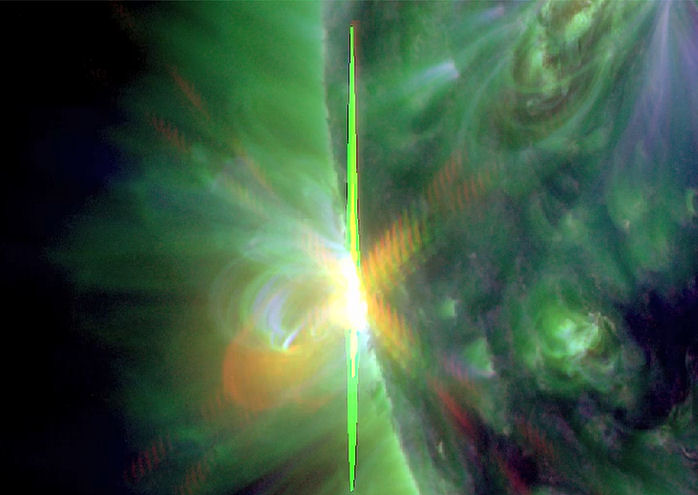
ALMOST-X FLARE: Today at 1814 UT, Earth-orbiting satellites detected an impulsive M9-class solar flare. The source was an active region just behind the sun’s southeastern limb. NASA’s Solar Dynamics Observatory recorded the extreme ultraviolet flash: image. Radio blackouts and ionization waves in the upper atmosphere are possible on the dayside of Earth as a result of this event. Stay tuned for updates.

from:    spaceweather.com

Background of Maine Earthquake

The Facts Behind the Maine Earthquake

Douglas Main, OurAmazingPlanet Staff Writer
Date: 17 October 2012
A USGS map showing, in blue, where people reported feeling the Maine earthquake (on Oct. 16, 2012).
CREDIT: USGS

How unusual was the magnitude-4.0 earthquake that struck southern Maine yesterday (Oct. 16)?

U.S. Geological Survey geophysicist Julie Dutton said it was larger than most but not too out of the ordinary for New England, where one or two minor earthquakes can be felt somewhere every year.

It’s unclear what exactly caused the quake, Dutton told OurAmazingPlanet. “To pinpoint which fault it was — we don’t have that information and we may never have that information,” she said. The area lacks the extensive network of seismometers present in more tectonically active areas. There are many faults in the area, and the fault that was active yesterday was probably small and may never be active again, Dutton said.

The East Coast is riddled with old faults, buried miles deep in the ancient crust of the North American plate, the tectonic plate that underlies the United States and Canada. But most of these fissures haven’t been active in a long time, and very few of them are well-studied or understood.

Stress naturally builds up within tectonic plates and is periodically released in earthquakes like this one, Dutton said.

As in other East Coast quakes, the vibrations Tuesday could be felt over a wide area – as far south as Long Island, N.Y., and as far north as southeastern Ontario, she said.

In North America, feeling shaking over such a larger area is unique to the East Coast. The crust of the eastern part of continent isn’t as fractured as elsewhere, which allows vibrations to travel long distances. That explains how last year’s 5.8-magnitude earthquake, centered in Virginia Aug. 23, was felt by nearly a third of the United States.

Last night’s temblor came from a rupture 4 miles (6 km) underground and struck at 7:12 p.m. local time (23:12 UTC), the USGS reported. The epicenter was about 21 miles west of Portland, Maine.

The earthquake shook houses in Boston and Connecticut, but it apparently did not cause any injuries or damage, according to news reports.  “A magnitude-4 can knock stuff off shelves and that kind of thing, but isn’t likely to cause major structural damage,” Dutton said.

The last earthquake to cause moderate damage in New England was a magnitude-5.6 temblor in New Hampshire in 1940, she said. The largest earthquake in recorded history in New England struck New Hampshire in 1638 and had an estimated magnitude of 6.5, according to the USGS.

Many parts of the country, including California and much of the Southeast, will be holding an earthquake drill tomorrow morning as part of the Great American Shakeout.

from:    http://www.livescience.com/24058-maine-earthquake-facts.html

Russia To Quit Kyoto Protools?

Russia hints plans to quit Kyoto Protocol October 18, 2012 Russian Prime Minister Dmitry Medvedev Enlarge Russia on Thursday hinted that it may refuse to sign up to a new round of targeted carbon cuts that could see the Kyoto environmental protection treaty extended beyond its end of 2012 expiry date. “One has to admit that we never got any real commercial gain from the Kyoto Protocol,” news agencies quoted Prime Minister Dmitry Medvedev, pictured on October 12, as telling a government meeting. Russia on Thursday hinted that it may refuse to sign up to a new round of targeted carbon cuts that could see the Kyoto environmental protection treaty extended beyond its end of 2012 expiry date.
“One has to admit that we never got any real commercial gain from the Kyoto Protocol,” news agencies quoted Prime Minister Dmitry Medvedev as telling a government meeting. “That does not mean that we have to try and drag it (the treaty) out any further,” Medvedev added. European diplomats at the May G8 summit in France said that Russia along with Japan and Canada had confirmed plans not to join the second round of carbon cuts. Russia ratified the treaty in 2004. It has since argued that its terms harm developing nations. Medvedev noted that he had said on repeated occasions in the past that “if the world community fails to agree on Kyoto, we would wave it goodbye.” He said he was thinking of extending the treaty’s terms with EU nations alone. “But considering our uneasy relations with the European Union, I am not sure how likely this scenario will be,” he said. A range of EU nations are probing Russian energy natural gas giant Gazprom for price-fixing and other unfair practices under its new Energy Charter Treaty. Medvedev did not explain his reasoning beyond the mention of Russia’s failure to tap into the profits it could have earned had it sold other nations unused carbon emission credits from its domestic producers. (c) 2012 AFP

Read more at: http://phys.org/news/2012-10-russia-hints-kyoto-protocol.html#jCp

Neil Kramer — Autodidact

The Path Of One

– 17/02/2011Posted in: Essays

The world of academia does not resonate too strongly with many who walk the path of conscious and spiritual growth. This is, perhaps, understandable when one considers that many entrenched academic concepts of institutional consensus, received wisdom and logical criteria for truth, can seem rather opposed to the trajectory of authentic conscious deepening. Not only that, but from a shadow perspective, it’s relatively straightforward to hijack the academic edifice. After all, if you can sequester the system, you can effectively steer all those who study under it.

In the West, the academic paradigm is still perceived as the ultimate hub for establishing scholarly credibility and continues to serve as the empirical arbitrator of accomplishment and consensus reality. Here in the US, I have noted that there’s still a great deal of fuss made about sticking Dr. in front of someone’s name. Billboards, TV and radio commercials, books and business cards are plastered with such academic titles. Dr Somebody is wheeled in as a talking head for some garish infotainment show, so as to offer an ‘expert’ view of politics, science, history or whatever. Many people buy it, hook, line and sinker. The alternative community is not immune to such occasional haughtiness either. Someone who got a PhD in Floral Management will leverage their title when publicizing their work in the Mysteries Of The Lost Aztec Kingdom. The irrelevance of their qualification does little to affect the credibility curve in the minds of many.

To put it bluntly, lots of people from many different walks of life believe that academic qualifications = authority. After all, who knows better?

Faith in the academic edifice is beginning to crack in some European countries, most notably England. The grandeur of someone’s bachelors or masters degree, or even doctorate, is not quite what it used to be. This is largely due to the fact that people have realized that the whole process of going to university and getting certain qualifications is getting easier and easier. In addition, the connection between one’s degree and the actual career path undertaken, is becoming increasingly divergent. For the last 40 years, successive UK Governments (Conservative and Labour) have resolutely pursued a campaign of getting more and more people into university and making sure they graduate. The annual charade of ever-escalating school and university pass rates is roundly derided by all with eyes to see. The result? Everyone and their dog has a degree now.

Speaking of declining standards in the US educational system, comedian George Carlin said: “They lower the passing grades so more kids can pass. More kids pass, the school looks good, everybody’s happy, the IQ of the country slips another two or three points and pretty soon all you’ll need to get into college is a fucking pencil.”

Perhaps academia has never quite been the glorious testament to human achievement that it presents itself to be. Even the most serious, free-thinking and well-intended scholars will often find themselves pulled into a vortex of insularity, prejudice and separatist specialization. It is the way of things in academia, particularly if you need approved funding for your work. You have to play the game, or else risk getting sidelined or even booted out. Collectivism is rewarded over independence; compliance over distinctiveness. Of course, this naturally balances out and improves over time, especially as the old guard fade away and the new crowd emerges, amongst which there’s always a healthy sliver of maverick and pioneering attitudes. But it takes a good long while to filter through. In the meantime, in such a rapidly changing and disinformation-saturated world, we cannot rely on academia to assist with our knowing. We have to do it for ourselves.

Dawn Of The Autodidact

An autodidact is someone who is largely self-taught. The autodidactic impulse is often characterized by a commitment in the individual to be a self-directed and life-long learner. There is an inherent appreciation that real knowledge is best transmitted direct to the discerning student, without any requirement for official mediation. Famous autodidacts include: William Blake, HP Lovecraft, Leonardo Da Vinci, Michael Faraday, Joseph Campbell, Nikola Tesla, George Bernard Shaw, Ernest Hemmingway, Frank Lloyd Wright, Edgar Alan Poe, Doris Lessing, Benjamin Franklin, Jakob Bohme, Abraham Lincoln, the Wright Brothers, Walt Whitman, Stanley Kubrick, Frank Zappa, John Cage, Arthur C Clarke, Joseph Conrad and Thomas Edison.

Being an autodidact does not mean having no formal education at all. It simply means that it is not the chief source of one’s learning. In the above examples, as it happens, many actually never did see the inside of a classroom. But even for those who did, they either dropped out, or relegated their formal education to mere background noise, from which their own autonomous learning sprang forth, far beyond the intellectual or temporal reach of any institution.

In my own life, I have routinely acknowledged that the most insightful people I have met have all been autodidacts. In some instances, the breadth and penetration of their knowing totally eclipses any apparently corresponding academic mindset. The opposite side of this equation has also proven true; the professors and Cambridge graduates that I have conversed with, at length, have been some of the least discerning and most blinkered folk imaginable. They particularly mark themselves out in this negative aspect by way of their own claims of achievement and authority. Very disagreeable. Of course, this is purely anecdotal and constitutes little more than a broad generalization. However, it does draw one’s attention to certain facets of the autodidactic method that warrant a closer look.

The great privilege of the autodidact is that they have a totally free hand to do whatever they want. Nobody can censor, prejudice or divert them from their own chosen areas of study. They can go where they want, when they want. No concept is too far out, no subject is taboo, no creative tangents are considered a waste of time and belief systems are often gratifyingly upgraded or even totally jettisoned. With correct alignment, all this information processing acts as a jumpgate for transmutation into the felt-experience of real wisdom.

Close on the heels of this freedom comes a distinct responsibility: self-discipline. It is incumbent on the independent scholar to hone a range of skills to endow their studies with the integrity, balance and penetration required to formulate empowering knowledge. Specifically – the ability to employ critical reason and discernment; to correlate and corroborate; to weigh any given idea against the consensus reality tunnel and one’s own personal reality tunnel; to use intuition; to watch how a notion moves through our belief systems and intellectual apparatus. What remains? What changes?

Another key difference between autodidacticism and academia is the value placed on direct felt experience. Who can walk the talk? If you physically meet a person, you can tell if they’re the real deal in the space of a few minutes. Even remotely, from just the spoken or written word, you can figure it out with a little heightened sensitivity. Anyone can read books, hunch over a laptop, visit a few temples, libraries and museums. But none of this constitutes real, juiced-up, direct encounter. The autodidact naturally places a far greater emphasis on the practical application of their knowledge than the academic. After all, they’re playing very different games. Self acceptance, rather than group acceptance, brings about a very different arc of learning. It must be said that there are, of course, some fine ground-breaking academics and there are some bloody awful independent scholars. There’s also no reason why one could not be both autodidactic and academic. Rare, but possible. There are many paths.

Creative Epistemology

Ascertaining the truth of a thing is always a strange and slippery business. Terence McKenna used to say that Austrian philosopher Ludwig Wittgenstein would deal with such problems by saying that something could be “true enough”. One interpretation of this being that if everything is relative, there’s little point in declaring something to be totally 100% true for everyone, in every situation, all the time. I am inclined to agree with this, albeit from an objective standpoint. Subjectively speaking however, we can feasibly say that something is true for ourselves. We can overlay a thing against our inner knowing and feel the essential veracity of it; judge its usefulness as a positive tool for perceiving and articulating our own reality tunnel. To call something ‘true’ in this way, is simply a piece of functional shorthand.

So what happens when the trueness of a thing diminishes? When it became clear that many of Carlos Castaneda’s accounts of his sorcerer’s apprenticeship with Don Juan Matus were factually inaccurate and even total fabrications – it changed the nature of his work for many people. Believers were disheartened. Skeptics were delighted. When I first read his works, it was very pre-Internet, and I had no idea of any of this. I read the classic six books and thoroughly enjoyed them. They spoke deeply to me. I have re-read them many times over the years. To this day, what is remarkable about them is how full of real gnosis they are. Despite the lo-fi anthropological value, I nevertheless find them to be truer than most other texts I’ve ever read. Just how the hell Castaneda came across such fabulous wisdom is still a mystery. Perhaps it was all an intentional double-bluff from the beginning, orchestrated to protect the real source of his teaching? Who knows. I’m just glad he put pen to paper, and decided to share it.

Since the late 1980’s, when I first came across Castaneda, I have had hundreds of experiences that have compelled me to explore the powerful overlay of the imaginal; positioned as it is so provocatively over both the real and the unreal. The further I walk down my own path, the wider I have to set the boundaries for what is real. It works both ways. What was fantasy, becomes actual; what was solid reality, becomes incongruous fakery. 911 being a textbook example. Most people don’t want to seriously study the events of 911, because in the back of their minds, they can feel the latent domino effect of collapsing belief systems. The real story of 911 is so off the map, that even the solemn ramifications of prior-knowledge and high-level treachery, pale compared to the issues of wider reality manipulation. Too weird.

Certainly, as we become more conscious, we become less susceptible to illusion; garbage constructs begin to fade and eventually dissolve altogether, with very little ‘mechanical’ effort from us. Even more significantly, with heightened awareness and a cleaner mental platform, we are able to channel greater resolutions of energy. We can go deeper with our knowing. Deeper into ourselves. Deeper into the universe.

It’s intriguing to watch how a thing can move from one reality filter to another with such fluidity; contravening the human boundaries of truth, belief and existence as if they didn’t exist at all. As I stated in an essay from May 2009, diverting all ones energies into the question of whether a given phenomenon is authentic or fake, may be missing the point. Many of the dozens of phenomenological koans that are routinely investigated in the alternative/esoteric field, go right to the heart of our complicity in the simulated reality construct we labor under. They exist to teach us not to judge whether something is real or not – but rather how it interacts with our own consciousness. As in quantum physics, consciousness itself changes the nature of the thing perceived. We really do have to take a long hard look at the operational value of consensus, received wisdom, peer acceptance and criteria for truth. This plays to the strengths of the autodidact, unshackled as they are from the chains of academic accord or the dreary guidelines of normality.

The real discipline of the independent thinker and the spiritual warrior, lies not in their scholarly capabilities and education, nor even in the anchoring of their knowledge into felt experience – it is in their willingness to transform their own consciousness. To change. This means letting go of things that we think we need, things we have become attached to, things we suspect might even be essential parts of us. More than anything else, it is this clinging to self that prevents us from moving forward. We sometimes forget that we are not the avatar.

The higher aspect of our being, our spirit if you will, never leaves the higher dimensional space. It is not plunged into the 3D as ‘we’ are. It remains effortlessly bulletproof and untainted in its purity, knowing, power and divinity. It is only the avatar that suffers the battle scars of earthly trauma and triumph. Yet this avatar is so lucid, so hi-resolution, so persuasive in its day-to-day consistency, that we forget it’s not actually us. A dream it may be, but one of no more or less reality than a dream from which we awaken in tears of rapture, or sadness, or longing. Undeniably, it moves us deeply.

Establishing a relationship between the avatar and the higher spirit – who we really are – is what certain occultists call the conversation of the Holy Guardian Angel. Hindu spiritual philosophers consider it as making contact with Atman (cognate with the Greek ‘asthma’, curiously enough, meaning to breathe). It is the Daemon of the ancient Greeks, with which Socrates himself documented his own intimate communion. It is in cultivating this relationship between self and spirit, that we transmute our inner knowing from merely acquiring navigational tools for the avatar, to the extraordinary ascendant journey of spiritualization. It is a natural path; elegant, innate, fulfilling and as real as you can imagine.

* Image: Deer Caller, by Susan Seddon Boulet.

from:    http://neilkramer.com/the-path-of-one.html
Fireball Graces Bay Area

BAY AREA FIREBALL: Last night, Oct. 17th, many people near San Francisco saw a slow-moving fireball exploding in the sky around 07:45 pm PDT. Witnesses report bright flashes of light and sonic booms that shook houses. Using a wide-field camera, Wes Jones caught the meteor disappearing behind the trees in the city of Belmont:

“We don’t know yet if the end point [of the meteor’s flight] was over land or water,” says meteor expert Peter Jenniskens of the NASA Ames Research Center. Jenniskens operates a network of Cameras for All-sky Meteor Surveillance (CAMS) near the Bay Area. “Data from the CAMS system should give us an answer [about landfall]. We’re analyzing the data now.” Stay tuned.

Note: Although Earth is nearing a stream of debris from Halley’s Comet, source of the Orionid meteor shower, this fireball was probably not an Orionid. The timing and direction of the meteor do not seem to match the Orionids.

fr/Spaceweather.com