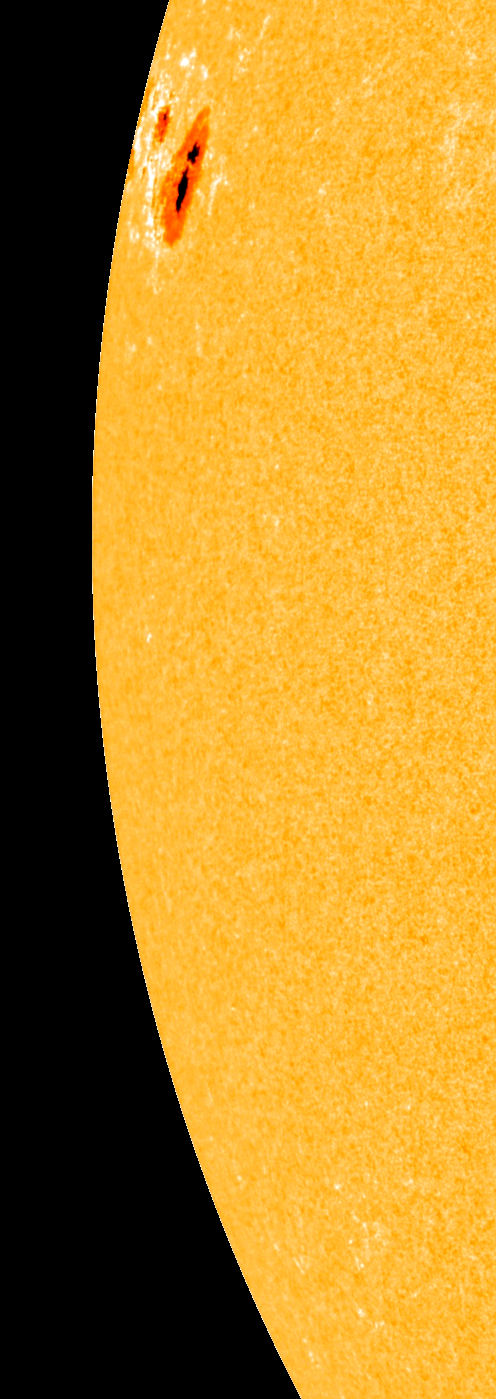
BIG NEW SUNSPOT: A large sunspot group is rotating into view over the sun’s northeastern limb. The emergence of this apparently significant active region could herald an increase in solar activity
fr/spaceweather.com
BIG NEW SUNSPOT: A large sunspot group is rotating into view over the sun’s northeastern limb. The emergence of this apparently significant active region could herald an increase in solar activity
fr/spaceweather.com
 The Moon: Really, it is your friend. Image courtesy of NASA.
{This article was originally posted on March 11, 2011. I’ve reposted it today because of another so-called “Supermoon” on May 6, 2012}
I’ve had a number of questions lately about a couple of events coming up this month astronomically and how they might effect geologic events – namely earthquakes and volcanoes – on Earth. I can tell you right now, without much doubt, that the answer, even before I tell you the question, is very, very little.
Now, the questions: (1) How will the close passage of Comet Elenin and Earth cause geologic catastrophes on March 15 and (2) How will the so-called “Supermoon“, a full moon when the moon is closest to Earth in its orbit, cause geologic catastrophes?
I know there has long been a desire to show about the gravitational resonance of planets/comets/asteroids/the sun might play a role in Earth’s geologic activity – and with some logic. We see the interaction of the Earth’s surface with the Moon’s gravity (and to some extent the Sun’s) with the tides in the oceans. Water has low viscosity so the tidal tugging of the moon as it rotates around the Earth sloshes the oceans back and forth to create our tides. One could imagine that the Earth’s crust/mantle/core might feel some of that gravitational interaction as well – and they do. John Vidale, a seismologist at the University of Washington, mentions that during full and new moons – when the moon is oriented between or opposite the Earth and the sun – there is potentially as much as a 1% increase in earthquake activity worldwide (and a slightly higher effect on volcanic activity). Let me repeat that: 1%. In any natural, geologic process that is mostly distributed randomly through time like earthquakes, 1% or there about is well within the “noise” of processes, so would these alignments produce much of a discernable increase? Probably not and this is with the two bodies that play the largest role in tidal forcing on Earth. There are other studies that suggest that this tidal tugging and pulling can cause small shifts in fault systems like the San Andreas, but one might argue that the moon is, in fact, “passively” releasing seismic energy on the fault, thus preventing or delaying large earthquakes! Trying to say that any other astronomical body might, even in some specific alignment, might cause more than a 1% increase in the chance of activity is remote at best.
Some of the so-called evidence for this moon-earthquake relationship is specious at best. From aNational Geographic article on the “lunar connection” back in 2005: “At least two major quakes may support [James A.] Berkland’s theory. The December 26, 2004, magnitude 9.1 in Sumatra, Indonesia, occurred on the day of a full moon. Likewise, the March 27, 1964, magnitude 9.2 earthquake in Alaska occurred on the day of maximum high tide. According to Berkland, such correlations are more than coincidences. They demonstrate a true connection between the moon and earthquake activity.” First off, two earthquakes coinciding with full moons is hardly scientific, statistically-sound evidence. How many “large” earthquakes (and who defines that anyway?) occur when it isn’t a full moon? And how many full moons have we had when there wasn’t a “large” earthquake? I’ve said this before, but it is an easy trap – correlation does not mean causation. Full moons happen 12 (maybe 13) times a year, so if you randomly sprinkle earthquakes through time, many large ones are bound to coincide with the full moon. USGS seismologist Dr. John Bellini followed up on Berkland’s theories: “Bellini questioned the scientific validity of Berkland’s predictions. He said they appear to be “self-selected statistical analysis of historical seismicity rates and are so vague in time and location that they are certain to be correct.”
Now, as for the Moon’s relative position to Earth and its effect, the Moon when it is at least closest is 356,401 km from the Earth’s surface and at its furthest, it is 406,700 km (with an average distance of 384,401 km. That is a difference of ~50,300 km ~ in other words, when the Moon is closest to Earth, it is ~12% closer than it is at its furthest. Newtonian physics tells us that the attraction between the Earth and the Moon is dictated by F = GM1M2/R2, where M1 and M2 are the masses of the Earth and Moon, G is the gravitational constant and R is the distance between the two bodies. Even a ~12% change in that value means that the force of gravity, in Newtons, only changes by ~30% at maximum (and only ~11% difference from average), a change that happens gradually as the Moon moves around its orbit. We see this fairly small change with different sized tides, but even those changes are not “disastrous”. When you consider the energy needed to move tectonic plates (or even the oceans), this change in gravitational energy from the Earth-Moon system is small. Remember, that the Moon is at its closest once a month, so just because it happens during a full moon doesn’t mean that the gravitational pull from the Moon is any stronger than it would be at any other perigee. Remember, the Moon reaches perigee every month and you don’t see massive earthquakes and eruptions every time this happens.
Some planetary bodies do see a profound effect of tidal forces. The moons of Jupiter areconstantly being tugged by the high gravity of Jupiter as the whiz around the gas giant. You can see that constant, frictional energy being imparted on the rocks of the moons in the relative geologic activity on the Galilean satellites – closest to Jupiter lies Io (at ~420,000 km), the most volcanically active body in the solar system. It gets tugged by a force 300% more than the Moon pulls on Earth. Next comes Europa (at ~664,000 km), where there are suggestions that liquid or slushy subsurface water exists due to tidal heating. Ganymede and Callisto, even further from Jupiter, show much fewer signs of liquid water or extensive tidal heating. The gravity of Jupiter is the direct cause for the geologic activity on these small planetary bodies.
 The lava flow from the Kamoamoa Fissure snaking around an old crater on Kilauea, as seen on March 10, 2011. This eruption did not start during a full/new moon. Image courtesy of HVO/USGS.
As I mentioned before, this sort of “correlation” of astronomical alignments and geologic disasters have been predicted before – with results that were coincidental at best. Back in 2006, there was rampant speculation about how a full moon was going to trigger an eruption of Mayon in the Philippines … and it didn’t. In a USGS article about volcanoes and the moon, they make the point that it does appear that activity at some volcanoes, like Kilauea, are effected by lunar cycles – however, this does not mean that an eruption at any specific volcano worldwide can be predicted using lunar cycles. There are just too many other variables, so unless the volcano is already erupting, such as Kilauea (see above from an eruption that didn’t start on a new/full moon), don’t expect the Moon to bring volcanoes to life. Even if the volcano is predisposed to be close to eruption (and even defining that is difficult), there is no data to support this (to borrow a quote from a paper that Chris Rowan’s uses in a post on the subject): “We found no conclusive evidence for a general correlation between volcanic activity and lunar tidal phase. This result is consistent with recent work which indicates that diurnal and fortnightly tidal stresses may be too short-lived and strain rates too high to effect a significant viscous response in partially molten regions of the Earth’s subsurface.” (Mason et al., 2004). During this Mayon hype in 2006, Phil Plait also took on these predictions and points out the biggest flaw with many of these “correlations”: “It’s small number statistics, like flipping a coin three times and having it come up heads each time. It’s rare, but it does happen on average one out of every eight times. You need bigger samples to get good statistics.”Science requires data that can show a valid correlation, not picking what fits best to your ideas. UPDATE: Phil takes on the “Supermoon” as well.
If anything, we should be concentrating on terrestrial forcing for “predicting” earthquakes. It could be that changes in the strength of the Earth’s magnetic field, due to the thickness and composition of the Earth, but might help find earthquake-prone locations. A study in Science by Song and Simons from 2003examined the gravity anomaly (how much the gravitational field from the Earth varies from the norm) along a subduction and then compared it to a long historical record of seismicity. It found that “within a given subduction zone, areas with negative gravity anomalies correlated with increased large earthquake activity. Areas with relatively high gravity anomalies experienced fewer large earthquakes.” However, how we can use the changes in gravity anomaly to predict earthquakes is still very unclear.
So, what can we take away from all this?

 Spirit Fire In the Orchard

Play of Lights
From the Conscious Media Network
In a remarkable presentation delivered at the 2011 Nexus Conference in Queensland, Pane Andov, otherwise known as “Astral Walker”, talks about the mega event that will take place at the end of 2012 and at beginning of the year 2013. Pane introduces us to this possibility by explaining that thousands of years ago, from the galactic centre of the Milky Way, there was a powerful release of an enormous amount of energy which, like a huge, shining, circular wave has slowly spread across the galaxy from its centre to its edges.
The released energetic pulse is already affecting the whole galaxy including the little dot we call our solar system. Very soon it will reach us and hit us with full strength. Among other things, this talk discusses the implications that this spreading wave of energy will have on our solar system, especially to our star and our planet, and how it will affect the DNA of life.
The way that Pane connects the dots makes it clear what our planet will face soon and what we as humans can do about it. Pane is also a contactee and delivers important messages which he backs up with scientific data. For the record, his DNA was changed when his biological body was only seven years old, enabling him to utilize abilities such telepathy, remote viewing, astral travel, along with the ability to make contact.
Pane claims that from time to time numerous ET races communicate and deliver important messages to him as a result of alternations to his DNA that occurred in his early childhood. One of those races is the positive race that is delivering the genuine crop circles, and they explained to him what the complex geometries mean. That’s how Pane was able to translate the complex geometric designs which contain the solution to the equation regarding what humanity is facing, when it’s going to happen, and what can be done about it.
For more references to Pane Andov and his research please visit his website:
http://www.paneandov.com/2012-pdf/
http://www.paneandov.com/sun-goes-red-giant-23-dec-2012/
from: http://www.spiritofmaat.com/may12/cosmic_expectations_and_consciousness_rising.html
 12th April 2012
By Jill Ettinger – organicauthority.com
Taking the urban garden to the next level, Seattle, Washington has officially broken ground on a dedicated seven acre area of city land set to be converted into an “edible forest” that will produce free food for the city’s residents and visitors, human or otherwise.
According to the Beacon Food Forest’s website, the project’s mission is “to design, plant and grow an edible urban forest garden that inspires our community to gather together, grow our own food and rehabilitate our local ecosystem.” The perennial permaculture forest project, believed to be the first of its kind in the U.S., will eventually be self-sustaining, much like the way a forest in nature works. Creating the self-sustaining environment is reliant upon the types of soil, insect life and companion plants placed strategically within the environment.
Seattle’s Beacon Food Forest, located in the Beacon Hill neighborhood, will provide an array of edible fruit-bearing plants including apple, pear, persimmon, chestnut and walnut trees; and edible berries such as blueberry, lingonberry and raspberry.
The project, which is already underway, is set to take several years to fully develop the seven acre plot just 2.5 miles from downtown Seattle. After aggressive outreach efforts by the Friends of the Food Forest community group to secure the plan were successful, the innovative planting initiative is underway securing permits to create the nation’s first “food forest.”
Not only will the edible forest provide free food to anyone with access to its bounty, but it will also provide healthy fruits and nuts, which are an important part of every diet and can often be unaffordable for families.
from: http://wakeup-world.com/2012/04/12/seattle-creating-massive-edible-forest-filled-with-free-food/

Guest Writer for Wake Up World
How much control do we have over our own lives? Are we really controlled by our genes, trapped in our own selfishness, like some modern authors want us to believe? Just how much power do we have to shape our lives and those of others?
Contrary to what many people are being led to believe, a lot of the emphasis placed on genes determining human behaviour is nothing but theory and doctrine. The “selfish gene” model is an assumption, it is not a scientific fact.
What Is The Central Dogma?
The central dogma is the doctrine that information in our cells flows only in one direction – from DNA to RNA to proteins. Simply put, it is a dogmatic belief in absolute determinism.
Let’s take a quick look at its history. Back in 1990, a huge, international research program began – the human genome project. Its stated goals were to map out all human genes and their interactions using computer software and then to convert that knowledge into (profitable) “benefits” for mankind, such as finding cures for the most horrible diseases.
They sure made it sound good and they spent a lot of taxpayers’ money on it, but was the whole project used for good? Personally, I don’t think so.
In essence, what the central dogma says is that since it is proteins that carry out the essential life-processes inside our cells, and their functions can only do what our genes say (this is what the medical establishment and certain fanatical branches of evolution theory want us to believe), then we humans are nothing more than the calculated, deterministic expression of our genes. We’re little robots whose biology, emotions, health and beliefs are not of our choosing. We’re humatons!
This is the theory that is being taught in medical schools and universities all over the world today. Fortunately for all conscious people, this disempowering belief has been proven to be false.
Is Evolution Deterministic?
Fifty years before the publication of Darwin’s The Origin Of Species, frenchman Jean Baptiste Lamarque postulated that living beings must have an innate perception of their environment in order to evolve, and that they evolve in response to changes in their surroundings. His idea was that genetic mutations are definitely notrandom. There is an inherent intelligence at play in life that we can’t even begin to understand.
The response of the “scientific community” at the time was not favourable. They ridiculed Lamarque’s theory and eliminated him from the history books, giving Darwin the sole credit for discovering evolution, even though, in reality, Darwin published his book fifty years after Lamarque and his book based a lot of its theory on the work of yet another man, Alfred Russel Wallace, many of whose ideas Darwin copied.
According to Lamarque, there is an interplay of forces between living beings and their environments. According to the Darwinian model, evolution is strictly deterministic and is based on random mutations.
So, who got closer to the truth? Luckily for us, Lamarque was right about at least one thing: cells have consciousness.
The Emerging Science Of Epigenetics.
Plenty of highly intelligent biologists have proven beyond a doubt that the determinism of the central dogma is false. Genes do not determine human outcomes – it is our responses to our environment that actually determine the expression of our genes.
This was proven definitively in 1988 by British molecular biologist John Cairns. Cairns took bacteria whose genes did not allow them to produce lactase, the enzyme needed to digest milk sugar, and placed them in petri dishes where the only food present was lactase. Much to his astonishment, within a few days, all of the petri dishes had been colonized by the bacteria and they were eating lactose. The bacterial DNA had changed in response to its environment.
This experiment has been replicated many times and they have not found a better explanation than this obvious fact – that even primitive organisms can evolve consciously.
So, information flows in both directions, from DNA to proteins and from proteins to DNA, contradicting the “central dogma.” Genes can be activated and de-activated by signals from the environment. The consciousness of the cell is inside the cell’s membrane. Each and every cell in our bodies has a type of consciousness. Genes change their expression depending on what is happening outside our cells and even outside our bodies.
What Does This Mean For Us?
We are free to make decisions that impact our lives and those of others. We are not robots carrying out the commands our genes. Our beliefs can change our biology. We have the power to heal ourselves, increase our feelings of self-worth and improve our emotional state. Every aspect of our lives can be improved with the right intention.
The worst thing we can do as thinking and feeling people is to get cut off from our deep, positive emotions and let fear and anger take over our lives. When we allow ourselves to be taken over by negativity, we are putting ourselves in a mental-biological state of fear akin to the fight or flight response.
In order to grow positively as human beings, we need to express positive emotions such as love, affection, joy and a will to conquer ourselves and our own lives. When we change our beliefs, we change our emotional states. When that happens, we change our lives.
First we have to believe. Only then do we give ourselves the opportunity to achieve.
About the Author
Konstantin Eriksen is a former stock-trader. After quiting his job, he studied biochemistry and got into natural health and the internal martial arts.
from: http://wakeup-world.com/2012/03/26/the-science-of-epigenetics-how-our-minds-can-reprogram-our-genes/
METEORS FROM HALLEY’S COMET: Earth is entering a stream of debris from Halley’s Comet, source of the annual eta Aquarid meteor shower. The shower peaks this weekend; the best time to look is during the hours before sunrise on Sunday, May 6th. Because the shower’s radiant is located below the celestial equator, southern hemisphere observers are favored, but even northerners should be able to see a few flecks of Halley-dust disintegrating in the atmosphere. Super-bright moonlight will cap the meteor rate at about 30 per hour.
In recent nights, NASA’s all-sky meteor network has picked up a number of early eta Aquarid fireballs. This one was bright enough to shine through the glow of sunrise and clouds over Tullahoma, Tennessee, on April 29th:

According to analysts at NASA’s Meteoroid Environment Office, this particular speck of comet dust hit the atmosphere traveling 62 km/s (139,000 mph) and disintegrated about 84 km (52 mi) above Earth’s surface.
The full Moon of May 5-6, 2012, with interfere with the visibility of the eta Aquarid peak.
fr/spaceweather.com
PERIGEE “SUPER MOON” ON MAY 5-6: Get ready for moonlight! The full Moon of May 5-6, 2012, is a perigee moon, as much as 14% bigger and 30% brighter than other full moons of 2012.
from: spaceweather.com
Last update: May 3, 2012 at 11:16 am by By Armand Vervaeck and James Daniell
Most important Earthquake Data:
Magnitude : 5.5Mw (USGS), 5.4Ml (IIEES)
UTC Time : 2012-05-03 14:39:35 UTC
Local time at epicenter : 2012-05-03 19:09:35
Depth (Hypocenter) : 10k (USGS), 14km (IIEES)
Geo-location(s) : 33km (20mi) SE from Abdanan, Iran, 43km (26mi) ENE from Dehloran, Iran
Earthquake overview : A Mw5.5 earthquake has struck the Iran-Iraq border.
Islamic Republic News Agency said on Wednesday night that there has been possible damage caused by this earthquake received.
Keep this page open or return regularly as we will be back with more details when they become available
– IEEES is reporting a Ml5.4 and 14km depth. This will most likely be damaging to local villages.
 IIEES earthquake epicenter showing the tectonic regime.
– Amazingly, only 15 damaging earthquakes from CATDAT have been registered since 1900 in this location within 100km radius, and of those this is the highest magnitude.
– This was given an earthquake-report danger rating of RED
for more information and updates, go to: http://earthquake-report.com/2012/05/03/shallow-strong-earthquake-strikes-the-iran-iraq-border-region/
 |
| No one knows why ancient people built Stonehenge. CREDIT: Pete Strasser | nasa.gov |
The stone slabs of England’s Stonehenge may have been more than just a spectacular sight to the ancient people who built the structure; they likely created an acoustic environment unlike anything they normally experienced, new research hints.
“As they walk inside they would have perceived the sound environment around them had changed in some way,”said researcher Bruno Fazenda, a professor at the University of Salford in the United Kingdom. “They would have been stricken by it, they would say, ‘This is different.'”
These Neolithic people might have felt as modern people do upon entering a cathedral, Fazenda told LiveScience.
Fazenda and colleagues have been studying the roughly 5,000-year-old-structure’sacoustic properties. Their work at the Stonehenge site in Wiltshire, England, and at a concrete replica built as a memorial to soldiers in World War I in Maryhill, Wash., indicates Stonehenge had the sort of acoustics desirable in a lecture hall
Stonehenge itself is no longer complete, so Fazenda and colleagues used the replica in Maryhill as a stand-in for the original structure. At both locations, they generated sounds and recorded them from different positions to see how the structure influenced the behavior of the sound.
At the replica, they found a reverberation time of just less than one second, the amount of time optimal for a lecture hall. Unlike an echo, which is a single response created when sound waves reflect off something, reverberation occurs when a sound is sustained by a quick succession of reflections arriving at different times.
Modern cathedrals can have reverberation times of about 10 seconds or more, while concert halls are designed so reverberation in them will last between two and five seconds, Fazenda said.
About one second of reverberation is “just enough for us to start becoming aware of it,” he said.
Based on their work at Maryhill, the researchers believe the many stones within Stonehenge would have diffracted and diffused sound waves, creating reverberation. The large amount of diffusion and diffraction would have also lead to good sound quality regardless of where the listener was standing in relation the source of sound within the structure.
“What we found in Maryhill as a model for Stonehenge was you could almost stand behind a stone and keep talking with a good level of voice, and people would be able to hear you somewhere else,” he said.
For the Neolithic people who built this structure, this sort of acoustic environment was likely quite unusual. They appear to have lived in smaller, thatched-roof homes made of wood, which would not have reflected sound as effectively. And the region around Stonehenge has no significant geographical features, like high cliffs, which are associated with echoes, or large caves, which are associated with reverberation, Fazenda said.
While some have suggested that Stonehenge was designed to create certain acoustic effects, Fazenda said he sees no evidence for this.
Rather than search for an acoustic motivation behind the construction of this mysterious structure, this research is intended to help better understand how the ancient people might have used the structure, he said.
Fazenda collaborated with Rupert Till of the University of Huddersfield in the UK and with archaeologist Simon Wyatt on this project.
from: http://www.livescience.com/20044-stonehenge-acoustics.html