Earthquake — India/Myanmar Border

Dangerous (shallow ?) earthquake near the India / Myanmar border (Manipur province)

Last update: July 14, 2012 at 10:03 pm by By

Earthquake overview : A dangerous extremely shallow strong earthquake occurred at 01:25 AM approx. 20 km from the Myanmar border in India. What looks like a moderate earthquake becomes dangerous because of the shallow depth of the hypocenter (6,5 km) reported by USGS.

Most important Earthquake Data:
Magnitude : M 5,6 (USGS), M5,5 (EMSC and GFZ) and M5,3 (CENC)
UTC Time : Saturday, July 14, 2012 at 19:55:12 UTC
Local time at epicenter : Sunday, July 15, 2012 at 01:25:12 AM at epicenter
Depth (Hypocenter) :
Geo-location(s) :
24 km (14 miles) S of Phek, India
43 km (26 miles) ESE of Kohima, India
57 km (35 miles) S of Zunheboto, India

Update : Phek, the village at 24 km from the epicenter has a population of 12863 (last census). One of the greatest dangers in the area will be the potential for landslides. Depending on the weather and the deforestation, which is common in India, landslides can easily occur. The city of Kohima has endured a MMI V , moderate shaking and counts 92000 people (we do not think however that major damage has occurred in this city). We have almost no data from the Myanmar side of the border, but we know that the area is very sparsely populated.

Update : Due to the darkness and the kind of terrain (very hilly forested area) it will take several hours before we expect to hear more news.

Update : 66000 people are living in the area which earthquake-report.com calls at risk, mainly because of the building methods in the area (a lot of brick and adobe houses) and because of the occurrence of the shaking in the middle of the night. A lot of the houses are also in wood and bamboo and can resist strong shaking.

Update : Based on the USGS data (M5,6 @ 6,5 km depth), 19000 people will have experienced a MMI VII very strong shaking. 91000 people a strong shaking.

Update : If the CENC and USGS data are right (even with the lower CENC Magnitude), we call an area of 20 km around the epicenter as highly vulnerable for damage and injuries.

Update : We did hesitate to start up an in-depth earthquake report because of the confusing data. A 6 km deep earthquake (USGS and CENC) and 40 to 45 km (GFZ and EMSC) can be related to “very dangerous” to “harmless)

This is what we wrote in our daily (major) earthquake overview : What looks like a moderate earthquake becomes dangerous because of the shallow depth of the hypocenter (6,5 km) reported by USGS. This depth is preliminary and has been contradicted by GFZ and EMSC who are stating an intermediate depth of 45 and 60 km. We have set the color of this earthquake to Orange because of this uncertainty. It would be green by 60 km and red by 6,5 km. The coming hours will tell us more about this! Indian seismologic agency has no live Internet data.
CENC, The Chinese seismological agency who is very reliable in this area reports a M5,3 at a depth of 6 km. If CENC data are correct, we will have to maintain the orange color of moderately dangerous.

for more information and updates, go to:    http://earthquake-report.com/2012/07/14/dangerous-shallow-earthquake-near-the-india-myanmar-border-manipur-province/

Comet 96/Maccholz Visits our Solar System

HOT COMET: Periodic comet 96P/Maccholz is passing by the sun today deep inside the orbit of Mercury. At closest approach, the icy visitor from the outer solar system will be less than 12 million miles (0.13 AU) from the solar surface. Coronagraphs onboard the Solar and Heliospheric Observatory are monitoring the encounter:

“Discovered in 1986, Comet 96P/Machholz is a fascinating comet that has passed through SOHO coronagraph images four times now,” says Karl Battams of the Naval Research Lab. “It’s not a huge comet but it is very photogenic, and puts on quite a display with its beautiful dusty tail.”

In an essay posted on his web site, Battams explains why the comet is so fascinating. Many researchers suspect 96P/Machholz is not a native of our solar system; some chemical evidence suggests it came from another star. Also, 96P/Machholz appears to be dynamically related (that is, the comet’s orbit is related) to a diverse collection of other objects in the solar system including asteroid 2003 EH1 and the Quadrantid, Southern Delta Aquariid, and daytime Arietid meteoroid streams. All of these things–the asteroid, the comet, and the meteoroids–might be fragments of a single “foreign” body that broke apart thousands of years ago.

fr/spaceweather.com

Bulgaria — Aftershock

Moderate earthquake (aftershock) in Bulgaria

Last update: July 14, 2012 at 1:07 pm by By

EMSC Bulgaria Jul 14 12:52 PM 4.5 10.0

Moderate earthquake (aftershock) in Bulgaria
The earthquake will be probably harmless as based on our experience in Bulgaria the Magnitude has stayed just below damaging levels.
Todays aftershock proves that the fault area has not reached its stabilization.
Today’s epicenter gain in the immediate vicinity of Pernik. Pernik is one of the major Bulgarian cities and is located very close to Sofia, were people will have felt this aftershock very well

from:    http://earthquake-report.com/2012/07/13/major-earthquakes-list-july-14-2012/


Dr. Jeff Masters on Hurricane Outlook

July Atlantic hurricane outlook
Posted by: Dr. Jeff Masters, 12:55 PM GMT on July 13, 2012 +21

It’s mid-July, and we have yet to see a named storm form in the Atlantic this month. The computer models are not predicting any development through at least July 20, and if we make it all the way to the end of the month without a named storm forming, it will be the first July since 2009 without a named storm. Since the current active hurricane period began in 1995, 13 of 17 years (76%) have had a named storm form during July. The busiest July occurred in 2005, when five named storms and two major hurricanes formed. These included Hurricane Dennis and Hurricane Emily–the strongest hurricanes ever observed so early in the season. Only eight major hurricanes have formed in July since record keeping began in 1851. As seen in Figure 1, most of the last half of July activity occurs in the Gulf of Mexico and waters off the Southeast U.S. coast. These type of storms form when a cold front moves off the U.S. coast and stalls out, with the old frontal boundary serving as a focal point for development of a tropical disturbance (as happened for Alberto, Beryl, Chris, and Debby in 2012.) There will be at least two cold fronts moving off the U.S. Mid-Atlantic coast over the next two weeks. The first of these fronts will push offshore around July 20, and we will need to watch the waters offshore of North Carolina for development then. Formation potential will be aided by ocean temperatures that are about 0.7°C (1°F) above average along the U.S. East Coast.


Figure 1. Tracks of all tropical storms and hurricanes 1851 – 2006 that formed July 16-31. The U.S. coast from North to Texas are the preferred strike locations. Only a few storms have formed in the tropical Atlantic and Caribbean in July. Wind shear is typically too high and SSTs too cool in July to allow African waves in the Caribbean and tropical Atlantic to develop into tropical storms. However, a few long-track “Cape Verdes” hurricanes have occurred in July, spawned by tropical waves that came off the coast of Africa. African tropical waves serve as the instigators of about 85% of all major hurricanes.


Figure 2. The seasonal distribution of Atlantic hurricane activity shows that July typically has low activity. Image credit: NHC.

Sea Surface Temperatures: slightly above average
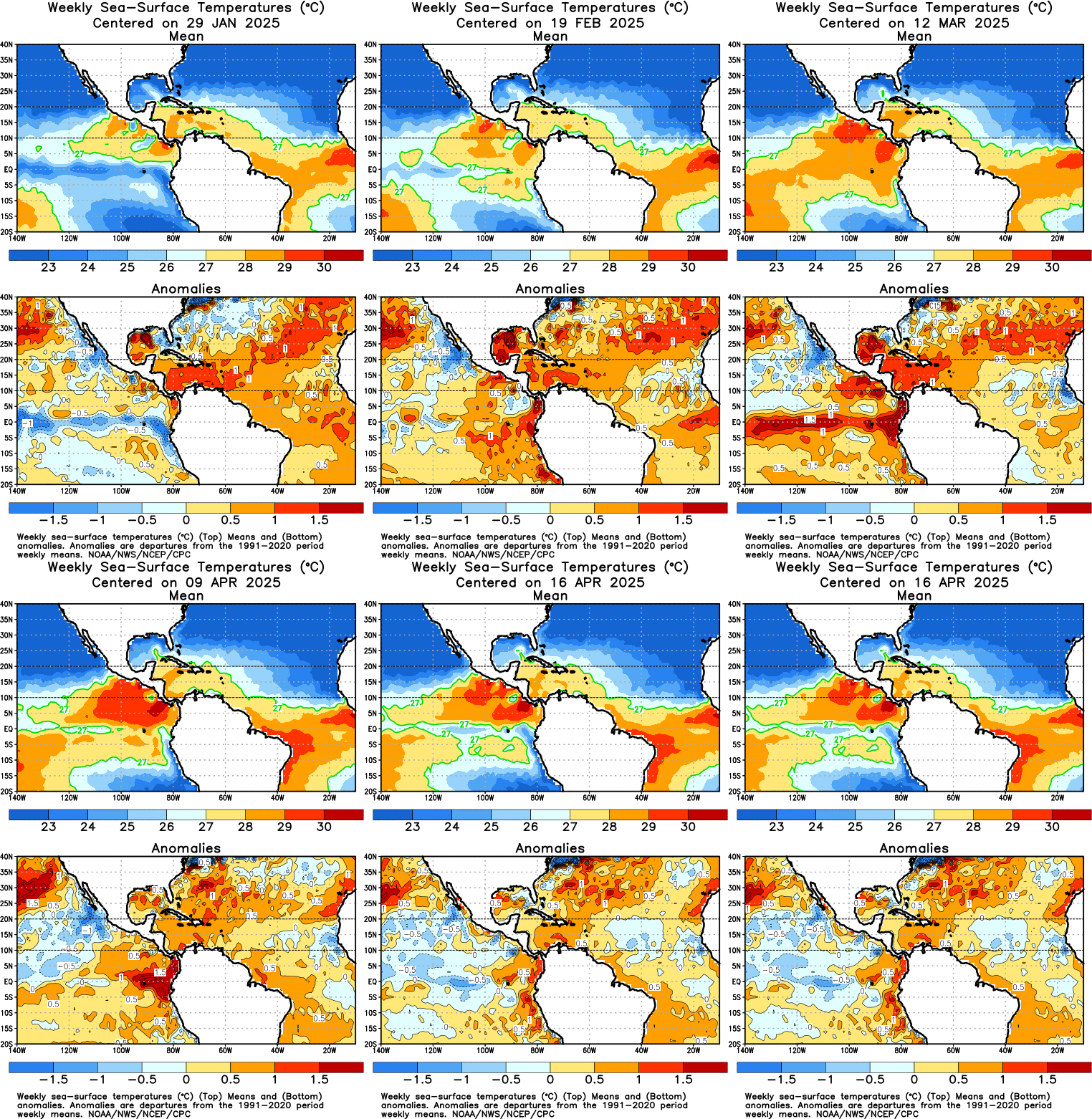
The departure of Sea Surface Temperatures (SST) from average over the tropical Atlantic between Africa and Central America was about 0.3°C above average during June (Figure 3.) This figure has not changed much over the first two weeks of July. These temperatures are not warm enough to appreciably affect the odds of a July named storm or hurricane. The strength of the Azores-Bermuda high has been near average over the past two weeks, driving near-average trade winds. The latest 2-week run of the GFS model predicts continued average-strength trade winds through late-July, so SSTs should remain about 0.3°C above average during this period, due to average amounts of cold water mixing up from below due to the wind action on the water.


Figure 3. Sea Surface Temperature (SST) departure from average for July 12, 2012. SSTs were 0.3°C above average over the tropical Atlantic’s Main Development region for hurricanes, from Africa to Central America between 10° and 20° North Latitude. Note the large region of above average SSTs along the Equatorial Pacific off the coast of South America, the hallmark of a developing El Niño episode. Image credit: NOAA/NESDIS

El Niño on the way?
For two consecutive weeks, ocean temperatures 0.5 – 0.6°C above average have been present in the tropical Eastern Pacific, which is right at the threshold for a weak El Niño episode. NOAA’s Climate Prediction Center has issued an El Niño Watch, and gives a 61% chance that El Niño conditions will be present during the August – September – October peak of the Atlantic hurricane season. The likely development of a full-fledged El Niño episode means that Atlantic hurricane activity will probably be suppressed in 2012, due to the strong upper-level winds and high wind shear these events typically bring to the tropical Atlantic.


Figure 4. Sea Surface Temperature (SST) departure from average for the the equatorial Eastern Pacific (the area 5°N – 5°S, 120°W – 170°W, also called the “Niña 3.4 region”). El Niño conditions exist when the SST in this region rises 0.5°C above average. As of July 9, 2012, SSTs in the Niño 3.4 region had risen to 0.5°C above average. To be considered an “El Niño episode”, El Niño conditions must occur for five consecutive months, using 3-month averages. Image credit: NOAA Climate Prediction Center.

Wind shear: above average
Wind shear is usually defined as the difference in wind between 200 mb (roughly 40,000 foot altitude) and 850 mb (roughly 5,000 foot altitude). In most circumstances, wind shear above 20 knots will act to inhibit tropical storm formation. Wind shear below 12 knots is very conducive for tropical storm formation. High wind shear acts to tear a storm apart. The jet stream has two bands of strong high-altitude winds that are currently bringing high wind shear to the Atlantic. The southern branch (subtropical jet stream) is bringing high wind shear to the Caribbean, and the northern branch (polar jet stream) is bringing high wind shear to the waters offshore of New England. This configuration often leaves a “hole” of low shear between the two branches, off the Southeast U.S. coast and over the Gulf of Mexico. The jet stream is forecast to maintain this two-branch pattern over the coming two weeks. Wind shear has been about 10 – 20% higher than average over the first two weeks of July, and is predicted to be mostly above average for the coming two weeks. This will cut down on the odds of a July storm.


Figure 5. Vertical instability over the Caribbean Sea in 2012 (blue line) compared to average (black line.) The instability is plotted in °C, as a difference in temperature from near the surface to the upper atmosphere. Thunderstorms grow much more readily when vertical instability is high. Instability has been lower than average, due to an unusual amount of dry air in the atmosphere, reducing the potential for tropical storm formation. Image credit: NOAA/NESDIS/CIRA.

Dry air: above average
As seen in Figure 5, there has been an unusual amount of dry, stable air in the Caribbean this year creating low levels of vertical instability. This has occurred due to a combination of dry air from Africa, and upper-atmosphere dynamics creating large areas of sinking air that dry as they warm and approach the surface. The Gulf of Mexico and tropical Atlantic between the coast of Africa and the Lesser Antilles have also seen low vertical instability this summer. June and July are the peak months for dry air and dust coming off the coast of Africa, and the Saharan dust storms have been quite active over the past two weeks. Expect dry air to be a major deterrent to any storms that try to form in the tropical Atlantic during July.

Steering currents: average
The predicted steering current pattern for the next two weeks is a typical one for July. We have an active jet stream bringing many troughs of low pressure off the East Coast of the U.S. These troughs are frequent enough and strong enough to recurve any tropical storms or hurricanes that might penetrate north of the Caribbean Sea. Steering current patterns are predictable only about 3 – 5 days in the future, although we can make very general forecasts about the pattern as much as two weeks in advance. There is no telling what might happen during the peak months of August, September, and October–we might be in for a repeat of the favorable 2010 and 2011 steering current pattern, which recurved most storms out to sea–or the unfavorable 2008 pattern, which steered Ike and Gustav into the Gulf of Mexico.

Summary: a below average chance of a July tropical storm
Given that none of the computer models are forecasting tropical storm formation in the coming seven days, SSTs are only slightly above average, and wind shear and vertical stability are above average, I’ll go with a 30% chance of a named storm forming in the Atlantic during the remainder of July.


Figure 6. Hurricane Emilia over the Eastern Pacific at 20:35 UTC July 10, 2012. At the time, Emilia was a Category 3 hurricane with 125 mph winds. Emilia peaked earlier in the day as a Category 4 storm with 140 mph winds–the strongest hurricane in the East Pacific so far in 2012. Image credit: NASA.

An active Eastern Pacific hurricane season
It’s been a very active start to the Eastern Pacific hurricane season, where we’ve already had six named storms, four hurricanes, and three intense hurricanes. A typical season has 4 named storms, 2 hurricanes, and 0 intense hurricanes by July 14. The formation of Tropical Storm Fabio on July 12 marks the 4th earliest formation of the Eastern Pacific’s season’s sixth storm. The record is held by the year 1985, when the season’s sixth storm formed on July 2. Record keeping began in 1949.

Have a great weekend, everyone, and I’ll be back Monday with a new post.

Jeff Masters

from:    http://www.wunderground.com/blog/JeffMasters/comment.html?entrynum=2152

Incoming X-Flare — Geomagnetic Storms Possible

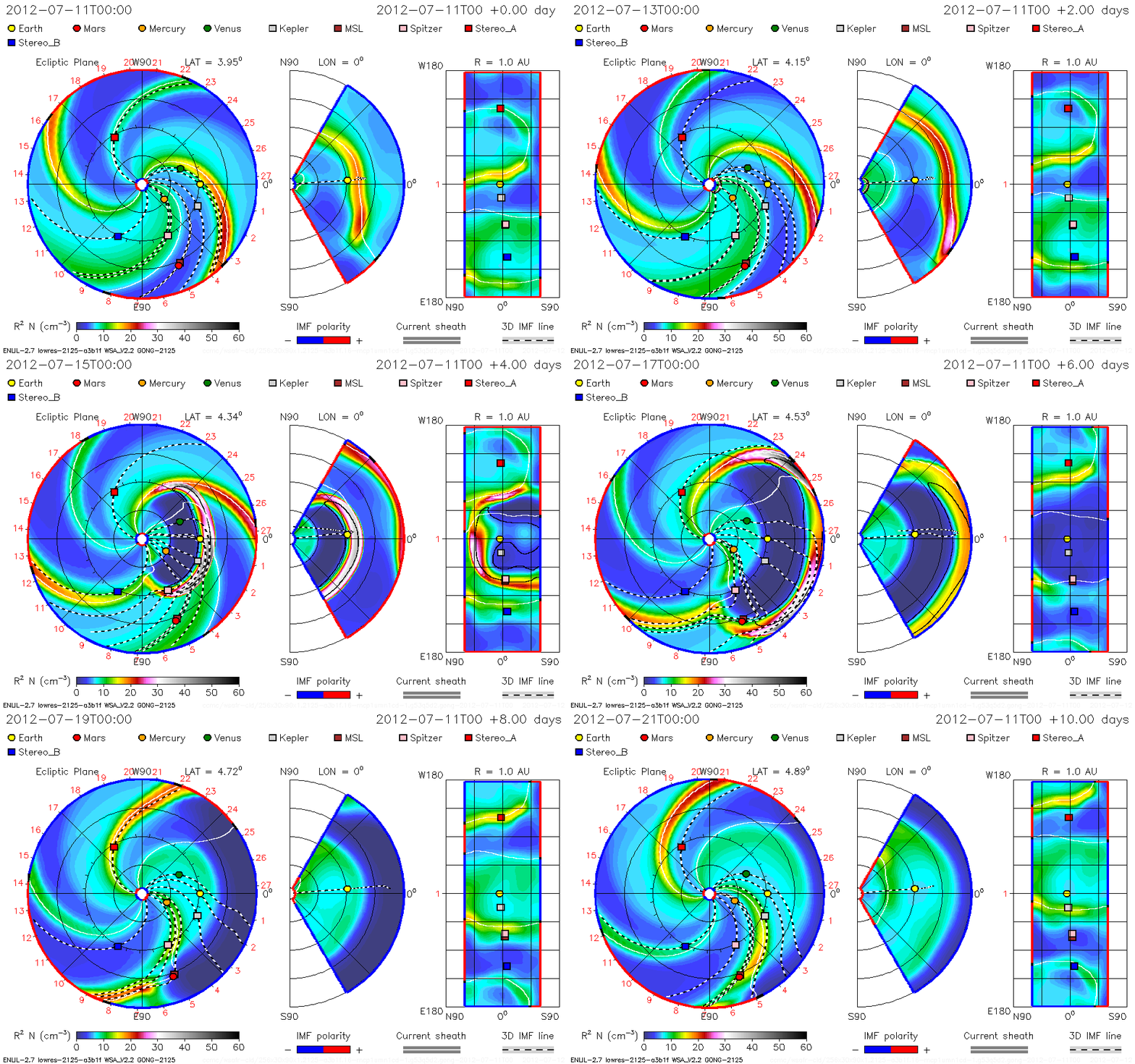
X-FLARE! Big sunspot AR1520 unleashed an X1.4-class solar flare on July 12th. Because the sunspot is directly facing Earth, everything about the blast was geoeffective. For one thing, it hurled a coronal mass ejection (CME) directly toward our planet. According to a forecast track prepared by analysts at the Goddard Space Weather Lab, the CME will hit Earth on July 14th around 10:20 UT (+/- 7 hours) and could spark strong geomagnetic storms. Sky watchers should be alert for auroras this weekend.

The explosion also strobed Earth with a pulse of extreme UV radiation, shown here in a movie recorded by NASA’s Solar Dynamics Observatory:

The UV pulse partially ionized Earth’s upper atmosphere, disturbing the normal propagation of radio signals around the planet. Monitoring stations in Norway, Ireland and Italy recorded the sudden ionospheric disturbance.

Finally, solar protons accelerated by the blast are swarming around Earth. The radiation storm, in progress, ranks “S1” on NOAA space weather scales, which means it poses no serious threat to satellites or astronauts. This could change if the storm continues to intensify.

fr/spaceweather.com

Clif High on the Nummo and the Dogon

CLIF HIGH – THE NUMMO AND THE DOGON

What a smart guy! Here’s his latest Wujo. This time Clif is here to give us insight into the movie, ‘Prometheus’, shining a light on its connection to the myths of the Dogon, and the Nummo. In a 55 minute audio presentation, he also makes reference to Alex Jones, and Shannon Dorey. If curiosity calls you to take your research a little deeper, I highly recommend that you check out Alex’s take on the subject, and make a point to tune in to Shannon Dorey’s interview on ‘Red Ice’ Radio.


from:    http://www.spiritofmaat.com/jul12/conscious_media_showcase_jul12.html

Alan Watts: This is It

The Road to HERE ~ Alan Watts

Worldview

Alan Watts was profoundly influenced by the East Indian philosophies of Vedanta and Buddhism, and by Taoist thought, which is reflected in Zen poetry and the arts of China and Japan.  After leaving the Church he never became a member of  another organized religion, although he wrote and spoke extensively about Zen Buddhism, Hinduism, and Taoisim. Some American Buddhists criticized him for not sitting regularly in zazen, even though he recorded several guided meditations teaching a variety of mediation techniques. Alan Watts responded simply by saying: “A cat sits until it is done sitting, and then gets up, stretches, and walks away.”
from:    http://alanwatts.com/life-and-works/
Check out this video:    http://www.youtube.com/watch?v=yeyss0Ng4T8&feature=player_embedded#!

Julia Griffin on Co-Creation

Walking Through Worlds

By Julia Griffin

I walk through this world, sometimes seeing. On those days, it makes sense to me. I understand the thinning of the veil, the strange urgency of the song of the nature. I accept it all – I’m fine in my trust of the unknown and laugh at the days when I cared.

Other times, my eyes are bound and I walk blindly into the shift of the worlds, feeling the planets turn around me as I stumble, grasping for footing. Time rushes around me, and nothing makes sense. I’m not sure where I am or where I’m going. Sometimes, I even feel afraid.

I’ve learned enough to know that the darkness takes the shapes of my fears and old memories. When I let go and focus on my heart, the world returns to its old familiar shape. I welcome the world that reminds me most of myself, and I wonder about the strange moments.

I’ve noticed a few consistencies: more light, greater intuition, acceleration of time, oscillation of energy and a constant rotation of reality. Every time I think I can relax and settle down, the energy changes again. Time alters too. I’ve lived through some of the longest days of my life this year. Other days have passed in seemingly minutes. The same master numbers show on the clock day after day when I glance to check the time.

Last year I prayed constantly as we passed through the partial planetary alignments. I’ve fought with bouts of frenetic energy and exhaustion all year. Some days, everything works the same – and other days it’s completely different. While I don’t have an expectation of settling back down in my old world, I continue to look for sure footing.

Nevertheless, I welcome the shift, the changing of the guard. Everyone’s waited for 2012, the number sitting like a reckoning or a prayer – a combination of hope and damnation, where mixed images of Armageddon and an odd Eden intermingle. The truth is: we’ll dance with the energies and create something marvelous — or not.

Once I read prophecies with bated breath. Now I just try to do today and tomorrow as best I can. I figure it’s time to rely on myself. No one else can take me through this time. So I traverse by listening to my heart.

It’s probably the most exciting time on earth, but I continue to follow the simple edicts of the philosophers which suit me. I meditate, send light out into the world and spend a lot of time observing, when I’m not trying to catch up on my work.

During the planetary retrogrades, I’ve spent a lot of time watching the dark fractals in my life, which glimmer and pass like fireflies. I send love to my flaws as I catch the memories that impact me like flashes of lightning. I like the new part of me that would like to live life differently because it leads me toward unconditional love.

No one ever said unconditional love was easy. It’s probably the hardest thing to understand how other people feel, even when you think they’re wrong or their energy goes in the opposite direction from yours. It’s also a challenge to relinquish old friends who like life as it is or don’t want to keep growing when focusing on higher frequency becomes a personal necessity. It’s also a challenge to truly love yourself, particularly if you listen within.

When I listen deeply, I know the truth. Complete surrender to the heart frightens everyone. It’s the biggest issue on our plates. It’s not about safety, the economy, the future, or spirituality. It’s about letting go of control and moving toward the soul.

Nothing is ever going to be the same. The familiarity lingers but disappears as we move toward evolution. In spirituality, you’re always losing who you think you are and finding a different perspective when guided by the heart.

I suspect it’s the next step in the big shift that leads to the change in the global and personal structures. That’s where I think we’re going – away from and back toward ourselves in the blink of an eye.

Shared Insights

In my spare moments, I’ve learned a few techniques for dealing with frequently changing energy. All of these practices require patience, time and flexibility. Modify the technique for the situation and don’t expect everything to work every time. Listen with the heart to find the right solution.

The Holographic Universe. Whenever you think about anyone or anything, you send energy to it. When you think about a person, place or situation, a holographic image is formed. The image is imbued with positive or negative energy, which colors the outcome.

Most people fail in understanding the relationship between consistent imagery in combination with emotion and co-creation. Constant thoughts about a particular place, person or image constitute active co-creation. The universe replicates the imagery of the mind and emotions.

In the past, group consciousness tended to dwell on negative imagery. Many lived in a perpetual pattern of angst and drama. Occasionally these situations recur. It’s helpful to ask the universe for a different perception of the situation or write an angel letter. Refuse to think about bothersome people or situations – the connection is lessened when focusing on something else.

When free from the issue, send light to the situation and the other person. See a different, more positive reality and imagine the “feeling” of a wonderful outcome. It’s hard not to blame other people or life for negative outcomes but it’s important for spiritual growth. Let go and move on.

NOTE: When not feeling one’s best, there’s a tendency to project “lower” holograms of others and receive lower energy holograms in return. For example we may receive information from people who do not fully love us or project negative feelings. When we are in a higher frequency, we tend to receive supportive holograms from others. Learn to note the difference and express boundaries neutrally on the more positive days.

Increased Electrical Energy and Fluctuating Magnetism. Detach periodically from electrical devices. Turn off whatever you can, such as the internet browser and phone. A great deal of electrical energy flows through the internet and may represent an open portal for psychic energies, particularly through email or social media. Large amounts of electrical (also spiritual) energy can make you feel tired and imbalanced.

Spend as much time in nature as possible. This year, we’ve had the weirdest weather ever and the garden’s growing incredibly. The birds are hatching their second set of fledglings and wildlife is everywhere. The earth may have already made her shift. Regardless, the earth helps to ground and protect from manmade energies, and natural beauty is good for the soul.

Oscillations in Energy. The overall energy oscillates, moving up and down, in no particular pattern. One day it’s easy to feel inspired about life. The next day it’s hard to function, or there’s too much to do. It’s the new normal.

When an individual grows spiritually, the oscillation or reception of waves of a new, heightened frequency is normal. When many people grow toward the higher self at one time, then planetary oscillation occurs. These oscillations appear to impact groups in specific places, moving to various geographical locations within in a day or two.

The oscillations don’t last long but can bring extreme tiredness or doubt about one’s spiritual quest and abilities. The wavering darkness teaches about the tendency to misread life through beliefs that distort the perception of the senses. After all, life is construed through the senses; it’s our method of reading energy and light as physical shapes in a human form.

Pay attention to the body’s messages. Visualize sleep and a consistent energy level. Work to maintain a higher frequency. It’s easy to let it slip when you’re busy or life goes well, but the point is to live at a higher level of spirituality. Stay strong and have courage. It will pass.

Increased Akashic Energy. Our access to the Akaskic (or quantum) field expands when many people work with their intuitive gifts. We feel other people and receive more of their thoughts through The Field’s quality of interconnectedness. It’s possible to co-create on a high level through this connection or descend into lower consciousness.

Tapping into the Akasha means asking for more information on a spiritual level, but it takes time to learn how to access, process and read it through the heart chakra. The information can come as a downpour on many levels because the Akasha encompasses everything – the physical, spiritual, emotional and mental realms.

We tend to attract people and information that resonates with our positive and negative beliefs, so identification of the lower energies is important. It’s helpful to spend a few minutes in meditation to separate ourselves from other people, including their thoughts and feelings; this process is known as calcination in alchemy.

Co-Creation. There is a shift in the definition of co-creation as people realize it’s about creating the best possible outcome for the world, others, and the self. It’s not about manipulation or getting what we want in the material world. (That’s the ego.) Positive manifestations do occur in the material world, but they accompany changes in the overall persona while seeking the light and maintaining faith.

Manifestation means tapping in, listening to the voice of the soul and learning to project a higher vision for the self and everyone involved. The process works at the elimination of lower emotions, projections and lifelong problems to bring freedom through meditative work and self-reflection.

There’s a subtle shift of the heart when a vision is accurate, accompanied by a feeling of expansion and happiness. Listening for the inner voice and taking small actions bring it into being, while guiding toward gestalt realizations about frequency and love. It’s a learning process, a practice of substituting positive feelings and images encountered on levels of deeper spirituality into the mundane of daily life.

Co-creation accompanies spiritual awakening for it is a desire for the replication of the happiness and perfection glimpsed in the esoteric world of light. It brings change, a response that accelerates the evolution of physical matter into a higher form of life.

from:    http://www.spiritofmaat.com/jul12/walking_through_worlds.html

On the Volcanoes of Columbia

The Volcanoes of Colombia: More Active or Just More Watched?

  • By Erik Klemett
  • It wasn’t too long ago that Galeras was the only show in town in Colombia. After Nevado del Ruiz settled from its eruptions during the 1980s, there wasn’t much other volcanic activity in the South American nation than the ever-active Galeras near Pasto. However, now it seems that more volcanoes are getting the attention of the INGEOMINAS (the Colombian Geological Survey). With all this news of Colombian volcanoes, I thought I’d offer a brief tour of the action. Remember, Colombia has a few dozen potentially active volcanoes, so this activity shouldn’t be too surprising. You can check out this page to see what each of the INGEOMINAS alert status mean.

A webcam capture of the June 30, 2012 eruption of Nevado del Ruiz in Colombia. Most of the volcano is obscured by clouds, but the grey-brown ash plume spread ash across the countryside. Image courtesy of INGEOMINAS.


Nevado del Ruiz

After an almost 2o year slumber, Nevado del Ruiz has sprung back to life this year, with multiple small, ashy explosions (see above) and constant seismicity that might be leading to more vigorous eruptions (or might not). A few thousand people have needed to evacuate the slopes of the snow-covered volcanoes, mostly due to the threat of lahars generated by these explosions and rapid melting of snow and ice at the summit. Ash continues to fall on areas around the volcano as the activity waxes and wanes as well. The latest update from INGEOMINAS on the activity at Ruiz has the volcano at Orange Level II status, meaning eruptions should be expected in days to weeks.

Machín

Machín, a neighbor of Ruiz, has also seen elevated levels of seismicity over the past few years. Nothing has occurred beyond earthquakes that suggest rock fracturing  that could be hydrothermal or magma movement under the volcano. Machín hasn’t erupted in over 1100 years and not much is known about the dome complex that sits within a 3-km caldera. INGEOMINAS currently has the volcano at Yellow Alert III due to the continued seismicity.

Huila

After over 450 years of quiet, Nevado del Huila came back to life in 2008 with a series of small explosions that has produced ash falls, lahars and lava domes at the summit of the volcano (totally a VEI 3 eruption so far). The eruption is considered to be ongoing, although right now the volcano is merely steaming from fumaroles at the summit and experienced tens to hundreds of small earthquakes each week. Huila currently sits at Yellow Alert III.

The steaming summit of Cumbal seen on August 1, 2010. Fumarolic activity such as this is common at Cumbal, but increased seismicity has prompted an increase in the alert level. Image courtesy of INGEOMINAS.

Cumbal

The latest volcano to join the parade of elevated activity is Cumbal (see above), a composite volcano that last erupted in 1926. A report that was issued yesterday (July 11) from INGEOMINAS has raised the alert status to Yellow Alert III after noticing increases in earthquake swarms under the volcano, along with an increase in the temperature of fumaroles at the summit of Cumbal. There has also been reports of noises coming from the volcano in the past few week as well. Much like Machín, not much is known about Cumbal, with only one other known eruption (in 1877). However, Cumbal has rumbled before without producing any eruption.

Sotará

Even less is known about Sotará, a small volcano near Popayán. There have been no known historic eruptions of Sotará, however in late June, seismometers recorded a swarm of over 900 small earthquakes under the volcano. INGEOMINAS did not raise the alert status for Sotará after the swarm, and the swarm seems to be very transitory in nature – not much activity before and after the June 30 swarm.

Galeras

The southernmost volcano in Colombia, Galeras continues to sit at Yellow Alert III. The volcano has not been as eruptively active over the last few months than in recent years, but seismicity continues as does sulfur dioxide emissions. INGEOMINAS describes the current activity as “a reflection of an evolving process that initiated mainly by the intrusion of magmatic material that began to emerge in mid-March 2012″ – that suggests a period of slow dome growth at Galeras right now.

Does all this activity mean that volcanism is on the rise in Colombia? Probably not – in fact, this might be a great case on how increased volcano monitoring helps us become more aware of how restless volcanoes can be when they aren’t erupting or about to erupt. Many of the volcanoes on Yellow Alert III status, like Cumbal and Machin, are only experiencing earthquakes are no one on the surface would even notice. So before many of these volcanoes were wired with seismometers, they could have experienced activity like this and no one would notice. The same can be said for volcanoes worldwide – we can capture so much more subtle information about volcanic activity today than we could even 15 years ago. This can give that false impression that there is more volcanic activity, but rather, we’re just getting more information about what volcanoes do all the time.

from:    http://www.wired.com/wiredscience/2012/07/the-volcanoes-of-colombia-more-active-or-just-more-watched/#more-120011