Work Less, Get More

The Many Benefits of Working Less

Yes, more time off would make us happier—but it’s a good idea for the economy and the planet, too.
 posted Jan 04, 2012


beach feet by Markus Kolb

Photo by Markus Kolb

Most of us have no trouble imagining the benefits of having more time off work: more time with friends and family, less stress, finally learning to play the violin. But the benefits of working less, it turns out, aren’t just for the individual enjoying a happier life. A culture less focused on the rat race means serious benefits for the planet and the economy, as well.

In this interview with Free Speech TV, sociologist Juliet Schor—who wrote the article Less Work, More Living in our Fall 2011 issue—explains why less work could work for all of us. (No Video?  Check it out at the link below.)

Video courtesy of FSTV

Juliet Schor is professor of sociology at Boston College and the author of the national bestseller The Overspent American.

Interested?

Save Internet Freedom

The Internet on Strike

What happened when major sites went on strike to offer a taste of a censored Internet.
posted Jan 18, 2012


Google homepage protests SOPA

Google used its homepage to protest SOPA and PIPA.

Update, Jan. 19: Following the blackout protests, 18 Senators—including 7 former sponsors of the bill—withdrew their support for the Protect IP Act, leaving it without enough votes.


Today, if you tried to find an apartment on Craigslist, Google photos of cute cats, or look up the 14th president on Wikipedia, you surely noticed something strange. These sites, cornerstones of our Internet lives, are blacked out today—and they’re not alone. A massive digital strike is underway, all in protest of what sounds like friendly legislation: the Stop Online Piracy Act (SOPA) in the House and its peer, the Protect IP Act (PIPA) in the Senate.

So why is the Internet on strike? Because what’s at stake in the bills, opponents say, is a lot bigger than LOLCats. According to the ACLU, the legislation “would not only impact unlawful infringing content, but also a wealth of completely legal content that has nothing to do with online piracy.”

SOPA would allow owners of intellectual property to cripple foreign sites that are using their copyrighted material illegally (for example, by demanding that search engines not index them, or that ad agencies not contract with them). But since this process would be governed by the “good faith belief” that sites are infringing, rather than judicial review, there’s a lot of worry that it would be misused.

Gizmodo explains:

Potential for abuse is rampant. As Public Knowledge points out, Google could easily take it upon itself to delist every viral video site on the internet with a “good faith belief” that they’re hosting copyrighted material. Leaving YouTube as the only major video portal. Comcast (an ISP) owns NBC (a content provider). Think they might have an interest in shuttering some rival domains? Under SOPA, they can do it without even asking for permission. […]

SOPA also includes an “anti-circumvention” clause, which holds that telling people how to work around SOPA is nearly as bad as violating its main provisions. In other words: if your status update links to The Pirate Bay, Facebook would be legally obligated to remove it. Ditto tweets, YouTube videos, Tumblr or WordPress posts, or sites indexed by Google. And if Google, Twitter, WordPress, Facebook, etc. let it stand? They face a government “enjoinment.” They could and would be shut down.

The resources it would take to self-police are monumental for established companies, and unattainable for start-ups. SOPA would censor every online social outlet you have, and prevent new ones from emerging.

In fact, SOPA has been having a rough road of late: the Obama administration came out against it, knocking it off course for the time being, and three co-sponsors of the bills withdrew their support as the Internet blackout (which the L.A. Times estimates to include some 10,000 websites) began. But PIPA is still set for mark-up next week.

And so the protest continues. Google, in a petition it’s circulating, states, “There’s no need to make American social networks, blogs and search engines censor the Internet or undermine the existing laws that have enabled the Web to thrive, creating millions of U.S. jobs.” A group of artists sent an open letter to Congress, explaining that “copyright law exists to promote the arts, but the new penalties in PIPA could be used against the new social media channels we depend on to make a living, and endanger freedom of expression.”

from:    http://www.yesmagazine.org/blogs/brooke-jarvis/the-internet-on-strike

On Getting Rid of Plastic Bags

Cities Take Up the “Ban the Bag” Fight

Why new policies across the nation could mean the end of plastic bags.
posted Dec 19, 2011


Plastic Bag photo by Kate Ter Haar

Photo by Kate Ter Haar.

Environmental activists are reducing plastic waste pollution by tackling disposable plastic bags, one city at a time. About 20 U.S. cities and towns have passed disposable bag reduction laws, including San Francisco and Washington, D.C.

Whether they impose a nominal fee for single-use, disposable bags, or ban them altogether, the laws encourage consumers to develop habits to replace disposable bags, particularly those made from plastic.

The most recent city to join the effort to ban the bag is Portland, Ore., which has banned single-use plastic bags at the checkouts of large retailers. The change was met with overwhelming support from most Portlanders, says Stiv Wilson of 5 Gyres Institute, who helped give out free reusable bags at grocery stores to ease the transition for shoppers on October 15, when the ban took effect.

The Portland ordinance, unanimously approved by Portland City Council, was the culmination of a four-year campaign by the Surfrider Foundation Portland Chapter, 5 Gyres Institute, and the Oregon League of Conservation Voters. It reflects growing public concern about the environmental impact of disposable plastic.

“Plastic bags typically have a low recycling rate, seem to be littered often and have an easy alternative in reusable bags,” says Bill Hickman, coordinator of the Surfrider Foundation’s “Rise Above Plastics” program. “We hope that people understand some of the unintended consequences that go along with a disposable lifestyle.”

plastic bag still
The Majestic Plastic Bag
The epic journey of a plastic bag from its release into the wild to ultimate destination in the middle of the Pacific Ocean.

Disposable shopping bags are a significant source of plastic pollution in the oceans, where scientists have identified five huge gyres of “plastic soup.” “We’ve reached a tipping point where we can’t keep up with the stuff that’s in the ocean,” says Wilson, who has visited three of the gyres for research. “I’ve seen it firsthand, and it’s startling.”

Proponents of ban-the-bag ordinances have faced powerful industry-backed counter-campaigns. The American Chemistry Council, a trade group representing plastics manufacturers, defeated legislation for a statewide ban on single-use bags in California, and spent $1.4 million in Seattle in 2008 to defeat a referendum that would have imposed a 20-cent fee on disposable grocery bags. Plastic bag manufacturer and recycler Hilex Poly Company funded a campaign that defeated Oregon’s proposed statewide ban earlier this year.

Campaigners hope the success of municipal ordinances will motivate grocers to support statewide bans in the near future.

from:    http://www.yesmagazine.org/issues/the-yes-breakthrough-15/cities-take-up-the-ban-the-bag-fight

January 22-28

Overall Color for the Week:    Canary Yellow

This week will be quite conflicted in so many ways.  An introductory note that I would like ot make is that electronic devices and anything that is plugged in — regardless of how you read that —- will be challenged this week.  When you find yourself in a situation where that happens, step back and think about what went before.  There are patterns that are developing at this time and there are many clues out there as to how they are forming.  YOu will know them if you are willing to do a little sleuthing.  Or just pay attention.  This is a week in which a keen sense of wonder will serve you well.  Also, you can find that your body is doing strange things.  Analyze that also.  It too has a pattern to it.  Listen to your body.  Honor it, and do as it requests, a nap, a snack, a meditation, a removal from a situation…. It will benefit you in the long run.  Do not worry about having to make excuses for your actions.  Things will flow in a new and different way and a lot of the old niceties are not necessary right now.  There are new and different energies coming in at this time, and they require a new response.  We are all learning. Continue reading

Seeing the “Forbidden Colors”

Red-Green & Blue-Yellow: The Stunning Colors You Can’t See

Natalie Wolchover, Life’s Little Mysteries Staff Writer
Date: 17 January 2012 Time: 09:42 AM ET


Credit: hddigital | Shutterstock

Try to imagine reddish green — not the dull brown you get when you mix the two pigments together, but rather a color that is somewhat like red and somewhat like green. Or, instead, try to picture yellowish blue — not green, but a hue similar to both yellow and blue.

Is your mind drawing a blank? That’s because, even though those colors exist, you’ve probably never seen them. Red-green and yellow-blue are the so-called “forbidden colors.” Composed of pairs of hues whose light frequencies automatically cancel each other out in the human eye, they’re supposed to be impossible to see simultaneously.

The limitation results from the way we perceive color in the first place. Cells in the retina called “opponent neurons” fire when stimulated by incoming red light, and this flurry of activity tells the brain we’re looking at something red. Those same opponent neurons are inhibited by green light, and the absence of activity tells the brain we’re seeing green. Similarly, yellow light excites another set of opponent neurons, but blue light damps them. While most colors induce a mixture of effects in both sets of neurons, which our brains can decode to identify the component parts, red light exactly cancels the effect of green light (and yellow exactly cancels blue), so we can never perceive those colors coming from the same place.

Almost never, that is. Scientists are finding out that these colors can be seen — you just need to know how to look for them.

Colors without a name

The color revolution started in 1983, when a startling paper by Hewitt Crane, a leading visual scientist, and his colleague Thomas Piantanida appeared in the journal Science. Titled “On Seeing Reddish Green and Yellowish Blue,” it argued that forbidden colors can be perceived. The researchers had created images in which red and green stripes (and, in separate images, blue and yellow stripes) ran adjacent to each other. They showed the images to dozens of volunteers, using an eye tracker to hold the images fixed relative to the viewers’ eyes. This ensured that light from each color stripe always entered the same retinal cells; for example, some cells always received yellow light, while other cells simultaneously received only blue light.

Images similar to those used in a famous 1983 experiment in which so-called "forbidden colors" were perceived for the first time. Credit: Life's Little Mysteries
Images similar to those used in a famous 1983 experiment in which so-called “forbidden colors” were perceived for the first time.
CREDIT: Life’s Little Mysteries

The observers of this unusual visual stimulus reported seeing the borders between the stripes gradually disappear, and the colors seem to flood into each other. Amazingly, the image seemed to override their eyes’ opponency mechanism, and they said they perceived colors they’d never seen before.

Wherever in the image of red and green stripes the observers looked, the color they saw was “simultaneously red and green,” Crane and Piantanida wrote in their paper. Furthermore, “some observers indicated that although they were aware that what they were viewing was a color (that is, the field was not achromatic), they were unable to name or describe the color. One of these observers was an artist with a large color vocabulary.”

Similarly, when the experiment was repeated with the image of blue and yellow stripes, “observers reported seeing the field as simultaneously blue and yellow, regardless of where in the field they turned their attention.”

It seemed that forbidden colors were realizable — and glorious to behold!

Its name is mud

Crane’s and Piantanida’s paper raised eyebrows in the visual science world, but few people addressed its findings. “It was treated like the crazy old aunt in the attic of vision, the one no one talks about,” said Vince Billock, a vision scientist. Gradually though, variations of the experiment conducted by Billock and others confirmed the initial findings, suggesting that, if you look for them in just the right way, forbidden colors can be seen.

Then, in 2006, Po-Jang Hsieh, then at Dartmouth College, and his colleagues conducted a variation of the 1983 experiment. This time, though, they provided study participants with a color map on a computer screen, and told them to use it to find a match for the color they saw when shown the image of alternating stripes — the color that, in Crane’s and Piantanida’s study, was indescribable.

“Instead of asking participants to report verbally (and hence subjectively), we asked our participants to report their percepts in a more objective way by adjusting the color of a patch to match their perceived color during color mixing. In this way, we discovered that the perceived color during color mixing (e.g., red versus green) is actually a mixture of the two colors, but not a forbidden color,” Hsieh told Life’s Little Mysteries, a sister site to LiveScience.

When shown the alternating stripes of red and green, the border between the stripes faded and the colors flowed into each other — an as-yet-unexplained visual process known as “perceptual filling in,” or “image fading.” But when asked to pick out the filled-in color on a color map, study participants had no trouble zeroing in on muddy brown. “The results show that their perceived color during color mixing is just an intermediate color,” Hsieh wrote in an email.

So if the color’s name is mud, why couldn’t viewers describe it back in 1983? “There are infinite intermediate colors … It is therefore not surprising that we do not have enough color vocabulary to describe [them all],” he wrote. “However, just because a color cannot be named, doesn’t mean it is a forbidden color that’s not in the color space.” [Fun Video: Pink Light Doesn’t Exist]

Color fixation

Fortunately for all those rooting for forbidden colors, these scientists’ careers didn’t end in 2006. Billock, now a National Research Council senior associate at the U.S. Air Force Research Laboratory, has led several experiments over the past decade that he and his colleagues believe prove the existence of forbidden colors. Billock argues that Hsieh’s study failed to generate the colors because it left out a key component of the setup: eye trackers. Hsieh merely had volunteers fix their gaze on striped images; he didn’t use retinal stabilization.

“I don’t think that Hsieh’s colors are the same ones we saw. I’ve tried image fading under steady fixation … and I don’t see the same colors that I saw using artificial retinal stabilization,” Billock said. In general, he explained, steady eye fixation never gives as powerful an effect as retinal stabilization, failing to generate other visual effects that have been observed when images are stabilized. “Hseih et al.’s experiment is valid for their stimuli, but says nothing about colors achieved via more powerful methods.”

Recent research by Billock and others has continued to confirm the existence of forbidden colors in situations where striped images are retinally stabilized, and when the stripes of opponent colors are equally bright. When one is brighter than the other, Billock said, “we got pattern formation and other effects, including muddy and olive-like mixture colors that are probably closer to what Hseih saw.”

When the experiment is done correctly, he said, the perceived color was not muddy at all, but surprisingly vivid: “It was like seeing purple for the first time and calling it bluish red.”

The scientists are still trying to identify the exact mechanism that allows people to perceive forbidden colors, but Billock thinks the basic idea is that the colors’ canceling effect is being overriden.

When an image of red and green (or blue and yellow) stripes is stabilized relative to the retina, each opponent neuron only receives one color of light. Imagine two such neurons: one flooded with blue light and another, yellow. “I think what stabilization does (and what [equal brightness] enhances) is to abolish the competitive interaction between the two neurons so that both are free to respond at the same time and the result would be experienced as bluish yellow,” he said.

You may never experience such a color in nature, or on the color wheel — a schematic diagram designed to accomodate the colors we normally perceive — but perhaps, someday, someone will invent a handheld forbidden color viewer with a  built-in eye tracker. And when you peek in, it will be like seeing purple for the first time.

from:   http://www.livescience.com/17948-red-green-blue-yellow-stunning-colors.html
Increasing Sunspot Activity

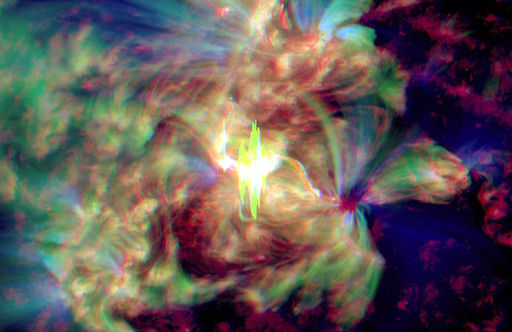
ADVANCING SUNSPOTS: A phalanx of sunspots is turning toward Earth. Their advance is documented in this two-day movie from the Solar Dynamics Observatory:

The large one in the middle, AR1401, has a “beta-gamma” magnetic field that harbors energy for M-class solar flares. At the moment it is unleashing one such flare every day, such as this flash recorded during the late hours of Jan. 19th. Eruptions from AR1401 will become increasingly geoeffective in the days ahead as the sun’s rotation aligns the active region with our planet.


fr/spaceweather.com

Solar Activity & SAT Debris

INCREASING SOLAR ACTIVITY CLEANS UP SAT-DEBRIS: Earth’s atmosphere has been puffing up in response to increasing levels of UV radiation from sunspots. This is good news for satellite operators, because a puffed up atmosphere helps clean up low-Earth orbit. “The number of cataloged debris in Earth orbit actually decreased during 2011,” reports Nick Johnson in NASA’s Orbital Debris Quarterlynewsletter. “[The figure below] illustrates how the rate of debris reentries from the Fengyun-1C anti-satellite test of January 2007 increased during the past year.”

“Even though only 6% of the total 3218 cataloged debris from the ill-advised engagement had reentered by the end of 2011, half of these debris fell out of orbit in the past 12 months,” he points out. “Likewise, many debris from the 2009 accidental collision of Cosmos 2251 and Iridium 33 are accelerating their departure from Earth orbit. In the absence of a new major satellite breakup, the overall orbital debris population should continue to decrease during 2012 and 2013.”

fr/spaceweather.com

Worldwide Volcano Webcams – List

/1/2012 — All the Volcano Webcams of the world

Posted on January 2, 2012

(mirrored from big think) just in case their site ever goes down

Pacific

Hawai’i (United States) 

Haleakala – info – webcam

Kilauea – info – webcams: Pu’u O’o | All HVO webcams | Halema`uma`u Crater from HVO | Halema`uma`u Crater overlook |

Mauna Kea – info – webcam

Mauna Loa – info – webcam

Mariana Islands (United States)

Anatahan – info – webcam

Western/Southern Pacific

Japan – The Japanese Meteorological Agency has a page of 40+ webcams, but the names are all in Japanese

Asama – info – webcams: one | two | three

Aso – info – webcams: one | two | three | four – multiple views | five

Bandai – info – one | two

Chokai – info – webcam

Daisetsu – info – webcam

Fuji – info – webcams: one | two | Shimiza port | Fujinomiya City | Lake Tanuki | Lake Saiko | Lake Kawaguchi | Mt. Mitsutoge | Fujiyoshida City | Oshino | Gotemba

Hiuchi – info – webcam

Iwate – info – webcams: one | two

Kirishima – info – webcams: one (sixth and seventh from bottom on right menu) | two |three

this list is quite extensive, and I have included just the few at the start.  To get to the source, the whole list compiled by Dutch Sinse, go to:    http://sincedutch.wordpress.com/2012/01/02/112012-all-the-volcano-webcams-of-the-world/

6.1 Quake off New Zealand

1/19/2012 — 6.1 magnitude earthquake hits New Zealand

Posted on January 19, 2012

Today, January 19, 2012 — a magnitude 6.1 earthquake struck about 120 miles south of New Zealand.

The entire south/west pacific plate has been moving exponentially faster over the past few months — things are picking up — not letting off.

Look at the screenshot below — showing the last 48 hours of earthquakes around the Pacific ring of fire.

http://earthquake.usgs.gov/earthquakes/recenteqsww/Quakes/usc0007ng0.php

Earthquake Details

  • This event has been reviewed by a seismologist.
Magnitude 6.1
Date-Time
Location 46.676°S, 165.724°E
Depth 18.1 km (11.2 miles)
Region OFF WEST COAST OF THE SOUTH ISLAND, N.Z.
Distances 204 km (126 miles) W of Invercargill, New Zealand
293 km (182 miles) SW of Queenstown, New Zealand
380 km (236 miles) WSW of Dunedin, New Zealand
940 km (584 miles) SW of WELLINGTON, New Zealand

——————————————————

from:    http://sincedutch.wordpress.com/