Covid-19 — Some Questions From the Experts

12 Experts Questioning the Coronavirus Panic

Below is our list of twelve medical experts whose opinions on the Coronavirus outbreak contradict the official narratives of the MSM, and the memes so prevalent on social media.

* * *

Dr Sucharit Bhakdi is a specialist in microbiology. He was a professor at the Johannes Gutenberg University in Mainz and head of the Institute for Medical Microbiology and Hygiene and one of the most cited research scientists in German history.

What he says:

We are afraid that 1 million infections with the new virus will lead to 30 deaths per day over the next 100 days. But we do not realise that 20, 30, 40 or 100 patients positive for normal coronaviruses are already dying every day.

[The government’s anti-COVID19 measures] are grotesque, absurd and very dangerous […] The life expectancy of millions is being shortened. The horrifying impact on the world economy threatens the existence of countless people. The consequences on medical care are profound. Already services to patients in need are reduced, operations cancelled, practices empty, hospital personnel dwindling. All this will impact profoundly on our whole society.

All these measures are leading to self-destruction and collective suicide based on nothing but a spook.

*

Dr Wolfgang Wodarg is a German physician specialising in Pulmonology, politician and former chairman of the Parliamentary Assembly of the Council of Europe. In 2009 he called for an inquiry into alleged conflicts of interest surrounding the EU response to the Swine Flu pandemic.

What he says:    Politicians are being courted by scientists…scientists who want to be important to get money for their institutions. Scientists who just swim along in the mainstream and want their part of it […] And what is missing right now is a rational way of looking at things.

We should be asking questions like “How did you find out this virus was dangerous?”, “How was it before?”, “Didn’t we have the same thing last year?”, “Is it even something new?”

That’s missing.

*

Dr Joel Kettner s professor of Community Health Sciences and Surgery at Manitoba University, former Chief Public Health Officer for Manitoba province and Medical Director of the International Centre for Infectious Diseases.

What he says:

I have never seen anything like this, anything anywhere near like this. I’m not talking about the pandemic, because I’ve seen 30 of them, one every year. It is called influenza. And other respiratory illness viruses, we don’t always know what they are. But I’ve never seen this reaction, and I’m trying to understand why.

[…]

I worry about the message to the public, about the fear of coming into contact with people, being in the same space as people, shaking their hands, having meetings with people. I worry about many, many consequences related to that.

[…]

In Hubei, in the province of Hubei, where there has been the most cases and deaths by far, the actual number of cases reported is 1 per 1000 people and the actual rate of deaths reported is 1 per 20,000. So maybe that would help to put things into perspective.

Audio Player

00:00
00:00

*

Dr John Ioannidis Professor of Medicine, of Health Research and Policy and of Biomedical Data Science, at Stanford University School of Medicine and a Professor of Statistics at Stanford University School of Humanities and Sciences. He is director of the Stanford Prevention Research Center, and co-director of the Meta-Research Innovation Center at Stanford (METRICS).

He is also the editor-in-chief of the European Journal of Clinical Investigation. He was chairman at the Department of Hygiene and Epidemiology, University of Ioannina School of Medicine as well as adjunct professor at Tufts University School of Medicine.

As a physician, scientist and author he has made contributions to evidence-based medicine, epidemiology, data science and clinical research. In addition, he pioneered the field of meta-research. He has shown that much of the published research does not meet good scientific standards of evidence.

What he says:

Patients who have been tested for SARS-CoV-2 are disproportionately those with severe symptoms and bad outcomes. As most health systems have limited testing capacity, selection bias may even worsen in the near future.

The one situation where an entire, closed population was tested was the Diamond Princess cruise ship and its quarantine passengers. The case fatality rate there was 1.0%, but this was a largely elderly population, in which the death rate from Covid-19 is much higher.

[…]

Could the Covid-19 case fatality rate be that low? No, some say, pointing to the high rate in elderly people. However, even some so-called mild or common-cold-type coronaviruses that have been known for decades can have case fatality rates as high as 8% when they infect elderly people in nursing homes.

[…]

If we had not known about a new virus out there, and had not checked individuals with PCR tests, the number of total deaths due to “influenza-like illness” would not seem unusual this year. At most, we might have casually noted that flu this season seems to be a bit worse than average.

– “A fiasco in the making? As the coronavirus pandemic takes hold, we are making decisions without reliable data”, Stat News, 17th March 2020

*

Dr Yoram Lass is an Israeli physician, politician and former Director General of the Health Ministry. He also worked as Associate Dean of the Tel Aviv University Medical School and during the 1980s presented the science-based television show Tatzpit.

What he says:

Italy is known for its enormous morbidity in respiratory problems, more than three times any other European country. In the US about 40,000 people die in a regular flu season and so far 40-50 people have died of the coronavirus, most of them in a nursing home in Kirkland, Washington.

[…]

In every country, more people die from regular flu compared with those who die from the coronavirus.

[…]

…there is a very good example that we all forget: the swine flu in 2009. That was a virus that reached the world from Mexico and until today there is no vaccination against it. But what? At that time there was no Facebook or there maybe was but it was still in its infancy. The coronavirus, in contrast, is a virus with public relations.

Whoever thinks that governments end viruses is wrong.

– Interview in Globes, March 22nd 2020

*

Dr Pietro Vernazza is a Swiss physician specialising Infectious Diseases at the Cantonal Hospital St. Gallen and Professor of Health Policy.

What he says:

We have reliable figures from Italy and a work by epidemiologists, which has been published in the renowned science journal ‹Science›, which examined the spread in China. This makes it clear that around 85 percent of all infections have occurred without anyone noticing the infection. 90 percent of the deceased patients are verifiably over 70 years old, 50 percent over 80 years.

[…]

In Italy, one in ten people diagnosed die, according to the findings of the Science publication, that is statistically one of every 1,000 people infected. Each individual case is tragic, but often – similar to the flu season – it affects people who are at the end of their lives.

[…]

If we close the schools, we will prevent the children from quickly becoming immune.

[…]

We should better integrate the scientific facts into the political decisions.

– Interview in St. Galler Tagblatt, 22nd March 2020

*

Frank Ulrich Montgomery is German radiologist, former President of the German Medical Association and Deputy Chairman of the World Medical Association.

What he says:

I’m not a fan of lockdown. Anyone who imposes something like this must also say when and how to pick it up again. Since we have to assume that the virus will be with us for a long time, I wonder when we will return to normal? You can’t keep schools and daycare centers closed until the end of the year. Because it will take at least that long until we have a vaccine. Italy has imposed a lockdown and has the opposite effect. They quickly reached their capacity limits, but did not slow down the virus spread within the lockdown.

– Interview in General Anzeiger, 18th March 2020

*

Prof. Hendrik Streeck is a German HIV researcher, epidemiologist and clinical trialist. He is professor of virology, and the director of the Institute of Virology and HIV Research, at Bonn University.

What he says:

The new pathogen is not that dangerous, it is even less dangerous than Sars-1. The special thing is that Sars-CoV-2 replicates in the upper throat area and is therefore much more infectious because the virus jumps from throat to throat, so to speak. But that is also an advantage: Because Sars-1 replicates in the deep lungs, it is not so infectious, but it definitely gets on the lungs, which makes it more dangerous.

[…]

You also have to take into account that the Sars-CoV-2 deaths in Germany were exclusively old people. In Heinsberg, for example, a 78-year-old man with previous illnesses died of heart failure, and that without Sars-2 lung involvement. Since he was infected, he naturally appears in the Covid 19 statistics. But the question is whether he would not have died anyway, even without Sars-2.

– Interview in Frankfurter Allgemeine, 16th March 2020

*

Dr Yanis Roussel et. al. – A team of researchers from the Institut Hospitalo-universitaire Méditerranée Infection, Marseille and the Institut de Recherche pour le Développement, Assistance Publique-Hôpitaux de Marseille, conducting a peer-reviewed study on Coronavirus mortality for the government of France under the ‘Investments for the Future’ programme.

What they say:

The problem of SARS-CoV-2 is probably overestimated, as 2.6 million people die of respiratory infections each year compared with less than 4000 deaths for SARS-CoV-2 at the time of writing.

[…]

This study compared the mortality rate of SARS-CoV-2 in OECD countries (1.3%) with the mortality rate of common coronaviruses identified in AP-HM patients (0.8%) from 1 January 2013 to 2 March 2020. Chi-squared test was performed, and the P-value was 0.11 (not significant).

[…]

…it should be noted that systematic studies of other coronaviruses (but not yet for SARS-CoV-2) have found that the percentage of asymptomatic carriers is equal to or even higher than the percentage of symptomatic patients. The same data for SARS-CoV-2 may soon be available, which will further reduce the relative risk associated with this specific pathology.

– “SARS-CoV-2: fear versus data”, International Journal of Antimicrobial Agents, 19th March 2020

Dr. David Katz is an American physician and founding director of the Yale University Prevention Research Center

What he says:

I am deeply concerned that the social, economic and public health consequences of this near-total meltdown of normal life — schools and businesses closed, gatherings banned — will be long-lasting and calamitous, possibly graver than the direct toll of the virus itself. The stock market will bounce back in time, but many businesses never will. The unemployment, impoverishment and despair likely to result will be public health scourges of the first order.

– “Is Our Fight Against Coronavirus Worse Than the Disease?”, New York Times 20th March 2020

Michael T. Osterholm is regents professor and director of the Center for Infectious Disease Research and Policy at the University of Minnesota.

What he says:

Consider the effect of shutting down offices, schools, transportation systems, restaurants, hotels, stores, theaters, concert halls, sporting events and other venues indefinitely and leaving all of their workers unemployed and on the public dole. The likely result would be not just a depression but a complete economic breakdown, with countless permanently lost jobs, long before a vaccine is ready or natural immunity takes hold.

[…]

[T]he best alternative will probably entail letting those at low risk for serious disease continue to work, keep business and manufacturing operating, and “run” society, while at the same time advising higher-risk individuals to protect themselves through physical distancing and ramping up our health-care capacity as aggressively as possible. With this battle plan, we could gradually build up immunity without destroying the financial structure on which our lives are based.

– “Facing covid-19 reality: A national lockdown is no cure”, Washington Post 21st March 2020

*

Dr Peter Goetzsche is Professor of Clinical Research Design and Analysis at the University of Copenhagen and founder of the Cochrane Medical Collaboration. He has written several books on corruption in the field of medicine and the power of big pharmaceutical companies.

What he says:

Our main problem is that no one will ever get in trouble for measures that are too draconian. They will only get in trouble if they do too little. So, our politicians and those working with public health do much more than they should do.

No such draconian measures were applied during the 2009 influenza pandemic, and they obviously cannot be applied every winter, which is all year round, as it is always winter somewhere. We cannot close down the whole world permanently.

Should it turn out that the epidemic wanes before long, there will be a queue of people wanting to take credit for this. And we can be damned sure draconian measures will be applied again next time. But remember the joke about tigers. “Why do you blow the horn?” “To keep the tigers away.” “But there are no tigers here.” “There you see!”

– “Corona: an epidemic of mass panic”, blog post on Deadly Medicines 21st March 2020

*

If you can find any other examples of noteworthy experts deviating from the mainstream narrative, please post them below. As always, this list have been impossible to build without Swiss Propaganda Research. Follow their work and share widely. An indispensable resource.

from:    https://off-guardian.org/2020/03/24/12-experts-questioning-the-coronavirus-panic/?__cf_chl_jschl_tk__=5631d40c98cb7d4dabb507a7d0291d7953adda33-1585808870-0-AQscOsM-haWHOsme8xd1jb-NlXavlPcyb_lamMdHkl9c6mMCcC1R_M3btUJI5b_qY9M7dvUl3NiQ8SRWfUqJDJ2ZcoqY5Pdw4VmjrVNJ0YOi1l5QrAEHQfC3zThjQtsRfs8EnJ5jtZYc3Pks151AENXlJeLLMnfut-vF9n55acVbJtO-FupadXicqIQ6gSxeh5Mg4pqrLaL3mRxTgY1LUO8jxUqgRIS09TGs3f5U8Wrq9Lt10nzPq-kWh7i4Sy6vTWMyhtg3EyTRsTXuz0AzRhep1QgvFfiOXoKRbU1eARaq3QUDGqx8CQHvizbHAYBphGJzdEsEMnHnQoMHzDKhAejy7Vkl8wXvLZZKBV1Y0lKm

A Quieter Earth

Coronavirus lockdowns have changed the way Earth moves

A reduction in seismic noise because of changes in human activity is a boon for geoscientists.


View down a road, featuring tram lines, with a tall building at the end.

Residents of Brussels have been told to stay at home, leaving the city’s streets empty.Credit: Jonathan Raa/NurPhoto via Getty

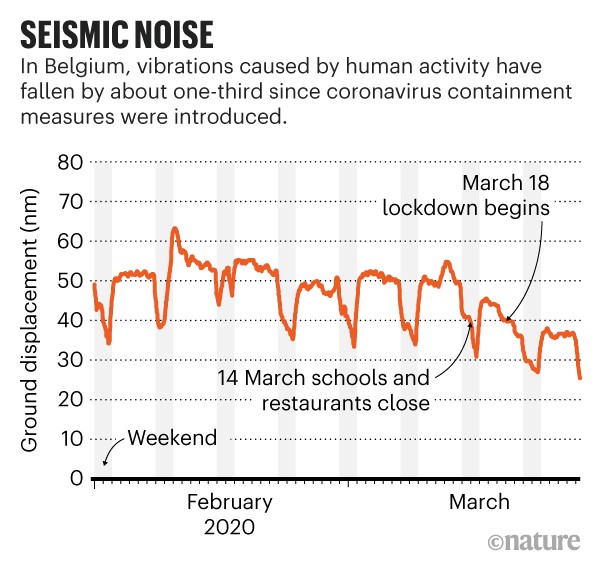
The coronavirus pandemic has brought chaos to lives and economies around the world. But efforts to curb the spread of the virus might mean that the planet itself is moving a little less. Researchers who study Earth’s movement are reporting a drop in seismic noise — the hum of vibrations in the planet’s crust — that could be the result of transport networks and other human activities being shut down. They say this could allow detectors to spot smaller earthquakes and boost efforts to monitor volcanic activity and other seismic events.

A noise reduction of this magnitude is usually only experienced briefly around Christmas, says Thomas Lecocq, a seismologist the Royal Observatory of Belgium in Brussels, where the drop has been observed.

Just as natural events such as earthquakes cause Earth’s crust to move, so do vibrations caused by moving vehicles and industrial machinery. And although the effects from individual sources might be small, together they produce background noise, which reduces seismologists’ ability to detect other signals occurring at the same frequency.

Source: Royal Observatory of Belgium

Data from a seismometer at the observatory show that measures to curb the spread of COVID-19 in Brussels caused human-induced seismic noise to fall by about one-third, says Lecocq. The measures included closing schools, restaurants and other public venues from 14 March, and banning all non-essential travel from 18 March (see ‘Seismic noise’).

The current drop has boosted the sensitivity of the observatory’s equipment, improving its ability to detect waves in the same high frequency range as the noise. The facility’s surface seismometer is now almost as sensitive to small quakes and quarry blasts as a counterpart detector buried in a 100-metre borehole, he adds. “This is really getting quiet now in Belgium.”

Information boost

If lockdowns continue in the coming months, city-based detectors around the world might be better than usual at detecting the locations of earthquake aftershocks, says Andy Frassetto, a seismologist at the Incorporated Research Institutions for Seismology in Washington DC. “You’ll get a signal with less noise on top, allowing you to squeeze a little more information out of those events,” he says.

The fall in noise could also benefit seismologists who use naturally occurring background vibrations, such as those from crashing ocean waves, to probe Earth’s crust. Because volcanic activity and changing water tables affect how fast these natural waves travel, scientists can study these events by monitoring how long it takes a wave to reach a given detector. A fall in human-induced noise could boost the sensitivity of detectors to natural waves at similar frequencies, says Lecocq, whose team plans to begin testing this. “There’s a big chance indeed it could lead to better measurements,” he says.

Belgian seismologists are not the only ones to notice the effects of lockdown. Celeste Labedz, a graduate student in geophysics at the California Institute of Technology in Pasadena, tweeted that a similar fall in noise had been picked up by a station in Los Angeles. “The drop is seriously wild,” she said.

However, not all seismic monitoring stations will see an effect as pronounced as the one observed in Brussels, says Emily Wolin, a geologist at the US Geological Survey in Albuquerque, New Mexico. Many stations are purposefully located in remote areas or deep boreholes to avoid human noise. These should see a smaller decrease, or no change at all, in the level of high-frequency noise they record, she says.

from:    https://www.nature.com/articles/d41586-020-00965-x?utm_source=fbk_nnc&utm_medium=social&utm_campaign=naturenews&fbclid=IwAR11iBTZdpp9A4EBjzBZEYLi8YihTj0cSFU-0y8y_xdothehyh1grqmkDqg?utm_source=wnd&utm_medium=wnd&utm_campaign=syndicated

A Reminder

House of Mica: The Message of the Hopi presented to the UN General Assembly

Hopi petroglyph at Prophecy Rock

___________________________

On December 10, 1992, Thomas Banyacya, Kykotsmovi Hopi Nation (Arizona), addressed the United Nations General Assembly (Full Text Here). In his speech, he explained to diplomats the significance of a petroglyph at Prophecy Rock (Hopiland). An ancient prophecy apparently predicted a “House of Mica” that feasibly describes the United Nations’ headquarters in New York.

“Greed and concern for material things is a common disease.” Thomas Banyacya, 1992

___________________________

“The Hopi and all original native people hold the land in balance by prayer, fasting and performing ceremonies. Our spiritual Elders still hold the land in the Western Hemisphere in balance for all living beings, including humans. No one should be relocated from their sacred homelands in this Western Hemisphere or anywhere in the world. Acts of forced relocation, such as Public Law 93-531 in the United States, must be repealed.

(Thomas and Oren Lyons held up a picture of a large rock drawing in Hopiland)

The United Nations stands on our native homeland. The United Nations talks about human rights, equality and justice and yet the native people have never had a real opportunity to speak to this assembly since its establishment until today. It should be the mission of your nations and this assembly to use your power and rules to examine and work to cure the damage people have done to this Earth and to each other. Hopi Elders know that was your mission and they wait to see whether you will act on it now.

Nature, the First People and the spirit of our ancestors are giving you loud warnings. Today, December 10, 1992, you see increasing floods, more damaging hurricanes, hail storms, climate changes and earthquakes as our prophesies said would come. Even animals and birds are warning us with strange change in their behavior such as the beaching of whales. Why do animals act like they know about the earth’s problems and most humans act like they know nothing? If we humans do not wake up to the warnings, the great purification will come to destroy this world just as the previous worlds were destroyed.   

Banyyaca explained the meaning of this Hopi petroglyph to the United Nations General Assembly in 1992

This rock drawing shows part of the Hopi prophecy. There are two paths. The first with technology but separate from natural and spiritual law leads to these jagged lines representing chaos. The lower path is one that remains in harmony with natural law. Here we see a line that represents a choice like a bridge joining the paths. If we return to spiritual harmony and live from our hearts, we can experience a paradise in this world. If we continue only on this upper path, we will come to destruction.

It’s up to all of us, as children of Mother Earth, to clean up this mess before it’s too late.”

(Full text of speech)

“House of Mica (glass) “
United Nations Headquaters, New York City

from:    http://theswillbucket.com/

Unknown Fault Responsible for Utah Quake 3/24/20

After a 5.7 earthquake, Utah seismologists investigate a ‘virtually unknown’ fault

Soon after Salt Lake City stopped shaking March 18 from its strongest earthquake on record, Amir Allam, a University of Utah seismologist, knew he had to get busy if he hoped to closely study the hundreds of aftershocks he knew would follow the 7:09 a.m. jolt.

The fault that is believed to have moved along the eastern base of the Oquirrh Mountains is virtually unknown, and here was a chance, dropping out of the blue, to image it.

But Allam had a problem.

All 210 of the U.’s portable seismographs, loaf-sized instruments known as nodal geophones, were currently deployed along California’s San Andreas fault and elsewhere, and, therefore, were unavailable for what he needed to do in his own backyard. The Salt Lake Valley hadn’t had a sizable shake since 1962 and last week’s 5.7 magnitude earthquake offered a rare opportunity to better map the network of fractures under the valley.

Allam and his U. colleagues quickly mustered up dozens of geophones from other institutions and began burying them near the epicenter of the initial quake, likely on a fault that has remained a mystery to Utah seismologists.

They hope to characterize it and determine how it is interconnected with the Wasatch fault running along the base of the foothills on Salt Lake City’s east side and its lattice of associated faults, or “strands.”

‘Jury is still out’

“We started immediately the morning of the [initial] earthquake, and we have been installing them ever since,” Allam said Tuesday as he unloaded shovels and 43 geophones from his truck. “These are the last bunch.”

He already had deployed 139 geophones, each equipped with 35 days of battery life, around the Salt Lake Valley, each measuring ground movements — vertical, north-south and east-west — from hundreds of aftershocks. These recordings will help scientists with the U., as well as the Utah and U.S. geological surveys, to characterize this intriguing fault.

The Wasatch fault system’s network of cracks in the earth stretches 230 miles from Malad, Idaho south to Fayette, Utah through Utah’s major metropolitan area, where at least 80% of the population resides. A magnitude 6 quake on the main fault could cause severe damage, depending on where it strikes. A 2016 report forecast a 57% chance of such a quake or stronger within the next 50 years. Scientists do not believe last week’s temblor will reduce the chance of a major quake on the Wasatch fault down the road.

“We want to map out the basin depth all over the valley. We actually don’t know it [the fault network] that well,” Allam said. “… We want to capture as many tiny aftershocks as we can, so we have a really dense deployment around the epicenter of the 5.7 quake. We want to get that fault structure. We want to know exactly how the Wasatch and its subsidiary faults are changing their patterns in the subsurface.”

The fault that likely moved dips to the west and is not expressed on the surface, according to Kris Pankow of the U. Seismograph Stations. It could be the same one that shook Magna in 1962 with a magnitude 5.2 quake that touched off a swarm of lesser aftershocks, but it can’t be known for sure because the instrumentation was not in place to precisely locate that quake.

“The jury is still out on the specific fault that moved and produced [the March 18] earthquake,” said Ryan Gold, a research geologist with the U.S. Geological Survey. “The specific strand, that’s what we are trying to sort out. Additional instrumentation is being installed to monitor ongoing seismicity.”

‘Aftershocks are going to diminish’

(Francisco Kjolseth | The Salt Lake Tribune) University of Utah seismologist Amir Allam deploys 43 portable seismic instruments to be buried above Salt Lake City on Tuesday, March 24, 2020, to capture data following last week’s 5.7 magnitude earthquake.

In the week since the main quake, the ground under Magna has kept shaking.

As of Tuesday at 4 p.m., 456 aftershocks had been recorded, according to Gold, coming at an average rate of one every 20 minutes. At least 29 were magnitude 3 and a handful exceeded magnitude 4. The fault released a magnitude 3.1 temblor Tuesday at 5:32 a.m., followed by many stronger than magnitude 2. Most were located very close to the original epicenter a few miles north northeast of Magna and just six miles beneath the surface.

“The number and size of aftershocks are going to diminish with time but within these sequences. It’s the fault adjusting to the changes in stress. They are kind of chattering,” said Pankow, who is also closely monitoring aftershocks with larger seismographs placed in a few strategic locations. “With time, that stress is going to dissipate.”

The larger instruments are connected to broadband, providing real time data on the aftershocks. Meanwhile, satellite imagery shows the ground moved several centimeters at the surface as a result of the main quake, according to Gold.

The aftershocks don’t occur in steady intervals but in clusters, according to a graphic representation posted by Seismograph Stations. In the first three days after the mainshock, dozens of aftershocks flared. They grew weaker and less frequent until Sunday night, when a magnitude 4 struck, followed quickly by numerous aftershocks.

“That magnitude 4 was its own stress release; it has its own set of aftershocks to go with it,” Pankow said. “We might have some more magnitude 4s before this is all done.”

Seismometers, types of seismograph that measure surface ground movement, are installed in at least three major historic structures in downtown Salt Lake City: the Utah Capitol, City Hall and West High School. These instruments record direction, intensity and duration of earthquakes. The data generated by these instruments helps engineers understand the seismic forces buildings on the Wasatch fault system could be subject to, according to Pankow.

Hillside research

An assistant research professor in the U.’s Department of Geology and Geophysics, Allam teaches jiu jitsu on the side. On Tuesday, he recruited some of his students on a moment’s notice to help schlep instruments into the hills above Salt Lake City’s Avenues neighborhood as the weather deteriorated in front of a snowstorm expected to arrive by Wednesday.

They hoisted 50-pound satchels over their shoulders, each holding six geophones, and trekked a half-mile up the Bonneville Shoreline Trail to a spot where Allam had identified a 500-meter transect along a ravine that was just starting to green up with the coming of spring. Here the team was to plant the geophones along a preselected line spanning a known strand of the Wasatch fault in the undulating terrain overlooking the city.

As a cold rain began to fall, the crews dug 8-inch holes in 13-meter intervals along a downsloping ridgeline on a roughly north-south axis. The geophones were placed in the holes, oriented directly north, and covered with dirt.

In a month, Allam and his associates will return to recover 182 geophones around the valley. The harvest is hoped to yield a bounty of data that paints a valuable picture of what lurks beneath Utah’s most populated region.

from:    https://www.sltrib.com/news/environment/2020/03/25/fault-that-shook-magna/

Climate Triage

Climate change is increasing flooding caused by seasonal ‘king tides’ in Florida and other coastal areas. AP Photo/Lynne Sladky

We can’t save everything from climate change – here’s how to make choices

Recent reports have delivered sobering messages about climate change and its consequences. They include the Intergovernmental Panel on Climate Change’s Special Report on Global Warming of 1.5°C; the fourth installment of the U.S. government’s National Climate Assessment; and the World Meteorological Organization’s initial report on the State of the Global Climate 2018.

As these reports show, climate change is already occurring, with impacts that will become more intense for decades into the future. They also make clear that reducing greenhouse gas emissions from human activities to a level that would limit warming to 2 degrees Celsius (3.6 degrees Fahrenheit) or less above preindustrial levels will pose unprecedented challenges.

Today, however, there is a large and growing gap between what countries say they’d like to achieve and what they have committed to do. As scholars focused on climate risk management and adaptation, we believe it is time to think about managing climate change damage in terms of triage.

Hard choices already are being made about which risks society will attempt to manage. It is critically important to spend limited funds where they will have the most impact.

Annual average temperature over the continental United States has increased by 1.8 degrees Fahrenheit relative to 1900. Additional increases ranging from 3 degrees Fahrenheit to 12 degrees Fahrenheit are expected by 2100, depending on global greenhouse gas emission trends. USGCRP

Triaging climate change

Triage is a process of prioritizing actions when the need is greater than the supply of resources. It emerged on the battlefields of World War I, and is widely used today in fields ranging from disaster medicine to ecosystem conservation and software development.

The projected global costs of adapting to climate change just in developing countries range up to US$300 billion by 2030 and $500 billion by mid-century. But according to a recent estimate by Oxfam, just $5 billion to $7 billion was invested in projects specific to climate adaptation in 2015-2016.

Triaging climate change means placing consequences into different buckets. Here, we propose three.

The first bucket represents impacts that can be avoided or managed with minimal or no interventions. For example, assessments of how climate change will affect U.S. hydropower indicate that this sector can absorb the impacts without a need for costly interventions.

The second bucket is for impacts that are probably unavoidable despite all best efforts. Consider polar bears, which rely on sea ice as a platform to reach their prey. Efforts to reduce emissions can help sustain polar bears, but there are few ways to help them adapt. Protecting Australia’s Great Barrier Reef or the Brazilian Amazon poses similar challenges.

Clare Mukankusi breeds beans for a gene bank in Kawanda, Uganda, with properties including drought resilience to help farmers cope with extreme conditions. Georgina Smith, CIAT, CC BY-NC-SA

The third bucket represents impacts for which practical and effective actions can be taken to reduce risk. For example, cities such as Phoenix, Chicago and Philadelphia have been investing for years in extreme heat warning systems and emergency response strategies to reduce risks to public health. There are a variety of options for making agriculture more resilient, from precision agriculture to biotechnology to no-till farming. And large investments in infrastructure and demand management strategies have historically helped supply water to otherwise scarce regions and reduce flood risk.

In each of these cases, the challenge is aligning what’s technically feasible with society’s willingness to pay.

What triage-based planning looks like

Other experts have called for climate change triage in contexts such as managing sea level rise and flood risk and conserving ecosystems. But so far, this approach has not made inroads into adaptation policy.

How can societies enable triage-based planning? One key step is to invest in valuing assets that are at risk. Placing a value on assets exchanged in economic markets, such as agriculture, is relatively straightforward. For example, RAND and Louisiana State University have estimated the costs of coastal land loss in Louisiana owing to property loss, increased storm damage, and loss of wetland habitat that supports commercial fisheries.

Valuing non-market assets, such as cultural resources, is more challenging but not impossible. When North Carolina’s Cape Hatteras lighthouse was in danger of collapsing into the sea, heroic efforts were taken to move it further inland because of its historic and cultural significance. Similarly, Congress makes judgments on behalf of the American people regarding the value of historic and cultural resources when it enacts legislation to add them to the U.S. national park system.

The next step is identifying adaptation strategies that have a reasonable chance of reducing risks. RAND’s support for the Louisiana Coastal Master Plan included an analysis of $50 billion in ecosystem restoration and coastal protection projects that ranked the benefits those projects would generate in terms of avoided damages.

This approach reflects the so-called “resilience dividend” – a “bonus” that comes from investing in more climate-resilient communities. For example, a recent report from the National Institute of Building Sciences estimated that every dollar invested in federal disaster mitigation programs – enhancing building codes, subsidizing hurricane shutters or acquiring flood-prone houses – saves society $6. Nevertheless, there are limits to the level of climate change that any investment can address.

The ‘Resilience Dividend Valuation Model’ provides communities with a structured way to frame and analyze resilience policies and projects.

The third step is investing enough financial, social and political capital to meet the priorities that society has agreed on. In particular, this means including adaptation in the budgets of federal, state, and local government agencies and departments, and being transparent about what these organizations are investing in and why.

Much progress has been made in improving disclosure of corporate exposure to greenhouse gas reduction policies through mechanisms such as the Task Force on Climate-Related Disclosures, a private sector initiative working to help businesses identify and disclose risks to their operations from climate policy. But less attention has been given to disclosing risks to businesses from climate impacts, such as the disruption of supply chains, or those faced by public organizations, such as city governments.

Advocates say corporate disclosure of climate risks would help investors to make informed decisions, and would allow corporations to prepare for climate change and have a strategy to deal with it.

Finally, governments need to put frameworks and metrics in place so that they can measure their progress. The Paris Climate Agreement calls on countries to report on their adaptation efforts. In response, tools like InformedCity in Australia are emerging that enable organizations to measure their progress toward adaptation goals. Nevertheless, many organizations – from local governments to corporate boardrooms – are not equipped to evaluate whether their efforts to adapt have been effective.

There are many opportunities to manage climate risk around the world, but not everything can be saved. Delaying triage of climate damages could leave societies making ad hoc decisions instead of focusing on protecting the things they value most.

from:    https://theconversation.com/we-cant-save-everything-from-climate-change-heres-how-to-make-choices-108141

Vegan for the Planet? Think Again!

Going vegan is a pointless form of virtue signaling – it doesn’t help the environment or the planet, analysis reveals

Image: Going vegan is a pointless form of virtue signaling – it doesn’t help the environment or the planet, analysis reveals

(Natural News) Think you’re saving the planet from climate change by driving an electric vehicle and switching to a “plant-based” diet? Think again.

In a paper he recently published, Bjørn Lomborg, director of the Copenhagen Consensus Center, deconstructs the myth that lugging around reusable grocery bags and using paper straws instead of plastic have any meaningful impact on our planet’s climate.

As it turns out, all of the messaging about how to individually fight “global warming” by reducing one’s personal “carbon footprint” is a gaggle of lies and propaganda – and this from a guy who’s a vehement believer in climate change!

Switching from beef to “Impossible Whoppers” will accomplish a whole lot of nothing, as will replacing all your incandescent lightbulbs with mercury-filled compact fluorescents (CFLs). The same goes for recycling and flitting around town in a Tesla – both useless endeavors in terms of “cooling” the planet.

According to Lomborg, these and many other individual actions represent little more than virtue signaling by climate elitists who accomplish nothing beyond simply feeling better about themselves by “going green.”

Using the example of British nature-documentary presenter and environmental activist David Attenborough, Lomborg highlights how Attenborough’s promise to unplug his phone charger when it’s not in use is a laughably pointless endeavor that will have basically zero impact on the environment.

“… even if he consistently unplugs his charger for a year, the resulting reduction in carbon-dioxide emissions will be equivalent to less than one-half of one-thousandth of the average person’s annual CO2 emissions in the United Kingdom,” Lomborg points out.

“Moreover, charging accounts for less than 1% of a phone’s energy needs; the other 99% is required to manufacture the handset and operate data centers and cell towers. Almost everywhere, these processes are heavily reliant on fossil fuels.”

You might as well keep eating those steaks because livestock farts aren’t heating the globe any more than the GMOs in those “plant-based” alternatives

As for going vegetarian or vegan, this, too, is a complete waste of time if it’s being done purely for the sake of “saving the planet.” Despite all of the fear-mongering about cow flatulence “warming” the atmosphere, the fact of the matter is that eating meat has virtually the same impact on the planet as not eating meat.

“… a systematic peer-reviewed study has shown that even if they succeed, a vegetarian diet reduces individual CO2 emissions by the equivalent of 540 kilograms – or just 4.3% of the emissions of the average inhabitant of a developed country,” Lomborg notes.

“Furthermore, there is a ‘rebound effect,’ as money saved on cheaper vegetarian food is spent on goods and services that cause additional greenhouse-gas emissions. Once we account for this, going entirely vegetarian reduces a person’s total emissions by only 2%.”

In the end, even if every person were to eat entirely vegan, only drive a Tesla, and power his or her home with wind and solar exclusively, the overall reduction in emissions would be so minimal as to be statistically non-existent.

Meanwhile, nations are throwing trillions of dollars at subsidizing these worthless changes, massively reducing their own wealth while propping up the illusion of “sustainability” – and to what end?

“We already spend $129 billion per year subsidizing solar and wind energy to try to entice more people to use today’s inefficient technology, yet these sources meet just 1.1% of our global energy needs,” Lomborg concludes.

“The IEA (International Energy Agency) estimates that by 2040 – after we have spent a whopping $3.5 trillion on additional subsidies – solar and wind will still meet less than 5% of our needs.”

To keep up with the latest news about the climate change hoax, be sure to check out ClimateScienceNews.com.

from:    https://www.naturalnews.com/2020-01-02-going-vegan-doesnt-help-environment-or-planet.html

The Spectacular ‘Shroom

All Natural, Mushroom-Based Pesticides Could Revolutionize Farming

(TT) — The massive decline of insect populations in recent years is an environmental crisis that is often overlooked, and by all indications, it seems that pesticides are largely to blame for this problem. However, researchers are currently developing alternatives that can hopefully protect crops for farmers without causing widespread harm to insect populations.

Biopesticides are derived from natural materials like plants, bacteria, and certain minerals. These substances are not harmful to the environment and also pose less of a risk to insects. Some Biopesticides are not even harmful, but just work to repel certain insects from the area, while others only target specific insects in a limited range.

One of the most interesting recent developments in the field of biopesticides is the use of fungi.

Fungus-based pesticides would still kill the insects that attempt to feast on the crops, but this will not be a toxin that gets into the environment, which reduces the widespread exposure to plant, animal and insect life.

Two fungus-based pesticides were developed and patented by the famous mycologist Paul Stamets. One of the products is specifically targeted toward fire ants, carpenter ants, and termites, while his other offering can affect roughly 200,000 insect species.

One of the fungi-based biopesticides, called MycoPesticide, will begin to sprout inside of the insect once it is eaten and will then feed on the creature until it dies, often with mushroom sprouts popping out of its head. It is also not harmful to bees, which has been a growing concern in relation to pesticides.

Fungi seen growing out of an affected insect. Photo Credit: Brian Lovett/University of Maryland Entomology

However, the cost is still a major obstacle for advocates of fungi-based pesticides, as they can be up to 20 times more expensive than chemical pesticides.

Paul Underhill, co-owner of the organic Terra Firma Farm in Winters, California says that the fungi methods are also a bit more difficult to work with.

“Some, like those with fungi, can require special storage, such as refrigeration. [And] the cost to the farmer can easily be 20 times what a conventional pesticide might be,” Underhill told NPR.

Photo Credit: Dr. Yuxian Xia and Nemat O. Keyhani, Chongqing University

The short term financial cost for biopesticides might be higher right now, but hopefully, those prices will start to fall as the development of this technology progresses. It is also important to consider the long term financial and environmental consequences that may not be immediately obvious in the short term.

There are also plant-based pesticides that are currently in development, which could also provide an alternative to conventional chemicals. One example is PureCrop1, a plant-based pesticide company that is partly owned by NBA star John Salley.

According to the PureCrop1, the organic pesticide is made with plant-based materials from grains, and seed crops. Their products do not contain petroleum distillates or synthetics including artificial foaming and thickening agents, builders, reagents, dyes or fragrances.

New solutions can’t come soon enough. According to a new study published this month in the scientific journal PLOS One, America’s agricultural landscape has grown 48 times more toxic to insects in the past 25 years. As Truth Theory reported last month, even fireflies are facing possible extinction all over the world.


By John Vibes | TruthTheory.com | Republished with permission

from:    https://themindunleashed.com/2019/08/all-natural-mushroom-based-pesticides.html

Situation: Critical – The Burning of the Rainforest

The Amazon Rainforest is on Fire and Hardly Anyone’s Talking About It

The hashtag #PrayForAmazonia went viral on Tuesday as social media users attempted to draw the world’s attention to the Amazon rainforest, which has been devastated for weeks by fires so intense they can be seen from space.

According to Euro News, it is unclear whether the fires were caused by agricultural activity or deforestation. Both have accelerated rapidly under Brazilian President Jair Bolsonaro, who made opening the Amazon to corporate exploitation a key plank of his election campaign.

Twitter users on Tuesday slammed the media for paying too little attention to the Amazon blazes, particularly given the essential role the rainforest plays in absorbing planet-warming carbon dioxide—a capacity that earned it the nickname “lungs of the world.”

“The Amazon has been burning for three weeks, and I’m just now finding out because of the lack of media coverage,” wrote one observer. “This is one of the most important ecosystems on Earth.”

Satellite data collected by the Brazilian government’s National Space Research Institute (INPE) published in June showed that deforestation has risen dramatically under Bolsonaro, who dismissed the research as “a lie” and fired INPE director Ricardo Galvão for defending the data.

As The Guardian reported, the INPE findings showed the Amazon “lost 739sq km during the 31 days [of May], equivalent to two football pitches every minute.”

As Newsweek reported Tuesday,

One large fire, which started in late July, burnt around 1,000 hectares of an environmental reserve in the Brazilian state of Rondônia—located on the border with Bolivia. This blaze, along with others in the region, created dense plumes of smoke that spread far across the state, endangering the health of people living in the area and the lives of animals.


Two weeks ago, the state of Amazonas in the northwest of the country declared a state of emergency in response to an increase in the number of fires there… Various fires have also been burning in the state of Mato Grosso, according to satellite imagery.

The fires have become so intense that smoke from the blaze darkened the afternoon sky on Monday in São Paulo, Brazil’s most populous city.

“The Amazon rainforest has been on fire for weeks, and it’s so bad it’s literally blotting out the sun miles away,” tweeted Robert Maguire, research director at U.S. government watchdog group Citizens for Ethics and Responsibility in Washington.

The advocacy group Amazon Watch on Tuesday called the Bolsonaro regime’s attacks on the world’s largest rainforest “an international tragedy.”

“What can we do?” the group tweeted. “1. Support the courageous resistance of the indigenous peoples of the Amazon. 2. Make clear to the agribusiness and financiers involved in the destruction that we won’t buy their products.”

By Jake Johnson | CommonDreams.org | Creative Commons

from:    https://www.wakingtimes.com/2019/08/22/the-amazon-rainforest-is-on-fire-and-hardly-anyones-talking-about-it/

On Serpent Mound

The Serpent Mound

The Great Serpent Mound of Ohio, the Largest Earthen Effigy in the World

The Great Serpent Mound is a 1,300-foot long and 3-foot high prehistoric effigy mound located on a plateau of a crater along Ohio Brush Creek in Adams County, Ohio, and is the largest surviving prehistoric effigy mound in the world. Resembling an uncoiling serpent, the mound is steeped in mystery and controversy. Despite over a century of research, there is no conclusive evidence about what it represents, when it was built, and what its true purpose was, though various astronomical alignments suggest it may have functioned as a type of calendar.

The Serpent Mound conforms to the curve of the land on which it rests, with its head approaching a cliff above a stream.  It winds back and forth for more than eight hundred feet and has seven distinct coils, ending in a triple-coiled tail. The serpent head has an open mouth extending around the east end of a 120-foot-long hollow oval feature, which is generally viewed as an egg, although other interpretations suggest it is the sun, the body of a frog, or merely the remnant of a platform. To the west of the effigy, is a triangular mound measuring approximately 32 feet at its base and long axis.  The Serpent Mound is believed to have been laid out all at once, with a layer of clay and ash, and reinforced with stones.

An illustration of the Serpent Mound

An illustration of the Serpent Mound. Image source .

Thousands of years ago, Native American peoples populated the Ohioan landscape with mounds and massive earthworks. Initial research attributed the effigy to the Adena culture, which flourished from 1000 BC to 100 AD.  The Adena culture are well-known for building burial and effigy mounds, many of which are located near the Great Serpent Mound.  However, radiocarbon dating on pieces of charcoal found within the Serpent Mound established that people worked on the mound around 1070 AD.  Thus, the mound may have been built by the Fort Ancient peoples, who lived in the Ohio Valley from 1000 CE to 1550 CE.  Nevertheless, the testing is not conclusive as it only reveals that 1000-year-old charcoal was found within the mound. This could have ended up there long after the effigy was originally built.

Interpretations of the Serpent Mound

The most predominant theory is that the Serpent Mound represents a giant snake, which is slowly uncoiling itself and about to seize a huge egg within its extended jaws. However many theories abound suggesting various interpretations. For instance, some think it may represent an eclipse, or the phases of the moon. Others have speculated that it represents the myth of the horned serpent found in many Native American cultures. In 1909, local German Baptist minister Landon West proposed another unusual theory: the serpent was writhing in its death throes as punishment for tempting Adam and Eve in what West believed was the original Garden of Eden.

There are serious suggestions that the serpent is intimately connected with the heavens. Several writers have suggested that the serpent is a model of the constellation we call the Little Dipper, its tail coiled about the North Star.

Various alignments of the serpent correspond to astronomical features, such as alignments of the sun and moon. In 1987 Clark and Marjorie Hardman published their finding that the oval-to-head area of the serpent is aligned to the summer solstice sunset, suggesting that one of the effigy’s purposes was to mark the turning of the year so that planting and gathering and hunting could be planned.

William F. Romain has suggested an array of six lunar alignments corresponding to the curves in the effigy’s body. If the Serpent Mound were designed to sight both solar and lunar arrays, it would be reflect the consolidation of astronomical knowledge into a single symbol.

Generations of researchers agree with the theory that the Serpent Mound holds astronomical significance, but the intent of those who built the serpent, and how it was used still remains a mystery.

Many scholars believe the Serpent Mound was used in religious ceremonies. When settlers first discovered the mound, there was a fire-scorched stone monument in the egg-shaped head, which has led some to suggest it was used as an altar of some sort – possibly sacrificial, based on the ceremonial knives unearthed among the blackened stones and a number of headless skeletons discovered in gravesites nearby.

Whatever its true purpose, the Serpent Mound attests to the ingenuity of its creators. As the Ancient Ohio Trail website so aptly states: “The genius of its designers remains apparent: this blend of beauty, familiarity, abstraction, power, precision, and mystery, make Ohio’s Serpent Mound one of the great, iconic images for all of human antiquity.”

Featured image: The Serpent Mound. Photo source .

By April Holloway

from:     https://www.ancient-origins.net/ancient-places-americas/great-serpent-mound-ohio-largest-earthen-effigy-world-001594

NOTE:    Check out Graham Hancock’s take on Serpent Mound in his new book AMERICA BEFORE

Crops and Weather

Total Catastrophe For U.S. Corn Production: Only 30% Of U.S. Corn Fields Have Been Planted – 5 Year Average Is 66%

By Michael Snyder

2019 is turning out to be a nightmare that never ends for the agriculture industry.  Thanks to endless rain and unprecedented flooding, fields all over the middle part of the country are absolutely soaked right now, and this has prevented many farmers from getting their crops in the ground.  I knew that this was a problem, but when I heard that only 30 percent of U.S. corn fields had been planted as of Sunday, I had a really hard time believing it.  But it turns out that number is 100 percent accurate.  And at this point corn farmers are up against a wall because crop insurance final planting dates have either already passed or are coming up very quickly.  In addition, for every day after May 15th that corn is not in the ground, farmers lose approximately 2 percent of their yield.  Unfortunately, more rain is on the way, and it looks like thousands of corn farmers will not be able to plant corn at all this year.  It is no exaggeration to say that what we are facing is a true national catastrophe.

According to the Department of Agriculture, over the past five years an average of 66 percent of all corn fields were already planted by now…

U.S. farmers seeded 30% of the U.S. 2019 corn crop by Sunday, the government said, lagging the five-year average of 66%. The soybean crop was 9% planted, behind the five-year average of 29%.

Soybean farmers have more time to recover, but they are facing a unique problem of their own which we will talk about later in the article.

But first, let’s take a look at the corn planting numbers from some of our most important corn producing states.  I think that you will agree that these numbers are almost too crazy to believe…

Iowa: 48 percent planted – 5 year average 76 percent

Minnesota: 21 percent planted – 5 year average 65 percent

North Dakota: 11 percent planted – 5 year average 43 percent

South Dakota: 4 percent planted – 5 year average 54 percent

Yes, you read those numbers correctly.

Can you imagine what this is going to do to food prices?

Many farmers are extremely eager to plant crops, but the wet conditions have made it impossible.  The following comes from ABC 7 Chicago

McNeill grows corn and soybeans on more than 500 acres in Grayslake. But much of his farmland is underwater right now, and all of it is too wet to plant. Rain is a farmer’s friend in the summer but in the spring too much rain keeps farmers from planting.

The unusually wet spring has affected farmers throughout the Midwest, but Illinois has been especially hard hit. Experts say with the soil so wet, heavy and cold, it takes the air out and washes nutrients away, making it difficult if not impossible for seeds to take root.

Right now, soil moisture levels in the state of Illinois “are in the 90th to 99th percentile statewide”.  In other words, the entire state is completely and utterly drenched.

As a result, very few Illinois farmers have been able to get corn or soybeans in the ground at this point

According to the U.S. Department of Agriculture’s crop progress reports, about 11% of Illinois corn has been planted and about 4% of soybeans. Last year at this time, 88% of corn and 56% of soybeans were in the ground.

I would use the word “catastrophe” to describe what Illinois farmers are facing, but the truth is that what they are going through is far beyond that.

Normally, if corn farmers have a problem getting corn in the ground then they just switch to soybeans instead.  But thanks to the trade war, soybean exports have plummeted dramatically, and the price of soybeans is the lowest that it has been in a decade.

As a result there is very little profit, if any, in growing soybeans this year

Farmers in many parts of the corn belt have suffered from a wet and cooler spring, which has prevented them from planting corn. Typically when it becomes too late to plant corn, farmers will instead plant soybeans, which can grow later into the fall before harvest is required. Yet now, planting soybeans with the overabundance already in bins and scant hope for sales to one of the biggest buyers in China, could raise the risk of a financial disaster.

And if the wet conditions persist, many soybean farms are not going to be able to plant crops at all this year.

Sadly, global weather patterns are continuing to go haywire, and much more rain is coming to the middle of the country starting on Friday

Any hopes of getting corn and soybean planting back on track in the U.S. may be washed away starting Friday as a pair of storms threaten to deliver a “one-two punch” of soaking rain and tornadoes across the Great Plains and Midwest through next week.

As much as 3 to 5 inches (8 to 13 centimeters) of rain will soak soils from South Dakota and Minnesota south to Texas, Oklahoma and Arkansas, according to the U.S. Weather Prediction Center in College Park, Maryland.

We have never had a year quite like this before, and U.S. food production is going to be substantially below expectations.  I very much encourage everyone to get prepared for much higher food prices and a tremendous amount of uncertainty in the months ahead.

Even though I have been regularly documenting the nightmarish agricultural conditions in the middle of the country, the numbers in this article are much worse than I thought they would be at this point in 2019.

This is truly a major national crisis, and it is just getting started.

About the author: Michael Snyder is a nationally-syndicated writer, media personality and political activist. He is the author of four books including Get Prepared Now, The Beginning Of The End and Living A Life That Really Matters. His articles are originally published on The Economic Collapse Blog, End Of The American Dream and The Most Important News. From there, his articles are republished on dozens of other prominent websites. If you would like to republish his articles, please feel free to do so. The more people that see this information the better, and we need to wake more people up while there is still time.

from:    https://www.activistpost.com/2019/05/total-catastrophe-for-u-s-corn-production-only-30-of-u-s-corn-fields-have-been-planted-5-year-average-is-66.html