Northern Pacific Volcano Update

Northern Pacific Update: Bezymianny Put on Red Alert for Eruption, Seismicity Noted at Iliamna in Alaska

The steaming dome at Bezymianny seen on June 11, 2011.

A few volcanoes along the northern Pacific rim are showing varying signs of potential eruptive activity:

Bezymianny: KVERT placed this active Kamchatka volcano (right) on Red Alert status over the last few days after a sharp and sustained increasein seismic activity. They also noted a sizable increase in size and temperature of the thermal anomaly seen at the summit of the volcano (observed by satellite), suggesting that new, hot magma is very close/at the surface. Put these two things together and KVERT suggests that “strong ash explosions up to 43,000 ft (13 km) a.s.l. possible at any time during the next 24 hours.” It has been about 11 months since the last explosive eruption at Bezymianny – and if anything does occur, you can see if the Bezymianny webcam is operating to catch a glimpse.

Iliamna: Over in the lower Cook Inlet of Alaska, seismicity has increased at Iliamna, but not enough to raise the alert status at the volcano above Green. However, the Alaska Volcano Observatory did mention that they will be watching the volcano closely as it has experienced a few small earthquake swarms over the past three months. This seismicity is similar to what was observed in 1996-97, but that did not lead to an eruption and the last confirmed eruption of the volcano was back in 1876 (although there may have been smaller explosions as recently as 1952). If you like watching webicorders trace the seismicity,Iliamna does have real-time monitoring. In a related note, the state and local officials are resisting a planto consolidate all its fighter aircraft in Alaska to Joint Base Elmendorf-Richardson near Anchorage from Eielson AFB near Fairbanks. Opponents of the move point out that this would put all these aircraft in danger if one of the volcanoes near Anchorage were to erupt.

Image: Bezymianny in Kamchatka by Yu. Demyanchuk/KVERT  

from:    http://www.wired.com/wiredscience/2012/03/northern-pacific-update-bezymianny-put-on-red-alert-for-eruption-seismicity-noted-at-iliamna-in-alaska/#more-99388

Nevado del Ruiz Volcano in Colombia Heating Up

Increasing Volcanic Unrest Observed at Nevado del Ruiz in Colombia

The crater of Nevado del Ruiz in Colombia seen on March 8, 2012. The area is obviously warm and INGEOMINAS scientists noticed ash in the crater area as well.

Eruptions reader Sherine pointed me towards the recent updates from INGEOMINAS in Colombia onNevado del Ruiz. The volcano hasn’t erupted in over 20 years, but the signs are beginning to point towards a potential revival of the volcano.


INGEOMINAS scientists were able to do a flyover with the Colombian Air Force and got a number of shotsof the summit area. They also reported “ash on the glacier, near the crater rim and on the eastern flank of the same,” likely from a February 22 explosion from Ruiz. The steam plume from the main crater on the day of the flyover was ~1.4 km / 4,500 feet. That same day, a seismic signal of tremor associated with multiple small ash emissions were reported along with an increase in sulfur dioxide emissions. All of these events suggest that Ruiz is seeing heating in the summit area and likely phreatic explosions. The increased sulfur dioxide would additionally suggest new magma in the volcano. The shots of the summit area clearly show steam coming from the crater, although it is doesn’t appear to show any new material in the crater. Shots of the entire summit show ash on some of the snow-covered areas as well (see below – grey on foreground slopes of the volcano).

The summit area of Nevado del Ruiz. In the foreground a small dusting of ash can be seen on the snow. The plume seen here reaches ~1.4 km.

Most people are familiar with Nevado del Ruiz due to the eruption in 1985 that killed over 23,000 people. That disaster was caused by a lahar (volcanic mudflow) generated by a small eruption from the summit crater melting the abundance ice and snow at the summit. The most recent pictures of the summit area (see below) show that there is plenty of snow to make lahars a very real hazard if Ruiz where to begin to enter a new period of eruption.

from:    http://www.wired.com/wiredscience/2012/03/increasing-volcanic-unrest-observed-at-nevado-del-ruiz-in-colombia/#more-99578

Solar WHAM on Its Way

WEEKEND SOLAR FLARE: Sunspot AR1429 is still erupting this weekend. On Saturday, March 10th, it produced a powerful M8-class flare that almost crossed the threshold into X-territory. During the flare, New Mexico amateur astronomer Thomas Ashcraft recorded a series of radio bursts at 21 and 28 MHz:


Dynamic spectrum courtesy Wes Greenman, Alachua County, Florida

The roaring sounds you just heard are caused by shock waves plowing through the sun’s atmosphere in the aftermath of the explosion. “There is incredible complexity in the waveforms,” notes Ashcraft. “This is a recording of one of the most turbulent events in all of Nature!”

In addition, the explosion propelled yet another CME toward Earth. According to a forecast track prepared by analysts at the Goddard Space Weather Lab, the cloud will hit our planet’s magnetosphere on March 12th at 1803 UT (+/- 7 hr), possibly sparking a new round of geomagnetic storms.

After passing Earth, the CME will also hit the Mars Science Lab (MSL) spacecraft on March 13th followed by Mars itself on March 14th. Mars rover Curiosity onboard MSL might get some interesting readings as the cloud passes by.

fr/spaceweather.com

March 11-17

Overall Color for the Week:    Light Amber Orange

No, you are not going crazy.  The energies are coming together right now, old and new, and the result is confusion, chaos, and oddities.  Step back from things this week.  Use your sense of humor as a defense.  It carries a certain kindness and acceptance that will be appealing to those out there who are looking for reaction. There is a strong urge these days towards purging a lot of the old.  This can manifest itself in bouts of throwing things away or crying your eyes out or laughing hysterically.  The important thing now is to let things happen as they do and then let them go.  Not always so easy, but helpful and healthful in the long run. There can be some physical issues this week, so listen to your body and do not attempt to overdo,  You will pay for it in the end. Oh, this is not a good time for second guessing or making decisions for yourself based on other’s opinions, the lure of the media, or the spur of the moment.  There is time.  It is good to remember that.  There is time to get the important things done.  The rest, well they are not that important after all.  Mercury goes retrograde Monday. This can be a tough retrograde, so stay centered and grounded in your own knowing and personal strength, and listen to your intuition.  You are,after all, part of it all.  Please, also be aware of your power.  It is growing, perhaps with growing pains inside of you — some of those physical issues.  See things for what they have to say to you.  Again, listen to your intuition and the voices in your head.  You are connected to Universal Consciousness, and as you take time, through meditation,, centering, grounding, opening, being WHO you are, its voice, gentle and true, will speak to you. Continue reading →

CME on the Horizon

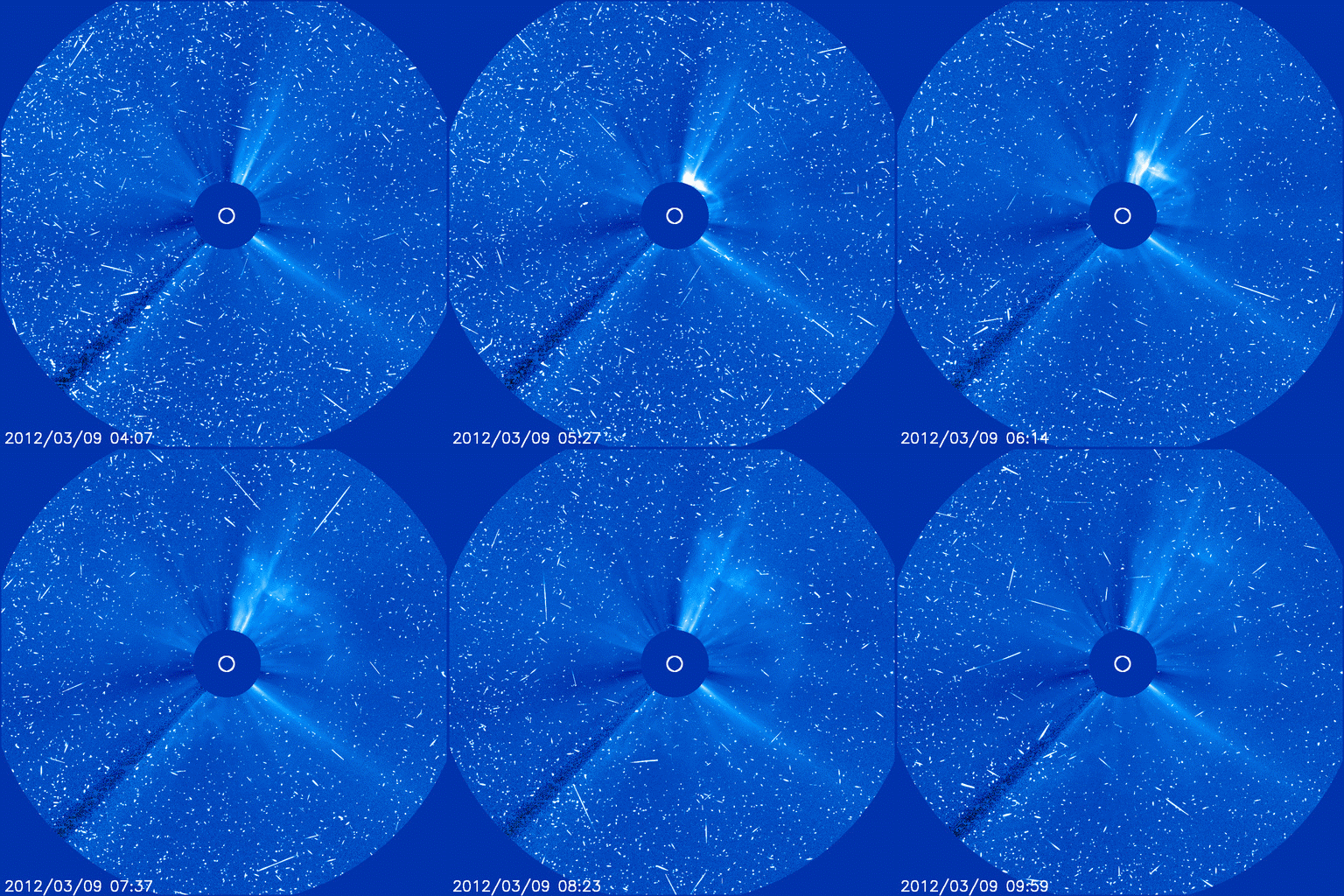
NCOMING CME: A CME from sunspot AR1429 is nearing Earth. According to analysts at the Goddard Space Weather Lab, the cloud will arrive on March 11th at 0649 UT (+/- 7 hr). NOAA forecasters say the odds of a strong geomagnetic storm at that time is 50%.

The same eruption that hurled the CME toward Earth also produced amonsterous tsunami of plasma on the sun. NASA’s Solar Dynamics Observatory recorded the shadowy but powerful wave rippling away from the blast site:

The tsumani was about 100,000 km high and raced outward at 250 km/s with a total energy of about 2 million megatons of TNT. Such waves often underlie CMEs like the one en route to Earth now.

Animated forecast tracks show that the CME will also hit the Mars Science Lab (MSL) spacecraft on March 12th followed by Mars itself on March 13th. Mars rover Curiosity onboard MSL might get some interesting readings as the cloud passes by.

fr/spaceweather.com

Incoming Solar Flare

WEEKEND SOLAR FLARE: Sunspot AR1429 is still erupting this weekend. On Saturday, March 10th, it produced a powerful M8-class flare that almost crossed the threshold into X-territory. In New Mexico, amateur radio astronomer Thomas Ashcraft recorded a series of shortwave bursts emanating from the blast site: audio. Also, the explosion propelled yet another CME toward Earth: forecast track. The cloud is expected to hit our planet’s magnetosphere on March 12th around 1800 UT. A CME from an earlier explosion will arrive much sooner, however.

fr/spaceweather.com

Daylight Savings Times Tales

5 Crazy Chapters in the History of Daylight Saving Time

Stephanie Pappas, LiveScience Senior Writer
Date: 09 March 2012 Time: 03:11 PM ET
The sun rises over the Atlantic ocean.
The purpose of daylight saving time is to sync people’s lives with the sun.
CREDIT: Roman Sigaev, Shutterstock

On Sunday, most Americans will wake up only to realize they’ve lost an hour of their weekend to daylight saving time — the price we pay for eight months of well-lit evenings.

Unless you live in Arizona or Hawaii, which don’t observe daylight saving, you’re probably used to this routine by now. But the history ofdaylight saving time has been anything but peaceful, from its first wartime introduction to its ongoing controversy today.

Bright idea

Ben Franklin gets credit for thinking up the idea of daylight saving time, albeit with his trademark wit. As ambassador to Paris, Franklin wrote a letter to the Journal of Paris in 1784 of his “discovery” that the sun gives light as soon as it rises, and needling Parisians for their night-owl, candle-burning ways.

Ben Franklin had the basic concept,” said David Prerau, author of “Seize the Daylight: The Curious and Contentious Story of Daylight Saving Time” (Thunder’s Mouth Press, 2005). What Franklin lacked, Prerau said, was a useful way to force everyone into living by the sun’s rules — other than some “humorous ideas” that Parisians surely wouldn’t have found very funny, including shooting off cannons at sunrise every morning.

Others took daylight saving time much more seriously, particularly William Willett, an Englishman who loved his early-morning horseback rides, Prerau told LiveScience; Willett he couldn’t believe that everyone else wanted to sleep in after the sun came up. He also touted the benefits of longer hours of daylight in the evenings.

Willett managed to get the idea of moving the clock forward during the summer months proposed in Parliament in 1908, but it was shot down.

“Willett was a steadfast guy, and so he proposed it again in 1909, 1910, 1911, and Parliament rejected it all those times,” Prerau said.

Willett might have kept this up, but he died in 1915, never to see his beloved daylight saving plan reach fruition.

Wartime rally

If Willett couldn’t convince the British populace that daylight saving time was needed, the Germans could. In 1916, with World War I ratcheting up, Germany put itself on daylight saving time to save energy for the war effort. Britain followed a month later.

When the United States got involved in the war in 1918, they too instituted daylight saving time. President Woodrow Wilson even wanted to keep the new system after the war ended. But at the time, the country was mostly rural. Farmers hated the time change, because their jobs were dependent on the sun, and daylight saving time put them out of sync with the city people who sold them goods and bought their products. Congress repealed daylight saving time, Wilson vetoed the repeal, and Congress promptly overrode his veto, a fairly rare occurrence.

“It’s been contentious,” Prerau said.

Total confusion

When World War II hit, daylight saving time came back into vogue, again to save energy for the war effort. The U.S. instituted daylight saving time less than a month after the Japanese attack on Pearl Harbor, Prerau said. This time, though, America’s increasingly industrialized population wasn’t as keen on losing their post-work daylight after the war ended. So when the national law requiring the time switch was repealed, some towns stuck with daylight saving.

It was chaos. One 35-mile bus ride from Moundsville, W.Va., to Steubenville, Ohio, took riders through no less than seven different time changes, Prerau said. At one point, the Twin Cities of Minneapolis and St. Paul were on different clocks, creating confusion for workers who lived in one city and commuted to the other.

“The suburbs didn’t know what to do at all,” Prerau said.

Uniform time

This every-town-for-itself system couldn’t last long. In 1966, Congress passed the Uniform Time act of 1966, specifying that states didn’t have to get on the daylight saving bandwagon, but that if they did, the whole state had to comply. And the federal government would determine the days of “springing forward” and “falling back,” the law stated, eliminating the problem of towns and cities setting their own daylight saving dates.

Expanding daylight saving

Since that time, Congress has expanded the length of daylight saving time three times, once in the 1970s during the country’s energy crisis, once in the 1980s, when April got brought under the daylight saving umbrella, and finally in 2007. Today, daylight saving time encompasses March into November.

The reasoning given for each of these changes was to save energy, Prerau said, but there are other benefits to springing forward. Fewer cars on the road on dark evenings mean fewer traffic accidents. And more daylight means more outdoor exercise for the after-work crowd.

On the other hand, expanding daylight saving time to encompass any more of the year might cause trouble. Russia shifted their clock to permanent daylight saving time in 2011, which worked fine until the depths of winter. Suddenly, the sun was rising at 10 a.m. in Moscow and 11 a.m. in St. Petersburg, Prerau said. People aren’t fond of starting their days in the pitch-black, he said, and now there’s talk of reversing the decision.

from:    http://www.livescience.com/18965-history-daylight-saving-time.html

Lasting Effects of Japanese Earthquake

7 Strange Ways the Japan Quake Shook the World

Andrea Thompson, OurAmazingPlanet Managing Editor
Date: 09 March 2012 Time: 09:48 AM ET


Japan 2011 earthquake map
Map showing the 11 March 2011 magnitude 9.0 off Tohoku mainshock and 166 aftershocks of magnitude 5.5 and greater until May 20. Warmer color indicates more recent events. Larger symbol indicates greater quake magnitude.
CREDIT: USGS

One year ago on March 11, the intense shaking and massive tsunami set off by a 9.0 magnitude earthquake off the coast of Japan wrought noticeable effects on our planet.

Not only did the twin events cause widespread damage along Japan’s coast — thequake was the largest in the country’s history — but they also triggered effects across the globe, from the surface to high up in the atmosphere. They even slightly altered the Earth’s gravity.

Here, OurAmazingPlanet reviews the strangest effects the 2011 Japan earthquake and tsunami had on our planet.

7 – Cracks in the seafloor

The earthquake ruptured below the seafloor off the coast of the Tohoku region, ripping open cracks along the ocean bottom. Submersibles spied these cracks, which measured around 3 to 6 feet (around 1 to 3meters) across, in the months after the earthquake.

fissure along seafloor after March 2011 japan earthquake
The many large earthquakes that have shaken our planet lately are the result of random events, not a pattern suggesting an uptick in such quakes. Shown here, one of the fissures that opened up on the seafloor after the March 2011 earthquake struck off Japan’s coast.
CREDIT: Norio Miyamoto, JAMSTEC

6 – Smaller quakes triggered worldwide

The massive 9.0 temblor shook large sections of Japan and is still setting off aftershocks in the area. But the shaking wasn’t limited to the immediate region, some scientists think. There is evidence that the quake set off microquakes and tremors around the globe, mostly in places already known for their seismic activity such as Taiwan, Alaska and central California. These events likely didn’t exceed a magnitude of 3.0.

However, some of the quakes occurred in low-activity areas, such as central Nebraska, central Arkansas and near Beijing. Tremors were even detected in Cuba. Scientists hope that linking these seismic events can help them better understand the inner workings of earthquakes. [Pictures: Japan Earthquake & Tsunami]

5 – Antarctic ice stream sped up

Thousands of miles away from Japan, the seismic waves of the Tohoku earthquake appeared to temporarily speed up the flow of the Whillans glacier. Glaciers are essentially rivers of ice that slowly flow, in the case of Antarctica, from the interior of the continent out to sea. The increased pace of the ice stream was detected by GPS stations located on the ice.

Japan Tsunami Iceberg
CREDIT: NASA.

4 – Antarctic iceberg broken

The earthquake and its resulting tsunami were so powerful and far-reaching that they also broke off huge icebergs from Antarctica’s Sulzberger Ice Shelf. (An ice shelf is the part of a glacier that floats atop the sea.) Satellite images detected thetsunami waves breaking off chunks of ice some 18 hours after the earthquake.

3 – Atmosphere was rattled

The massive earthquake not only shook the earth, but also rattled the atmosphere.

Research had indicated that the surface motions and tsunamis that earthquakes generate can also trigger waves in the atmosphere, and the Japan earthquake generated the largest such disturbances seen yet, creating ripples in electrically charged particles reaching nearly 220 miles (350 kilometers) above the Earth.

2 – Gravity altered

The earthquake was so powerful that it altered the pull of gravity under the area affected by the quake, as detected by the Gravity Recovery and Climate Experiment (GRACE) satellites. The quake slightly thinned the crust, causes a slight reduction in the local gravity field.

1 – Earth’s day shortened

An analysis conducted just days after the earthquake struck found that the temblor accelerated Earth’s spin, shortening the length of the 24-hour day by 1.8 microseconds. A microsecond is a millionth of a second.

The planet’s rotation sped up because the earthquake shifted the distribution of Earth’s mass, said geophysicist Richard Gross at NASA’s Jet Propulsion Laboratory in Pasadena, Calif., who made the calculation.

from    http://www.livescience.com/18950-ways-japan-earthquake-shook-world.html


Solar Storms & Earthquake Connections

Strong Geomagnetic storm hits late, earthquake prone areas should keep alert

Published on March 9, 2012 – 16:00 UT
– By TWS Staff Reporter
– Edited by Staff Editor

Another piece of the earthquake trigger puzzle is the work done by TheWeatherSpace.com Senior Meteorologist Kevin Martin. Martin has been bashed at by others in the weather field, media outlets, and even Tony Phillips at SpaceWeather. Martin has been working on his theory of how solar storms may be a trigger to earthquakes since before the year 2000. According to online records, Martin was once known as “Geomagnetic Man”, in-which he was predicting quake windows like fellow predictor Berkland.(TheWeatherSpace.com) – Two theories floating around have come together to question what is next. As the Full Moon goes and the Solar Storm remains or fades, two people are wondering what will happen next.

Geologist Jim Berkland is the founder and developer of the theory involving earthquakes and the moon positions. According to Berkland, his Earthquake window this month was March 8th through the 15th, issued on March 8th. His theory is based on Syzygy, which is a twice-monthly alignment of the Sun and the Moon, from new to full.
No records before-hand show the work being done. Martin is the founder and developer of the theory that solar storms and geomagnetic storms may trigger earthquakes. Dr. Tony Phillips last year finally was starting to agree on what Martin has been saying for over 12 years now and more people should be aware of the trigger.

“Oh I get laughed at a lot but down the line the joke is always on them,” said Martin. “I think outside of the box, something not many want to do today. The generation of today’s youth and world is laziness and Xbox. Back in 1998 is when I started working on my theory, which I still believe in today to be a trigger.”

At the current time only a magnitude 7.1 was registered in the Southern Pacific, northeast of Australia. Coincidentally it happened when the geomagnetic storm arrived. The area of the quake is prone to large quakes, but last year a solar storm hit the planet and Japan had the devastating earthquake right as it hit.

Right now the geomagnetic levels are dropping after a peak of 7 on the 1 through 9 scale. This went well with what Martin had said on TWS’ official Facebook page on Thursday morning when Dr. Tony Phillips had declared the storm “a dud”.

“What matters is how much energy is being trapped up there in the geomagnetic field of the Earth, and when the Bz goes south, these particles will find a “Crack” so to speak and filter downwards,” said Martin. ” This can happen either right after impact or within 6-18 hours after the initial impact. Also the impact could come in waves throughout the day.”

Martin states that the trigger window is still open 24 hours after the storm finishes. Earthquakes hit without notice but it can still be a good idea to be ‘On-Watch’ and alert when triggers are elevated.
from:    http://www.theweatherspace.com/news/TWS-30912-solar-storm-hits-planet.html

Continuing Solar Storms


Solar storms causing few problems on Earth

Geomagnetic and solar radiation storms hitting Earth after Tuesday’s solar flares may not be as big as advertised, the National Oceanic and Atmospheric Administration said Thursday.

Together, such storms can affect GPS systems, other satellite systems and power grids, but none of these problems has been reported, even as the leading edge of the sun’s coronal mass ejections from Tuesday hit Earth on Thursday morning, scientists said.

The geomagnetic storm has reached only G1 intensity on a scale from G1 (weak) to G5 (extreme), and the solar radiation storm is an S3 (strong) on a similar 1-to-5 scale, NOAA’s Space Weather Prediction Center said. Earlier, NOAA had predicted a G3/S4 event.

Still, the solar radiation storm has prompted some airlines to divert planes from routes near the north pole, where radio communications may be affected and passengers at high altitudes may be at a higher than normal radiation risk.

“Today we are using alternate routes for seven westbound flights to Asia. We will monitor possible solar impact to the operation in making decisions for tomorrow and future dates,” Delta Air Lines spokesman Anthony Black said.

American Airlines put three high-polar flights – from the U.S. to Japan and China– on lower-altitude routes on Thursday, spokesman Ed Martelle said. And United Airlines rerouted four flights to Asia, according to United spokesman Mike Trevino.

The geomagnetic storm still could give earthlings quite a show Thursday night. The storm is expected to produce auroras, or northern lights, that may be visible as far south as the northern United States, said Physicist Joseph Kunches with the Space Weather Prediction Center.

Tuesday’s solar eruptions included two solar flares – intense bursts of radiation from the sun – and two coronal mass ejections, which are releases of gas and magnetic fields from the outer sun. The coronal mass ejections reached Earth on Thursday.

Kunches likened the challenge of forecasting the strength of the storms to hitting a major league pitcher’s fastball.

“Like a hitter, we try (to) figure out if the pitch is coming down the middle of the plate or is low and outside,” Kunches said. “The problem is, the pitch comes from the sun from 93 million miles away.”

Forecasters also try to figure out which way the particles ejected from the sun are oriented, which has major implications on how strong the event will be.

“Like a curveball, the orientation can change. We didn’t see the spin with this event,” Kunches said.

He added that the event is not over, and the effect of the solar radiation could increase if it becomes better aligned later Thursday. By Friday morning, the solar storm should be diminishing.

The sunspot that produced the storms, however, still will be facing Earth through the weekend, and further emissions could bring new storms to the planet.

from:   http://lightyears.blogs.cnn.com/2012/03/08/radiation-from-solar-storms-begins-to-hit-earth/?hpt=hp_c2