Paper Wine Bottles?

Greenbottle’s paper wine bottle is biodegradable, compostable

16 November 11

A British company called Greenbottle has designed a wine bottle made entirely out of paper, which weighs nearly a tenth of the amount of a regular glass bottle.

It was developed by Martin Myerscough, the technology director of the company, who came up with the concept after talking to the manager of his local tip, who told him that air-filled plastic bottles are the biggest problem he had to deal with. Myerscough started with milk bottles — creating a design that crushes flat and decomposes, leaving nothing but a small residue from the waterproof bag that contains the milk (which is recyclable if facilities are available locally).

Now, he’s turned to reinventing the wine bottle. Each paper bottle contains the same type of bag found in boxed wine so that the wine is kept fresh. The carbon footprint is cut to 10 percent of that of glass bottle but the big bonus is in terms of weight — each bottle weighs just 55g, whereas a regular glass bottle weighs more like 500g, which slashes transport costs.

It remains to be seen whether shoppers go for it, and — at least at first — hardcore oenophiles are likely to be unimpressed by the bag approach, but Asda’s promised to put milk cartons on shelves in 2012, so wine won’t like be far behind. Myerscough’s strategy for that is to approach wine manufacturers — he wants to license the patented technology to vineyards so that the wine doesn’t need to be shipped to a bottling plant first.

from:    http://www.wired.co.uk/news/archive/2011-11/16/paper-wine-bottle

Apply Now to Become an Astronaut

Nasa opens online recruitment for next wave of astronauts

16 November 11
Want to work in sunny Houston, Texas; earn upwards of $142,000 (£90,000) a year; and take the odd trip into outer space? Nasa is now seeking candidates for astronaut positions for flights to the International Space Station, trips to asteroids and journeys into deep space.

Sadly, you need to be a US citizen, and you’ll also need a bachelor’s degree in engineering, science or math and three years of professional experience. Plus, you’ll need 20/20 vision, be in tip-top medical shape, and be anywhere between 62 and 75 inches tall — to fit inside a Russian Soyuz rocket, that is.

Your odds are quite low, too. Since picking its first seven astronauts from the US military in 1959, only 330 astronauts have been picked for the intensive Astronaut Candidate training program from the thousands of applications received.

What’s in the job description of a 21st century astronaut? Successful applicants will generally work aboard the ISS in three to six month-long missions, and help Nasa’s efforts to partner up with commercial companies like SpaceX to ensure future transportation to the space station.

They’ll also help build and, eventually, fly the Orion Multi-Purpose Crew Vehicle (MPCV), which is designed for human deep space exploration — potentially to Mars. An unmanned orbital test flight has been penciled in for an early 2014 launch.

If you fancy the job, you can apply online here. But before you do so, you might want to listen to our interview with Canadian astronaut Julie Payette, in episode 50 of the Wired.co.uk Podcast.

Nasa is also in the process of picking a near-Earth asteroid to explore, with plans to set foot on a chunk of space rock in 2025. The administration plans to send a robotic precursor mission to the asteroid approximately five years before humans arrive.

Nasa’s more ambitious plans have been hampered by economic woes, and acompromise spending plan — approved by a House and Senate conference committee this week — will cut the agency’s spending money even further. Nasa will receive $17.8 billion this fiscal year — $924 million less than the White House requested and $684 million less than it received this year.

Thankfully, a House bid to cancel Nasa’s over-budget James Webb Space Telescope — a super powerful telescope that will succeed the ageing Hubble in 2018 — has been denied, but the compromise bill has capped the program’s spending at $8 billion.

$3.8 billion will go towards the human space exploration programs that these budding astronauts are being hired for, while $406 million has been earmarked to fund commercial spaceship development at Boeing, Space X, Sierra Nevada and Blue Origin.

from:    http://www.wired.co.uk/news/archive/2011-11/16/nasa-seeks-astronaut

Storms on the Rise Since the ’80’s

Weather has become more erratic since 1984

16 November 11

A study from climatologists at Princeton University suggests that weather has grown more erratic on a day-to-day basis since the middle of the 80s. 

David Medvigy, an assistant professor in the Department of Geosciences at Princeton, and Claudie Beaulieu, a postdoctoral research fellow in Princeton’s Program in Atmospheric and Oceanic Sciences, believe that extremely sunny or cloudy days have become more common and that swings between stormy days and dry days have increased dramatically.

This has obviously occurred at a time when global temperatures have been rising, but it’s impossible to say for sure whether the increase in variability is being caused by climate change. On the one hand, a warmer world means there’s more energy in the atmosphere to generate dramatic weather with, but on the other hand, climate is merely an average of weather over a long period of time.

This increase in variability could have impacts on the stability of ecosystems and on industries like agriculture, renewable energy production and transport. “Our work adds to what we know about climate change in the real world and places the whole problem of climate change in a new light,” saud Medvigy. “Nobody has looked for these daily changes on a global scale. We usually think of climate change as an increase in mean global temperature and potentially more extreme conditions — there’s practically no discussion of day-to-day variability.”

He added: “If you don’t know what role variability is playing now, you’re not in a very strong position for making remarks about how it might change in the future,” he said. “We’re at a stage where we had better take a look at what this research is pointing out.”

The most extreme variations in weather were observed in the tropics, but those effects radiate around the glove, said William Rossow, a professor of earth system science and environmental engineering at the City College of New York. “Wherever it’s raining heavily, especially, or variably is where the atmosphere is being punched. As soon as it is punched somewhere in the tropics it starts waves that go all the way around the planet,” he said.

“Signals end up going over the whole globe, and whether they’re important in a particular place or not depends on what else is happening,” he added. “But you can think of storms as being the disturbances in an otherwise smooth flow. That’s why this is a climate issue even though we’re talking about daily variability in specific locations.”

The results of the study were published in the Journal of Climate.

from:    http://www.wired.co.uk/news/archive/2011-11/16/erratic-weather

New Canary Island Forming

Undersea volcano about to create new Canary Island

14 November 11

Volcanologists studying an undersea volcano erupting near the island of El Hierro believe that it’s just 70 metres from the surface and may create new land.

Over the past week or so, the geological upheaval in the Canary Islands has caused jets of water to rise more than 20 metres into the air and locals claim to have even seen rocks thrown out of the sea. Measurements taken by researchers show that seething water is significantly warmer than the surrounding sea. The culprit is the Canarian hotspot — the islands are underlain by a deep magma plume that is believed to have first appeared 60 million years ago.

Since July 2011, more than 10,000 small earthquakes have shaken the island of El Hierro and since October they’ve grown significantly stronger, with some surpassing four on the Richter scale. At the start of November, residents in the southern part of the island had to leave their homes after tremors hit the area and supherous gases drifted through. The Canary Islands’ volcanology institute,Involcan, has reported a three-fold increase in carbon dioxide levels.

Since then, however, the quakes have shifted from the south of the island to the north. While the southern tremors occurred at a depth of more than 10km, the northern ones have moved upwards and Spain’s national geographic institute has warned that there could be minor eruptions in or near the El Golfo valley on the northern coast of the island.

For the moment, however, there is no immediate risk of major surface eruption, so locals are canvassing for names for the imminent new territory. Proposed names, according to Spiegel Online, include “The Discovery”, “Atlantis”, and “The Best”.

from:    http://www.wired.co.uk/news/archive/2011-11/14/canary-islands-volcano

Leonids Peak Nov.17-18

LEONID METEOR SHOWER: Earth is passing through the debris field of Comet Tempel-Tuttle, parent of the annual Leonid meteor shower. Barring a direct hit by a filament of dust, which forecasters consider unlikely, this year’s shower should be mild. Peak rates of 10 to 20 meteors per hour are expected on Nov. 17th and 18th.

from:  spaceweather.com

Solar Activity

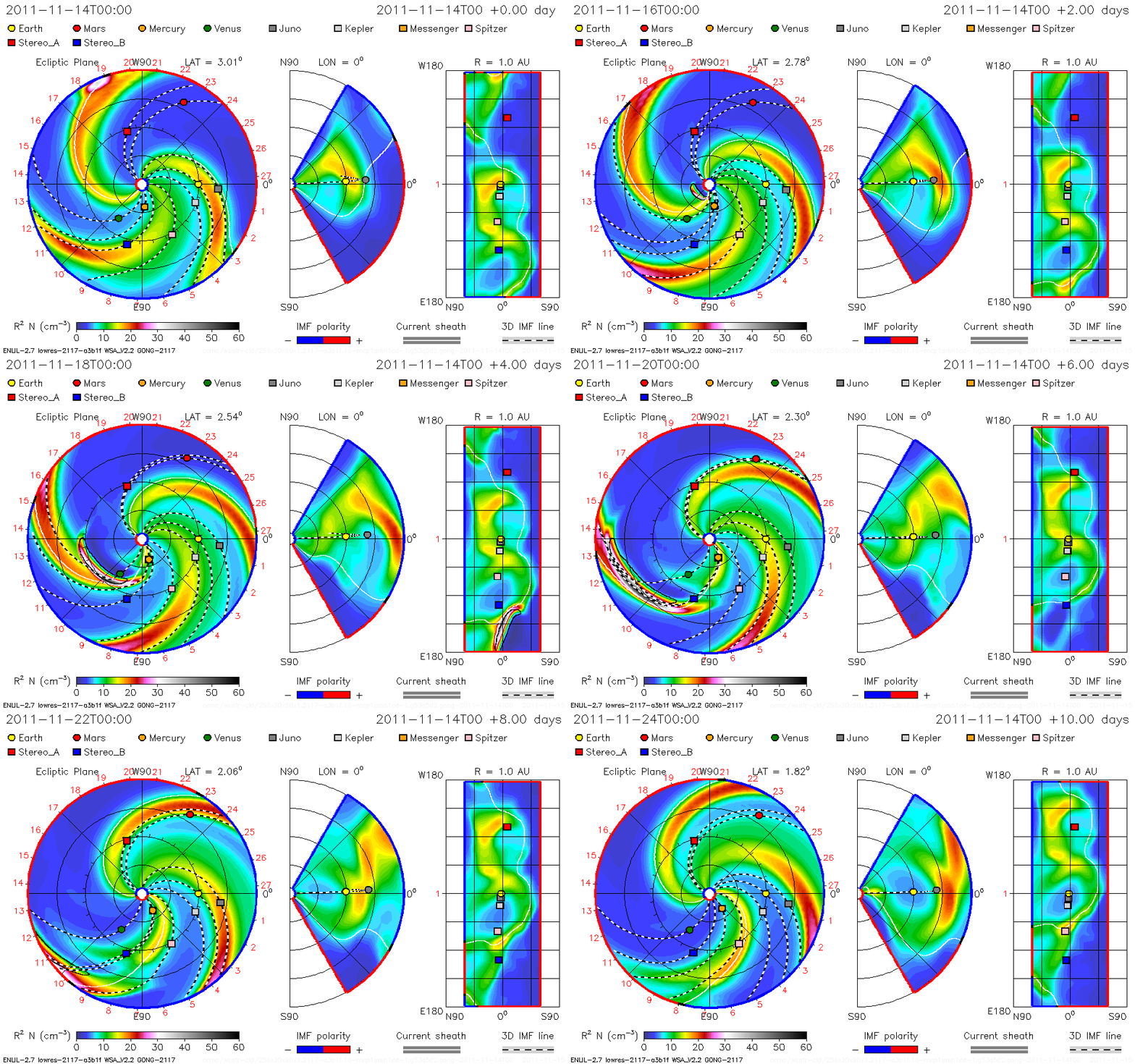
SOLAR BLAST: A magnetic prominence dancing along the sun’s southeastern limb became unstable on Nov. 15th and slowly erupted. NASA’s Solar Dynamics Observatory recorded the event, which unfolded over a period of thirteen hours:

The eruption hurled a cloud of plasma (CME) toward Venus. According to a forecast track created by analysts at the Goddard Space Weather Lab, the cloud should reach the second planet on Nov. 17th. Venus has no global magnetic field to protect it from CMEs. The impact will likely strip a small amount of atmosphere from the planet’s cloudtops.

from: spaceweather.com

October Weather Extremes

October 2011 Global Weather Extremes Summary

Published: 8:16 PM GMT on November 05, 2011
October 2011 Global Weather Extremes Summary

October was a relatively calm month so far as global weather extremes were concerned. The biggest story for the United States was the unprecedented snowstorm that struck the mid-Atlantic and Northeast on October 29-30th. Unusual warmth occurred in Europe at the beginning of the month and in southern Africa towards the end of the month. Extreme flooding affected Central America, Italy, and Southeast Asia.

Below are some of the month’s highlights.

NORTH AMERICA

The most intense October snowstorm on record left between 22 and 27 dead and 2.5 million without electricity from Virginia to Maine when a classic northeaster cyclone moved up the Atlantic Coast on October 29th and 30th. As of this writing, a week later, some 800,000 are still without power in Connecticut and Massachusetts. Amazing snow totals of over two feet affected the hardest hit portions of Massachusetts and New Hampshire (see Jeff Masters and my blog of Oct. 30). At the peak of the storm on Saturday evening, Windsor, Massachusetts received 26.0” of snow in just a six-hour period.

Unisys surface analysis map for 8 p.m. EST October 29th, around the time when the snow was falling at its heaviest in southern New England.

Concord, New Hampshire had 22.2” in a 15-hour period between 4pm Oct. 29 and 7am October 30. This was the 2nd greatest 24-hour snowfall on record for this city that has experienced many formidable snowstorms since records began there in 1871 (the record 24-hour snowfall was 25” during the famous blizzard of December 26-27, 1969).

Heavy wet snow toppled trees onto parked cars in Worcester, Massachusetts. The storm has become the 14th billion-dollar natural disaster in the U.S.A. so far this year. Photo by Adam Hunger/AP.

In spite of some significant rainfall during the month, portions of western Texas and the Texas Panhandle experienced several intense dust storms reminiscent of the 1930s ‘Dust Bowl’ era. Amarillo, and Lubbock, Texas as well as Dodge City, Kansas remained on track for their driest calendar year on record. In contrast, much of Ohio and Pennsylvania have already achieved their wettest year on record. As of Nov. 1st Williamsport, Pennsylvania has recorded 63.18” (old record 61.27” in 1972), Scranton 54.02” (old record 53.71” in 1945), Harrisburg has recorded 67.59” (old record 59.67” in 1863), Cleveland, Ohio has measured 55.81”(old record 53.83” in 1990), and Binghamton, New York 61.86” (old record 49.33” in 2006).

Hurricane Jova roared ashore on Mexico’s west coast between Manzanillo and Puerto Vallarta on October 12th with 100mph wind gusts and killing five.

An amazing nighttime video capture of Hurricane Jova’s winds as the storm came ashore north of Manzanillo, Mexico on October 12th. Photo/video taken by wunderground blogger Mike Theiss at Tenacatita, Mexico.

The coldest temperature measured in the northern hemisphere during October was -61.4°F (-51.9°C) at Summit, Greenland.

SOUTH AMERICA and CENTRAL AMERICA

Extreme flooding in El Salvador and Guatemala resulted in the deaths of at least 105 people the week of October 13-20. It was one of the worst natural disasters in recent history for El Salvador. One location, Huizucar, in El Salvador recorded an astonishing 59.57” (1513mm) of precipitation in the ten-day period of October 10-20.

Map of precipitation totals across El Salvador the period of October 10-20. El Salvadoran National Hydrological Service.

Winds of 75mph in mid-October whipped up fallen volcanic ash (that had accumulated as the result of the eruption of Chile’s Puyehue volcano) closing airports in Argentina and Uruguay.

EUROPE

The United Kingdom recorded its warmest October temperature on record when a reading of 85.8°F (29.9°C) was observed at Gravesend, Kent on October 1st. This surpassed the previous warmest October temperature of 84.9°F (29.4°C) set at Cambridgeshire on October 1, 1985. Wales also broke its warmest October day on record with an 82.8°F (28.2°C) reading at Hawarden, Flintshire on October 1st (previous record was 79.5°F (26.4°C) at Ruthin, Denbighshire on October 1, 1985). Stephen Burt writes me, “At least as noteworthy was the fact that 1 October became the hottest day of the year quite widely in central southern England and in western and northern England. In central southern England, within the last 100 years, the hottest day of the year has never occurred later than 8 September.” The month was the 8th warmest October on record for the U.K. since 1910.

Dublin, Ireland, reported 82.2mm of rainfall in 24 hours on October 24th, its wettest October day since 1954. Two people died in flooding as a result. The coldest temperature measured in the U.K. during October was -3.3°C at Santon Downham, Suffolk on October 20th. The highest wind gust measured was 77mph at Killowen, County Down on October 17th.

Incredible flash flooding struck much of Italy on October 26th killing at least nine and devastating towns in the Liguria region near Genoa and also in central Tuscany. An amazing 450mm (17.72”) of rain fell in just four hours at Quezzi, Liguria. The torrential rains also affected extreme southeastern France where up to 600mm (23.62”) of rain in 12 hours were reported.

A flooded street in Genoa during the intense rainfall of October 26th. Photo by Luca Zennaro/EPA

AFRICA

An extreme heat wave affected Botswana, Zimbabwe, and Zambia during the last week of October. All-time absolute maximum temperatures were recorded in Harare (98.1°F/36.7°C) and Bulawayo (101.3°F/38.5°C), Zimbabwe; Livingston (106.3°F/41.3°C), Zambia; and Francistown, Botswana where the 107.8°F (42.1°C) was just shy of the national record for Botswana of 108.3°F (42.4°C) recorded at Gomo in January 1932.

The hottest temperature observed was 112.3°F (44.6°C) at Buffalo Range, Zimbabwe on October 25th. This was also the warmest temperature observed in the southern hemisphere during October.

ASIA

The big story in Asia during October was (and still is!) the flooding in Thailand where Bangkok remains submerged as of this writing and the situation seems to be getting worse as flood waters continue their march toward the heart of the city. For details on the Bangkok flood see my previous blog. Some 507 people have died in Thailand so far as a result of the floods.

In Burma (Myanmar), over 100 people died in the city of Pakokku, which rests on the banks of the Irrawaddy River in central Burma, on October 21-22 when a flash flood swept away 2000 homes in Pakokku and four other towns in the Magwe Division.

The main bridge of Pakokku, Burma (Myanmar) swept away by floodwaters on October 22nd. Photo taken by unidentified resident of Pakokku.

Heavy rains also pelted the South China island province of Hainan in early October as the result the passage of Tropical Storm Nalgae. The city of Haikou apparently recorded 13.13” (333.6mm) of rain in 24 hours and 20.35” (517mm) in 48 hours, the greatest accumulations on record for the site.

The warmest temperature in the northern hemisphere and the world during October was 113.7°F (45.4°C) measured at Mecca, Saudi Arabia on October 1st.

AUSTRALIA

Temperatures were close to normal in most of Australia during October and precipitation was considerably above normal (152% of normal nation-wide to be precise) making this the 17th wettest October in over 112 years of record.

The normally wet top station of Bellenden Ker, Queensland measured 58.82” (1494mm) of precipitation during the month, the highest such figure ever measured during October at any site in Australia. 17.32” (440mm) of this total fell on the singe day of Oct. 19th, the 2nd greatest calendar day measurement for October in Australian history (record is 21.70”/551.2mm at Pacific Heights, Queensland on Oct. 8, 1914).

Map of rainfall deciles for October, 2011. It was the 3rd wettest October on record for Western Australia. Map courtesy of the Australian Bureau of Meteorology.

The warmest temperature measured during the month was 111.2°F (44.0°C) at Wyndham Aero, Western Australia on October 12th. The coldest temperature was 18.0°F (-7.8°C) at Thredbo, New South Wales on October 3rd.

ANTARCTICA

The coldest temperature in the southern hemisphere and the world during October was -98.5°F (-72.5°C) recorded at Dome Fuji on Oct. 14th.

KUDOS Thanks to Maximiliano Herrera for global temperature extremes data and Stephen Burt for the U.K. extremes.

Christopher C. Burt
Weather Historian

Earthquake off Coast of Guatemala

Moderate deep earthquake close to the Guatemala coast

Last update: November 17, 2011 at 2:09 pm by By 

Earthquake overview :  A moderate deep earthquake occurred at 7:30 local Guatemala time. The depth of the hypocenter will make this earthquake being felt in a wide.

To read the full story as it happened, we advise our readers to start at the lower part of the page (earthquake data).

Keep this page open or return regularly as we will be back with more details when they become available

Update 13:59 UTC  : NO damage or injuries are expected due to this earthquake

Update 13:59 UTC  : The current earthquake is the third earthquake in the same area in less than 1 hour. The other 2 were respectively 4.6 and 5.0

Update 13:59 UTC  : Based on the I Have Felt It reports from USGS, we can report that the earthquake was experienced as a MMI II-III shaking

Update 13:49 UTC  : false alarm as the earthquake was very deep (96 km) which weakens the shaking very much

Update : focal depth is unknown at the moment (varies strongly depending on the source)

Update : Epicenter approx. 30 km inland of the Guatemala coast

Update : Seismogical agencies are currently calculating the earthquake data. Preliminary readings are mentioning 5.0 to 5.5 magnitude range.

for more and updates, go to:    http://earthquake-report.com/2011/11/17/strong-earthquake-close-to-the-guatemala-coast/

fr/Phoenix Rising Star on Emergency Readiness

offered here as an “fyi” for those who are interested:

The Art and Science of Emergency Preparedness

By Phoenix Rising Star

This article is not meant to instill fear, but rather awareness.

Let’s face it.

The world has been seeing more natural and man-made disasters lately.

Tsunami’s, earthquakes, tornadoes, floods, nuclear radiation, solar flares, you name it.

It’s easy to say, oh, that only happens to someone else. It can’t happen to me!

But why couldn’t it?

And more importantly, what would you do if a disaster did happen to you?

Are you ready for any eventuality?

I always listen to my angels. And when they told me, “It’s time to stock-pile.” I listened.

I don’t have a clear idea why I’m stock piling. I just sense that there will be interruptions in power and transportation, leading to shortages, limitations, and lack.

It was interesting to me how I was not the only one to receive this information at this time. Friends and clients began calling me, asking me if I received the same message. We’re all sensing a six to nine month period of time where things will not be as we have known them — and that in order to prepare for this eventuality, it would be helpful to have food and water supplies. Maybe a separate emergency power supply and alternative methods of food preparation.

That’s when I began to do some research. There are different kinds of preparedness just as there are different kinds of emergencies.

There are evacuation emergencies, such as when you need to leave your home immediately, taking only what you can carry. These include tornados, fires (home or wildfire), tsunami’s, floods, volcano’s, earthquakes, storms, etc.

There are long-term emergencies, where the power is out for an indefinite amount of time and it’s not possible to buy food for a variety of reasons. Water is cut off. While any evacuation emergency could cause this, there are also solar flares, terrorism, or government shut downs that could contribute.

Again, I am here not to create fear, but awareness. These things happen. And when they happen to me, I want to know I’ve done everything I can to create ease and grace. Not hardship.

As I discussed the generalities with like-minded friends, I found a variety of responses of readiness. One friend said, “Well, I would run to the nearest hardware store and stock up on seeds.”

I thought for a moment and replied, “To do what? Eat sprouts for 90 days while you wait for the plants to grow?” I figured that would be too late.

Another friend said, “Well, I have all the containers I ever used for my clothes storage. You know, the plastic tubs? I’m going to store rice in them.”

I knew enough to say, “Yes, but those plastic tubs, if they’re not food-grade, have pesticides built into them. Are you sure you want to store your food in there?”

Still another said, “I think I’ll just go to the drugstore and stock up on nuts.”

I had to tell her, “Yes, but those are likely to have been roasted in a poor grade of oil, such as cottonseed, which is high in pesticides and insecticides. Do you want to depend on that as your sole source of nutrition? How long do you think that will last?”

There is so much to learn, it’s almost overwhelming. Where does one start?

The best piece of advice I found was: Make a list of all the food you prepare at home for one month, and list the ingredients. Make sure this list is only the foods you like the most. Once you have that list, you’ll know what to stock-pile.

If you don’t prepare food for yourself, maybe it’s time to learn.

An interesting piece of advice I found was: most doctors agree that healthy humans can go up to eight weeks without food as long as they have water. Assuming you’re in reasonable shape and in ideal conditions – that is, not in the heat or cold and not exerting, a human can probably live for about 3 to 5 days without any water. Healthier humans can live another day or so longer.

Oh great. Somehow that doesn’t make me feel very good. Angels, what exactly is going on here anyway?

So, while I was figuring out what I eat on a regular basis and listing ingredients, I did some additional research on water.

Assuming water supplies become scarce, contaminated, or dependent on my stock-piling, what do I need to know in order to survive?

For evacuation emergencies, it’s important to have portable amounts of stored, safe, clean water. There are ‘boxed water’ kits that provide water in juice-like boxes, easy to carry, store in a backpack and also can last five years in this format if necessary.

Now that’s what I call preparedness!

I can’t vouch for the taste, but it’s good to know. Here’s a good place to order them:www.quakekare.com.

And advice from the experts is that for a long term emergency plan you need two things: one is a way to make water safe for drinking and the other is a way of replenishing the water.

Ways to make safe drinking water include purification such as boiling, disinfecting or ultraviolet light. A combination of these will just about kill off anything that might make you sick or die, but boiling and ultraviolet light rely on some type of fuel source.

* Note to self: have a backup plan for your emergency plan.

If there’s no fuel, what type of disinfecting would take care of almost anything? Bleach, Chlorine Dioxide, Iodine, or Silver. For more information on this, visit this website:http://beprepared.com

Water filtration can also create safe drinking water. Using a filter or filter device, units strain the impurities from water. The larger the impurity, the easier it is to remove. The smaller, the harder it is to remove. And of course, the problem with filters is their short term use and need for replacement.

One unit I have found that both purifies and filters without replacement filters is the Clayton Nolte Natural Action Technologies unit. Complete with a life-time guarantee, these units structure water back to life, surround and shield anything that does not promote life, and thus prevent the body from taking on harmful elements. In talking with Clayton about a new prototype meant for small cities, he casually mentioned trying the prototype on sludgy, sewer water. He ran the sewer water one time through his unit, and proceeded to drink the clean, clear water that came through it without any ill effects.

Now that’s preparedness!

Unfortunately that particular unit is not available for the public yet, but you can still get a portable unit for evacuation or long term storage. More information may be found atwww.spiritofwater.org.

* Note to self: Begin with the cleanest water possible.

Regarding water storage, 14 gallons per person is recommended, both stationary and portable. Water weighs eight pounds per gallon. You do the math. Figure out what containers you might need for stationary and find smaller, lighter ones for portable.

Food grade materials, such as plastic are recommended, but not to be stored in sunlight. Barrels range from 14 to 55 gallons. More information on water storage can be found here:

http://beprepared.com Storage Options
and here: www.quakekare.com/emergency-water-supplies-c-15_17.html

Basically, don’t recycle milk containers for water containers. They don’t inhibit bacterial or algae growth. If you do use recycled soda pop containers, make sure they are clean and stored in a dark place. Use clean sturdy containers that protect against light penetration. BPA free. Glass is not recommended because it breaks easily during an emergency.

If you treat with bleach, use 2-4 drops of unscented per quart of water. For all other disinfectants, follow the directions provided with the product. If you are using tap water, and there’s chlorine in your water, you probably don’t need to add any other disinfectant.

Water free of microorganisms, in a tightly closed food grade container and kept from sunlight, will remain safe indefinitely.

How does one replenish water if the water supply has been cut off?

Rainwater collection or harvesting, storm water collection, ground water collection (from sump pumps), condensate from dehumidifiers (although if there’s no power…), reusing gray water (slightly used water such as shower water for toilets, landscapes, etc.), and solar stills (collecting water from organic sources while using a plastic or glass barrier to create a green-house effect).

* Note to self: start collecting rainwater now.

For information on rainwater collection products, I liked this site: http://raintankdepot.com. The prices are good, and they understand how to keep water fresh and potable through solar and other options.

More information on gray water can be found here: http://tlc.howstuffworks.com Find out why you shouldn’t use gray water on your vegetable or herb garden.

More information on solar stills can be found here: www.solaqua.com Solar stills have been around since the 1500’s!

By now, most of you are convinced I’m crazy, have already stopped reading this, and/or are reading this with a big question mark in your mind. Where is she going with all this? Is this for real?

For me it is real. I believe in angels. And when they tell me to prepare, that’s what I do.

Now you know how to prepare to stay alive with water.

You are creating preparation for food storage.

You might also build a basic supply kit for emergencies.


Choose from this list:

a three day supply of non-perishable food

a three day supply of water, 1 gallon per person, per day

flashlight and batteries

portable, battery powered radio or tv and batteries

cash

photocopies of important information

matches, lighters

first aid supplies

extra clothing

kitchen utensils for food, water

special needs accessories such as contact solutions, prescriptions, glasses, hearing aid batteries

items for infants and children

extra blankets (there are incredibly light weight ones available online)

anything else to meet your needs for three days

You can check out different survival packs from retailers such as REI (www.rei.com) to give you an idea of what to put in yours. Or purchase a ready-made one if you prefer. Be sure to shop around as different retailers offer a variety of emergency supplies for a variety of prices.

Just when I thought all I had to do was stock-pile food, water and an emergency pack, Drunvalo starts talking about the solar flares. They are becoming more and more intense and are expected to be so great by 2013, they may pose the greatest threat to humanity in a long time. They potentially interrupt computers and could potentially erase all hard drives, shutting down transportation, power, and literally everything. When solar flares hit the earth, people lose control because of the interruption in their personal fields.

* Note to self: Follow Drunvalo’s recommendations.

Drunvalo’s recommendation: Program your Merkaba for two programs.

1. God will protect me.

2. When solar flares occur, my MerKaBa field maintains my magnetic field I’m used to and slowly creates a re-alignment in my magnetic field that my bodies can handle with grace and ease.

With awareness, preparation, and empowerment
I am Phoenix

from:   http://www.spiritofmaat.com/aug11/emergency_preparedness.html
LED Lights — Green Power

Alternative LED Lighting Combats Energy Crisis

Jacob Gersh, DOE ARPA-E
Date: 11 November 2011 Time: 11:17 AM ET


behind the scenes, bts, national science foundation, nsf, LED, LED lighting, light, energy, downlights, Cree TrueWhite technology, Cree LED Lighting, Jacob Gersh, ARPA-E, led lighting versus fluorescents, led lighting versus traditional, what's good about
Cree LR6 LED downlights illuminate the dining room of a Denny’s restaurant in Colorado Springs, Co. More than 400 LR6 downlights were installed in the dining rooms five area restaurants, cutting approximately $15,500 per year in energy costs
CREDIT: Cree, Inc.

This Behind the Scenes article was provided to LiveScience in partnership with the National Science Foundation.

Alternative lighting is emerging as a potent method to combat the energy crisis. Light-emitting diode lighting technologies could provide an innovative way to save energy and make wasteful lighting obsolete.

Cree LED Lighting is manufacturing such a technology in Durham, North Carolina. Cree focuses on the production of light-emitting diode (or LED) lighting, powerand communications devices, all of which are supported by advancements in silicon carbide semiconductor technology.

Silicon carbide chips are more durable and perform better than traditional silicon semiconductors. Cree discovered these properties of carbide chips while working with the University of Arkansas in 2001 on a grant from the National Science Foundation. They designed computer modeling methods to simulate silicon carbide semiconductors under extreme conditions. Cree then worked on a 2007 National Science Foundation grant to develop microwave technology to rapidly process silicon carbide semiconductors.

LEDing the way

Although Cree’s work led to semiconductor applications for power and radio technology, Cree’s most successful products to date are LED lights using their silicon carbide semiconductors.

If widely adopted, the potential impact of LED lights on national energy consumption could be enormous. “On average, LED lighting can save up to 85 percent of the electricity used by incandescent bulbs, since most of the energy emitted from those lights is converted to heat instead of light,” said Michelle Murray, Director of Communications at Cree. “For fluorescents, depending on whether you compare LED lighting to compact fluorescents or fluorescent tube lighting, LEDs can save between 20 and 50 percent of the energy used by those lighting sources.”

In addition to LED lighting’s energy benefits, it holds mechanical advantages over standard fluorescent and incandescent lights.

“LEDs do not have fragile filaments like incandescent bulbs, or special gases inside, like fluorescents,” said Murray.

The best choice

The filaments in most incandescent bulbs not only limit each bulb’s life, they can generate large amounts of waste heat. Fluorescent bulbs are more efficient than incandescent bulbs, but contain potentially harmful mercury. When fluorescent bulbs expire, the toxic mercury has to be properly managed in order to protect both human health and the environment.

behind the scenes, bts, national science foundation, nsf, LED, LED lighting, light, energy, downlights, Cree TrueWhite technology, Cree LED Lighting, Jacob Gersh, ARPA-E, led lighting versus fluorescents, led lighting versus traditional, what's good about
Cree’s CR6 LED Energy Star certified downlight powered by Cree TrueWhite technology.
CREDIT: Cree, Inc.

“Any lighting system is only as good as its weakest part,” said Murray. “So good quality solid-state lighting [like LED based bulbs] has a system-level design approach — the LEDs, the optics, the driver and the thermals are all optimized for their specific application. This allows LED lighting to last for years — even decades.”

LED lights are not given a lifetime based on failure, like incandescent or fluorescent bulbs. Instead, LED lights are considered in need of replacement when they only provide 70 percent of their original efficacy. The LED technology developed by Cree is engineered to last a minimum of 50,000 hours before requiring replacement, which is greater than the 40,000-hour lifetime of many fluorescent bulbs.

Failing fluorescents

Fluorescent bulbs are given an estimated lifetime based upon the failure rate of the bulb: After 40,000 hours of use, 50 percent of fluorescent lights will have broken and will require replacement. According to the DOE Caliper 9 Summary Report, because of that high failure rate, some fluorescent bulbs are advertised at a more practical lifetime of 24,000 hours — less than half the lifetime of a silicon carbide semiconductor-based LED.

In June 2011, President Barack Obama visited Cree to tour the company’s Durham, N.C. manufacturing facilities as well as meet with the Jobs and Competitiveness Council to discuss the direction of American business. The President highlighted Cree technology as a driving force in leading a clean energy revolution and aiding American manufacturing, but LED lighting is still not yet a familiar technology to the public.

“Awareness is the biggest challenge,” Murray said. “Awareness about how to buy good quality LED lighting products, and awareness that they already are on the market.”

Murray also highlights challenges in educating the public to understand the up-front cost of LED lighting versus the potential payback over the life of a fixture. Initially LED lights cost more than fluorescent and incandescent bulbs, but the savings in energy and bulb replacement typically pay for the LED’s higher cost over time.

from:    http://www.livescience.com/16997-cree-led-lighting-nsf-bts.html